Short Report
S
J. Braz. Chem. Soc., Vol. 24, No. 1, 171-176, 2013.Printed in Brazil - ©2013 Sociedade Brasileira de Química 0103 - 5053 $6.00+0.00
*e-mail: [email protected]
β
-Cyclodextrin Coated Fe
3O
4Nanoparticles: a Simple Preparation and
Application for Selective Oxidation of Alcohols in Water
Jie Zhu, Peng-cheng Wang and Ming Lu*
College of Chemical Engineering, Nanjing University of Science and Technology, Xiao Ling Wei, 200, 210094 Nanjing, P. R. China
Um catalisador magnético foi sintetizado via proceso de ativação da carboimida em β-ciclodextrina funcionalizada com nanopartículas core-shell (Fe3O4/SiO2/CM-β-CD). O
catalisador apresenta elevada atividade na oxidação seletiva de vários álcoois usando NaOCl como oxidante e água como solvente. Foi obtido um processo seletivo na ausência de metal de transição e de fácil separação do catalisador.
A magnetically separable catalyst was synthesized via a carbodiimide activation process with β-cyclodextrin functionalized by core-shell nanoparticles (Fe3O4/SiO2/CM-β-CD). The catalyst
presented high activity for selective oxidation of various alcohols with NaOCl as oxidant and water only as the solvent. A substrate-selective and transition metal-free process was achieved with easy separation of the catalyst.
Keywords: β-cyclodextrin, magnetic, oxidation
Introduction
The selective oxidation of primary and secondary alcohols into the corresponding aldehydes and ketones is undoubtedly one of the most important and challenging transformations in organic chemistry.1,2 Many efforts have been devoted to the field with a variety of catalysts been developed such as metal complexes,3-6 tetramethylpiperidinyloxide (TEMPO),7-9 heteropoly acids10,11 and so on.Nevertheless, organic solvents are usually used to promote the reaction process, which is considered to be contrary to the concept of green chemistry.
On the other hand, water as an abundant, cheap and nontoxic reaction medium has attracted great attention and gradually has become an active area of research.12,13 The use of water as environmentally benign solvent also reduces the harmful effects of organic solvents thus minimizing the cost of waste disposal.
To perform oxidation reactions in water, the solubility problem of substrates or catalysts must be conquered, since the limited mutual solubility between water and organic agents. For solutions, β-cyclodextrin (β-CD) appears to be an ideal choice as a phase transfer catalyst.14-16 Cyclodextrins are cyclic oligosaccharides possessing
hydrophobic cavities, which can bind substrates selectively and catalyze chemical reactions with high selectivity. The oxidation of alcohols in the presence of β-CD has also been reported. Particular examples were presented with o-iodoxybenzoic acid (IBX),17 N-bromosuccinimide (NBS),18,19 NaOCl,20 as oxidant in water. Despite of the high efficiency of reaction, easy separation and recovery of β-CD, however, still remains a problem.
Recently, a possible strategy to circumvent these problems is to use supported materials that have magnetic properties, thus allowing easy separation of the catalysts by simply applying an external magnetic field.21-24 So herein we presented a magnetically separable β-CD (Scheme 1, Fe3O4/SiO2/CM(carboxymethyl)−β-CD), which was modified by magnetic silica nanoparticles and used for oxidation of various alcohols. Water was used as the only solvent and NaOCl as a cheap and green oxidant. Facilitated recovery of β-CD and excellent efficiency for selective oxidation of alcohols were achieved. As far as we know, only adsorption property of the material has been studied,2,26 and it was the first time to use it in oxidation reactions.
Experimental
(SI) section. For the oxidation process, Fe3O4/SiO2 MNPs coated CM-β-CD (1 mmol) was dissolved in deionized water (25 mL) and sonicated for 15 min. To the mixture, alcohol (1 mmol) was added at 50 oC, followed by the addition of NaOCl (10%, 5 mL) dropwisely over 20 min. When the reaction was finished, the mixture was extracted by ethyl acetate and dried over anhydrous sodium sulfate. Then ethyl acetate was removed in vacuum. The crude product was analyzed by gas chromatography (GC).
Results and Discussion
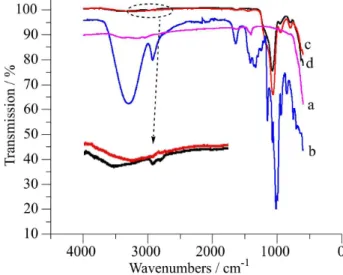
Magnetic nanoparticles (Fe3O4) (MNPs) were chosen as the core magnetic support because of their simple synthesis, low cost, and relatively large magnetic susceptibility. To prepare the catalyst, β-CD was allowed to react with monochloroacetic acid before immobilized onto MNP. The resulting CM−β-CD was coated on MNP successfully with the help of cyanamide by dehydration (Scheme 1). IR spectrum of MNP coated CM−β-CD (Figure 1) shows detectable changes that are characteristic of β-CD group, which clearly differs from that of the bare magnetic nanoparticles (bare MNPs) and unfunctionalized silica-coated nanomagnets (SMNP). Comparing Figures 1a and 1c it is possible to suggest that there was formation of a silica shell, since the existence of the characteristic Si−O−Si stretching at 1082 and 1095 cm-1 on Fe
3O4/SiO2 MNPs (Figure 1c) and Fe3O4/SiO2/CM−β-CD MNPs (Figure 1d). In the spectrum of Fe3O4/SiO2/CM−β-CD MNPs (Figure 1d), the most important asymmetric and symmetric C−H stretching bands are found at 2866 and 2936 cm-1 respectively, which prove successful grafting of CM−β-CD on silica coated magnetic particles27 and the characteristic peaks of CM−β-CD in the region of 900-1200 cm-1 might be overlapped with the broad and strong peak due to silica coating. XRD analyses were also applied to the prepared Fe3O4, Fe3O4/SiO2 MNPs and Fe3O4/SiO2/CM−β-CD core-shell
nanoparticles. The coating process of silica shell has been confirmed by IR spectrum in Figure 1 and as shown in Figure 2, a diffuse peak in (b) and (c) at about 20 degree that belong to it are also exhibited. Furthermore, the XRD patterns show characteristic peaks of Fe3O4 and the coating process did not induce any phase change of Fe3O4. In other words, the IR analysis indicated the successful anchoring of the β-CD group on the surface of magnetic nanobeads, and the XRD analysis suggested the phase maintenance of Fe3O4. Raman analyses were also applied to confirm the synthesis of Fe3O4/SiO2/CM−β-CD (SI section).
To further characterize the catalyst, TEM images were obtained as shown in Figure 3. It is clear that the synthesized catalysts are well dispersed, but also in some Fe3O4
Fe3O4 OH
ClCH2COOH
C NH NH
Fe3O4
O CCH2OCH2
O TEOS
Ethanol H2O NH4OH
CM-β-CD
Fe3O4/SiO2/CM−β-CD
SMNP MNP
CH2OH
CH2OCH2C
OH O
Scheme 1. The synthesis of Fe3O4/SiO2/CM−β-CD.
Figure 1. FTIR spectra of (a) bare MNPs; (b) β-CD; (c) Fe3O4/SiO2 MNPs and (d) Fe3O4/SiO2/CM−β-CD MNPs.
areas bigger structures with are observed, more likely coming from aggregation/coalescence of individual nanoparticles. It can be seen that dark Fe3O4 cores were surrounded by grey silica shells, suggesting the successful coating process. As for the catalyst after being used for 10 times, aggregation phenomenon is clearly presented, which may be a problem that inhibits the recycling for more times.
A thermogravimetric study showing the TG curves for β-CD, Fe3O4/SiO2 and Fe3O4/SiO2/CM−β-CD were carried out to help to show the immobilization of β-CD. As shown in Figure 4, Fe3O4/SiO2 had almost no weight loss from 50 to 800 oC (curve a). The catalyst Fe
3O4/SiO2/ CM−β-CD went through a similar process of weight loss compared with that of pure β-CD, indicating the successful anchoring of β-CD onto Fe3O4/SiO2 MNPs. Within 200 oC, the weight loss was probably attributed completely to the absorbed water molecules. Around 300 oC, the TG curve of Fe3O4/SiO2/CM−β-CD was not as sharp as that of pure
β-CD with a little advanced weight loss as well, which was supposed to due to the introduction of carboxymethyl (CM) group for every β-CD.
The catalytic activity of functionalized β-CD was first tested in the oxidation of benzyl alcohol using NaOCl as an oxidant with water as the only solvent. The reactions do not need any other additives and different reaction conditions including the amount of NaOCl, β-CD and reaction temperature were investigated (Table 1). The reaction conversion increased directly along with the amount of
β-CD and was almost free form the affection of Fe3O4/SiO2 (entries 4-7 and 12). It is known that β-CD and substrates can form host-guest complex. This complexation depends on the size, shape and hydrophobicity of the guest molecule. In our work, the oxidation reaction proceeded smoothly, which confirms the role of β-CD as a phase-transfer catalyst to accelerate the pseudo homogeneous reaction. When the mol ratio between β-CD and substrate reached 1, best result was achieved. Further increase of β-CD showed no benefit, and on the contrary decreased the opportunity for contact.
Figure3. TEM images of (a) Fe3O4/SiO2/CM−β-CD MNPs and (b) Fe3O4/SiO2/CM−β-CD MNPs after being used for 10 times.
Figure 4. TG curves of (a) Fe3O4/SiO2, (b) Fe3O4/SiO2/CM−β-CD and (c) β-CD.
Table 1. The influence of reaction conditions on benzyl alcohol oxidationa
Entry NaOCl / mL Fe3O4/SiO2/CM−β-CD / mmol T / oC Conv. / % Yield / %
1 1 1 50 24 23
2 5 1 50 98 97
3 10 1 50 99 97
4 5 0 50 trace trace
5 5 0.1 50 8 7
6 5 0.5 50 33 33
7 5 2 50 97 96
8 5 1 30 30 30
9 5 1 40 61 61
10 5 1 60 98 97
11 5 1 70 98 97
12b 5 1 50 99 99
aWith benzyl alcohol 1 mmol, 10% NaOCl aqueous solution was added dropwisely over 20 min and then the reaction was continued for 1.5 h; bunfunctionalized
Table 2. Oxidation of various alcoholsa
Entry Alcohol Products t / h Conv. / % Yield / %
1 1.5 98 97
2 2 98 93
3 2 96 94
4 2.5 96 95
5 1 99 99
6 4 92 90
7 4 93 89
8 1.5 95 92
9 2 93 91
10 2 86 83
11 5 47 47
12 6 50 49
13 1-C8H17OH 1-C7H13CHO 24 Trace trace
14 24 Trace trace
15 24 Trace trace
16 24 Trace trace
aReaction conditions: alcohol 1 mmol, Fe
On the other hand, high temperature favored the oxidation process but may lead to the decomposition of NaOCl. So the oxidant was added dropwisely over 20 min to alleviate the unwanted decomposition. As a result, 1 mmol of
β-cyclodextrin, 5 mL NaOCl (10%) and 50 oC were chosen as a suitable reaction condition for the following reactions.
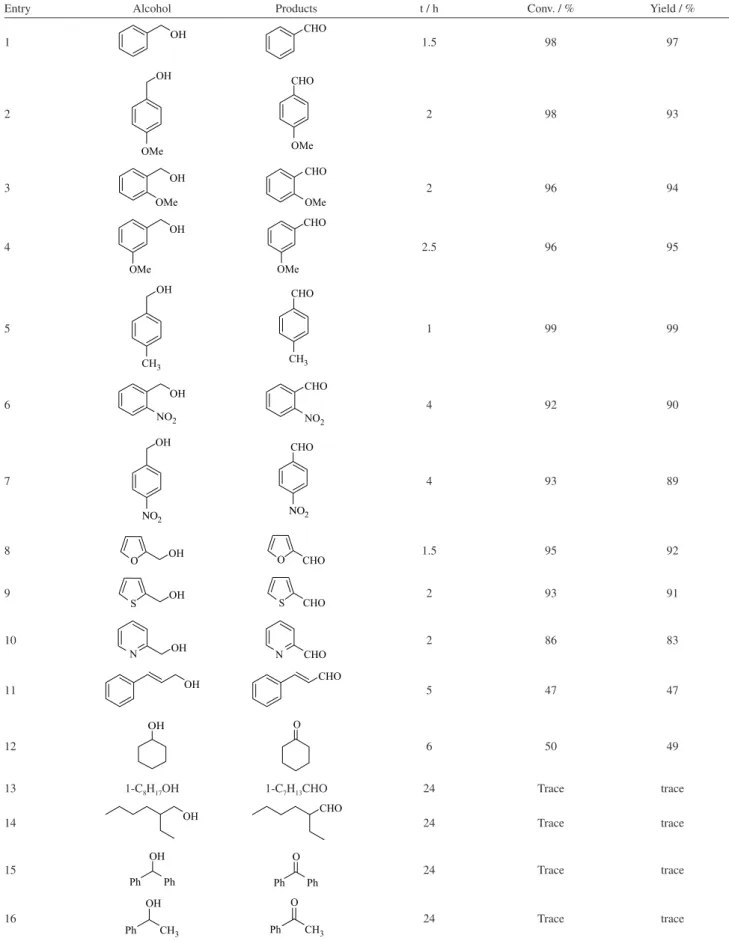
To examine the utility and generality of this methodology for the oxidation of alcohols, we applied the present catalyst system to a variety of alcohols as shown in Table 2. Obviously, all the primary benzylic alcohols tested were converted into their corresponding aldehydes in high yields and no overoxidation to acids was observed (entries 1-7). It is noteworthy that a type of heterocyclic alcohol (entries 8-10), being less active in many reported systems, worked well in the Fe3O4/SiO2/CM−β-CD/H2O/ NaClO system (entries 8-10). Together with the fact that substituted groups in benzene ring lowered the reactivity, the space configuration of guest molecules was proposed to be an important factor to initiate the reaction. Unfortunately, in the case of aliphatic alcohols such as 1-C8H17OH and isooctyl alcohol, the result was unsatisfactory even after elongating the reaction time (entries 13-14), probable due to the difficulty in forming complexation between long chain aliphatic alcohol and β-CD. This may also account for the ineffective of benzhydrol and 1-phenylethanol.
The advantage of the magnetic phase-transfer catalyst lies in not only the reaction with water as the sole solvent attributed to the formation of complexation between substrates and β-CD , but also in the ease of separation and recyclability provided by the Fe3O4/SiO2 support. Simply by applying an external magnet to the reaction vessel a separation of the catalyst is achieved within 5 s and the resulting clear supernatant can be decanted (Figure 5). The recovered Fe3O4/SiO2/CM−β-CD can be reused for at least 10 times without great loss of activity (the details can be seen in supporting information). The coated SiO2 ensured the stability of Fe3O4 core against oxidation in the reaction,
so as to achieve a high recyclability. After 10 times of reuse, SiO2 may be dropped off. The Fe3O4, losing the protection of SiO2 was easy to be oxidized. As the principal part of magnetism was destroyed, the catalyst would be lost in the solution and recovery decreased gradually.
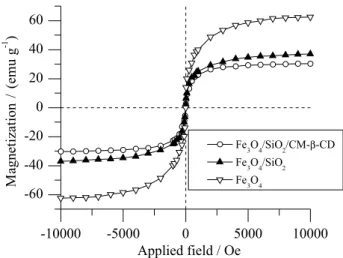
All synthesized particles have small coercivities, which indicate they are superparamagnetic in nature. As shown in Figure 6, saturation magnetizations for Fe3O4, Fe3O4/SiO2 and Fe3O4/SiO2/CM−β-CD are 62.56, 37.98 and 30.28 emu g-1, respectively. The order is due to the increasing amount of nonmagnetic material (organic ligands) on the particle surface, which makes up a larger percentage of the nonmagnetic fraction. A direct result of this effect is that it takes longer time to separate Fe3O4/SiO2 and Fe3O4/SiO2/CM−β-CD than bare Fe3O4 nanoparticles from particle solution.
Based on the previous studies,20 a possible mechanism for the aerobic oxidation of alcohols in the system was proposed as shown in Scheme 2. The formation of aldehydes might be occurred through a SN1 mechanism. Firstly, a β-CD inclusion complex between β-CD and
Figure 5. Easy separation of magnetic Fe3O4/SiO2/CM−β-CD MNP catalyst within 5 s (a) during reaction; (b) after separation.
Figure 6. Magnetization curves for Fe3O4, Fe3O4/SiO2 and Fe3O4/SiO2/ CM−β-CD.
H2O
Alcohol β
R1CR2
Η ΗΟ
ClO−
β Alcohol R1CR2
Ο
Cl H
R1CR2
O
Cl− OH
−
OH−
H2O
C O R2
R1
NaOCl H2O
product after reaction
external magnet
substrate was formed in situ with the help of hydrogen bond,17 which was dispersed in water as a pseudo homogeneous phase. Carbonium ion was then formed and attacked by ClO− anion on carbon atom. Further elimination
of Cl− gave the corresponding aldehydes. After reaction,
Fe3O4/SiO2/CM−β-CD was easily recovered with the help of external magnet to be reused.
Conclusions
In summary, we have presented an elegant, simple and transition metal-free methodology for substrate selective oxidation of alcohols, catalyzed by Fe3O4/SiO2/CM−β-CD with cheap NaOCl oxidant using water as the sole solvent. In particular, the present catalytic system shows excellent activity with β-CD served as a phase transfer catalyst. The system also couples the advantages of heterogeneous (easy separation, and excellent reusability) attributed to magnetic Fe3O4/SiO2 system.
Supplementary Information
The experimental details are provided as Supplementary Information, available free of charge at http://jbcs.sbq.org.br as PDF file.
Acknowledgments
We are grateful to the NSAF and NSFC (Grant N. 1076017) of China for supporting this research.
References
1. Hudlicky, M.; Oxidations in Organic Chemistry, American Chemical Society: Washington, DC, 1990.
2. Mallat, T.; Baiker, A.; Chem. Rev.2004, 104, 3037.
3. Hanson, S. K.; Wu, R.; Silks, L. A. P.; Org. Let. 2011, 13, 1908. 4. Hanson, S. K.; Baker, R. T.; Gordon, J. C.; Scott, B. L.; Silks,
L. A. P.; Thorn, D. L.; J. Am. Chem. Soc. 2010, 132, 17804. 5. Ye, Z.; Fu, Z.; Zhong, S.; Xie, F.; Zhou, X.; Liu, F.; Yin, D.;
J. Catal. 2009, 261, 110.
6. Fujita, K. I.; Yoshida, T.; Imori, Y.; Yamaguchi, R.; Org. Lett.
2011, 13, 2278.
7. Tebben, L.; Studer, A.; Angew. Chem., Int. Ed. 2011, 50, 5034. 8. Liu, R. H.; Liang, X. M.; Dong, C. Y.; Hu, X. Q.; J. Am. Chem.
Soc.2004, 126, 4112.
9. Ciriminna, R.; Pagliaro, M.; Org. Process Res. Dev. 2009, 14, 245.
10. Weng, Z.; Liao, G.; Wang, J.; Jian, X.; Catal. Commun. 2007, 8, 1493.
11. Shi, X. Y.; Wei, J. F.; J. Mol. Catal. A: Chem. 2005, 229, 13. 12. Herrerías, C. I.; Yao, X.; Li, Z.; Li, C. J.; Chem. Rev. 2007, 107,
2546.
13. Lubineaul, A.; Auge, J.; Top. Curr. Chem.1999, 206, 1. 14. Rao, K. R.; Nageswar, Y. V. D.; Sridhar, R.; Reddy, V. P.;
Curr. Org. Chem. 2010, 14, 1308.
15. Krishnaveni, N. S.; Surendra, K.; Rao, K. R.; Chem. Commun.
2005, 669.
16. Zhu, C.; Wei, Y.; Catal. Lett. 2011, 141, 582.
17. Surendra, K.; Krishnaveni, N. S.; Reddy, M. A.; Nageswar, Y. V. D.; Rao, K. R.; J. Org. Chem. 2003, 68, 2058.
18. Krishnaveni, N. S.; Surendra, K.; Rao, K. R.; Adv. Synth. Catal.
2004, 346, 346.
19. Surendra, K.; Krishnaveni, N. S.; Kumar, V. P.; Sridhar, R.; Rao, K. R.; Tetrahedron Lett. 2005, 46, 4581.
20. Ji, H.B.; Shi, D.P.; Shao, M.; Li, Z.; Wang, L. F.; Tetrahedron Lett. 2005, 46, 2517.
21. Karimi, B.; Farhangi, E.; Chem.--Eur. J. 2011, 17, 6056. 22. Tucker-Schwartz, A. K.; Garrell, R. L.; Chem.--Eur. J. 2010,
16, 12718.
23. Ma, M.; Zhang, Q.; Yin, D.; Dou, J.; Zhang, H.; Xu, H.; Catal. Commun. 2012, 17, 168.
24. Miao, C. X.; Wang, J. Q.; Yu, B.; Cheng, W. G.; Sun, J. A.; Chanfreau, S.; He, L. N.; Zhang, S. J.; Chem. Commun. 2011, 47, 2697.
25. Ghosh, S.; Badruddoza, A. Z. M.; Uddin, M. S.; Hidajat, K.; J. Colloid Interface Sci. 2011, 354, 483.
26. Kang, Y.; Zhou, L. L.; Li, X., Yuan, J. Y.; J. Mater. Chem. 2011, 21, 3704.
27. Ji, Y.; Liu, X.; Guan, M.; Zhao, C.; Huang, H.; Zhang, H.; Wang, C.; J.Sep. Sci. 2009, 32, 2139.
Submitted: March 6, 2012