
Brazilian Journal of Physics, vol. 37, no. 2C, June, 2007 723
Accelerating Solutions of Perfect Fluid Hydrodynamics for
Initial Energy Density and Life-Time Measurements in Heavy Ion Collisions
T. Cs¨org˝o,
MTA KFKI RMKI, H-1525 Budapest 114, POBox 49, Hungary and
Instituto de F´ısica Te´orica - UNESP, Rua Pamplona 145, 01405-900 S ˜ao Paulo, SP, Brazil
M. I. Nagy, and M. Csan´ad
ELTE, E¨otv¨os Lor´and University, H - 1117 Budapest, P´azm´any P. s. 1/A, Hungary
Received on 11 February, 2007
A new class of accelerating, exact, explicit and simple solutions of relativistic hydrodynamics is presented. Since these new solutions yield a finite rapidity distribution, they lead to an advanced estimate of the initial energy density and life-time of high energy heavy ion collisions. Accelerating solutions are also given for spherical expansions in arbitrary number of spatial dimensions.
Keywords: Relativistic hydrodynamics; Exact solutions; Initial energy density; Particle spectra and correlations
I. INTRODUCTION
Relativistic hydrodynamics can be successfully applied both at the largest and the smallest scales of physics. How-ever, its equations are highly nonlinear, and only few exact relativistic solutions are presently known. We present here a recently found family of exact solutions [1]. These generalize the Landau-Khalatnikov solution [2–4], as they are also accel-erating and yield a finite rapidity distribution. They are simple and explicit, similarly to the Hwa-Bjorken solution [5, 6]. We show new 1+ 3 dimensional solutions [1], that are reduced to the exact hydro solutions of refs. [7–11] in the accelerationless limit.
II. NEW SIMPLE SOLUTIONS OF RELATIVISTIC
HYDRODYNAMICS
Let us denote the metric tensor by gµν = diag(1,−1,−1,−1), the four-velocity by uµ = γ(1,vn), the pressure byp, the energy density byε, the temperature by T, the charged particle density bynand the entropy density byσ. All fields depend on the coordinatesxµ. We denote by
rthe spatial coordinaterz in 1+1 dimensions, and the radial
coordinate in 1+ d dimensions (where r≥0). Relativistic hydrodynamics expresses local momentum, energy and charge conservation:
(ε+p)uν∂νuµ = (gµρ−uµuρ)∂ρp, (1) (ε+p)∂νuν+uν∂νε = 0, (2)
∂ν(nuν) = 0. (3)
¿From these relations entropy conservation also follows: ∂ν(σuν) =0. Our choice of Equations of State (EoS) is that of an ideal gas: p=nT,ε=κp. For an ultra-relativistic ideal gas ind spatial dimensions,κ=d=1/c2s. In the considered case,σ ∝Td.
We use theτandηRindler coordinates:
|r|<|t|: r=τsinhη, t=±τcoshη, (4)
|r|>|t|: r=±τcoshη, t=τsinhη. (5)
In order to generalize the Hwa-Bjorken solution, we intro-duced theλ>0 parameter, and found the following class of solutions:
v = tanhλη, (6)
p = p0
³τ0
τ
´λd(1+1/κ)h
coshη 2
i−(d−1)φ(λ)(1+1/κ)
, (7)
n = n0
³τ0
τ
´λd
ν(s)hcoshη 2
i−(d−1)φ(λ)
, (8)
T = T0
³τ0
τ
´λd/κ 1
ν(s)
h
cosh(η 2)
i−(d−1)φ(λ)/κ
. (9)
The initial pressure, number density and temperature are de-noted by p0, n0 and T0, respectively. The above forms are hydrodynamical solutions for the special values ofλ andκ as given below. Theλ=1 ,|r|<|t|, ν(s) =1 case is the d-dimensional generalization of the well known inertial Hwa-Bjorken flow [5, 6], whereκandd >1 are arbitrary. Here ν(s)is an arbitrary positive scaling function, given by the ini-tial conditions, andsis a scaling variable, that has a vanishing co-moving derivative:
|r|<|t| : s(τ,η) =³τ0 τ
´λ−1
sinh[(λ−1)η], (10)
|r|>|t| : s(τ,η) =³τ0 τ
´λ−1
cosh[(λ−1)η], (11)
valid forλ6=1. Ifλ=1, we haves=s0ηfor|r|<|t|, while
s=τ/τ0for|r|>|t|.
724 T. Cs¨org˝o, M. Csan´ad, and M. Nagy
–1 –0.5 0.5 1
t
–1.5 –1 –0.5 0.5 1 1.5
r
FIG. 1: Fluid trajectories of theλ=2 exact solution.
describe a flow with relativistic acceleration. If λ=2, the trajectories are uniformly accelerating, see Fig. 1 and ref. [1].
III. RAPIDITY DISTRIBUTIONS AND ENERGY DENSITY
ESTIMATION
Ford =1, the rapidity distribution, ddny was calculated in a Boltzmann approximation in ref. [1]. The freeze-out tem-perature isT(η=0,τ=τf) =Tf. We assumed [1], that the
freeze-out hypersurface is pseudo-orthogonal to uµ. With a saddle-point integration, forλ>0.5, andm/Tf≫1 (wherem
is the particle mass), we got
dn dy≈nfτf
s
2πm Tfλ(2λ−1)
coshα2−1
³y
α
´
e− m Tfcoshα(
y
α),
(12)
withα=2λ−1
λ−1. The “width” of this distribution is
∆y2= α
m/Tf−1/2+1/α
. (13)
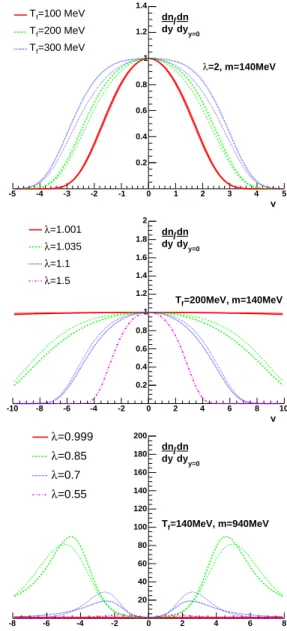
The rapidity distribution has a minimum aty=0, if∆y2<0 (i.e. 1/2+Tf/(4m)<λ<1), it is flat ifλ=1 orλ=1/2+
Tf/(4m), otherwise it is approximately Gaussian. The typical
cases are plotted in Fig. 2.
As an application, we estimate the energy density reached in heavy ion reactions. Let us focus on the thin transverse slab at mid-rapidity, just after thermalization (τ=τ0), illustrated by Fig. 2 of ref. [6]. The radiusRof this slab is estimated by the radius of the colliding hadrons or nuclei, and the volume is dV= (R2π)τ
0dη0. The energy content isdE=hmtidn, where hmtiis the average transverse mass aty=0, so similarly to
Bjorken, the initial energy density is
ε0= h
mti
(R2π)τ 0
dn dη0
. (14)
For accelerationless, boost-invariant Hwa-Bjorken flowsη0=
ηf =y, however, for our accelerating solution we have to
ap-ply a correction factor of∂ηf ∂η0
∂y
∂ηf = (τf/τ0) λ−1(
2λ−1). Thus
-5 -4 -3 -2 -1 0 1 2 3 4 5
0.2 0.4 0.6 0.8 1 1.2 1.4
y=0 dy dn / dy dn
y
=100 MeV
f
T
=200 MeV
f
T
=300 MeV
f
T
=2, m=140MeV λ
-10 -8 -6 -4 -2 0 2 4 6 8 10
0.2 0.4 0.6 0.8 1 1.2 1.4 1.6 1.8 2
y=0 dy dn / dy dn
y
=1.001
λ
=1.035
λ
=1.1
λ
=1.5
λ
=200MeV, m=140MeV f
T
-8 -6 -4 -2 0 2 4 6 8
20 40 60 80 100 120 140 160 180 200
y=0 dy dn / dy dn =0.999
λ =0.85 λ
=0.7 λ
=0.55 λ
=140MeV, m=940MeV f
T
FIG. 2: Normalized rapidity distributions from the new solutions for variousλ,Tf andmvalues. Thick lines show the result of numerical integration, thin lines the analytic approximation from eq. (12). For λ>1 and not too bigTf it can be used with about 10 % error.
the initial energy densityε0can be accessed by a corrected es-timationεcas
εc
εB
= (2λ−1)
µτ
f
τ0
¶λ−1
, εB= h
mti
(R2π)τ 0
dn
dy. (15)
HereεBis the Bjorken estimation, which is recovered if ddny
is flat (i.e. λ=1), but forλ>1, both correction factors are bigger than 1. Hence the initial energy densities are under-estimated by the Bjorken formula. Fig. 3 indicates fits to BRAHMS pseudo-rapidity distributions from ref. [13], these fits indicate thatεc=8.5−10 GeV/fm3in Au+Au collisions
Brazilian Journal of Physics, vol. 37, no. 2C, June, 2007 725
-4 -2 0 2 4
0.2 0.3 0.4 0.5 0.6 0.7 0.8 0.9 1
Normalized pseudorapidity distributions from BRAHMS
η
0-5%
0.9)
×
5-10% (
0.8)
×
10-20% ( 0.7)
×
20-30% (
0.6)
×
30-40% ( 0.5)
×
40-50% ( Normalized pseudorapidity distributions from BRAHMS
2 4 6 8 10 12 14 16 18 20
1.4 1.5 1.6 1.7 1.8 1.9 2 2.1 2.2
Correction factor to the Bjorken-estimate
0 τ / f τ B
∈∈c →
Error bars
0-5% 5-10% 10-20% 20-30% 30-40% 40-50%
Correction factor to the Bjorken-estimate
FIG. 3: Top panel: Fits of eq. (12) todn/dηdata as measured by the BRAHMS collaboration [13] in√sNN=200 GeV Au+Au collisions at various centralities. Bottom panel: εc/εB ratio as a function of τf/τ0. Using the Bjorken estimate ofεB=5 GeV/fm3as given in the BRAHMS White Paper [14], andτf/τ0=7-10, we find an initial energy density ofεc= (1.7−2.0)εB=8.5−10 GeV/fm3.
IV. LIFE-TIME DETERMINATION
For a Hwa-Bjorken type of accelerationless, coasting longi-tudinal flow, Sinyukov and Makhlin [15] determined the lon-gitudinal length of homogeneity as
Rlong=
r
Tf
mt
τB. (16)
Heremtis the transverse mass andτBis the (Bjorken)
freeze-out time. However, acceleration influences the estimated life-times of the reaction. If the flow is accelerating, the estimated origin of the trajectories is shifted, and we found the follow-ing correction of eq. (16), at mid-rapidity, for broad but finite rapidity distribution:
Rlong=
r
Tf
mt
τc
λ ⇒ τc=λτB. (17)
Thus in earlier HBT analyses the effective proper-time dura-tion of the reacdura-tion have beenunderestimated, as pointed out also in refs. [16–19]. BRAHMS pseudo-rapidity distributions in Fig. 3 yieldλ≈1.2, and imply a 20 % increase in the esti-mated life-time of the reaction.
V. SUMMARY
We have presented new, simple and accelerating solutions of relativistic hydrodynamics. We have improved quantita-tively on Bjorken’s initial energy density estimate, by tak-ing into account the longitudinal work, which is important for finite rapidity distributions. We have fitted the BRAHMS pseudo-rapidity distributions with the resulting simple forms, and pointed out that in Au+Au collisions at RHIC, 8.5 - 10 GeV/fm3 initial energy densities are reached, a factor of 2 larger, than the Bjorken estimate. We have also corrected the Sinyukov-Makhlin formula for longitudinal work effects, and found an increase of the life-time of the reaction by about 20 %, as extracted from the longitudinal HBT radius parameter in Au+Au collisions at√sNN=200 GeV.
Acknowledgements: T. Cs. would like to thank Y. Hama and S. S. Padula for their kind hospitality in Brazil and for their providing an excellent working atmosphere during the ISMD 2006 and WPCF2006 conferences. This work has been supported by the Hungarian OTKA grant T049466, and by a FAPESP grant from S˜ao Paulo, Brazil.
[1] T. Cs¨org˝o, M. I. Nagy and M. Csan´ad, nucl-th/0605070. [2] L. D. Landau, Izv. Akad. Nauk Ser. Fiz.17(1953) 51. [3] I.M. Khalatnikov, Zhur. Eksp. Teor. Fiz.27(1954) 529 [4] S. Z. Belenkij and L. D. Landau, Nuovo Cim. Suppl. 3S10
(1956) 15 [Usp. Fiz. Nauk56(1955) 309]. [5] R. C. Hwa, Phys. Rev. D10(1974) 2260. [6] J. D. Bjorken, Phys. Rev. D27(1983) 140.
[7] T. Cs¨org˝o, F. Grassi, Y. Hama and T. Kodama, Phys. Lett. B
565(2003) 107, [nucl-th/0305059].
[8] T. Cs¨org˝o, L. P. Csernai, Y. Hama and T. Kodama, Heavy Ion Phys. A21(2004) 73, [nucl-th/0306004].
[9] T. S. Bir´o, Phys. Lett. B474, 21 (2000). [10] T. S. Bir´o, Phys. Lett. B487, 133 (2000).
[11] Yu. M. Sinyukov and I. A. Karpenko, Acta Phys.Hung.A25,
141-147 (2006).
[12] T. S. Bir´o, private communication. The authors are grateful to him for this comment.
[13] I. G. Beardenet al.[BRAHMS Collaboration], Phys. Rev. Lett.
88, 202301 (2002) [nucl-ex/0112001].
[14] I. Arseneet al.[BRAHMS Collaboration], Nucl. Phys. A757, 1 (2005) [nucl-ex/0410020].
[15] A. N. Makhlin and Yu. M. Sinyukov, Z. Phys. C39, 69 (1988). [16] U. A. Wiedemann, Nucl. Phys. A661, 65C (1999)
[17] T. Renk, Phys. Rev. C69, 044902 (2004)
[18] M. Csan´ad, T. Cs¨org˝o, B. L¨orstad and A. Ster, Nukleonika49, S49-S55 (2004) [nucl-th/0402037].
![FIG. 3: Top panel: Fits of eq. (12) to dn/dη data as measured by the BRAHMS collaboration [13] in √](https://thumb-eu.123doks.com/thumbv2/123dok_br/18982535.457572/3.892.114.391.79.485/fig-panel-fits-dη-data-measured-brahms-collaboration.webp)
