Systematic review
The role of perioperative warming
in surgery: a systematic review
O papel do aquecimento perioperatório em cirurgia: uma revisão sistemática
Muhammad Shaique Sajid
1, Ali Jabir Shakir
2, Kamran Khatri
3, Mirza Khurrum Baig
4Department of Colorectal Surgery, Worthing Hospital, Worthing, West Sussex, United Kingdom
1MBBS, MBA, MD, MSc, FRCS. Specialist Registrar in General & Colorectal Surgery, Department of Colorectal Surgery, Worthing Hospital, Worthing, West Sussex, United Kingdom. 2MBBS, FRCS. Specialty Surgeon in General & Colorectal Surgery, Department of Colorectal Surgery, Worthing Hospital, Worthing, West Sussex, United Kingdom.
3MBBS, MRCS. Senior House Oficer in General & Colorectal Surgery, Department of Colorectal Surgery, Worthing Hospital, Worthing, West Sussex, United Kingdom. 4MBBS, MD, FRCS. Consultant Surgeon in the Department of Colorectal Surgery, Worthing Hospital, Worthing, West Sussex, United Kingdom.
ABSTRACT
OBJECTIVE: The objective of this review was to systematically analyze the trials on the effectiveness of perioperative warming in surgical patients.
METHODS: A systematic review of the literature was undertaken. Clinical trials on perioperative warming were selected according to speciic criteria and analyzed to generate summative data expressed as standardized mean difference (SMD).
RESULTS: Twenty-ive studies encompassing 3,599 patients in various surgical disciplines were retrieved from the electronic databases. Nineteen randomized trials on 1785 patients qualiied for this review. The no-warming group developed statistically signiicant hypothermia. In the ixed effect model, the warming group had signiicantly less pain and lower incidence of wound infection, compared with the no-warming group. In the random effect
model, the warming group was also associated with lower risk of post-anesthetic shivering. Both in the random and the ixed effect models, the warming group was associated with signiicantly less blood loss. However, there was signiicant heterogeneity among the trials.
CONCLUSION: Perioperative warming of surgical patients is effective in reducing postoperative wound pain, wound infection and shivering. Systemic warming of the surgical patient is also associated with less perioperative blood loss through preventing hypothermia-induced coagulopathy. Perioperative
warming may be given routinely to all patients of various surgical disciplines in order to counteract the consequences of hypothermia.
RESUMO
OBJETIVO: O objetivo desta revisão é analisar sistematicamente os ensaios sobre a eicácia do aquecimento perioperatório em pacientes cirúrgicos.
MÉTODOS: Uma revisão sistemática da literatura foi realizada. Ensaios clínicos sobre aquecimento perioperatório foram selecionados segundo critérios especíicos e analisados para gerar dados sumativo expresso na diferença média padronizada (standardized mean difference, SMD).
RESULTADOS: Vinte e cinco estudos englobando 3.599 pacientes de várias disciplinas de cirurgia foram obtidos a partir de bases de dados eletrônicas. Dezenove ensaios aleatórios em 1.785 pacientes qualiicados para esta revisão. Nenhum grupo de aquecimento desenvolveu estatisticamente
signiicativa hipotermia. No modelo de efeito ixo, grupo de aquecimento tiveram signiicativamente menos dor e menor incidência de infecção na ferida quando comparado com o grupo de não-aquecimento. No modelo de efeito aleatório, grupo de aquecimento também foi associado a um menor risco
de tremores pós-anestesia. Em ambos os modelos de efeitos ixos e aleatórios, o aquecimento foi signiicativamente associado com menor perda de sangue. No entanto, houve signiicativa heterogeneidade entre os ensaios.
CONCLUSÃO: O aquecimento perioperatório de pacientes cirúrgicos é eicaz na redução da dor pós-operatória ferida, infecção ferida, e tremores. O aquecimento sistêmico do paciente cirúrgico também está associado com menor perda de sangue no perioperatório prevenindo hipotermia e induzindo
coagulopatia. O aquecimento perioperatório pode ser administrado rotineiramente a todos os pacientes cirúrgicos de diversas disciplinas, a im de neutralizar as consequências da hipotermia.
KEY WORDS:
Body temperature regulation.
Hypothermia. Blood loss, surgical.
Shivering. Wound infection.
PALAVRAS-CHAVE: Regulação da temperatura
corporal. Hipotermia.
Perda sanguínea cirúrgica. Tremor por sensação de frio
Introduction
Hypothermia, deined as core temperature below 36 °C1-3 is com-mon in operating theaters and has often been disregarded as an inevi-table consequence of general anesthesia and surgery.2,4,5 he body’s core temperature is determined by the balance between heat loss and heat gain. Exposure to a cold operating theater environment and anesthetic-induced impairment of thermoregulatory control are two of the com-monest contributing factors that tip the balance in favor of heat loss, thereby leading to hypothermia in surgical patients.1,6
Hypothermia confers distinct beneits as well as severe compli-cations in surgical patients. he potential beneits include protection against the deleterious efects of cerebral ischemia and malignant hyper-thermia.7 However, hypothermia may increase susceptibility to perioper-ative wound infection by causing vasoconstriction and impaired immu-nity. Vasoconstriction decreases the partial pressure of oxygen in tissue, which lowers the resistance to infection.8 he other commonly known adverse efects of hypothermia include shivering,9 prolonged duration of drug action,10 coagulopathy,11 myocardial ischemia and decreased resis-tance to surgical infections.12 Perioperative warming has been shown to reduce perioperative complications.13,14 Several prophylactic and thera-peutic measures have been tried with the aim of reducing or abolishing the development of perioperative hypothermia. Various perioperative warming techniques like simple cotton blankets, carbon-iber sheets, circulating hot water mattresses, forced air warming, warm luid infu-sion and esophageal heat exchange systems9,15,16 are in use in all surgical disciplines. hese perioperative warming systems are being used during the preoperative, intraoperative and postoperative phases with variable eicacy. he duration of perioperative warming is also under review and prolonged exposure of surgical patients to warming systems has proven to be quite efective in major elective abdominal surgery.17
he aim of this systematic review was to compare the eicacy of perioperative warming of surgical patients aimed at reducing the
con-sequences of wound infection, coagulopathy, blood loss, postoperative pain and postoperative shivering, in relation to no warming.
Methods
Relevant prospective randomized controlled trials on perioperative warming among surgical patients published between January 1980 and June 2007 were identiied through the Medical Literature Analysis and Retrieval System Online (Medline), Excerpta Medica (Embase), Cumula-tive Index to Nursing and Allied Health Literature (CINAHL), Cochrane library and Pubmed databases. he search strategy for target articles was not limited by time, age or gender. However, through frequent and thor-ough searching, it was noticed that there were no published comparative, non-randomized or randomized trials in the literature before 1980. he terms “randomized trials on perioperative warming”, “trials on periopera-tive warming” and “warming in surgical patients” were used in combina-tion with the headings “surgical patients”, “forced air warming”, “ther-moregulation in anesthetized patients” and “warming blankets”. Relevant articles referenced in these publications were obtained. he “related ar-ticle” function was also used to widen the search criteria. All abstracts, comparative studies, randomized trials, non-randomized trials and cita-tions that were irstly scanned through were reviewed comprehensively in accordance with the Quality of Reporting of Meta-analyses (QUORUM) template for the literature search. Each article was critically reviewed to assess its eligibility for inclusion or exclusion in this review.
Statistical analysis was performed by a senior statistician, using the Statistics for Windows software in Microsoft Excel 2007. he methods used were Hedges G statistic for the calculation of standardized mean diference (SMD), the inverse variance method for the ixed efect mod-el and the DerSimonian/Laired method for the random efect modmod-el. he estimate of the diference between the two techniques was pooled depending on the efect weights in the results, which were determined by the variance in each trial estimate. Forest plots were used for graphi-cal displays of results from the meta-analysis: the square around the esti-mate represents the accuracy of the estimation (sample size) and the line represents the 95% conidence interval.
Results
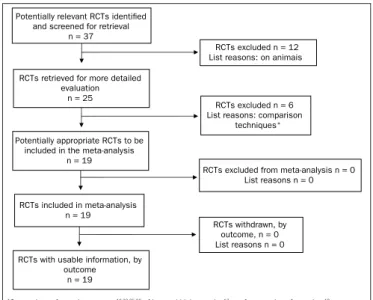
Twenty-ive studies encompassing 3,599 patients in various surgi-cal disciplines were retrieved from the electronic databases. Nineteen randomized controlled trials11-12,14,18-32 on 1,785 patients qualiied for this review in accordance with the inclusion criteria (Figure 1). Six trials16,17,33-36 were excluded for the reasons mentioned in Figure 1. he characteristics of the trials included are given in Table 1.11,12,14,18-32
Methodological quality of studies included
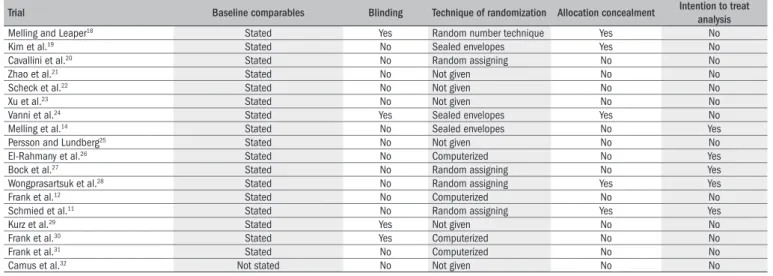
he characteristics of the trials included are explained comprehen-sively in Table 2 for methodological quality analysis.11,12,14,18-32 he Man-tel-Haenszel ixed efect model was used to compute robustness and susceptibility to any outlier among these trials. he allocation, conceal-ment and blinding of the investigator or assessor were not clearly report-ed, and consequently the methodological quality of the trials was
con-RCTs retrieved for more detailed evaluation
n = 25
Potentially appropriate RCTs to be included in the meta-analysis
n = 19
RCTs included in meta-analysis n = 19
RCTs with usable information, by outcome
n = 19
Potentially relevant RCTs identified and screened for retrieval
n = 37
RCTs excluded n = 12 List reasons: on animais
RCTs excluded n = 6 List reasons: comparison
techniques*
RCTs excluded from meta-analysis n = 0 List reasons n = 0 RCTs withdrawn, by
outcome, n = 0 List reasons n = 0
Table 1. Characteristics of included trials
Trial Patients Warming technique Type of surgery Outcome measurements
Melling and Leaper18 45 Non-contact radiant heat system General surgery Pain and wound infection
Kim et al.19 40 Forced warming blanket Cardiothoracic Temperature
Cavallini et al.20 76 Forced warming blanket Plastic surgery Temperature, coagulation
Zhao et al.21 40 Forced warming blanket Abdominal surgery Temperature, blood loss, shivering,
extubation time
Scheck et al.22 30 Carbon-iber warming blanket Trauma patients Temperature
Xu et al.23 40 Forced warming blanket and luid
warming device
Abdominal surgery Temperature, blood loss, shivering,
extubation time
Vanni et al.24 30 NA Abdominal surgery Temperature
Persson and Lundberg25 59 Forced warming blanket Gynecological Temperature, pain
Melling et al.14 421 Forced warming blanket General surgery Wound infection
El-Rahmany et al.26 149 Forced warming blanket Cardiothoracic Temperature, cardiovascular vital signs
Bock et al.27 40 Forced warming blanket Abdominal Surgery Temperature, blood loss, stay, cost,
transfusion.
Wongprasartsuk et al.28 26 Forced warming blanket Orthopedic O
2 consumption, CO2 production, pain,
temperature
Frank et al.12 300 Forced warming blanket Vascular, thoracic and abdominal Temperature, ischemic heart disease,
cardiac arrest
Schmied et al.11 60 Forced warming blanket Orthopedics Blood loss, transfusions
Kurz et al.29 200 Forced warming blanket Colorectal surgery Wound infection, stay
Frank et al.30 74 Forced warming blanket Vascular, thoracic and abdominal Neuroendocrine response,
tempera-ture, blood pressure, pulse rate
Frank et al.31 100 NA Vascular surgery Temperature, cardiac stress
Camus et al.32* 22 Forced warming blanket Abdominal Surgery Temperature, shivering
Camus et al.32† 33 Forced warming blanket Abdominal surgery Temperature, shivering
*limb a of trial; †limb b of trial. NA = not available. Heating technique was not mentioned in the trial but this group was deinitely provided with perioperative warming.
Methodological heterogeneity
Different techniques for randomization Lack of blinding in many trials No allocation concealment in many trials Analysis by intention to treat is not stated in all trials Analysis of randomized and non-randomized trials together
Clinical heterogeneity
Different surgical specialties analyzed together Different outcome variables assessed e.g. stress hormone level
Different perioperative warming techniques used Variable follow-up time among trials
Non-consistent results from trials
Chart 1. Causes of heterogeneity
sidered inadequate and the results from our review may be considered biased. Heterogeneity (clinical and methodological diversity) was seen among all these trials (Chart 1). Limited availability of data on various outcome variables and lack of a major multicenter double blind ran-domized controlled trial restricted this review with regard to detailed sub-group analysis. However, a subgroup analysis of trials with clearly reported allocation concealment was performed. We felt that perform-ing sensitivity analysis was not relevant due to limited numbers of stud-ies. We attempted to assess publication bias by using funnel plots, but this was diicult to compute due to the small numbers of patients.
Hypothermia
Fourteen trials12,20-24,26-32,37 contributed towards the combined analysis on the development of hypothermia in the no-warming group. In both the ixed and the random efect models, the no-warming group developed
Trial Baseline comparables Blinding Technique of randomization Allocation concealment Intention to treat analysis
Melling and Leaper18 Stated Yes Random number technique Yes No
Kim et al.19 Stated No Sealed envelopes Yes No
Cavallini et al.20 Stated No Random assigning No No
Zhao et al.21 Stated No Not given No No
Scheck et al.22 Stated No Not given No No
Xu et al.23 Stated No Not given No No
Vanni et al.24 Stated Yes Sealed envelopes Yes No
Melling et al.14 Stated No Sealed envelopes No Yes
Persson and Lundberg25 Stated No Not given No No
El-Rahmany et al.26 Stated No Computerized No Yes
Bock et al.27 Stated No Random assigning No Yes
Wongprasartsuk et al.28 Stated No Random assigning Yes Yes
Frank et al.12 Stated No Computerized No No
Schmied et al.11 Stated No Random assigning Yes Yes
Kurz et al.29 Stated Yes Not given No No
Frank et al.30 Stated Yes Computerized No No
Frank et al.31 Stated No Computerized No No
Camus et al.32 Not stated No Not given No No
Table 2. The randomized controlled trials included, all of them with stated inclusion and exclusion criteria
RCT = randomized controlled trial.
infection [SMD 0.32, 95% CI (0.18-0.56), P = 0.0001, df = 2, z = -3.99;
Table 514,18,29 and Figure 4], compared with the no-warming group. here was no heterogeneity among the trials (Q = 0.06, P = 0.96).
Shivering
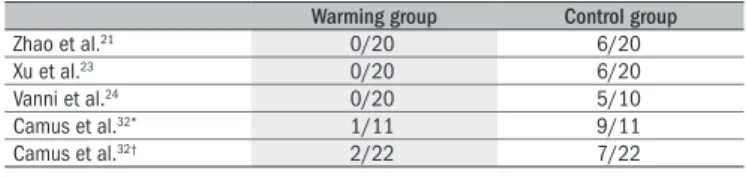
Five trials21,23,24,32 contributed towards the combined analysis on postoperative shivering. In the random efect model, the warming group was associated with lower risk of post-anesthetic shivering [SMD 0.01, 95% CI (0.001-0.08), P = 0.0000, df = 4, z = -4.43; Table 621,23,24,32 and Figure 5], compared with the no-warming group. here was no het-erogeneity among the trials (Q = 0.082, P = 0.9980).
Blood loss
Five trials11,21,23,25,27 contributed towards the combined analysis on perioperative blood loss. Both in the random and in the ixed efect mod-els, the warming group was associated with signiicantly less blood loss [random efect SMD -1.60, 95% CI (-1.92, -1.29), P = 0.0000, df = 4, z = -9.99; and ixed efect SMD -2.10, 95% CI (-3.31, -0.89), P = 0.0007, df = 4, z = -3.40; Table 711,21,23,25,27 and Figure 6]. However, there was sig-niicant heterogeneity among the trials (Q = 55.77, P = 0.0000).
Myocardial dysfunction, coagulopathy and stress hormone imbalance
here was insuicient data in the trials available to assess hypo-thermia-induced myocardial dysfunction, coagulopathy and stress hor-mone imbalance.
Subgroup analysis
In the subgroup analysis, trials with allocation concealment2,11,19,24,28 were analyzed separately. Two trials24,28 contributed towards the
calcu-Warming group Control group
Cavallini et al.20 36 ± 0.6 C 34 ± 1.0
Zhao et al.21 36.4 ± 0.4 C 35.3 ± 0.5 C
Scheck et al.22 36.4 ± 0.2 C 34.7 ± 0.6 C
Xu et al.23 36.4 ± 0.4 C 35.3 ± 0.5 C
Vanni et al.24 34.2 ± 1.1 C 34.1 ± 0.9 C
El-Rahmany et al.26 34.5 ± 0.1 C 34.5 ± 0.1 C
Bock et al.27 36.5 C 35.5 C
Wongprasartsuk et al.28 36.9 ± 0.55 C 36.2 ± 0.87 C
Frank et al.12 36.7 ± 0.1 C 35.4 ± 0.1 C
Kurz et al.29 36.6 ± 0.5 C 34.7 ± 0.6 C
Frank et al.30 36.7 ± 0.1 C 35.3 ± 0.1 C
Camus et al.32* 36.4 ± 0.1 C 34.6 ± 0.3 C
Camus et al.32† 37.1 ± 0.1 C 35.1 ± 0.2 C
Matsuzaki et al.37 36.9 ± 0.3 C 36.6 ± 0.5 C
Table 3. Temperature changes: combined analysis
*limb a of trial; †limb b of trial.
Figure 2. Hypothermia: combined analysis of the randomized controlled trials in the review.
Favours warming Favours no-warming
Cavallini et al.20
Zhao et al.21
Scheck et al.22
Xu et al.23
Matsuzaki et al.37
Vanni et al.24
El-Rahmany et al.26
Bock et al.27
Wongprasartsuk et al.28
Frank et al.12
Kurz et al.29
Frank et al.30
Camus et al.32*
Camus et al.32†
Total (ixed effect) Total (random effects)
-20.00 -15.00 -10.00 -5.00 0.00 5.00 10.00
Standardized mean difference
*limb a of trial; †limb b of trial.
Mean pain score (Visual Analogue Scale) 0-10 cm Warming group Control group
Melling and Leaper18 2.8 4.5
Wongprasartsuk et al.28 5.7 6.1
Table 4. Postoperative pain: combined analysis
Postoperative pain
Two trials18,28 contributed towards the combined analysis on post-operative pain. In the ixed efect model, the warming group had signii-cantly less pain [SMD -1.84, 95% CI (-2.45, -1.22), P = 0.0000, df = 1, z = -5.8]. In the random efect model, this diference was not statistical-ly signiicant between the two groups [SMD -2.0, 95% CI (-4.5, 0.46), P = 0.11, df = 1, z = -1.59; Table 418,28 and Figure 3]. However, there was signiicant heterogeneity among the trials (Q = 16.28, P = 0.001).
Wound infection
hree trials14,18,29 contributed towards the combined analysis on the postoperative wound infection rate. In the ixed efect model, the warming group was associated with lower risk of developing postoperative wound
Figure 3. Postoperative pain: combined analysis of the randomized controlled trials in this review.
Favours warming Favours no-warming
Melling and Leaper18
Wongprasartsuk et al.28
Total (ixed effect)
Total (random effects)
-5.00 -4.00 -3.00 -2.00 -1.00 0.00 1.00
Wound infection frequency
Warming group Control group
Melling et al.14 13/277 19/139
Melling and Leaper18 0/30 1/15
Kurz et al.29 6/104 18/96
Table 5. Wound infection: combined analysis
Warming group Control group
Zhao et al.21 0/20 6/20
Xu et al.23 0/20 6/20
Vanni et al.24 0/20 5/10
Camus et al.32* 1/11 9/11
Camus et al.32† 2/22 7/22
Table 6. Trials on postoperative shivering: combined analysis
*limb a of trial; †limb b of trial.
Warming group Control group
Zhao et al.21 112 ± 80 ml 350 ± 145 ml
Xu et al.23 112 ± 80 ml 350 ± 145 ml
Persson and Lundberg25 108 ± 27 ml 308 ± 47 ml
Bock et al.27 635 ± 507 ml 1070 ± 803 ml
Schmied et al.11 1670 ± 320 ml 2150 ± 550 ml
Table 7. Trials on blood loss: combined analysis
Favours warming Favours no-warming
Melling and Leaper18
Melling et al.14
Kurz et al.29
Total (ixed effect)
Total (random effects)
0.01 0.10 1.00 10.00
Standardized mean difference
Figure 4. Wound infection: combined analysis of the randomized controlled trials in this review.
lation of hypothermia. he warming group was at less risk of develop-ing hypothermia, compared with the no-warmdevelop-ing group (P = 0.0163). Two trials18,28 contributed towards the calculation of postoperative pain. he warming group was associated with less postoperative wound pain, compared with the non-warming group (P = 0.0001). he combined calculation of perioperative blood loss, wound infection and postop-erative shivering could not be performed because of insuicient data quoted in the trials.
Discussion
Patients in various surgical disciplines are exposed to numerous fac-tors that may alter thermoregulatory mechanisms and result in postop-erative hypothermia, including a cold operating theater, cold intrave-nous luids, cold blood transfusions, cold antiseptic skin preparations and anesthesia.1,38,39 he latter obliterates behavioral responses and in-hibits aferent input, thereby lowering the temperature threshold for thermoregulatory responses to hypothermia and preventing eferent re-sponses.40 Some patients are particularly at higher risk of developing hy-pothermia: the factors involved include surgery lasting for more than two hours, extremes of age, trauma, abdominal surgery, thoracic sur-gery, massive transfusions of intravenous luids or blood and massive blood or luid loss.38,39 Inadvertent perioperative hypothermia prolongs the recovery time and also increases blood loss, surgical site infection and total hospital stay.8,39
Perioperative skin warming has been shown to reduce the initial postinduction hypothermia, intraoperative hypothermia and postoper-ative shivering, even for procedures lasting for more than three hours.9 Furthermore, a single hour of preoperative skin surface warming has been reported to reduce the rate at which core hypothermia developed dur-ing the irst hour of anesthesia.33 Our analysis shows that the no-warm-ing group is at signiicant risk of developno-warm-ing perioperative hypothermia, which in turn can give rise to signiicant perioperative morbidity.
Perioperative systemic warming, in addition to standard forced warm air intraoperative warming, signiicantly reduces blood loss and compli-cations in patients.17 hese indings corroborate those from the indepen-dent studies of Schmied et al.11 and Winkler et al.34 In the latter study on blood loss following total hip arthroplasty, even a small diference in median core intraoperative temperature of 0.5 °C resulted in signii-cantly less blood loss among the patients who were warmed. his exces-sive blood loss in hypothermic patients is due to hypothermia-induced coagulopathy41,42 that results from impaired platelet aggregation and pro-longed bleeding time. Bleeding time depends on several variables, in-cluding the number and function of platelets, white and red cell counts, vascular factors, hormones and temperature. Although studies have been widely conducted, the bleeding time test does not strictly correlate with surgical bleeding.41,43 Nonetheless, with standardized techniques and knowledge of the merits and limitations of the bleeding time test, it is useful for diagnosing hemostasis disorders, guiding their therapy and warning of unexpected bleeding complications in surgical patients.44 Stensrud et al.45 evaluated the efects of intraoperative hypothermia on blood transfusion during cardiac surgery. hey reported that even though no diferences in total blood requirements were reported between
pa-tients receiving a normothermic cardiopulmonary bypass and those re-ceiving a hypothermic bypass, the hypothermic patients showed an ac-tivated partial thromboplastin time that was prolonged by nearly 8%, compared with patients who were actively warmed. No diferences were observed in prothrombin time and ibrinogen concentrations. Our study conirms that perioperative warming can signiicantly reduce bleeding following surgery and that it may be recommended for regular use.
Figure 6. Blood loss: combined analysis of the randomized controlled trials in this review.
Favours warming Favours no-warming
Zhao et al21
Xu et al.23
Persson and Lundberg25
Bock et al.27
Schmied et al.11
Total (ixed effect)
Total (random effects)
-3.50 -3.00 -2.50 -2.00 -1.50 -1.00 -0.50 0.00 0.50
Standardized mean difference
period, to two hours before and after surgery, the incidence of wound infection can be further reduced from 27% to 13% and overall compli-cations can be reduced from 54% to 32%.17 Our review concludes that perioperative warming can signiicantly reduce the incidence of wound infection.
here was signiicant heterogeneity among the trials (Chart 1). here may be many reasons for heterogeneity, including combined anal-ysis on trials from various surgical disciplines, combined analanal-ysis on tri-als in which diferent types of anesthesia (general, spinal or combined epidural and spinal) are used in variable doses and inclusion of trials in which warming was given to diferent parts of the body. he results from the studies included in this review were also inconsistent. No ma-jor multicenter, randomized, controlled trial was reported in the litera-ture. hus, it was diicult to ind high quality, unbiased data for analy-sis. Nonetheless, this is the only reported systematic review on the role of perioperative warming among surgical patients.
Conclusion
In conclusion, perioperative warming of surgical patients is efec-tive for reducing postoperaefec-tive wound pain, wound infection and shiv-ering. Systemic warming of surgical patients is also associated with less perioperative blood loss, by preventing hypothermia-induced coagul-opathy. Perioperative warming may be given routinely to all patients in various surgical disciplines in order to counteract the consequences of hypothermia.
Figure 5. Shivering: combined analysis of the randomized controlled trials in this review.
Favours warming Favours no-warming
Zhao et al21
Xu et al.23
Vanni et al.24
Camus et al.32*
Camus et al.32†
Total (ixed effect)
Total (random effects)
0.01 0.10 1.00 10.00 100.00
Standardized mean difference
References
1. Buggy DJ, Crossley AW. Thermoregulation, mild perioperative hypothermia and postanaes-thetic shivering. Br J Anaesth. 2000;84(5):615-28.
2. Morley-Forster PK. Unintentional hypothermia in the operating room. Can Anaesth Soc J. 1986;33(4):515-28.
3. Bone RC, Balk RA, Cerra FB, et al. Deinitions for sepsis and organ failure and guideli-nes for the use of innovative therapies in sepsis. The ACCP/SCCM Consensus Conference Committee. American College of Chest Physicians/Society of Critical Care Medicine. Chest. 1992;101(6):1644-55.
4. Slotman GJ, Jed EH, Burchard KW. Adverse effects of hypothermia in postoperative patients. Am J Surg. 1985;149(4):495-501.
5. Sessler DI. Mild perioperative hypothermia. N Engl J Med. 1997;336(24):1730-7. 6. Sessler DI. Complications and treatment of mild hypothermia. Anesthesiology.
2001;95(2):531-43.
7. Sessler DI. Consecuencias y prevención de la hipotermia intraoperatoria moderada [Con-sequences and prevention of mild intraoperative hypothermia]. Rev Esp Anestesiol Reanim. 1997;44(2):45-6
8. Kurz A, Sessler DI, Lenhardt R. Perioperative normothermia to reduce the incidence of surgi-cal-wound infection and shorten hospitalization. Study of Wound Infection and Temperature Group. N Engl J Med. 1996;334(19):1209-15.
9. Just B, Trévien V, Delva E, Lienhart A. Prevention of intraoperative hypothermia by preopera-tive skin-surface warming. Anesthesiology. 1993;79(2):214-8.
10. Heier T, Caldwell JE, Sessler DI, Miller RD. Mild intraoperative hypothermia increase duration of action and spontaneous recovery of vecuronium blockade during nitrous oxide-isolurane anesthesia in humans. Anesthesiology. 1991;74(5):815-9.
11. Schmied H, Kurz A, Sessler DI, Kozek S, Reiter A. Mild hypothermia increases blood loss and transfusion requirements during total hip arthroplasty. Lancet. 1996;347(8997):289-92. 12. Frank SM, Fleisher LA, Breslow MJ, et al. Perioperative maintenance of
normother-mia reduces the incidence of morbid cardiac events. A randomized clinical trial. JAMA. 1997;277(14):1127-34.
13. Kurz A, Sessler DI, Narzt E, et al. Postoperative hemodynamic and thermoregulatory conse-quences of intraoperative core hypothermia. J Clin Anesth. 1995;7(5):359-66. 14. Melling AC, Ali B, Scott EM, Leaper DJ. Effects of preoperative warming on the
inci-dence of wound infection after clean surgery: a randomised controlled trial. Lancet. 2001;358(9285):876-80.
15. Hynson JM, Sessler DI, Moayeri A, McGuire J, Schroeder M. The effects of preinduction war-ming on temperature and blood pressure during propofol/nitrous oxide anesthesia. Anes-thesiology. 1993;79(2):219-28; discussion 21A-22A.
16. Rasmussen YH, Leikersfeldt G, Drenck NE. Forced-air surface warming versus oesophageal heat exchanger in the prevention of peroperative hypothermia. Acta Anaesthesiol Scand. 1998;42(3):348-52.
17. Wong PF, Kumar S, Bohra A, Whetter D, Leaper DJ. Randomized clinical trial of perioperative systemic warming in major elective abdominal surgery. Br J Surg. 2007;94(4):421-6. 18. Melling AC, Leaper DJ. The impact of warming on pain and wound healing after hernia
surgery: a preliminary study. J Wound Care. 2006;15(3):104-8.
19. Kim JY, Shinn H, Oh YJ, Hong YW, Kwak HJ, Kwak YL. The effect of skin surface warming during anesthesia preparation on preventing redistribution hypothermia in the early operative period of off-pump coronary artery bypass surgery. Eur J Cardiothorac Surg. 2006;29(3):343-7. 20. Cavallini M, Baruffaldi Preis FW, Casati A. Effects of mild hypothermia on blood coagulation
in patients undergoing elective plastic surgery. Plast Reconstr Surg. 2005;116(1):316-21; discussion 322-3.
21. Zhao J, Luo AL, Xu L, Huang YG. Forced-air warming and luid warming minimize core hypo-thermia during abdominal surgery. Chin Med Sci J. 2005;20(4):261-4.
22. Scheck T, Kober A, Bertalanffy P, et al. Active warming of critically ill trauma patients during intrahospital transfer: a prospective, randomized trial. Wien Klin Wochenschr. 2004;116(3):94-7.
23. Xu L, Zhao J, Huang YG, Luo AL. [The effect of intraoperative warming on patient core tempe-rature]. Zhonghua Wai Ke Za Zhi. 2004;42(16):1010-3.
24. Vanni SM, Braz JR, Módolo NS, Amorim RB, Rodrigues GR Jr. Preoperative combined with intraoperative skin-surface warming avoids hypothermia caused by general anaesthesia and surgery. J Clin Anesth. 2003;15(2):119-25.
25. Persson K, Lundberg J. Perioperative hypothermia and postoperative opioid requirements. Eur J Anaesthesiol. 2001;18(10):679-86.
26. El-Rahmany HK, Frank SM, Schneider GM, et al. Forced-air warming decreases vasodilator requirement after coronary artery bypass surgery. Anesth Analg. 2000;90(2):286-91.
27. Bock M, Müller J, Bach A, Böhrer H, Martin E, Motsch J. Effects of preinduction and intraope-rative warming during major laparotomy. Br J Anaesth. 1998;80(2):159-63.
28. Wongprasartsuk P, Konstantatos A, McRae R. The effect of forced air warming on postopera-tive oxygen consumption and temperature in elecpostopera-tive orthopaedic surgery. Anaesth Intensive Care. 1998;26(3):267-71.
29. Kurz A, Sessler DI, Lenhardt R. Perioperative normothermia to reduce the incidence of surgi-cal-wound infection and shorten hospitalization. Study of Wound Infection and Temperature Group. N Engl J Med. 1996;334(19):1209-15.
30. Frank SM, Higgins MS, Breslow MJ, et al. The catecholamine, cortisol, and hemodynamic responses to mild perioperative hypothermia. A randomized clinical trial. Anesthesiology. 1995;82(1):83-93.
31. Frank SM, Beattie C, Christopherson R, et al. Unintentional hypothermia is associated with postoperative myocardial ischemia. The Perioperative Ischemia Randomized Anesthesia Trial Study Group. Anesthesiology. 1993;78(3):468-76.
32. Camus Y, Delva E, Just B, Lienhart A. Leg warming minimizes core hypothermia during abdo-minal surgery. Anesth Analg. 1993;77(5):995-9.
33. Grocott HP, Mathew JP, Carver EH, et al. A randomized controlled trial of Arctic Sun Tempera-ture Management System versus conventional methods for preventing hypothermia during off-pump cardiac surgery. Anesth Analg. 2004;98(2):298-302.
34. Winkler M, Akça O, Birkenberg B, et al. Aggressive warming reduces blood loss during hip arthroplasty. Anesth Analg. 2000;91(4):978-84.
35. Leben J, Tryba M, Kurz-Müller K, Schregel W. Prävention intraoperativer Hypothermie bei Kin-dern [Prevention of intraoperative hypothermia in children]. Anaesthesist. 1998;47(6):475-8. 36. Hofer CK, Worn M, Tavakoli R, et al. Inluence of body core temperature on blood loss and transfusion requirements during off-pump coronary artery bypass grafting: a comparison of 3 warming systems. J Thorac Cardiovasc Surg. 2005;129(4):838-43.
37. Matsuzaki Y, Matsukawa T, Ohki K, Yamamoto Y, Nakamura M, Oshibuchi T. Warming by resisti-ve heating maintains perioperatiresisti-ve normothermia as well as forced air heating. Br J Anaesth. 2003;90(5):689-91.
38. Macario A, Dexter F. What are the most important risk factors for a patient’s developing intraoperative hypothermia? Anesth Analg. 2002;94(1):215-20, table of contents. 39. Hildebrand F, Giannoudis PV, van Griensven M, Chawda M, Pape HC. Pathophysiologic
chan-ges and effects of hypothermia on outcome in elective surgery and trauma patients. Am J Surg. 2004;187(3):363-71.
40. Sessler DI. Perioperative heat balance. Anesthesiology. 2000;92(2):578-96.
41. Krause KR, Howells GA, Buhs CL, et al. Hypothermia-induced coagulopathy during hemor-rhagic shock. Am Surg. 2000;66(4):348-54.
42. Lynn M, Jeroukhimov I, Klein Y, Martinowitz U. Updates in the management of severe coagu-lopathy in trauma patients. Intensive Care Med. 2002;28 Suppl 2:S241-7.
43. Valeri CR, MacGregor H, Cassidy G, Tinney R, Pompei F. Effects of temperature on blee-ding time and clotting time in normal male and female volunteers. Crit Care Med. 1995;23(4):698-704.
44. Wolberg AS, Meng ZH, Monroe DM 3rd, Hoffman M. A systematic evaluation of the effect of temperature on coagulation enzyme activity and platelet function. J Trauma. 2004;56(6):1221-8.
45. Stensrud PE, Nuttall GA, de Castro MA, et al. A prospective, randomized study of cardiopul-monary bypass temperature and blood transfusion. Ann Thorac Surg. 1999;67(3):711-15. 46. Greif R, Akça O, Horn EP, Kurz A, Sessler DI. Supplemental perioperative oxygen to redu-ce the incidenredu-ce of surgical-wound infection. Outcomes Research Group. N Engl J Med. 2000;342(3):161-7.
Sources of funding: None
Conlict of interest: None
Date of irst submission: December 8, 2008
Last received: September 29, 2009
Accepted: October 01, 2009
Address for correspondence:
Mr Muhammad Shaique Sajid
Surgical Specialist Registrar, Washington Suite North Wing, Worthing Hospital,
![Table 5 14,18,29 and Figure 4], compared with the no-warming group. here was no heterogeneity among the trials (Q = 0.06, P = 0.96)](https://thumb-eu.123doks.com/thumbv2/123dok_br/19026676.473696/4.892.64.438.359.581/table-figure-compared-warming-group-heterogeneity-trials-q.webp)