Rev Odontol UNESP. 2016 July-Aug; 45(4): 227-233 © 2016 - ISSN 1807-2577
ORIGINAL ARTICLE
Doi: http://dx.doi.org/10.1590/1807-2577.14815
Relining efects on the push-out shear bond strength of
glass iber posts
Efeitos do reembasamento sobre a resistência ao cisalhamento por extrusão (push-out) de
pinos de ibra de vidro
Adriana Rosado Valente ANDRIOLI
a, Margareth COUTINHO
b, Andréa Araújo de VASCONCELLOS
c,
Milton Edson MIRANDA
a*
aFaculdade de Odontologia e Centro de Pesquisas Odontológicas, São Leopoldo Mandic,
Campinas, SP, Brasil
bUFMS – Universidade Federal de Mato Grosso do Sul, Campo Grande, MS, Brasil cCurso de Odontologia, UFC – Universidade Federal do Ceará, Campus Sobral, CE, Brasil
Resumo
Introdução: O correto uso de pinos de fibra de vidro em dentes tratados endodonticamente é essencial para o sucesso clínico do tratamento restaurador. Objetivo: Esse estudo avaliou a resistência ao cisalhamento por extrusão (push-out) em pinos de fibra de vidro reembasados (R) ou não reembasados (NR), cimentados com cimento resinoso auto-adesivo [RelyXTM U100 (U100)] e cimento resinoso convencional [RelyXTM ARC (ARC)]. Material e método: Sessenta dentes humanos unirradiculares foram tratados endodonticamente e divididos nos grupos ARC-NR; U100-NR; ARC-R; U100-R. Os dentes foram seccionados nos terços cervical, médio e apical para serem submetidos ao teste de cisalhamento por extrusão (push-out). A resistência de união foi analisada pelo teste de Friedman; os tipos de cimento e de pinos foram comparados pelo teste de Mann Whitney. O padrão de falhas foi avaliado com câmera digital através de imagens em 200x de ampliação e foi classificado como falhas adesivas (na interface cimento/dentina ou cimento/pino), coesivas (cimento ou pino), e mistas. Resultado: No grupo ARC-NR, os valores de resistência de união foram maiores no terço cervical; os grupos U100-NR e ARC-R foram semelhantes entre os terços. No grupo U100-R, os valores de resistência de união foram semelhantes nos terços cervical e médio, e houve menor valor no terço apical. Para pinos de fibra de vidro não reembasados, a média mais alta dos valores de resistência de união foi com cimento resinoso auto-adesivo. Considera-se ainda que os pinos reembasados com cimento resinoso convencional tiveram camada de cimento mais forte em comparação com os pinos de fibra não reembasados. Conclusão: A técnica do pino reembasado foi eficiente no grupo ARC-R. Os grupos ARC-NR e U100-R mostraram melhor resistência de união na região cervical das paredes do canal radicular. As principais falhas foram adesivas na interface cimento-pino.
Descritores: Colagem dentária; materiais dentários; dentina; técnica para retentor intrarradicular; resistência ao cisalhamento.
Abstract
Introduction: The correct use of glass fiber posts in endodontically treated teeth is essential for the clinical success of restorative treatment. Objective: This study evaluated the push-out shear bond strength of relined (R) or non-relined (NR) glass fiber posts, cemented with self-adhesive resin cement [RelyXTM U100 (U100)] and conventional resin cement [RelyXTM ARC (ARC)]. Material and method: Sixty human single-rooted teeth were endodontically treated and divided into ARC-NR; U100-NR; ARC-R; U100-R groups. The teeth were sectioned into cervical, middle and apical thirds, and subjected to the push-out test. Bond strength was analyzed by the Friedman test; cement and post types were compared by the Mann Whitney test. The pattern of failures was evaluated with digital camera through images at 200x magnification, and was classified as adhesive (at the cement/dentin or cement/post interface), cohesive (cement or post), and mixed failures. Result: In ARC-NR, bond strength values were higher in the cervical third; in U100-NR and ARC-R they were similar between the thirds. In U100-R, in the cervical and middle thirds the bond strength values were similar, and there was lower value in the apical third. For non-relined glass fiber posts, the highest mean bond strength values were observed with self-adhesive resin cement. Whereas, relined posts cemented with conventional resin cement had stronger cement layer in comparison with non-relined fiber posts. Conclusion: The post relining technique was efficient in ARC-R. ARC-NR and U100-R showed improved bond strength in the cervical region of canal walls. The main failures were adhesive at the cement-post interface.
INTRODUCTION
he application of intraradicular iber posts is an alternative procedure for restoring endodontically treated teeth. hese posts exhibit the following advantages: thy have esthetic properties; and are: resistant to corrosion; easy to remove if necessary; implanted in one or two visits1; lexible and compatible with adhesive cement systems2. In addition, the modulus of elasticity of the posts is similar to that of root dentin3, distributing occlusal forces and reducing the risk of severe fractures4. Restoration failures usually result from endodontic complications or the cement system used5,6, emphasizing that adhesive processes in particular deserve attention.
Studies on the adhesive capacity of cement systems that have investigated the presence, location and thickness of the hybrid layer in root dentin have suggested that the clinical success of post bonding is associated with frictional rather than micromechanical retention or chemical bond to dentin5,7,8.
Whether a perfect it between the post and canal walls is mandatory to ensure retention is a controversial question. Perez et al.9 reported that the bond is not compromised when there is a thick cement layer around the iber. However, other study associated iber post displacement with the high thickness of the cement layer10. In general, cement thickness is not measured accurately, but D’Arcangelo et al.11 found high bond strength values when using an appropriate oversized post space produced with a thickness of 0.1-0.3 mm.
he post relining technique was proposed for treating teeth with oval-shaped canals, irregular and/or retentive root canals, or those that underwent extensive endodontic preparation10,12. his technique is used in attempts to improve itting quality, by allowing the formation of a more uniform and thinner cement layer.
Few studies have shown the eiciency of relined posts13,14, also known as anatomical posts10,12. Some researchers7,8 have attributed the shear strength of intraradicular iber post cementation not only to the action of adhesive agents but also to frictional forces; however, studies that investigate this relationship are scarce, especially as regards shaped glass iber posts.
he bonding capacity of iber posts is inluenced by diferent factors, and luting agents are an important consideration. Two groups of adhesive resin cements widely used consist of a multiple-step technique and self-adhesive dual-cured luting agent, with signiicant diference in pre-treatment the of root canal15. A multiple-step technique is more sensitive and needs more clinical time; whereas, self-adhesive dual-cured luting agents require no pre-treatment16, and the bonding process between tooth and iber post consists of a chemical reaction between phosphate methacrylates and hydroxyapatite17.
Another factor that inluences the bond quality is the root canal depth, considering: the dentin morphology; dentinal tubule diameter per area; visualization during the clinical step; and proximity of photo-activating light4,5.
Against this backdrop, the present study used the push-out test to evaluate bond strength between the root dentin and relined or
non-relined glass iber posts, cemented with two types of resin cements.
he hypotheses were: glass iber post relining would increase the bond strength to root canal walls; multistep etch-and-rinse resin cement would have a higher bonding capacity than self-adhesive cement; and the bond strength would be higher in the cervical third of dentin.
MATERIAL AND METHOD
Sixty sound, single-rooted, extracted, human teeth were stored in 0.9% thymol until the experiment began. he inclusion criteria were absence of: restoration, caries or root cracks; previous endodontic treatments, posts or crowns; severe root curvatures; and root length of 15 ± 1 mm from the cement-enamel junction (CEJ). he research was approved by the Research Ethics Committee of the São Leopoldo Dental School (Protocol 2010/0068).
Endodontic Treatment
Teeth were sectioned transversally immediately below the CEJ by using a low-speed #7016 diamond saw (KG Sorensen, São Paulo, Brazil). he step-back technique was used for endodontic treatment, with stainless steel K-iles (Dentsply-Maillefer, Ballaigues, Switzerland) up to ile size #45. All enlargement procedures were followed by irrigation with 0.5% sodium hypochlorite. Prepared root canals were illed with gutta-percha cones by using the lateral condensation technique and AH 26 sealer (Dentsply, Rio de Janeiro, Brazil). he coronal access was sealed with Coltosol (Coltene-Whaledent, Altstätten, Switzerland) as temporary restorative material. he specimens were then stored in 100% relative humidity at 37 °C for 7 days.
Experimental Groups
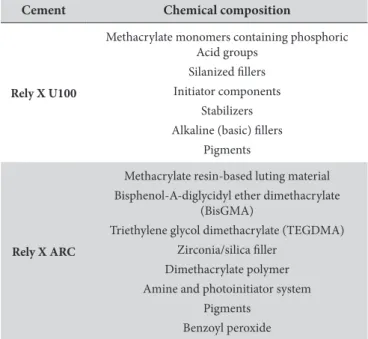
he specimens were randomly divided into 4 groups (n=15), according to combinations between the cementation system, RelyX ARC (ARC) (3M-ESPE, Seefeld, Germany) or RelyX U100 (U100) (3M-ESPE, Seefeld, Germany) (Table 1), and the type of iber post (Reforpost, Angelus, PR, Brazil), relined post (R) or non-relined post (NR), forming the following groups (n=15): ARC-R, U100-R, ARC-NR and U100-NR.
Post-space Preparation
Ater 1 week, gutta-percha was removed from the canals with #1 Gates Glidden burs, leaving 4 mm of the apical seal. he post space was then prepared with low-speed drills. Drill #1 was used to prepare the canals of groups receiving non-relined posts (ARC-NR and U100-NR); and sequence drill #2 (Angelus, PR, Brazil); diamond bur #4137 (KG Sorensen, SP, Brazil); and drill #3 (Angelus, PR, Brazil) to prepare canals treated with relined posts (ARC-R and U100-R).
Post Preparation
For relining, posts were cleaned with 37% phosphoric acid (Condac, FGM, Brazil) for 1 min; rinsed before they received silane application for 1 min, and the Scotchbond Multi-Purpose Plus (SBMP) (3M-ESPE, Seefeld, Germany) adhesive system. Canal walls in turn, were lubricated with KY gel (Johnson & Johnson, SP, Brazil). Filtek Z250 (3M-ESPE, Seefeld, Germany). Composite resin was then condensed into the canal, and iber post Exacto #1 (Angelus, PR, Brazil) inserted. he composite resin was photo-activated for 7 s (halogen light 600 mW/cm2, LH 600 Optilux 401, Demetron), and the post associated with the resin composite removed from the canal and fully photo-activated for 80s. he canal walls were rinsed copiously to remove the lubricant gel.
he relined and non-relined posts were cleaned by applying 37% phosphoric acid for 1 min; copiously rinsed with water; silane application for 1 min and activator application. he protocol used for post cementation was according to the cement used.
In groups ARC-R and ARC-NR, the canal walls were treated before cementation, according to the following steps: irst, etching was performed with 37% phosphoric acid for 15s; rinsing, and removing the excess with paper points. Ater this, the activator was applied with microbrush for 15s; excess material was removed with paper points; primer was applied with microbrush for 15s; excess material was removed with paper points, and inally, the catalyst was applied with microbrush for 15s, and the excess material removed with paper points.
Whereas, in groups U100-R and U100-NR, the canal wall was not previously treated. he cementation protocol was the same for both cement groups. he cements were mixed for 10s and inserted into the root canals with a Centrix syringe. he posts were inserted with light hand pressure and excess luting material was removed. Ater 2 min, the cervical region of the root was photo-activated for 40s.
Ater storage in distilled water at 37 °C for 1 week, the roots were sectioned into three 1-mm-thick slabs. hese were placed on a push-out jig in a mechanical testing machine (model DL2000, EMIC, São José dos Pinhais, Brazil). he load was applied at a crosshead speed of 0.5 mm/min until the post was dislodged. he bond strength value, in MPa, was calculated for each slab.
Comparisons between the cements (U100 and ARC) and between the techniques (using relined and non-relined posts) were made by the Mann-Whitney U test. he root regions (apical, middle and cervical) were compared using the Friedman test followed by the Dunn post-test. Statistical analysis were performed by using SigmaStat 2.0 program, at a signiicance level of 0.05.
Ater the push-out test, the failure patterns were evaluated by capturing images with a digital camera at 200x magniication (DIGLAB - BASF, Ludwigshafen, Germany). he failure patterns were classiied as adhesive (failure at the cement/dentin or at the cement/post interface), cohesive (of the cement or of the post), and mixed failures (adhesive and cohesive).
RESULT
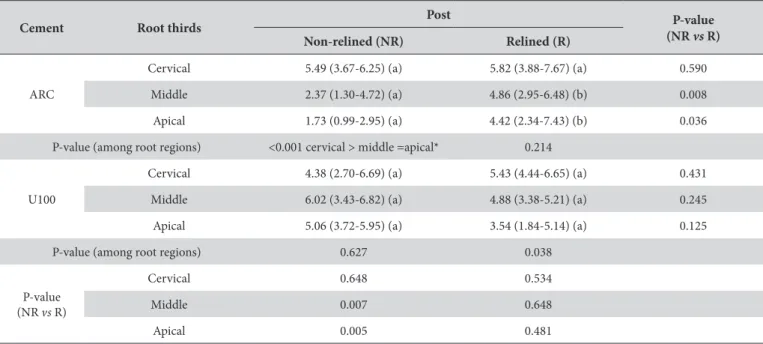
Table 2 shows the push-out shear bond strength values of the posts, comparing the cements, post types (R and NR) and root regions. Diferences in cement (U100 vs ARC) were observed only in middle and apical root regions and non-relined posts, with higher bond strength values exhibited for U100. Diferences between the techniques (R vs NR) were also observed only in the middle and apical thirds when ARC cement was used, with higher bond strength values shown in ARC-R than in ARC-NR. Push-out shear bond strength difered among the root regions only in ARC-NR and U100-R. In ARC-NR, bond strength values were higher in the cervical than in the other root regions, whereas in U-100-R, the Dunn test showed no diferences between the pairs.
As regards the bond failures, a visual observation of the specimens detected 180 failures, 103 (57.2%) adhesive at the cement/dentin interface, 7 (3.88%) adhesive at the cement/post interface, 12 (6.66%) cohesive of the cement, 1 (0.55%) cohesive of the post and 57 (31.66%) mixed failures, which represented diferent failure modes (Figure 1).
DISCUSSION
Establishing adequate shear bond strength between the post and the root canal is fundamental for the clinical success of restorative treatment of endodontically treated teeth6. hus, the shear bond strength of glass iber posts has been extensively studied.
Adhesive techniques and the root canal environment are highly variable and susceptible to the action of multiple factors that cannot be controlled. As a result, the shear bond strength data showed high variance, and were therefore analyzed by non-parametric procedures, as adopted in an earlier study18.
Grandini et al.10 reported that the technique of post relining with composite resin is easy to apply. However, in the present study several diiculties were encountered during the restoration steps. Firstly, to remove undercuts in the canal walls; secondly, to pull the
Table 1. Chemical composition of resin cements used
Cement Chemical composition
Rely X U100
Methacrylate monomers containing phosphoric Acid groups
Silanized illers Initiator components
Stabilizers Alkaline (basic) illers
Pigments
Rely X ARC
Methacrylate resin-based luting material Bisphenol-A-diglycidyl ether dimethacrylate
(BisGMA)
Triethylene glycol dimethacrylate (TEGDMA) Zirconia/silica iller
Dimethacrylate polymer Amine and photoinitiator system
Pigments Benzoyl peroxide
post/resin set out of the root canal; and inally, to readapt the post during cementation. Polymerization shrinkage of the composite resin used for relining the post did not facilitate removal of the relined posts before the complementary photo-activation session. Nevertheless, this technique has a number of advantages. he relined post is tightly inserted into the root canal, so that cement pressure against the canal walls improves cement-bond contact, avoiding water absorption13 and reducing porosity at the bond interface13,19. his prevents bubble formation11 that can inhibit polymerization, if there are trapped bubbles in the cement layer19.
Studies using scanning electron microscopy (SEM) have shown that iber post cementation produces resin-dentin interdifusion zones. hese zones consist of lateral resin projections together with discontinuous gaps along the interface between the cement-adhesive system throughout the root canal, which are probably produced by polymerization shrinkage18. he hygroscopic expansion of the cements produced by water sorption is believed to reduce the size of the gaps produced by shrinkage and improve marginal sealing20. hese indings indicate that iber post resistance to dislodgement is mainly related to frictional retention and this was corroborated by the similarity among specimens treated with iber post application
with the use of diferent adhesive systems7. his suggested that iber post resistance to displacement was proportional to the area of contact with dentin; that is, with the intertubular dentin area14.
Following the above mentioned line of reasoning, we raised the hypothesis that the push-out shear bond strength would be increased by post relining due to the rise in frictional retention. Indeed, another study showed that post relining enhanced shear bond strength, irrespective of cement type14. However, the hypothesis was only partially accepted since the efects of relining were observed only when RelyX ARC cement was used, as found by Faria-e-Silva et al.13. he ARC-R treatment produced a thinner, more uniform and stronger cement layer compared with that of ARC-NR, the latter exhibiting low bond strength values in the middle and apical third of roots.
No efects of relining were detected in treatments when RelyXTM U100 cement was used. hus, the complex technique of glass iber post relining promoted no beneits that justiied its use in conjunction with this type of resin cement.
he second hypothesis, in which the multistep etch-and-rinse system (SBMP + RelyXTM ARC) produce higher post shear bond strength than self-adhesive resin cement (RelyXTM U100) was rejected.
Table 2. Push-out shear bond strength of posts in the diferent root regions and according to cement and post type
Cement Root thirds Post P-value (NR vs R)
Non-relined (NR) Relined (R)
ARC
Cervical 5.49 (3.67-6.25) (a) 5.82 (3.88-7.67) (a) 0.590
Middle 2.37 (1.30-4.72) (a) 4.86 (2.95-6.48) (b) 0.008
Apical 1.73 (0.99-2.95) (a) 4.42 (2.34-7.43) (b) 0.036
P-value (among root regions) <0.001 cervical > middle =apical* 0.214
U100
Cervical 4.38 (2.70-6.69) (a) 5.43 (4.44-6.65) (a) 0.431
Middle 6.02 (3.43-6.82) (a) 4.88 (3.38-5.21) (a) 0.245
Apical 5.06 (3.72-5.95) (a) 3.54 (1.84-5.14) (a) 0.125
P-value (among root regions) 0.627 0.038
P-value (NR vs R)
Cervical 0.648 0.534
Middle 0.007 0.648
Apical 0.005 0.481
*Contrasts between the root regions were determined by means of the Dunn test (p<0.05).
As observed in a previous study, the bond strength provided by post relining was not associated with the type of cement system, since the non-relined posts achieved higher bond strength values when they were treated with self-adhesive resin cement (U-100)6.
Self-adhesive cements are generally better than multistep etch-and-rinse cements because of their good chemical interaction with calcium in hydroxyapatite, which improves the mechanical features of the interface produced21. hey appear to exhibit low polymerization shrinkage due to their viscoelasticity, increasing shear bond strength by maintaining close contact with root canal walls22. Self-adhesive cements are easy to apply, and do not require dentin etching, or the use of a bonding agent, which makes cementation protocols less complex. he phosphoric acids of self-adhesive resin cements are responsible for etching the demineralized substrate, and simultaneously allowing resin cement iniltration into the dentin7.
In contrast to our indings, other studies have shown poor bonding behavior of self-adhesive resin cement. his is explained by the deicient dentin hybridization18,23,24 and incomplete smear layer removal promoted by its weak-acid monomers and hydrolysis of adhesive components7. Given these discrepancies, the bonding behavior of cements deserves further studies, especially since the high variability of the root canal environment hinders the application of cementation techniques.
Shear bond strength in the root thirds tended to decrease with root canal depth (Table 2), corroborating several studies24,25. herefore, the third hypothesis tested in the present study, which was that post shear bond strength would be higher in the cervical than in the other root regions, was accepted. Indeed, the highest bond strength values were found in the cervical root region, except for ARC-R and U100-NR, in which no statistical diferences were found between the root thirds, as also reported by Faria-e-Silva et al. 13.
he cervical third shows a peculiar dentin morphology, which justiies the higher shear bond strength values in this root region. Compared with the middle and apical thirds, it exhibits higher density of larger-diameter tubules per area4,5,24, facilitating the penetration of resin cement4,5. With easy visualization and accessibility, procedures such as cleaning, application of adhesive agents and evaporation of materials are eicient19. he proximity of photo-activating light allows greater cement conversion, increasing the push-out shear bond strength and release of polymerization stress21 through the free surface area26.
he middle third showed intermediary push-out shear bond strength, sometimes approaching that of the cervical third and sometimes that of the apical third, as previously reported in another study11. his reinforces the transitional nature of this root region, relected in its morphology4.
he apical third, in the deepest canal region, showed lower shear bond strength values in groups ARC-NR and U100-R, in agreement with earlier studies5,24. Unlike the cervical third, the apical root region is not well visualized and is diicult to reach. With ineicient cleaning, residues of gutta percha and other products may not be completely removed19. Moisture control is also diicult in the apical third, hindering the functioning of adhesive systems5,6,8. his region receives a low incidence of photo-activating light, thereby decreasing cement conversion26. Given these features, the
dual resin cements are used to treat this root region rather than chemically and light-activated types.
Another characteristic of the apical third is the low density of small-diameter tubules, which prevents resin tag formation4 and thus reduces the bond strength. he shrinkage stress produced at this site during polymerization cannot be dissipated, due to root anatomy, even though resin conversion is not complete. Cement shrinkage stress results from the C-factor (ratio of the bonded to the unbonded surface areas of the cavity), which is likely to exceed 200 in root canals5. his causes loss of integrity and gap formation at the adhesive interface5,8,18. Of several studies reviewed, only those of Muniz, Mathias27 and Bitter et al. 28 found higher push-out shear bond strength in the apical third. he authors reported that the dentin area had a higher inluence on this variable than the tubule density.
he last stage of the present study identiied the main failure modes at the adhesive interface. Adhesive failure at the cement-dentin interface was the most common defect (57%), as shown in Figure 1A, followed by mixed fracture, which represented adhesive fracture associated with cohesive failure of the cement (Figure 1B). hese indings conirm the diiculty in establishing good interaction between the cement and dentin substrate, probably because of the great variability in root canal morphology and features of resin system bonding, as described in other studies13,25. Although some studies10,13,18 have discussed the post relining technique, further studies are needed to safely apply this procedure. In practical terms, the post lining technique coupled with the use of multistep etch-and-rinse cements is more complex than the technique with the use of RelyXTM U100 self-adhesive cement, thus the former requires more skilled operators, material resources and longer clinical time.
CONCLUSION
he authors were able to conclude that:
1) Post relining improved the bond strength when used with conventional resin cement in comparison non-relined iber posts, especially in middle and apical thirds;
2) With non-relined glass iber posts, self-adhesive resin cement showed better bond strength than conventional resin cement;
3) he cervical root third showed the highest bond strength values.
ACKNOWLEDGEMENTS
REFERENCES
1. Lamichhane A, Xu C, Zhang F-Q. Dental fiber-post resin base material: a review. J Adv Prosthodont. 2014 Feb;6(1):60-5. http://dx.doi. org/10.4047/jap.2014.6.1.60. PMid:24605208.
2. Goracci C, Ferrari M. Current perspectives on post systems: a literature review. Aust Dent J. 2011 Jun;56(Suppl 1):77-83. http://dx.doi. org/10.1111/j.1834-7819.2010.01298.x. PMid:21564118.
3. Suzuki TY, Gomes-Filho JE, Gallego J, Pavan S, Dos Santos PH, Fraga Briso AL. Mechanical properties of components of the bonding interface in different regions of radicular dentin surfaces. J Prosthet Dent. 2015 Jan;113(1):54-61. http://dx.doi.org/10.1016/j.prosdent.2014.07.009. PMid:25277035.
4. Ferrari M, Mannocci F, Vichi A, Cagidiaco MC, Mjör IA. Bonding to root canal: structural characteristics of the substrate. Am J Dent. 2000 Oct;13(5):255-60. PMid:11764112.
5. Bouillaguet S, Troesch S, Wataha JC, Krejci I, Meyer JM, Pashley DH. Microtensile bond strength between adhesive cements and root canal dentin. Dent Mater. 2003 May;19(3):199-205. http://dx.doi.org/10.1016/S0109-5641(02)00030-1. PMid:12628431.
6. Toman M, Toksavul S, Sarıkanat M, Firidinoglu K, Akın A. The evaluation of displacement resistance of glass FRC posts to root dentine using a thin slice push-out test. Int Endod J. 2009 Sep;42(9):802-10. http://dx.doi.org/10.1111/j.1365-2591.2009.01586.x. PMid:19548933. 7. Goracci C, Fabianelli A, Sadek F, Papacchini F, Tay F, Ferrari M. The contribution of friction to the dislocation resistance of bonded fiber
posts. J Endod. 2005 Aug;31(8):608-12. http://dx.doi.org/10.1097/01.don.0000153841.23594.91. PMid:16044046.
8. Pirani C, Chersoni S, Foschi F, Piana G, Loushine RJ, Tay FR, et al. Does hybridization of intraradicular dentin really improve fiber post retention in endodontically treated teeth? J Endod. 2005 Dec;31(12):891-4. http://dx.doi.org/10.1097/01.don.0000164853.92310.e7. PMid:16306825.
9. Perez BE, Barbosa SH, Melo RM, Zamboni SC, Özcan M, Valandro LF, et al. Does the thickness of the resin cement affect the bond strength of a fiber post to the root dentin? Int J Prosthodont. 2006 Nov-Dec;19(6):606-9. PMid:17165301.
10. Grandini A, Goracci C, Monticelli F, Borracchini A, Ferrari M. SEM evaluation of the cement layer thickness after luting two different posts. J Adhes Dent. 2005;7(3):235-40. PMid:16240965.
11. D’Arcangelo C, D’Amario M, De Angelis F, Zazzeroni S, Vadini M, Caputi S. Effect of application technique of luting agent on the retention of three types of fiber-reinforced post systems. J Endod. 2007 Nov;33(11):1378-82. http://dx.doi.org/10.1016/j.joen.2007.07.027. PMid:17963968. 12. Grandini S, Sapio S, Simonetti M. Use of anatomic post and core for reconstructing an endodontically treated tooth: a case report. J Adhes
Dent. 2003;5(3):243-7. PMid:14621246.
13. Faria-e-Silva AL, Pedrosa-Filho CF, Menezes MS, Silveira DM, Martins LRM. Effect of relining on fiber post retention to root canal. J Appl Oral Sci. 2009 Nov-Dec;17(6):600-4. http://dx.doi.org/10.1590/S1678-77572009000600012. PMid:20027434.
14. Macedo VC, Faria e Silva AL, Marcondes Martins LR. Effect of cement type, relining procedure, and length of cementation on pull-out bond strength of fiber posts. J Endod. 2010 Sep;36(9):1543-6. http://dx.doi.org/10.1016/j.joen.2010.04.014. PMid:20728724.
15. Kadam A, Pujar M, Patil C. Evaluation of push-out bond strength of two fiber-reinforced composite posts systems using two luting cements in vitro. J Conserv Dent. 2013 Sep;16(5):444-8. http://dx.doi.org/10.4103/0972-0707.117522. PMid:24082575.
16. Ferracane JL, Stansbury JW, Burke FJ. Self-adhesive resin cements- chemistry, properties and clinical considerations. J Oral Rehabil. 2011 Apr;38(4):295-314. http://dx.doi.org/10.1111/j.1365-2842.2010.02148.x. PMid:21133983.
17. Al-Assaf K, Chakmakchi M, Palaghias G, Karanika-Kouma A, Eliades G. Interfacial characteristics of adhesive luting resins and composites with dentine. Dent Mater. 2007 Jul;23(7):829-39. http://dx.doi.org/10.1016/j.dental.2006.06.023. PMid:16934865.
18. Silva RAT, Coutinho M, Cardozo PI, Silva LA, Zorzatto JR. Conventional dual-cure versus self-adhesive resin cements in dentin bond integrity. J Appl Oral Sci. 2011 Aug;19(4):355-62. http://dx.doi.org/10.1590/S1678-77572011005000010. PMid:21710099.
19. Santos V, Perdigão J, Gomes G, Silva AL. Sealing ability of three fiber dowel systems. J Prosthodont. 2009 Oct;18(7):566-76. http://dx.doi. org/10.1111/j.1532-849X.2009.00482.x. PMid:19515165.
20. Huang C, Kei LH, Wei SH, Cheung GS, Tay FR, Pashley DH. The influence of hygroscopic expansion of resin-based restorative materials on artificial gap reduction. J Adhes Dent. 2002;4(1):61-71. PMid:12071630.
21. Gerth HU, Dammaschke T, Züchner H, Schäfer E. Chemical analysis and bonding reaction of RelyX Unicem and Bifix composites: a comparative study. Dent Mater. 2006 Oct;22(10):934-41. http://dx.doi.org/10.1016/j.dental.2005.10.004. PMid:16364427.
22. Dauvillier BS, Feilzer AJ, De Gee AJ, Davidson CL. Visco-elastic parameters of dental restorative materials during setting. J Dent Res. 2000 Mar;79(3):818-23. http://dx.doi.org/10.1177/00220345000790030601. PMid:10765954.
23. Calixto LR, Bandéca MC, Clavijo V, Andrade MF, Vaz LG, Campos EA. Effect of resin cement system and root region on the push-out bond strength of a translucent fiber post. Oper Dent. 2012 Jan-Feb;37(1):80-6. http://dx.doi.org/10.2341/11-035-L. PMid:21942240.
24. Topcu FT, Erdemir U, Sahinkesen G, Mumcu E, Yildiz E, Uslan I. Push-out bond strengths of two fiber post types bonded with different dentin bonding agents. J Biomed Mater Res B Appl Biomater. 2010 May;93(2):359-66. http://dx.doi.org/10.1002/jbm.b.31590. PMid:20091920. 25. Reginato CF, Oliveira AS, Kaizer MR, Jardim OS, Moraes RR. Polymerization efficiency through translucent and opaque fiber posts and
bonding to root dentin. J Prosthodont Res. 2013 Jan;57(1):20-3. http://dx.doi.org/10.1016/j.jpor.2012.05.003. PMid:23116926.
27. Muniz L, Mathias P. The influence of sodium hypochlorite and root canal sealers on post retention in different dentin regions. Oper Dent. 2005 Jul-Aug;30(4):533-9. PMid:16130876.
28. Bitter K, Meyer-Lueckel H, Priehn K, Kanjuparambil JP, Neumann K, Kielbassa AM. Effects of luting agent and thermocycling on bond strengths to root canal dentine. Int Endod J. 2006 Oct;39(10):809-18. http://dx.doi.org/10.1111/j.1365-2591.2006.01155.x. PMid:16948667.
CONFLICTS OF INTERESTS
he authors declare no conlicts of interest.
*CORRESPONDING AUTHOR
Milton Edson Miranda, Faculdade de Odontologia e Centro de Pesquisas Odontológicas, São Leopoldo Mandic, Av. Barão de Itapura, 2294, Cjs. 63-69, Guanabara, 13073-300 Campinas - SP, Brasil, e-mail: [email protected]