Rev Odontol UNESP. 2016 July-Aug; 45(4): 195-200 © 2016 - ISSN 1807-2577
ORIGINAL ARTICLE
Doi: http://dx.doi.org/10.1590/1807-2577.24915
Evaluation of methods for stain removal in acrylic resin
denture teeth: in vitro study
Avaliação de métodos de remoção de manchas em dentes de resina acrílica para prótese total:
estudo in vitro
Ana Flávia Balestrero CASSIANO
a, Andressa Rosa Perin LEITE
a, Vivian Barnabé POLICASTRO
a,
Marco Antonio COMPAGNONI
a, Ana Carolina PERO
a*
aFaculdade de Odontologia de Araraquara, UNESP – Universidade Estadual Paulista, Araraquara, SP, Brasil
Resumo
Introdução: O manchamento dos dentes artificiais pode estar relacionado à abrasão da resina acrílica provocada pela escovação, resultando na maior deposição de corantes provenientes de bebidas, e consequentemente maior prejuízo estético. Objetivo: O objetivo do presente estudo foi avaliar métodos de remoção de manchas extrínsecas por meio de analise com espectofotômetro. Material e método: Dentes artificiais foram divididos em 12 grupos (n=10), de acordo com o tipo de tratamento (repolimento – Re ou imersão em perborato de sódio, Corega Tabs – Sp), tipo de solução de manchamento, café (Cf ) ou Coca-Cola (Cc) ou água (W) e com/sem escovação (B). Os métodos de remoção de manchas propostos (Re e Sp) foram realizados de acordo com protocolos pré-estabelecidos. Os espécimes Sp foram submetidos a 7 ciclos de imersão (5 minutos cada). O repolimento foi realizado com pastas de pedra pomes e branco de espanha, utilizando escovas de cerdas macias e rodas de feltro. As leituras de estabilidade de cor (ΔE) foram realizadas por meio de um espectrofotômetro: T0 (baseline), T1 (após escovação/imersão em bebidas), e T2 (após Re ou Sp). Resultado: Alterações de cor entre T1 e T2 (teste T pareado; α=0,05) foram observadas para o grupo CfSp (p=.032); e para os grupos BWRe (p=.000), BCfRe (p=.049) e CcRe (p=.042). Os dentes artificiais submetidos à escovação mostraram maior alteração de cor (ANOVA 2 fatores; p<0,001). Conclusão: Conclui-se que a imersão em perborato de sódio (Corega Tabs) pode ser utilizada para remoção de manchas de café e o repolimento para remoção de manchas de Coca-Cola. Ainda, a escovação produziu as maiores alterações de cor nos dentes artificiais, independentemente da solução de imersão.
Descritores: Dente artificial; prótese total; escovação; estabilidade de cor.
Abstract
Introduction: The staining of artificial teeth can be related to the acrylic resin abrasion caused by brushing, resulting in higher deposition of dyes from the beverage, and consequently higher aesthetic damage. Objective: The aim of this in vitro study was to evaluate methods for removal of stains from acrylic denture teeth using spectrophotometric analysis. Material and method: Artificial teeth were divided into twelve groups (n=10) according to the type of treatment (re-polishing - Re or immersion in Corega Tabs - Sp), staining solutions, coffee (Cf ) and Coca-Cola (Cc) or water (W) and with/without toothbrushing (B). The Sp specimens were submitted to seven immersion cycles (5 min each). The Re specimens were polished with pumice stone followed by Spain white paste. Color differences (ΔE) were captured by a spectrophotometer: T0 (baseline), T1 (after brushing/immersion in solutions) and T2 (after Re or Sp). Result: Statistically significant color change between T1 and T2 (paired T-test; α =.05) was observed for the group CfSp (p=.032); and for the groups BWRe (p=.000), BCfRe (p=.049) and CcRe (p=.042). Higher color changes were observed for the specimens submitted to toothbrushing (ANOVA two way; p<.001). Conclusion: It could be concluded that the immersion in sodium perborate (Corega Tabs) can be used for removal of coffee stains from denture teeth, and re-polishing for removal of Coca-Cola stains. Still, toothbrushing produced greater color changes on denture teeth, regardless of the immersion solution.
INTRODUCTION
Acrylic resin artiicial teeth are frequently used for dentures fabrication due to several advantages, such as the chemical bond to the denture base, improved aesthetics and the ease of adjustment1,2.
However, resin teeth have the disadvantage of high susceptibility to stains2-4.
Clinical discoloration and extrinsic staining in acrylic resin teeth can be afected by many factors, including the type of denture tooth, dietary habits and oral hygiene of patients2.
Diferent beverages, accelerated aging, light activation, bleaching, cleaning agents, and smoking afect the color of such materials5.
he extrinsic stain is time dependent and associated with eating habits, such as consumption of tea, red wine, cola and cofee that act as an extrinsic factor for color alteration due to the absorption and adsorption of these stains1,6. Furthermore, improper brushing
techniques could potentially cause wear of denture teeth and acrylic resins and adversely afect the esthetic of the denture, providing an increased roughness and increasing the accumulation of dyes derived from the diet6. herefore, it is possible to suppose that the
surface topography afects the amount of staining of a material, and an increased surface area is more prone to be stained than a lattened one6. Acidic solutions promoted greater material surface
degradations; therefore the pH of the staining solution may be another factor afecting the material color change1. Bagheri et al.7
demonstrated the pH of diferent staining solutions, among them cofee (pH=5.01), red wine (pH=3.70) and cola (pH=2.70).
he staining of acrylic resin denture teeth may be removed by mechanical or chemical denture cleansing regimens8. he abrasive
action of polishing has been used to remove extrinsic stains on the surface of acrylic resin9, and it is considered a basic procedure for
obtaining good aesthetics as well as smooth and polished surfaces10,
facilitating the hygiene and comfort of users of removable dentures11.
Alkaline peroxides could also contribute to stain removal by means of the mechanical action of the bubbles of oxygen resulting from the efervescent reaction of this product12.
Many studies have investigated the efects of staining pigments in denture teeth2,5,6. However, few studies evaluated methods for
removing stains from beverages in acrylic resin denture teeth8.
he aim of this study was to evaluate, by means of spectrophotometric analysis, methods for removal of stains from acrylic denture teeth. he null hypothesis was that color stability of the denture teeth would not be inluenced by the procedures for removing stains during the proposed period. In addition, it was hypothesized that toothbrushing would not afect the color change of the denture teeth, regardless of the coloring beverage.
MATERIAL AND METHOD
Experimental Design
The specimens consisted of artificial acrylic resin tooth, maxillary right central incisors; shade A2 (Biotone, Dentsply Ind. e Com, Rio de Janeiro, RJ, Brazil). Artificial teeth were
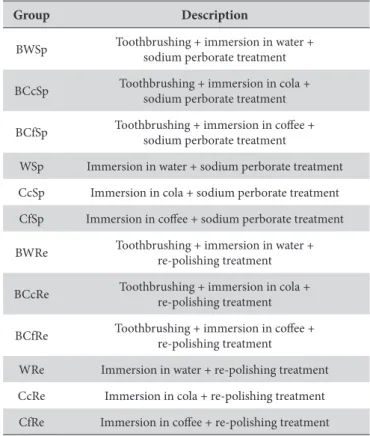
divided into twelve groups (n=10). Table 1 describes the groups of the study.
Toothbrushing
he toothbrushing test was performed in a testing machine (MAVTEC, comércio e serviços de desenvolvimento para laboratório, Ribeirão Preto, SP, Brazil), where 11,000 brushing cycles were performed on the buccal face of the artiicial tooth, simulating one year of brushing13,14.
A solution of distilled water with toothpaste (Colgate, Colgate-Palmolive, São Bernardo do Campo, SP, Brazil) at a ratio of 1:1 by bulk, and Classic Colgate brushes (Colgate, Colgate-Palmolive, São Bernardo do Campo, SP, Brazil) with sot bristles, were chosen for testing. he brushes and the solution were replaced every 2,750 cycles, simulating three months of use.
Preparation of Staining Solutions
Cofee (Nescafé tradição instantâneo, Nestlé Brasil Ltda, Araras, SP, Brazil) and cola (Coca-Cola, Curitiba, PR, Brazil) were the beverages selected in this study, and distilled water was used as a control group. Cofee solution was prepared by adding 3.6 mg of cofee to 300 mL of boiling distilled water and this solution was used only ater its complete cooling.
The artificial teeth were immersed in 20 mL of each beverage and remained immersed for 12 days at 37 °C, simulating 1-year daily consumption of beverages15. The beverages were
replaced every 3 days, and stirred once a day to avoid particles precipitation1.
Table 1. Description of the study groups (n=10)
Group Description
BWSp Toothbrushing + immersion in water +
sodium perborate treatment
BCcSp Toothbrushing + immersion in cola +
sodium perborate treatment
BCfSp Toothbrushing + immersion in cofee +
sodium perborate treatment
WSp Immersion in water + sodium perborate treatment
CcSp Immersion in cola + sodium perborate treatment
CfSp Immersion in cofee + sodium perborate treatment
BWRe Toothbrushing + immersion in water +
re-polishing treatment
BCcRe Toothbrushing + immersion in cola +
re-polishing treatment
BCfRe Toothbrushing + immersion in cofee +
re-polishing treatment
WRe Immersion in water + re-polishing treatment
CcRe Immersion in cola + re-polishing treatment
Protocols Proposed for the Removal of Stains
Chemical method: immersion in sodium perborate
For Groups 1 to 6, the efervescent solution of sodium perborate (Corega Tabs, Staford Miller Ind., Rio de Janeiro, RJ, Brazil) was prepared according to the manufacturer’s instructions, by adding one tablet to 200 mL of warm tap water (40 °C). he specimens were submitted to seven immersion cycles (5 min each), simulating a 7- day use16,17. Ater each cycle, the soaking solution was discarded
and the specimens were thoroughly washed in running water. Ater having been subjected to the seven cycles of immersion in sodium perborate, the specimens were washed for 1 minute in an ultrasonic device containing deionized water and 1%detergent, and were then dried with paper towels prior to the color readings15.
Mechanical method: re-polishing
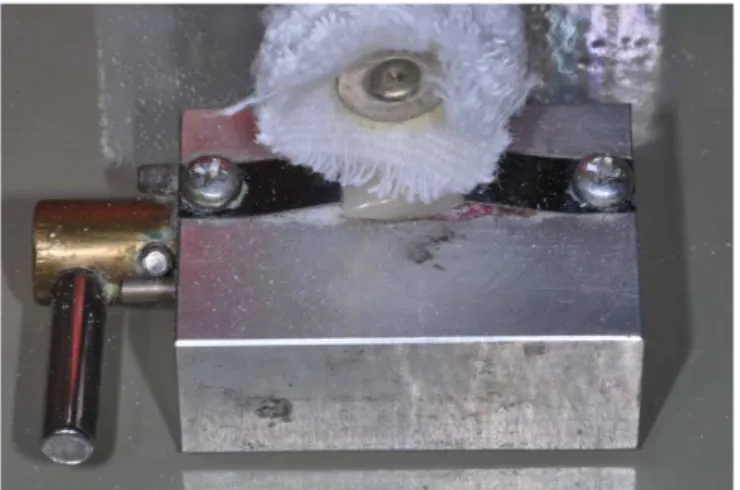
he specimens from Groups 7 to 12 were subjected to a re-polishing procedure according to the routine laboratory procedures used for polishing dentures. For this, a micromotor coupled to a handpiece was ixed on a device to standardize this procedure. his device was also used to adequately position the specimen (Figure 1).
Each specimen was polished in a two-step procedure: 1) use of a sot bristle brush (Bordente, São Paulo, SP, Brazil) and pumice stone (SSWhite Artigos Dentários Ltda., Rio de Janeiro, RJ, Brazil)
and; 2) use of a felt wheel (Bordente, São Paulo, SP, Brazil) and Spain white paste (Asfer, São Caetano do Sul, SP, Brazil). For each step, each specimen was polished for 10 seconds, six times per specimen, at 3,000 rotations per minute18. he pumice stone and
Spain white pastes were prepared in the proportion of 5.0 g to 1 ml of water. Ater the re-polishing procedures, the specimens were washed for 1 minute in an ultrasonic bath containing deionized water and 1% detergent and were dried with paper towels prior to color readings15.
Spectrophotometric Analysis of Color Stability
Color stability readings were performed at diferent times: T0, T1 and T2, according to the experimental diagram (Figure 2), using a portable spectrophotometer (BYK Gardner, São Paulo, SP, Brazil).
Color measurements were obtained using the CIELAB (Commission Internationale de L’Eclarirage) system, which positions the color in a coordinate system19. For each artiicial tooth, three
color measurements were made on each occasion (T0, T1 and T2) on the buccal surface of the tooth, obtaining an average. he color comparison between the readings was determined by the color diference or ΔE.
Total color changes were expressed by the formula6,20: ΔE*= [(ΔL)2
+ (Δa)2 + (Δb)2]1/2, where ΔL, Δa, and Δb are the diferent values of L*, a* and b* at T0, T1 and T2.
Statistical Analysis
In the present study, two separate analyses were performed to compare the values corresponding to ΔE. For comparing the T0T1ΔE and T1T2ΔE, data were submitted to a paired T-test, which showed signiicant efects of variation factor periods. For the comparison between the proposed stain removal treatments (Sodium perborate and re-polishing), the T1T2 ΔE data were compared by an independent T-test. In addition, ANOVA two way for independent samples was performed to compare data of T0T1ΔE with and without toothbrushing. All analyses were performed with α=.05.
Figure 1. Device used for the re-polishing procedures.
RESULT
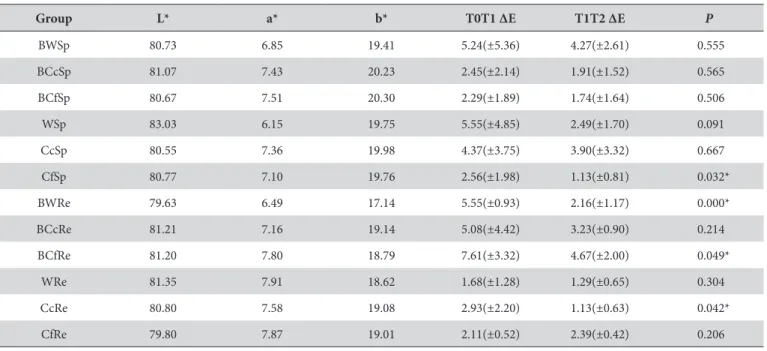
In Table 2, for the groups treated with sodium perborate (Groups Sp), the results showed a statistically signiicant color change between T0T1ΔE and T1T2ΔE, only for group CfSp. For the groups submitted to re-polishing (Groups Re), signiicant diferences between T0T1ΔE and T1T2ΔE were found for groups BWRe, BCfRe and CcRe.
he comparison between the proposed methods for stain removal demonstrated that the type of treatment was signiicant for all groups except for the group of teeth immersed in water (p =.052). Treatment with Corega Tabs was more efective for the brushing + immersion in cola, brushing + immersion in cofee and immersion in cofee groups. Nevertheless, re-polishing was more efective in teeth submitted to brushing + immersion in water and immersion in cola (Table 3).
Figure 3 shows the comparison of ΔE, for the groups with and without toothbrushing, ater immersion protocols in the diferent solutions (water, cola or cofee). It was observed that toothbrushing produced higher color changes on the denture teeth (ANOVA two way, p<.001), regardless of the solution.
DISCUSSION
he null hypothesis was rejected, since signiicant diferences were found among the color changes of the denture teeth according to the procedures for removing stains and periods evaluated
Table 2. Color data in CIE L*a*b* color space, means and standard deviations of T0T1 ΔE (ater brushing and / or immersion in beverages) and T1T2 ΔE (ater stain removal methods), according to the group
Group L* a* b* T0T1 ΔE T1T2 ΔE P
BWSp 80.73 6.85 19.41 5.24(±5.36) 4.27(±2.61) 0.555
BCcSp 81.07 7.43 20.23 2.45(±2.14) 1.91(±1.52) 0.565
BCfSp 80.67 7.51 20.30 2.29(±1.89) 1.74(±1.64) 0.506
WSp 83.03 6.15 19.75 5.55(±4.85) 2.49(±1.70) 0.091
CcSp 80.55 7.36 19.98 4.37(±3.75) 3.90(±3.32) 0.667
CfSp 80.77 7.10 19.76 2.56(±1.98) 1.13(±0.81) 0.032*
BWRe 79.63 6.49 17.14 5.55(±0.93) 2.16(±1.17) 0.000*
BCcRe 81.21 7.16 19.14 5.08(±4.42) 3.23(±0.90) 0.214
BCfRe 81.20 7.80 18.79 7.61(±3.32) 4.67(±2.00) 0.049*
WRe 81.35 7.91 18.62 1.68(±1.28) 1.29(±0.65) 0.304
CcRe 80.80 7.58 19.08 2.93(±2.20) 1.13(±0.63) 0.042*
CfRe 79.80 7.87 19.01 2.11(±0.52) 2.39(±0.42) 0.206
* P<0.05: signiicant diference between groups (paired T-test, α=0.05).
Table 3. Means and standard deviations of T1T2 ΔE (ater stain removal treatments), according to group
Group Perborate sodium Re-polishing P
Brushing + immersion in water 4.27(±2.61) 2.16(±1.17) 0.032*
Brushing + immersion in cola 1.91(±1.52) 3.23(±0.90) 0.029*
Brushing + immersion in cofee 1.74(±1.64) 4.67(±2.00) 0.002*
Immersion in water 2.49(±1.70) 1.29(±0.65) 0.052
Immersion in cola 3.90(±3.32) 1.13(±0.63) 0.027*
Immersion in cofee 1.13(±0.81) 2.39(±0.42) 0.000*
* P<0.05: signiicant diference between methods (independent T-test, α=0.05).
(T0, T1 and T2). he results indicated that there were diferences in stain removal eiciency depending on the type of treatment of removal of stains. In addition, the hypothesis that toothbrushing would not afect the color change of the denture teeth was also reject, since higher color changes were observed for the groups submitted to toothbrushing, regardless of the coloring beverage.
Our results are in agreement with Hipólito et al.6 and Leite et al.21.
hese authors inferred that the surface proile/topography afects the amount of staining of a material. hus, the results of this study suggest that toothbrushing produced more rough surfaces favoring the accumulation of stains on the denture teeth.
Extrinsic factors such as adsorption or absorption of extrinsic stains are still a major problem for esthetic restorations7. he staining
agents selected for this study are in common daily use and have a strong potential to stain acrylic denture teeth, as evaluated in many studies1,2,4,6.
he color change observed among the periods evaluated (T0, T1 and T2) suggests that the treatment of removing stains by immersion in Corega Tabs solution presented positive results only in the group of teeth submitted to immersion in cofee (Group CfSb). It could be demonstrated that the comparison between the T0T1 ΔE and T1T2 ΔE values for this group was statistically signiicant (p=0.032), and in T2, the ΔE value (1.13) was statistically lower compared to T1 (2.56). According to Jagger & Harrison12, this chemical method for
denture cleaning performs a mechanical cleaning action induced by oxygen released during the efervescent reaction product, which could contribute to the stain removal.
In this study, the re-polishing produced a signiicant efect for removing stains for the brushing + immersion in water, brushing + immersion in cofee and immersion in cola groups. In these groups, the T1T2 ΔE values were statistically lower compared to the T0T1 ΔE values. he results of this study also suggest that the treatment with Corega Tabs was more efective than re-polishing for stain removal for the brushing + immersion in cola, brushing + immersion in cofee, and immersion in cofee groups. he re-polishing was only efective for stain removal for the group of teeth submitted to immersion in cola.
It could be supposed that re-polishing was more efective method for removal of stains from cola considering that immersion in this beverage produced greater surface degradations due to the acid pH of this beverage (pH=2.70)6,7,21. herefore, re-polishing
was more efective than Corega Tabs for removal of stains of cola because re-polishing is capable to alter the surface topography of the material, producing smoother surfaces22, whereas Corega
Tabs used as denture cleanser did not alter the surface roughness of acrylic resin17,23.
On the other hand, in this study, the treatment with Corega Tabs was more efective for removal of stains of cofee. Cofee is
considered the most chromogenic agent, which presents yellow dyes with chemical ainity with the acrylic resin1,5,6,24. It could be
hypothesized that the mechanical action of the oxygen bubbles produced during the reaction of the sodium perborate solution was efective for removing cofee stains, as observed by Kurtulmus-Yilmaz, Deniz8. hese authors showed that Corega tabs, among other denture
cleansers, were eicient methods for removal of cofee, tea and red wine stains of artiicial teeth.
In previous studies, it has been suggested that ΔE greater than 3.3 is considered clinically unacceptable2,6. In the present study,
the artiicial teeth submitted to immersion in cola and treated with Corega Tabs numerically showed a reduction in color change values, however, this average value reached 3.90 ater this treatment. he group submitted to brushing associated with immersion in cofee treated with repolishing also obtained a reduction in the ΔE value from 7.61 to 4.67. Although the statistical test (paired t test, p=.049) has pointed out signiicant diferences, the inal ΔE value was greater than 3.3, indicating a clinically unacceptable color change2,6.
hus, it could be suggested that the treatment with Corega Tabs could be more indicated for removing stains from cofee and re-polishing would be more appropriate for the removal of cola stains, since in these groups, the color change was signiicantly reduced and within clinically acceptable values.
Artiicial brushing can be considered one of the limitations of this study because it may be vigorous and may be more abrasive than manual brushing25. Another limitation was the protocol used
for simulation of methods of removing stains, and maybe other time periods or frequencies of re-polishing methods could provide more efective results. Further studies are needed to evaluate the eicacy of diferent types of treatments for the stain removal of artiicial teeth.
CONCLUSION
Within the limitations of this study, the following conclusions were drawn:
• Corega Tabs could be more indicated for removing stains
from cofee and re-polishing would be more appropriate for the removal of cola stains.
• Toothbrushing produced higher color changes on the den -ture teeth, regardless of the coloring beverage.
ACKNOWLEDGEMENTS
he authors gratefully acknowledge the inancial support of FAPESP (São Paulo Research Foundation), Grant number
2014/04153-9.
REFERENCES
1. Koksal T, Dikbas I. Color stability of different denture teeth materials against various staining agents. Dent Mater J. 2008;27(1):139-44. http://dx.doi.org/10.4012/dmj.27.139. PMid:18309623.
3. Whitman DJ, McKinney JE, Hinman RW, Hesby RA, Pelleu GB Jr. In vitro wear rates of three types of commercial denture tooth materials. J Prosthet Dent. 1987 Feb;57(2):243-6. http://dx.doi.org/10.1016/0022-3913(87)90154-5. PMid:3470516.
4. Satoh Y, Nagai E, Azaki M, Morikawa M, Ohyama T, Toyoma H, et al. Study on high-strength plastic teeth. Tooth discoloration. J Nihon Univ Sch Dent. 1993 Sep;35(3):192-9. http://dx.doi.org/10.2334/josnusd1959.35.192. PMid:8246042.
5. Barão VA, Ogawa ES, Moreno A, Mesquita MF, Wee AG, Assunção WG. Long-term clinical evaluation of the color stability and stainability of acrylic resin denture teeth. J Prosthet Dent. 2015 Jun;113(6):628-35. http://dx.doi.org/10.1016/j.prosdent.2015.02.003. PMid:25858222. 6. Hipólito AC, Barão VA, Faverani LP, Ferreira MB, Assunção WG. Color degradation of acrylic resin denture teeth as a function of liquid diet:
ultraviolet-visible reflection analysis. J Biomed Opt. 2013 Oct;18(10):105005. http://dx.doi.org/10.1117/1.JBO.18.10.105005. PMid:24126696. 7. Bagheri R, Burrow MF, Tyas M. Influence of food-simulating solutions and surface finish on susceptibility to staining of aesthetic restorative
materials. J Dent. 2005 May;33(5):389-98. http://dx.doi.org/10.1016/j.jdent.2004.10.018. PMid:15833394.
8. Kurtulmus-Yilmaz S, Deniz ST. Evaluation of staining susceptibility of resin artificial teeth and stain removal efficacy of denture cleansers. Acta Odontol Scand. 2014 Nov;72(8):811-8. http://dx.doi.org/10.3109/00016357.2014.913195. PMid:24807730.
9. Jefferies SR. The art and science of abrasive finishing and polishing in restorative dentistry. Dent Clin North Am. 1998 Oct;42(4):613-27. PMid:9891644.
10. Covey DA, Tahaney SR, Davenport JM. Mechanical properties of heat-treated composite resin restorative materials. J Prosthet Dent. 1992 Sep;68(3):458-61. http://dx.doi.org/10.1016/0022-3913(92)90410-C. PMid:1432761.
11. Asmussen E. Factors affecting the color stability of restorative resins. Acta Odontol Scand. 1983;41(1):11-8. http://dx.doi.org/10.3109/00016358309162298. PMid:6575570.
12. Jagger DC, Harrison A. Denture cleansing: the best approach. Br Dent J. 1995 Jun;178(11):413-7. http://dx.doi.org/10.1038/sj.bdj.4808788. PMid:7599014.
13. Dyer D, Addy M, Newcombe RG. Studies in vitro of abrasion by different manual toothbrush heads and a standard toothpaste. J Clin Periodontol. 2000 Feb;27(2):99-103. http://dx.doi.org/10.1034/j.1600-051x.2000.027002099.x. PMid:10703654.
14. Izumida FE, Ribeiro RC, Giampaolo ET, Machado AL, Pavarina AC, Vergani CE. Effect of microwave disinfection on the surface roughness of three denture base resins after tooth brushing. Gerodontology. 2011 Dec;28(4):277-82. http://dx.doi.org/10.1111/j.1741-2358.2010.00393.x. PMid:21342242.
15. Guler AU, Yilmaz F, Kulunk T, Guler E, Kurt S. Effects of different drinks on stainability of resin composite provisional restorative materials. J Prosthet Dent. 2005 Aug;94(2):118-24. http://dx.doi.org/10.1016/j.prosdent.2005.05.004. PMid:16046965.
16. Pero AC, Scavassin PM, Leite ARP, Marin DOM, Paleari AG, Compagnoni MA. Effect of immersion cleansers on the bond strength between a denture base resin and acrylic resin teeth. Int J Adhes Adhes. 2013 Jul;44:180-3. http://dx.doi.org/10.1016/j.ijadhadh.2013.02.011. 17. Peracini A, Davi LR, Ribeiro NQ, Souza RF, Silva CHL, Paranhos HFO. Effect of denture cleansers on physical properties of heat-polymerized
acrylic resin. J Prosthodont Res. 2010 Apr;54(2):78-83. http://dx.doi.org/10.1016/j.jpor.2009.11.004. PMid:20083448.
18. Barbosa GKS, Zavanelli AC, Guilherme AS, Zavanelli RA. Efeito de diferentes técnicas de acabamento e polimento sobre a rugosidade superficial de resinas acrílicas utilizadas para restaurações provisórias. Cienc Odontol Bras. 2009 Jan-Mar;12(1):15-22.
19. Chatzivasileiou K, Emmanouil I, Kotsiomiti E, Pissiotis A. Polishing of denture base acrylic resin with chairside polishing kits: an SEM and surface roughness study. Int J Prosthodont. 2013 Jan-Feb;26(1):79-81. http://dx.doi.org/10.11607/ijp.3157. PMid:23342338.
20. International Commission on Illumination. Colorimetry: official recommendations of the International Commission on Illumination. Vienna: Bureau Central de la CIE; 1986.
21. Leite VM, Pisani MX, Paranhos HF, Souza RF, Silva-Lovato CH. Effect of ageing and immersion in different beverages on properties of denture lining materials. J Appl Oral Sci. 2010 Jul-Aug;18(4):372-8. http://dx.doi.org/10.1590/S1678-77572010000400009. PMid:20835572.
22. Türkün LS, Türkün M. Effect of bleaching and repolishing procedures on coffee and tea stain removal from three anterior composite veneering materials. J Esthet Restor Dent. 2004;16(5):290-301, discussion 301-2. http://dx.doi.org/10.1111/j.1708-8240.2004.tb00056.x. PMid:15726798.
23. Ertas E, Guler AU, Yücel AC, Köprülü H, Güler E. Color stability of resin composites after immersion in different drinks. Dent Mater J. 2006 Jun;25(2):371-6. http://dx.doi.org/10.4012/dmj.25.371. PMid:16916243.
24. Gregorius WC, Kattadiyil MT, Goodacre CJ, Roggenkamp CL, Powers JM, Paravina RD. Effects of ageing and staining on color of acrylic resin denture teeth. J Dent. 2012 Dec;40(Suppl 2):e47-54. http://dx.doi.org/10.1016/j.jdent.2012.09.009. PMid:23007129.
25. Assunção WG, Barão VA, Pita MS, Goiato MC. Effect of polymerization methods and thermal cycling on color stability of acrylic resin denture teeth. J Prosthet Dent. 2009 Dec;102(6):385-92. http://dx.doi.org/10.1016/S0022-3913(09)60200-6. PMid:19961997.
CONFLICTS OF INTERESTS
he authors declare no conlicts of interest.
*CORRESPONDING AUTHOR
Ana Carolina Pero, Departamento de Materiais Odontológicos e Prótese, Faculdade de Odontologia de Araraquara, UNESP – Universidade Estadual Paulista, Rua Humaitá 1680, 14801-903 Araraquara - SP, Brasil, e-mail: [email protected]