I LLNESS UNCERTAI NTY AND TREATMENT MOTI VATI ON I N TYPE 2 DI ABETES PATI ENTS
João Luís Alv es Apóst olo1 Cat ar ina Sofia Cast r o Viv eir os2 Helena I sabel Ribeir o Nunes3 Helena Raquel Faust ino Dom ingues4
Apóst olo JLA, Viveiros CSC, Nunes HI R, Dom ingues HRF. I llness uncert aint y and t reat m ent m ot ivat ion in t ype 2 diabet es pat ient s. Rev Lat ino- am Enferm agem 2007 j ulho- agost o; 15( 4) : 575- 82.
Aim s: To char act er ize t he uncer t aint y in illness and t he m ot iv at ion for t r eat m ent and t o ev aluat e t he exist ing r elat ion bet w een t hese var iables in individuals w it h t ype 2 diabet es. Met hod: Descr ipt ive, cor r elat ional st udy, using a sam ple of 62 individuals in diabet es consult at ion sessions. The Uncert aint y St ress Scale and t he Tr eat m ent Self- Regulat ion Quest ionnair e w er e used. Result s: The indiv iduals w it h t y pe 2 diabet es pr esent low lev els of u n cer t ain t y in illn ess an d a h igh m ot iv at ion f or t r eat m en t , w it h a st r on ger in t r in sic t h an ex t r in sic m ot iv at ion . A n eg at iv e cor r elat ion w as v er if ied b et w een t h e u n cer t ain t y in t h e f ace of t h e p r og n osis an d t r eat m ent and t he int r insic m ot iv at ion. Discussion: These indiv iduals ar e alr eady adapt ed, act ing accor ding t o t h e m ean in gs t h ey at t r ibu t e t o illn ess. Un cer t ain t y can f u n ct ion as a t h r eat , in t er v en in g n egat iv ely in t h e at t ribut ion of m eaning t o t he event s relat ed t o illness and in t he process of adapt at ion and m ot ivat ion t o adhere t o t r eat m ent . I nt r insic m ot ivat ion seem s t o be essent ial t o adher e t o t r eat m ent .
DESCRI PTORS: uncer t aint y ; m ot iv at ion; diabet es m ellit us, t y pe 2
LA I NCERTI DUMBRE EN LA ENFERMEDAD Y LA MOTI VACI ÓN PARA EL TRATAMI ENTO EN
DI ABÉTI COS TI PO 2
Obj et iv os: Car act er izar la in cer t idu m br e an t e la en f er m edad y la m ot iv ación par a el t r at am ien t o y evaluar la relación exist ent e ent re est as variables en diabét icos t ipo 2. Mét odo: Est udio descript ivo, correlacional, en una m uest ra de 62 diabét icos at endidos en consult a. Usadas la Escala de I ncert idum bre ant e la Enferm edad y la Escala de Mot iv ación par a el Tr at am ient o. Result ados: Los diabét icos t ipo 2 pr esent an baj os niv eles de incert idum bre ant e la enferm edad y una elevada m ot ivación para el t rat am ient o, siendo la m ot ivación int rínseca m ás elev ada que la ex t r ínseca. Se v er ificó cor r elación negat iv a ent r e la incer t idum br e fr ent e al pr onóst ico y t rat am ient o y la m ot ivación int rínseca para el t rat am ient o. Discusión: Est os pacient es se encuent ran adapt ados act uando en conform idad con los significados que at ribuyen a la enferm edad. La incert idum bre puede funcionar com o am enaza int erfiriendo negat ivam ent e en la at ribución de significados de los acont ecim ient os relacionados con la enfer m edad y con el pr oceso de adapt ación y m ot iv ación par a adher ir se al t r at am ient o. La m ot iv ación int r ínseca par ece ser un aspect o fundam ent al en la m ot iv ación par a el t r at am ient o.
DESCRI PTORES: incer t idum br e; m ot iv ación; diabet es m ellit us t ipo 2
I NCERTEZA NA DOENÇA E MOTI VAÇÃO PARA O TRATAMENTO EM DI ABÉTI COS TI PO 2
Obj ect iv os: Car act er izar a incer t eza na doença e a m ot iv ação par a o t r at am ent o e av aliar a r elação exist ent e ent re est as variáveis, em diabét icos t ipo 2. Mét odo: Est udo descrit ivo, correlacional, num a am ost ra de 62 diabét icos at endidos em consult a. Aplicadas a Escala de I ncert eza na Doença e a Escala de Mot ivação para o Tr at am en t o. Resu lt ad os: Os d iab ét icos t ip o 2 ap r esen t am b aix os n ív eis d e in cer t eza n a d oen ça e elev ad a m ot ivação para o t rat am ent o. A m ot ivação int rínseca é m ais elevada do que a ext rínseca. Exist e um a correlação negat iva ent re a incert eza face ao prognóst ico e t rat am ent o e a m ot ivação int rínseca para o t rat am ent o. Discussão: Os result ados sugerem que est es indivíduos se encont ram adapt ados agindo em conform idade com os significados que at r ibuem à doença. A incer t eza pode funcionar com o am eaça int er fer indo negat ivam ent e na at r ibuição de significados aos acont ecim ent os r elacionados com a doença e com o pr ocesso de adapt ação e m ot ivação par a adesão ao t rat am ent o. A m ot ivação int rínseca parece ser um aspect o fundam ent al na m ot ivação para o t rat am ent o.
DESCRI TORES: incer t eza; m ot iv ação; diabet es m ellit us t ipo 2
Disponible en castellano/ Disponível em língua portuguesa SciELO Brasil w w w .scielo.br/ rlae 1 RN, Doctoral Student in Nursing Sciences, Adjunct Professor, Escola Superior de Enferm agem Dr. Ângelo da Fonseca, Portugal, e-m ail: [email protected]; 2 RN, Medical Service I I I for Wom en and Reum at ology, Port ugal, e- m ail: cat arinaenf@hot m ail.com ; 3 RN, Centro de Saúde dos Olivais, Portugal, e- m ail:
len n an u n es@h ot m ail. com ; 4 RN, I n st it u t o Por t u g u ês d e On colog ia Fr an cisco Gen t il, Coim b r a Reg ion al On colog y Cen t er, Por t u g al, e- m ail:
576
I NTRODUCTI ON
H
eal t h sy st em s h av e t o f ace n u m er o u s problem s. One of them is treatm ent abandonm ent or incorrect com pliance by patients with chronic illnesses like diabet es. Lack of m ot ivat ion and non- com pliance are probably the m ost significant causes of treatm ent failure, which leads to health system dysfunctions and in cr eases m or b id it y an d m or t alit y. Lit er at u r e h as reported that individuals with diabetes find it difficult to com ply with the treatm ent program(1) (m etabolic control,food planning, physical activity and m edical treatm ent). D i a b e t e s i s o n e o f t h e m o st d e m a n d i n g chronic illnesses, in both the physical and psychological sense. Living with this illness im plies adopting a lifestyle adj ust ed t o one’s healt h condit ion, w hich calls for ch an ges in ev er y day life act iv it ies an d per m an en t com pliance w it h t he t r eat m ent , since it is t he only way t o avoid t he serious com plicat ions( 2).
To live wit h a chronic incurable illness is t o live in a state of constant uncertainty. There is m ore to the challenge of adjusting to a chronic illness than the sim ple biophysical adapt at ion t o it s process. I n fact , m ultiple adaptations are required, and the im plied state of uncertainty is a deep and personal experience( 3).
Un cer t ain t y is con sid er ed a m aj or f act or af f ect in g adj u st m en t t o t h e illn ess. How ev er, f ew st udies have been developed t o underst and t he long term effects of uncertainty on chronic illnesses( 3). The
per for m ed r esear ch m ainly r epor t t hat t his concept has been st udied in cont ex t s of econom y, decision m ak in g, pr edict ion , t oler an ce, con t r ol, st r ess an d am biguit y. I n t his sense, it is per t inent t o enhance knowledge in t his underexplored field.
The concept of illness uncert aint y has been changing over tim e. However, there is a consensus that it is a cognitive state in which individuals are incapable of attributing a m eaning to illness-related events. This is observed in sit uat ions in which one is not able t o assign definite values to objects and events and/ or to precisely predict illness outcom es(4-5). These aspects can in t er fer e w it h t h e m ot iv at ion al pr ocess as w ell as t reat m ent com pliance. Th e i l l n ess- asso ci at ed stim uli cause reactions that are, supposedly, explained by t he uncer t aint y t heor y in four st ages: t he fir st com prises the antecedents that generate uncertainty; the second regards perceiving uncertainty as either a threat or an opportunity; the third corresponds to the coping strategies adopted to reduce the uncertainty that is considered a threat or, on the other hand, to m aintain the uncertainty that is considered an opportunity; and,
finally, the fourth regards the state of adaptation that results from the adopted coping strategies(3).
Wit h r espect t o m ot iv at ion, t his concept is defin ed as a gr ou p of per ceiv ed for ces t h at m ak e one act , and is influenced by one’s experiences and ot her ext ernal fact ors( 6- 7).
Hum an beings rarely act based on a single m otive. Rather, hum an behavior is im pelled by intrinsic and ex t r insic m ot iv at ions( 8). I nt r insic m ot iv at ion is
responsible for an individual’s participation in an activity for the sheer pleasure of the activity, and not for a tangible reward that could result. On the other hand, extrinsic m otivation is that through which one takes part in an activity with the aim of obtaining a tangible reward(7-9).
Sev er al t h eor ies at t em p t t o d escr ib e t h e m otivational phenom enon. However, none are thorough regarding the process. It is worth highlighting that despite t h eir d iv er sit y, t h e r en ow n ed ap p r oach es ar e n ot contradictory. Rather, they are complementary and, thus, permit understanding a certain motivational phenomenon that, in the present study, leads to treatment compliance or non- com pliance. The t heories t hat aim t o describe the phenomenon as well as the influencing factors include: Leventhal’s Model of Behavior Self-Regulation, Treatment Com pliance Models and the Health Beliefs Model.
Leventhal’s Model of Behavior Self- Regulation pr ov ides a t heor et ical const r uct ion/ ex planat ion t hat h elp s t o u n d er st an d t h e f act or s in f lu en cin g on e’s percept ions regarding illness t hreat s, t he associat ion bet ween t hose percept ions, t he descript ions of self-report ed illness sym pt om s, and how personal beliefs influences one’s self- care behavior and drives one t o eit her prom ot e or ignore illness t hreat s.
According to this m odel, there are two active processes in the illness: cognition, which refers to the objective interpretation of illness threat; and em otion, which is the subjective reaction to a threat. These parallel processes, cognition and em otion, are interactive. For inst ance, t he t ype 2 diabet es diet im plies cognit ively processing the inform ation to understand the com plex r elat ionship bet w een consum ing car bohy dr at es and blood glucose levels. How ev er, em ot ional pr ocesses int eract wit h sociocult ural values of food and eat ing. Those values com e from social experience; therefore, t hey m ight be consider ed m or e im por t ant t han t he cognit ion process when one decides t o eat food t hat increases blood glucose levels, since one feels socially obliged to do that(10).
Th e h ealt h b elief s m od el is b ased on t h e su p p osit ion t h at h ealt h y b eh av ior s ar e r at ion ally det er m in ed by t h e v u ln er abilit y t o h ealt h t h r eat s.
I llness uncert aint y and t reat m ent ...
Apóst olo JLA, Viveiros CSC, Nunes HI R, Dom ingues HRF.
I ndividuals end up assigning a value to those perceptions that m akes them believe or not in the efficacy of the act ions t hat lead t o t he im provem ent of t heir healt h. Therefore, based on these beliefs, it is possible to predict different healt h- associat ed behaviors, at t he level of eit h er illn ess p r ev en t ion or h ealt h p r om ot ion( 1 1 ).
Com pliance im plies an act ive at t it ude wit h volunt ary and collaborative involvem ent of both the patient and the health care professional, in a com bined process that aim s to change patient behavior. Hence, patients com ply with the treatm ent or therapeutic protocol based on a com bined agreem ent, in which patients take part, and which allows patients to develop an appreciation of the im portance of certain prescribed actions(12).
I n d i v i d u a l s ca n n o t i ce t h e b e n e f i t s, t h e barriers, t heir suscept ibilit y t o, and t he seriousness of t heir illness. But if one assigns lit t le im por t ance t o one’s own healt h, overvaluing ot her areas in t heir life, t he degree of com pliance wit h a proposed act ion w ill be t oo low an d on e’s disposit ion t ow ar d t h at act ion can be null, and, t hus, it will not t ake place( 13). I n t his direct ion, t he present st udy had t he following purposes: t o describe t he charact erist ics of illness uncert aint y and t reat m ent m ot ivat ion in t ype 2 diabetes patients who were attended at two Health Cen t er s in t h e Cen t r al Region of Por t u gal; an d t o analyze t he relat ionship bet w een illness uncert aint y and t reat m ent m ot ivat ion in t hose pat ient s.
METHOD
Type of st udy
This is a descriptive- correlational quantitative study, developed with the following research question and hypot hesis:
Q1- What are the characteristics of illness uncertainty and treatm ent m otivation in type 2 diabetes patients? H1- There is a relation between illness uncertainty and t reat m ent m ot ivat ion in t hese pat ient s.
Var iables
Th e st u d i e d v a r i a b l e s w e r e : i l l n e ss uncert aint y, w hich is a cognit ive st at e in w hich t he individual is unable t o assign a m eaning t o illness-relat ed event s( 4- 5); and t reat m ent m ot ivat ion, which
is a group of perceived st rengt hs t hat cause one t o act , influenced by one’s own experiences and ot her ext ernal fact ors( 6- 7).
Sam p le
The sam ple consisted of 62 individuals, adults an d eld er ly, w h ich w er e at t en d ed in d iab et olog y appointments at the Health Centers in the cities of Pombal and Figueira da Voz, Portugal, from February 9th to April
2nd 2004. Subjects were between 43 and 84 years old,
wit h an average age of 67.06 years and a st andard deviat ion of 8.18 years. Most subj ect s ( 59.7% ) were women. In terms of marital status, 67.7% were married, 1.6% single, 6.5% divorced and 24.2% widowed.
Pr oced u r es
The instrum ent was adm inistered in a sam ple o f i n d i v i d u a l s d i a g n o se d w i t h t y p e 2 d i a b e t e s, consider ing t he pr e- det er m ined cr it er ia of including pat ient s t hat cam e t o diabet ology appoint m ent s at Health Centers of the cities Pom bal and Figueira Foz, Por t ugal, bet w een Febr uar y 9t h and Apr il 2nd 2004,
who had agreed to participate in the study. I n view of t hese crit eria, 62 individuals were int erviewed.
Et hical aspect s
Before dat a collect ion, t he research proj ect was approved by the Directors of both referred Health Cent ers. I ndividuals who agreed t o part icipat e in t he research signed t he free and inform ed consent form . Subjects’ conditions were taken into consideration and the researchers clarified all doubts that were presented.
I nst r um ent s
Th e i n st r u m e n t u se d f o r d a t a co l l e ct i o n consist s of sociodem ogr aphic quest ions, in addit ion t o part A of t he Uncer t aint y St r ess Scale ( USS) and t he Tr eat m ent Mot iv at ion Scale ( TMS) .
The USS(14) com prises three parts. I n part A,
individuals are asked to classify their degree of uncertainty in areas regarding their health condition and coping with uncertainty. I n part B, participants are asked to classify their stress level related to uncertainty. Part C comprises a 10 cm analogical visual scale that m easures overall uncertainty, stress, threat, and the perception of aspects corresponding to the state of uncertainty.
The Port uguese version( 14) of t he USS, called
578
t e r m s o f p r o g n o si s, t r e a t m e n t a n d co p i n g w i t h uncert aint y. Five answer possibilit ies are given: 0 - I have no uncertainty; 1- I have little uncertainty; 2- I have uncert aint y; 3- I have som e uncert aint y; 4- I h av e m u ch u n cer t ain t y. Th e r espect iv e scor es ar e obt ained by adding up t he answ ers t o t he it em s in each dim ension. The t ot al uncer t aint y scor e is t he sum of the 24 item s.
Regarding validit y, t he I US( 15) show ed good
int er nal consist ency, w it h Cr onbach alpha values of .72 for uncert aint y t oward prognosis, .70 for coping wit h uncert aint y, and .82 for t he t ot al scale. I n t he sam e study( 15), the I US was adm inistered with Zung’s
self - ev alu at ion an x iet y scale, obt ain in g r espect iv e co r r e l a t i o n v a l u e s o f . 4 0 , . 6 8 , a n d . 6 9 f o r t h e pr ognosis, t r eat m ent , coping and t ot al uncer t aint y dim ensions, which m ay be interpreted as a argum ent for t he crit erion validit y of t he I US.
I n t h e st u d i e d p a t i e n t sa m p l e , t h e I US sh ow ed g ood in t er n al con sist en cy, w it h Cr on b ach alpha values of .81, .73, and .87, r espect iv ely, for p r o g n o s i s a n d t r e a t m e n t , c o p i n g , a n d t o t a l u n cer t ain t y. Cor r elat ion v alu es b et w een t h e it em and t he t ot al scor e of each sub- scale and t he t ot al scor e w er e abov e . 30, ex cept for it em s 1 and 23, w hose v alues w er e . 2 3 and . 2 4 .
The TMS used in t his st udy result s from an a d a p t a t i o n o f t h e Tr e a t m e n t Se l f - Re g u l a t i o n Qu e st i o n n a i r e ( TRSQ) f o r d i a b e t e s, w h i ch w a s d e v e l o p e d t o e x p l a i n t h e Se l f - D e t e r m i n a t i o n Theory( 16). This is a theory based on hum an m otivation
and has been adapt ed t o sev er al sit uat ions in t he prom ot ion of healt hy life habit s, nam ely weight loss and physical exercises in the long term , keeping adults away from sm oking and im proving glucose cont rol in individuals wit h diabet es( 17).
The TMS is a Lik er t scale com posed of 19 i t em s, o f w h i ch 1 3 ev a l u a t e i n t r i n si c t r ea t m en t m ot iv at ion , w h ile t h e ot h er six look at ex t r in sic t r eat m en t m ot iv at ion . Th is scale aim s t o m easu r e aut onom ous and cont r olled m ot iv at ions t o adopt a healthy life style regarding diabetes treatm ent, glucose control and practicing exercises. Answers are organized on a scale from 1 t o 7 point s, ranging from st rongly disagree to strongly agree, in which the score of each dim ension is obt ained by sum m ing t he answ er s of item s in each dim ension and by the total score.
I n t he st udy sam ple, t he inst rum ent showed good internal consistency, with Cronbach alpha values of .78, .88, and .86, r espect ively, for ext r insic and int rinsic m ot ivat ion, and t he t ot al. Correlat ion values
of the item with the score of each sub- scale and with the scale total exceeded .39, except for item 15, whose value is .13.
RESULTS
Re g a r d i n g i l l n e ss u n ce r t a i n t y, t h e d a t a show r educed av er age v alues for t he t ot al and for t h e dim en sion s, u n cer t ain t y con cer n in g pr ogn osis a n d t r e a t m e n t , a n d c o p i n g w i t h u n c e r t a i n t y, cor r esponding t o 1.29, 1.32, and 1.20, r espect iv ely, and w it h a r educed disper sion of . 63, . 67 and . 66 ( Table 1 ) .
Ta b l e 1 - Av er a g e v a l u es a n d d i sp er si o n o f t h e answers t o it em s t hat evaluat e illness uncert aint y
y t n i a t r e c n u s s e n ll i g n i n r e c n o c s m e
tI X SD Min Max
h tl a e h u o y t c e t e d o t e n o d e v a h d l u o c u o y t a h W -* 1 .r e il r a e n o it i d n o
c 1.89 1.494 0 4
h tl a e h y m f o t n e m p o l e v e d e h t g n i d r a g e R -* 2 . n o it i d n o
c 1.81 1.114 0 4
. n o it i d n o c h tl a e h t n e r r u c y m g n i d r a g e R -*
3 1,92 1.271 0 4
h tl a e h y m p l e h ll i w e l y t s h tl a e h y m n i s e g n a h c fI -* * 4 . n o it i d n o
c 1.32 1.184 0 4
d l o t e v a h s r e h t o t a h w f o e s n e s e k a m o t w o H -* * 5 . n o it i d n o c h tl a e h y m t u o b a e
m 1.15 0.989 0 3
s a h t a h t t n e m t a e rt e h t f o y c a c if f e e h t g n i d r a g e R -* 6 . e m o t d e s o p o r p n e e
b 0.71 1.062 0 4
.l o rt n o c r e d n u s i m e l b o r p h tl a e h y m fI -*
7 1.39 1.464 0 4
. n o it i d n o c h tl a e h y m t u o b a s r e h t o ll e t o t t a h W -* *
8 1.24 1.250 0 4
n e e b e v a h I s n o it a n a l p x e t n e r e ff i d e h t g n i d r a g e R -* 9 . n e v i
g 1.13 1.221 0 4
y m h ti w e r e fr e t n i ll i w n o it i d n o c h tl a e h y m fI -* * 0 1 . s e it i v it c a l a u s u y m p o l e v e d o t y ti li b
a 1.06 1.17 0 4
. s m o t p m y s y m h ti w l a e d o t w o H -* * 1
1 1.82 1.337 0 4
.t n e m t a e rt y m r o f e d a m s e c i o h c e h t g n i d r a g e R -* 2
1 1.00 1.173 0 4
n i r a e p p a ll i w e c n a r a e p p a y m n i s e g n a h c e h t fI -* * 3 1 . p i h s n o it a l e r e t a m it n i y
m 1.13 1.261 0 4
e h t e m o c r e v o o t g n i o d n e e b e v a h I t a h w fI -* 4 1 . e m p l e h ll i w n o it a u ti
s 1.08 1.076 0 4
f o r o t a c i d n i e l b a il e r a e r a s tl u s e r m a x e y m fI -* 5 1 . n o it i d n o c h tl a e h l a e r y
m 1.00 1.293 0 4
s n o it o m e h ti w l a e d o t y ti li b a y m g n i d r a g e R -* * 6 1 . m e l b o r p h tl a e h y m o t d e t a l e
r 1.65 1.294 0 4
s n o it o m e h ti w l a e d o t y tl u c if fi d y n a e v a h I fI -* * 7 1 . m e l b o r p h tl a e h y m o t d e t a l e
r 1.71 1.372 0 4
e v a h I n o it a m r o f n i e h t f o y ti l a u q e h t g n i d r a g e R -* 8 1 . n e v i g n e e
b 0.76 1,155 0 4
t a h t s t n e m t a e rt e h t ll a h ti w y l p m o c d l u o h s I fI -* 9 1 . d e s o p o r p n e e b e v a
h 0.74 1.241 0 4
n o m m o c n u f o e c n a tr o p m i e h t s i t a h W -* 0 2 . n o it i d n o c h tl a e h y m o t s m o t p m y
s 2.00 1.201 0 4
o t t n a tr o p m i e r a t a h t e l p o e p n o t n u o c n a c I fI -* * 1 2 . m e h t d e e n I n e h w e m y b d n a t s o t e
m 0.56 1.081 0 4
y m y b d e t c e ff a e b ll i w n o it i d n o c l a i c n a n if y m fI -* * 2 2 . n o it i d n o c h tl a e
h 0.95 1.324 0 4
e s o l c y a p e b d l u o h s I s m o t p m y s h c i h W -* 3 2 . o t n o it n e tt
a 2.18 1.349 0 4
h tl a e h y m k c e h c o t e v r e s b o d l u o h s I t a h W -* 4 2 . n o it i d n o
c 1.16 1.204 0 4
y t n i a tr e c n u s s e n ll i l a t o
T 1.29 0.63 0.25 3.13
t n e m t a e rt d n a s i s o n g o r p d r a w o t y t n i a tr e c n
U 1.32 0.67 0.213.36
y t n i a tr e c n u h ti w g n i p o
C 1.20 0.66 0.00 2.80
* item s concerning the dim ension uncertainty about prognosis and treatm ent * * it em s concerning t he dim ension coping wit h uncert aint y
I llness uncert aint y and t reat m ent ...
Apóst olo JLA, Viveiros CSC, Nunes HI R, Dom ingues HRF.
I n all the item s, m axim um ( 4) and m inim um ( 0 ) v a l u es a r e o b ser v ed , co n si d er ed i n t h e I US anchors; except for it em 5, in w hich t he m axim um value present ed was 3.
Although these patients showed a low degree of illn ess u n cer t ain t y, t h ey r ep or t ed h av in g m or e uncertainty about sym ptom s ( item s 20, 23) and health condition ( item s 1, 3) in the dim ension of uncertainty t oward prognosis and t reat m ent .
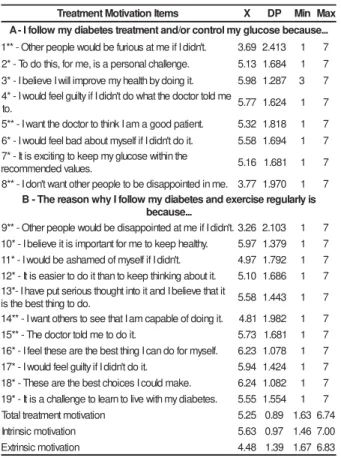
As to treatm ent m otivation in total and in the r esp ect i v e d i m en si o n s o f i n t r i n si c a n d ex t r i n si c m otivation, considering the lim its ( 1- 7) , high average v a l u e s w e r e o b se r v e d : 5 . 2 5 , 5 . 6 3 a n d 4 . 4 8 , r espect iv ely. Disper sion values w er e . 8 9 , . 9 7 , and 1.39. I ntrinsic m otivation values were superior to those of ext rinsic m ot ivat ion ( Table 2) .
Ta b l e 2 - Av er a g e v a l u es a n d d i sp er si o n o f t h e answers t o it em s t hat evaluat e t reat m ent m ot ivat ion
ex cep t f o r i t em 3 , r eg a r d i n g t h e b el i ef t h a t b y com ply in g w it h t r eat m en t , on e w ill im pr ov e on e’s health, in which the m inim um value presented was 3. Alt hough pat ient s pr esent ed indicat or s of a high degr ee of t r eat m ent m ot iv at ion , t h e lat t er is higher in aspects associated with m aintaining healthy l i f e h a b i t s ( d i m e n si o n o f i n t r i n si c m o t i v a t i o n ) evaluated by item s 18 - “ These are the best choices I could m ake” - and 6 - “ I feel these are the best things I can do for m yself”.
I t i s w o r t h h i g h l i g h t i n g t h at t h e h i g h est dispersion was observed in answers to item s 1 and 9, which evaluat e ext rinsic m ot ivat ion regarding ot hers’ indignation in case the patient does not keep diabetes under cont rol.
Association between illness uncertainty and treatm ent m ot iv at ion
I n Table 3, a negative association is observed between illness uncertainty and treatm ent m otivation. Th is is ev iden ced bet w een t h e in t r in sic t r eat m en t m ot ivat ion dim ension and illness uncert aint y t oward diagnosis and t reat m ent .
Table 3 - Associat ion bet ween illness uncert aint y and t reat m ent m ot ivat ion*
* item s regarding the intrinsic m ot ivation dim ension * * it em s regarding t he int rinsic m ot ivat ion dim ension
The data resulting from the evaluation of the answers t o t he various it em s, according t o Table 2, show that a m aj ority of type 2 diabetes patients present a high degree of treatm ent m otivation in the different aspect s.
I n all item s, m axim um ( 7) and m inim um ( 1) values are observed, considered in t he TMS anchors;
! Non- com pliance with the variable norm alit y presupposit ions, t hrough the Kolm ogorov - Sm irnov test with Lilliefors’ correct ion.
I n fact , alt hough t he associat ion is not high, the data suggest that the higher the uncertainty level t o w a r d d i a g n o si s a n d t r ea t m en t , t h e l esser t h e patients feel intrinsically m otivated to adopt a healthy life st y le concer ning diabet es, glucose cont r ol and physical act ivit y.
DI SCUSSI ON
I n general, subj ect s present a low degree of illness uncer t aint y and high t r eat m ent m ot iv at ion. No n et h el ess, i n t r i n si c m o t i v a t i o n i s h i g h er t h a n ex t r insic.
s m e tI n o it a v it o M t n e m t a e r
T X DP Min Max
.. . e s u a c e b e s o c u l g y m l o r t n o c r o / d n a t n e m t a e r t s e t e b a i d y m w o ll o f I -A .t ' n d i d I fi e m t a s u o ir u f e b d l u o w e l p o e p r e h t O -* *
1 3.692.413 1 7
. e g n e ll a h c l a n o s r e p a s i , e m r o f , s i h t o d o T -*
2 5.131.684 1 7
.t i g n i o d y b h tl a e h y m e v o r p m i lli w I e v e il e b I -*
3 5.981.287 3 7
e m d l o t r o t c o d e h t t a h w o d t' n d i d I fi y tl i u g l e e f d l u o w I -* 4 . o
t 5.771.624 1 7
.t n e it a p d o o g a m a I k n i h t o t r o t c o d e h t t n a w I -* *
5 5.321.818 1 7
.t i o d t' n d i d I fi fl e s y m t u o b a d a b l e e f d l u o w I -*
6 5.581.694 1 7
e h t n i h ti w e s o c u l g y m p e e k o t g n it i c x e s i tI -* 7 . s e u l a v d e d n e m m o c e
r 5.16 1.681 1 7
. e m n i d e t n i o p p a s i d e b o t e l p o e p r e h t o t n a w t' n o d I -* *
8 3.771.970 1 7
s i y l r a l u g e r e s i c r e x e d n a s e t e b a i d y m w o ll o f I y h w n o s a e r e h T -B .. . e s u a c e b .t ' n d i d I fi e m t a d e t n i o p p a s i d e b d l u o w e l p o e p r e h t O -* *
9 3.262.103 1 7
. y h tl a e h p e e k o t e m r o f t n a tr o p m i s i ti e v e il e b I -* 0
1 5.971.379 1 7
.t ' n d i d I fi fl e s y m f o d e m a h s a e b d l u o w I -* 1
1 4.971.792 1 7
.t i t u o b a g n i k n i h t p e e k o t n a h t ti o d o t r e i s a e s i tI -* 2
1 5.101.686 1 7
ti t a h t e v e il e b I d n a ti o t n i t h g u o h t s u o ir e s t u p e v a h I -* 3 1 . o d o t g n i h t t s e b e h t s
i 5.581.443 1 7
.t i g n i o d f o e l b a p a c m a I t a h t e e s o t s r e h t o t n a w I -* * 4
1 4.811.982 1 7
.t i o d o t e m d l o t r o t c o d e h T -* * 5
1 5.73 1.681 1 7
.f l e s y m r o f o d n a c I g n i h t t s e b e h t e r a e s e h t l e e f I -* 6
1 6.231.078 1 7
.t i o d t' n d i d I fi y tl i u g l e e f d l u o w I -* 7
1 5.941.424 1 7
. e k a m d l u o c I s e c i o h c t s e b e h t e r a e s e h T -* 8
1 6.241.082 1 7
. s e t e b a i d y m h ti w e v il o t n r a e l o t e g n e ll a h c a s i tI -* 9
1 5.551.554 1 7
n o it a v it o m t n e m t a e rt l a t o
T 5.25 0.89 1.636.74
n o it a v it o m c i s n ir t n
I 5.63 0.97 1.467.00
n o it a v it o m c i s n ir t x
E 4.48 1.39 1.676.83
y t n i a t r e c n u s s e n ll I )l a t o T ( y t n i a t r e c n U s i s o n g o r p d r a w o t t n e m t a e r t d n a h ti w g n i p o C y t n i a t r e c n u
rs ! p rs! p rs! p
n o it a v it o m t n e m t a e r T )l a t o t
( -0.276 0.030* -0.310 0.014* -0.199 0.121
n o it a v it o m c i s n i r t x
E -0.159 0.216 -0.130 0.312 -0.159 0.217
n o it a v it o m c i s n i r t n
580
Patients show less uncertainty regarding their ex p ect at ion s t ow ar d social- f am ily su p p or t . Th ese results show the fam ily support felt by patients, which allows t hem t o express t heir em ot ions, which coping st r a t eg i es a r e cen t er ed i n , a n d h a v e a p o si t i v e influence on their expectations concerning the illness, t reat m ent and prognosis. Moreover, pat ient s acquire a pr obabilist ic v iew poin t , w it h t h e possibilit y t h at posit ive t hings will t ake place( 18).
At t en t ion sh ou ld also be giv en t o t h e low degree of uncert aint y t oward efficacy, com pliance t o t he proposed t reat m ent , and qualit y of t he received infor m at ion.
Co n ce r n i n g e f f i ca cy a n d t r e a t m e n t com pliance, result s suggest t hat t he st udied pat ient s have already adapted to the illness, and have adopted appr opr iat e coping st r at egies t o eit her m aint ain or reduce illness uncertainty, as pointed out in stage four of it s concept ualizat ion( 4). Aft er t he init ial phase, in
which pat ient s agreed wit h t he proposed t reat m ent , t h e n e x t p h a se i n v o l v e s m a i n t a i n i n g b e h a v i o r s recognized as im portant to keep a quality of life that pat ient s consider good.
Re g a r d i n g t h e q u a l i t y o f t h e r e ce i v e d inform at ion, since pat ient s are regularly followed in m edical appointm ents, the proxim ity with health care professionals indicat es t hat pat ient s find answers t o t heir quest ions direct ly from t hose professionals and con sider t h e in f or m at ion t h ey r eceiv e abou t t h eir illness and t heir healt h condit ion reliable. Hence, t his translates into the low degree of uncertainty patients r epor t .
I n fact , t he t heory support s t hat t he lack of inform ation originates uncertainty because it does not allow pat ient s t o build a reference fram e. How ev er, this is the only uncertainty situation that is tem porary and m ost easily corrected. To do this, the health care pr ofessional should be av ailable t o cor r ect ly infor m and clarify any doubt s pat ient s m ay have( 4).
The theory also shows that the developm ental m odel of treatm ent com pliance includes three stages. The fir st is t he pat ient agr eeing w it h t he pr oposed treatm ent, which is negotiated between the latter and t h e h ealt h car e pr of ession al. I n t h e secon d st age ( t reat m ent com pliance) , pat ient s cont inuously follow t he proposed t reat m ent and t he surveillance of t heir ow n h ealt h , r egar dless of an y obst acles t h at m ay h i n d e r t h e i r t r e a t m e n t . Th e l a st st a g e r e g a r d s t r eat m ent m aint enance and healt h sur v eillance, in w h ich pat ien t s k eep t h e adopt ed m easu r es in t h e
previous stages, with the aim of im proving their health and incorporating them to their life style, thus changing new behaviors int o habit s( 19).
This st udy indicat es an elev at ed degr ee of m o t i v a t i o n r e g a r d i n g h e a l t h i m p r o v e m e n t a n d m ain t en an ce in in d iv id u als w it h t y p e 2 d iab et es. Mor eov er, it suggest s t hat t hese indiv iduals act in accordance with what they believe is the best thing to do regarding t heir healt h. This is consist ent wit h t he Healt h Beliefs Model, which post ulat es t hat decisions m ade by patients to adopt a certain healthy behavior, l i k e co n t r o l l i n g ca p i l l a r y g l u co se a n d ex er ci si n g regularly for instance, is due to psychological variables, such as per ceiv ing t he benefit s of cer t ain act ions. Ther efor e, pat ient s assign a cer t ain v alue t o t hose perceptions. That assigned value m akes them believe in t he efficacy of t he act ions t hat help im prove t heir healt h( 13).
I n t h i s r e se a r ch , t h e l o w e st t r e a t m e n t m ot iv at ion v alu es r ef er t o t h e r eason s t h at m ak e individuals behave accor ding t o w hat ot her s expect o f t h e m . Th o se v a l u e s b e l o n g t o t h e e x t r i n si c m otivation dim ension. Results show that these patients appear t o act m or e accor din g t o in t r in sic t h an t o ext rinsic m ot ivat ion. However, bot h are im port ant t o m ove pat ient s in t he sense of keeping t heir diabet es under cont rol.
Hum an beings ar e com plex and r ar ely act based on a single m ot ive. An individual’s behavior in a cert ain sit uat ion is based on int rinsic and ext rinsic m ot ivat ions( 8). However, t he t heory does not indicat e
which, int rinsic or ext rinsic, is st rongest . The World Healt h Or g an izat ion ack n ow led g es t h at access t o m edication is a necessary but insufficient variable for t r ea t m en t su ccess. Pa t i en t co m p l i a n ce w i t h t h e recom m endat ions m ade by healt h care professionals is an im por t an t v ar iable, bu t econ om ic an d social v a r i a b l e s, a s w e l l a s i l l n e ss a n d t r e a t m e n t ch ar act er ist ics, in ad d it ion t o h ealt h p r of ession al t r aining, fam ily par t icipat ion and a m ult idisciplinar y a p p r o a ch a r e a l so co n si d er ed i m p o r t a n t f o r t h e efficacy of t reat m ent com pliance( 20).
The st udy hypot hesis was part ially accept ed. Th e asso ci at i o n b et w een i l l n ess u n cer t ai n t y an d intrinsic treatm ent m otivation shows that patients with great er uncert aint y t oward prognosis and t reat m ent are those less m otivated to com ply with the treatm ent t hey consider effect ive.
The theory of illness uncertainty explains how individuals react to illness- related stim uli and how they
I llness uncert aint y and t reat m ent ...
Apóst olo JLA, Viveiros CSC, Nunes HI R, Dom ingues HRF.
st r uct ur e t he m eaning assigned t o t hese ev ent s( 3).
Since pat ient s hav e a low uncer t aint y degr ee, it is presum ed t hat t hey have adopt ed coping st rat egies, w h ich h u m an s u su ally u se t o face st r ess- in du cin g events, appropriate to their situation, and uncertainty i s ack n o w l ed g ed as an o p p o r t u n i t y t o g r o w an d change. This aspect deser v es fur t her inv est igat ion. Uncer t aint y, w hen under st ood as a t hr eat , offer s a challenge as well as an opport unit y. This opport unit y t hat pat ient s have t o m aint ain and/ or im prove t heir health condition m ay lead to an increase in m otivation t o com ply w it h t he t r eat m ent s pr oposed by healt h care professionals( 13).
Th is idea is su ppor t ed by pr oblem solv in g m odels that suggest that individuals deal with illnesses or sym pt om s as t hey would wit h any ot her everyday issue. That is, w hen facing a cer t ain pr oblem or a ch an g e in t h eir h ealt h con d it ion , in d iv id u als ar e m otivated to overcom e the problem and recover their norm ality. Regarding health and illness, being healthy is an individual’s nor m al st at e, hence, w hen illness occurs, it is interpreted as a problem that will m otivate one t o reest ablish t heir healt h condit ion.
Therefore, pat ient s perceive t heir illness as an opportunity or as a threat. I f patients perceive the risks of certain actions and the benefits of others, they adopt st rat egies and behaviors t hat cont ribut e t o not worsening their health condition. Thus, it is im portant for pat ient s t o act iv ely par t icipat e in t he self- car e process and com ply wit h t he proposed t reat m ent .
As v er ified in t his st udy, a high degr ee of m ot ivat ion im plies t hat pat ient s consider healt h- and illness- r elat ed issues im por t ant . Mor eover, pat ient s believ e t h at t h ey w ill r eap ben ef it s f r om ch an ges m a d e i n t h e i r l i f e st y l e b a se d o n h e a l t h r ecom m en d at ion s, an d t h u s p r ev en t t h e on set of furt her com plicat ions.
The higher the perceived illness susceptibility and seriousness, the lower the illness uncertainty. That perception is also directly related to the probability of t he decision leading t o an act ion, w hich should be based on t reat m ent m ot ivat ion( 13).
Act u a l l y, i n ca se s o f ch r o n i c i l l n e sse s, u n ce r t a i n t y m a y f u n ct i o n a s a t h r e a t t o i l l n e ss adaptation, thus reducing one’s ability to adopt coping strategies and assign m eanings and values to illness-r elat ed obj ect s and ev ent s. This m ak es indiv iduals unable t o cor r ect ly pr edict illness out com es, w hich negatively interferes in the process of adaptation and m ot ivat ion t o com ply wit h t he t reat m ent .
How ev er, ot her var iables could ex plain t he variat ion in t reat m ent m ot ivat ion. For inst ance, t he fact t hat t hese pat ient s at t end m edical appoint m ent s provides t hem wit h access t o privileged healt h care. The cont act wit h healt h care services, including t he m otivational and inform ational load provided by health care professionals, m ay also be a factor to j ustify the m ot ivat ion values found.
Thus, it is j ustified to study these variables in ot her sam ples in order t o diagnose uncert aint y and treatm ent m otivation levels, m ainly in individuals who are not followed in m edical appoint m ent s.
CONCLUSI ON
Regarding illness uncert aint y, result s rev eal t h at m ost p at ien t s sh ow a low d eg r ee of illn ess u n ce r t a i n t y. Ho w e v e r, p a t i e n t s r e p o r t h i g h e r uncertainty regarding sym ptom s and health condition, bot h pert aining t o t he uncert aint y t oward prognosis and t r eat m ent dim ension. Low er degr ees of illness u n cer t a i n t y a r e a sso ci a t ed w i t h p a t i en t s h a v i n g significant others to count on, which falls in the coping with uncertainty dim ension. Low illness uncertainty is also r elat iv ely r elat ed t o t r eat m ent com pliance, it s efficacy, and to the quality of inform ation, which belong t o t he uncer t aint y t ow ar d pr ognosis and t r eat m ent dim ension.
Results show that m ost patients present high degrees of t reat m ent m ot ivat ion. Higher m ot ivat ion degr ees w er e obser v ed in t h e in t r in sic m ot iv at ion d im en sion , m ain ly in asp ect s r elat ed t o k eep in g h ealt h y life h abit s an d im pr ov in g an d m ain t ain in g one’s health condition. Aspects in which patients show a low er m ot ivat ion degr ee include t he r easons t hat m ak e diabet es pat ien t s beh av e accor din g t o w h at ot her s expect of t hem , t hat is, aspect s of ext r insic m ot ivat ion. These result s show t hat t ype 2 diabet es pat ient s appear t o act m ost ly accor ding t o int r insic rat her t han ext rinsic m ot ivat ion.
Pat ien t s w it h gr eat er u n cer t ain t y feel less m ot iv at ed t ow ar d t r eat m ent , especially t hose w it h great er uncert aint y t oward prognosis and t reat m ent , w h o f eel less in t r in sically m ot iv at ed t o adh er e t o t r eat m ent .
582
Fu r t h e r m o r e , i t w o u l d p e r m i t , t h r o u g h h e a l t h e d u ca t i o n a ct i o n s, t o r e d u ce u n ce r t a i n t y a n d encour age pr im ar y car e pat ient s t o com ply w it h a perm anent therapy and adaptation to the illness, thus adopt ing a life st yle appropriat e t o t he disease, wit h
a view t o im proving qualit y of life and adding years to one’s life and life to one’s years. I t is also proposed that studies be perform ed concerning the relationship between illness uncertainty, treatm ent m otivation and glucose cont rol.
REFERENCES
1. Sant os ECB, Zanet t i ML, Ot ero LM, Sant os MA. O cuidado sob a ótica do pacient e diabét ico e de seu principal cuidador. Rev Lat ino- am Enfer m agem 2005 m aio- j unho; 13( 3) : 397-4 0 6 .
2. Bishop GD. Healt h psychology: int egrat ing m ind and body. Bost on: Allyn and Bacon; 1994.
3 . La n d i s BJP. Un ce r t a i n t y, sp i r i t u a l w e l l - b e i n g , a n d psy chosocial adj ust m ent t o chr onic illness. [ disser t at ion] . Aust in: Univer sit y of Tex as; 2001.
4. Mishel MH, Braden CJ. Finding m eaning: ant ecedent s of uncer t aint y in illness. Nur s Res 1988; 37( 2) : 98- 103. 5. Mishel MH. Reconcept ualizat ion of t he uncert aint y in illness t heory. I m age J Nurs Sch 1990; 22( 4) : 256- 62.
6 . Ry an RM, Deci EL. Self - det er m in at ion t h eor y an d t h e facilit at ion of int r insic m ot iv at ion, social dev elopm ent , and w ell- being. Am Psy chol 2000; 55( 1) : 68- 78.
7. Deci EL, Ryan RM. The “ what ” and “ why” of goal pursuit s: hum an needs and t he self- det erm inat ion of behavior. Psychol I n q 2 0 0 0 ; 1 1 ( 4 ) : 2 2 7 - 6 8 .
8. Sprint hall RC, Sprint hall NA. Psicologia educacional: um a abordagem desenvolvim ent ist a. Lisboa: McGraw Hill; 1993. 9. Feldm an RS. Com pr eender a psicologia. 5ª ed. Lisboa: McGr aw Hill; 2001.
1 0 . Jay n e RL, Ran k in SH. Applicat ion of lev en t h al’s self -regulat ion m odel t o chinese im m igrant s wit h t ype 2 diabet es. I m age J Nur s Sch 2001; 33( 1) : 53- 9.
11. Teixeira JAC. Psicologia da saúde e sida. Lisboa: I SPA; 1 9 9 3 .
1 2 . Reach G. Ob ser v an ce in d iab et es: f r om t h er ap eu t ic educat ion t o t her apeut ic alliance. Ann Med I nt er ne 2003; 1 5 4 ( 2 ) : 1 1 7 - 2 0 .
13. Ogden J. Psicologia da saúde. Lisboa: Clim epsi; 1999. 14. Hilt on BA. The uncert aint y est resse scale: it s developm ent a n d p sy ch o m e t r i c p r o p e r t i e s. Ca n J Nu r s Re s 1 9 9 4 ; 2 6 ( 3 ) : 1 5 - 3 0 .
15. Silva A, Alm eida C, Dinis, MJ. A incert eza na doença e a m ulher face à cirurgia diagnóst ica da m am a com colocação d e a r p ã o . [ Mo n o g r a f i a ] . Co i m b r a : Esco l a Su p e r i o r d e Enferm agem Dr. Ângelo da Fonseca; 2003.
16. Ryan RM, Connell JP. Per ceiv ed locus of causalit y and int ernalizat ion: exam ining reasons for act ing in t wo dom ains. J Per s Soc Psy chol 1 9 8 9 ; 5 7 ( 5 ) : 7 4 9 - 6 1 .
17. William s GC, Freedm an Z, Deci EL. Support ing aut onom y t o m o t i v at e p at i en t s w i t h d i ab et es f or g l u cose con t r ol . Diabet es Car e 1 9 9 8 ; 2 1 ( 1 0 ) : 1 6 4 4 - 5 2 .
1 8 . Lazu r e G. Mét h odologie: l’in cer t it u de… l’in f lu en ce de l ’ é v o l u t i o n d ’ u n co n ce p t su r l e d e v é l o p p e m e n t d e l a connaissance infir m ièr e. Rech Soins I nfir m 1998; ( 53) : 24-3 6 .
19. Ribeir o JLP. Psicologia e saúde. Lisboa: I SPA; 1998. 2 0 . Wor l d Heat h Or g an i zat i on . Ad h er en ce t o l on g - t er m t herapies: evidence for act ion [ m onograph on- line] . Geneva: WHO; 2003; [ cit ado em 28 de Junho de 2006] . Disponível em : ht t p: / / www.who.int / chronic_ condit ions/ adherencereport / en/
Recebido em : 8.2.2006 Aprovado em : 2.5.2007
I llness uncert aint y and t reat m ent ...
Apóst olo JLA, Viveiros CSC, Nunes HI R, Dom ingues HRF.