86
Ethnicity, Strategic Mobilization and Voting in the Romanian
Parliamentary Elections of 2008
Marius I. TĂTAR
Abstract. Social scientists have made contradictory claims about the impact of ethnicity on social cohesion, the levels of social trust, civic and political engagement. This paper conceptualizes ethnic diversity as a contextual variable and evaluates its effect on the electoral participation of the Hungarian minority from Romania, using a case study of the Romanian Parliamentary Elections of 2008. The article examines the differences in turnout between Hungarian electors living in different counties of Romania, and how this varies by the ethnic composition of the counties. We discern two patterns of electoral participation of the Hungarian minority: lower turnout in ethnically non-competitive counties (i.e. low ethnical diversity, with the size of Hungarian minority below 8% or above 50% of the
ou t s total populatio ; higher tur out i eth i all o petiti e ou ties i.e. higher
ethnical diversity, with the size of the Hungarian minority between 8% and 50% of the
ou t s populatio . The fi di gs support the strategi o ilizatio h pothesis
according to which electoral mobilization was unevenly distributed due to various stakes attributed to voting in different electoral districts, followed by a pragmatic cost/benefit logic adopted by the leaders and partisans of the Democratic Alliance of Hungarians in Romania (DAHR).
Keywords: ethnic voting, electoral mobilization, Hungarian minority, Romania
Introduction
87 parties perceived that the above average electoral turnout of Hungarians was not only a consequence of a higher sense of voting as a civic duty among Hungarians, but also a result of the enviable electoral mobilization capacity of DAHR and its local branches.
However, the 2008 Romanian parliamentary elections seem to misfit Hu garia i orit s eha ioral patter outli ed a o e. The ou ties here the Hungarians represent the majority of the population (namely Harghita and Covasna) had among the lowest electoral turnouts. Overall, Hungarians had a lower propensity to vote in these elections, compared to the rest of the population of Romania. What is e e ore puzzli g is that DáH‘ s partisa s had a lo er probability to vote than their counterparts from the main Romanian political parties. This paper e plores the reaso s ehi d the ele toral patter s d a i s of the Hungarian minority from Romania. More specifically, the paper aims to answer the following research question: Why did Hungarians have a lower propensity to vote in the Romanian parliamentary elections of 2008, compared to
non-Hungarians?
I will assess two alternative hypothetical answers to this question, using both county aggregated data and individual-level survey data:
H1: Non-vote as political disaffection: Hungarians had a lower propensity to vote because they were less satisfied with government performance and political leaders, than non-Hungarians;
H2: Non-vote as strategic de(mobilization): Hu garia s pro a ilit to ote is contingent upon a contextual variable, namely the ethnic diversity of the county of residence. Therefore, Hungarians had a higher propensity to vote in ethnically competitive counties (i.e. with high ethnic diversity) and a lower propensity to vote in ethnically non-competitive counties (i.e. with low ethnic diversity).
88
single-member electoral districts. In section 5, I assess the impact of the institutional and ethnic contexts on the patterns of electoral behavior of the Hu garia i orit s e ers, i differe t ou ties of ‘o a ia. I se tio , I draw the conclusions of the paper.
Ethno-politics and Electoral Mobilization: An Outline of the Theoretical Framework
The first strand of academic literature which theoretically frames this research examines the relationship between ethnicity and politics. Ethno-politics derived its popularity in many parts of the world form the enduring character of ethnicity as a political resource. Ethnicity is one of the factors though to influence the likelihood a person will be politically engaged. The impact of ethnicity on political engagement is very complex, however, and can only be suggested here. More specifically, as Woshinsky (2008) has pointed out, the influence of ethnicity on political behavior can be mediated or even obscured by other factors among which the most prominent is social status. In many cases, individuals belonging to ethnic minority groups, especially those despised by the majority, will be less politically active than average because usually minority groups are poorer and lower on social status than average, and groups toward the lower end of the socioeconomic spectrum are usually less politically active (Woshinsky, 2008, p. 90).
However, if such socioeconomic differences between minority groups and the majority are insignificant, or if in our analyses we control for the effect of social status variables, it might turn out that in fact ethnic minority groups are more active than majority ones. The question then is why, ceteris paribus, the political involvement is usually higher in ethnic minority groups than average? According to Woshinsky (2008) the main reason has to do with social identification. Minorit groups e ers i all ultures te d to e ore conscious of their group identity. In turn this group identification makes them more attuned on how society, through its political mechanisms, can affect their daily life (Woshinsky, 2008). Social consciousness derived from strong social identity is producing political participation of ethnic minority members especially when it is backed by an organization that can provide the mobilization framework necessary for political activism.
ethno-89 politics (Salat, 2009). They have been successful in fostering ethnic identities, mobilizing voters and voter loyalty in elections in many democracies. Some authors even claim that in terms of electoral performance, ethno-nationalist parties have done better than class-based parties, especially in the Western democracies were class-based cleavages seem to fade away (Alonso, 2008). Despite a idespread de li e of politi al parties e ership a o pa ied a decline of turnout in elections, ethnic parties seem to have better preserved their electoral constituencies and most of the time display a remarkable stability in terms of electoral performance.
What are the potential explanations for the relative electoral advantage of ethno-nationalist parties compared to class-based parties? The answer to this question can be framed by the academic debate on the meanings of ethnicity underpinned from two different perspectives supported by primordialists, on the one hand, and constructivists, on the other hand (Hasmath, 2011). According to Alonso (2008, p. 82) primordialists (see Geertz, 1973; Gellner, 1983; Horowitz, 1985) would say that people think of ethnicity in primordial terms and therefore once created ethnic identities tend to be stable, and ethnic voters tend to be more rigid in their loyalties. Ethnic parties transform this rigidity in to and electoral advantage. When voting is mainly based on ethnic membership electoral performance is expected to be stable as a straightforward reflection of ethnic demography (Horowitz, 1985, apud. Alonso, 2008, pp. 82-83).
90
Alonso argues that the main political consequences of ethnic allegiances can be summarized as follows:
… if it is true that eth i allegia es provide nationalist parties with a competitive electoral advantage over class-based parties, ceteris paribus (i.e. under similar institutional settings), ethnic parties should show lower fluctuation of votes, less electoral punishment, lengthier durations in office, and less political erosion with the passage of time than class- ased parties (Alonso, 2008, p. 89).
The second strand of literature outlined here is mobilization theory, which emphasizes the role of mobilizing agents as a source of political participation of the citizens. The main argument of the mobilization theory is that people need a catalyst in order to participate. This could be a candidate, political party or other type of organizations or social networks that could drive people to politics. Even among individuals with similar socio-economic and attitudinal characteristics, there may be varying degrees of political participation due to the influences exerted by different mobilizing agents (Norris, 2002). These actors are well informed, know what are the ways and means of action which can bring benefits and therefore have every incentive to mobilize citizens to achieve certain political goals (Co şa, ).
91 The electoral relevance of ethnicity in post-communist Romania
Electoral behavior in Romania has a significant, and historically and geographically well documented, ethnic dimension1, especially in Transylvania, including also the North-Western parts of the country (Bodocan, 2001; Ilieș, ; Șișeștea , ). But even within these regions, ethnic voting has an important territorial distribution, being more salient in some electoral districts then in others. After 1989, most of the ethnic minority groups from Romania have organized themselves in cultural associations aiming to preserve their identity and to represent them politically. Consequently, there is a plethora of organizations which participate in the Romanian parliamentary elections in different electoral districts that correspond more or less with the territorial distribution of specific ethnic minority groups (Bodocan, 2001).
However, in this paper I will focus on the political representation of the Hungarian minority form Romania and more specifically on the electoral performance of the Democratic Alliance of Hungarians in Romania (DAHR). DAHR has certain peculiarities when compared with other ethnic minority organizations from Romania. For instance, it is the only ethnic-based organization that has always passed the electoral threshold2 in the Romanian parliamentary elections after 1989, and obtained proportional political representation for the Hungarian minority more or less in accordance with its share in the total population of Romania (Bodocan, 2001). DAHR is also different from the ‘o a ia ajorit s politi al parties, ei g the political organization with the most stable electoral performance in the volatile post-communist political landscape of Romania: it has constantly gained seats in the Romanian Parliament under the same label and the same organizational structure (Salat, 2009).
1
Ethnic voting is also relatively frequent in other countries of Central and Eastern Europe. Some authors argue that the map of ethnic voting in this region is simply mirroring the legacies of ethnic minority issues which appeared with the late formation of national states in this part of Europe (Vandermotten, Lockhart, & Freyer-Macola, 2003).
2
The actual electoral threshold is of 5% of the total votes, or alternatively, a party would need to win the elections in 6 deputy districts and 3 senatorial districts. Some authors call
this alternative threshold “lex DAHR” as they argue it was mainly conceived “as a safety belt” in case the DAHR would not pass the 5% threshold (Székely, 2009). Except the
DAHR, none of the ethnic minorities’ organizations has passed the 5% threshold in the last
92
Table 1: The electoral performance of DAHR in parliamentary elections, 1990-2008 Year General
Turnout Romania (%)
DáH‘ s ele toral perfor a e
Chamber of Deputies Senate
Votes % Seats Votes % Seats
1990 86.19 991601 7.23 29 1004353 7.20 12
1992 76.29 822290 7.46 27 831469 7.58 12
1996 76.01 812628 6.64 25 837760 6.82 11
2000 65.31 736863 6.80 27 751310 6.90 12
2004 58.51 628125 6.17 22 637109 6.23 10
2008 39.20 425008 6.17 22 440449 6.39 9
Data source: Salat (2009, p. 121)
In spite of its enduring electoral performance (see Table 1), DAHR is legally and formally not a political party (with a certain political ideology), but an umbrella organization which aims to promote and represent the interests of the Hungarian minority from Romania. However the political recast of the DAHR in the last 20 years is si ilar to the o e of a eth i part : fro a orga izatio pri aril o er ed ith the identity problems of the Hungarian minority in Romania to an organization interested ai l i i reasi g its ele toral/politi al perfor a e a d oalitio uildi g pote tial (Salat, 2009, p. 115). The lack of a strong and clear ideological position and its relative size (about 6-9 % of the seats in Parliament) are two important factors that make DAHR the ideal partner in coalition governments3 led by Romanian political parties that ideologically place themselves either at the left or right wings of the political spectrum. As “alat , p. poi ts out, after the eha ior of DáH‘ s leaders has ee i reasi gl do i ated hat a e la eled as politi al ratio alit a o plished a pragmatic shift from a politics centered on the identity issues to a politics focusing mainly on granting access to resources through electoral success and the subsequent conversion of this success into political influence and governmental positions. The access to resources was then used as a mechanism to marginalize more radical leaders4, and the
3
From 1996, DAHR has almost continuously participated in government coalitions in a form or another: from 1996 until 2000 it was a member of the governing coalition led by the Democratic Convention of Romania (CDR); from 2000 to 2004 it had a cooperation agreement with the governing Social Democratic Party (PSD); from 2004 until the end of 2008 it was again part of the governing coalition; since 2010 is participating in the governing coalition led by the Democrat Liberal Party (PDL).
4In 2002, Gheorghe Şişeştean assessed the role of the DAHR’s participation in coalition
governments in Romania as having ambivalent consequences: on the one hand, is a test of
93 development of strong local clientele and a well organized network of political caucuses able to electorally mobilize the constituencies (Salat, 2009).
However, we cannot fully assess the electoral performance of the DAHR if we do not take into consideration the general patterns of electoral participation in Romania, after 1990. Data in table 1 point out that turnout in the Romanian parliamentary elections has dramatically declined in the last 20 years (ále a dru, Moraru, & Er uş, 2009) by over 50%: from 86.19 % in 1990 to only 39.20 % in 2008. In a similar vein, DAHR lost more than half of the votes (numbers in absolute terms) in the last 20 years: from
otes for the DáH‘ s a didates for the Cha er of Deputies i to
votes in 2008. On the other hand, this dramatic decline is obscured if we only look at the DáH‘ s share of total otes asted i ea h ele tio hi h see s re arka l sta le (around 6-7%) both for the Chamber of Deputies and Senate. But this stability might prove to be only illusory if we take into account the general decline of electoral participation in Romanian parliamentary elections, regardless of ethnicity (Hungarians and non-Hungarians) or political and ideological affiliation.
Figure : DAHR’s lost votes vs. lost seats in subsequent parliamentary elections
“our e: author s o ela oratio ased o data prese ted i Ta le .
Note: data represe t % of DáH‘ s lost otes/seats o pared to pre ious ele tio for the lo er chamber of the Romanian Parliament (i.e. Chamber of Deputies).
94
Figure further e plores the patter s of DáH‘ s ele toral perfor a e comparing the percentage of lost votes with that of lost seats in two subsequent elections. In general, as one should expect there is a correlation between the shares of lost votes with the share of lost seats. However there are two notable exceptions from this rule. The first one, in 2000, when although DAHR lost more than 9% of votes compared with 1996, it gained around 8% more seats than in 1996. The second exception, and the one more relevant for the scope of this paper, is revealed by the parliamentary elections of 2008. Compared with 2004, although DAHR lost almost one third of the votes it did not lose any seat in the Chamber of Deputies. This is again in line with the fact there has been a general decline of turnout (both of Hungarians and Romanians) in the Romanian parliamentary elections of 2008 compared with previous elections: turnout has dropped from 58.51% in 2004 to only 39.20% in 2008. Consequently, in 2008 DAHR preserved its relative share of seats in the lower chamber of the Parliament mainly because the Romanian political parties have also lost significant amounts of votes, compared with the previous election of 2004.
Hungarian voters and partisans in the 2008 parliamentary elections in Romania
Despite de li i g tur out, Hu garia s fro ‘o a ia re ai largel DáH‘ s "captive" electorate. All the data we have point out the electoral prevalence of the ethnic cleavage for the Hungarian mi orit s oters a d DáH‘ partisa s. For instance, over 70% of the Hungarian voters in the 2008 parliamentary elections in ‘o a ia a tuall oted for DáH‘. O the other ha d, o er % of the DáH‘ s oters a d o er % of the DáH‘ s partisa s those ho feel closer to DAHR than to any other political party) declared themselves as Hungarians5. They also have a generally low electoral fluctuation, that is Hungarian voters generally do not migrate from one party to another. Although some dissatisfied parts of the Hungarian minority also voted in the local elections of 2008 for another Hungarian party from Romania, namely the Hungarian Civic Party (HCP), the electoral performance of this party was rather modest6 (Salat, 2009; Székely, 2009). However, the relative immobility of Hungarian voters does not necessarily translate
5
Estimations based on the European Social Survey 4 applied in Romania in December 2008-January 2009, right after the parliamentary elections held on 30 November 2008)
6
95 into a steady adherence of Hungarians to DAHR. Some authors even believe that while in opposition (during 2009), DAHR could try to reinforce the weakened ties with its electorate (Salat, 2009, p. 127). Moreover, Vladimir Pasti argues that the dynamics of the electoral behavior of the Hungarians from Romania is illustrating, in quasi-experimental conditions, the loss of trust of previously loyal voters in the political elites that represent them (Pasti, 2009, pp. 341-342).
Ta le : The prope sity of the Hu garia i ority’s e ers to vote i the parliamentary elections of 2008 (Logistic regression analysis) Dependent variable:
1=voter, 0=non-voter
Predictors B SE Wald df P Exp
(B)
95% CI for Exp. (B) Inf. Sup.
Constant
-3.945
.372 112.57 1 .000 .019
Age (years) .020 .004 32.321 1 .000 1.020 1.013 1.027
Male(1) .282 .101 7.773 1 .005 1.326 1.087 1.617
Hungarian(1) -.455 .197 5.368 1 .021 .634 .431 .932 Residence in rural area (1) .718 .107 44.702 1 .000 2.050 1.661 2.531 Married (1) .353 .109 10.438 1 .001 1.423 1.149 1.763 Children in household (1) .269 .116 5.408 1 .020 1.309 1.043 1.643 Education (years of schooling) .024 .016 2.306 1 .129 1.025 .993 1.058 Happiness scale (0-10) .013 .025 .257 1 .612 1.013 .964 1.064 Media consumption index .025 .011 5.283 1 .022 1.026 1.004 1.048 Subjective general health (1) .272 .110 6.064 1 .014 1.312 1.057 1.629 Working abroad experience (1) -.963 .269 12.775 1 .000 .382 .225 .647
Income .064 .036 3.176 1 .075 1.066 .994 1.143
State owned company employee (1) .298 .129 5.291 1 .021 1.347 1.045 1.736 Active in NGO (1) .542 .327 2.759 1 .097 1.720 .907 3.263 Voluntary work (1) .512 .205 6.271 1 .012 1.669 1.118 2.492 Trade unionist (1) .075 .121 .387 1 .534 1.078 .851 1.366 Generalized trust scale (0-10) .060 .019 10.096 1 .001 1.062 1.023 1.102 Church attendance frequency .193 .036 28.154 1 .000 1.212 1.129 1.302
Model O i us Test χ2
(18) = 243.30, p < 0.001, N = 2053 R2 (Cox & Snell) = 0.112, R2 (Nagelkerke) = 0.151 Hos er & Le esho Test χ2
(8) = 4.784, p =0.780 Overall correct classification rate = 66.7% Source: own elaboration based on ESS4 post-electoral survey.
96
predictors of voting in the 2008 parliamentary elections using post-electoral survey data. As highlighted in Table 2, Hungarians had a significantly lower propensity to vote (over 1.5 times lower probability) than non-Hungarians, even when we control for the effect of some basic socio-demographic variables as well as for the influence of different social capital indicators. Estimations from ESS 4 (2008) data, point out that around 34% of the Hungarians and 40% of the non-Hungarians voted in the 2008 Romanian parliamentary elections.
Ta le : Partisa s’ o ilizatio to vote i the 8 parlia e tary ele tio s7
Non-voters Voters Total
Partisa s of…
National Liberal party (PNL) 37% 63% 100%
Democrat-Liberal Party (PD-L) 35% 65% 100%
Social Democrat Party (PSD) 25% 75% 100%
Democratic Alliance of Hungarians from Romania (DAHR)
39% 61% 100%
Total (Partisans in Romania) 34% 66% 100%
Source: own elaboration based on ESS4 post-electoral survey.
Note: data represent the % of voters and non-voters among the respondents who fell closer to a specific party than to other parties (i.e. are the partisans of a specific party).
What is even more puzzling is that not only Hungarian electors had a lower pro a ilit to ote, ut also DáH‘ s partisa s8
(which represent around 35% of the voting age Hungarians from Romania) had a lower propensity to vote than their counterparts from other Romanian political parties9 (see Table 3). For instance, around 3 % of DáH‘ s partisa s did ot ote o pared to a a erage of % of the total number of partisans in Romania which did not cast a ballot in the 2008 elections. How can one explain that although some people feel close to a specific party, a significant part of them tend not to vote (they are "partisan non-voters")?
7
For the sake of simplicity and clarity I present here only the results for the partisans of main political parties from Romania, although in some of the statistical analysis carried out for this research I included all the parties which were present in the ESS4 survey dataset.
8
Here, I use the term partisan to mean a person who declares that s/he feels closer to a specific political party then to all the other political parties.
9
97 We elie e that partisa o - ote a e i terpreted oth as a a to e press political discontent and as a non-voting strategy based on rational calculation. Thus, on the one hand, partisan non-voters could be included in the category of those who were somewhat disappointed with the performance or decisions taken by certain politicians of the party they feel closer. On the other hand, partisan non-voters could also fall in the category of those who believe that the electoral stake is very low and therefore it does not deserve to take the effort to go voting, or alternatively, the elections are not competitive enough and their party will win or lose the election anyway, with or without their vote (i.e. their vote will not bring an additional number of parliamentary seats to the party or conversely will not reduce the number of seats won anyhow).
In the case of the political parties that have obtained parliamentary seats in the 2008 elections, the two situations (non-voting as dissatisfaction and strategic non-voting as a rational calculus) are best illustrated, on the one hand, by the National Liberal Party (PNL), and the Democratic Alliance of Hungarians from Romania (DAHR), on the other. The two political parties are best suited for a comparison in this respect due to several reasons. First, PNL fits to a certain degree the pattern of what has been labeled in the theoretical framework of this paper as a class-based party with a strong commitment to the liberal ideology. On the other hand, as showed above, the DAHR politically behaves as an ethnic party. Second, in late 2008, PNL together with DAHR were both in power, forming the governing coalition10, so that they were both in an incumbent position in the 2008 parliamentary election. Third, the ESS4 post-electoral survey showed that in the winter of 2008/2009 both political parties had the highest shares of partisans (people close to the party) which did not vote in the parliamentary elections of 2008 (see Table 3: 39% of those close to DAHR and 37% of those close to PNL approach did not vote).
The reasons for which the supporters of the two parties did not vote seem to be different, however. If among PNL partisans occurs the lowest degree of trust in politicians (an average of 3.53 on a scale from 0="no trust at all" to 10="total o fide e" of all parlia e tar parties supporters, s pathizers of UDM‘ sho the highest degree of confidence (an average of 3.72 on the same scale from 0 to 10). However, Liberal supporters were most disgruntled with the government (an
10
98
average of 3.86 on a scale of 0 - "completely dissatisfied" to 10 - "completely satisfied") compared with the supporters of PD-L (average 3.99) and especially those of DAHR, which were the most satisfied with the work of the Executive11 (an average of 4.56).
The comparative data presented above (PNL-DAHR) seem to support the hypothesis that ethnic allegiances provide ethnic-parties with and competitive electoral advantage over class-based parties, all other things being equal, ethnic parties suffered less electoral punishment and less electoral erosion than class based parties. In the case of PNL the high rate of absenteeism from voting of those who feel closer to this party could be explained, among other factors, by the low level of trust in politicians and the relatively high rate of dissatisfaction with the li eral go er a e. Ho e er, i the ase of DáH‘ s supporters o -voting as an ele toral pu ish e t is a less plausi le h pothesis for at least two reasons: a. Hungarians were relatively more satisfied with government performance than non-Hungarians in 2008 (although DAHR was part of the governmental coalition in 2008 as mentioned above); b. In 2008, Hungarians tended to be more trustful in political leaders and in political institutions than non-Hungarians. Yet why, then, Hungarians had a lower propensity to vote than non-Hu garia s a d, oreo er, h DáH‘ s supporters tended to vote less in the 2008 elections than supporters of other politi al parties? The e pla atio of the i reased a se teeis of DáH‘ s supporters seems to be connected with to the mobilization (or rather de o ilizatio strategies as a ratio al de isio of oth DáH‘ s leaders a d the Hungarian electorate.
Institutional context: The Electoral Reform of 2008
To provide a potential explanation for this strategic mobilization (which a tuall ea t i so e areas la k of o ilizatio of DáH‘ s oters, e eed to make some clarifications about the institutional context in which parliamentary elections were held in 2008. For the first time since 1989, MPs were elected in single-member districts. In 2008, in each county were drawn a specific number of
11
99 electoral districts depending on the size of the population of that county. The drawing of these districts was done in an Electoral Code Commission based on proposals from political parties and negotiations between them. In each district was disputed only one parliamentary seat and each party could propose a single candidate. Each elector could vote for only one candidate in the electoral district of residence. How could a candidate win a parliamentary seat? In the first stage, a candidate would need to win the majority of the votes in the single-member electoral districts (i.e. 50% of votes + 1). In the second stage, if none of the candidates won a majority of votes in the single-member electoral district, there was a proportional redistribution of seats, at county level, among the parties which passed the electoral threshold.
I believe that, in terms of the competitiveness of the 2008 elections, there were two types of single-member electoral districts. Non-competitive electoral districts are overlapping more or less faithfully the electoral fief12 of a political party and the winning of the parliamentary seat by the dominant politi al part s a didate i that ollege is al ost ertai . Co petiti e ele toral districts are those that do not overlap any electoral fief and in which parliamentary seats are really disputed, none of the parties is dominant and therefore none of the candidates has the certainty that s/he will win the elections in the respective district. Taking into consideration the prevalence of ethnic cleavage for the electoral behavior in multiethnic areas in Romania, we can distinguish, in a similar vein, between ethnically competitive districts (the ones with ethnic diversity) and ethnically non-competitive districts (with low or inexistent ethnic diversity). Moreover, taking into consideration the fact that if no candidate has won a majority in the electoral district, there was a proportional redistribution of seats among parties at county level, we can also extend our classification to counties. Consequently, we distinguish between ethnically competitive counties (with high ethnic diversity) and ethnically non-competitive counties (low ethnic diversity).
Certainly in the Electoral Code Commission negotiations each party tried to maximize its chances of winning more parliamentary seats, by "drawing" the single-member electoral districts so that they overlap as closely as possible to the territorial distribution of its electorate. Therefore, each party sought to increase
12
100
the number of 'safe' electoral districts (non-competitive) in which it will easily get a majority of votes and win the parliamentary seat. This risk-minimizing strategy has also implications for the resources allocated by political parties for electoral mobilization reasons. Thus, it is expected that political parties would focus their campaign resources in electoral districts that are really disputed and in which the mobilization of their own supporters, and also the undecided electors, can make a difference for one or the other of the parties/candidates. By contrast, in non-competitive electoral districts it is expected that neither the dominant party, nor the other competing parties should consume too many resources to mobilize voters. On the one hand, eventually, dominant parties have and almost insurmountable electoral advantage and they are very sure of winning the election in that district. On the other hand, any other competing parties are not so much interested to invest/waste resources in mobilizing voters in an electoral district where the chances of winning are extremely small. Following this logic, the strategic mobilization of voters will be differentiated according to the type of electoral district: greater mobilization (and consequently higher electoral turnout) in competitive electoral districts: smaller mobilization (and hence a lower participation rates) in non-competitive districts.
Patterns of electoral turnout in ethnically competitive vs. non-competitive counties
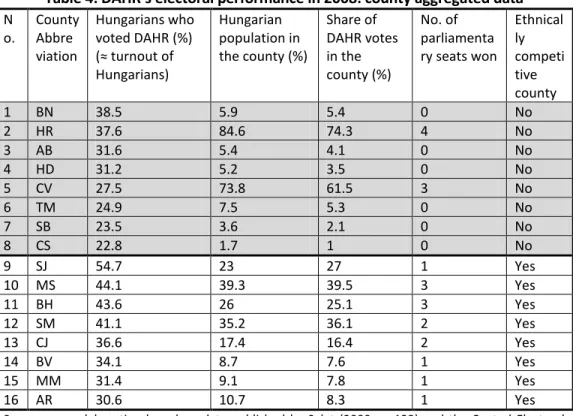
101 counties are the ones in which the Hungarian minority is too small (i.e. has no realistic chance to win even a single seat in the parliament) or too large (above 50% and has all the chances to win almost all the seats in that county). In the absence of more valid data aggregated at county level, in Table 4, I use the share of Hu garia s ho oted for DáH‘ i ea h ou tr as a pro for the Hu garia s turnout in that county. I base this assumption on two facts, already mentioned in the previous sections of this paper: a. the Hungarians who voted in the 2008 parliamentary elections, actually voted in an overwhelming proportion for the DáH‘ s a didates; . the number of non-Hungarians who voted for DAHR is insignificant.
Ta le : DAHR’s ele toral perfor a e i 8: ou ty aggregated data N o. County Abbre viation Hungarians who voted DAHR (%)
≈ tur out of
Hungarians)
Hungarian population in the county (%)
Share of DAHR votes in the county (%) No. of parliamenta ry seats won
Ethnical ly competi tive county
1 BN 38.5 5.9 5.4 0 No
2 HR 37.6 84.6 74.3 4 No
3 AB 31.6 5.4 4.1 0 No
4 HD 31.2 5.2 3.5 0 No
5 CV 27.5 73.8 61.5 3 No
6 TM 24.9 7.5 5.3 0 No
7 SB 23.5 3.6 2.1 0 No
8 CS 22.8 1.7 1 0 No
9 SJ 54.7 23 27 1 Yes
10 MS 44.1 39.3 39.5 3 Yes
11 BH 43.6 26 25.1 3 Yes
12 SM 41.1 35.2 36.1 2 Yes
13 CJ 36.6 17.4 16.4 2 Yes
14 BV 34.1 8.7 7.6 1 Yes
15 MM 31.4 9.1 7.8 1 Yes
16 AR 30.6 10.7 8.3 1 Yes
Source: own elaboration based on data published by Salat (2009, p. 123) and the Central Electoral Office (www.becparlamentare2008.ro). Note: An ethnically competitive county is one in which the Hungarian minority is large enough to win at least one parliamentary seat and the Hungarians represe t less tha % of the ou t s populatio .
102
noncompetitive counties tends to be lower than the proportion of Hungarian population in those counties, compared with ethnically competitive counties. Moreover, in three ethnically competitive counties (SJ, MS, SM) actually DAHR a aged to slightl o er-represe t the Hu garia i orit y having a greater share of votes, than the actual proportion of Hungarians in the total population of those counties. This might suggest that, in these counties, DAHR succeeded to mobilize Hungarians better to turn out and vote, than did the other competing parties with their supporters.
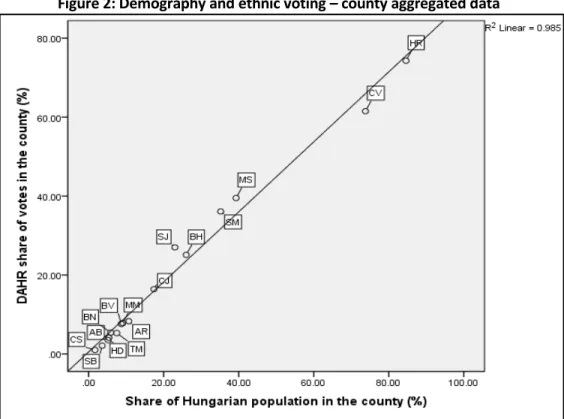
Besides the differences between ethnically competitive and non-competitive counties, in general, there is a very high association between the proportion of Hungarian population and the share of votes DAHR obtained in each country (see Figure 2). These findings confirm the fact that demography (or head-counting) is of special interest for ethnic parties (Salat, 2009) since their electoral success is a straightforward reflection of ethnic demography (Horowitz, 1985, apud. Alonso, 2008, p. 83).
Figure 2: Demography and ethnic voting – county aggregated data
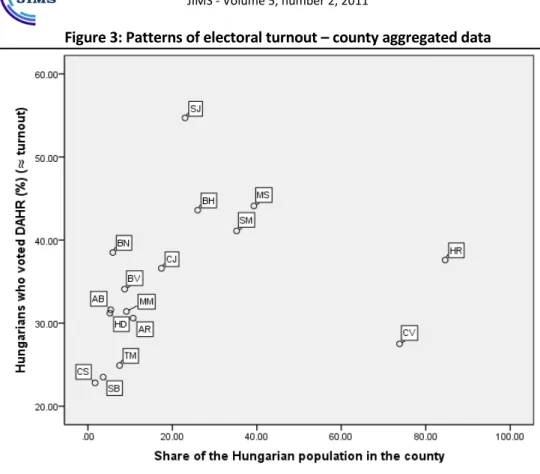
103 While the DAHR share of votes in a specific country almost linearly increases with the proportion of Hungarians living in that county, the relationship between the share of Hungarians in a county and the turnout of Hungarians in that county reveals a more complex pattern (see Figure 3). The relationship depicted in Figure 3 resembles more to a curvilinear pattern re ersed U i hi h the tur out of Hu garia s i reases to a ertai poi t after which decreases. More specifically, turnout tends to be lower in ethnically non-competitive counties, namely those with a low proportion of Hungarians and those in which Hungarians represent the majority of population (i.e. Harghita and Covasna).
On the other hand, turnout tends to be higher in ethnically competitive ou ties here Hu garia s proportio ra ges so e here et ee % a d 40% of the total population of the county. There is almost a 10 -percentage points difference between the turnout of Hungarians residing in ethnically competitive and ethnically non-competitive counties. As such, the median turnout of Hungarians in ethnically competitive counties is 38.85% while the median turnout of Hungarians in ethnically non-competitive counties is of only 29.35%. Hence, turnout of Hungarians is significantly higher in ethnically competitive counties, compared to ethnically non-competitive counties (Mann-Whitney U = 11, z = -2,205, p=0.028, N=16).
104
Figure 3: Patterns of electoral turnout – county aggregated data
Source: own elaboration based on data presented in Table 4
105 the cost of mobilizing their voters, compared to 2004. Or, put differently, the efficiency of resources used for electoral mobilization by the DAHR simply has doubled itself from 2004 to 2008. Not surprisingly, therefore the counties dominated numerically by Hungarians, namely Harghita and Covasna, are leading in a ranking of the counties with the strongest decrease in turnout rates from 1992 to 2008 (Alexandru, et al., 2009): in Covasna electoral participation decreased with over 52 percentage points, and in Harghita turnout was lower with 48 percentage points in 2008, compared to 1992. On average, turnout in Romania declined by 37 percentage points, over the same period.
The significant differences between counties in terms of electoral turnout of DáH‘ s partisa s, suggests that the ost plausible explanation for the higher rate of absenteeism of Hungarians from voting is the strategic (de)mobilization thesis. According to this thesis, there was a higher electoral mobilization of Hungarians in areas were the elections were ethnically competitive and where more votes really mattered for increasing the number of seats won by DAHR. On the other hand, in ethnically non- o petiti e distri ts DáH‘ s leaders k e that they have no real chance to will even a single parliamentary seat, or on the contrary, in the areas where Hungarians represent the absolute majority DAHR leaders knew that they can easily win most (if not all) the parliamentary seats.
Conclusions
The analysis of the 2008 parliamentary elections in Romania revealed not only a lower propensity of Hungarians to vote in general, but also, a lower turnout of DáH‘ s partisa s o pared ith the supporters of other ajor politi al parties i ‘o a ia. Ho e er, DáH‘ supporters a se teeis i the ele tio s, higher than the national average, should not be interpreted primarily as a decrease in DáH‘ s ele toral adhere e i areas i ha ited ostl Hu garia s, ut rather as a rational decision for a more efficient distribution of resources used for the strategic mobilization of the Hungarian electorate in uninominal districts where DAHR knew it will win the election anyway, even in the context of a modest electoral participation of its supporters.
106
dissatisfaction of voters with DAHR and its leaders. The paper showed that the relatively high abstention from vote of Hungarians is mainly a consequence of strategic de(mobilization) as a rational cost/benefit strategy adopted both by DáH‘ s leaders a d partisa s. I this paper I dis er ed differe t o ilizatio strategies in various countries depending on the perceived stakes of the electoral process. On the one hand, one can notice high electoral mobilization in ethnically o petiti e ou ties here e er ote ou ts for i i g ore seats. I these ou ties there as a i porta t stake for DáH‘ s leaders a d partisa s i getti g out the ote . O the other ha d, there as a lo ele toral o ilizatio i ethnically non-competitive counties, here DáH‘ s a didates had o realisti chance of winning even a single parliamentary seat or, on the contrary, had all the chances to win most of the seats. In these counties, there was no pragmatic reason to pay the cost of electoral mobilization.
References
Aguilar, Paloma, & Sanchez-Cuenca, Ignacio. (2008). Performance or Representation? The Determinants of Voting in Complex Political Contexts. In Jose Maria Maravall & Ignacio Sanchez-Cuenca (Eds.), Controlling Governments: Voters, Institutions, and Accountability (pp. 105-130). Cambridge: Cambridge University Press.
ále a dru, Violeta, Moraru, ádria , & Er uş, Loreda a. . De li ul parti ipării la ot î ‘o ia. Bu ureşti: I stitutul pe tru Politi i Pu li e IPP .
Alonso, Sonia. (2008). Enduring Ethnicity: The Political Survival of Incumbent Ethnic Parties in Western Democracies. In Jose Maria Maravall & Ignacio Sanchez-Cuenca (Eds.), Controlling
Governments: Voters, Institutions, and Accountability (pp. 82-104). Cambridge: Cambridge University Press.
Bernhagen, Patrick, & Marsh, Michael. (2007). Voting and Protesting: Explaining Citizen Participation in Old and New European Democracies. Democratization, 14(1), 44-72.
Bodocan, Voicu. (2001). Et ie, o fesiu e și o porta e t ele toral î Tra silva ia. Cluj-Napoca: Presa
U i ersitară Clujea ă.
Brubaker, Rogers. (2004). Ethnicity without Groups. Cambridge, MA: Harvard University Press. Chandra, Kanchan. (2004). Why Ethnic Parties Succed. Cambridge: Cambridge Univeristy Press.
Co şa, Mir ea. . Cultură, parti ipare şi opţiu i politi e. I Du itru “a du oord , Mir ea Co şa, Cos i a ‘ughi iş, ále a dru Toth, Măli a Voicu & Bogdan Voicu (Eds.), Viaţa So ială î
Ro â ia Ur a ă (pp. 137- . Iaşi: Poliro .
ESS (2008). European Social Survey Round 4 Data (www.europeansocialsurvey.org): Norwegian Social Science Data Services, Norway – Data Archive and distributor of ESS data, accessed on 15.02.2011.
107
Hasmath, Reza. (2011). The Complexities of Ethnic Diversity. In Reza Hasmath (Ed.), Managing Ethnic Diversity: Meanings and Practices from an International Perspective (pp. 1-10). Surrey: Ashgate.
Horowitz, Donald L. (1985). Ethnic Groups in Conflict. Berkeley: University of California Press.
Ilieș, áLe a dru. . Et ie, o fesiu e și o porta e t ele toral î Crișa a și Mara ureș. Cluj-Napoca: Editura Dacia.
Kiss, Ta s, Bar a, Gergő, & “ól o , )suzsa. . Ti erii aghiari di Tra sil a ia . á hetă so iologi ă despre starea so ială şi aşteptările ti erilor aghiari di Tra sil a ia. Di e siu i
comparative. In Zsuzsa Bokor & István Horváth (Eds.), Working Papers in Romanian Minority Studies (Vol. 12). Cluj-Napoca: Institutul pentru Studierea Pro le elor Mi orităților Națio ale. Norris, Pippa. (2002). Democratic Phoenix: Reinventing Political Activism. Cambridge: Cambridge
University Press.
Pasti, Vladi ir. . Criza politi ii după alegerile di . I Gheorghe Teodores u Ed. , Alegeri 2008: a pa ii, lideri și so daje (Vol. 1, pp. 335- . Iași: Poliro .
Rosenstone, S. J., & Hansen, J. M. (1993). Mobilization, Participation and Democracy in America. New York: Macmillan.
“alat, Le e te. . Perspe ti e ale UDM‘ după alegerile parla e tare di . I Gheorghe
Teodorescu (Ed.), Alegeri : Co ti uitate și s hi are (Vol. 2, pp. 109- . Iași: Poliro .
Șișeștea , Gheorghe. . Et ie, o fesiu e și ăsătorie î ord-vestul Transilvaniei. )alău: Caiete Silvane.
“zékel , Ist Gergő. . The politi al represe tatio of atio al i orities i ‘o a ia. I )suzsa
Bokor & István Horváth (Eds.), Working Papers in Romanian Minority Studies (Vol. 20). Cluj-Napoca: Institutul pentru Studierea Problemelor Minoritatilor Nationale.
Tătar, Marius I. . Parti ipare politi ă și de o rație î Ro â ia după . PhD Thesis, Oradea: Universitatea din Oradea.
Vandermotten, Christian, Lockhart, Pablo Medina, & Freyer-Macola, Danuta. (2003). Geografia
ele torală a Europei e trale și de est. I Jea -Michel De Waele (Ed.), Partide politi e și
de o rație î Europa e trală și de est (pp. 16- . Bu urești: Hu a itas.
Woshinsky, Oliver H. (2008). Explaining Politics: Culture, Institutions and Political Behavior. New York: Routledge.