Fisioter. Mov., Curitiba, v. , n. , p. - , jul./set. Licenciado sob uma Licença Creative Commons
[T]
Description of the Pediasuit Protocol
TM[)]
Descrição do Protocolo PediaSuit
TM[A]
Eduardo Mendonça Scheeren[a], Luis Paulo Gomes Mascarenhas[b], Claudiana Renata Chiarello[c], Ana Cláudia Martins Szczypior Costin[d], Leonardo Oliveira[e], Eduardo Borba Neves[f]
[a] Doutor em Ciências pela Universidade Tecnológica Federal do Paraná UTFPR , docente da Ponti ícia Universidade Católica do Paraná PUCPR , Curitiba, PR - Brasil, e-mail: [email protected]
[b] Doutor em Saúde da Criança e do Adolescente pela Universidade Federal do Paraná UFPR , docente do Centro Universitário Campos Andrade Uniandrade , Curitiba, PR - Brasil, e-mail: [email protected]
[c] Especialista em Fisioterapia Pediátrica pela Faculdade Evangélica do Paraná, docente do Centro Universitário Campos de Andrade Uniandrade , Curitiba, PR - Brasil, e-mail: [email protected]
[d] Especialista em Fisioterapia Pediátrica pela Faculdade Evangélica do Paraná, docente do Centro Universitário Campos de Andrade Uniandrade , Curitiba, PR - Brasil, e-mail: [email protected]
[e] Terapeuta Ocupacional pela Keiser University FL , membro fundador da Clínica Therapies kids, Fort Lauderdale, FL - EUA, e-mail: leo@therapies kids.com
[f] Doutor em Engenharia Biomédica pela Universidade Federal do Rio de Janeiro COPPE/UFRJ , docente do Centro Universitário Campos de Andrade Uniandrade , Curitiba, PR - Brasil, e-mail: [email protected]
[R]
Abstract
Introduction: PediaSuit ProtocolTM is an intensive therapy with a holistic approach to the treatment of indi-viduals with neurological disorders like cerebral palsy CP , developmental delays, traumatic brain injuries, autism and other conditions which affect a child's motor and/or cognitive functions. Objective: The aim of the present work is to describe the PediaSuit ProtocolTM. Methods: The authors team remained two months observing the care provided in a clinic with physical therapists trained by the PediaSuit ProtocolTM team USA . Results: The PediaSuitTM is a therapeutic protocol which uses a suit combined with intensive physical therapy and consists of up to four hours of therapy a day, ive days a week, during three or four weeks. The PediaSuit ProtocolTM is customized to it the needs of each child, with speci ic functional goals, and usually involves an intensive rehabilitation program. )t combines the best elements of various techniques and meth-ods, and has a sound rationale based on exercise physiology. Conclusion: This protocol anticipates results obtained only with long periods of conventional physical therapy.
[P]
474
[B]
Resumo
Introdução: O Protocolo PediaSuitTM é uma terapia intensiva com uma abordagem holística para o tratamento
de indivíduos com distúrbios neurológicos, como paralisia cerebral (PC), atrasos de desenvolvimento, lesões ce-rebrais traumáticas, autismo e outras condições que afetam as funções motoras e/ou cognitivas de uma criança.
Objetivo: O objetivo do presente trabalho foi descrever o Protocolo PediaSuitTM. Métodos: A equipe de autores
permaneceu dois meses observando os cuidados prestados em uma clínica com fisioterapeutas treinados pela equipe PediaSuit ProtocolTM (EUA). Resultados: O PediaSuitTM é um protocolo terapêutico que utiliza um traje
especial combinado com a terapia física intensiva, com duração de até quatro horas por dia, cinco dias por se-mana, durante três ou quatro semanas. O Protocolo PediaSuitTM é personalizado para atender às necessidades
de cada criança, com objetivos específicos, e, geralmente, envolve um programa intensivo de reabilitação. Ele combina os melhores elementos de várias técnicas e métodos e tem bons fundamentos com base na fisiologia do exercício. Conclusão: Esse protocolo antecipa resultados obtidos somente com longos períodos de fisioterapia tradicional.
[K]
Palavras-chave: Protocolo PediasuitTM. Fisioterapia intensiva. Paralisia cerebral.
is re lected in daily functional activities that usually follow or are combined with strengthening exercises. Elimination of pathological re lexes and establish-ing new, accurate, and functional patterns of move-ments is of signi icant importance .
A typical day of a intensive generic program may consists of warming up and deep tissue massage, tone reduction and sensory integration techniques, decreasing pathological movement patterns, increas-ing active proper movement patterns, stretchincreas-ing/ strengthening speci ic muscle groups responsible for functional movement, progressive resistance exer-cise, balance/coordination and endurance training, and transferring of functional activities and gait train-ing , , . The intensive therapy is ideal for those looking to accelerate their progress in developmental and functional skills .
According to Report Executive Committee, Cerebral palsy CP describes a group of permanent disorders of the development of movement and pos-ture, causing activity limitations that are attributed to non-progressive disturbances that occurred in the developing fetal or infant brain. The motor disorders of cerebral palsy are often accompanied by distur-bances of sensation, perception, cognition, commu-nication and behavior; by epilepsy, and by secondary musculoskeletal problems .
There is no standard therapy that works for all pa-tients e.g., CP and they need different kinds of therapy
to overcome their impairments . Treatment for CP
focuses on how to help the child maximize his or her Introduction
PediaSuit ProtocolTM therapy has been proposed
as an alternative to conventional physiotherapy and is based on a suit originally designed by the Russians
Penguin suit , in the late s, to be used by
cos-monauts in space, to minimize the effects and to
main-tain neuromuscular itness of weightlessness - .
Suit therapy, or dynamic proprioceptive correc-tion , has been popularized as a treatment modal-ity in Poland and in the United States, and is focused on improving sensory stimulation and providing patients with the ability to stand and move through suit therapy resistance. This method allows a person to learn movement, standing posture and balance strategies .
PediaSuit ProtocolTM is an intensive therapy with a
holistic approach to the treatment of individuals with neurological disorders like cerebral palsy CP , develop-mental delays, traumatic brain injuries, autism and other conditions which affect a child’s motor and/ or cognitive functions. According to the literature ,
, , the intensive therapy results in a signi icantly improved skills acquisition when compared with conventional amounts of physiotherapy and it can generally accelerate the acquisition of motor abilities in children with CP, for example.
The key element in an intensive therapy is a strengthening and balance program established for the participant based on his/her individual needs,
475
Protocol general considerations
The PediaSuit ProtocolTM therapy method
com-bines the best elements of proven various techniques
, , - and methods - , , and has a sound
rationale based on the exercise physiology. The
docu-mented history of the PediaSuit ProtocolTM supports
its use for individuals with debilitating muscular dis-orders and degenerative muscular complications.
The PediaSuit ProtocolTM therapy is the use of a
suit combined with intensive physical therapy and consists of up to four hours of therapy a day, ive days a week, for three or four weeks. The PediaSuit
ProtocolTM is composed by four steps: warm up and
stretching, suit, monkey cage and spider cage .
Equipments
Suit
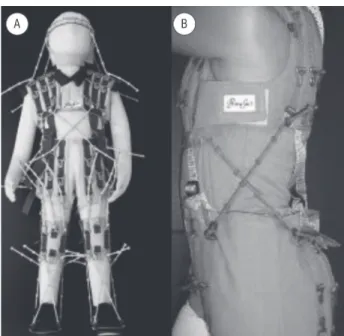
The suit consists of a vest, shorts, knee pads and specially adapted shoes with hooks and elastic cords that help tell the body how it is supposed to move in space Figure . Therapists use the suit to hold the body in proper physical alignment. During specialized exercises, the therapists adjust the elastic connectors that topographically mirror lexor and extensor mus-cles, trunk rotators and the lower limbs. Additional attachments correcting the position of feet, head and other areas of the body have also been designed. The suit serves as a stability vest that produces a vertically directed load of approximately to kg.
Ability Exercise Unit
Not only is the ability exercise unit Figure the most effective device for improving muscle strength, it also allows isolation of the desired muscle group. What this means is that whenever a person with a neurological disorder is asked to perform a certain movement, due to muscle tone and lack of coordina-tion, strength and balance, he/she will try to per-form that movement with both extremities upper and lower at the same time. The ability exercise unit, along with speci ic exercises performed in it, allows one to re-educate the patient’s nervous system to isolate one extremity from the other and move it independently.
potential . The treatment plan may include physical therapy, which helps to develop the strength of muscles, as well as, improve or develop skills to enhance their independence in motor skills such as walking, sitting,
self-care, play and maintaining balance , , , .
The intervention plan may also include occupa-tional therapy, which helps to develop ine motor skills such as dressing, feeding, writing, and other daily living tasks. These therapies are focused on decreasing the degree of impairment e.g., muscle spasticity and increasing participation in activities of daily living . Speech therapy may help patients to develop communication skills focusing in par-ticular on speaking, which may be dif icult due to problems with muscle tone of the tongue and throat
, . Still others may need surgery, drug therapy
e.g., to control seizures and muscle spasms and/or mechanical aids that are tailored to the unique needs
and impairments of each patient . Considering
we are presenting a new intensive therapy treat-ment, the aim of this present work was to describe
the PediaSuit ProtocolTM.
Methods
One of the authors of this study was part of the
PediaSuit ProtocolTM therapy developer team. )n this
sense, the description shown may be understood as a normative document for the standardization of the protocol. Other authors contributed in the detailed organization and systematization description of the protocol. To this end, the authors team remained from
st September to th October, observing the care
provided in a clinic with physical therapists trained
by PediaSuit ProtocolTM team USA . )n addition, print
and online materials provided by the clinic that
devel-oped the PediaSuit ProtocolTM were used and a search
was conducted by the descriptor Pediasuit , in March
, in Scopus, )S) Web of KnowledgeSM, Pubmed,
Medline, SciELO and Google scholar databases. )n the search performed no paper was found, except one case
study involving the Pediasuit ProtocolTM developed by
researchers from Curitiba, Paraná - Brazil , where
the authors described only the neuromotor changes over days of treatment.
476
Figure 1 - Suit with its parts: shorts, knee pads and spe-cially adapted shoes with hooks and elastic cords – Coronal plane (A); Sagittal plane (B) Source: Research data.
Phase 1 – warm up and stretching (45 min)
The patient is positioned on a table where the skin brushing protocol upper and lower limb and trunk is done during approximately minutes. The warm up activities consist in active and passive stretching at main joints wrist, elbow, shoulder, ankle, knee and hip, joint compression . This procedure takes about minutes.
Krueger et al. claim that physical stimulus
can trigger action potentials at the neuronal level, in
this sense, Wood et al. studied the effects of the
brushing on the excitability of the triceps surae moto-neurone pool, using the (offmann re lex ( re lex as a measure of this excitability. The experiment was performed with neurologically normal subjects on a total of twenty-two ive males, seventeen females . The cutaneous stimulation was produced by light brushing of the skin overlying triceps surae muscles, using a standard cm diameter soft paintbrush. The area of skin stimulated was cm x cm, running along the length of the muscle, and brushing was per-formed in a distal to proximal direction.
Pronation/Supination Stretch
While the child is lying on his back, place his arm slightly away from his body. Use one hand to stabilize just above the elbow. Then apply a gentle downward pressure turning the palm of the hand down towards the loor. (old this for seconds before slowly turn-ing the palm up towards the ceilturn-ing. Again apply a gentle over pressure and hold for seconds. This is one stretch; repeat three to ive times on each arm. This can be done three to ive times a week.
Trunk Rotation Stretch (single leg stretch or with both legs together)
Place child laid on his back, bend one leg up with hand on knee, and rotate it towards the opposite side stretching the obliques. Place your other hand on chest or shoulder to stabilize trunk. Do not allow the upper body to come off of the loor. (old this for a count of seconds, and then repeat three to ive times to both sides. This can be done ive times a week.
Figure 2 - Ability exercise unit (spider and monkey cage) Source: Research data.
477
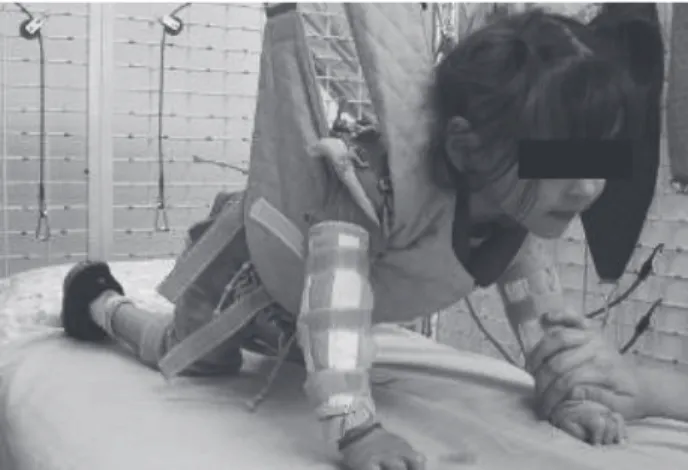
using bungee cords Figure .The bungee cords
ad-justment is just enough to allow the child the secu-rity and balance needed to practice activities on their own. The cage also allows the child and therapist to work on activities that would normally take two or three therapists to work on, by acting as extra hands.
Children are able to accomplish activities in the spider cage that they are not able to do without the assistance of the bungee cords. Depending on the way the bungee cords are placed, one can practice sitting, kneeling, quadruped, standing, strengthening exer-cises, jumping Figure and many other activities. This way, the four phases of the PediaSuit
ProtocolTM bring a wide incentive promotion which
is directly related to each child needs. The advantage of the protocol is that it allows applying holistic and speci ic stimulus to patients, progressively, and it can be modi ied each time the therapists realize that such modi ication provides bene its to the patient.
Phase 2 – Suit
)t is donned on the patient a soft dynamic
proprio-ceptive orthosis called the suit and attached the elastic
cords in the speci ic suit places in order to correct pos-tural deviations. The suit aligns the body as close to normal as possible. Reestablishing the correct postural alignment plays a crucial role in normalizing muscle tone, sensory and vestibular function. Following don-ning of the suit, activities as weight bearing, mobility, agility, coordination, weight shifting, balance, transi-tioning, motor planning and strengthening are done. The suit is used to train a child to gain the ability to isolate the desired movements and strengthen the muscle groups responsible for that movement. The suit allows one to gain range of motion, muscle and joint lexibility, as well as functional skills.
A patient, while wearing the suit goes through various exercises including how to walk . The suit works as an elastic frame surrounding the body and does not limit the amplitude of movement but adds an additional weight load on it within designed limits. The suit serves as an external skeletal support for patients with neuromuscular disorders including Cerebral Palsy . The suit facilitates independence in the development of new gross and ine motor skills like sitting, standing, and walking. When worn during and in conjunction with physical therapy, the suit can accelerate a child’s progress due to the
propriocep-tive stimulation increase , .
Phase 3 – “Monkey cage”
The ability exercise unit is also extremely help-ful while working on specific goals like endurance for a certain skill. With the use of the tracking rail Figure , the patient and the therapist work on the proper coordination of the movement for example: reciprocation , the quality of the movement and en-durance. )t is very helpful and often used in the center of the study as a dynamic stander. Patients learn the concept of weight shifting and weight bearing along with the consequences of its lack in a safe way.
Phase 4 – “Spider cage”
)n the spider cage, the children are hooked up a belt around their waist that is attached to the cage
Figure 3 - Patient using the tracking rail in the monkey cage Source: Research data.
478
Other considerations
PediaSuit ProtocolTM therapy increases deep
pro-prioceptive awareness and positions the child in a more ideal alignment during various activities. Re-establishing the correct postural alignment plays a crucial role in normalizing muscle tone, sensory and
vestibular function - .
The suit aligns the body as close as possible to normal and the idea is to move body parts against
re-sistance, thus improving muscle strength . An
at-tached series of elastic cords provides compression to the body’s joints tactile stimulation and resistance to muscles when movement occurs. Through placement of the elastic cords, selected muscle groups can be ex-ercised as the patient moves limbs, thus, suit therapy is a form of controlled exercise against resistance.
Neves et al. found out in a case study of the
PediaSuit™ rehabilitation with a spastic diplegia patient that there was improvement in motor func-tion, body composition and ankle range of motion in response to the protocol applied. These inds cor-roborate what we have observed in the PediaSuit
ProtocolTM clinics.
)ntensive integrated physical therapy programs are customized to it the needs of each child, with speci ic functional goals and usually involve a
rehabilitation program that includes about
min-utes of exercise per day for days a week, including
to minutes of the suit application.
PediaSuitTM therapy is often used as part of a
com-prehensive program of intensive physiotherapy that consists in ive to seven hours a day for four weeks . )t combines the best elements of various tech-niques and methods, and has a sound rationale based on exercise physiology. )t is important to note that use of the suit is only one component of an overall approach. Parental involvement is highly encouraged and parents are often part of the treatment program. )t needs to be mentioned, however, that a true inten-sive therapy program is not merely doing the same ex-ercise over and over again, but rather is a structured approach to physical activity with consideration to the person’s individual cycles of progressive overload
, , fatigue and recovery - .
)ntensive pediatric therapy is usually an hours program over four weeks. With traditional therapy, hours would normally be delivered over weeks avg. two hours per week or seven and a half months. Children require repetition to learn new tasks and they need, at least, weeks intervention period so that differences in physical activity can be quanti ied . Children with disabilities require many more repetitions to learn the same task, often thousands
compared to hundreds of repetitions , and the
intensive therapy helps to accomplish this goal. While strengthening muscles and improving func-tion, the system of exercises performed in the ability exercise unit contributes to gains in range of motion, both active and passive, and improved muscle
lex-ibility and tone, promoting good bene its , for
the cerebral palsy population . According to Wu
et al. , passive stretching combined with engaging
in active movement training with CP children demon-strated improvements in joint biomechanical prop-erties, motor control performance, and functional capability in balance and mobility.
Children’s physical development and movement is linked closely to other aspects of their daily learn-ing. )t is in luenced by their growing con idence and enjoyment of physical play, by their increasing ability to control their own bodies through movement and
by their physical well-being and strength .
As children develop physically, they become faster, stronger, more mobile and more secure by their bal-ance, and they start to use these skills in a wider range of physical activities and also become more aware of
479 . Tsorlakis N, Evaggelinou C, Grouios G, Tsorbatzoudis
C. Effect of intensive neurodevelopmental treatment in gross motor function of children with cerebral palsy. Dev Med Child Neurol. ; : - .
doi: . /j. - . .tb .x.
. Bottos M, Feliciangeli A, Sciuto L, Gericke C, Vianello A. Functional status of adults with cerebral palsy and impli-cations for treatment of children. Dev Med Child Neurol.
; : - . doi: . /S .
. Damiano DL. Activity, activity, activity: rethinking our physical therapy approach to cerebral palsy. Phys Ther.
; : - . doi: . /ptj. .
. Arpino C, Vescio MF, de Luca A, Curatolo P. Ef icacy of intensive versus nonintensive physiotherapy in children with cerebral palsy: a meta-analysis. )nt J Rehabil Res. ; : - . doi: . /
MRR. b e f .
. Rosenbaum P, Paneth N, Leviton A, Goldstein M, Bax M, Damiano D, et al. A report: the de inition and classi ica-tion of cerebral palsy April . Dev Med Child Neurol Suppl. ; : - . PMid: .
. Stark C, Nikopoulou-Smyrni P, Stabrey A, Semler O, Schoe-nau E. Effect of a new physiotherapy concept on bone mineral density, muscle force and gross motor function in children with bilateral cerebral palsy. J Musculoskelet Neuronal )nteract. ; : - . PMid: . . Engelen V, Ketelaar M, Gorter JW. Selecting the appro-priate outcome in paediatric physical therapy: how individual treatment goals for children with cerebral palsy are re lected in GMFM- and PED). J Rehabil Med.
; : - . doi: . / - .
. Ketelaar M, Vermeer A, (art (, Van Petegem-van Beek E, (elders PJ. Effects of a functional therapy program on motor abilities of children with cerebral palsy. Phys Ther.
; : - . PMid: .
. Desloovere K, De Cat J, Molenaers G, Franki ), (im-pens E, Van Waelvelde (, et al. The effect of different physiotherapy interventions in post-BTX-A treatment of children with cerebral palsy. Eur J Paediatr Neurol.
; : - . doi: . /j.ejpn. . . . . Neves EB, Scheeren EM, Chiarello CR, Costin ACMS,
Mas-carenhas LPG. O PediaSuit™ na reabilitação da diplegia espástica: um estudo de caso. EFDeportes.com Revista digital. ; ; [cited Apr. ]. Available from: http://www.efdeportes.com/efd /o-pediasuit-na-reabilitacao-da-diplegia-espastica.htm.
. Wood L, Nicol DJ, Thulin C. The effects of skin brushing on ( re lex amplitude in normal human subjects. Exp
Physiol. ; : - . PMid: .
themselves as individuals. This developing sense of iden-tity is linked closely to their own self image, self-esteem and con idence. All the bene its highlighted above come
throw the thought of Palisano et al. , who call the
attention to the importance of programs that emphasize lifelong itness, weight control, and conditioning.
Conclusion
The PediaSuit ProtocolTM is customized to it the
needs of each child, with speci ic functional goals and usually involves an intensive rehabilitation program. )t combines the best elements of various techniques and methods, and has a sound rationale based on ex-ercise physiology. )t is important to note that the use of the suit is only one component of an overall approach. This protocol anticipates results obtained only with long periods of conventional physical therapy i.e. half to one hour per day, one to three days per week .
Parental involvement is highly encouraged and parents are often part of the treatment program. )t needs to be mentioned, however, that a true intensive therapy program is not merely doing the same exer-cise over and over again, but rather is a structured approach to physical activity with consideration to the person’s individual cycles of progressive overload, fatigue and recovery.
References
. Semenova K. Basis for a method of dynamic proprio-ceptive correction in the restorative treatment of pa-tients with residual-stage infantile cerebral palsy. Neu-rosci Behav Physiol. ; : - . doi: . /
BF .
. Bar (aim S, (arries N, Belokopytov M, Frank A, Copelio-vitch L, Kaplanski J, et al. Comparison of ef icacy of Adeli suit and neurodevelopmental treatments in children with cerebral palsy. Dev Med Child Neurol. ; :
-. doi: -. /S .
. Alagesan J, Shetty A. Effect of modi ied suit therapy in spastic diplegic cerebral palsy-a single blinded ran-domized controlled trial. Online J (ealth Allied Scs.
; : .
. Bower E, McLellan DL, Arney J, Campbell MJ. A randomised controlled: trial of different intensities of physiotherapy and different goal setting procedures in children with cerebral palsy. Dev Med Child Neurol. ; : - .
480
. Ebersole KT, Malek DM. Fatigue and the electrome-chanical ef iciency of the vastus medialis and vas-tus lateralis muscles. J Athl Train. ; : - .
doi: . / - - . . .
. Blangsted A, Sjøgaard G, Madeleine P, Olsen (B, Søgaard K. Voluntary force contraction elicits prolonged low-frequency fatigue and changes in surface electromyog-raphy and mechanomyogelectromyog-raphy. J Electromyogr Kinesiol.
; : - . doi: . /j.jelekin. . . . . Fowler EG, Knutson LM, DeMuth SK, Siebert KL, Simms VD, Sugi M(, et al. Pediatric endurance and limb strength-ening PEDALS for children with cerebral palsy using stationary cycling: a randomized controlled trial. Phys
Ther. ; : - . doi: . /ptj. .
. LeMura LM, Von Duvillard SP. Clinical exercise physiol-ogy: application and physiological principles. Philadel-phia: Lippincott Williams & Wilkins; .
. Cramer JT, (oush TJ, Weir JP, Johnson GO, Coburn JW, Beck TW. The acute effects of static stretching on peak torque, mean power output, electromyography, and mechanomyography. Eur J Appl Physiol. ;
-: - . doi: . /s - - -x.
. Wu YN, (wang M, Ren Y, Gaebler-Spira D, Zhang LQ. Combined passive stretching and active movement rehabilitation of lower-limb impairments in chil-dren with cerebral palsy using a portable robot. Neurorehabil Neural Repair. ; : - .
doi: . / .
. Scholtes V, Dallmeijer A, Rameckers E, Verschuren O, Tempelaars E, (ensen M, et al. Lower limb strength training in children with cerebral palsy–a randomized controlled trial protocol for functional strength training based on progressive resistance exercise principles. BMC Pediatr. ; - . PMid: .
. Palisano RJ, Snider LM, Orlin MN. Recent advances in physical and occupational therapy for children with ce-rebral palsy. Semin Pediatr Neurol. ; : - . doi: . /j.spen. . . .
Received: / /
Recebido: / /
Approved: / /
Aprovado: / /
. Palisano RJ, Copeland WP, Galuppi BE. Performance of physical activities by adolescents with cerebral palsy. Phys Ther. ; : . doi: . /ptj. . . Brehm MA, (arlaar J, Schwartz M. Effect of ankle-foot
orthoses on walking ef iciency and gait in children with cerebral palsy. J Rehabil Med. ; : - .
doi: . / - .
. Deutsch JE, Borbely M, Filler J, (uhn K, Guarrera-Bowl-by P. Use of a low-cost, commercially available gaming console Wii for rehabilitation of an adolescent with cerebral palsy. Phys Ther. ; : - .
doi: . /ptj. .
. Krueger E, Scheeren EM, Nogueira-Neto GN, Button VLSN, Neves EB, Nohama P. Potencial de ação: do es-tímulo à adaptação neural. Fisioter Mov. ; :
-. doi: -. /S - .
. Marek SM, Cramer JT, Fincher AL, Massey LL, Dangel-maier SM, Purkayastha S, et al. Acute effects of static and proprioceptive neuromuscular facilitation stretch-ing on muscle strength and power output. J Athl Train.
; : - . PMid: .
. Liang L-Y, Chen J-JJ, Wang Y-L, Jakubiec M, Mierzejewska J, Piotrkiewicz M. Changes in spinal motoneuron fast-ness in post-stroke spastic patients. J Med Biol Eng.
; : - .
. McKay WP, Chilibeck PD, Daku BL, Lett B. Quantifying the mechanical work of resting quadriceps muscle tone. Eur J Appl Physiol. ; : - . doi: . /
s - - - .
. Ward AB. Assessment of muscle tone. Age Ageing. ; : - . doi: . /ageing/ . . . . Kids T. Therapies kids. ; [cited Sept. ].
Available from: http://www.therapies kids.com/. . Duchateau J, Semmler JG, Enoka RM.
Train-ing adaptations in the behavior of human motor units. J Appl Physiol. ; : - . doi: . / japplphysiol. . .
. Ryan AS, )vey FM, Prior S, Li G, (afer-Macko C. Skel-etal muscle hypertrophy and muscle myostatin reduction after resistive training in stroke survi-vors. Stroke. ; : - . doi: . /
STROKEA(A. . .
. Baptista RR, Scheeren EM, Macintosh BR, Vaz MA. Low-frequency fatigue at maximal and submaximal muscle contractions. Braz J Med Biol Res. ; : - .