215
NORTH ATLANTIC OSCILLATION (NAO) AND INSECT DAMAGE IN SERBIAN FORESTS
V. DUCIĆ1, JELENA LUKOVIĆ1, M. MILENKOVIĆ2, and NINA ĆURČIĆ3
1 Faculty of Geography, University of Belgrade, 11000 Belgrade, Serbia 2 Faculty of Forestry, University of Belgrade, 11000 Belgrade, Serbia 3 Institute of Geography “Jovan Cvijić”, SANU, 11000 Belgrade, Serbia
Abstract - his paper examines the relationship between North Atlantic Oscillation (NAO) and damage made by insects in Serbian forests. he damage has been separated into three groups: bark beetles, gypsy moth and damage made by other insects. For North Atlantic Oscillation the NAO index is used. he period of investigation was 1969-2001. Data were stud-ied on an annual scale as well as with ive-year moving averages. Analysis showed a statistically signiicant correlation for NAO index and gypsy moth.
Key words:NAO, gypsy moth, forests, Serbia
INTRODUCTION
North Atlantic Oscillation (NAO) is one of the dominant modes of global climate. he term itself was introduced by Walker (1924). It is deined as the sea-level pressure diference between the sub-tropical anticyclone over the Azores and the subpo-lar depression over Iceland. It has signiicant inlu-ence on winter weather conditions in Europe and parts of the North America. his is considered as the normal condition, which becomes more inten-sive during winter. here are positive and negative phases of NAO. During the positive phase, winters in North Europe are warmer and wetter with less rainfall than usually. A negative phase is followed by colder winters in North Europe and higher pre-cipitation in the southern parts of Europe (Hurell and Van Loon, 1997).
he relationship between the population dynam-ics of living organisms and indicators of atmospheric circulation has been the subject of many papers, with regard to North Atlantic Oscillation.
vari-ables. Data on insects are usually less predictable than those on birds or mammals.
NAO impact is found in marine organisms. Piontkovski et al. (2006) have found a positive corre-lation between copepod abundance in the northern Adriatic Sea and the NAO, with a 0- to 1-year time lag.
he NAO index and ENSO (El Nino Southern Oscillation) have been studied in terms of their re-lationship with precipitation in Serbia (Ducic et al., 2006) in the period 1951-2000. Precipitation data from 20 meteorological stations were analyzed. A statistically signiicant decadal trend has been cal-culated for two stations. Using cluster analysis, all the stations are grouped into three categories. Cor-relation analysis was performed for each cluster with ENSO and NAO indices. he statistically signiicant results could be possibly explained by an indirect mechanism of ENSO impact on the NAO index (Harrison and Larkin, 1998).
he main hypothesis in this paper is the existence of a relationship between the NAO as an indicator of atmospheric circulation and damage from insects in Serbian forestry.
DATA AND METHODOLOGY
Data on damage in forests caused by insects were taken from the series of Bulletins “Forestry in the Republic of Serbia”, published by the Republic Statis-tical Oice. hese damages are separated into three groups: bark beetles, gypsy moth and other insects.
Bark beetles are of greater signiicance to conif-erous forests than to deciduous forests. In Serbia, the bark beetles of pine, spruce and ir are of particular importance.
Gypsy moth (Lymantria dispar L.) (Lepidoptera: Lymantriidae) has a tendency to over-reproduce, re-sulting in the caterpillars of this species causing de-foliation over large areas of forest, crops and urban greenery.
Other insects present a particular group which consists primarily of Coleoptera and Lepidoptera species.
Data on total damages are available for the pe-riod 1969-2001, and include damage structure. Data on structure since 2002 are missing, so the period 1969-2001 has been used for analysis.
Annual losses in wood mass expressed in m3 were used as an indicator of the damage caused by insects in the forests of Serbia. hese data are considered to be a more accurate indicator than those concerning the area of damage, because the area of damage does not include the quantity of biomass, which describes the intensity of degradation.
Data on air temperature, rainfall amount and cloud cover were taken from the Hydrometeorologi-cal Service of Serbia.
Data for the NAO index were obtained from the internet site (www.cru.uea.ac.uk/tpdata/nao.dat).
As regards the methodology of the investigation, statistical tools such as coeicient of contingency and correlation coeicient were used. Data series were tested to determine distribution. As some series did not show normal distribution (Gaussian), Spear-man’s test of correlation coeicient was applied. In order to clearly isolate possible NAO signals on the damage caused by insects in Serbian forests, the pe-riod of ive-year moving averages was used.
RESULTS AND DISCUSSION
During the investigated period (1969-2001), 82% of the damage was made by bark beetles, 6.1% by gypsy moth, and the remaining 11.9% by other insects. Bark beetles in 10 out of the 33 years participated 100%. Other insects were the absolute majority in 3 years and the gypsy moth in 1 year (1997 with 66.8%).
r = 0.05, only for the gypsy moth (R = -0.49). here-fore, further analysis included damage done by gyp-sy moth alone (Table 1)
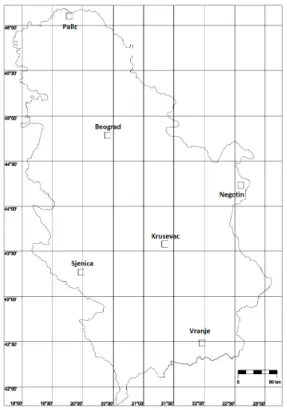
Correlations were calculated between the dam-age done by gypsy moths and annual temperature, precipitation and cloud cover variability for six sta-tions located in the north (Palic), southwest (Sjeni-ca), southeast (Vranje), east (Negotin) and two cen-tral positions (Belgrade and Krusevac) (Fig. 1). here were no statistically signiicant correlations calculat-ed at any of meteorological stations. his may con-tribute to the primary hypothesis about NAO impact on gypsy moth population dynamics. Atmospheric circulation (NAO) is a clear indicator of climate phe-nomena in the habitat and therefore the obtained re-lationship was to be expected.
Between the NAO index and the damage caused by gypsy moth using a period of ive-year moving averages, the correlation was R = -0.61 (signiicant at the level of r = 0.05). Fig. 2 clearly shows an opposite relationship. he lowest pentad of the NAO index
Table 1. Annual and ive-year moving averages data series for NAO Index and losses in wood mass (m3) caused by the gypsy moth.
Annual values Five -year moving averages
Years Gypsy
moth NAO Years
Gypsy
moth NAO Pentads
Gypsy
moth NAO Pentads
Gypsy
moth NAO
1969 434 -0.44 1986 0 0.56 1969/1973 110.8 -0.19 1984/1988 27 -0.10
1970 100 0.18 1987 135 -0.51 1970/1974 24 0.02 1985/1989 27 -0.04
1971 0 -0.55 1988 0 -0.32 1971/1975 4 -0.01 1986/1990 27 0.30
1972 20 -0.04 1989 0 0.57 1972/1976 4 0.09 1987/1991 27 0.26
1973 0 -0.09 1990 0 1.23 1973/1977 0 0.06 1988/1992 0 0.58
1974 0 0.59 1991 0 0.34 1974/1978 0 0.11 1989/1993 0 0.67
1975 0 0.05 1992 0 1.11 1975/1979 0 0.03 1990/1994 0 0.66
1976 0 -0.07 1993 0 0.12 1976/1980 0 -0.05 1991/1995 131.2 0.29
1977 0 -0.21 1994 0 0.51 1977/1981 0 -0.06 1992/1996 1102 0.02
1978 0 0.21 1995 656 -0.61 1978/1982 0 0.12 1993/1997 1947.2 -0.23
1979 0 0.19 1996 4854 -1.01 1979/1983 0 0.15 1994/1998 1957.2 -0.21
1980 0 -0.37 1997 4226 -0.18 1980/1984 0 0.16 1995/1999 2058.8 -0.30
1981 0 -0.09 1998 50 0.26 1981/1985 0 0.14 1996/2000 1927.6 -0.17
1982 0 0.67 1999 508 0.05 1982/1986 0 0.27 1997/2001 1395.8 -0.06
1983 0 0.34 2000 0 0.04 1983/1987 27 0.04 - -
-1984 0 0.26 2001 2195 -0.45 - - -
-1985 0 -0.47 - - -
-
(1995-1999) fully coincides with the largest average pentad of gypsy moth damage.
For one outbreak (1995-1999) with most of the damage done by gypsy moths, the contingency co-eicient was (-1), which conirms the opposite rela-tion (Fig. 3). he year with the greatest damage done by gypsy moth (1996 - 4854 m3), corresponds to the lowest values of the NAO index. he least damage was in 1998 (50 m3), when the NAO index had the highest value.
Although results for meteorological elements did not show any statistically signiicant correlations, the relationship between gypsy moth outbreaks and meteorological factors should not be ignored, using other insects as well. his is evident from the results given by Stige et al. (2007), who investigated the re-lationship between the annual abundance of the ori-ental migratory locust Locusta migratoria manilen-sis in China with temperature and precipitation re-constructions for the period 957-1956. he authors found that decadal mean locust abundance was highest during cold and wet periods. hese periods coincide with the above-average frequencies of both loods and droughts in the lower Yangtze River, phe-nomena that are associated with locust outbreaks.
he results determined that the relationship be-tween the NAO and the extent of the damage done by gypsy moths could be explained by the inluence of
solar activity in both investigated elements. Boberg and Lundstedt (2002) have correlated solar wind and the NAO, while the inluence of solar lux at 2.8 GHz on the population dynamics of insects was found by Izmaylov et al. (2005), Kravchenko et al. (2006), Jovanović et al. (2006) and Milenković et al. (2010), where the last authors studied gypsy moth outbreaks in Serbia.
he NAO index, as well as indicators of solar ac-tivity in the future, could be the basis on which to forecast gypsy moth population dynamics. However, research is necessary for more accurate forecasting further.
Acknowledgments: his study was supported by the Serbian Ministry of Education and Science, under Grant III47007.
REFERENCES
Boberg, F. and H. Lundstedt (2002). Solar wind variations related
to luctuations of the North Atlantic Oscillation.
Geophysi-cal Research Letters, 29 (15), 13(1-4).
Briers, R. A., Gee, J. H. R. and R. Geoghegan (2004). Efects of
the North Atlantic Oscillation on growth and phenology of stream insects. Ecography, 27, 811-817.
Ducic V., Milovanovic B. and J. Lukovic (2006). Connection
be-tween ENSO index, NAO index and decadal scale vari-ability of precipitation in Serbia. Fourth International Conference- Global changes and regional challenges, Soia University “St. Kliment Ohridski”, Faculty of Geology and Geography, 28-29 April 2006, Soia, Bulgaria, Proceed-ings.
Fig. 2. Five-year moving averages of NAO Index and Gypsy moth (1969/1973-1997/2001)
Harrison D. E., and N. K. Larkin (1998). El Nino-Southern Oscil-lation sea surface temperature and wind anomalies. Rev.
Geophys., 36, 353-399.
Hurrell, J. W. and H. Van Loon (1997). Decadal Variations in
cli-mate associated with the North Atlantic oscillation,
Cli-matic Change 36, 301–326.
Izmaylov, D. M., Obukhova, L. K. and A. A. Konradov (2005).
Correlations of life-span variation parameters in 128 successive generations of Drosophila melanogaster with changes in atmospheric pressure and geomagnetic activ-ity. International Journal of Biometeorology, 49, 337-344.
Jonas, J. L. and A. Joern (2007). Grasshopper (Orthoptera:
Acrididae) communities respond to ire, bison grazing and weather in North American tallgrass prairie: a long-term study. Oecologia, 153, 699-711.
Jovanović, B. D., Čamprag, D. S., Sekulić, R. R. and T. B. Kereši
(2006): Solar Activity Inluence to the Numerousness Dy-namics of Bothynoderes punctiventris Germ. in Vojvodina.
Proc. Nat. Sci. Matica Srpska Novi Sad, 110, 239-248.
Knape, J. and P. de Valpine (2011). Efects of weather and climate
on the dynamics of animal population time series. Proc. R.
Soc. B, 278, 985-992.
Kravchenko, K. L., Grechany, G. V. and G. D. Gadjiev (2006):
Cor-relation between Drosophila population sizes and solar ac-tivity parameters. Biophysics, 51, 466-470.
Lima, M., Harrington, R., Saldaña, S. and S. Estay (2008).
Non-linear feedback processes and a latitudinal gradient in the climatic efects determine green spruce aphid outbreaks in the UK. Oikos117 (6), 951-959.
Milenković, M., Ducić, V. and B. Milovanović (2010). he
inlu-ence of the solar lux at 2.8 GHz on outbreaks of the gypsy moth (Lymantria disparL.) (Lepidoptera: Lymantriidae) in Serbia. Arch. Biol. Sci., Belgrade, 62 (4), 1021-1025.
Piontkovski, S. A., O’Brien, T. D., Umani, S. F., Krupa, E. G., Stuge,
T. S., Balymbetov, K. S., Grishaeva, O. V. and A. G. Kasymov
(2006). Zooplankton and the North Atlantic Oscillation: a basin-scale analysis. J. Plankton Res. 28 (11), 1039-1046.
Schmidt, N. M., Asferg, T. and M. C. Forchhammer (2004).
Long-term patterns in European brown hare population dynam-ics in Denmark: Efects of agriculture, predation and cli-mate. BMC Ecology, 4:15.
Stige, L. C., Chan, K.-S., Zhang, Z., Frank, D. and N. C. Stenseth
(2007). housand-year-long Chinese time series reveals climatic forcing of decadal locust dynamics. Proceedings of the National Academy of Sciences of the United States of
America104 (41), 16188-16193.
Walker, G.T. (1924). Correlation in seasonal variation of weather,