833
https://doi.org/10.1590/0004-282X20170142
IMAGES IN NEUROLOGY
Pontine calcification in late stage cerebellar
multiple system atrophy: a marker of
synucleinopathy neurodegeneration?
Calcificação da ponte na atrofia de múltiplos sistemas forma cerebelar avançada: um
marcador de neurodegeneração para as sinucleinopatias?
José Luiz Pedroso
1,2, Orlando G. Barsottini
1,2, Marcos Knobel
2, Benjamin Wolf Handfas
2, Antonio J. Rocha
3,
Elias Knobel
2A 78-year-old woman presented with progressive
ataxia, dysautonomia (hypotension and urinary
incon-tinence), and pyramidal signs that started 17 years ago.
Brain MRI performed 15 years ago showed pontocerebellar
atrophy and the “hot cross bun” sign (Figure 1). Multiple
system atrophy, cerebellar form (MSA-C) was diagnosed.
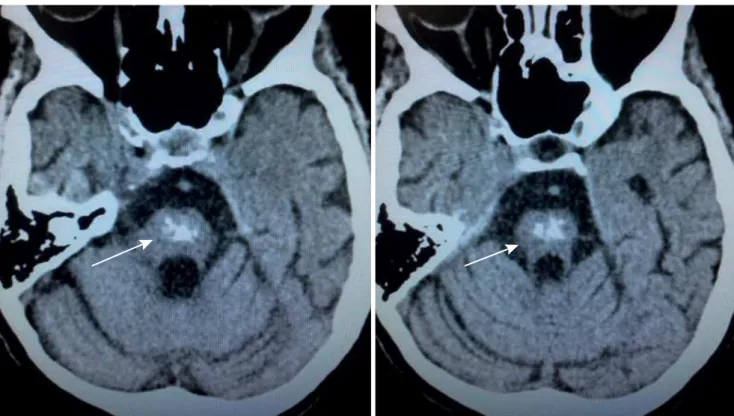
A routine brain CT scan performed two years ago
dis-closed pontine calcification (Figure 2).
Multiple system atrophy is a neurodegenerative
dis-order included in the synucleinopathies group
1. The
cer-ebellar form, MSA-C, usually causes pontocercer-ebellar
atro-phy and a “hot cross bun” sign in the pons, due to selective
loss of myelinated transverse pontocerebellar fibers and
raphe
1,2. This prospective observation demonstrates that
pontine calcification may be part of the
neurodegenera-tion process in MSA-C.
1Universidade Federal de São Paulo, Unidade de Ataxia, Departamento de Neurologia, São Paulo SP, Brasil;
2Hospital Israelita Albert Einstein, São Paulo SP, Brasil;
3Faculdade de Ciências Médicas da Santa Casa de São Paulo, Divisão de Radiologia, São Paulo SP, Brasil.
Correspondence: José Luiz Pedroso; Departamento de Neurologia da UNIFESP; Rua Pedro de Toledo, 650, CEP 04039-002; São Paulo SP, Brasil. E-mail: [email protected]
Conflict of interest: There is no conflict of interest to declare. Received 10 December 2016; Accepted 12 July 2017.
Figure 1.
MRI performed two years after disease onset. (A) Sagittal T1-weighted shows pontocerebellar atrophy; (B) Axial
T1-weighted depicted the “hot cross bun” sign; (C) Axial gradient-echo showed no evidence of calcification in the pons.
834
Arq Neuropsiquiatr 2017;75(11):833-834Figure 2.
Brain CT performed 15 years after disease onset. Marked pontine calcification, centered on transverse pontocerebellar
fibers and raphe.
References
1. Gilman S, Low PA, Quinn N, Albanese A, Ben-Shlomo Y, Fowler CJ et al. Consensus statement on the diagnosis of multiple system atrophy. J Neurol Sci. 1999;163(1):94-8. https://doi.org/10.1007/BF02309628