cop
yr
ight
© ABE&M todos os direitos reser
v
ados
perspectives
LUDMILA ALVES SANCHES DUTRA PATRÍCIA GODOY GARCIA COSTA LARA FRANCIELE RIBEIRO VELASCO ANGÉLICA AMORIM AMATO GUSTAVO BARCELOS BARRA
Sabin Institute and Sabin Laboratory of Clinical Analysis (LASD, PGGC, LFRV, GBB); Section of Endocrinology, University Hospital of Brasilia, Faculty of Medicine, University of Brasilia UnB (AAA); Brasilia, DF, Brazil.
Received in 13/8/2008 Accepted in 12/9/2008
ABSTRACT
Objective: The aim of the present study is to validate a rapid and simple allele-specifi c PCR that genotypes TCF7/L2 rs7903146 (C/T) polymorphism with stan-dard PCR instruments. Methods: Two forward primers with variations in their 3’ nucleotides were designed in such a way that each was specifi c for one of the two variants. They were combined with a common reverse primer into two PCR reactions. Specifi c amplifi cation indicates the presence of the allele. One hundred and four DNA samples were genotyped by this method. To evaluate the assay, the polymorphism spanning region of 63 DNA samples represent-ing the three possible genotypes was sequenced. Results: The rs7903146 al-lele assignments derived from the alal-lele-specifi c PCR were in complete agreement with sequencing. Conclusions: The assay described here is a suit-able strategy for the TCF7/L2 rs7903146 (C/T) genotyping also allowing rapid and reliable identifi cation. (Arq Bras Endocrinol Metab 2008; 52/8:1362-1366) Keywords: Type 2 diabetes; TCF7/L2; SNP; rs7903146
RESUMO
Ensaio de PCR Alelo-Específi co para Genotipar o SNP rs7903146 no Gene
TCF7L2 para Rápida Triagem de Suscetibilidade ao Diabetes.
Objetivo: O objetivo deste estudo foi validar um método de PCR alelo-espe-cífi co, rápido e simples, para genotipagem do polimorfi smo rs7903146 (C/T) no gene TCF7/L2 utilizando equipamentos convencionais. Métodos: Dois
primers forward com variações nos seus nucleotídeos 3’ foram desenhados de forma que cada um fosse específi co para uma das variantes. Eles foram combinados com um primer reverso comum em duas reações de PCR. A amplifi cação de tamanho específi co indica a presença do alelo. Cento e qua-tro amostras de DNA foram genotipadas por esse método. Para validar o ensaio, uma amostragem representativa dos três possíveis genótipos (63 amostras) teve a região contendo o polimorfi smo seqüenciada. Resultados:
A genotipagem do polimorfi smo rs7903146 derivada da PCR alelo-específi ca estava em completa concordância com o sequenciamento. Conclusões: O ensaio aqui descrito é uma estratégia adequada para a genotipagem do poli-morfi smo rs7903146 (C/T) do gene TCF7/L2 e permite identifi cação alélica rápida e precisa. (Arq Bras Endocrinol Metab 2008; 52//8:1362-1366)
Descritores: Diabetes tipo 2; TCF7/L2; SNP; rs7903146
INTRODUCTION
poly-cop
yr
ight
© ABE&M todos os direitos reser
v
ados
genic, but only genetic variants with small effect sizes had been indentifi ed until transcription factor-7-like 2 (TCF7/L2) was identifi ed as the most important T2D susceptibility gene to date (1-3).
Genetic variants in the gene encoding this trans-cription factor have been consistently associated with T2D and impaired insulin secretion (1, 4-7). Among them, the rs7903146 T allele is probably the best marker to evaluate the effect of this gene on T2D risk. This allele increases the risk of T2D by 1.45 in heterozygous and by 2.41 in homozygous (5). All these fi ndings have been replicated in populations of different ethnic des-cent includingcaucasian Europeans (3), Japanese and Indian people (8-10), Latin Americans (11) and West Africans (12), representing the main ethnical groups with a high prevalence of T2D (2).
The T allele at rs7903146 also predicted the pro-gression from impaired glucose tolerance to T2D among the participants of the Diabetes Prevention Pro-gram (1). Additionally, the T allele has been associated with increased glycosylated hemoglobin levels in both T2D and healthy individuals and among diabetic pa-tients, was present in a higher frequency in those requi-ring insulin therapy, and underrepresented in those managed by diet alone (13). In addition, it has been shown that the T allele infl uences initial treatment res-ponse to sulfonylurea therapy, with more treatment fai-lure rates in the TT homozygotes. The heterozygote group displayed an intermediate failure rate and no sig-nifi cant effect of genotype was observed on the respon-se to metformin (14). Furthermore, the rs7903146 also showed a signifi cant association with high triglyce-rides in families with familial combined hyperlipidaemia (15), and an association with colorectal tumors has also been recently reported (16,17).
TCF7/L2 gene encodes for a transcription factor involved in the canonical beta-catenin-dependent Wnt signaling a pathway, which regulates cell survival, mi-gration, proliferation, differentiation and in organ deve-lopment (18). Heterodimerization of TCF7/L2 with
β-catenin in the nucleus forms a transcriptionaly pro-ductive complex to activate the expression of Wnt-sig-naling target genes, including intestinal proglucagon (18,19). The proglucagon is the precursor of gut-deri-ved insulinotropic hormone glucagon-like peptide (GLP-1) and it has recently been shown that GLP-1 and its synthetic agonist, exendin-4 (Exd4), induce Wnt signaling in rat’s pancreatic beta cells, both in pri-mary islet cells and in INS-1 cells (18). The same
au-thors also provided indication that active Wnt signaling stimulates the multiplication of beta cells, and that transfection of a dominant-negative TCF7/L2 inhibits both basal and Exd4-stimulated INS-1 cell prolifera-tion, suggesting that reduced TCF7/L2 action could result in diminished beta cell mass. These results offer physiological evidence supporting the genetic epide-miological studies, suggesting an important role of TCF7/L2 in maintaining beta cell’s mass and/or func-tion (18).
However, it is not readily apparent how TCF7/L2 variants, in particular the intronic variant rs7903146, might affect TCF7/L2 expression or its protein pro-duct function (1). It has been shown that in T2D pa-tients with rs7903146 T allele TCF7/L2 mRNA expression in islets increased 5-fold, particularly in ho-mozygote TT (20). Nevertheless, the reasons why im-pairment of TCF7/L2 action inhibits beta cell proliferation and why TCF7/L2 mRNA expression is increased in T2D are poorly understood. Moreover, the fi ndings heretofore suggest that TCF7/L2 genoty-ping, particularly rs7903146, could have clinical appli-cations in the near future.
The genotyping methods for rs7903146 used in association studies have always involved sophisticated technologies, like primer extension with detection by MALDI-TOF mass spectroscopy using a SEQUE-NOM® platform (1,6,7,20) and TaqMan® SNP geno-typing assays (4,9,13). These methods are fast, but require expensive dedicated instrumentation. Alongsi-de, “for diagnostic analysis and for scientifi c studies of a large number of patients, fast and economic assays that can be performed with standard PCR instruments are highly desirable” (21). We describe here a rapid and simple allele-specifi c PCR methodology for rs7903146 (C/T) genotyping.
SUBJECTS AND METHODS
cop
yr
ight
© ABE&M todos os direitos reser
v
ados
site, did not have mismatches. The allele-specifi c forward primers (rs7903146 C or rs7903146 T) and the reverse primer (rs7903146 R) were combined in two parallel PCR reactions (Primers’ sequences and commentary are listed in Table 1). Since mismatches extend at a lo-wer rate, resulting in an amplifi cation delay, the geno-type is scored based on differential amplifi cation of the two alleles.
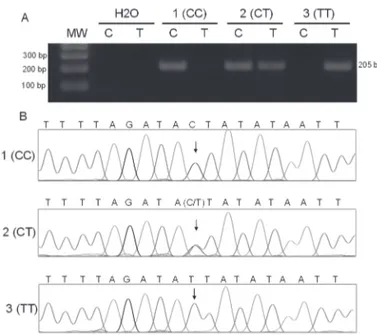
For rs7903146 (C/T) genotyping validation, 104 DNA samples from healthy and anonymous donors were used. The average age of the volunteers was 27.7±11 years, and 59.6% were male. A written infor-med consent for DNA analysis was obtained from all the subjects and the use of these samples was approved by the local institutional review board. Genomic DNA was prepared from 50 µL of whole blood by the Che-lex-100 method (23). For each sample, two PCR reac-tions were run in parallel, one with primers rs7903146 C and rs7903146 R (PCR C) and a second with pri-mers rs7903146 T and rs7903146 R (PCR T), each containing 1X PCR Buffer with (NH4)2SO4, 2 mmol/L MgCl2, 1.25 U of Taq DNA Polymerase (Fermentas, Inc.), 200 µmol/L of each deoxynucleotide triphos-phate (Fermentas, Inc), 100ng of each primer and 5-20 µL of genomic DNA in a fi nal volume of 50 µL. Ampli-fi cation was performed on a PTC-100 thermal cycler (MJ research, Inc) and the cycling conditions were as follows: initial denaturation for 3 min at 94 °C; follo-wed by 32 cycles of 1 min at 94 °C, 1 min at 50 °C, and 1 min at 72 °C; and fi nal extension for 5 min at 72 °C. The PCR products were analyzed by electrophoresis on 1.5% Tris-acetate-EDTA/ethidium bromide agarose gels, visualized under ultraviolet illumination and the presence of a 205-bp band in PCR C or T indicated the
presence of the allele. A sample was considered negati-ve for a particular allele when the amplicon was absent. Furthermore, as the DNA starting material for each allele-specifi c genotyping reaction came from the same DNA sample, one control the other in detecting either a false negative reaction secondary to extraction failure or the presence of an inhibitor. The accuracy of the genotype discrimination was demonstrated by direct sequencing of the PCR product amplifi ed from 63 se-lected samples using primers rs7903146 seq and rs7903146 R, which span the polymorphic region. PCR products were sequenced in both the sense and antisense orientations, with the use of an automated sequencer (ABI-377, Perkin-Elmer).
RESULTS
First of all, the 104 volunteers were genotyped by the new method using 5µl of genomic DNA starting mate-rial. We observed that 43 (41.34%) volunteers were ho-mozygote CC, 45 (43.27%) heterozygote CT and 16 (15.39%) homozygote TT. This genotype distribution is consistent with Hardy-Weinberg equilibrium. Next, the polymorphic spanning region of 63 selected DNA samples of known genotype, 25 homozygotes CC, 24 heterozygotes CT and 14 homozygotes TT were se-quenced, as described in subjects and methods, and 100% of concordance between the two methods was observed. A representation of the genotyping by allele-specifi c PCR and sequencing confi rmation can be found in Figure 1.
Moreover, to ascertain the assay reproducibility all 63 sequenced samples were re-tested by the allele-spe-cifi c PCR, and again 100% concurrence was obtained.
Table 1. Primers for rs7903146 C/T genotyping by allele-specifi c PCR and sequencing analysis.
Primer Sequence 5’–3’a Commentary
rs7903146 C GAACAATTAGAGAGCTAAGCACTTTTTAGAAAC Forward primer specifi c for allele C detection
rs7903146 T GAACAATTAGAGAGCTAAGCACTTTTTAGAGAT Forward primer specifi c for allele T detection
rs7903146 R AGATGAAATGTAGCAGTGAAGTGC Common reverse primer
rs7903146 SEQ GGTAATGCAGATGTGATGAGATCT Forward primer for amplifi cation of rs7901146 spanning region
cop
yr
ight
© ABE&M todos os direitos reser
v
ados
in previous TCF7/L2 association studies. We also ob-served that the assay performed equally as well with an excess of template starting material. Alongside, we strongly recommend that users optimize the PCR con-ditions, specially the number of cycles, because genoty-ping is based on the delay in product amplifi cation and, it is expected, that the excess of cycles could result in poor genotyping discrimination.
The frequencies of the rs7903146 alleles observed in the healthy Brazilian volunteers randomly selected in this study were 63% for the C allele and 37% for T alle-le. It was the fi rst genotyping study in the Brazilian population, which represents an heterogeneous ethnic group. The minor allele frequency (T Allele) observed in other populations were: Northern Europeans (18-30%), other Caucasians (27-34%), Asians (3-28%), and Africans (28-35%) (4). Moreover, our group will con-duct further studies to confi rm the association of this single nucleotide polymorphism with T2D in Brazil.
In conclusion, we have determined that the rapid allele-specifi c PCR method described here is an useful and precise tool for genotyping the SNP rs7903146 in TCF7L2 gene, the strongest T2D susceptibility gene described to date.
Acknowledgments: The authors are greatly indebted to the con-tribution from Lídia Freire Abdalla, Leonardo Abdala Giacomi-ni, Paula Pires Nascimento, Monalisa Ferreira Azevedo, Dr. Luciana Ansaneli Naves, Janete Ana Ribeiro Vaz, and Sandra Santana Soares Costa. We also gratefully thank the volunteers of the study. Grant/Funding support: This study was supported by Sabin Institute and Laboratory of Clinical Analysis. Financial disclosures: Non applicable. No other confl ict of interest rele-vant to this article was reported.
REFERENCES
1. Florez JC, Jablonski KA, Bayley N, Pollin TI, de Bakker PI, Shul-diner AR, et al. TCF7L2 polymorphisms and progression to diabetes in the Diabetes Prevention Program. N Engl J Med. 2006;355(3):241-50.
2. Hattersley AT. Prime suspect: the TCF7L2 gene and type 2 dia-betes risk. J Clin Invest. 2007;117(8):2077-9.
3. Zeggini E, McCarthy MI. TCF7L2: the biggest story in diabetes genetics since HLA? Diabetologia. 2007;50(1):1-4.
4. Cauchi S, El Achhab Y, Choquet H, Dina C, Krempler F, Weit-gasser R, et al. TCF7L2 is reproducibly associated with type 2 diabetes in various ethnic groups: a global meta-analysis. J Mol Med. 2007.
5. Grant SF, Thorleifsson G, Reynisdottir I, Benediktsson R, Ma-nolescu A, Sainz J, et al. Variant of transcription factor 7-like 2 (TCF7L2) gene confers risk of type 2 diabetes. Nat Genet. 2006;38(3):320-3.
Figure 1. A) Representative genotyping of rs7903146 C/T by allele-specifi c PCR. For each sample, two PCR reaction were performed, one with primes rs7903146 C and rs7903146 R (PCR C) and a second with primers rs7903146 T and rs7903146 R (PCR T), and run side by side on an agarose gel. A 205-bp band indicated the presence of the allele; amplifi cation fail-ure indicated the absence of the allele. In the gel, the fi rst lane shows the product from the size-standard sample; for the other lanes, C and T indicate the product from PCR C and PCR T, respectively, amplifi ed from negative control (wa-ter) and from selected DNA sample of each possible geno-types [1 (CC), 2 (CT) and 3 (TT)]. B) Sequencing of PCR products amplifi ed with primers rs7903146 SEQ and rs7903146 R from selected DNA sample in A reproducing allele-specifi c PCR results.
Also, we tested if excess of DNA starting material could harm the allele discrimination. We varied the initial template DNA from 5-20ul and observed that the ge-notypes were correctly assigned for all tested samples (data not shown).
DISCUSSION
cop
yr
ight
© ABE&M todos os direitos reser
v
ados
16. Folsom AR, Pankow JS, Peacock JM, Bielinski SJ, Heiss G, Bo-erwinkle E. Variation in TCF7L2 and increased risk of colon cancer: the Atherosclerosis Risk in Communities (ARIC) Study. Diabetes Care. 2008;31(5):905-9.
17. Slattery ML, Folsom AR, Wolff R, Herrick J, Caan BJ, Potter JD. Transcription factor 7-like 2 polymorphism and colon cancer. Cancer Epidemiol Biomarkers Prev. 2008;17(4):978-82. 18. Liu Z, Habener JF. Glucagon-like peptide-1 activation of
TCF7L2-dependent Wnt signaling enhances pancreatic beta-cell proliferation. J Biol Chem. 2008;283:8723-35.
19. Yi F, Brubaker PL, Jin T. TCF-4 mediates cell type-specifi c regula-tion of proglucagon gene expression by beta-catenin and glyco-gen synthase kinase-3beta. J Biol Chem. 2005;280(2):1457-64. 20. Lyssenko V, Lupi R, Marchetti P, Del Guerra S, Orho-Melander
M, Almgren P, et al. Mechanisms by which common variants in the TCF7L2 gene increase risk of type 2 diabetes. J Clin In-vest. 2007;117(8):2155-63.
21. Endler G, Kyrle PA, Eichinger S, Exner M, Mannhalter C. Multi-plexed mutagenically separated PCR: simultaneous single-tu-be detection of the factor V R506Q (G1691A), the prothrombin G20210A, and the methylenetetrahydrofolate reductase A223V (C677T) variants. Clin Chem. 2001;47(2):333-5.
22. Newton CR, Graham A, Heptinstall LE, Powell SJ, Summers C, Kalsheker N, et al. Analysis of any point mutation in DNA. The amplifi cation refractory mutation system (ARMS). Nucleic Aci-ds Res. 1989;17(7):2503-16.
23. Walsh PS, Metzger DA, Higuchi R. Chelex 100 as a medium for simple extraction of DNA for PCR-based typing from forensic material. Biotechniques. 1991;10(4):506-13.
Correspondence to:
Gustavo Barcelos Barra
Sabin Institute and Sabin Laboratory of Clinical Analysis SEPS 910 sul Edifício Via Brasil, loja 03, térreo
70390-108 Brasília, DF E-mail: [email protected]
6. Saxena R, Gianniny L, Burtt NP, Lyssenko V, Giuducci C, Sjo-gren M, et al. Common single nucleotide polymorphisms in TCF7L2 are reproducibly associated with type 2 diabetes and reduce the insulin response to glucose in nondiabetic indivi-duals. Diabetes. 2006;55(10):2890-5.
7. Scott LJ, Bonnycastle LL, Willer CJ, Sprau AG, Jackson AU, Narisu N, et al. Association of transcription factor 7-like 2 (TCF7L2) variants with type 2 diabetes in a Finnish sample. Diabetes. 2006;55(9):2649-53.
8. Chandak GR, Janipalli CS, Bhaskar S, Kulkarni SR, Mohankrish-na P, Hattersley AT, et al. Common variants in the TCF7L2 gene are strongly associated with type 2 diabetes mellitus in the Indian population. Diabetologia. 2007;50(1):63-7.
9. Hayashi T, Iwamoto Y, Kaku K, Hirose H, Maeda S. Replication study for the association of TCF7L2 with susceptibility to type 2 diabetes in a Japanese population. Diabetologia. 2007;50 (5):980-4.
10. Horikoshi M, Hara K, Ito C, Nagai R, Froguel P, Kadowaki T. A genetic variation of the transcription factor 7-like 2 gene is as-sociated with risk of type 2 diabetes in the Japanese popula-tion. Diabetologia. 2007;50(4):747-51.
11. Lehman DM, Hunt KJ, Leach RJ, Hamlington J, Arya R, Ab-boud HE, et al. Haplotypes of transcription factor 7-like 2 (TCF7L2) gene and its upstream region are associated with type 2 diabetes and age of onset in Mexican Americans. Dia-betes. 2007;56(2):389-93.
12. Helgason A, Palsson S, Thorleifsson G, Grant SF, Emilsson V, Gunnarsdottir S, et al. Refi ning the impact of TCF7L2 gene va-riants on type 2 diabetes and adaptive evolution. Nat Genet. 2007;39(2):218-25.
13. Kimber CH, Doney AS, Pearson ER, McCarthy MI, Hattersley AT, Leese GP, et al. TCF7L2 in the Go-DARTS study: evidence for a gene dose effect on both diabetes susceptibility and con-trol of glucose levels. Diabetologia. 2007;50(6):1186-91. 14. Pearson ER, Donnelly LA, Kimber C, Whitley A, Doney AS,
Mc-Carthy MI, et al. Variation in TCF7L2 infl uences therapeutic response to sulfonylureas: a GoDARTs study. Diabetes. 2007;56 (8):2178-82.