Indirect signals of spawning aggregations of three commercial reef ish species
on the continental shelf of Bahia, east coast of Brazil
Lutjanus analis
(Mutton snapper),
Lutjanus jocu
(Dog snapper) and
Mycteroperca bonaci
(Black
grouper) are reef ishes of high commercial value,
and are among the principal exploited reef resour
-ces on the eastern and northeastern coast of Brazil.
These species share the habit of forming transient
spawning aggregations, predictable in time and
space, which leaves them particularly vulnerable.
The present study aimed to obtain indirect indica
-tors of periods and places of spawning aggregations
for these species, based on the exploratory analysis
of available data on commercial catches and ishing
efforts in Southern Bahia. Line ishery landings data
were monitored in 12 locations in the region, and
catch records of Mutton snapper (1320 landings),
Dog snapper (654) and Black grouper (1162) were
analyzed. A strategy was developed for exploratory
analysis of monthly CPUE variation and individual
distribution of CPUE per trip. The results showed
the occurrence of aggregations in 26 speciic sites,
with values of relative abundance far above the an
-nual mean, during spring/summer and autumn/win
-ter. The occurrence of these anomalous catches was
validated with the ishermen responsible for respec
-tive ishing trips. Additional studies are needed to
conirm spawning activity at these sites. Analysis of
inter-annual variation suggests a decreasing trend
in relative abundance of Black grouper and Mut
-ton snapper, possibly associated with unregulated
ishing of spawning aggregations.
A
bstrAct
Aline Rocha França, George Olavo*
Laboratório de Biologia Pesqueira, Programa de Pós-Graduação em Modelagem em Ciências da Terra e do Ambiente, Universidade Estadual de Feira de Santana - UEFS
(Av. Transnordestina S/N, Novo Horizonte, 44036-900, Feira de Santana, Bahia, Brazil)
*Corresponding author: [email protected]
Descriptors:
Mycteroperca bonaci
,
Lutjanus analis
,
Lutjanus jocu
, Spawning aggregation, Artisanal reef
isheries, snapper.
Lutjanus analis
(Cioba),
Lutjanus Jocu
(Dentão) e
Mycteroperca bonaci
(Badejo) são peixes recifais
de alto valor comercial e estão entre os principais
recursos explotados na costa da Bahia. Estas espé
-cies compartilham o hábito de formar agregações
reprodutivas transientes, previsíveis no tempo e no
espaço, o que as torna particularmente vulneráveis.
O presente estudo objetivou obter indicadores indi
-retos de períodos e locais de possível ocorrência de
agregações reprodutivas destas espécies, a partir da
análise exploratória de dados de captura e esforço
de pesca disponíveis para a região do Baixo Sul da
Bahia. Foram analisados dados de desembarques da
pesca de linha monitorados em 12 localidades da
região, com registros de captura de Cioba (1320 de
-sembarques), Dentão (654) e Badejo (1162). Foi de
-senvolvida uma estratégia de análise exploratória da
variação mensal e distribuição individual das CPUE
por viagem. Os resultados indicaram ocorrência de
agregações em 26 sítios especíicos, observando va
-lores de abundância relativa muito acima das médias
anuais, tanto no período de primavera/verão, como
no de outono/inverno. As ocorrências dessas captu
-ras foram validadas junto aos pescadores responsá
-veis por tais pescarias. Estudos adicionais são neces
-sários para conirmar a atividade de desova nesses
locais. Análise da variação inter-anual das CPUE
sugere tendência de declínio na abundância relati
-va do Badejo e da Cioba, possivelmente associada à
pesca não controlada sobre agregações reprodutivas.
r
esumo
Descritores:Mycteroperca bonaci, Lutjanus analis,
Lutjanus jocu, Agregação reprodutiva, Pesca arte-sanal recifal, vermelhos.
INTRODUCTION
The three species considered in this study have de
-mersal life habits associated with reef environments: the
Mutton snapper Lutjanus analis (CUVIER, 1828), the
Dog snapper Lutjanus jocu (BLOCH & SCHNEIDER,
1801) and the Black grouper Mycteroperca bonaci (POEY,
1860). All three of them are of high commercial value and among the principal resources exploited by ishing activity on the east and northeast coast of Brazil (MARTINS et al., 2006; FRÉDOU, 2004). Together they accounted for 9.4% of the marine ish production recorded in Bahia state, in 2006 (IBAMA, 2008). These ishes are caught mainly by handline ishing, the primary ishing gear used by artisanal leets of the state of Bahia for over four centuries (OLAVO et al., 2005). In 2006, the estimated handline ishing lan
-dings were of 9,598 t, representing 22% of all state ish production among all types of marine and estuarine ishe
-ries (IBAMA, 2008).
The three species live alone or in small groups from coastal and estuarine zones to outer continental shelfs and upper slope mesophotic reef ecosystems, reaching depths greater than 100 m (HEEMSTRA; RANDALL, 1993; FREDOU; FERREIRA, 2005; CLARO; LINDEMAN, 2008; HINDERSTEIN et al., 2010; OLAVO et al., 2011). They share ecological, biological, and behavioral characte
-ristics, such as the performance of spawning aggregations, which make them particularly vulnerable to unregulated isheries (DOMEIER; COLIN, 1997; COLEMAN et al., 1999), and offshore mineral exploration and production activities (carbonates and hydrocarbons) which are curren
-tly expanding along the Brazilian coast (MARCHIORO et al., 2005; OLAVO et al., 2011). During the reproductive period, which can last for days or weeks, hundreds of ish migrate to speciic spawning areas (DOMEIER; COLIN, 1997). These aggregation events are predictable in time and space, and are well known by the artisanal ishermen of Bahia (OLAVO et al., 2005).
A spawning aggregation can be deined as “a group of ish of the same species gathering for spawning pur
-poses, with a density or number of ish signiicantly hi
-gher than that observed in the aggregation area during the non-reproductive period” (DOMEIER; COLIN, 1997). The identiication of spawning activity during these ag
-gregations may be assessed by means of two types of signal: direct and indirect (COLIN et al., 2003). Direct signals provide unambiguous evidence of the occurrence
of a spawning aggregation. They include direct observa
-tion, documentation of courtship behavior, and witnessing the spawning time during scuba diving at spawning sites. Additionally, hydrated oocytes are indicative of imminent spawning, and post-ovulatory follicles on the gonads of females caught in an aggregation are indicative of recent spawning (COLIN et al., 2003).
Indirect signals require additional supporting infor
-mation to conirm the reproductive character of the ag
-gregation. Examples of indirect signals include a swollen abdomen in the females, a change in the breeding color pattern, or a signiicant increase in the relative abundan
-ce or a sharp rise in commercial catches in -certain times of year and ishing areas. In this last case, COLIN et al. (2003) suggested that an increase of at least three times the mean relative abundance or catch rates observed du
-ring the non-reproductive period is indicative of a possible spawning aggregation.
SADOVY et al. (2008) estimated that 79% of the spa
-wning aggregations whose status is known by the Science and Conservation of Fish Aggregations (SCRFA) organi
-zation show signs of decline, in addition to records of alre
-ady extinct aggregations in different regions of the world. In Brazil, the irst initiative to systematically survey re
-ef ish spawning aggregations was proposed under the “Pro-Arribada Project: Reef Fish Spawning Aggregation in Brazil”. This project originated from an agreement between the national environmental agency IBAMA and the oil and gas industry, involving a multi-institutional network of Brazilian researchers on reef ish ecology and isheries for implementation. The project was created with the primary goal of supporting the environmental licen
-sing of oil and gas exploration/prospecting and production activities offshore in Brazil. The information generated by the project can also be used in future proposals for reef isheries management strategies, as well as planning ne
-tworks of Marine Protected Areas.
The survey and analysis of previous catch data and commercial ishing efforts were the initial steps of the project, following the methodology established by SCRFA (COLIN et al., 2003). This study aims to obtain indirect indicators for the identiication of periods and sites of possible occurrence of Mutton snapper (L. analis), Dog
snapper (L. jocu) and Black grouper (M. bonaci) spawning
MATERIAL AND METHODS
D
atabasesThe oficial ishing statistics available for the state of Bahia present serious inconsistencies regarding the dis
-continuity and quality of catch data, which are generally underestimated for reef ish, as demonstrated by KLIPPEL et al. (2005a). Furthermore, they are only available by mu
-nicipality and commercial category of species (MARTINS et al., 2006; FREIRE; OLIVEIRA, 2007; IBAMA, 2008).
In the study area, the southern coast of the state of Bahia between the latitudes of 13º00’S and 14º30’S (Figure 1), data from Petrobras’ Participatory Monitoring of Fishing Activity project are available for the period between March 2005 and August 2009. This project is a consistent source of information on catch and effort of the regional handline ishing. The monitoring project collected data on landings in 12 artisanal ishing com
-munities: Barra Grande, Boipeba, Camamu, Gamboa, Garapuá, Guaibim, Ilha do Contrato, Ilha d’Ajuda, Barra dos Carvalhos, Morro de São Paulo, São Francisco, and Valença. Although this database only contains catch data for commercial species, there is a high and satisfactory correlation between the commercial names and the biolo
-gical species of the three resources discussed here: Mutton snapper (regionally named Cioba - Lutjanus analis), Dog
snapper (Dentão - Lutjanus jocu) and Black grouper
(Badejo - Mycteroperca bonaci).
For these species, complementary data are also avai
-lable from biological sampling obtained by the REVIZEE Program (MMA/SECIRM) from September 1997 to September 1999. These data include information with bet
-ter taxonomic, biological, and spatial resolution, and the catch data are detailed by biological species, ishing area and sample of length frequencies (COSTA et al., 2005). However, for the study area, these data are restricted to handline catches sampled at the landing ports of Valença. Together, the data from these two sources provide a uni
-que and meaningful set of information about the reef ishe
-ries undertaken in the study area (Table 1).
D
ataa
nalysisIn this analysis, each landing was considered a sam
-pling unit. Only the landings of ishing trips in which the target species of this study were caught were included in the analysis. Communities with less than 30 landings with catch of the target species were disregarded, because the leets of these communities are targeted to other ishing
Figure 1. Map of the study area in Southern Bahia, on the eastern Brazilian coast, showing the communities where handline artisanal leets were monitored in landings ports, between 2005-2009.
resources. For L. analis, the communities of Guaibim
and Morro de São Paulo were excluded. For L. jocu, the
communities of Garapuá, Ilha d’Ajuda and Morro de São Paulo, and for M. bonaci only the landings of the Ilha
d’Ajuda leet were excluded.
We developed an exploratory analysis strategy from monthly mean (arithmetic mean) variation and distribu
-tion of individual catch per unit effort (CPUE) per trip. The CPUE was assumed to be a speciic relative abun
-dance index in ishing areas visited during a ishing trip (sampling unit), as demonstrated by COSTA et al. (2005). The CPUE is calculated according to the follo
-wing equation:
CPUE = Cs,t/(Ft x Dt)
Where:
Cs,t = total catch in kg of the species (s) on the ishing trip (t)
Ft = number of ishermen on board during the trip (t)
Database Monitoring period
Total of leets monitored (communities)
Total of vessels monitored
Total of landings monitored
Number and percentage of landings monitored with catches of the species
L. analis L. jocu M. bonaci
Revizee
Program Sep/1997 to Oct/1999 1 24 148 107 (72.3%) 86 (58.1%) 68 (46.0%) Participatory
Monitoring Mar/2005 to Aug/2009 12 534 5588 1213 (21.7%) 568 (10.2%) 1094 (19.6%)
Table 1. Characteristics of data available in the two databases analyzed. Numbers and percentages of the total monitored
landings (sampling units) refer to landings with catches of the three target species analyzed for handline isheries in southern Bahia: Black grouper (Mycteroperca bonaci), Mutton snapper (Lutjanus analis) and Dog snapper (Lutjanus jocu)
A global mean CPUE by species has been calculated from the monthly CPUE series for the entire period of available data, for each database (Revizee and Petrobras). This overall CPUE was used as the basis for the establish
-ment of threshold criteria that identify possible ish ag
-gregations, considering a level of CPUE three times the global CPUE mean, as suggested by COLIN et al. (2003):
of 1.5 and 3.0 times the interquartile distance from the 1st quartile to the bottom and from the 3rd quartile to the top. The interquartile distance is the amplitude of the boxes of a boxplot, between percentiles 25% and 75% (FRY, 2002).
For validation purposes, the veracity of the occurren
-ce of ishing with extremely high catches (CPUE extreme points, outliers and far outliers) was veriied with the i
-shermen responsible for such catches in the communities of Gamboa, Boipeba, Camamu and Barra Grande. This veriication occurred through semi-structured interviews with the master isherman identiied in the database. During the interviews, additional information was col
-lected about which species occur in large numbers and in which periods of the year, what the speciic locations of aggregation are and why these aggregations occur. This additional information was used for triangulation with monitoring data, and the information obtained from the i
-sherman immediately checked for concordance with catch peaks recorded in the database.
Fork length (FL) of the target species, measured to the lower centimeter, was also observed in the database of lan
-dings from Valença sampled by the REVIZEE Program, as the participatory monitoring database does not include this kind of information.
RESULTS
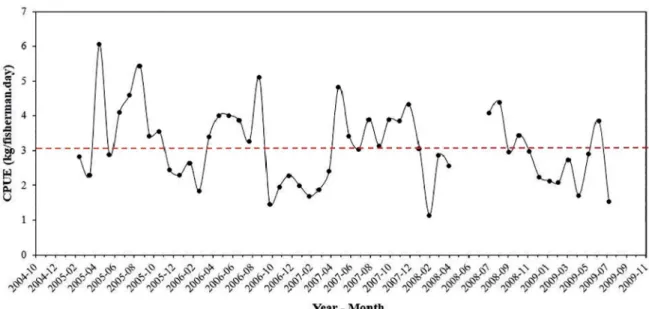
The data analyzed showed monthly mean CPUE peaks both during the period of spring/summer oceano
-graphic conditions (September to February), and during the fall/winter period (March to August).
b
lackgrOuper(
M
ycteropercabonaci)
A total of 1,094 landings with catch of the Black grou
-per, recorded between 2005-2009, were analyzed. The highest monthly mean CPUE occurred during the autu
-mn/winter, between the months from April to September (Figure 2). Less pronounced CPUE peaks were also detected in November and December.
CPUEthreshold-criteria = 3 x CPUEglobal mean
Considering the wide variation observed in CPUE per trip and the low sensitivity of the global mean due to the occurrence of anomalous records of extremely high CPUE, monthly distributions of individual CPUE per trip were investigated, identifying the provenance (from “where” - ishing area, sites of aggregation - and “who” - isherman, boat, community) of the maximum extreme points, ou
-tliers and far ou-tliers observed in the boxplots.
In addition to the monthly distributions of individual CPUE per trip, nonparametric Kruskal-Wallis test statis
-tics were calculated to verify the variation of interannual CPUE.
Boxplots are non-parametric techniques, which show the differences between the data of populations without making any assumptions about the type of statistical dis
-tribution (HOAGLIN et al., 1983). A boxplot is a concise way to graphically depict groups of numerical data, using a box that indicates the 25th percentile (1st quartile) and 75th
percentile (3rd quartile) of sample distribution; an internal line that represents the median (2nd quartile); and vertical lines (whiskers) adjacent to the box, on the top and bot
-tom, which show the continuity of the distribution up to the maximum and minimum extreme values, respectively. Points external to the distribution are represented here by asterisks (outliers) and small circles (far outliers), which represent data that markedly deviate from other elements of the sample in which they occur (FRY, 2002). It is no
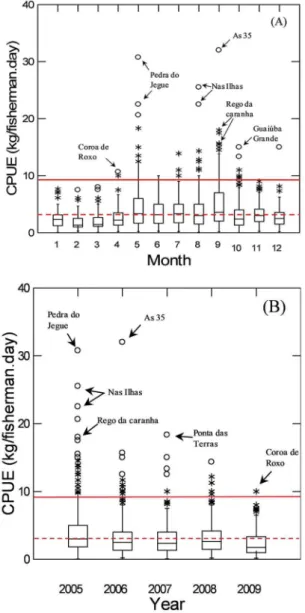
Figure 3 shows the boxplot of the distribution of Black grouper individual CPUE per ishing trip (sampled landings) grouped by month (A) and by year (B), for the entire data series (2005-2009). Extreme maximum values (vertical lines) that exceed the threshold criteria of three times the global mean CPUE (9.3 kg/ishermen.day) we
-re observed in May, June and September. These ext-reme CPUE values can be considered an indirect indicator of Black grouper aggregation in those months, in the light of the criteria proposed by COLIN et al. (2003).
Outliers and far outliers are observed in the CPUE data distribution presented in Figure 3. In particular, the occur
-rence of far outliers in CPUE of the Black grouper landin
-gs monitored, with CPUE values far above the threshold criteria (CPUE of 9.3 kg/isherman.day) in May, July to October, and December indicate the possibility that these landings were from catches performed in aggregations. By investigating these outliers and far outliers, it was possible to identify “where” (ishing areas, aggregation sites) the catches had been undertaken (Table 2 and Figure 3).
M
uttOnsnapper(
L
utjanusanaLis)
For Mutton snapper, a total of 1,213 landings with ca
-tch of the species were analyzed, for the same time period (2005-2009). During this period, the data revealed a hi
-gher mean CPUE in late spring and summer (November to January), and late autumn and winter (April to August) (Figure 4).
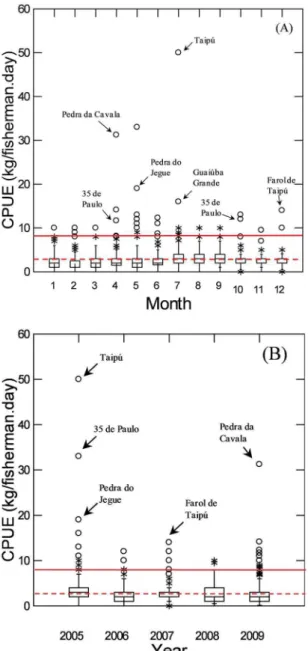
Figure 5 shows the boxplot of Mutton snapper CPUE distribution of each ishing trip, grouped by month (A) and by year (B) for the period from 2005 to 2009. Far outliers and outliers can be observed throughout the year, yet they are more pronounced from April to July, far ex
-ceeding the value of three times the global CPUE mean (8.4 kg/isherman.day).
The identiication of the landings corresponding to Mutton snapper CPUE with highest values (extremes, outliers and far outliers) above the threshold criteria (8.4 kg/isherman.day) reveal sites and periods of catches performed on possible aggregations of L. analis (Table 2
and Figure 5).
D
Ogsnapper(
L
utjanusjocu)
The Dog snapper data set presented a total of 568 lan
-dings analyzed. Between 2005-2009, Lutjanus jocu had a
monthly mean CPUE distribution similar to that observed
for Lutjanus analis, but with higher recordings in autumn
(April-May), and less pronounced peaks of relative abun
-dance in September and December (Figure 6).
Figure 7 shows the boxplot of Dog snapper CPUE distribution per ishing trip (sampled landings) grouped by month (A) and by year (B) for the data series from 2005 to 2009 (n = 568). Extreme maximum CPUE va
-lues (vertical lines) are observed in the months of April, July, and September, reaching the CPUE threshold crite
-ria (8.7 kg/isherman.day). Far outliers, above the CPUE Figure 2. Variation of monthly mean CPUE (kg/isherman.day) for the Black grouper (Mycteroperca bonaci) in the monitored period between 2005
t
raDitiOnalfisherMen’
sknOwleDgeanDvaliDatiOnOfextreMecatches
The data corresponding to the extreme catches identi
-ied in the CPUE analysis were veri-ied with the ishermen who obtained such abundant catches. Among these, only three records were refuted, all referring to the Dog sna
-pper (L. jocu): one in September 2005, with a landing in
Boipeba, and two others in December 2007 and December 2008, with landings in Barra Grande. They were refuted due to the incorrect species identiication of the landing, since the interviewees remembered that those were catches of the Cubbera snapper (Lutjanus cyanopterus). The other occur
-rences were validated by the ishermen, who conirmed the catch levels, periods, and locations of catches performed on aggregations of each of the species in question.
These ishermen call “Arribação” or “Arribada” the pe
-riods in wich large catches of the Black groupper, Mutton, and Dog snappers characteristically occur. In all interviews (n = 9), the expert isherman indicated autumn/winter as the period of greatest abundance for the three species, es
-pecially the Mutton and Dog snappers, which occur in even greater quantities than the Black grouper in winter. When asked about the reasons for the concentration of such ishes in winter, the majority of interviewees responded that the snappers aggregate for reproductive purposes or migrate to spawn, while for the Black grouper most ishermen did not know the reason for the aggregations (Figure 8).
t
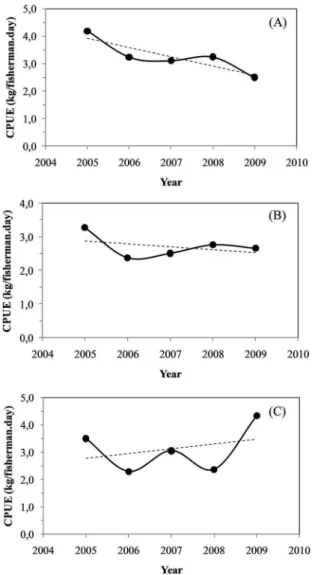
renDOfpOpulatiOnDeclineOne aspect of great importance that could be observed in this data analysis was the declining trend in CPUE over the last ive years, especially for the Black grouper and Mutton snapper. Figure 9 shows the annual variation of mean CPUE of each species discussed in this paper, for the period 2005-2009. The CPUE between years was com
-pared using nonparametric tests, as there was no normal distribution of data when tested by Shapiro-Wilk (ZAR, 2010). There were signiicant differences between years for each of the three species (Kruskal-Wallis test: M. bonaci,
p = 2.23E-10; L. analis, p = 0.014; L. jocu, p = 5.10E-05).
Pairwise comparison between the years using the Mann-Whitney statistic revealed signiicant differences between 2005 and 2009 for M. bonaci (p = 8.27E-11) and L. analis
(p = 0.005); L. jocu showed no signiicant difference
between 2005 and 2009 (p = 0.653).
Figure 3. Boxplot with the distribution of Black grouper (M. bonaci)
CPUE per trip, grouped by month (A) and by year (B), between 2005-2009 (n = 1,094). The dashed line (---) indicates the global mean CPUE for the species (3.1 kg/ishermen.day). The solid line (____) indicates the value three times higher than the global mean CPUE (9.3 kg/ishermen.day). (*) Represents outliers. (o) Represents far-outliers. The arrows indicate some of the identiied potential sites of ish aggregations.
Table 2. Fishing areas and periods of ishing trips with the highest speciic CPUEs (kg/isherman.day) above the threshold
criteria (three times the global mean CPUE) for the Black grouper (Mycteroperca bonaci), Mutton snapper (Lutjanus analis)
and Dog snapper (Lutjanus jocu), recorded by the Petrobras participatory monitoring, between 2005-2009, in the study area.
The table also shows the species total catch (kg) of the respective ishing trips
Species Periods of the year Month Fishing areas Total catch CPUE
Black grouper (Mycteroperca bonaci)
autumn/winter
May Pedra do Jegue 123 30.8
May Ponta das Terras 110 18.3
August Nas ilhas 51 25.2
spring/summer
September As 35 128 32
September Rego da Caranha 36 18
September Guaiúba Grande 35 17.5
September Jequiriçá 31 15.5
December Cabeceira da Lama 15 15
September Nas ilhas 35 17.5
Mutton snapper (Lutjanus analis)
autumn/winter
May 35 de Paulo 300 33.3
July Taipú 100 50
April Pedra da Cavala 281 31.2
spring/summer December Farol do Taipu 28 14
October 35 de Paulo 25 12.5
Dog snapper (Lutjanus jocu)
autumn/winter
May 35 de Paulo 70 35
May 35 de Paulo 328 27.3
May Cova da Onça 800 40
May Rebaixa 25 25
spring/summer
September Jequiriçá 20 10
December Cabeceira da Lama 20 10
December Rego da Caranha 25 12.5
October 35 de Paulo 30 15
Figure 4. Variation of monthly mean CPUE (kg/isherman.day) for the Mutton snapper (Lutjnus analis) in the monitored period between 2005 and
Figure 5. Boxplot with the distribution of Mutton snapper (L. analis)
CPUE per trip, grouped by month (A) and by year (B), between 2005 and 2009 (n = 1,213). The dashed line (---) indicates the global mean CPUE for the species (2.8 kg/ishermen.day). The solid line (____) indicates the value three times higher than the global mean CPUE (8.4 kg/ishermen.day). (*) Represents outliers. (o) Represents far outliers. The arrows indicate some of the identiied potential sites of ish aggregations.
l
engthvariatiOnincatchTable 3 presents data of length variation in catch per ishing trip, obtained for landings sampled by the REVIZEE Program in Valença, taking into consideration only the landings with the highest CPUE per trip (extreme CPUE values, outliers and far outliers) recorded for the period 1997-1999.
The maximum CPUE values observed in this data set were, generally, lower than the values recorded in the 2005-2009 speciic series. This difference is due to the fact that the REVIZEE sampling program involved only one community of the study area (Valença), over a period of about two years, whereas the data from Petrobras’ parti
-cipatory monitoring includes 11 other communities with signiicant handline leets besides Valença, and for a lon
-ger monitoring period (ive years).
DISCUSSION
The results indicated the occurrence of possible ag
-gregation processes at least 26 speciic sites, both during spring/summer and autumn/winter, identiied from values of relative abundance indices (CPUE) at least three times above the global mean CPUE, considering the threshold criteria suggested by COLIN et al. (2003). The identii
-cation of extreme CPUE values, outliers, and far outliers provided better indications of potential aggregation sites and periods for the three species evaluated, which may be associated with spawning processes or migration to spa
-wning aggregation sites. BARNETT; LEWIS (1994) re
-ported that the presence of outliers can signify changes in the behavior of a system through deviations in the natural population or increases of elements outside the population examined. As applied to the object of this study, an ou
-tlier can signify an acute change in relative abundance of the species, caused by possible concentrations of ish in a given ishing area sampled during the ishing trip, fea
-turing aggregations with or without spawning purposes. Additional studies that focus on these places and perio
-ds are needed to conirm the spawning character of these aggregations.
The occurrences of extremely high catches were va
-lidated with the ishermen, according to whom the win
-ter aggregations of Mutton snapper and Dog snapper are predominantly due to reproductive activities. Most of the ishermen responded that they did not know the reason for the winter aggregations of Black grouper. However, the second most common response was that the winter aggre
-gations occur because of spawning. The identiication of the boats and ishermen who performed these catches has made it possible to begin another research phase, focused on surveying the traditional knowledge of ishermen about the aggregation sites and validate the spawning activity by direct indicators. This phase aims to involve ishermen in the research process and support participatory construc
for conservation and sustainable use of the regional spaw
-ning aggregations (MALAFAIA et al., 2014).
Among the sites observed throughout the monito
-ring periods (1997-1999 and 2005-2009), the “Coroa de Roxo”, “35 de Paulo” and “Rego da Caranha” were the
most productive ishing spots, presenting extremely high and recurring signiicant catch rates for the three species analyzed. These same aggregation sites were described by NUNES (2009) as being among the main ishing areas of the Southern Bahia region, considering the abundan
-ce of target reef resour-ces for hook and line ishing. For all the catches of reef ish monitored by the REVIZEE Program in Valença (1997-1999), Lutjanus analis, L. jocu
and M. bonaci together represented 62.5% of all catches
from “Coroa Roxo”, 40.3% from “Rego da Caranha”, and
47.6% from “35 de Paulo”.
The “Coroa Roxo” and “Rego da Caranha” are ishing
areas relatively close to each other. Both are about 25 km from the coastline, while “35 de Paulo” is about 30 km
further south, at a distance of approximately 13 km from coastline. These ishing areas are characterized by reef en
-vironments associated with geomorphological features of the seabed, such as channels, ravines and biogenic reefs lo
-cated near the continental shelf break, which, in this area, is about 50 m deep, or 35 fathoms, as local ishermen often refer to this zone (OLAVO et al., 2005; NUNES, 2009). Not coincidentally, most of the ishing areas identiied as aggregation sites in the study area are located on the shelf break, which is generically referred to as “The 35”
(“As 35”) or, particularly, as speciic ishing spots locally named “35 do Cemitério”, “35 do Aguaceiro” or “35 de Paulo”, among others “35”.
More comprehensively, OLAVO et al. (2011) charac
-terized a shelf edge zone, in a bathymetric range including the shelf break, from 40 m to 200 m depth, as an ecotone and priority area for the conservation of reef ish diversity in the south-western Atlantic, in a narrow strip along the continental margin. Increasing attention has been given to the presence of reef formations located on the continental shelf break and upper slope, particularly in the north-wes
-tern Atlantic (PARKER; MAYS, 1998; SEDBERRY et al., 2004; OLAVO et al., 2007; FRANCINI-FILHO; MOURA, 2008; OLAVO et al., 2011). HINDERSTEIN et al. (2010) discuss the peculiarities of the ecology and management needs of the mesophotic reef ecosystems, es
-pecially in tropical shelf edge regions. On the eastern and northeastern Brazilian coast, this zone at the shelf edge has considerable socioeconomic importance and supports important multispecies reef isheries, concentrating a great part of the handline commercial ishing efforts and pro
-duction (FREDOU, 2004; COSTA et al., 2005, MARTINS et al., 2005; FREDOU; FERREIRA, 2005; OLAVO et al., 2005). Regional leets have species of the snapper-grouper complex (COLEMAN et al., 1996) as their main targets.
These species have biological, ecological and beha
-vioral characteristics that make them particularly vulne
-rable to overexploitation and predatory ishing, as well as degradation and loss of essential habitats for their life Figure 6. Variation of monthly mean CPUE (kg/isherman.day) for the Dog snapper (Lutjanus jocu) in the monitored period between 2005 and
Figure 7. Boxplot with the distribution of Dog snapper (L. jocu)
CPUE per trip, grouped by month (A) and by year (B), between 2005 and 2009 (n = 568). The dashed line (---) indicates the global mean CPUE of (2.9 kg/ishermen.day) for the species. The solid line (____) indicates the value three times higher than the global mean CPUE (8.7 kg/ishermen.day). (*) Represents outliers. (o) Represents far outliers. The arrows indicate some of the identiied potential sites of ish aggregations.
Figure 9. Trends in the annual mean CPUE distribution of Black grouper (A), Mutton snapper (B) and Dog snapper (C) for the handline ishery in the study area, over the period analized from march 2005 to august 2009.
Figure 8. Perception of the reasons for winter aggregations, from main ishermen (n = 9) identiied as responsible for the largest catches of the Mutton snapper, Dog snapper and Black grouper in the databases available for the study area.
Table 3. Fork length range (FLmin and FLmax, in mm) of catches by species in the landings identiied with the highest CPUE
(kg/isherman.day) obtained during the sampling period of REVIZEE Program (1997-1999), in Valença, Southern Bahia. Fishing areas and total catch of species (kg) on each ishing trip sampled on landing, as well as the number of individuals measured and the lengths at irst maturity (L50, mm) available in the literature are also presented
Species Periods of
the year Fishing areas N Total
catch CPUE FL min. - FL max. L50 Literature
Black grouper
(Mycteroperca bonaci)
autumn/winter
Rego da Caranha 10 199 8 690-1210 580 to 951a Coroa de Roxo 12 109.7 5.5 520-1260
Coroa de Roxo 10 56.9 2.4 580-870
spring/summer
Cova da Onça 9 113 5.6 720-1180 538 to 659 b Pedra do Jegue 15 114.7 4.1 500-1040
Coroa de roxo 4 60 3 835-1150
Nas 35 9 98.4 4.9 390-1210
Mutton snapper
(Lutjanus analis)
autumn/winter
Coroa de Roxo 99 297.8 12.4 390-720 280 c Coroa de Roxo 60 226 11.3 370-720
Rego de Caranha 57 196.2 7.8 390-730
spring/summer
Subaúma 88 313.5 8.7 360-700 Quiepe 20 49.4 4.1 345-700 35 do Cemitério 9 59.2 3.9 485-685 Jaguaripe/Caixa Prego 11 36.4 3 460-750
Norte 10 40.3 3.3 520-790
Pedra da Cavala 11 44.1 2.9 540-700
Nas 35 5 26.3 2.2 315-660
Dog snapper (Lutjanus jocu)
autumn/winter Coroa de Roxo 98 362.4 15.1 330-710 510 d Rego de Caranha 56 229 9.2 360-720
spring/summer
Pedra de Pedro/Pedra de Isac 10 31.3 3.5 470-660 319 to 352 b 35 do Cemitério 4 33.6 2.2 535-690
Cova da Onça 9 46.7 2.3 580-720
a: HEEMSTRA; RANDALL (1993); b: FREITAS el al. (2011); c: FERREIRA et al. (2004); d: CLARO; LINDERMAN (2008).
Additional data from the length sampling undertaken by the REVIZEE Program in Valença allow one to ask whe
-ther the ish caught during the identiied aggregations could have already reached the length of irst maturity (L50) when caught. For Black grouper, HEEMSTRA; RANDALL (1993) reported that the range of gonadal maturation length varies between 58 cm and 95.1 cm, with a mean of 72.1 cm. FREITAS et al. (2011) found a L50 of 63.33 cm (± 2.57 cm) for females and 58.14 cm (± 4.32 cm) for males of this species caught on the Abrolhos Bank. For the aggregations identiied in the REVIZEE data series, specimens with leng
-ths equal to or greater than L50 were observed both during the spring/summer and autumn/winter. However, larger ish were observed in autumn/winter. In this same period (autu
-mn/winter), CLARO; LINDERMAN (2003) observed re
-productive aggregations of M. bonaci in Cuba. TEIXEIRA
et al. (2004) reported reproductive peaks of Black grouper in the winter and the phenomenon of “correction” in the
summer (this also accounts for an increase in the abundance of catches, but supposedly relates to feeding behavior) for the Northeast of Brazil. FREITAS et al. (2011) identiied the period from winter to spring as the reproductive pha
-se of the species with the highest gonadosomatic rates in August and September.
The length of irst gonadal maturation of L. jocu in
Cuba, according to CLARO; LINDERMAN (2008), is 51 cm, given that the highest percentage of mature fema
(smaller minimum lengths) were seen to be present in the winter. In the spring/summer, the largest ish, already of reproductive size, predominated in the catches. These ob
-servations corroborate the indings of FERREIRA et al. (2004) in Northeast Brazil, where mature specimens oc
-curred throughout the year, except in July, and the repro
-ductive peak was observed between January and March. Nevertheless, additional studies are needed to investigate this behavior in the study area.
According to CLARO; LINDERMAN (2008), L. analis sexual differentiation is initiated between 18 and
20 cm, and the juvenile stage, with inactive gonads, exten
-ds up to 35-40 cm. In the Northeast of Brazil, in a popula
-tion of individuals of up to 99 cm, the length at maturity reached 28 cm (FERREIRA et al. 2004). Given the results obtained from the data available in the study area, it is possible to infer that most specimens collected during the CPUE peak were already within a length range that desig
-nates mature ish apt for reproduction, despite the observa
-tion of larger ish in the summer.
On analyzing the inter-annual variation of CPUE re
-corded for the period from 2005 to 2009, and using the Kruskal-Wallis/Mann-Whitney tests, we observed a strong and statistically signiicant (p = 8.27E-11) declining trend
in Black grouper relative abundance. The annual mean CPUE recorded for Black grouper in 2009 presented a drop of 41% in relation to the mean CPUE level observed in 2005. Analysis of long-term trends in ishing catches and yields in the Abrolhos region during the 70s indicates that Mycteroperca bonaci showed a decreasing tendency
in its catches and yields, being replaced by smaller spe
-cies, such as the Yellowtail snapper (Ocyurus chrysurus),
Vermillion snapper (Rhomboplites aurorubens) and Coney
(Cephalopholis fulva) in the 90s (COSTA et al., 2005;
MARTINS et al., 2005).
For the Mutton snapper, a declining trend in CPUE was also observed (Kruskal-Wallis/Mann-Whitney). In 2009, it represented about 81% of the CPUE registered in 2005 (a drop of 19%). These trends can be corrobo
-rated by the stock assessments made by the REVIZEE Program, for the reference year of 1998, already showing that Lutjanus analis was in a state of moderate overexploi
-tation, but Lutjanus jocu was below suitable ishing morta
-lity levels (KLIPPEL et al., 2005b). Oficial ishing statis
-tics available for the state of Bahia recorded up to 11,160 t of ish caught by handline ishing in 1998 (27.3% of the total catch resulting from all forms of ishing). In 2002, this dropped to 14.7%, with an estimated production of only 6,965 t (IBAMA, 2008).
This situation shows cause for concern. The decline may be associated not only with unregulated ishing of re
-ef ish spawning aggregations, but also with the increasing degradation and loss of suitable habitats as detailed by SADOVY et al. (2008) for other spawning aggregations around the world.
ACKNOWLEDGMENTS
We are grateful to all ishermen from the ishing com
-munities who voluntarily participated in this research. We thank Petrobras for kindly providing data series on catch and ishing effort from the participatory monitoring project of the ishing landings in the study area, and REVIZEE Program (MMA) by the available biological sampling data. This work was incorporated into the Pro-Arribada Project (Reef Fish Spawning Aggregation in Brazil), supported by the Brazilian Biodiversity Fund (FUNBIO) through arran
-gement with IBAMA and ICMBIO to subsidize the licen
-sing for marine seismic and oil and gas exploration acti
-vities off Brazilian coast. Two anonymous reviewers made numerous comments that improved te manuscript.
REFERENCES
BARNETT, V. & LEWIS, T. Outliers in Statistical Data. 3ed. New York: John Wiley & Sons, 1994. 604 p.
CLARO, R.; LINDEMAN, K. C. Spawning aggregation sites of snapper and grouper species (Lutjanidae and Serranidae) on the insular shelf of Cuba. Gulf. Caribbean Res., v. 14, n. 2, p. 91-106, 2003.
CLARO, R.; LINDEMAN, K. C. Biología y Manejo de los Par -gos (Lutjanidae) en el Atlántico Occidental. La Habana: Ins -tituto de Oceanología, 2008. 472 p.
COLEMAN, F. C.; KOENIG, C. C.; COLLINS, L. A. Reproduc -tive styles of shallow-water grouper (Pisces: Serranidae) in the eastern Gulf of Mexico and the consequences of ishing spawning aggregations. Environ. Biol. Fishes, v. 47, n. 2, p. 129-141, 1996.
COLEMAN, F. C.; KOENIG, C. C.; EKLUND, A. M.; GRIMES, C. Management and conservation of temperate reef ishes in the Sapper-grouper complex of the southern United States. In: A. MUSICK. (Ed.). Life in the Slow Lane: Ecology and Con -servation of Long-Lived Marine Animals. Bethesda: Ameri -can Fisheries Society, 1999. p. 233-242.
COLIN, P. L.; SADOVY, Y. J.; DOMEIER, M. L. Manual for the Study and Conservation of Reef Fish Spawning Aggrega -tions. Society for the Conservation of Reef Fish Aggregations Special Publication. v.1, n. 1, p.1-98, 2003.
DOMEIER, M. L.; COLIN, P. L. Tropical reef ish spawning aggregations: deined and reviewed. Bull. Mar. Sci., v. 60, n. 3, p. 698-726, 1997.
FERREIRA, B. P.; REZENDE, S. M.; TEIXEIRA, S. F.; FRÉ -DOU, T. Lutjanus jocu. In: LESSA, R. P. NÓBREGA, M. F.;
BEZERRA JUNIOR, J. L. Dinâmica de Populações e Avalia -ção de Estoques dos Recursos Pesqueiros da Região Nordeste - vol. II. Programa REVIZEE, Subcomitê Regional Nordeste. Recife: Universidade Federal Rural de Pernambuco, 2004. FRÉDOU, T. The ishing activity on coral reefs and adjacent
ecosystems. A case of study of the Northeast of Brazil. Thesis submitted for the degree of Doctor of science in Oceanogra -phy. Federal University of Pernambuco. 2004. 218 p. FRÉDOU, T.; FERREIRA, B. Bathymetric trends of Northern
brazilian snappers (Pisces, Lutjanidae): implications for the reef ishery dynamic. Braz. Arch. Biol. Tech., v. 48, n. 5, p. 787-800, 2005.
FREIRE, K. M. F.; OLIVEIRA, T. L. S. Reconstructing catches of marine commercial isheries for Brazil. Fish. Cent. Res. Rep., v.15, n.2, p. 61-68, 2007.
FREITAS, M. O.; MOURA, R. L.; FRANCINI-FILHO, R. B.; MIN -TE-VERA, C. V. Spawning patterns of commercially important reef ish (Lutjanidae and Serranidae) in the tropical western Sou -th Atlantic. Scientia Marina, v.75, n.1, p. 135-146, 2011. FRY, J. C. Biological Data Analysis: Practical Approach. New
York: Oxford University Press, 2002. 448 p.
HEEMSTRA, P.C.; RANDALL J. E. FAO Species Catalogue. Vol. 16. Groupers of the World (Family Serranidae, Subfami -ly Epinephelinae) - An annotated and illustrated catalogue of the grouper, rockcod, hind, coral grouper and lyretail species known to date. FAO. Fish. Synop., v. 125, n. 16, p. 382, 1993. HINDERSTEIN, L. M.; MARR, J. C. A.; MARTINEZ, F. A.;
DOWGIALLO, M. J.; PUGLISE, K. A.; PYLE, R. L.; ZA -WADA, D. G.; APPELDOORN, R. Introduction to mesopho -tic coral ecosystems: Characterization, ecology, and manage -ment. Coral Reefs, v. 29, p. 247-251, 2010.
HOAGLIN, D. C.; MOSTELLER, F.; TUKEY, J. W. Understan -ding Robust and Exploratory Data Analysis. New York: John Wiley and Sons, 1983. 447 p.
IBAMA. Boletim da Estatística da Pesca Marítima e Estuarina do Nordeste do Brasil - 2006. Tamandaré: CEPENE/ICMBIO, 2008. 385 p.
KLIPPEL, S.; MARTINS, A. S.; OLAVO, G.; COSTA, P. A. S.; PERES, M. B. Estimativas de desembarque da pesca de li -nha na costa central do Brasil (estados do Espírito Santo e Bahia) para um ano padrão (1997-2000). In: COSTA, P. A. S.; MARTINS, A. S.; OLAVO, G. (Orgs.). Pesca e Potenciais de Exploração de Recursos Vivos na Região Central da Zona Econômica Exclusiva brasileira (Série Livros, 13). Rio de Ja -neiro: Museu Nacional, 2005a. p. 71-82.
KLIPPEL, S; OLAVO, G.; COSTA, P. A. S.; MARTINS, A. S.; PERES, M. B. Avaliação dos estoques de lutjanídeos da costa central do Brasil: análise de coortes e modelo preditivo de Thompson e Bell para comprimentos. In: COSTA, P. A. S.; MARTINS, A. S.; OLAVO, G. (Eds.). Pesca e potenciais de exploração de recursos vivos na região central da Zona Eco -nômica Exclusiva brasileira (Série Livros n.13). Rio de Janei -ro: Museu Nacional, 2005b. p. 83-98.
LINDEMAN, K. C.; PUGLIESE, R.; WAUGH, G. T.; AULT, J. S. Developmental patterns within a multispecies reef i -shery: management applications for essential ish habitats and protected areas. Bull. Mar. Sci., v. 66, n. 3, p. 929-956, 2000.
MALAFAIA, P; OLAVO, G.; FRANÇA, A.; SEARA, F.; OLI -VEIRA, B.; ALMEIDA, J.; SOLEDADE, R.; ALENCAR, S.; RÊGO, L.; CASTRO, M. Experiência de Monitoramento Participativo a Bordo de Embarcações da Pesca Artesanal no Território da Cidadania do Baixo Sul da Bahia, Brasil. Desen -volv. Meio Ambiente, v. 32, p. 165-180, 2014.
MARTINS, A. S.; OLAVO, G.; COSTA, P. A. S. A pesca de linha de alto mar realizada por frotas sediadas no Espírito Santo, Brasil. In: COSTA, P. A. S.; MARTINS, A. S.; OLAVO, G. (Eds.). Pesca e potenciais de exploração de recursos vivos na região central da Zona Econômica Exclusiva brasileira. Rio de Janeiro: Museu Nacional, 2005. p. 35-55.
MARTINS, A. S.; COSTA, P. A. S.; OLAVO, G.; HAIMOVICI, M. Recursos Pesqueiros da Região Central. In: MMA, Se -cretaria de qualidade ambiental (Org.). Programa REVIZEE. Avaliação do Potencial Sustentável de Recursos Vivos na Zona Econômica Exclusiva. Brasília: Relatório Executivo. MMA, 2006. p. 181-206.
MARCHIORO, G. B.; NUNES M. A.; DUTRA, G. F.; MOURA, R. L.; PEREIRA, P. G. P. Avaliação dos impactos da explora -ção e produ-ção de hidrocarbonetos no Banco dos Abrolhos e adjacências. Megadiversidade, v. 1, p. 225-310, 2005. NUNES, A. S. A Utilização da Geologia na Identiicação dos
Hábitats mais Adequados para o Estabelecimento de Áreas Marinhas Protegidas na Costa do Dendê, Bahia. Tese de Dou -torado. Salvador: Universidade Federal da Bahia, 2009. OLAVO, G.; COSTA, P. A. S.; MARTINS, A. S. Caracterização
da pesca de Linha e dinâmica das frotas linheiras da Bahia, Brasil. In: COSTA, P. A. S.; MARTINS, A. S.; OLAVO, G. (Eds.). Pesca e Potenciais de Exploração de Recursos Vivos na Região Central da Zona Econômica Exclusiva brasileira. Rio de Janeiro: Museu Nacional, 2005. p. 13-34.
OLAVO, G.; COSTA, P. A. S.; MARTINS, A. S.; FERREIRA, B. P. Shelf-edge reefs as priority areas for conservation of reef ish diversity in the tropical Atlantic. Aquatic. Conserv. Mar. Freshw. Ecosyst., v. 21, n. 2, p. 199-209, 2011
POLOVINA, J.; RALSTON, S. (Ed.). Tropical snappers and groupers: biology and isheries management. London: Wes -tview Press. 1987. 659 p.
SADOVY, Y. M.; CORNISH, A.; DOMEIER, M.; COLIN, P.; RUSSELL, M.; LINDEMAN, K. C. A Global Baseline for Spawning Aggregations of Reef Fishes. Conser. Biol., v. 22, n. 5, p. 1233-1244, 2008.
SADOVY, Y.; CHEUNG, W. L. Near extinction of a highly fe -cund ish: the one that nearly got away. Fish Fisheries, v. 4, n. 1, p. 86-99, 2003.
TEIXEIRA, S. F.; FERREIRA, B. P.; PADOVAN, I. P. Aspects of ishing and reproduction of the black grouper Mycteroperca bonaci (Poey, 1860) (Serranidae: Epinephelinae) in the Nor -theastern Brazil. Neotrop. Ichthyol., v. 2, n.1, p.19-30, 2004. ZAR, J. H. Biostatistical analysis. 5th edition. New Jersey: Upper