The Lorentz-Dirac Equation and the
Structures of Spacetime
Mano elito M. deSouza
Universidade Federal do Esprito Santo Departamento de Fsica 29065.900, Vitoria, ES, Brasil
Received 11 November, 1997
An interpretation of the causality implementation of the Lienard-Wiechert solution raises doubts against the validity of the Lorentz-Dirac equation and the limits of validity of the Minkowski structure of spacetime.
I Introduction
Early in this century, the search for the correct equa-tion of moequa-tion for a pointlike charged classical particle was a major problem in theoretical physics. The ad-vent of quantum mechanics brought some hope that it could be properly understood in the framework of a quantum theory. The proposed third-order Lorentz-Dirac equation could not be accepted because of its numerous problems (which have not been solved, but just forgotten). In our opinion, this was a bad point for theoretical physics: one has failed to see that the Minkowski space is not the appropriate underlying geo-metric structure for the description of close interacting elds. The solution of these problems is still of great relevance since it may signal steering corrections one has to make in eld theory for avoiding old problems of QED and the stalling situations in some areas as quantum gravity and QCD.
In modern eld theories, Poincare invariance is im-posed, and the Minkowski space-time is taken as the ap-propriate scenario for describing non-gravitational phe-nomena. For electromagnetic elds in vacuum, far from charges, this has received conrmation from a solid ex-perimental basis , but not for elds in a close vicinity of their sources. Even from a theoretical viewpoint, the question is not so clear: the problems faced by quan-tum eld theories for dealing with elds dened in close
neighboring points are well known. These diculties are generally taken as indications of some failure in the quantum basis of the theories (or at least as an indica-tion of the existence of some limits of validity). In this paper, we wish to emphasize that the same problem occurs in classical physics disguised on this old con-troversy about the correct equation of motion for the classical electron. Having inherited the same spacetime structure of their classical predecessors, it is not sur-prising that the quantum theories also face a similar problem for dening elds in a close vicinity. Therefore, the roots of this problem must be searched at deeper grounds, in the very foundation of the assumed struc-tures of the space-time continuum.
Assuming the validity of energy momentum con-servation [1,2,3], a classical spinless point charge in an isotropic and homogenous Poincare invariant space-time leads to the Lorentz-Dirac equation,
ma = eFext:V + 2e 2
3 (:
a,a
2V ): (1)
This equation is written in a context where the elec-tron world-line, parameterized by its proper time , is a known function, z(): Then, the electron velocity is V = dz=d; a = dV=d, and _ada=d. eF
extis the
exterior force driving the electron, which, if taken as of electromagnetic origin, is written as F
ext = F
extV ,
where m and e are the electron mass and charge, respec-tively, and the speed of light is c = 1. The presence of the Schott term, 2e
2
3 :
features of (1), like microscopic non-causality, runaway solutions, preacceleration, and other bizarre eects [4]. The adoption of an integral equation with a convenient choice of limits can avoid either one of these two last problems, but not both. On the other hand, this term is necessary for energy-momentum conservation; with-out it would be required a null radiance (a2 = 0) for
an accelerated charge. The argument, although cor-rect, that such causality violations are not observable because they are outside the scope of classical physics [5] and are blurred [6] by quantum-mechanics eects is not enough compelling, because the same problems remain in a quantum formalism, just disguised in other apparently distinct problems.
It must be added that the inclusion of spin and some extension or structure for the electron would be just a complication without a changing in the essence of the problem. Taking a spinless particle is a valid simplifying hypothesis since the point at stake is not that one must consider every property of the physical electron, but why one gets physically non-acceptable results if one starts from apparently good premises and uses only mathematicallysound procedures. It can only mean that something in the premises or in the proce-dures is not as good as one thinks. The problems that appear in both classical and quantum theories when one has to consider the limit situation of two objects (the electron and its electromagnetic eld, for example) dened on a same point are the crux of the question. For the classical electron the picture is quite clear: the energy-momentum conservation produces sound phys-ical results in any region around the charge except at the position of the charge. It will be argued in the fol-lowing that this is a strong indication of the breaking down of the validity of some accepted premises about the structure of the space-time: electron and photon require dierent local space-time structure. The failure of recognizing this result yields the equation (1). It amounts to requiring that the propagation of a massive object (the electron) attends the same constraint of the photon (a massless object).
The geometrization of a physical principle is a very useful tool because it assures its automatic implemen-tation and allows that we concentrate our attention
on other aspects of the problem we are studying. The Minkowski spacetime represents a geometrization of the relativistic requirement that the velocity of light be a universal constant. Despite its undisputed success through the theory of special relativity, in the interface between a eld and its source it produces a violation of causality. By revisiting the Lienard-Wiechert solution, we review its implicit and geometric causality imple-mentation and show that it implies a more complex spacetime than the Minkowskian one with its light-cone structure. This suggested new model of spacetime requires a revision of our concepts of eld theories of interacting massive and massless elds and shows the weak points in the demonstrations of the Lorentz-Dirac equation.
II The Lorentz-Dirac Equation
The derivation of the Lorentz-Dirac equation, with the use of techniques of distribution theory, can be roughly schematized [1] in the following way. The electromag-netic eld F = A; ,A;with @:A @A = 0,
satises the Maxwell's equations, 2F = 4J,where J,
given by,
J(x) = eZ
dV 4[x
,z()]; (2)
is the current for a point particle with electric charge e and four-velocity V. The Lienard - Wiechert solution [3,5,7],
A = eV ; > 0; (3)
in terms of retarded coordinates, by which any space-time point x is constrained with a particle world-line point z() by
R2= 0 (4)
and R0 > 0, with R
x,z(); ,V::R,
where is the Minkowski metric tensor, (with signa-ture +2). is the spatial distance between the point x where the electromagnetic eld is observed and the point z(), position of the charge, in the charge rest frame at its retarded time. The total particle and eld energy-momentum tensor, T = Tm+ , consists of
Tm = m
Z
= 14
(FF,
4 FF);
where F =Fret+Fext is the retarded eld added to
any external electromagnetic eld acting on the charge. It induces = ret+ mix+ ext. We are omitting
any mention to some messy calculations [1] related to the highly non integrable parts of ret;which requires
some renormalizations of on the charge worldline.
The required momentum conservation,
T;= 0; (5)
is satised without any problem at any point but =
0; (x=z), where T is not dened. In order to handle
the singularity at= 0;T must be treated not as just
a function dened only at >0 but as a distribution
dened everywhere. Then, (5) is replaced by
c
Z
dx 4
T;(x) =, Z
dx 4
T;=,lim
"!0 Z
dx 4
T;(,") = 0; (6) d
where (x) is an arbitrary dierentiable function with
a compact support and(x) is the Heaviside function, (x >0) = 1, (x < 0) = 0. Another integration by
parts gives lim
"!0 Z
dx 4
;T(x)(,") = 0; (7)
which, after integration, produces, in the limit, the Lorentz-Dirac equation (1). We want to pin point a crucial passage (common to most derivation of this kind) in this procedure for posterior careful analysis: the limit " ! 0, which represents a change from a
point x where there is only electromagnetic eld and no electric charge,>0, to a pointz(), instantaneous
location of the electron,= 0.
III Geometry of Causality
There is a beautiful and physically meaningful under-lying geometry describing the structure of causality in relativistic classical electrodynamics, of which we will give here just a brief description. The Lienard-Wiechert solution (3) is an explicit function of x and of the re-tarded proper time of its source, ret, which is a
solu-tion of the constraint (4). When taking derivatives of functions of retarded coordinates, like (3), the dieren-tiation of the constraint (4) must be considered and it implies [7,9] on R:dR= 0, then R>(dx,Vd) = 0
andR:dx+d= 0;or
d+K :dx= 0 (8)
where K R= = ,@=@x. The eects of this
con-straint on derivatives of functions of retarded time, like A, can be automatically accounted for if each derivative is replaced by a directional derivative,
@ ,!r @,K@=@; (9)
so that
@A(x)
r et=
rA(x): (10)
On the RHS of (10) x and are treated as 5
inde-pendent parameters; the restriction (8) among and x
(present on the LHS) is transferred tor. The
geomet-ric meaning of ris then quite clear; it is the possible
derivative allowed by the restriction (8), that is, dis-placements on the hyperplane d +K :dx = 0 only.
The constraints (4) and (8) have clear geometrical and physical meanings: the electron and its electromagnetic eld must belong to and remain in a same lightcone; they represent, respectively, a global and a local imple-mentation of the relativistic causality.
and extending its meaning to be a change in the location of a physical object (particles, elds, etc). Therefore, the constraint R
2 = 0
; valid for the electromagnetic
eld, is replaced by x
2= 0
; (11)
showing, in an explicit way, that this massless eld propagates keeping constant its propertime, = 0. K
as a null vector,K
2= 0, represents a lightcone
genera-tor, the direction of propagation of the electromagnetic eld. Equation (4) or (11) can be seen as a restriction on the set of solutions of (8), and both (11) and (8), are constraints to be imposed on the propagation of mass-less objects. They make sense for the electromagnetic eld and as such they have accordingly been used in section 2 for>0, but they cannot be extended to the
propagation of a massive object, like an electron. The appropriate constraint, equivalent to (11) for an electron, has to be
,() 2=
x 2
; (12)
where is the variation of the electron propertime
during its propagation along a distance x(which, for
the electron, now means z); likewise, the constraint
(8) must be replaced by
d+V:dx= 0; (13)
and, similarly, a directional derivative corresponding to (9) is dened, replacing K by V:
@
,!r
@
,V
@=@ (14)
The dierences between (9) and (14) just reect the distinct constraints on the propagation of massive and of massless physical objects.
We are now in condition to dene the unifying geomet-ric background that underlies equations (9-14). Con-sider all the physical objects (electrons, electromag-netic elds, etc) immersed in a at 5-dimensional space,
R
5 R
4 R
1, whose line elements are dened by c
(S 5)
2= x
M
MN x
N = ( S
4) 2
,(x
5)2=
x: :x,(x 5)2
; (15)
d
where M;N = 1 to5. Immersed in this larger space,
every physical object is restricted to a 4-dimensional submanifold, its spacetime, by
,(x 5)2=
x 2
: (16)
(S 5)
2 =
,2()
2 for a physical object, always. In
other words, the change x
5 of a physical object is
restricted to be the change of its very propertime, x
5=
. This is a causality condition, standing for
both (11) and (12). So, the constraints on the propa-gation of physical objects become restrictions on their allowed domain in R
5, that is in the denition of their
allowed spacetime. (16) may be written, in an obvious notation, as
(t) 2= (
) 2+ (
~ x)
2
; (17)
which denes a 4-dimensional hypercone in the local tangent space of R
5. See Fig.1. It is a
CAUSALITY-CONE, a generalization of the Minkowski lightcone. A lightcone, the domain of a massless physical object, is an intersection of a causality-cone and a 4-dimensional hyperplane dened by: x
5 =
const. The interior of a
lightcone is the projection of a causality-cone on such a (x
5 =constant)-hyperplane. Each observer perceives
an strictly (1+3)-dimensional world and his x 5
coin-cides with the elapsed time measured on his own clock, as required by special relativity; it represents his aging, according to his own clock.
This is in contradistinction to a Kaluza-Klein type of theory for unication of elds, which uses a space-like fth dimension and then needs a compactication mechanism to justify the non observability ofx
5. The
A subtle detail must be observed. It is not correct that we are interpreting x
5 as a proper time; it is x
5, the
variation ofx
5of a physical object, that is interpreted
as the variation ofitsproper time, its aging. The
prop-agation of physical objects, in this geometric setting, is restricted by the dierential of (16), d+x:dx= 0,
or
d+f:dx= 0; (18) f:dx = f
dx
, where f =
x
; and f is a timelike
four-vector if d 6= 0, or (extending (18) to include)
a light-like four-vector if d = 0. (18) denes a
fam-ily of four-dimensional hyperplanes parameterized by f, tangent to and enveloping the causality-cone (17). (17) and (18) dene a causality-cone generator whose tangent, projected on a (x
5=
constant),hy per pl ane, is
f. A lightlike f corresponds to K of (8) while a timelike f stands for V of (13).
Figure1. TheCausality-cone.
The simultaneous imposition of (17) and (18) rep-resents a causality implementation stricter than the Einstein causality (implemented through (11) only)). In the Einstein causality a physical object must remain inside (if 6= 0) or on (if = 0) its light-cone.
In this extended causality a free point physical ob-ject must remain on its causality-cone generator (its causality-line).
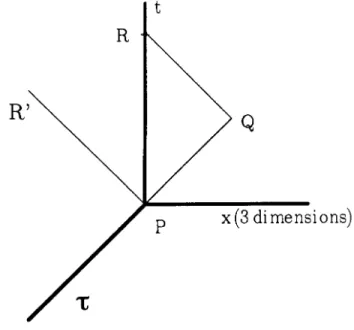
Figure2. Thetwin paradox.
Let us consider the Figure 2 in order to have a clear understanding of the meaning of x
5 of a
phys-ical object as its aging. This gure may represent a vain physicist looking himself at a mirror, or the limit-ing case (v c) of the twin paradox in Special
Rel-ativity. PR
0 and PQ are two generators of a same
causality-cone. PQ belongs to the light-cone (taking
v c). PR 0= (0
;0;0;;x
5) with
t = , while PQ= (~r ;
t
2
;0) andQR = (,~r ; t
2
;0): PR 0 is the
physicist world-line on his rest frame. R is the physicist image reected (back to him) at Q, or his twin brother returning from a trip to Q. They meet again at the timet=t
R
>0, at the same space point (~r= 0), from
where they had departed from each other, but now with distinct fth coordinates, x
5
R = 0 and x
5
R 0
> 0, that
represent their distinct agings.
Let us mention now a rich and interesting point of this geometry. Observe the dierence between and
t in (17): they are invariant under dierent subgroups of isometry |SO(3;1) and O
4, respectively| of the
causality-cone. Both sides of ()
2= ( t)
2
,(~x) 2
are invariant under transformation of the S0(1;3)
group, that is, rotation in a Minkowski spacetime (~x;t);
but in
(t) 2= (
) 2+ (
~ x)
2
both sides are invariant under 04, the rotation group in
Euclidean 4-dimensional spacetime (~x;):
The use of t in the place of as the invariant
cor-responds to a Wick rotation without the need of an-alytic continuation [10,11], t ! it, and lends to it a
clear physical and geometrical interpretation. Physi-cally it means that, for an Euclidean four-dimensional spacetime, events should be labelled not by the time measured in the observer's clock, but with their local proper time, read on their local clocks. 04is the
invari-ance group of the causality-cone for rotations around its t-axis. Care must be taken with the interpretation of the 04sub-groups involving
, as they correspond to
Lorentz and conformal transformations.
For those unaccustomed to the idea of extra-dimensions, we remind again that the Minkowski space-time represents the geometrization of an experimentally founded physical principle: the constancy of the speed of light. It requires that the time (up to then, just a parameter) be treated as the fourth coordinate of a four-dimensional manifold, the spacetime. We are doing here something very similar: the geometrization of causality, embodied in the relations (16) or (17). It requires a fth coordinate with the role of a propertime. We can now return to our initial problem, which in this geometry is pictured by an electron and its electro-magnetic eld (photon) in a same causality-cone, each along its own cone-generator. This picture, although simple, discards some old problems like self-interactions and their associated innities, but this will be discussed elsewhere (see the reference [13]). Let us consider in-stead the metric structure of the spacetime associated to each physical object. The metric induced by (18) on (15) of a physical object, (dS
5) 2=
dx: :dx,(f:dx) 2= dx:(,ff):dx, is given byg
=
for a massless eld
(since thend =,f:dx= 0), and byg = ,f f , with f = f and g = + f f
2 for massive
physical objects. The distinct causality requirements of massive and of massless elds and particles are, there-fore, represented by immersions with distinct metric structures. They can both be written in a single expres-sion (using either f
2 = 0 or f
2 =
,1 for, respectively
massless and massive objects):
g = + f 2 f f ; (19) g = ,f 2 f f
1 + (f 2)2
: (20)
At this point we can understand that a plus sign in front of ()
2 of the line element (15) would imply
on S 5
0 for all physical object and would induce g = + f f
, as a metric on a causality-cone of a
massive object, which would not be consistent because then,g
f
0.
The existence of two distinct metric structures for a massive and a massless eld invalidates (1) as the re-sult of (6). While T
;
= 0 for
> 0 remains valid
in this new picture, its limit when ! 0 is not as
simple as described before because it involves now a lo-cal change of manifolds with dierent metric structure (!,ff). Physically it only makes sense! For>0
one is dealing with electromagnetic elds (photons) for which (8,11) represent the causality requirement that A(x,t) andz(
ret) remain on a same light-cone, but for = 0 one has an electron, a massive particle, which
must attend a completely dierent causality relation (12,13). As a matter of fact, the limit of K when
tends to zero is an indeterminacy that can be resolved with a derivatived=d and the L'Hospital rule:
lim !0 K = lim !0 f = V V : (21)
This is coherent with (9) and (14). This change of K to V was not considered in the limit passage of (7), as also, of course, the change of metric required by (19). This procedure extends, in fact, the photon causality con-straint (11) to the electron; it corresponds to treating the electron as if it were a massless object. This new vision of spacetime requires a revision not only of the Lorentz-Dirac equation but of any theory of interact-ing elds. This will be discussed in subsequent papers. Our immediate goal has been attained with the stress-ing of the connections among causality violation in the Lorentz-Dirac equation and the spacetime structure.
IV Summary and Conclusions
this equation has always been accompanied by many doubts about its validity. It has been obtained from the most diverse approaches and its uniqueness has been scrutinized and proved under very generic and accept-able conditions [1, 2]. However, we do not endorse the apparently most accepted view that this is, after all, the correct equation and that its problems appear only when we stretch its application to situations when a quantum theory should be used instead.
With the strategy of geometrizing the Principle of Causality, that is, of transferring its implementation to the background spacetime structure, we nd that a model of spacetime, more complex than the model of Minkowski, is required. It makes clear that the weak point common to all demonstrations of the Lorentz-Dirac equation is the extrapolation for the electron of restrictions that are valid only for its electromagnetic eld. The Minkowski spacetime represents just a ge-ometrization of the Einstein postulates of Special Rel-ativity, and so it does not contemplate the dierence in the metric structure required for a more strict geomet-ric implementationof causality. Therefore, the Lorentz-Dirac equation is the result of imposing to the electron a causality behavior that is valid only for its
electro-magnetic eld. [13].
References
[1] E.G.P. Rowe, Phys. Rev. D, 12, 1576 (1975) and 18,
3639 (1978); Nuovo Cim. B73, 226 (1983).
[2] A. Lozada, J. Math. Phys.30, 1713 (1989).
[3] S. Parrot,Relativistic Electrodynamics and Dierential Geometry, Springer-Verlag, New York, (1987). [4] J. C. Eliezer, Rev. Mod. Phys.19, 148 (1947).
[5] J. D. JacksonClassical Electrodynamics, 2nd ed., chap. 14, John Wiley & Sons, New York, NY (1975). [6] C. Itzkyson, J. Zuber Quantum Field Theory, p. 43-44
McGraw-Hill, Singapore (1983).
[7] F. Rohrlich, Classical Charged Particles. Reading, Mass. (1965).
[8] C. Teitelboim, D. Villaroel, Ch.G. Van Weert, Rev. Nuovo Cim.3, 1 (1980).
[9] J. R. Fanchi, Phys. Rev D20, 3108 (1979).
[10] R. L. Ingraham, Lettere al Nuovo Cimento 7, 846
(1973a); Il Nuovo Cimento27B, 293 (1975).
[11] C. Itzkyson, J. Zuber Quantum Field Theory, p.300, 485, McGraw-Hill, Singapore (1983).