INTRODUCTION
Sugarcane is grown in over 110 countries. Brazil is the world’s largest producer of sugarcane, followed by India, China, and Thailand. It is estimated that the Brazilian sugarcane production will reach 597 million tons in the 2012/2013 crop [1]. This industry is based mainly on the production of sugar and ethanol, which generates huge amounts of sugarcane bagasse. The bagasse is the matted cellulose iber waste, whose composition is about 26.6–54.3 % cellulose, 22.3–29.7% hemicellulose, and 14.3–24.5% lignin [2]. This waste material is mainly reused in the same industry as fuel in boilers for energy co-generation [3]. As a result, the sugarcane industry produces huge amounts of a solid waste material known as sugarcane bagasse ash
(SCBA) worldwide.
According with FIESP [4], each ton of bagasse is estimated to produce 25 kg of residual SCBA. The Brazilian sugarcane industry alone generates around 4 million tons per year of SCBA. So far, the inal solution for this solid waste has been mainly its use as soil fertilizer. Only seldom it is utilized further. This is not a safe solution for inal disposal of this abundant waste, because it causes signiicant changes in the physico-chemical characteristics of the soils and environmental problems. Thus, efforts should be done in order to ind a permanent solution for the inal disposal and valorization of this solid waste material in an ecological and economical way. The ceramic industry uses huge amounts of natural raw materials for the manufacture of clay-based products [5-7]. This fact, however, has brought
Incorporation of sugarcane bagasse ash waste as an alternative raw
material for red ceramic
(Incorporação de resíduo de cinzas de bagaço de cana-de-açúcar como
uma matéria-prima alternativa para cerâmica vermelha)
K. C. P. Faria, J. N. F. Holanda
Grupo de Materiais Cerâmicos/LAMAV-CCT, Universidade Estadual do Norte Fluminense Darcy Ribeiro, Av. Alberto Lamego 2000, Campos dos Goytacazes, RJ, 28013-602, Brazil
[email protected], [email protected]
Abstract
The sugarcane industry generates huge amounts of sugarcane bagasse ashes (SCBA). This work investigates the incorporation of a SCBA waste as an alternative raw material into a clay body, replacing natural clay material by up to 20 wt.%. Clay ceramic pieces were produced by uniaxial pressing and ired at temperatures varying from 700 to 1100 ºC. The technological properties of the clay ceramic pieces (linear shrinkage, apparent density, water absorption, and tensile strength) as function of the iring temperature and waste addition are investigated. The phase evolution during iring was followed by X-ray diffraction. The results showed that the SCBA waste could be incorporated into red ceramics (bricks and rooing tiles) in partial replacement for natural clay material. These results conirm the feasibility of valorisation of SCBA waste to produce red ceramic. This use of SCBA can also contribute greatly to reducing the environmental problems of the sugarcane industry, and also save the sources of natural raw materials used in the ceramic industry.
Keywords:sugarcane bagasse ash, waste, red ceramic, recycling.
Resumo
A indústria de cana-de-açúcar gera enormes quantidades de cinzas de bagaço de cana-de-açúcar (CBCA). Este trabalho investiga a incorporação de um resíduo de CBCA como uma matéria-prima alternativa numa massa argilosa substituindo material de argila natural por até 20% em peso. Peças de cerâmica vermelha foram produzidas por prensagem uniaxial e queimadas em temperaturas entre 700 e 1100 ºC. As propriedades tecnológicas das peças de cerâmica vermelha (retração linear, massa especíica aparente, absorção de água e resistência à tração) como uma função da temperatura de queima e adição de resíduo de CBCA são investigadas. A evolução das fases durante o processo de queima foi acompanhada via difração de raios X. Os resultados mostraram que o resíduo de CBCA poderia ser incorporado em cerâmica vermelha (blocos cerâmicos e telhas) em substituição parcial do material de argila natural. Estes resultados conirmam a viabilidade de valorização do resíduo de CBCA em cerâmica vermelha. Este uso de resíduo de CBCA pode contribuir signiicativamente para redução dos problemas ambientais da indústria de cana-de-açúcar e, também, economizar as fontes de matérias-primas naturais usadas na indústria cerâmica.
the ceramic industry to face scarcity of good quality raw materials in locations close to the plants [8]. The SCBA waste is mainly composed of silicon oxide (SiO2), with other minor components such as aluminum, iron, calcium, and potassium oxides [9]. Thus, SCBA waste is very similar in terms of chemical composition to common clays used in the production of red ceramic. This means that the reuse of SCBA waste as a possible raw material for red ceramic is an important technological solution [10-13]. However, in spite of the fact that SCBA waste was produced in large amounts every year, insuficient attention was devoted to the incorporation of SCBA waste in the production of red ceramic.
The aim of this study is to investigate the suitability of incorporation of SCBA waste as a low cost raw material in the production of red ceramic.
MATERIALS AND METHODS
The raw materials used were common clay and SCBA waste. The common clay used was provided by a local red ceramic industry. The SCBA waste sample was colleted from a sugarcane mill located in south-eastern Brazil (Campos dos Goytacazes, RJ). Both samples in the form of granular powder were dried (110 ºC), and then sieved until a fraction passing in a 42 mesh (< 355 mm ASTM) sieve.
Coarser particles were rejected. The chemical compositions of the raw materials were determined by energy-dispersive X-ray spectrometer (EDX 700, Shimadzu). The loss on ignition was determined by calculating the wt.% difference between a sample dried at 110 ºC and a sample calcined at 1000 ºC during 2 h.
Mineralogical analysis of the raw materials was performed by X-ray diffraction (XRD 7000, Shimadzu), with monochromatic Cu-ka radiation at a scanning speed
1.5º 2q/min over non-oriented specimens. The crystalline
phases were identiied by comparing the intensities and positions of the Bragg peaks with those listed in the JCPDS-ICDD iles.
The particle size analysis of the raw materials was determined according to the NBR 7181-84 standard. The plastic properties were obtained through the Atterberg consistency limits according to the Brazilian standards (NBR 6459-84 and NBR 7180-84).
Five different clay/SCBA waste mixtures were prepared (Table I). The additions of SCBA waste were up to 20 wt.% in gradual replacement of common clay. The clayey compositions were mixed and homogenized in a cylindrical mixer for 30 min. The moisture content was adjusted to 7 wt.% water (moisture mass/dry mass).
The ceramic pieces in form of disks (25 mm diameter) were uniaxially pressed at 21 MPa, and then dried at 110 ºC for 24 h. The iring step was carried out at soaking temperatures varying from 700 to 1100 ºC, using a slow-iring cycle of total duration of 24 h (cold-to-cold). Heating and cooling rates were controlled.
The ceramic pieces were characterized in terms of linear shrinkage, water absorption, apparent density, and tensile strength. Linear shrinkage values upon drying and iring were evaluated from the variation of the main dimension (diameter) of the pieces. The apparent density values were determined using the Archimedes method of immersion in water. The water absorption values were determined from the weight differences between the as ired and water saturated pieces (immersion in boiling water for 2 h). The tensile strength of the ired pieces obtained by the diametral compressive method [14] was determined by using a universal testing machine (model 5582, Instron). The crossbar speed was hold at 0.5 mm/min for all tests. Mineralogical analysis of the ired pieces was done via X-ray diffraction. Microstructural analysis was done via scanning electron microscopy.
RESULTS AND DISCUSSION
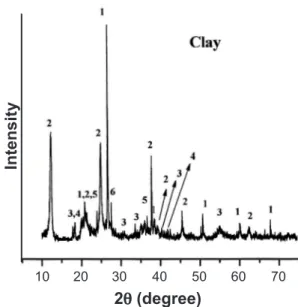
The XRD pattern of the SCBA waste is shown in Fig. 1. The following crystalline phases were identiied: quartz (SiO2), cristobalite (SiO2), hydrated calcium phosphate (Ca3(PO4)2.H2O), potassium carbonate (K2CO3), mullite (3Al2O3.2SiO2), and hematite (Fe2O3), with predominance of quartz. For the common clay, as shown in Fig. 2, kaolinite (2SiO2.Al2O3.2H2O) is the dominant clay mineral. Accessory minerals are quartz, gibbsite, goethite, and potash feldspar.
The chemical composition and loss on ignition of the raw materials used are given in Table II. In this table are also given the chemical compositions of SCBA wastes originated from different places. The SCBA waste is constituted mainly by SiO2 (61.59 wt.%), followed by Fe2O3, K2O, CaO, and Al2O3 (minor amounts of Ti, Mg, Mn, and P oxides). These results are in agreement with the XRD data (Fig. 1). The loss on ignition (LOI) is relatively high (9.78 wt.%), and is related mainly with the presence of organic matter. The chemical composition of the SCBA waste used in this work, as shown in Table II, is different from the others found in the literature [14-17]. This can be explained in terms of the different soils in which sugarcane grow, fertilization method, and soil management. The commercial common clay showed an expected typical composition rich in SiO2, Al2O3, and Fe2O3, with minor amounts of Ti, Ca, Mg, Mn, K, Na, and P oxides. The content of iron oxide (8.83 wt.%) is high, and characterizes the common clay as red iring clay. Formulations ClayRaw MaterialsSCBA
Waste KC0
KC5 KC10 KC15 KC20
100 95 90 85 80
0 5 10 15 20 Table I - Clayey formulations utilized (wt.%).
In addition, the loss on ignition (9.44 wt.%) is related mainly with the presence of clay minerals, hydroxides, and organic matter.
The data of particle size of the clay/SCBA waste mixtures were plotted in the Winkler’s diagram (Fig. 3). The Winkler’s diagram is based on the particle size of clay materials, where the vertices represent different particle size ranges (< 2 mm;
2 – 20 mm; and > 20 mm) [19]. According to the Winkler’s
diagram, it is possible to identify four major regions of clay-based products. These regions are: i) region A – it is adequate
for high quality products; ii) region B – rooing tiles; iii) region C – hollow loor bricks; and iv) region D – illed loor bricks. As can be observed in Fig. 3, the granulometric behavior of the clayey mixtures has been modiied with the SCBA waste additions. The formulation KC0 (no SCBA waste added) is placed in the boundary between the A (high quality product) and B (rooing tiles) regions. The formulation KC10 showed consistency as raw material of rooing tiles (region B). The formulation KC20 is placed inside of the characteristic region for hollow loor bricks (region C).
10 20 30 40 50 60 70
2q (degree)
Figure 1: XRD pattern for the SCBA waste sample. 1 – quartz; 2 – cristobalite; 3 – potassium carbonate; 4 – hematite; 5 – calcium phosphate; 6 – mullite.
[Figura 1: Difratograma de raios X da amostra de resíduo de CBCA. 1 – quartzo; 2 – cristobalita; 3 – carbonato de potássio; 4 – hematita; 5 – fosfato de cálcio; 6 – mullita.]
Figure 2: XRD pattern for the common clay sample. 1 – quartz; 2 – kaolinite; 3 – illite/mica; 4 – gibbsite; 5 – goethite; 6 – potash feldspar.
[Figura 2: Difratograma de raios X da amostra de argila. 1 – quartzo; 2 – caulinita; 3 – illita/mica; 4 – gibsita; 5 – goetita; 6 – feldspato potássico.
10 20 30 40 50 60 70
2q (degree)
Oxides Clay SCBA Waste Ref. [15] Ref. [16] Ref. [17] Ref. [18]
SiO2 Al2O3 Fe2O3 TiO2 CaO MgO MnO K2O Na2O
P2O5 SO3 ZrO2 Cr2O3 Sc2O3 ZnO V2O5 LOI+ 43.22 32.84 8.83 1.51 0.44 -0.10 2.56 -1.06 -9.44 61.59 5.92 7.36 1.46 5.00 1.17 0.10 6.22 -0.98 0.42 -9.78 72.74 5.26 3.92 0.32 7.99 2.78 -3.47 0.84 1.59 -59.87 20.69 5.76 -3.36 1.87 -1.37 1.11 -1.06 -0.63 60.97 0.09 0.09 -5.97 8.65 0.42 9.02 0.70 8.34 -5.70 83.707 -6.537 1.162 1.183 -0.081 -6.146 -0.682 0.303 0.094 0.040 0.037 0.029 -Table II - Chemical composition (wt.%) of the raw materials.
[Tabela II - Composição química (% em peso) das matérias-primas.]
The plasticity of the clay/SCBA waste mixtures (Fig. 4) was evaluated by the Atterberg´s consistency limits. The Atterberg plastic index (PI) was determined by PI = UPL – LPL, in which UPL is the upper plastic limit and LPL is the lower plastic limit. The incorporation of SCBA waste into clay body reduces its global plasticity. In fact, the SCBA waste is a non-plastic material rich in silica particles. It was found that the upper plastic limit varies from 63.6 to 54.9 %, lower plastic limit (water of plasticity) from 30.8 to 29.3 %, and the Atterberg plastic index from 33.5 to 25.6 %. These values are within the adequate range for industrial production of clay-based products [20]. Thus, the SCBA waste could be incorporated in moderate amounts into plastic clay body as
a non-plastic component, which provides structural support that helps to retain shape during drying and iring steps.
The physical properties of the red ceramic pieces in the dried state at 110 ºC are presented in Table III. The results demonstrate that no signiicant differences in the drying shrinkage and drying density of the pieces were observed among the studied clayey formulations. In addition, the shrinkage and density values for all clay ceramic pieces satisfy the safe limits for industrial production of red ceramic.
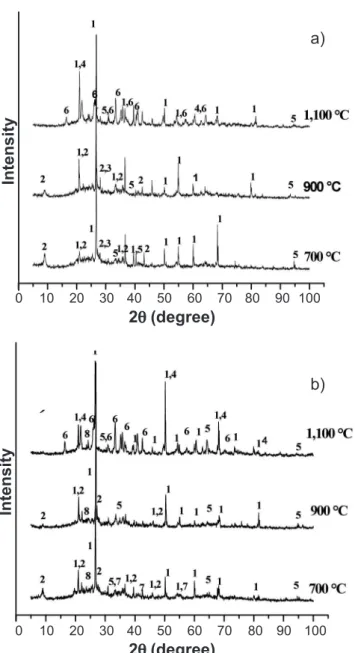
Figs. 5a and b show the XRD patterns of the KC0 and KC10 formulations ired at different temperatures. It can be observed in Fig. 5a that at 700 ºC the peaks of kaolinite, gibbsite, and goethite are not seen. Kaolinite is transformed into amorphous metakaolinite [21]. Gibbsite has likely been transformed into a transition alumina phase, while goethite has been transformed in hematite. The peaks of illite/mica and potash feldspar remain up to 900 ºC, while the peaks of quartz are present during all iring temperatures. At 1100 ºC peaks of mullite, hematite, and cristobalite appear. Specimens containing SCBA waste (KC10 sample) showed a quite different phase evolution as revealed by the XRD patterns (Fig. 5b). Quartz and calcium phosphate peaks are observed for all iring temperatures. At 700 ºC, quartz, illite/mica, cristobalite, calcium phosphate, and potassium carbonate appear. At 900 ºC, the peaks of potassium carbonate have disappeared. At 1100 ºC, mullite peaks were detected.
Figs. 6a-c show the SEM micrographs of the ired specimens at 1100 ºC prepared with different amounts of added SCBA waste. The effect of the incorporation of SCBA waste (Figs. 6b-c) is to increase the open porosity of the ired specimens. This is associated with high concentrations of silica particles and organic matter in the SCBA waste sample. In addition, the SCBA waste containing specimens (Fig. 6b) showed microcracks probably related to the inversion
b-quartz ®a-quartz during cooling.
Figs. 7-10 show the changes observed in the technological properties (linear shrinkage, apparent density, water absorption, and tensile strength) of the red ceramic pieces as a function of the waste additions and iring temperature. The results demonstrate clearly that the technological properties are strongly dependent on both the waste additions and iring temperature.
Plastic Clay
Sandy Clay
Sandy Clay
Figure 3: Granulometric classiication of the clay/SCBA waste mixtures according to Winkler diagram. 1 – KC0; 2 – KC10; 3 – KC20.
[Figura 3: Classiicação granulométrica das misturas argila/ resíduo de CBCA de acordo com o diagrama de Winkler. 1 – KC0; 2 – KC10; 3 – KC20.]
Figure 4: Atterberg consistency limits for the clayey formulations. [Figura 4: Limites de consistência de Atterberg para as formulações argilosas.]
65
45 55
35 60
40
25 50
30
KC0
Clayey Formulations
Plastic properties (%)
KC10 KC20
Formulation Drying Shrinkage
(%) Drying Density(g/cm3)
KC0 KC5 KC10 KC15 KC20
0.10 ± 0.06
0.09 ± 0.04
0.06 ± 0.04
0.08 ± 0.04
0.05 ± 0.03
1.75 ± 0.02
1.71 ± 0.02
1.72 ± 0.02
1.67 ± 0.02
1.70 ± 0.02
Table III - Physical properties of the red ceramic pieces in the dried state at 110 ºC.
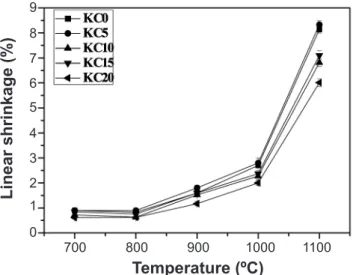
Fig. 7 shows the linear shrinkage of the red ceramic pieces ired at different temperatures. This property is very important for the dimensional control of the inished red ceramic products. The linear shrinkage increases continuously with the increase of the iring temperature for all SCBA waste additions. The ceramic pieces presented low iring shrinkage up to 1000 ºC (0.61–2.80%), resulting in good dimensional control. At 1100 ºC, however, a higher range of values is measured (6.01–8.33%). According with the literature [22] for temperatures up to 1000 ºC, the red ceramic pieces are sintered predominantly via solid state
sintering mechanism. Above 1000 ºC the specimens are sintered prevalently by viscous low [22, 23]. This explains the higher values of linear shrinkage. It can also be seen in Fig. 7 that the shrinkage of the SCBA waste containing pieces is lower than that in the pure clay pieces (KC0 formulation). In fact, as shown in Fig. 4, the incorporation of the SCBA Figure 5: XRD patterns for the red ceramic pieces ired at different
temperatures. a) KC0; and b) KC10. 1 – quartz; 2 – illite/mica; 3 – potash feldspar; 4 – cristobalite; 5 – hematite; 6 – mullite 7 – potassium carbonate – 8; calcium phosphate.
[Figura 5: Difratogramas de raios X das peças de cerâmica vermelha queimadas em diferentes temperaturas. a) KC0 e b) KC10. 1 – quartzo; 2 – illita/mica; 3 – feldspato potássico; 4 – cristobalita; 5 – hematita; 6 – mullita; 7 – carbonato de potássico; 8 - fosfato de cálcio.]
0 10 20 30 40 50 60 70 80 90 100
2q (degree)
0 10 20 30 40 50 60 70 80 90 100
2q (degree)
Figure 6: SEM micrographs of the ired specimens at 1100 ºC: a) KC0; b) KC10; and c) KC20.
[Figura 6: Micrograias obtidas via MEV das amostras queimadas em 1100 ºC: a) KC0; b) KC10; e c) KC20.]
a)
b)
Intensity
waste rich in silica particles reduces the plasticity of the used common clay. Thus, the SCBA waste improved the dimensional control of the red ceramic pieces.
The apparent density of the ired pieces is shown in Fig. 8. It can be seen that the density decreases for higher SCBA waste additions. This result is in accordance with the linear shrinkage values. The pieces ired up to 1000 ºC presented the lowest apparent density (1.51–1.70 g/cm3), which is
due to the combined inverse effects of sintering and weight loss. At 1100 ºC, however, a substantial increase in apparent density (1.77–1.94 g/cm3) was observed, which is in line
with the vitriication that helps to reduce the open porosity of the red ceramic pieces.
Fig. 9 shows the curve of tensile strength of the ired pieces. As expected, the effect of the iring temperature
Figure 8: Apparent density as a function of SCBA waste amount for all temperatures.
[Figura 8: Massa especíica aparente como uma função da quantidade de resíduo de CBCA para todas as temperaturas.]
2.0
1.9
1.8
1.7
1.6
1.5
700
Temperature (ºC) 900
800 1000 1100
Apparent density (g/cm
3)
Figure 7: Linear shrinkage as a function of SCBA waste amount for all temperatures.
[Figura 7: Retração linear como uma função da quantidade de resíduo de CBCA para todas as temperaturas.]
9
5 7
3 8
4 6
2 1 0
700
Temperature (ºC)
Linear shrinkage (%)
900
800 1000 1100
was to increase the mechanical strength mainly above 1000 ºC. This behavior is in accordance with the densiication behavior during sintering (Figs. 7 and 8). The results also showed that the SCBA waste additions tend to decrease the mechanical strength of the clay ceramic pieces. This signiies that high amounts of SCBA waste should be avoided because it tends to severely reduce the mechanical strength of the red ceramic pieces.
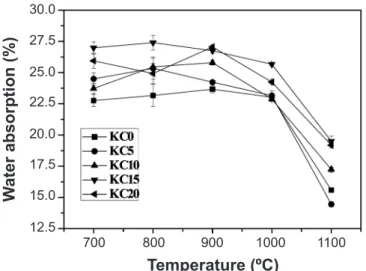
Fig. 10 shows the water absorption of the ired pieces. The water absorption is related to the volume of the open pores, that is, the pores that are connected with the specimen’s surface. As expected, the water absorption increased for higher SCBA waste additions. This behavior agrees with the observation of the microstructure (Fig. 6) and apparent density (Fig. 8). It can also be seen in Fig. 10 that the water absorption behaves differently below and above 1000 ºC. In the 700- 1000 ºC temperature range, the water absorption presented only a small variation (22.76-27.40%). At 1100 ºC, a signiicant decrease in water absorption is measured (14.45-19.50%), caused by open-pore partial closure. The water absorption (wa) is also a physical property that deines the class to which any clay-based building materials suits. The reference values of water absorption currently accepted in the industrial practice for manufacture of bricks and rooing tiles are: optimal range (wa = 12–24%) and acceptable range (wa = 10-30%) [20]. In this study the speciication for bricks and rooing tiles has been attained in the following iring temperatures: i) KC0 (optimal range between 700 and 1100 ºC); ii) KC5 and KC10 (optimal range between 1000 and 1100 ºC and acceptable range between 700 and 900 ºC); and iii) KC15 and KC20 (optimal range at 1100 ºC and acceptable range between 700 and 1000 ºC).
The colour and appearance of the red ceramic pieces in the dry state and ired at different temperatures were Figure 9: Tensile strength as a function of SCBA waste amount for all temperatures.
[Figura 9: Resistência à tração como uma função da quantidade de resíduo de CBCA para todas as temperaturas.]
5 7
3 4 6
2
1
0
700
Temperature (ºC)
Tensile strength (MPa)
900
Figure 10: Water absorption as a function of SCBA waste amount for all temperatures.
[Figura 10: Absorção de água como uma função da quantidade de resíduo de CBCA para todas as temperaturas.]
examined. All ceramic pieces in the dried state (at 110 ºC), as shown in Fig. 11, presented brown colour. However, the incorporation of SCBA waste tends to modify the hue of the pieces toward darken brown colour. In fact, the pieces have small black’s dots that characterize the presence of SCBA waste. Despite this, the incorporation of SCBA waste had little inluence on the colour of the ired pieces (Fig. 12). The pieces showed reddish-yellow colour typical of red ceramic materials. At 1100 ºC, however, the ceramic pieces become slightly darker. This can is directly associated with iron oxide present in the used clayey body. It can also be observed that no red ceramic piece has shown any indication of surface stains due to the incorporation of SCBA waste. Thus, the iring colour of the ired pieces is suitable for red ceramic production.
CONCLUSIONS
This work has demonstrated that the SCBA waste could be incorporated as a low cost raw material to produce red ceramics (bricks and rooing tiles). This is very important because the incorporation of the SCBA waste into clay body can contribute greatly to reduce the environmental impacts caused by the sugarcane industry worldwide. The SCBA waste is chemically rich in silica particles (SiO2), but also contains calcium phosphate, potassium carbonate, mullite, cristobalite, and hematite as accessory minerals. It is a non-plastic material that signiicantly affects the granulometric and plastic behavior of the used clay body. It was found that the SCBA waste inluenced the technological properties, microstructure, and phase evolution of the ired red ceramic pieces. The incorporation of SCBA waste into clay body tends to improve the dimensional stability of the red ceramic pieces. The water absorption speciications for bricks and rooing tiles have been achieved in the iring temperature range employed. The results also showed that the mechanical strength was severely reduced for additions above 10 wt.% of SCBA waste. For this reason, this study suggests that only moderate additions of SCBA waste should be used in the production of red ceramic.
ACKNOWLEDGEMENTS
The authors would like to thank CNPq and FAPERJ for the inancial support and Usina Sapucaia by the supply of SCBA waste.
REFERENCES
[1] CONAB, Acompanhamento da Safra Brasileira: Cana-De-Açúcar, Brasília, DF (2012).
[2] K. S. Shanmukharadhya, K. Ramachandran, J. Energy Inst. 82 (2009) 120-122.
[3] B. R. Stanmore, Waste Biomass Valor. 1 (2010) 77-89. [4] FIESP, Ampliação da Oferta de Energia Através da Biomassa (Bagaço de Cana-De-Açúcar), S. Paulo, SP (2001).
Figure 11: Variation in colour of the ceramic pieces after drying at 1100 ºC.
[Figura 11: Variação na cor das peças cerâmicas após secagem a 1100 ºC.]
Figure 12: Variation in colour of the ceramic pieces after iring at different temperatures.
[Figura 12: Variação na cor das peças cerâmicas após queima em diferentes temperaturas.]
30.0
27.5
25.0
22.5
20.0
17.5
15.0
12.5
700
Temperature (ºC)
W
ater absorption (%)
900
800 1000 1100
700 ºC
KC0
KC5
KC10
KC15
KC20
900 ºC
[5] L. A. Díaz Rodríguez, R. Torrecillas, Bol. Soc. Esp. Cerám. Vídrio 41 (2002) 459-470.
[6] C. N. Djangang, A. Elimbi, U. C. Melo, C. Nkoubou, G. Leconte, J. Yuon, J. P. Bonnet, D. Njopwowo, Ind. Ceram. 27 (2007) 79-88.
[7] H. Baccour, M. Medhioub, F. Jamoussi, T. Mhiri, A. Daoud, Mater. Charact. 59 (2008) 1613-1622.
[8] R. R. Menezes, G. A. Neves, H. C. Ferreira, Rev. Bras. Eng. Agrí. Amb. 6, 2 (2002) 303-313.
[9] K. C. P. Faria, Master Thesis, UENF-PPGECM, Campos dos Goytacazes, RJ (2011).
[10] E. S. Freitas, Master Thesis, UENF-PPGEC, Campos dos Goytacazes, RJ (2005).
[11] S. R. Teixeira, A. E. Souza, G. T. A. Santos, A. F. V. Pena, J. Am. Ceram. Soc. 91 (2008) 1883-1887.
[12] V. S. Aigbodion, S. B. Hassan, T. Aux, G. B. Nyior, J. Miner. Mater. Charac. Eng. 9 (2010) 67-77.
[13] K. C. P. Faria, R. F. Gurgel, J. N. F. Holanda, J. Environ. Manag. 101 (2012) 7-12.
[14] F. Chen, Z. Sun, J. Xu, Int. J. Rock Mech. Min. Sci. 38,
(2001) 475-479.
[15] J. F. Martirena, H. B. Middendorf, M. Gehrke, H. Buldelmann, Cem. Concr. Res. 28, 11 (1998) 1525-1536. [16] J. Payá, J. Monzó, M. V. Borrachero, L. Diaz-Pinzón, L. M. Ordónez, J. Chem. Technol. Biotechnol. 77, 3 (2002) 321–325.
[17] G. C. Cordeiro, F. R. D. Toledo, E. M. R. Fairbair, Quim. Nova 32, (2009) 82-86.
[18] M. O. Paula, I. F. F. Tinôco, C. S. Rodrigues, E. N. Silva, C. F. Souza, Rev. Bras. Eng. Agrí. Amb. 13, 3 (2009) 353-57.
[19] H. G. F. Winkler, Ber. DKG 31 (1954) 337-343. [20] M. Dondi, Int. Ceram. J. (2003) 55-59.
[21] P. S. Santos, Ciência e Tecnologia de Argilas, Vol. 1, 2a
Ed., Edgard Blücher Ltda, S. Paulo, SP (1989).
[22] F. A. C. Milheiro, M. N. Freire, A. G. P. Silva, J. N. F. Holanda, Ceram. Int. 31 (2005) 757-763.
[23] J. S. Reed, Principles of Ceramic Processing, 2nd Ed.,