PUSHOVER ANALYSIS OF FLAT SLAB BUILDINGS WITH SHEAR
STUDS PUNCHING REINFORCEMENT
Brisid ISUFI1, António M. P. RAMOS2, Válter J. G. LÚCIO3, Ildi CISMASIU4,
ABSTRACT
Low energy dissipation, punching shear failures and the high lateral flexibility are among the main reasons why it is not recommended to use flat slabs as primary seismic elements in buildings. Punching failures can lead to progressive collapse of the entire building if integrity reinforcement is not provided. Meanwhile, several experimental campaigns have shown that flat slab specimens with enhancement of the punching shear strength via shear reinforcement can achieve considerably large drifts when subjected to horizontal loads. The purpose of this study is to investigate the effect of such drift capacity enhancement in the overall behavior of regular flat slab buildings towards seismic actions. Pushover analyses of buildings with and without shear reinforcement, with 1, 3 and 5 stories and different column cross sections are presented. The unbalanced moment – drift relationships of the slab – column connections are calibrated based on an experimental campaign performed at Universidade NOVA de Lisboa. A simple model, similar to models previously reported in literature, is used to represent the unbalanced moment transfer mechanism by dropping the unbalanced moment to a low value when the joint rotation reaches the experimentally observed value. The presence of shear reinforcement considerably influences the global response of the models. However, several deficiencies in the seismic behavior of the models are observed, even in models where the flat slabs sustain large drift ratios.
Keywords: flat slab; pushover; reinforced concrete; punching; shear studs
1. INTRODUCTION
Horizontal cyclic loading tests of flat slab specimens with shear reinforcement have shown that a significant increase in the drift capacity is achieved compared to similar specimens without shear reinforcement. Early campaigns such as those described in Hanna et al. (1975) and recent ones such as
the campaign containing the specimens presented in this communication, indicate that the introduction of shear reinforcement substantially improves the behavior of flat slabs under
horizontal cyclic loading. Shear studs are among the most effective and practical solutions. The efficiency of the shear studs in the enhancement of punching shear strength has been investigated by several experimental concentric monotonic loading tests, such as those summarized in Ferreira et al. (2014) and more recent ones such as Lips et al. (2012), Hegger et al. (2017). The efficiency under horizontal cyclic loading has been investigated in Brown (2003), Cao (1993), Robertson et al. (2002), Tan and Teng (2005), Broms (2007), Kang and Wallace (2008), Cheng et al. (2010), Song et al. (2012), Park, et al. (2012) and Matzke et al. (2015).
Considerably high drift ratios at failure have been reported in the abovementioned publications. In a real building, however, it is often not possible to attain such high drift ratios without failure of other structural elements (for example, columns, shear walls and nonstructural components). For example, Pan and Moehle (1989) concluded that the required displacement ductility for the vertical elements in a flat slab
1
PhD Student, Faculdade de Ciências e Tecnologia, Universidade NOVA de Lisboa, Portugal,
2
CERIS, Faculdade de Ciências e Tecnologia, Universidade NOVA de Lisboa, Portugal, [email protected] 3
CERIS, Faculdade de Ciências e Tecnologia, Universidade NOVA de Lisboa, Portugal, [email protected] 4
2
building is considerably higher than that for the slab – column connections. The use of flat slabs as primary seismic elements is discouraged in highly seismic areas due to research findings and lack of code coverage. For example, Eurocode 8 (2004) does not fully cover such buildings. However, a better understanding of the seismic behavior of these buildings would contribute in the risk mitigation of existing buildings and safer design of new ones.
To investigate the influence of slab shear reinforcement in the overall structural behavior of such buildings, pushover analyses of structural models calibrated based on two specimens tested at the Department of Civil Engineering, Faculdade de Ciências e Tecnologia, Universidade NOVA de Lisboa (DEC/FCT/UNL) are presented. The main variables were the shear reinforcement in the flat slabs, the number of stories and column cross sections. The experimental program is briefly described in the next sections, followed by a description of the structural models and the presentation and discussion of the pushover analyses.
2. EXPERIMENTAL PROGRAM
2.1 Description of the specimens
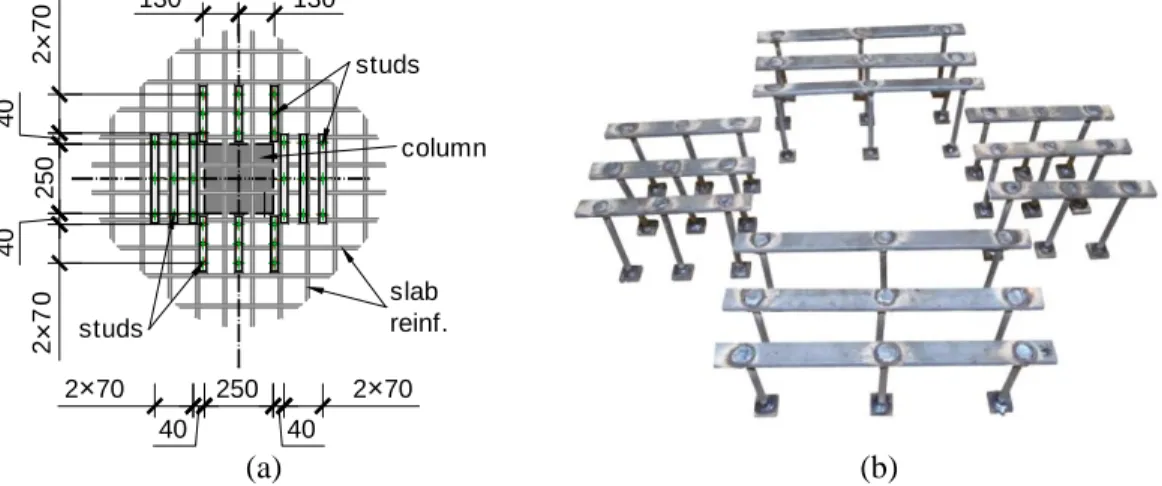
Two specimens tested under reversed horizontal cyclic loading at DEC/FCT/UNL are used as the basis of calibration of the structural models. The specimens are briefly described in this section. A detailed description and analysis can be found in Isufi et al. (2018). The two specimens were similar in terms of geometry and longitudinal reinforcement. However, one of the specimens (C-Ref) had no shear reinforcement and served as a reference specimen, whereas the other specimen (C-SSR3) was reinforced with three rows of 8 mm diameter studs spaced at 70 mm in a cruciform layout near the column (Figure 1).
(a) (b)
Figure 1. Shear reinforcement of specimen C-SSR3. (a) Layout. (b) Photo of the complete set of studs The specimens had overall dimensions 4.15 m × 1.85 m, thickness equal to 150 mm and a 2.0 m high steel column (1.0 m above and below the slab) with a rigid square base plate with side dimensions equal to 250 mm. The top reinforcement consisted of Φ12 mm bars spaced at 100 mm in vicinity of the column and at 200 mm outside the column region. Rebars parallel to the longest direction were placed on top of the rebars in the shortest direction. The bottom reinforcement consisted of Φ10 mm bars at uniform spacing of 100 mm. The nominal concrete cover for the top and bottom longitudinal bars was 20 mm. Details of the longitudinal reinforcement are the same as those provided for the specimens of Almeida et al. (2016).
The cylinder compressive strength fc and the modulus of elasticity of concrete Ec were determined on
the cyclic loading test day using five cylinders with diameter 150 mm and height 300 mm. Five other cylinders were used for the determination of the tensile splitting strength of concrete, fct,sp. The concrete
characteristics determined from tests are summarized in Table 1 along with the applied gravity load in the critical shear perimeter Vg, yield strength fy and yield strain εy of 12 mm bars (top bars), 10 mm bars
2×70 40 250 2×70 40 2× 7 0 4 0 2 5 0 2× 7 0 4 0 130 studs column slab reinf. studs 130
3 (bottom bars) and 8 mm bars (studs).
Table 1. Main material characteristics determined from tests. specimen fc (MPa) Ec (GPa) fct,sp (MPa) Vg (kN) fy (MPa) εy (%) Φ8 Φ10 Φ12 Φ8 Φ10 Φ12 C-Ref 62.3 41.4 4.4 224.8 - 550 542 - 0.27 0.27 C-SSR3 41.2 35.2 3.2 196.4 485 524 545 0.24 0.26 0.27
2.2 Test setup and loading protocol
The test setup developed at DEC/FCT/UNL was used (Almeida et al. 2016). This setup allows modelling of the specimens with both negative and positive bending moment regions, i.e. the specimens represent the portion of the slab from mid-span to mid-span in the longitudinal direction. For the transversal direction, a width equal to 22% of the span is assumed.
After the application of the full gravity load with the values of Vg shown in Table 1, reversed horizontal
cyclic displacements are applied at the top end of the column while maintaining the gravity load constant. For drift ratios smaller than 4%, the cycles for each target drift are repeated three times, in order to observe the strength and stiffness degradation during successive cycles. Two repetitions are performed for 4% drift ratio. For higher drifts, only one cycle per target drift is completed. Target drifts are increased in steps of 0.5% until failure of the specimen.
2.3 Main results
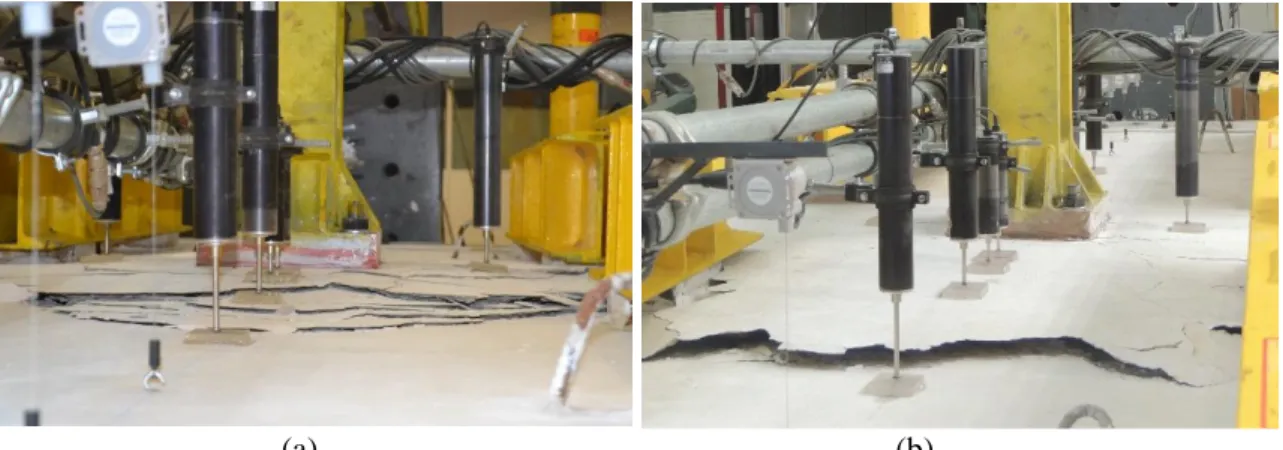
The application of the gravity load was associated with few flexural cracks in both negative and positive bending moment regions of specimen C-Ref. Cracks developed further, and their width gradually increased during the application of lateral drifts. New flexural cracks became visible at 0.5% drift ratio at distances further away from the face of the column. Narrow radial cracks were visible, originating from the corners of the column. At the first two 1.0% drift cycles, the cracks were further developed, and their width was increased gradually. At the end of the second cycle of 1.0% drifts, signs of the initiation of a punching failure were present. Relative shear displacement of concrete cover was observed at a distance 100 and 200 mm from the face of the column and the radial cracks were increased in number and opening. A brittle punching failure occurred in the third cycle with target drift 1.0% (Figure 2-a).
(a) (b)
Figure 2. Specimens at the end of the test. (a) C-Ref. (b) C-SSR3
In specimen C-SSR3, few flexural cracks were observed in the top face of the slab near the column after the application of the total gravity load. Small radial cracks appeared in the top face of the slab at the column region for 0.5% drift ratio. The cracks continued to develop further for larger drifts. At 2.0% drift ratio, minor flexural cracks started to appear at positive bending moment regions, whereas the cracks on the top face opened considerably. At 3% drift ratio, a peripheral crack appeared at distance
4
approximately 50-60 mm from the column face and the connection reached its maximum unbalanced moment capacity. At 3.5% drift, more radial cracks propagated; however, the hysteretic behavior remained stable without significant strength degradation. Stable behavior was also observed in the first cycle of 4.0% drift ratio, but a sudden punching failure occurred in the second cycle (Figure 2-b). Immediate drop of the horizontal load was observed after punching failure. Punching occurred outside the shear reinforced zone. Spalling of concrete cover was observed in the bottom part of the slab and the diagonal crack was initiated exactly at the lower part of the studs of the outer shear reinforcement perimeter. Above the top reinforcement, the inclination of the crack was decreased, and the failure region was extended up to a radius ranging between approximately 650 mm and 750 mm from the axis of the column. The horizontal force – displacement relationships for the two specimens are shown in Figure 3.
3. MODELLING OF FLAT SLAB BUILDINGS FOR PUSHOVER ANALYSIS
3.1 Slab – column connections
Nonlinear analyses are challenging for flat slab structures, especially in terms of structural modelling of the flat slab – column connections. The model should be able to accurately represent the unbalanced moment – drift relationship, including the loss of unbalanced moment transfer capacity due to punching failures.
Models consisting of shell elements combined with linear elements and springs are proposed by Choi and Kim (2015) for nonlinear static analysis and by Liu et al. (2015) for progressive collapse analysis. A “grid model” is proposed by Coronelli (2010) to model the flat slab with a grid of beam elements. The first model to directly incorporate punching failures into the structural analysis was proposed by Hueste and Wight (1999). They developed a new element which was made available and implemented in the nonlinear program DRAIN-2DM (Tang and Goel, 1998). The element checks for punching failures based on a failure criterion determined as a function of the experimentally observed relationship between the gravity shear ratio (the ratio between the applied gravity load and the concentric punching shear resistance) and the ultimate drift ratio.
The model proposed by Kang et al (2009) has been used mainly in research studies related to the seismic behavior of flat slab buildings. It involves zero length column strip slab flexural hinges, a connection spring and rigid end zones inside the joint region. The connection spring is assigned a rigid-plastic behavior and a limit-state model that triggers degradation once the conditions are met for a punching failure. Such conditions are set in terms of stresses in the critical punching shear perimeter and inter-story drift ratios. The limit state model has been developed by Elwood (Elwood and Moehle, 2003), (Elwood, 2004) and is available for use in the OpenSees (McKenna et al. 2010) platform. The slab springs are used to model flexural plastic hinges in the slab. The springs are calibrated so that different failure modes are captured by the model, namely a) punching failure prior to slab reinforcement yielding; b) yielding of slab reinforcement followed by a punching failure and c) punching failure after flexural yielding in the column strip for a certain inter-story drift ratio. Kang et al. (2009) used shake table tests to validate their model and showed promising results in terms of comparison with the experiments. The model used and tested in this study is based on the model proposed by Kang et al. (2009), with some modifications. The first is related to the modelling of the slab-beams. Herein a nonlinear fiber element modelling approach is adopted instead of using elastic elements and slab plastic hinges. Since the slab – column connections in this paper are calibrated based on experimental tests, modifications are also made on the nonlinear behavior characteristics of the model components. For instance, a linear transition zone is added between the rigid branch and the perfectly plastic branch in the connection spring (Figure 4), as it was found to produce results that match closer to the experiment. The OpenSees (McKenna et al. 2010) platform is used throughout this study. The spring is modelled using the LimitState (Elwood, 2004) uniaxial material in OpenSees, which has a trilinear backbone curve and a hysteretic behavior based on the Hysteretic material (Scott et al. 2016). The hysteretic behavior of the connection spring lies outside the scope of this communication and is not further discussed herein. The characteristics of the connection springs are determined based on the experimental observations. The limit state model is based on the global connection rotation. This approach limits the application to buildings in which the global rotation at the slab – column connections is not significantly influenced
5
by the flexural deformation of the entire building as a long cantilever.
The model used for calibration of the connection spring characteristics (Figure 4-b) replicates the boundary conditions of the test setup and it is shown in Figure 4-a. The ACI 318-14 (2014) eccentric shear model for moment transfer (see Kang et al. (2009)) is used to determine the yield unbalanced moment of the connection spring My,unb, as follows:
, 3 , 3 ,
(
y c h y c h)
y unb fM
M
M
γ
(1)where M+y,c+3h and M-y,c+3h are the positive and negative slab yield moments calculated based on a section
width equal to the dimension of the column’s side plus three times the thickness of the slab, with average material characteristics as measured by the tests. Equation 1 was calibrated to match the experimental value of My,unb and it was found that a value of the portion of the unbalanced moment transferred by
flexure equal to γf = 0.7 gives the best result.
(a) (b)
Figure 3. Comparison of experimental and numerical results. (a) Specimen C-Ref. (b) Specimen C-SSR3
Figure 4. Model used for calibration of the slab – column connections. a) Model of the test setup. b) Connection spring moment-rotation relationship.
Using the model described in Figure 4, the force-displacement relationships of Figure 3 are obtained from a pushover analysis with incremental displacements applied at the top of the column. The figure shows that there is a good agreement between the experiment and the numerical model in terms of the force-displacement relationship and punching failure prediction.
-5 -4 -3 -2 -1 0 1 2 3 4 5 -160 -120 -80 -40 0 40 80 120 160 -80 -60 -40 -20 0 20 40 60 80 -100 -80 -60 -40 -20 0 20 40 60 80 100 Drift ratio (%) U n b a la n c e d m o m e n t (k N m ) H o ri z o n ta l fo rc e ( k N ) Horizontal displacement (mm) C-Ref, exp. C-Ref, numerical -5 -4 -3 -2 -1 0 1 2 3 4 5 -160 -120 -80 -40 0 40 80 120 160 -80 -60 -40 -20 0 20 40 60 80 -100 -80 -60 -40 -20 0 20 40 60 80 100 Drif t ratio (%) U n b a la n c e d m o m e n t (k N m ) H o ri zo n ta l fo rc e ( k N ) Horizontal displacement (mm) C-SSR3, exp. C-SSR3, numerical constrained rotation and deflection horizontal loading
fibre element (slab)
gravity loads
fibre element
fibre element (column)
fibre column rigid elements fibre slab coinciding points Munb (kNm) rotation (rad) (symmetric) connection spring My,unb 0.8My,unb 0.01 a) b)
6 3.2 Material modeling
The structural steel used for steel columns and the reinforcement used for both columns and slabs is modelled using a Giuffré-Menegotto-Pinto model with isotropic strain hardening (named Steel02 in OpenSees) (Filippou et al. 1983), (Filippou and Mazzoni, 2012). A concrete material with linear tension softening (named Concrete02 in OpenSees, (Filippou and Mazzoni, 2010)) is used to model the slab-beams and the concrete columns.
The material characteristics determined from tests were used, as described in Table 1. Tensile strength of concrete was taken equal to 0.9fct,sp and the modulus of elasticity of concrete was taken 0.9Ec, in
accordance with the recommendations of Eurocode 2 (2004). Assumptions based on practice and simplicity were made for properties required by the material models that were not directly determined from tests. For instance, the strain hardening ratio of structural steel (used in steel columns) was assumed 1% and close to zero for reinforcement steel. The yield strength of structural steel was taken equal to 275 MPa. The modulus of elasticity was taken 210 GPa for structural steel and 200 GPa for reinforcement steel. Concrete ultimate strain was assumed equal to 0.35%. Crushing strength was taken equal to 72% of the maximum strength, considering confined concrete. The concrete and steel properties for the columns and the slabs were assumed similar.
3.3 Global models
A total of 27 frames were modelled and analyzed in the OpenSees (McKenna et al. 2010) platform. The frame models presented herein consist of an array of basic sub-assembly units such as that shown in Figure 4, therefore they are “scale models” of the prototype building corresponding to the laboratory tests. The models are given names based on the following convention: number of stories followed by the type of slab – column connections followed by a description of the columns. The types of slab – column connections are: R- for rigid connections, NoSr for connections calibrated based on specimen C-Ref and SSR for connections calibrated based on specimen C-SSR3. The column types are: S- for steel HE120M columns (same as the column used in the laboratory tests), C1- for reinforced concrete square 250×250 columns reinforced with 12Ø12 bars and C2- for reinforced concrete square 250×250 columns reinforced with 12Ø16 bars. For example, the model 3-NoSr(S) is a three-story frame with steel columns and flat slabs without shear reinforcement. All the frames have 5 bays (Figure 5). It is assumed that punching failures cannot occur in the exterior connections due to the presence of a continuous support (a beam) for the slab, therefore no rotational spring is modelled in the exterior connections. All columns within a model are modelled with the same cross section properties.
Figure 5. Geometry of the models (variable number of stories)
Although impractical for real buildings, the frames with steel column cross sections are presented for model verification and completeness. The column C1 is chosen such that its moment – curvature relationship matches as closely as possible to that of the laboratory steel column for the elastic range of loading. Furthermore, C1 has a bending moment capacity comparable with that of the flat slab-beam elements. The other column, C2, has the same cross section outer dimensions but it has a high reinforcement ratio and a bending capacity approximately 1.3 times that of the slab specimen. The
cross-full restraint nonlinear fiber elements rotational springs I-1 nonlinear fiber elements nonlinear fiber elements Lx= 3.84m Lx Lx Lx Lx 2 .0 0 m 2 .0 0 m 2 .0 0 m
7
section dimensions are kept the same as the steel base plate dimensions, and since the slab – column connections are calibrated based on joint rotations, using reinforced concrete columns instead of the steel column in the structural models is considered acceptable.
For the pushover analysis, a lateral load pattern compatible with the first mode of vibration of the structure was applied. P-Δ effects were included in the analysis. The analyses are terminated when the monitored displacement reaches a value of 500 mm or when analysis convergence is no longer achieved.
4. RESULTS AND DISCUSSION
4.1 Pushover curves
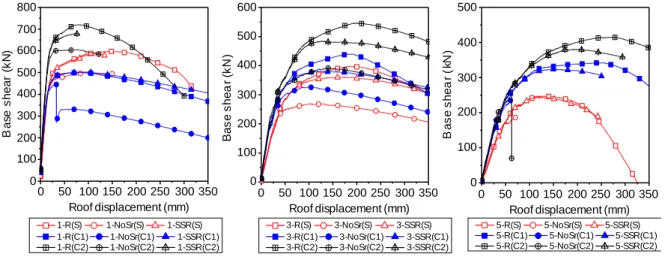
The obtained pushover curves are given in Figure 6. The curves corresponding to models with rigid joints (i.e., without rotational springs) are also given for reference. Since these models do not accurately account for the portion of the unbalanced moment that is transferred to the slab and because they assume that the full width of the beam-slab participates in the load resisting frame, they overestimate the strength of the structure, as expected. However, the initial stiffness of these models closely matches the initial stiffness of models with connection springs. Obtaining an accurate force-displacement relationship with the rigid joint model technique would require a modification of the width of the slab-beam, as for example in Dovich and Wight (2005). Such models are not further discussed herein.
Figure 6. Pushover curves for one, three and five story frames
From the pushover curves it is noticed that, regardless of the columns’ type, the frames with slabs without shear reinforcement have considerably lower strength and deformation capacity. The models with reinforced concrete columns have closely matching initial branches. The models with highly reinforced columns (i.e. C2) attained considerably higher maximum base shear forces for all building heights. Frames with steel columns are noticeably less stiff than full reinforced concrete frames for 3 and 5 story models. In the subsequent paragraphs, only full reinforced concrete frames are considered. To facilitate the comparison of the pushover curves for frames with reinforced concrete columns, they are transformed into idealized elasto – perfectly plastic curves for an equivalent Single Degree of Freedom (SDOF) system following the procedure recommended in Annex B of Eurocode 8, Part 1 (2004). The formation of the plastic mechanism is assumed to correspond to the point in the curve with maximum base shear force. The resulting capacity curves are plotted in Figure 7 in Spectral Acceleration – Spectral Displacement coordinates (ADRS format), along with the displacement ductility value, μ. Except for the one-story frame models, the ductility factor determined as the ratio between the ultimate displacement and the yield displacement is always lower than 2.7. In buildings with 3 to 5 stories with slabs without shear reinforcement and with C1 columns, the ductility factor drops below 2.0. These
5-R(S) 5-NoSr(S) 5-SSR(S) 5-R(C1) 5-NoSr(C1) 5-SSR(C1) 5-R(C2) 5-NoSr(C2) 5-SSR(C2) Roof displacement (mm) 1-R(S) 1-NoSr(S) 1-SSR(S) 1-R(C1) 1-NoSr(C1) 1-SSR(C1) 1-R(C2) 1-NoSr(C2) 1-SSR(C2) 0 50 100 150 200 250 300 350 0 100 200 300 400 500 600 B a s e s h e a r (k N ) Roof displacement (mm) 3-R(S) 3-NoSr(S) 3-SSR(S) 3-R(C1) 3-NoSr(C1) 3-SSR(C1) 3-R(C2) 3-NoSr(C2) 3-SSR(C2) 0 50 100 150 200 250 300 350 0 100 200 300 400 500 B a s e s h e a r (k N ) Roof displacement (mm) 0 50 100 150 200 250 300 350 0 100 200 300 400 500 600 700 800 B a se s h e a r (k N )
8
values of ductility are quite low for seismic design of reinforced concrete buildings. It is noticed however, that models with highly reinforced columns (C2) have a slightly better behavior, yet not substantially different, in terms of global strength.
Figure 7. Idealized elasto – perfectly plastic curves for equivalent SDOF systems of frames with reinforced concrete columns
4.2 Punching failures
The unbalanced moments in the rotational springs used in the slab – column connections are analyzed in this paragraph. It was noticed that, due to the regularity and uniformity of the cross sections, there were no significant differences in terms of unbalanced moment – rotation relationship between the slab – column connections of the same story. Therefore, in Figure 8 to Figure 10 the unbalanced moments are given for one representative flat slab – column connection per story. The corresponding global pushover curve is plotted in the secondary vertical axis with a thick semi-transparent line to facilitate the comparison. The connection names are in accordance with Figure 5.
(a) (b) (c) (d)
Figure 8. Unbalanced moment in slab – column connections in one story RC frames. (a) SSR(C1). (b) 1-SSR(C2). (c) 1-NoSr(C1). (d). 1-NoSr(C2)
(a) (b) (c) (d)
Figure 9. Unbalanced moment in slab – column connections in three story RC frames. (a) SSR(C1). (b) 3-SSR(C2). (c) 3-NoSr(C1). (d). 3-NoSr(C2) 0 50 100 150 200 0.0 0.1 0.2 0.3 0.4 0.5 0.6 0.7 Spectra l acceler ation (g) Spectral displacement (mm) 5-NoSr(C1), µ = 1.4 5-SSR(C1), µ = 2.0 5-NoSr(C2), µ = 1.4 5-SSR(C2), µ = 2.1 3-NoSr(C1), µ = 2.7 3-SSR(C1), µ = 2.3 3-NoSr(C2), µ = 2.6 3-SSR(C2), µ = 1.9 1-NoSr(C1), µ = 2.6 1-SSR(C1), µ = 5.1 1-NoSr(C2), µ = 5.0 1-SSR(C2), µ = 3.6 0 100 200 300 400 500 600 700 0 20 40 60 80 100 120 0 100 200 300 400 Global bas e s hear (k N ) U nb. m om ent (k N m ) Roof displacement (mm) I-1 1-SSR(C1) 0 100 200 300 400 500 600 700 0 20 40 60 80 100 120 0 100 200 300 400 Global bas e s hear (k N ) U nb. m om ent (k N m ) Roof displacement (mm) I-1 1-SSR(C2) 0 100 200 300 400 500 600 700 0 20 40 60 80 100 120 0 30 60 90 120 Global bas e s hear (k N ) U nb. m om ent (k N m ) Roof displacement (mm) I-1 1-NoSr(C1) 0 100 200 300 400 500 600 700 0 20 40 60 80 100 120 0 30 60 90 120 Global bas e s hear (k N ) U nb. m om ent (k N m ) Roof displacement (mm) I-1 1-NoSr(C2) 0 100 200 300 400 500 0 20 40 60 80 100 120 0 100 200 300 400 Global bas e s hear (k N ) U nb. m om ent (k N m ) Roof displacement (mm) I-1 II-1 III-1 3-SSR(C1) 0 100 200 300 400 500 0 20 40 60 80 100 120 0 100 200 300 400 Global bas e s hear (k N ) U nb. m om ent (k N m ) Roof displacement (mm) I-1 II-1 III-1 3-SSR(C2) 0 100 200 300 400 500 0 20 40 60 80 100 120 0 100 200 300 400 Global bas e s hear (k N ) U nb. m om ent (k N m ) Roof displacement (mm) I-1 II-1 III-1 3-NoSr(C1) 0 100 200 300 400 500 0 20 40 60 80 100 120 0 100 200 300 400 Global bas e s hear (k N ) U nb. m om ent (k N m ) Roof displacement (mm) I-1 II-1 III-1 3-NoSr(C2)
9
(a) (b) (c) (d)
Figure 10. Unbalanced moment in slab – column connections in five story RC frames: (a) SSR(C1), (b) 5-SSR(C2), (c) 5-NoSr(C1), (d) 5-NoSr(C2).
As it was shown in the previous section, the pushover curves for frames with slabs with and without shear reinforcement have substantial differences. In Figure 8 to 10 it is noticed that the pushover curves of building models with flat slabs with no shear reinforcement are considerably influenced by the premature punching failure of the connections, leading to lower global base shear forces and global failure in some cases. For instance, the analysis is interrupted after punching failures in first three lower stories of models 5-NoSr(C1) and 5-NoSr(C2) (Figure 10-c, -d) due to a global instability. In models 1-NoSr(C2) and 3-1-NoSr(C2), the base shear continues to increase slightly even after punching failures, however, it remained lower than that of the corresponding models with shear reinforced slabs, namely 1-SSR(C2) and 3-SSR(C2).
In contrast to frames without shear reinforcement, it is observed that punching failures are not associated with major noticeable effects in the pushover curves for three story frames with shear reinforcement (Figure 9). This is because punching failures occurred for considerably large roof displacements and column plastic hinges were already formed for much smaller global displacements. In five story frames, however, punching failures are associated with premature interruption of the analysis due to global instability. For model 5-SSR(C1), the peak base shear force was reached but it was not possible to detect any punching failure. However, the slab – column connections in the three lower stories had reached their maximum unbalanced moment transfer capacity before the interruption of the analysis (Figure
10-a, -b). In 5-SSR(C2), the behavior was similar to 5-SSR(C1), but punching failures at the second story
were detected. In models with three stories the analysis detected punching failures in all three levels. The first story connections failed first, closely followed by the second story connections. The roof connections failed at a later stage, for considerably larger horizontal displacements. The sequence of punching failures followed that of the inter-story drifts imposed by the pattern of lateral loads applied in the pushover analysis. In models 1-SSR(C1) and 1-SSR(C2), punching failures did not occur because a global failure mechanism controlled by the columns was formed before triggering the limit state model of the connections. The horizontal plateau was reached in the connection springs of 1-SSR(C2). Although models with shear reinforcement with the same number of stories reached different maximum base shear forces depending on the columns and the shear reinforcement, the global failure modes were not affected by the reinforcement of the columns or the presence of the shear reinforcement in slabs. For instance, all three-story-models reached global instability when column cross sections at the base were plasticized, accompanied by yielding or punching failure in the connection springs. In five-story frames with shear reinforcement, it was noticed that the two upper stories did not experience significant excursions in the nonlinear range. However, the bases of the columns were plasticized and the three lower story slab – column connections yielded.
Slab – column connections fail in a brittle manner which results in a zero or very low residual unbalanced moment transfer capacity. Although connection failures were observed in both with and without shear reinforcement models, there are significant differences between them. For instance, it is not possible to have a yielding plateau in the slab – column connection springs for slabs without shear reinforcement. After a punching failure, the column plastic hinges become the only barrier against global collapse. This mechanism can be significantly affected by the increased eccentricity of the vertical loads (P-Δ effect). A desired global failure mechanism would be one in which punching failures did not occur, column plastic hinges (except for hinges at foundation level) did not form and slab flexural plastic hinges were
0 100 200 300 400 0 20 40 60 80 100 120 0 100 200 300 Global bas e s hear (k N ) U nb. m om ent (k N m ) Roof displacement (mm) I-1 II-1 III-1 IV-1 V-1 5-SSR(C1) 0 100 200 300 400 0 20 40 60 80 100 120 0 100 200 300 Global bas e s hear (k N ) U nb. m om ent (k N m ) Roof displacement (mm) I-1 II-1 III-1 IV-1 V-1 5-SSR(C2) 0 100 200 300 400 0 20 40 60 80 100 120 0 20 40 60 80 Global bas e s hear (k N ) U nb. m om ent (k N m ) Roof displacement (mm) I-1 II-1 III-1 IV-1 V-1 5-NoSr(C1) 0 100 200 300 400 0 20 40 60 80 100 120 0 20 40 60 80 Global bas e s hear (k N ) U nb. m om ent (k N m ) Roof displacement (mm) I-1 II-1 III-1 IV-1 V-1 5-NoSr(C2)
10
developed. As described above, this behavior was not observed in its ideal form in any of the frames. Flexural yielding of the slab at negative bending moment regions near the slab – column connections is in fact detected in some slab-beam elements but this does not bring significant improvement of the global behavior due to the slab – column connection hinges soon reaching the horizontal yielding plateau. Early flexural yielding of the slab for the building models under consideration could be influenced by the considerably high gravity load and the limited width of the slab-beam element. 4.3 Further verifications and discussion
To investigate the influence of certain modelling assumptions described in the previous paragraphs, three more structural analyses were performed. Model 3-SSR(C1) was re-analyzed neglecting the P-Δ effects. This resulted in a pushover curve (Figure 11) with a slight hardening behavior instead of the softening behavior of Figure 9-a. This means that neglecting the P-Δ effects for this model could lead to a misinterpretation of the global ductility.
Figure 11. Pushover curves for variants of the model 3-SSR(C1)
Model 3-SSR(C1) was analyzed for two variants of the limit state model for the slab – column connections (Figure 11). In one variant, the residual unbalanced moment after punching was set to zero. Compared to the basic model, slightly more numerical problems were experienced during the analysis of the model with zero residual unbalanced moment (the analysis failed to converge for a smaller roof displacement). In the second variant, the limit state model was not used at all (i.e., the connection could yield indefinitely while maintaining the unbalanced moment My,unb). It was found that the differences in
the global pushover curve were minor (see Figure 11). This indicates that the unbalanced moment transfer for the model 3-SSR(C1) was of minor importance for large displacements. In other words, a further enhancement of the drift capacity of the slab – column connections would not bring any substantial benefit for the structure as a whole. This is again explained by the governing role of the columns in the overall structural behavior.
5. CONCLUSIONS
Pushover analyses of 1, 3 and 5 story flat slab – column frames were presented. A model representing the unbalanced moment transfer mechanism in slab – column connections was described. It was shown that models with no explicit consideration of the behavior of the connections overestimated the global strength. The presence of shear reinforcement in flat slabs played an important role in the global behavior of the frames under consideration. Frames with flat slabs without shear reinforcement had lower strength and ductility compared to frames in which the slabs were reinforced with shear studs. However, the behavior was found to be largely depended on the columns. The global ductility factor was low for all the cases considered. The global failure mechanism was not a desired one for adequate
0 50 100 150 200 250 300 350 400 450 500 0 100 200 300 400 500 B a s e s h e a r (k N ) Roof displacement (mm) Basic model, no P-Δ Basic model, with P-Δ
Zero residual unb.moment, no P-Δ No limit state model, with P-Δ
11
seismic behavior, regardless of column type and the shear reinforcement. In all cases, the ability of the column base sections to resist and to deform governed the behavior of the frames under large horizontal displacements. As a result, further increasing the ultimate drift ratio (for example, by increasing the amount and extent of shear reinforcement) would not lead to a substantially better seismic behavior of the considered frames, although it would contribute in the limitation of local damage for strong earthquakes. Nonetheless, introduction of shear reinforcement in the slabs contributed in avoiding punching failures at the early stages of horizontal loading (i.e., prior to reaching the maximum global base shear force). Such failures are associated with considerable and potentially unrepairable damage to the structure and should therefore be avoided.
6. ACKNOWLEDGMENTS
The first author benefited from a scholarship under the Grant Agreement 2014-0848/001-001-Erasmus Mundus Action 2-Partnerships.
7. REFERENCES
Almeida, A. F. O., Inácio, M. M., Lúcio, V. J. & Pinho Ramos, A., 2016. Punching behaviour of RC flat slabs under reversed horizontal cyclic loading. Engineering Structures, 117(June), p. 204–219.
American Concrete Institute (ACI Committee 318), 2014. Building Code Requirements for Structural Concrete (ACI 318-14) and Commentary on Building Code Requirements for Structural Concrete (ACI 318R-14). Farmington Hills, MI, USA: American Concrete Institute.
Broms, C. E., 2007. Flat Plates in Seismic Areas: Comparison of Shear Reinforcement Systems. ACI Structural
Journal, 104(6, November-December), pp. 712-721.
Brown, S. J., 2003. Seismic Response of Slab Column Connections. PhD Dissertation.. Calgary, Alberta, Canada: University of Calgary.
Cao, H., 1993. Seismic Design of Slab-Column Connections. MSc Dissertation.. Calgary, Alberta, Canada: University of Calgary.
CEN, 2004. EN 1992-1-1. Eurocode 2: Design of concrete structures – Part 1–1: general rules and rules for buildings. s.l.:CEN.
CEN, 2004. EN 1998-1, Eurocode 8: Design of structures for earthquake resistance - Part 1: General rules, seismic actions and rules for buildings. s.l.:CEN.
Cheng, M.-Y., Parra-Montesinos, G. J. & Shield, C. K., 2010. Shear Strength and Drift Capacity of Fiber-Reinforced Concrete Slab-Column Connections Subjected to Biaxial Displacements. ASCE Journal of Structural
Engineering, 136(9), pp. 1078-1088.
Choi, K.-K. & Kim, J.-C., 2015. Nonlinear model simulating load–deformation relationship of flat plate structures.
Engineering Structures, Volume 85, pp. 26-35.
Coronelli, D., 2010. Grid Model for Flat-Slab Structures. ACI Structural Journal, 107(6), pp. 645-653.
Dovich, L. M. & Wight, J. K., 2005. Effective Slab Width Model for Seismic Analysis of Flat Slab Frames. ACI
Structural Journal, 102(6), pp. 868-875.
Elwood, K. J., 2004. Modelling failures in existing reinforced concrete columns. Canadian Journal of Civil
Engineering, 31(5), pp. 846-859.
Elwood, K. J. & Moehle, J. P., 2003. Shake Table Tests and Analytical Studies on the Gravity Load Collapse of
Reinforced Concrete Frames. PEER 2003/01, Berkeley, California, USA: Pacific Earthquake Engineering
Research Center, College of Engineering, University of California, Berkeley.
Ferreira, M. P., Melo, G. S., Regan, P. E. & Vollum, R. L., 2014. Punching of Reinforced Concrete Flat Slabs with Double-Headed Shear Reinforcement. ACI Structural Journal, 111(2), pp. 363-374.
12
Filippou, F. C., Popov, E. P. & Bertero, V. V., 1983. Effects of Bond Deterioration on Hysteretic Behavior of
Reinforced Concrete Joints. Report No. UCB/EERC-83/19, Berkeley, California, USA: Earthquake Engineering
Research Center. College of Engineering, University of California.
Filippou, F. & Mazzoni, S., 2010. Concrete02 Material -- Linear Tension Softening. [Online] Available at: http://opensees.berkeley.edu/wiki/index.php/Concrete02_Material_--_Linear_Tension_Softening [Accessed 22 08 2017].
Filippou, F. & Mazzoni, S., 2012. Steel02 Material -- Giuffré-Menegotto-Pinto Model with Isotropic Strain
Hardening.[Online] Available at:
http://opensees.berkeley.edu/wiki/index.php/Steel02_Material_--_Giuffré-Menegotto-Pinto_Model_with_Isotropic_Strain_Hardening [Accessed 22 08 2017].
Hanna, S. N., Mitchell, D. & Hawkins, N. M., 1975. Slab – column connections containing shear reinforcement and transferring high-intensity reversed moments. Structures & Mechanics Report SM 75-1., Seattle, Washington, USA: University of Washington.
Hegger, J., Sherif, A. . G., Kueres, D. & Siburg, C., 2017. Efficiency of Various Punching Shear Reinforcement Systems for Flat Slabs. ACI Structural Journal, 114(3), pp. 631-642.
Hueste, M. B. & Wight, J. K., 1999. Nonlinear punching shear failure model for interior slab-column connections.
Journal of Structural Engineering, 125(9), pp. 997-1008.
Isufi, B., Ramos, A. and Lúcio, V., 2018. Reversed horizontal cyclic loading tests of flat slab specimens with studs as shear reinforcement. Manuscript in preparation.
Kang, T. H.-K. & Wallace, J. W., 2008. Seismic Performance of Reinforced Concrete Slab-Column Connections with Thin Plate Stirrups. ACI Structural Journal, 105(5, September-October), pp. 617-625.
Kang, T. H.-K., Wallace, J. W. & Elwood, K. J., 2009. Nonlinear Modeling of Flat-Plate Systems. ASCE Journal
of Structural Engineering, 135(2), pp. 147-158.
Lips, S., Ruiz, M. F. & Muttoni, A., 2012. Experimental Investigation on Punching Strength and Deformation Capacity of Shear-Reinforced Slabs. ACI Structurall Journal, 109(6), pp. 889-900.
Liu, J., Tian, Y., Orton, S. L. & Said, A. M., 2015. Resistance of Flat-Plate Buildings against Progressive Collapse. I: Modeling of Slab-Column Connections. ASCE Journal of Structural Engineering, 141(12), pp. 04015053-1-13. Matzke, E. M., Lequesne, R. D., Parra-Montesinos, G. J. & Shield, C. K., 2015. Behavior of Biaxially Loaded Slab-Column Connections with Shear Studs. ACI Structural Journal, 112(3, May-June), pp. 335-346.
McKenna, F., Scott, M. H. & Fenves, G. L., 2010. Nonlinear Finite Element Analysis Software Architecture Using Object Composition. Journal of Computing in Civil Engineering, 24(1), pp. 95-107.
Pan, A. & Moehle, J. P., 1989. Lateral Displacement Ductility of Reinforced Concrete Flat Plates. ACI Structural
Journal, 86(3), pp. 250-258.
Park, H.-G., Kim, Y.-N., Song, J.-G. & Kang, S.-M., 2012. Lattice Shear Reinforcement for Enhancement of Slab-Column Connections. Journal of Structural Engineering ASCE, 138(3, March), pp. 425-437.
Robertson, I. N., Kawai, T., Lee, J. & Enomoto, B., 2002. Cyclic Testing of Slab-Column Connections with Shear Reinforcement. ACI Structural Journal, 99(5, Sept.-Oct.), pp. 605-613.
Scott, M., Filippou, F. & Mazzoni, S., 2016. OpenSees Command Manual - Hysteretic Material. [Online] Available at: http://opensees.berkeley.edu/wiki/index.php/Hysteretic_Material [Accessed 7 July 2017].
Song, J.-K., Kim, J., Song, H.-B. & Song, J.-W., 2012. Effective Punching Shear and Moment Capacity of Flat Plate-Column Connection with Shear Reinforcements for Lateral Loading. International Journal of Concrete
Structures and Materials, 6(1), pp. 19-29.
Tang, X. & Goel, S. C., 1998. DRAIN-2DM technical notes and user’s guide. Research Rep. No. UMCE 88-1, Ann Arbor, Michigan, USA: University of Michigan.
Tan, Y. & Teng, S., 2005. Interior Slab-Rectangular Column Connections Under Biaxial Lateral Loadings. In:
SP-232 Punching Shear in Reinforced Concrete Slabs,. Farmington Hills, Michigan, USA: American Concrete