Article
J. Braz. Chem. Soc., Vol. 19, No. 1, 60-63, 2008. Printed in Brazil - ©2008 Sociedade Brasileira de Química 0103 - 5053 $6.00+0.00
*e-mail: [email protected]
Determination of Azoxystrobin Residue by UV Detection High Performance
Liquid Chromatography in Mango
S. Sundravadana,*
,aD. Alice,
aR. Samiyappan
aand S. Kuttalam
baDepartment of Plant Pathology, bDepartment of Agricultural Entomology,
Centre for Plant Protection Studies, Coimbatore 641 003, Tamil Nadu, India
O resíduo de azoxistrobina em mangas foi determinado por cromatografia líquida de alta per-formance (HPLC). O resíduo foi extraído com acetonitrila e purificado tanto por extração líquido-líquido (LLE) quanto por extração de fase sólida (SPE). A análise cromatográfica foi realizada em uma coluna ODS2 com fase móvel acetonitrila: água 80:20 v/v e detecção por UV em 255 nm. As recuperações médias e limites de determinação foram iguais a 85.57 % e 0.004 µg g-1 de amostra,
respectivamente. Os resultados reveleram que a meia vida da azoxistrobina foi igual a um dia, para a dose recomendada. Portanto, não há problemas de contaminação da cadeia alimentar e do meio ambiente pela adição de azoxistrobina em mangas.
Azoxystrobin residue was determined in mango fruits using high performance liquid chroma-tography (HPLC). Residues of azoxystrobin were extracted with acetonitrile and purified by both liquid liquid extraction (LLE) and solid phase extraction (SPE) clean up. The HPLC analysis was carried out on ODS2 column with acetonitrile: water (80:20 v/v) as the mobile phase with UV detection at 255 nm. The rate of average recoveries and limits of determinations were 85.57 % and 0.004 µg per g of sample, respectively. The results revealed that the half life of azoxystrobin in mango fruit was one day for recommended dose, hence no concern regarding contamination of the food chain and environment by azoxystrobin
Keywords: azoxystrobin, fungicide, HPLC-UV, mango
Introduction
Azoxystrobin,(Table 6) a natural product from wood-decaying mushroom fungi, Strobilurus tenacellus (Pers. ex Fr.) Singer.,1has a broad spectrum of activity against fungal diseases in leading crops like rice, wheat, fruits (mango, apple, vines), vegetables, peanuts etc.2 It was reported that, spraying of azoxystrobin (75 mg a.i per L) significantly suppressed mango anthracnose (Colletotrichum gloeo-sporioidesPenz.) and increased yield.3 On the other hand, fungicides application can leave chemical residue results in acute or chronic health risk on consumption. Hence study of residual analysis is indispensable, to know the residual level, such that the amount does not exceed maximum residue level (MRL) specified for individual chemicals.
Gas chromatography (GC) is the most commonly adopted analytical technique for determination of residues in fruits and vegetables. GC under micro electron capture
detection (µ-ECD) was found to be effective in determining azoxystrobin residues in apples.4 The present study aimed at the determination of azoxystrobin residues in mango fruits by solid phase extraction clean up coupled liquid chromatography (LC)-UV detection.
Experimental
Analytical standards and working solution
Standard stock solution was prepared by dissoving ana-lytical standard azoxystrobin (C22H17N3O5; 96% purity) in acetone and stored at -200C. Working solution was prepared by diluting the standard stock solution with acetone, which was then used for sample fortification (0.05, 0.1 and 0.2 mg per kg) and for injection in the LC system.
Treatment conditions
Random-61 Sundravadana et al.
Vol. 19, No. 1, 2008
ized Block Design with three replications. Three doses of azoxystrobin 25 SC (suspension concentrates) viz., 0.25 mL perL (lower dose); 1.0 mL perL (recommended dose); 2.0 mL per L (double the recommended dose) were sprayed.
Sample preparation
Fruit samples were collected randomly from the experi-mental plots, at 0, 1, 3, 5,7,10 and 14 days after last spray.
Extraction and clean up procedures
Mango fruits samples (25 g) were transferred into the glass jar and homogenized with acetonitrile: water (90:10 v/v). Then macerate was filtered through a Buchner funnel over laid with what man No.1 filter paper to a round bottom flask with mild suction to separate the sediments and aliquot. The aliquot was collected, quantified to 200 mL with acetonitrile: water (90:10 v/v). To get the clear organic phase, partitioning with an equivalent volume of dichloromethane plus ½ equivalent volumes of 5% NaCl solution in a separating funnel for about 1min, filtered through 20 g of anhydrous Na2SO4 and evaporates to dryness under reduced pressure. The residue was redissolved in hexane: dichloromethane (50:50) and transferred to solid phase extraction (SPE) clean up to separate out interfering substances. The silica cartridge was conditioned with 5 mL of hexane: dichloromethane (50:50 v/v) followed by sample loading and washing with 5 mL of dichloromethane and ethyl acetate (90:10 v/v). Azoxystrobin was eluted from the SPS cartridge using 5 mL of dichloromethane and ethyl acetate (70:30 v/v). The elute was evaporated to near dryness and quantified with 1mL of acetonitrile and aliquot (20µl) was injected into the LC-UV system.
Recovery studies
The method described for sample preparation was vali-dated by a recovery investigation. Untreated mango samples were fortified with known amounts of azoxystrobin (0.05, 0.1 and 0.2 mg per kg) and processed according to the above procedure. Every recovery was done on five replicates.
Instrumentation
Chromatographic analysis was carried out using a Hitachi mobile L 6200 HPLC equipped with UV detection which was set at 255 nm. The system equilibrium was achieved with
acetonitrile (HPLCgrade): Double distilled water (80:20 v/v mobile phase) at 1 mL per min flow rate.
The following operation conditions and equipment were used: low pressure gradient pump at 350 psi; isotherm at room temperature; OD S2 Lichro sphere® 60-RP, select B(5 µm) 250-4(ID) Column; 20 µL (fixed loop) injection and a D 2500 Hitachi Integrator.
Results and Discussion
In early studies, determination of azoxystrobin residue done by GC in fruits.4But comparison of HPLC over Gas Chromatography, less volatile and larger samples can be used with HPLC. It was discovered that better separation of the components of the mixture occurs if the particles in the stationary phase are very small. However, it was also found that if very small particles were used in the column, then the liquid passed very slowly through the column. Therefore, a pump is used to force the liquid through the column. This is not necessary in GC but a shorter column can be used in HPLC because the separation is more efficient. Hence the present study carried out to determined azoxystrobin residue by UV detection HPLC in mango.
Determination and recoveries
The performance of HPLC method was assessed by evaluating quality parameters, such as recovery values and limits of detection (LOD). Recoveries of azoxystrobin at different fortification levels, i.e., 0.05, 0.1 and 0.2 mg per kg, were determined from mango samples. There is no interfering beaks were observed on the chromatogram of the samples under the selected conditions. The recover-ies obtained for mango fruit was in the average range of 81.94–97.91 %, LOD was 0.002 µg per g of samples, given in Table 1.
Azoxystrobin residues in mango fruits
J. Braz. Chem. Soc. 62 Determination of Azoxystrobin Residue by UV Detection High Performance Liquid Chromatography
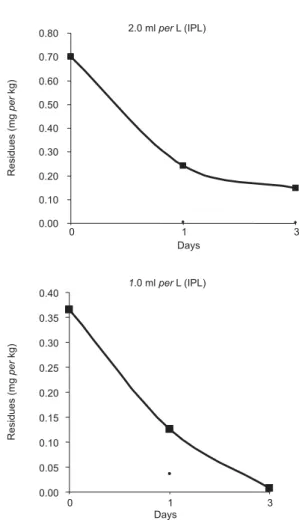
(1.0 mL perL) and 7th day (2.0 mL per L) after treatment, respectively. Dissipation pattern of azoxystrobin residue in mango fruits shown in Figure 1. Recommended dose of azoxystrobin dissipated up to 91.67 %, 3 days after spray (Table3). Based on the declined behavior of azoxystrobin, seven transformations of azoxystrobin residue was com-puted. The modified regression co–efficient (MR2) of deter-mination were 0.8286 and 0.7599, respectively for 1 mL per L and 2 mL per L and best fitted for both concentrations was Inverse Power Law (IPL) (Table 4).The half-life (T 0.5) and waiting period for recommended dose of azoxystrobin were 1.25 and 1.92 days, respectively (Table 5). Considering the Australian Pesticide and Veterinary Medicines Authority (APVMA) established maximum residue limits (MRLs) for azoxystrobin mango 0.05 mg per kg,5the suggested waiting period after spraying of azoxystrobin two day in accordance with good agricultural practices (GAP). The results showed that azoxystrobin was rapidly metabolized in mango fruits. The same way Chen et al. determined residue of azoxystrobin on Chinese cabbage, declined from 4.10 to 0.63 mg per kg with 18 days and from 13.21 to 0.10 mg per kg with in 9 days on Chinese kale.6
Table 1. Recovery percentage of azoxystrobin in fortified mango samples
Crops Particulars Azoxystrobin recovery % Mean recovery Recovery factors
RF 0.05 mg per kg 0.1 mg per kg 0.2 mg per kg
Mango Fruits 81.94 87.08 87.68 85.57 1.17
LOD 0.002 µg per g of sample.
Table 2. Persistence of azoxystrobin in mango fruits
Days After Spray
Azoxystrobin residues µgper g of samples
0.25 mL per L 1.0 mL per L 2.0 mL per L
0 0.0183 0.4296 0.9067
1 BDL 0.3652 0.7002
3 BDL 0.0358 0.0042
5 BDL BDL BDL
7 BDL BDL BDL
BDL – Below Detectable level; LOD 0.002 µg per g of samples
Table 3. Dissipation of azoxystrobin residues in mango fruits
Days After Spray
Dissipation of azoxystrobin residues (%)
0.25 mL per L 1.0 mL per L 2.0 mL per L
0 - -
-1 100.00 14.99 22.77
3 100.00 91.67 76.75
5 100.00 100.00 99.53
7 100.00 100.00 100.00
Table 4. Regression Coefficient of azoxystrobin residues in mango fruits
Azoxystrobin mLper L
1st order 1.5th order 2nd order RF 1st order RF 1.5th order RF 2nd order IPL
Best fit
R MR2 R MR2 R MR2 R MR2 R MR2 R MR2 R MR2
0.25 - - -
-1.0 -0.9821 0.3426 0.9082 0.6433 -0.8519 -0.9704 -0.8895 -1.7987 0.7790 -0.1051 0.7111 -1.1976 0.9638 0.8286 IPL
2.0 -0.9471 0.6678 -0.9774 -8.4885 0.9797 -0.9982 -0.9113 -1.8521 -0.9092 -0.5059 0.8835 -1.0000 0.9802 0.7599 IPL RF – Root function; R – Regression Co efficient; MR2– Modified R2; IPL – Inverse Power Law
Table 5. Intercept, slope, half life and waiting period of azoxystrobin residues in mango fruits
Azoxystrobin
mLper L A UL LL B UL LL T0.5 UL LL
Waiting periods
(Days)
Predicted equation
0.25 - - -
-1.0* -0.2496 11.8483 -12.3475 3.0570 13.8102 -7.6961 1.25 2.2550 2.25 1.92 Y = -0.2496 + 3.0570x
63 Sundravadana et al.
Vol. 19, No. 1, 2008
Table 6. Physico-chemical properties and molecular structure of
azoxystrobin
Structural Formula
Chemical Name (IUPAC)
MethylE )-2-{2-[6-(2cyano-phenoxy)pyrimidin-4-yloxy] phenyl}-3-methoxyacrylate
Molecular Weight 403.4
Molecular Formula C22H17N3O5
Solubility in water 10 mg per L at 25 °C
Solubility in organic solvents at 20 °C, 96.2% pure material
Solvent Solubility (g per L)
n-hexane (0.57)
octan-1-ol (1.4)
methanol (20)
toluene (55)
acetone (86)
ethyl acetate (130)
dichloromethane (400)
Melting point 118-119 °C
Vapor pressure <10-5 Pa at 20 °C
Partition Coefficient (Kow)
4 4 0 ( l o g P = 2 . 6 4 ) h t t p : / / pmep.cce.cornell.edu/profiles/ extoxnet/24dcaptan/azoxystrobin-ext.html
Conclusion
Thus, azoxystrobin residue in mango fruits was effec-tively determined by high performance liquid chromatogra-phy with UV detection. The results revealed that the half life of azoxystrobin in mango, when sprayed at recommended dose (1.0 mL per L) was one day and residue dissipates within three days after spray, thus spraying of azoxystrobin is very unlikely to cause any acute or chronic health risk.
References
1. Anke, J. F.; Dherwinkler, W.; Steglich, G.; Schramm,E.; J. Antibiotic.1977,30, 806.
2. Bertlett, W.; John, M.; Chris, R. A.; Godfrey, J. R.; Godwin, A. A.; Steve, P. A.; Heaney, P. S.; Maund, S. J.; Pesticide Outlook2001,12,
143.
3. Junior, R. S.; Costa, F. M.; Rosiana, E. M. M.; Nunes, G. H. S.; Filho, J. A.; Miranda, U. S.; Fitopatologia Brasileira2004,29,
193.
4. Giza, I.; Sztweirtnia, V.; Acta Chromatographic2003,19,226. 5.
http://www.safemeat.com.au/NR/rdonlyres/9ED0AAD4-E203-4E9B-9C20-2F806057CE78/0/avocado_mango_Jan06FINAL.pdf 6. Chen, M. F.; Chien, H. P.; Wong, S. S.; Li, G. C.; Plant Prot.
Bull.2004,46,123.
Received: February 11, 2007
Published on the web: January 22, 2008
Figure 1. Back transformed decline curve of azoxystrobin in mango