Key words: Friedreich Ataxia; Urodynamics; Lower Urinary Tract Symptoms; Urinary Bladder; Urination Disorders
Int Braz J Urol. 2013; 39: 867-74
__________________
Submitted for publication: October 10, 2012
__________________
Accepted after revision: July 24, 2013
Purpose: To assess the prevalence of LUTS, urinary tract and urodynamics changes in patients with Friedreich’s Ataxia (FA), the most common form of hereditary ataxia. Materials and Methods: This study evaluated 258 patients with genetically confirmed diagnoses of FA. Of the patients, 158 responded to a questionnaire which assessed their urinary symptoms. Patients with clinical changes underwent renal function examina-tions, ultrasound, and urodynamic studies (UDS).
Results: The sample analyzed showed that 82% of the patients complained of LUTS, although only 22% related the symptoms with quality of life impairment. Twenty eight (18%) of them agreed to undergo urodynamic evaluation. Urgency was the most common symptom. The exam was normal in 4 (14%) and detrusor underactivity was the most common finding. 14% (4 patients) presented with dilatation of the upper urinary tract at ultrasound scans. None of them had creatinine alterations.
Conclusions: LUTS was found in a large percentage of patients with FA, but only a few related it to their quality of life impairment. Although creatinine levels was normal in this sample, some patients may show upper urinary tract abnormalities, with deserves close observation and proper care.
Urinary Symptoms and Urodynamics Findings in Patients
with Friedreich’s Ataxia
_______________________________________________
André F. A. Musegante, Priscila Natasja S. Almeida, Raphael Temporão M. Monteiro, Ubirajara
Barroso Jr
SARAH Network of Rehabilitation Hospitals (AFAM, PNSA), Salvador; SARAH Network of Rehabilitation Hospitals (RTMM), Brasília and Bahiana University of Bahia (UBjr), Salvador, BA, Brazil
ABSTRACT
ARTICLE
INFO
_________________________________________________________ ___________________
INTRODUCTION
Freidreich’s ataxia (FA) is the most com-mon form of hereditary ataxia, with an estima-ted prevalence of 2 to 3 people per 100,000 (1). It consists of a neurodegenerative disease asso-ciated with a dynamic mutation of the trinucle-otide guanine adenine adenine (GAA) in the first intron of the gene x25, located on the long arm of chromosome 9 (9q11). The trinucleotide repe-at expansion causes a reduction in the synthesis of the protein frataxin, and the lowered frataxin levels in the mitochondria cause oxidative dama-ge and progressive neuronal dedama-generation (2). The
clinical diagnosis is confirmed with a genetic test that demonstrates the GAA repeat expansion. In a normal individual, the GAA sequence is repea-ted 7 to 22 times. Those who suffer from FA can have between 200 and over 1,000 repetitions of the GAA sequence. In general, more repetitions of the GAA trinucleotide signify an earlier onset of and more severe case of FA (3).
we worked with a larger number of patients, all of whom had previously undergone a molecular evaluation with regards to their FA.
MATERIALS AND METHODS
All 258 patients with genetically confir-med cases of FA using the Polymerase chain re-action (PCR) method were evaluated. Any patients without genetic confirmation, with associated neurological disorders or cognitive impairment, or with surgical history in the LUT were exclu-ded. A telephone interview was conducted to ga-ther information about LUTS. In the absence of a validated questionnaire for neurogenic bladder, one was created by the authors specifically for this paper. (Table-1). Patients who underwent clinical changes in the LUT were invited to continue par-ticipating in the research of the urinary tract with renal function tests, kidney and urinary tract ul-trasounds, and UDS. During the UDS (Medtronic Duet, Minneapolis, Minnesota, USA) uroflowme-try was initially carried out; followed by cystome-try and pressure flow studies. An anal electrode
was used to record the electromyographic data of the external urethral sphincter and perineal mus-cles. Changes in the detrusor contractions were defined as: underactivity (contraction of reduced strength and/or duration, resulting in prolon-ged bladder emptying and/or a failure to achieve complete bladder emptying within a normal time span); overactivity (involuntary detrusor con-tractions during the filling phase which may be spontaneous or provoked); acontractile (contrac-tion cannot be demonstrated during urodynamic studies) (4). Detrusor sphincter dyssynergia was considered as detrusor contraction concurrently with an involuntary contraction of the urethral and/or periurethral striated muscle (4). Bladder capacity was considered reduced when it was less than 350 mL (4). Post voiding residue was con-sidered insignificant to 100 mL (5). Normal flow depends on the age and gender: Males < 40 yr > 22 mL/s, 40-60 yr > 18 mL/s e > 60 yr > 13 mL/s. Females < 50 yr > 25 mL/s e > 50 yr > 18 mL/s (6). The study also followed ultrasound results and urinary levels of creatinine and urea. The results shown correspond to mean ± standard deviation.
Table 1 - Questionnaire of urinary symptoms.
1. a. Do you believe that the number of times you void per day has increased?
1. b. If yes, do you void more than 6 times during the day?
2. a. Do you wake up at night to void?
2. b. If yes, do you void more than 3 times during the night?
3. Do you lose urine on clothing during the day?
4. Do you lose urine on clothing without feeling it?
5. Do you feel an urgency to urinate?
6. Do you have difficulty voiding?
We applied the chi-square test for the relationship between post void residual urine and DU/ detrusor acontractility (DA), detrusor-sphincter dyssyner-gia (DSD) and alteration in detrusor contraction/ FIM scale. Fisher’s exact test was used for pyrami-dal tract changes as well as changes in the detru-sor contractions/DSD, renal dilatation/ FIM scale, residue/FIM scale and DO and urgency. This study was approved by the Institutional Review Board. All patients have signed an informed consent.
RESULTS
Out of the 258 medical records, 45 (17%) had out of date telephones, 7 patients (3%) refu-sed, and 206 patients (80%) agreed to participate in the study. Of those who agreed to participate in the study, 48 (23%) failed to respond so we have analyzed the results on 158 patient samples. Data on the neurological symptoms of patients who participated in the urological research are shown in Figure-1.
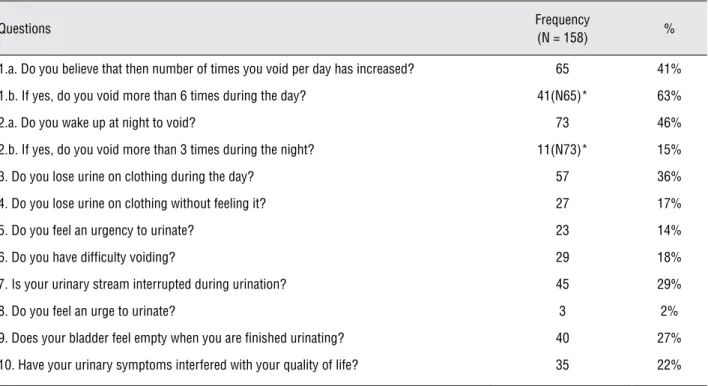
The primary complaints of 129 of the patients were related to storage symptoms. Fre-quency was cited by the majority; 63% of the pa-tients voided more than 6 times per day, 46% were waking up at night to void, and 36% had urinary incontinence. Despite the clinical findings, only 35 (22%) believed that their LUTS interfered with their quality of life (Table-2).
Out of the 129 patients who showed LUT dysfunction, 28 (7 men and 21 women) agreed to
undergo urodynamic diagnostic testing. The mean age of this subgroup was 32 (± 11.2). The mean age of the patients during the onset of the disease was 16 (± 7) years and the average time that passed between the disease onset and the study was 20 (± 9) years.
Clinically, the most frequently reported symptom on this sub-group of subjects was ur-gency, present in 21 (75%) of patients. Urinary incontinence was seen in 17 (61%), urinary fre-quency in 11 (39%), effort to urinate in 9 (32%), nocturia in 7 (25%), and incomplete bladder emp-tying in 7 (25%) (Table-3).
All 28 patients underwent UDS, which showed up normal in 4 (14%) patients. Changes in detrusor contraction were observed in half the patients, with DU being the most common abnor-mality. Of the patients with DO, only one had de-trusor pressure greater than 40 cmH20 (53 cmH20). There was no change in bladder compliance in any patient.
Bladder sensitivity was altered in 17 (60.7%) patients; diminished in 14 (50%) and in-creased in 3 (10.7%). Bladder capacity was below what is considered normal in only 4 (14%) patients. Urine flow was diminished in 14 (50%) of patients, taking gender and age into consideration. In 11 (39%) patients the flow was below 10 mL/s, and 3 patients with DA had no voiding. The residual volume after voiding was greater than 100 mL in 11 (39%) patients, 8 patients had changes in detru-sor contractions (acontractility and underactivity) and 3 had normal detrusor contractions. DSD was
found in 8 (28.5%) patients, 6 women and 2 men (Table-4).
Creatinine and urea levels were not altered
The relationship between post-void resi-dual urine and DU/DA and DSD was significant (p = 0.0004). The relationship between pyramidal
Table 2 - Frequency of each question in the questionnaire.
Questions Frequency
(N = 158) %
1.a. Do you believe that then number of times you void per day has increased? 65 41%
1.b. If yes, do you void more than 6 times during the day? 41(N65)* 63%
2.a. Do you wake up at night to void? 73 46%
2.b. If yes, do you void more than 3 times during the night? 11(N73)* 15%
3. Do you lose urine on clothing during the day? 57 36%
4. Do you lose urine on clothing without feeling it? 27 17%
5. Do you feel an urgency to urinate? 23 14%
6. Do you have difficulty voiding? 29 18%
7. Is your urinary stream interrupted during urination? 45 29%
8. Do you feel an urge to urinate? 3 2%
9. Does your bladder feel empty when you are finished urinating? 40 27%
10. Have your urinary symptoms interfered with your quality of life? 35 22%
* The frequency (n) in the questions 1.b and 2.b refers to those who answered "yes" in the previous question
Table 3 - Frequency of urinary symptoms in the 28 patients who participated in the urodynamic study.
Urinary Symptoms Frequency
(N = 28)
%
Urgency 21 75%
Incontinence 17 61%
Increased Frequency 11 39%
Effort to Urinate 9 32%
Post Void Residual Urine 7 25%
Altered stream 6 21%
Table 4 - Urodynamics findings in 28 patients with FA.
Urodynamics Data Frequency
(N = 28)
%
Detrusor
Overactivity 5 17.9
Underactivity 6 21.4
Acontractility 3 10.7
Normal 14 50.0
Sensitivity
Increased 3 10.7
Decreased 14 50.0
Normal 11 39.3
Post Void Residual Urine
Increased 11 39
Insignificant 17 61
Flow
Normal 17 61
Altered 11 39
Bladder Capacity
Normal 24 86
Decreased 4 14
Compliance
Normal 28 100.0
Decreased 0 0.0
Dyssynergia
Present 8 28.6
Absent 20 71.4
= 1.0 and p = 0.7 respectively). Urgency and DO were unrelated (p = 0.6).
DISCUSSION
Patients initially enter the clinic between the ages of 8 and 15 and are diagnosed with gait
tion, nystagmus and reduction of the vestibulo--ocular reflex, point to cerebellar dysfunction. Cardiac diseases appear in 60% of patients with FA, the best known of which is concentric hyper-trophic cardiomyopathy. Diabetes mellitus is pre-sent in 10 to 30% of patients (7). Lower urinary tract dysfunction has been reported in several ata-xias, but has not been studied further (2,8). FA is estimated to have around 50% of LUTS, but there are a limited number of studies on the subject, no specific questionnaires, and the studies are not always confirmed by molecular analysis (8).
There are few studies in the literature on clinical and urodynamic findings of patients with FA, and the studies that do exist contain data from patients without molecular confirmation and with other types of ataxia (2,8). Therefore, it might be impossible to know whether the findings truly correlate to this particular group.
This study showed that 82% of patients with FA suffer from at least one symptom descri-bed in questions 1-9. If questions 3 and 4 are the only ones considered (relating to incontinence), the prevalence of these symptoms among patients with FA decreases to 40% (N = 62). Previously pu-blished studies show this type of patient presents around 50% of these urinary symptoms (2,8,9) using the International Prostate Symptoms Sco-re (IPSS), but 56% of the patients aSco-re female (8). There is no significant difference in the mean ages of patients with FA or in the mean time of the di-sease evolution between our study and previously published literature that accounts for this discre-pancy. Unlike our study, however, previous arti-cles neglected to report certain clinical neurologi-cal features, including the use of wheelchairs and the patients’ degree of independence, which makes it difficult to evaluate the severity of the patients’ FA and comparison between the samples (2,8-10). Figure-1 shows that less than 43% of patient sam-ples have an impairment in the pyramidal tract or in other systems, which shows the evolutiona-ry state of the disease. It is also noteworthy that
the literature. Urinary incontinence was present in 61% of our patients, which contrasts with the 27.6% found by Diez Rodríguez et al. (8). Note that the IPSS does not question patients about incon-tinence. There are a few possible explanations for this discrepancy: the difference in the population studied (our patients were studied genetically); pa-tients in our study had not received any treatment; or perhaps neurological impairment was more pronounced in our patients (8). Other symptoms such as nocturia, frequency, feeling of incomple-te bladder emptying, and effort to urinaincomple-te are in accordance with other published works. Based on this variety of findings, we agree with Rodríguez et al. (8) who argued that the variety of symptoms and urodynamic findings in patients with ataxia is due to the multi-factorial damaging potential to the central nervous system during the evolution of FA, considering that all segments of the nervous system (posterior cord, spinocerebellar pathways, pyramidal tracts, spinal ganglia, cerebellum and peripheral nerves) have the potential to be affec-ted. A supra sacral legion could cause damage in the reflex arc and a dyssynergia voiding pattern (2).
In published literature, the most predomi-nant urodynamic finding is DO, ranging from 22% to 61% (2,10,11). Our series shows DO in 17.9% of cases. DU was seen in 21.4% of patients and DA in 10.7%. Previous literature shows the rate of DA to vary between 23.5% and 26.7% (2,12). It is pos-sible that the progression of the disease probably affects the neurophysiologic pathways of the mic-turition. The presence of DSD (28.5%) in this study does not differ from the literature (20% to 37%) (2,10) and once again the neurological findings seem to agree with our urological data, because 43% of our sample has changes in the pyramidal tract.
intermittent catheterization cleaning. Statistically we can not associate renal dilation with neurolo-gical worsening (change in FIM scale).
Regarding the clinical-urodynamic corre-lation we can state that the complaint of urgency does not seem to represent DO, as there were 21 patients with urgency and only 5 with DO. Four out of the 21 (19%) patients who complained of urgency also had DO. The high level of post voi-ding residual urine seems to demonstrate more precisely the presence of DSD and/or DU/DA, be-cause out of 11 (39%) patients with high levels of post-void residual, 10 (91%) had some of these diagnoses, however we found no association be-tween residual and neurological worsening (chan-ge of FIM scale). The presence of a lesion in the pyramidal tract seems to be related to changes in sphincter and/or detrusor contractions, as only 4 (40%) patients with pyramidal changes did not show dyssynergia and/or changes in bladder con-traction (overactivity, acontractile, and underacti-vity). In the literature, only Caraceni demonstra-ted a statistically significant correlation between pyramidal lesions and DO and DSD (9). We do not find this relation to be significant.
We used the alteration in the FIM scale to represent patients with more severe neurological impairment, and thus tried to show that these pa-tients have greater urological disorders, however we found no significance. We recognize that there was a low rate of attendance for the completion of the exams. Perhaps the importance of urinary symptoms is reduced before a neurological con-dition is prominent. With this, we have comple-ted the investigation, especially in patients less affected by the disease. The lack of urodynamic parameters defined in previously published work is another factor that can change the comparison of our findings. Therefore, we know that many present symptoms, but few report them, and that these should always be investigated since changes in the upper and lower urinary tracts were found.
CONCLUSIONS
LUT dysfunction was found in a large per-centage of patients with FA, but only a few re-lated it to their quality of life impairment (22%).
Urgency was the most prevalent symptom (75%), and DO was the second most common urodyna-mic finding (17.9%). Urgency was associated with DO in only 14% of patients. Although creatinine levels were normal in this sample, some patients may show upper urinary tract abnormalities, whi-ch deserve close observation and proper care.
ABBREVIATIONS
DA = Detrusor acontractility
DO = Detrusor overactivity
DU = Detrusor underactivity
DSD = Detrusor-sphincter dyssynergia
FA = Freidreich’s ataxia
GAA = Guanine adenine adenine
IPSS = International Prostate Symptoms Score
LUT = lower urinary tract
LUTS = lower urinary tract symptoms
PCR = Polymerase chain reaction
UDS = Urodynamic studies
CONFLICT OF INTEREST
None declared.
REFERENCES
1. Jankovic JJ, Tolosa E: Parkinson’s disease and movement disorders. Philadelphia, Lippincott Williams & Wilkins. 2002.
2. Diez Rodríguez JM, Salinas Casado J, Fernández del Busto E, Mora Durbán M, Mañas Pelillo A, Muñoz Delgado B, et al.: Clinico-urodynamic correlation in the hereditary atax-ias. Arch Esp Urol. 2003; 56: 915-25.
3. La Pean A, Jeffries N, Grow C, Ravina B, Di Prospero NA: Predictors of progression in patients with Friedreich ataxia. Mov Disord. 2008 30; 23: 2026-32.
4. Abrams P, Cardozo L, Fall M, Griffiths D, Rosier P, Ulmsten U, et al.: The standardisation of terminology of lower uri-nary tract function: report from the Standardisation Sub-committee of theInternational Continence Society. Neurou-rol Urodyn. 2002; 21: 167-78.
6. Jørgensen JB, Jensen KM: Uroflowmetry. Urol Clin North Am. 1996; 23: 237-42.
7. Delatycki MB, Paris DB, Gardner RJ, Nicholson GA, Nassif N, Storey E, et al.: Clinical and genetic study of Friedreich ataxia in an Australian population. Am J Med Genet. 1999; 87: 168-74.
8. Díez Rodríguez JM, Salinas Casado J, Fernández del Busto E, Navarro Sebastián J, Mora Durbán M, Mañas Pelillo A, et al.: Urogenital alterations in hereditary and sporadic neuro-degenerative ataxias. Neurologia. 2005; 20: 17-23. 9. Caraceni E, Leone G, Ardito S: Neurogenic bladder
dys-function in hereditary Friedreich’s ataxia. Urodinamica 1992; 2: 177-9.
10. Vezina JG, Bouchard JP, Bouchard R: Urodynamic evalua-tion of patients with hereditary ataxias. Can J Neurol Sci. 1982; 9: 127-9.
11. Nardulli R, Monitillo V, Losavio E, Fiore P, Nicolardi G, Meg-na G: UrodyMeg-namic evaluation of 12 ataxic subjects: neu-rophysiopathologic considerations. Funct Neurol. 1992; 7: 223-5.
12. Leach GE, Farsaii A, Kark P, Raz S: Urodynamic manifesta-tions of cerebellar ataxia. J Urol. 1982; 128: 348-50.
______________________ Correspondence address:
André Ferraz de Arruda Musegante, MD Urologist of SARAH Network of
Rehabilitation Hospitals, Av. Tancredo Neves, 2782, Caminho das Árvores,