Association of the Chemical Engineers of Serbia AChE www.ache.org.rs/CICEQ
Chemical Industry & Chemical Engineering Quarterly 19 (3) 359−368 (2013) CI&CEQ
XIAO-QIN XIONG KE-JING HUANG CHUN-XUAN XU CHUN-XUE JIN QIU-GE ZHAI
College of Chemistry and Chemical Engineering, Xinyang Normal University, Henan, Xinyang, China
SCIENTIFIC PAPER
UDC 544.6:547.436:66.012.1 DOI 10.2298/CICEQ120325070X
GLASSY CARBON ELECTRODE MODIFIED
WITH POLY(TAURINE)/TIO
2-GRAPHENE
COMPOSITE FILM FOR DETERMINATION OF
ACETAMINOPHEN AND CAFFEINE
A novel electrochemical sensor poly(taurine)/TiO2-graphene nanocomposite
modified glassy carbon electrode (PT/TiO2-Gr/GCE) was fabricated. This
sen-sor was based on an electrochemically polymerized taurine layer on a TiO2
-gra-phene modified glassy carbon electrode. The electrochemical behavior of acet-aminophen and caffeine at the modified electrode was studied by cyclic volt-ammetry and differential pulse voltvolt-ammetry. The results showed that the oxi-dation peak currents of acetaminophen and caffeine were linear with their con-centrations in the range of 1×10⁻⁷-9×10⁻⁵ M and 2.5×10⁻⁵-2×10⁻⁴ M, respecti-vely. The detection limits of acetaminophen and caffeine were 3.4×10⁻⁸ M and 5.0×10⁻⁷ M, respectively (S/N = 3). This modified electrode showed good sen-sitivity and stability, which has promising potential applications in electroche-mical sensors and biosensors design.
Keywords: taurine; TiO2-graphene nanocomposite; acetaminophen;
caf-feine; electropolymerization.
Acetaminophen (N-acetyl-p-aminophenol or
paracetamol), an antipyretic and analgesic drug, is widely used in the world. It is used mainly as an effective medicine for the relief pain and reduction of fever and a suitable alternative for patients who are sensitive to aspirin [1-5]. Caffeine (3,7-dihydro-1,3,7- -trimethyl-1H-purine-2,6-dione) is a natural alkaloid
N-methyl derivative of xanthine, and is extensively present in foods such as coffee, tea, cola nuts, yerba-mate, guarana berries and cacao bean. Caffeine ingestion exerts many physiological effects, such as stimulation of the central nervous system, diuresis and gastric acid secretion [2]. The unique properties of caffeine are also applied in analgesic preparations. Therefore, acetaminophen and caffeine often occur together in analgesic pharmaceutical formulations.
Generally, limited use of acetaminophen and caffeine does not exhibit any harmful side effects. However, overdosed ingestions of acetaminophen lead to the accumulation of toxic metabolites, which
Correspondence: K-J. Huang, College of Chemistry and Chemi-cal Engineering, Xinyang Normal University, Henan, Xinyang 464000, China.
E-mail: [email protected] Paper received: 25 March, 2012 Paper revised: 3 July, 2012 Paper accepted: 3 July, 2012
may cause severe and sometimes fatal heptato-toxicity and nephroheptato-toxicity, which in some cases associate with renal failure [4-7]. Caffeine is con-sidered to be a risk factor for cardiovascular diseases and may have behavior effects such as depression and hyperactivity. Therefore, in analgesic preparation
(BDD) electrode for acetaminophen and caffeine simultaneous determination. However, prior to the experiments, this electrode was cathodically pre-treated in a 0.5 mol L-1 H2SO4 solution [2]. Sanghavi
et al. used an in situ surfactant-modified multi-walled carbon nanotube paste electrode for simultaneous determination of acetaminophen and caffeine. An accumulation potential of -0.7 V and an accumulation duration time of 300 s were used for stripping voltam-metric analysis [24].
Recently, graphene (Gr) was found to be an ideal two-dimensional (2D) catalyst support to anchor metal and semiconductor catalyst nanoparticles because of its unique two-dimensional geometric structure, large surface area, and high mobility of charge carriers [25]. Being a famous semiconductor, TiO2 has received much attention due to its
nontoxi-city, long-term stability, low cost and mutifunctions [26]. Most recently, we reported the TiO2-Gr
nano-composite prepared by hydrothermal method using graphene as templates to immobilized TiO2
nanopar-ticles. The as-prepared TiO2-Gr exhibited remarkable
electrocatalytic activity toward dopamine oxidation [23]. Taurine is a well-known dissociated amino acid, which exhibits important physiological functions and pharmacological characteristics. It has been widely used as a food nutrition enhancer and common drug. Taurine possesses electron-rich N atoms and high electron density of sulfonic groups. Hence, the poly-(taurine) (PT) film is negatively charged and is propi-tious to adsorb acetaminophen and caffeine from the solution. PT modified electrodes have been reported and have shown good electrochemical performance [27, 28]. In this work, we report about the fabrication of PT modified electrode by electrochemical polymeri-zation of taurine on the TiO2-Gr-modified glassy
car-bon electrode (PT/TiO2-Gr/GCE) and the application
of the modified electrodes for simultaneous detection of acetaminophen and caffeine.
EXPERIMENTAL
Chemicals and materials
Graphite powder (320 mesh, spectrum pure) was purchased from Sinopharm Chemical Reagent Co., Ltd., China. Titanium isopropoxide (Ti(OiPr)4)
was obtained from Aladdin Chemistry Co., Ltd., China. Acetaminophen and caffeine were purchased from Alfa Aesar and used without further purification. Taurine was purchased from Shanghai No. 1 Che-mical Company (Shanghai, China). The phosphate buffer solution (PBS) was prepared using Na2HPO4
and NaH2PO4. Double distilled water was used to
pre-pare all solutions used in the present work.
Apparatus
All electrochemical experiments were carried out with a CHI660D electrochemical workstation (CH Instruments, Shanghai). A conventional three-elec-trode system was used for all electrochemical experi-ments, which consisted of a platinum wire as counter electrode, an Ag/AgCl/3M KCl as reference electrode, and a bare or modified glassy carbon electrode (3mm diameter) as working electrode. All pH measurements were measured with a PHS-3C digital pH meter (Shanghai Rex Instrument Factory, Shanghai, China). A Hitachi S-4800 scanning electron microscope (SEM) was used.
Preparation of TiO2-graphene nanocomposite
Graphene oxide was synthesized from graphite powder according to the modified Hummers method [29,30]. Gr was obtained by the chemical reduction of a colloidal suspension of exfoliated graphene oxide sheets in water with hydrazine hydrate [31]. To pre-pare TiO2-Gr nanocomposite, Gr (50 mg), titanium
isopropoxide (0.2 mL) and H2SO4 (1 M, 2 mL) was
firstly added into a 25-mL Teflon-sealed autoclave. This resultant mixture was ultrasonicated for 10 min, and then the autoclave was kept in oven for 24 h at the temperature of 170 °C. Finally, black powder of TiO2-Gr nanocomposite was obtained by filtration,
rinsed thoroughly with deionized water and methanol, and dried in vacuum [25].
Preparation of the modified electrodes
The as-prepared TiO2-Gr nanocomposite (1.5
mg) was dispersed in DMF (4.0 mL) to form a homo-genous suspension. Before modification, glass car-bon electrode (GCE) was polished to a mirror-like with 0.3 and 0.05 µM of alumina slurry, and then washed successively with ultrapure water, anhydrous alcohol and ultrapure water in an ultrasonic bath and dried in N2 flow. The TiO2-Gr film-modified GCE
(TiO2-Gr/GCE) was prepared by dropping 6 µL of the
resultant suspension on the cleaned GCE, and dried at room temperature.
The PT/GCE and PT/TiO2-Gr/GCE were
pre-pared as follows. Cyclic voltammetry (CV) was used to form polymerization film on the bare GCE and TiO2-Gr/GCE, respectively. The polymeric film was
deposited by cyclic sweeping from -1.5 to 2.0 V at 100
mVs-1 for 10 cycles in PBS (pH 7.0) containing
Serum sample preparation
Human blood serum samples were obtained from healthy volunteers. The samples were centri-fuged at 4000 rpm for 30 min at room temperature. Then 1.2 mL of acetonitrile was added to remove serum protein, followed by fortification with acetami-nophen and caffeine. After vortexing for 1 min, the mixture was centrifuged for 10 min at 10000 rpm to remove the serum protein residues. The supernatant was taken carefully and appropriate volumes of this supernatant were transferred into the electrochemical glass cell and diluted up to the volume with the PBS.
RESULTS AND DISCUSSION
Surface morphology of TiO2-graphene and
poly(taurine)/TiO2-graphene composite
The surface morphologies of TiO2-Gr and
PT/TiO2-Gr composite were examined by SEM
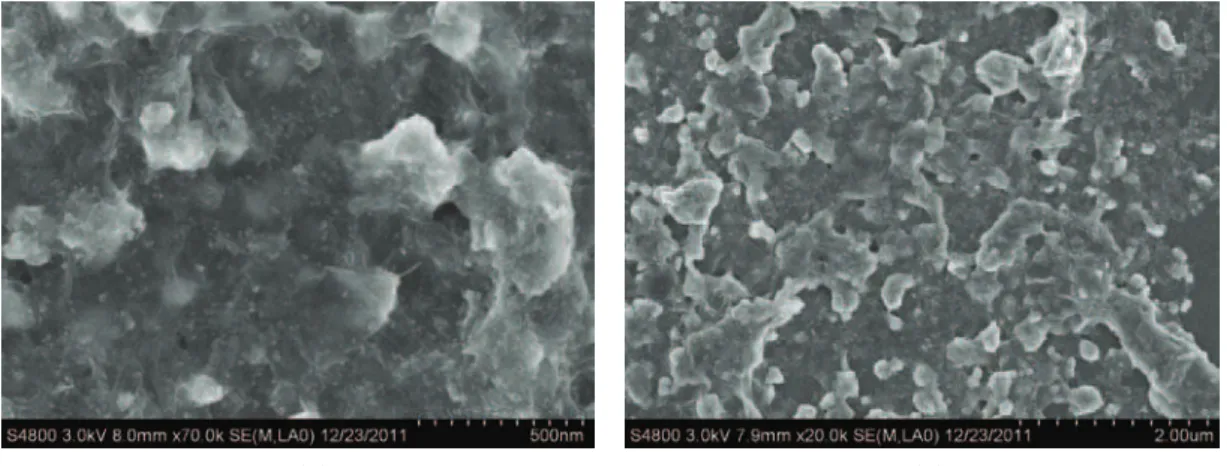
obser-vation (Figure 1). In Figure 1A, it can be seen that TiO2 was formed in a highly faceted morphology on
the substrates of Gr with ca. 20-30 nm diameter for the clusters. As shown in the SEM images, the as-prepared TiO2-Gr nanocomposite exhibited
consider-able edge plane defect structures. These edge plane defects have shown to be essentially responsible for the high electron transfer kinetics and the electroca-talytic activity of Gr, which contributed significantly to the electrochemical property of the present TiO2-Gr
nanocomposite as well. Figure 1B depicts the SEM image of the PT/TiO2-Gr composite, showing that a
layer of PT was formed on the TiO2-Gr surface.
The electropolymerization of taurine at the TiO2-graphene/GCE
In the previous reports, repeated cyclic voltam-metry was used for the electrochemical formation of PT film. The potential scan range was the most
important factor. If the positive value for polymeriza-tion was below 1.6 V or if the negative one was above -0.8 V, no polymer reaction occurred [26]. Therefore, we selected the potential range of -1.5 and 2.0 V as the electropolymerization potential window in this work.
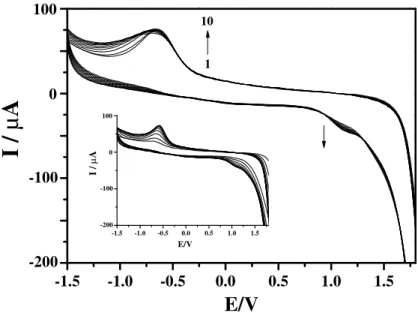
Figure 2 shows CVs of electrochemical poly-merization of taurine on the TiO2-Gr/GCE. One obvious
reduction peak was observed at -0.7 V. An increase in cycle number results in the enhancement of the peak currents and a slight shift of potential peak, which was reflecting the continuous growth of the film. It could be observed that the film growth was faster for the first four cycles than for the other cycles. After modifi-cation, a shiny and light green color was found on the electrode surface. These facts indicated taurine was deposited on the surface of TiO2-Gr film modified
GCE by electropolymerization. The inset of Figure 2 shows CVs of electrochemical polymerization of tau-rine on the GCE, and a similar phenomenon was obtained.
Effect of different electrodes
In the present study, the electrochemical behavior of the mixture containing acetaminophen and caffeine on the aforementioned electrodes (bare GCE, TiO2-Gr/GCE, PT/GCE, PT/TiO2-Gr/GCE) was
investigated using the CV. Figure 3 depicts CVs curves of the acetaminophen and caffeine (0.1 mM) in PBS (0.1 M, pH 7.0) at a scan rate of 100 mVs-1. A well shaped oxidation peak and a poorly defined reduction peak on the bare GCE was observed (curve a). The height of the reduction peak was lower than that of the oxidation peak. For caffeine, the oxidation peak was characterized by an extraordinarily asym-metric shape and no obvious reduction peak was observed on the reverse scan, indicating that the oxi-dation was irreversible. The oxioxi-dation peak potentials of acetaminophen and caffeine at bare GCE are 461
(A) (B)
and 1433 mV, respectively. Compared to bare GCE, the oxidation peak potential of acetaminophen at the PT/GCE (curve c) shifted 23 mV negatively, and the peak current decreased slightly. However, caffeine showed the oxidation peak current increased slightly without the change of peak potential. To TiO2-Gr/
/GCE, acetaminophen and caffeine demonstrated broad oxidation peaks at 539 and 1476 mV, respecti-vely. The charging current was obviously larger than that at both the above electrodes (curve b). Also, the peak current of acetaminophen enhanced slightly. The highest improvement of the oxidation peak cur-rents of acetaminophen and caffeine was obtained at
the PT/TiO2-Gr/GCE (curve d). These phenomena
indicated that the enhancement effect may be due to the synergetic effect of PT and TiO2-Gr. The PT film
might facilitate the adsorption of acetaminophen and caffeine from the solution to the modified electrode surface through physical adsorption by the improve-ment of area of the modified electrode. Moreover, the coarseness of the modified electrode surface also contributed to this.
Effect of scan rate
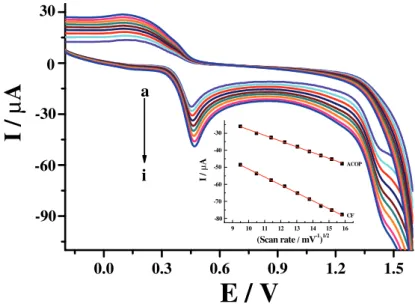
The effect of scan rate was also studied at the PT/TiO2-Gr/GCE. Figure 4 showed that the oxidation
peak shifted to a more positive value for both com-pounds, and the reduction peak of acetaminophen shifted to more negative values with increasing scan rates that had concurrent increases in current. For acetaminophen, the plot of the anodic peak current (ip) vs. the square root of scan rate showed excellent
-1.5
-1.0
-0.5
0.0
0.5
1.0
1.5
-1.5 -1.0 -0.5 0.0 0.5 1.0 1.5
E/V
I /
µ
A
-200 -100 0 100
I /
µ
A
E/V
-200
-100
0
100
1 10
Figure 2. Cyclic voltammograms for the polymerization of taurine on the TiO2-Gr/GCE. Inset: cyclic voltammograms for the
polymerization of taurine on bare GCE. Scan rate of 100 mV s-1. The supporting electrolyte: 0.1 M phosphate buffer (pH 7.0).
0.0 0.3 0.6 0.9 1.2 1.5
40
a b c
I /
µ
A
d
E / V
-100 -80 -60 -40 -20 0 20
linearity over the range of 90-250 mV s-1, the
corres-ponding equation was: ip (μA) = -3.38(v / mV s–1)1/2 +
+ 5.927 (R = 0.999) (inset a of Figure 4). Similarly, as shown in inset to Figure 4, the oxidation peaks cur-rents of caffeine increased linearly with the increase of square root of scan rate, the corresponding equation was: ip (μA) = -4.658(v / mV s–1)1/2 - 4.637 (R =
= 0.999). This revealed that the oxidation processes of acetaminophen and caffeine on the surface of PT/ /TiO2-Gr/GCE were under diffusion control.
Effects of supporting electrolyte
The electrode reaction can be affected by the buffer solution. The effect of different electrolyte on the current responses was investigated. Some elec-trolytes including KHP-NaOH, NH4Cl, NaH2PO4
-Na2HPO4, BR, NaNO3, KCl and NH3-NH4Cl (each 0.1
M) were studied. The results showed that high current peaks and good peak shape were obtained in phos-phate buffer. Therefore, this solution was applied in the subsequent studies.
Effect of pH
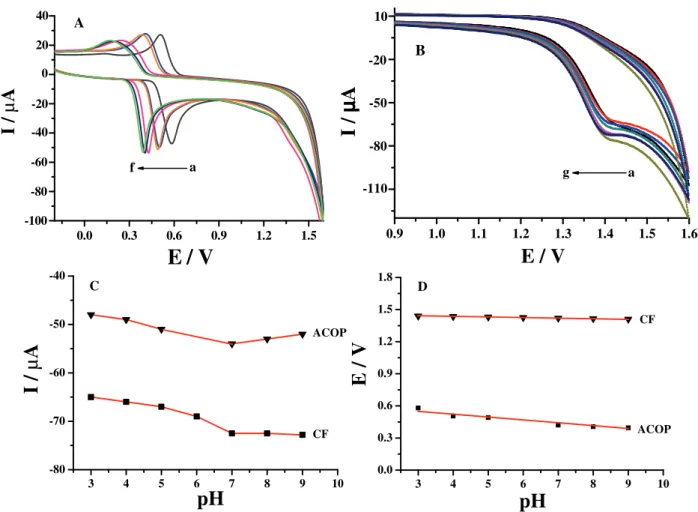
The effect of varying pH of buffer solution on the electrochemical behavior of acetaminophen and caf-feine at PT/TiO2-Gr/GCE was performed using CV in
0.1 M PBS. Figure 5 depicts the response of peak current and potential of acetaminophen and caffeine to pH. The anodic and cathodic peak potentials were shifted negatively when the solution pH was increased (Figure 5D). The anodic peak current of acetamino-phen increased from pH 3.0 to 7.0 and reached the maximum at pH 7.0, and then decreased again with higher pH value (Figures 5A and 5C). The anodic
peak current of caffeine increased from pH 3.0 to 7.0 and kept almost unchanged in the pH range of 7.0-9.0 (Figure 5B). To obtain the high response signal for acetaminophen and caffeine, the solution of pH 7.0 was used for the optimal supporting electrolyte.
Effect of TiO2-graphene amount
The effect of TiO2-Gr amount was investigated.
When the amount of TiO2-Gr suspension (0.375 mg
mL-1) increased from 0 to 6 µL, the oxidation peak
current of acetaminophen and caffeine increased notably. However, when it exceeded 6 µL, the oxi-dation peak currents conversely showed gradual dec-line. Therefore, 6 µL of TiO2-Gr suspension was
selected for the fabrication of the electrochemical sensor in this work.
Simultaneous determination of acetaminophen and caffeine
Under the optimal experiment conditions, the simultaneous determination of acetaminophen and caffeine was carried out at PT/TiO2-Gr/GCE. The
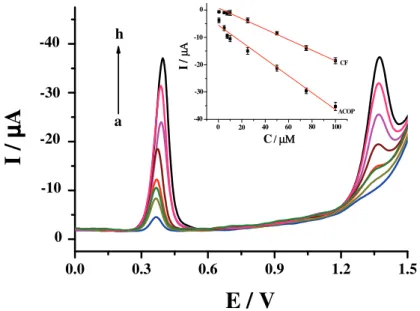
experiment was performed by changing the equal concentrations of acetaminophen and caffeine over the range from 5×10⁻⁷ to 1×10⁻⁴ M. The differential pulse voltammetric results (Figure 6) showed two well-distinguished anodic peaks at potentials of 396 and 1372 mV, corresponding to the oxidation for acet-aminophen and caffeine, respectively. The peak cur-rent values were proportional to the concentrations of acetaminophen and caffeine in the mixture. The insert of Figure 6 showed the relationship between the anodic currents and the concentrations of acetamino-phen (curve a) and caffeine (curve b). The oxidation
0.0
0.3
0.6
0.9
1.2
1.5
9 10 11 12 13 14 15 16
CF ACOP
I /
µ
A
-80
(Scan rate / mV-1)1/2
-70 -60 -50 -40 -30
I /
µ
A
E / V
30
0
-30
-90
-60
i
a
Figure 4. Cyclic voltammetric response of the PT/TiO2-Gr/GCE to 70 µM acetaminophen and 210 µM caffeine in 0.1 M BPS (pH 7.0) at
peak current of acetaminophen was proportional to its concentration over the range from 0.5 to 100 µM, obeying the following equation: I (µA) = -0.302(C / / µM) - 6.143 (R = 0.991). The oxidation peak current of caffeine was proportional to its concentration over the range from 0.5 to 100 µM, obeying the following equation: I (µA) = -0.186(C / µM) + 0.255 (R = 0.994). The detection limits of acetaminophen and caffeine were 3.4×10⁻⁸ and 5.0×10⁻⁷ M, respectively. A compa-rison of the detection methods are shown in Table 1, which includes the limit of detection and the linear range. Table 1 indicates that the proposed sensor exhibited low detection limit and wide measurement range. The reason might be as follows: firstly, the excellent electrical conductivity of Gr enhanced the charge transport; secondly, the formation of the PT film increased the adsorb amount of analytes.
Individual determination of acetaminophen and caffeine
For further investigation of electrochemical res-ponse when both substances are present in the
tion, the DPV experiments were performed in solu-tions containing variable concentration of one species and constant concentration of the other one. The separate determination of acetaminophen in the con-centration range of 1.0×10⁻⁷-9.0×10⁻⁵ M was accom-plished in solutions containing caffeine at the fixed concentration of 3.0×10⁻⁵ M. As shown in Figure 7A, the peak current of acetaminophen clearly increased gradually while that of caffeine remained fairly cons-tant, suggesting that the change of acetaminophen did not have significant influence on the peak currents and peak potentials of the caffeine. On the other hand, the separate determination of caffeine in the concentration range of 2.5×10⁻⁵-2.0×10⁻⁴ M was
accomplished in solutions containing acetaminophen at the fixed concentration of 1.0×10⁻⁶ M. As shown in Figure 7B, the peak current of caffeine increased gradually while that of acetaminophen remained fairly constant. Furthermore, the peak currents of acetami-nophen or caffeine increased linearly with the increase of concentration in the presence of a constant con-centration of the other compound (insert in Figure 7A
0.0 0.3 0.6 0.9 1.2 1.5
A
40
I /
µ
A
E / V
f a
20
0
-20 -40
-100 -80 -60
0.9 1.0 1.1 1.2 1.3 1.4 1.5 1.6
-110 -80 -50 -20
I
/
µ
A
E / V
10
B
g a
3 4 5 6 7 8 9 10
-80 -70 -60 -50 -40
C
pH
I /
µ
A
ACOP
CF
3 4 5 6 7 8 9 10
0.0 0.3 0.6 0.9 1.2 1.5 1.8
D
CF
ACOP
E / V
pH
Figure 5. A) Cyclic voltammograms of 160 µM of acetaminophen at PT/TiO2-Gr/GCE with different pH values of PBS (0.1 M) (a-f): pH 3,
4, 5, 7, 8 and 9; B) cyclic voltammograms of 390 µM caffeine at PT/TiO2-Gr/GCE with different solution pH values (a-f): pH 3, 4, 5, 6, 7,
and 7B). The calibration equations were ipa (µA) =
= -0.543(C / µM) - 2.432 (R = 0.990) and ipa(µA) =
= -0.179(C / µM) - 0.654 (R = 0.993) for acetami-nophen or caffeine, respectively. The detection limits were 3.4×10⁻⁸ and 5.0×10⁻⁷ M, respectively. Hence, it was confirmed that for the oxidation of acetamino-phen and caffeine at PT/TiO2-Gr/GCE, the other
com-ponent did not give interference to the electroche-mical signal.
Interference study
Under the optimized conditions, the influence of various foreign species on the simultaneous determi-nation of acetaminophen and caffeine (50 µM) was
investigated in PBS (pH 7.0). It was found that the common ions such as Na+, K+, Fe3+, Cu2+, Al3+, Cl-, NO3-, H2PO4-, HPO42-, CO32-, and SO42- had almost no
interference with acetaminophen and caffeine detec-tion. As for the common interferences in pharmaceu-tical samples for the determination of acetaminophen and caffeine, 10-fold sodium carbonate, saccharin, citric acid, ascorbic acid, glucose, uric acid had no obvious interference with the current response of acet-aminophen and caffeine (signal change below 5%).
Stability, reproducibility and repeatability
In order to investigate the stability of PT/TiO2
-Gr/GCE, the reproducibility was tested. Repetitive CV
0.0 0.3 0.6 0.9 1.2 1.5
CF
ACOP
C / µΜ
I /
µΑ
-40 -30 -20 -10 0
100 80 60 40 20 0
E / V
0-10 -20 -30 -40
I /
µ
A
h
a
Figure 6. Differential pulse voltammograms of PT/TiO2-Gr/GCE in 0.1 M PBS (pH 7.0) containing equal concentrations of
acetaminophen and caffeine: a) 0.5, b) 5, c) 7.5, d) 10, e) 25, f) 50, g) 75 and h) 100 µM. Inset: calibration plots of the oxidation peak current versus different concentration of acetaminophen and caffeine.
Table 1. Comparison of electrochemical sensors for acetaminophen (ACOP) and caffeine (CF)
Modified electrode Linear range, μM LOD / μM Reference
Screen-printed carbon electrode ACOP: 2.5-1000 ACOP : 0.1 [1]
Carbon-doped diamond electrode ACOP: 0.5-83; CF: 0.5-83 ACOP: 0.49; CF: 0.035 [2]
Palladium nanoclusterspolyfuran/platinum electrode ACOP: 0.5-100 ACOP: 0.0764 [3]
ZrO2 nanoparticles/carbon paste electrode ACOP: 1.0-2500 ACOP: 0.912 [4]
Graphene/GCE ACOP: 0.1-20 ACOP: 0.032 [6]
Nafion/ruthenium oxide pyrochlore/GCE ACOP: 5-250; CF: 10-250 ACOP: 2.2; CF: 1.2 [8]
Poly(taurine)/multiwalled carbon nanotube/GCE ACOP: 1.0-100 ACOP: 0.5 [17]
Nafion-ruthenium oxide pyrochlore/GCE CF: 5-200 CF: 2.0 [19]
Nafion/GCE CF: 0.995-10.6 CF: 0.798 [20]
Carbon nanotubes/carbon-ceramic electrode ACOP: 0.2-100.0 ACOP: 0.12 [21]
Dowex50wx2 and gold nanoparticles/glassy carbon paste electrode
ACOP: 0.0334-42.2 ACOP: 0.0047 [22]
In situ surfactant-modified multi-walled carbon nanotube paste electrode
ACOP, CF: 0.291-62.7 ACOP: 0.0258; CF: 0.0883 [24]
measurements were performed 20 times in 0.1 M PBS (pH 7.0). The relative standard deviations (RSD) were 1.81 and 3.17% for acetaminophen (100 µM) and caffeine (100 µM), respectively. This result sug-gested that this sensor had a good reproducibility and did not undergo surface fouling during the voltammet-ric measurements. The stability of PT/TiO2-Gr/GCE
towards the catalytic oxidation of acetaminophen (100 µM) and caffeine (100 µM) was examined as well. The CVs of this binary solution were recorded after this electrochemical sensor has been dipped into PBS (pH 7.0) for 2 weeks. The anodic current responses of acetaminophen and caffeine individually decreased 4.25 and 4.83%, indicating that the good stability of developed sensor. Furthermore, the repeatability between multiple PT/TiO2-Gr modified glassy carbon
electrodes was carried out by parallel determining of 100 µM acetaminophen and caffeine mixture. The RSD was 3.29% for 6 independent glassy carbon electrodes modified with PT/TiO2-Gr.
Analytic application
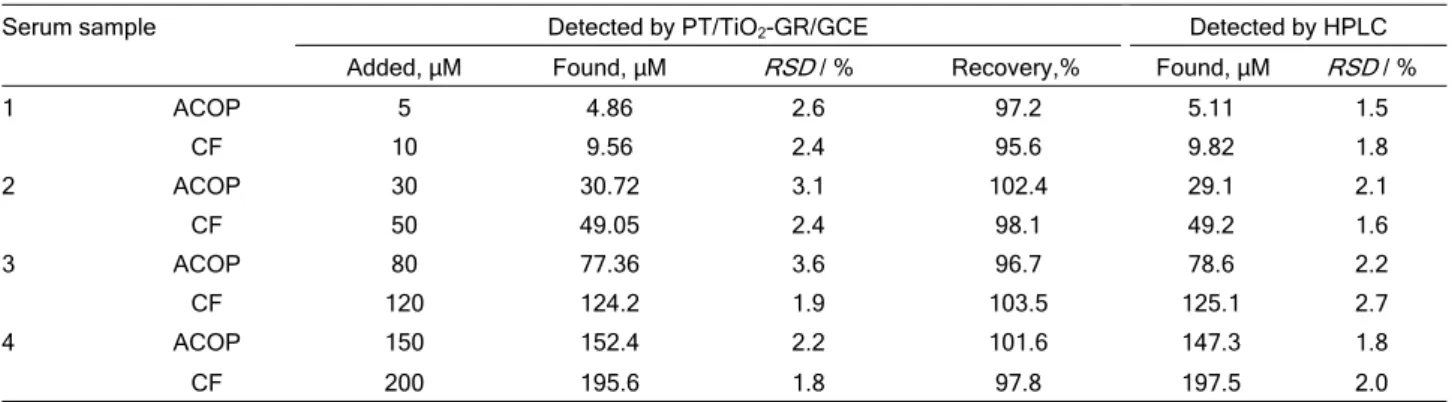
In order to testify the performance of this modi-fied electrode in real sample analysis, four serum samples from the hospital affiliated to our university were examined by the developed electrochemical sensor and the high-performance liquid chromato-graphy (HPLC) method, respectively. The concentra-tions of acetaminophen and caffeine were measured by the standard addition method, and the results showed that no acetaminophen and caffeine were found in the four serum samples. To test the reliability of the measurements, a known amount of acetami-nophen and caffeine standard was spiked in the serum samples, and then analyzed with a standard addition method. The obtained results were shown in Table 2. The recoveries were in the range of 95.6% to 103.5%. It was in accordance with the result obtained by using HPLC, which indicated the developed was reliable and feasible.
0.0 0.3 0.6 0.9 1.2 1.5
0 20 40 60 80 100 -50
-40 -30 -20 -10 0
C / µM
I /
µ
A
I /
µ
A
0 -10 -20 -30 -40 -50
E / V
ja
A
0.2 0.4 0.6 0.8 1.0 1.2 1.4 1.6
30 60 90 120 150 180 210
-40 -30 -20 -10 0
C / µΜ
I /
µΑ
I /
µ
A
E / V
0-20 -40
-60 f
a
B
Figure 7. A) Differential pulse voltammograms of PT/TiO2-Gr/GCE in 0.1M BPS (pH 7.0) containing 30 µM caffeine and different
concentrations of acetaminophen: a) 0.1, b) 1, c) 3, d) 5, e) 7, f) 10, g) 30, h) 50, i) 70 and j) 90µM. Inset: plot of oxidation peak current as a function of acetaminophen concentration. B) Differential pulse voltammograms of PT/TiO2-Gr/GCE in 0.1 M BPS (pH 7.0)
containing 1 µM acetaminophen and different concentrations of caffeine: a) 25, b) 50, c) 70, d) 90, e) 100 and f) 200 µM. Inset: plot of oxidation peak current as a function of caffeine concentrations.
Table 2. Determination of acetaminophen and caffeine in human serum samples
Serum sample Detected by PT/TiO2-GR/GCE Detected by HPLC
Added, µM Found, µM RSD / % Recovery,% Found, µM RSD / %
1 ACOP 5 4.86 2.6 97.2 5.11 1.5
CF 10 9.56 2.4 95.6 9.82 1.8
2 ACOP 30 30.72 3.1 102.4 29.1 2.1
CF 50 49.05 2.4 98.1 49.2 1.6
3 ACOP 80 77.36 3.6 96.7 78.6 2.2
CF 120 124.2 1.9 103.5 125.1 2.7
4 ACOP 150 152.4 2.2 101.6 147.3 1.8
CONCLUSION
In this work, a novel type of polymer/TiO2
-Gr-modified glassy carbon electrode was prepared and used for the simultaneous determination of acetami-nophen and caffeine. The modified electrode exhi-bited many desirable properties including excellent stability, reproducibility, high sensitivity, low detection limit and satisfactory linear range. Furthermore, its ease to construct, low cost and no treatment before use make it feasible to be applied in routine deter-mination.
Acknowledgments
This work was supported by the National Natural Science Foundation of China (20805040), Program for Science and Technology Innovation Talents in Universities of Henan Province (2010HASTIT025), Excellent Youth Foundation of He’nan Scientific Com-mittee (104100510020), and the Foundation of He’nan Education Committee (2009A150023).
REFERENCES
[1] P. Fanjul-Bolado, P. J. Lamas-Ardisana, D. Hernández-Santosa, A. Costa-García, Anal. Chim. Acta638 (2009) 133-138
[2] B.C. Lourencão, R.A. Medeiros, R.C. Rocha-Filho, L.H. Mazo, O. Fatibello-Filho, Talanta 78 (2009) 748-752
[3] N.F. Atta, M.F. EI-Kady, A. Galal, Sens. Actuators, B 141 (2009) 566-574
[4] M. Mazloum-Ardakani, H. Beitollahi, M.K. Amini, F. Mirk-halaf, M. Abdollahi-Alibeik, Sens. Actuators, B 151 (2010) 243-249
[5] S. Shahrokhian, E. Asadian, Electrochim. Acta 55 (2010) 666-672
[6] X.H. Kang, J. Wang, H. Wu, J. Liu, I.A. Aksay, Y.H. Lin, Talanta 81 (2010) 754-759
[7] R.T. Kachoosangi, G.G. Wildgoose, R.G. Compton, Anal. Chim. Acta 618 (2008) 54-60
[8] J.M. Zen, Y.S. Ting, Anal. Chim. Acta 342 (1997) 175-180
[9] M. Knochen, J. Giglio, B.F. Reis, J. Pharm. Biomed. Anal. 33 (2003) 191-197
[10] J.F. Chiou, S.L. Chen, S.M. Chen, S.S. Tsou, C.Y. Wu, J. S. Chu, T.Z. Liu, J. Food. Drug. Anal. 16 (2008) 36-40
[11] Sirajuddin; A.R. Khaskheli, A. Shah, M.I. Bhanger, A. Niaz, S. Mahesar, Spectrochim Acta, A 68 (2007) 747-751
[12] H. Filik, I. Sener, S.D. Cekic, E. Kilic, R. Apak, Chem. Pharm. Bull. 54 (2006) 891-896
[13] S. Ravisankar, M. Vasudevan, M.M. Gandhimathi, B. Suresh, Talanta 46 (1998) 1577-1581
[14] A. Goyal, S. Jain, Acta Pharm. Sci. 49 (2007) 147-151
[15] P.S. Selvan, R. Gopinath, V.S. Saravanan, N. Gopal, S. A. Kumar, K. Periyasamy, Asian J. Chem. 19 (2007) 1004-1010
[16] J.C. Song, J. Yang, J.F. Zeng, J. Tan, L. Zhang, Sens. Actuators, B 155 (2011) 220-225
[17] Q.J. Wan, X.W. Wang, F. Yu, X.X. Wang, N.J. Yang, A.J. Bard, L.R. Faulkner, J. Appl. Electrochem. 39 (2009) 785- –790
[18] T.L. Lu, Y.C. Tsai, Sens. Actuators, B 153 (2011) 439-444
[19] J.M. Zen, Y.S. Ting, Y. Shih, Analyst 123 (1998) 1145-1147
[20] B. Brunetti, E. Desimoni, P. Casati, Electroanal. 19 (2007) 385-388
[21] B. Habibi, M. Jahanbakhshi, M.H. Pournaghi-Azar, Elec-trochim. Acta 56 (2011) 2888-2894
[22] B.J. Sanghavi, A.K. Srivastava, Anal. Chim. Acta. 706 (2011) 246-254
[23] O.V. Lau, S.F. Luk, Y.M. Cheung, Analyst 114 (1989) 1047-1051
[24] B.J. Sanghavi, A.K. Srivastava, Electrochim. Acta 55 (2010) 8638-8648
[25] Y. Fan, H.T. Lu, J.H. Liu, C.P. Yang, Q.S. Jing, Y.X. Zhang, X.K. Yang, K.J. Huang, Colloids Surfaces, B 83 (2001) 78-82
[26] L.C. Jiang, W.D. Zhang, Electroanal. 21 (2009) 988-993
[27] Y. Wang, Z.Z. Chen, Colloids Surfaces, B 74 (2009) 322- –327
[28] M. Rajkumar, S.C. Chiou, S.M. Chen, S. Thiagarajan, Int. J. Electrochem. Sci. 6 (2011) 3789-3800
[29] W.S. Hummers, R.E. Offeman, J. Am. Chem. Soc. 80 (1958) 1339-1339
[30] N.I. Kovtyukhova, P.J. Ollivier, B.R. Martin, T.E. Mallouk, S.A. Chizhik, E.V. Buzaneva, A.D. Gorchinskiy, Chem. Mater. 11 (1999) 771-778
XIAO-QIN XIONG KE-JING HUANG CHUN-XUAN XU CHUN-XUE JIN QIU-GE ZHAI
College of Chemistry and Chemical Engineering, Xinyang Normal University, Henan, Xinyang, China
NAUČNI RAD
ELEKTRODA OD STAKLASTOG UGLJENIKA
MODIFIKOVANA POLI(TAURIN)/TIO
2-GRAFEN
KOMPOZITNIM FILMOM ZA ODRE
Đ
IVANJE
ACETAMINOFENA I KOFEINA
Napravljena je nova elektroda od staklastog ugljenika modifikovana poli(taurin)/TiO2
-gra-fen nanokompozitnim filmom (PT/TiO2-Gr/GCE). Ovaj senzor je zasnovan na
elektrohe-mijskoj polimerizaciji taurinskog sloja na TiO2 grafen modifikovanoj elektrodi od
staklas-tog ugljenika. Elektrohemijsko ponašanje acetaminofena i kafeina na modofikovanim elektrodama je proučavano cikličnom volatmetrijom i diferencijalnom pulsnom voltamet-rijom. Rezultati pokazuju da oksidacioni pik struje ima zadovoljavajuću linearnost u op-segu koncentracija od 1×10⁻⁷-9×10⁻⁵ M za acetaminofen i 2.5×10⁻⁵-2×10⁻⁴ M za kafein. Limit detekcije za acetaminofen je 3.4×10⁻⁸ M, a za kofein 5.0×10⁻⁷ M. Ova modifikovana elektroda je pokazala dobru osetljivost i stabilnost, pa ima obećavajuću potencijalnu pri-menu kao dobar elektrohemijski senzor i biosenzor.
Ključne reči: taurin; TiO2-grafen nanokomposit; acetaminofen; Kofein;