Introduction
Manual aiming movements to ixed targets are composed by an initial ballistic impulse, via open-loop control, that roughly approaches the limb to the target and a inal homing under closed-loop control, usually with ine adjustments through vi-sual and proprioceptive feedback to guarantee accuracy1,2. Peak velocity is used as the main kinematic marker to distinguish the initial impulse phase (primary submovement) and the inal homing phase (secondary submovement)3. The time interval
preceding peak velocity (primary submovement) relects the preprogrammed phase of the movement. After peak velocity, the second submovement initiates4. The number of discontinuities
in the acceleration of the secondary submovement relects the online correction of the movement trajectory5.
Sex is a factor that inluences the way in which aiming movements are planned and controlled. Women produce lower peak velocities and longer movement times than men do6,7. Moreover, women are more accurate than men are7. Men spend less time decelerating toward the target than women. Another interesting inding is that an increased index of dificulty (ID) of the task produces fewer errors and increased time after peak velocity for women than for men8. Overall, men prefer a mode
of aiming control that emphasizes speed, whereas women prefer a strategy of control that emphasizes accuracy9. The
response-style hypothesis8,10 assumes the manifestation of sex-speciic response strategies when the sensory motor system is challenged by different task constraints. Evidently, biomechanical factors differ between men and women, but when the same mechanical aspects of the movement are maintained and different cognitive
processes are required, the difference between sexes in aiming movements becomes related to mental proceIn previous studies, we employed an aiming task that simulated different cognitive and motor constraints observed daily under manual control3,11,12. This task seems to be an interesting form of investigating other types of task constraints that can inluence the control strategies in women and men. The task has four conditions of execution, a pre-potent (very usual) condition, a distractor condition, a response inhibition condition, and a higher index of dificulty condition. We can expect faster movement times and higher levels of peak velocity for men, mainly in the pre-potent condition. Men are less prone to the control of pre-potent responses, show-ing the inability to inhibit an activated or pre-cued response12,13. Therefore, we can hypothesize that men will produce more errors in the inhibition of responses than women will.
When comparing the pre-potent condition with the higher ID condition, we can also expect, based on the Rohr8 indings, a
bigger difference in the distribution of the primary and second-ary submovements for women than for men. We hypothesized that the primary submovement of women will be shorter in the higher ID condition to guarantee accuracy in the homing part of the movement. Finally, we can expect differences between sexes in the distractor condition. The distractor condition symbolizes a context in which irrelevant information, relative to the pre-potent condition, needs to be suppressed for a successful goal achievement. The goal of this condition is the same as that of the pre-potent condition, but a yellow, not a green target, ap-pears in 10% of the trials and it is inserted to produce conlict in the subjects’ response selection. Women present in the third part of the Stroop Color-Word test have a better ability to inhibit
Original Article (short paper)
Comparison between manual aiming control and
sex in different task constraints
Lidiane Aparecida Fernandes Herbert Ugrinowisch João Roberto Ventura de Oliveira
Mayndra Giusti Salvador Lucas Eduardo Antunes Bicalho
Guilherme Menezes Lage
Universidade Federal de Minas Gerais, UFMG, Belo Horizonte, MG, Brazil
Abstract — Aims: This study aimed to investigate the comparison between sex and manual aiming control in different
cognitive and motor constraints of the task. Methods: Eighty-four right-handed participants (42 women) performed
110 trials of a manual aiming task with a non-inking pen on a digitizing tablet. The aiming task required four different conditions of execution. The control condition appeared on the computer screen in 70% of the trials, and the other three conditions, (a) distractor, (b) inhibition of response and (c) higher index of dificulty, each appeared in 10% of the trials. Results: Compared with women, men produced shorter movement and response times, as well as higher peak
velocity in the control and distractor conditions. When the index of dificulty of the task increased, men produced only higher peak velocity. Women produced more corrective movements to achieve the target only in the control condition.
Conclusion: Our results corroborate those of previous studies that indicate sex-speciic response strategies when the
sensory motor system is challenged by different task constraints.
irrelevant information than men14. Thus, we hypothesize that
women will process the distractor condition faster, relected in shorter reaction and movement times than men will.
We designed this study to investigate the comparison between sex and manual aiming control in different cognitive and motor constraints of the task. Given that sex-speciic response strategies are inluenced by different task constraints6,7, we hypothesized several differences in the aiming control between sexes, as described in the preceding paragraphs. To our knowledge, no study has investigated the comparison between sex and aiming control when applying different cognitive constraints of the task
Methods
We studied 84 participants ranging from 18 to 40 years old (42 women, 42 men; mean age= 24.3 ± 4.3 years). All participants were right-handed university students as classiied by the Edinburgh Handedness Inventory15 who had normal or
corrected-to-normal visual acuity in both eyes. A local ethics committee approved all procedures (ETIC 064/09). Participants signed an informed consent form after receiving a complete explanation of the study. To calculate the sample size of a two-tailed design, we adopted an alpha of 0.05 and a power of 0.9. A minimum of 42 participants for each group was identiied using G*Power version 3.1.9.2.
Manual aiming movements were quantiied using a Wacom Intuos 3 digitizing tablet (30.4 cm × 30.4 cm, RMS accuracy 0.01 cm, 200 Hz), a non-inking pen and MovAlyzeR software (NeuroScript, LLC; Tempe, AZ, USA). The tablet was attached to an MS Windows laptop computer (15.4” diagonal widescreen) running MovAlyzeR software. The distance traveled by the non-inking pen on the tablet was proportional to the distance traveled by the cursor on the computer screen.
The motor task and procedures used in previous studies were also used in this study3,11,12. The participants were required to make fast and accurate strokes (displayed in real time on the laptop monitor) from the home position to the target. A trial started by displaying both the home position and a illed-in green circle target (the precue) indicated on the monitor. The cursor was to be kept at the home position during this precue period. Then, the green target would disappear from the screen, and in a time interval that ranged randomly from 2 to 3 s, the green target appeared again as the imperative stimulus indicating “go”. The participants were instructed to move the cursor to the target as quickly and accurately as possible. This procedure was our control condition and appeared in 70% of the trials (pre-potent stimuli). The dificulty index (ID) of the above conditions was 5.2 bits16.
The target (1 cm diameter) was presented at the same distance (19 cm center-to-center) and angle (45º upper right from the home position). ID was calculated using the following formula:
Log2 (2A/W),
Where A is the amplitude of the movement and W is the
target width.
Each of the other three conditions only appeared in 10% of the trials. A illed-in yellow circle appeared instead of the
green circle target in the distractor condition. A illed-in red circle appeared, indicating “stop”, in the inhibition of response condition. Under this condition, the participant was instructed to not move the pen. The higher index of dificulty condition was the third condition. A illed-in green circle appeared simi-larly to the target used in the control condition. However, the size of the target was smaller (0.5 cm of diameter) than the target of the other three conditions (1 cm of diameter), and had an ID of 6.3 bits. Moreover, the position of the target was more distant (2 cm) and a new angle was presented (40º) (see more details in 3). Again, only movement amplitude and target
width were used for calculating ID. The goal of executing the movement to the target as quickly and accurately as possible was still the same.
The participants received standardized instructions concern-ing the study. Participant held the non-inkconcern-ing pen in a usual pen grip with the right hand. To become familiar with the apparatus and task and to ind a suitable posture, participants carried out six trials of the control condition. The body midline was aligned with the home position. Following familiarization, the motor task was then performed. Participants performed 100 trials of the task. The order in which conditions appeared was random-ized in each block of 10 trials. Hence, in each block of 10 trials, participant performed 7 trials of the control condition and 1 trial of each one of the other conditions.
After the presentation of the imperative stimulus, participants had 2 seconds to move from the home position to the target. After 2 seconds, the target disappeared and the recording of the trial was ended. A red trace was displayed on the screen concomitantly with the non-inking pen movement. The test took approximately 16 minutes to be completed.
The non-inking pen movements were low-pass iltered at 12 Hz using Fast Fourier Transform (FFT) and differentiated to yield estimates of the velocity and acceleration curves. We segmented a stroke into primary and secondary submovements by the irst negative-to-positive zero crossing after the absolute peak velocity in the acceleration proile. The primary submovement denotes the initial impulse phase and the secondary submove-ment represents the online controlled phase.
The performance measurements examined were: (1) reac-tion time (RT), (2) movement time (MT), (3) response time (RespT, the sum of reaction and movement time), (4) score of incorrect hits to the target (0 if hit and 1 if missed) and (5) score of response inhibition errors (0 if “stop” and 1 if “go”). The kinematic measures analyzed were: (1) peak velocity (PV), (2) relative time to peak velocity (RTPV) and (3) the number of discontinuities in acceleration in the secondary The mean values based on 10 trials for the distractor, the inhibition of response, and the higher index of dificulty conditions were calculated for all dependent measures. For the control condition, the mean values based on 70 trials were calculated for all measures. The Kolmogorov-Smirnov Test showed that the PV violated the assumption of normal distribution under control and higher in-dexes of conditions, as well as the ND in the control condition, but the data were normalized by a logarithmic transformation (log10). The same inferential analyses applied by Lage et al.,3
were conducted. Chi-squared tests were used to analyze the following nominal data: (a) total frequency of the scores of in-correct hits to the target and (b) total frequency of the scores of response inhibition errors. The effect size was calculated using Cohen’s formula17. A signiicant difference at the level of 0.05 was adopted for all statistical analyses.
Results
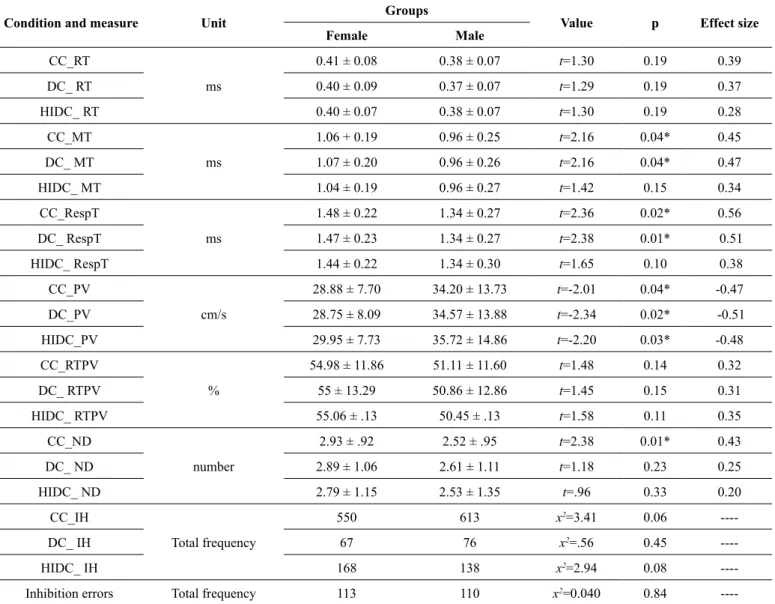
In the control condition, the inferential analysis of the data indicated differences between groups for the measures of MT, RespT, PV and ND. The men produced shorter MT and RespT and achieved higher PV than women. The women produced an increased ND compared to the men. There were no differences between groups for the RT and RTPV measures. The descriptive and inferential results are presented in Table 1.
In the distractor condition, the inferential analysis of the data indicated differences between groups for the measures of MT, RespT, and PV. The men produced shorter MT and RespT and achieved higher PV than women. There were no differ-ences between groups for the RT, RTPV and ND measures. The descriptive and inferential results are presented in Table 1.
In the higher index of dificulty condition, the inferential analysis of the data indicated differences between groups only for the measure of PV. The men achieved higher PV than the women. There were no differences between groups for the other measures. The descriptive and inferential results are presented in Table 1.
In the inhibition of response condition, there was no differ-ence between groups. The descriptive and inferential results are presented in Table 1.
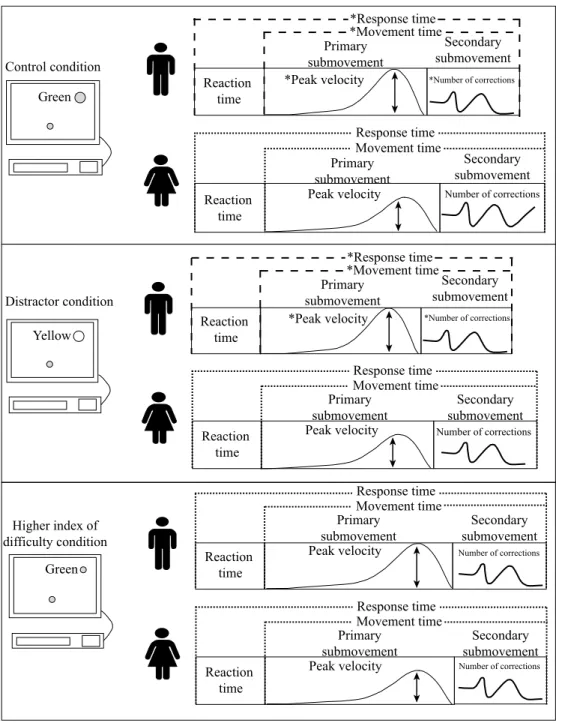
Figure 1 shows the signiicant differences between men and women in the control, distractor, and higher index of dif-iculty conditions.
Table 1. Means and standard deviations of women and men for dependent measures obtained in all conditions of execution; results of Student’s t-tests and Chi-squared tests; effect size results.
Condition and measure Unit
Groups
Value p Effect size
Female Male
CC_RT
ms
0.41 ± 0.08 0.38 ± 0.07 t=1.30 0.19 0.39
DC_ RT 0.40 ± 0.09 0.37 ± 0.07 t=1.29 0.19 0.37
HIDC_ RT 0.40 ± 0.07 0.38 ± 0.07 t=1.30 0.19 0.28
CC_MT
ms
1.06 + 0.19 0.96 ± 0.25 t=2.16 0.04* 0.45
DC_ MT 1.07 ± 0.20 0.96 ± 0.26 t=2.16 0.04* 0.47
HIDC_ MT 1.04 ± 0.19 0.96 ± 0.27 t=1.42 0.15 0.34
CC_RespT
ms
1.48 ± 0.22 1.34 ± 0.27 t=2.36 0.02* 0.56
DC_ RespT 1.47 ± 0.23 1.34 ± 0.27 t=2.38 0.01* 0.51
HIDC_ RespT 1.44 ± 0.22 1.34 ± 0.30 t=1.65 0.10 0.38
CC_PV
cm/s
28.88 ± 7.70 34.20 ± 13.73 t=-2.01 0.04* -0.47
DC_PV 28.75 ± 8.09 34.57 ± 13.88 t=-2.34 0.02* -0.51
HIDC_PV 29.95 ± 7.73 35.72 ± 14.86 t=-2.20 0.03* -0.48
CC_RTPV
%
54.98 ± 11.86 51.11 ± 11.60 t=1.48 0.14 0.32
DC_ RTPV 55 ± 13.29 50.86 ± 12.86 t=1.45 0.15 0.31
HIDC_ RTPV 55.06 ± .13 50.45 ± .13 t=1.58 0.11 0.35
CC_ND
number
2.93 ± .92 2.52 ± .95 t=2.38 0.01* 0.43
DC_ ND 2.89 ± 1.06 2.61 ± 1.11 t=1.18 0.23 0.25
HIDC_ ND 2.79 ± 1.15 2.53 ± 1.35 t=.96 0.33 0.20
CC_IH
Total frequency
550 613 x2=3.41 0.06
----DC_ IH 67 76 x2=.56 0.45
----HIDC_ IH 168 138 x2=2.94 0.08
----Inhibition errors Total frequency 113 110 x2=0.040 0.84
Discussion
We designed this study to investigate the comparison between sex and manual aiming control in different cognitive and motor constraints of a task. Given that sex-speciic response strategies are inluenced by different task constraints, we hypothesized several differences in the aiming control between sexes. Our hypotheses were partially conirmed.
We expected faster MT for men, mainly in the control condition. Our results conirm this hypothesis. This type of difference between sexes is often observed in aiming studies6,7. Surpassing our expectations, men also presented faster MT in the distractor condition, indicating that this type of cognitive
constraint does not directly affect the male-speciic response strategy. Conversely, when the motor demand increased in the higher index of dificulty condition, the advantage in terms of MT disappeared. The same pattern of results was observed for the RespT measure. Remarkably, the men maintained the same MT (0.96 s) and RespT (1.34 s) across the task demands. Thus, the non-difference found in the higher index of dificulty condition was produced by the adaptation in female behavior when facing the higher spatiotemporal demand of this condition.
Results apparently different from our indings in the higher index of dificulty condition have been found. Rohr18 found
clearer differences between sexes in MT when the task dificulty increased. However, this type of result reinforces the idea that
Green Control condition
Distractor condition
Yellow
Higher index of difficulty condition
Green
Reaction time
*Peak velocity *Number of corrections
Primary submovement
Secondary submovement *Response time
*Movement time
Reaction time
Peak velocity Number of corrections
Primary submovement
Secondary submovement Response time
Movement time
Reaction time
*Peak velocity *Number of corrections
Primary submovement
Secondary submovement *Response time
*Movement time
Reaction time
Peak velocity Number of corrections
Primary submovement
Secondary submovement Response time
Movement time
Reaction time
Peak velocity Number of corrections
Primary submovement
Secondary submovement Response time
Movement time
Reaction time
Peak velocity Number of corrections
Primary submovement
Secondary submovement Response time
Movement time
sex-speciic response strategies are inluenced by different task constraints. Rohr18 applied a traditional Fitts reciprocal tapping
task16, in which the performer was required to address the aims
of speed and accuracy with no deadline. However, when Rohr8
applied a discrete aiming task with a ixed demand of speed, no interaction between task dificulty and sex was found for MT. Similarly, Rohr18 and Teeken et al.,6 found no difference in MT
between sexes in a reciprocal aiming task, but found a differ-ence in a discrete aiming task. However, similar to our study Teeken et al.,6 instructed the participants to move as quickly
and accurately as possible. Finally, when rapid aiming move-ments were executed on targets that changed size and position during hand trajectory, men were not faster than women for MTA possible explanation of the adaptation of female behavior when facing the higher spatiotemporal demands of the higher index of dificulty condition is that when the task demand was lower (e.g., in the control condition), women produced more controlled movements, emphasizing accuracy. This type of strategy was apparently better in the prepotent condition, in which there was a tendency toward better accuracy. The partici-pants had two seconds to achieve the target; this time interval was suficient, even for adopting an accuracy-emphasized ap-proach. Nonetheless, for the same index of dificulty, but with the distractor stimuli, this type of approach did not work. The number of corrective movements in the secondary submovement was different between sexes in the control condition, but it was identical in the distractor condition. We did not ind an easy way to explain these indings regarding accuracy and the number of corrective movements. Interestingly, the effect sizes between the control and distractor conditions were very close to those of the MT (0.45 and 0.47, respectively) and RespT (0.56 and 0.51, respectively), but they fell from medium to low for the number of corrective movements in the secondary submovement (0.43 and 0.25, respectively). Somehow, the distractor stimuli affected the women’s online control. Further research needs to be carried out to analyze this question.
Among the dependent measures used, the measure of PV best epitomized the difference between sexes. In all conditions of execution, men achieved a higher level of PV than women did. Medium effect sizes17 were observed, independent of the demand of the task. However, the comparison between these indings and the literature shows that higher PV for men is not a pattern observed independent of the task characteristic. In unpredictable conditions of target size and position19 , and
in aiming executed with a ix demand of speed8, there was no
difference between sexes.
The hypothesis that men would present more errors in the inhibition of response was not conirmed. In traditional Go/No-Go neuropsychological tasks11,20,21 the perceptual requirements are high, but the demands to the motor system are low, requiring just the pressing of a button with a inger3. In our more
demand-ing motor task, the men inhibited their response with the same level of eficiency as women. Our hypothesis that women would produce faster RT in the distractor condition than men was also not conformed. Again, the type of behavior observed in tasks with a low demand to the motor system (e.g., Stroop Color-Word Test) was not found in our aiming task. Further studies should
be carried out to analyze whether tasks with similar perceptual requirements but different motor demands produce different results when comparing the performance between sexes. Finally, the hypothesis on the difference in the distribution of the primary and secondary submovement between sexes was not found in any of our conditions. While our task required speed and ac-curacy, the unique study that found differences in the primary and secondary distribution was the Rohr8 test which exhibited
a ixed speed. At least when speed and accuracy were required, the distribution of the submovements was identical between sexes, independent of the task demand.
Conclusions
Overall, our indings, in comparison with previous results found in the literature, permit us to conclude that when a performer is instructed to move as quickly and accurately as possible in a discrete aiming task, men present faster MT and RespT than women, with the exception of the condition with high dificulty. In this type of task, PV is higher for men than women. Lastly, our results reinforce the response-style hypothesis because the manifestation of sex-speciic response strategies was observed when the sensory motor system was challenged by different task constraints.
References
1. Woodworth RS. The accuracy of voluntary movement. Psychol Rev. 1899;3(2):106.
2. Abrams RA, Pratt J. Rapid aimed limb movements: Differential effects of practice on component submovements. J Mot Behav. 1993;25(4):288-298.
3. Lage GM, Malloy-Diniz LF, Neves FS, de Moraes PHP, Corrêa H. A kinematic analysis of the association between impulsivity and manual aiming control. Hum Mov Sci. 2012;31(4):811-823. 4. Khan M, Franks I, Elliott D, Lawrence GP, Chua R, Bernier P,
et al. Inferring online and ofline processing of visual feedback in target-directed movements from kinematic data. Neurosci Biobehav Rev. 2006;30(8):1106-1121.
5. Mieschke PE, Elliott D, Helsen WF, Carson RG, Coull J a. Manual asymmetries in the preparation and control of goal-directed move-ments. Brain Cogn. 2001;45(1):129-140.
6. Teeken JC, Adam JJ, Paas FG, van Boxtel MP, Houx PJ, Jolles J. Effects of age and gender on discrete and reciprocal aiming movements. Psychol Aging. 1996;11(2):195-198.
7. Barral J, Debû B. Aiming in adults: Sex and laterality effects. Laterality Asymmetries Body, Brain Cogn. 2004;9(3):299-312. 8. Rohr LE. Upper and lower limb reciprocal tapping: evidence for
gender biases. J Mot Behav. 2006;38(1):15-17.
9. Hansen S, Elliott D. Three-dimensional manual responses to un-expected target perturbations during rapid aiming. J Mot Behav. 2009;46(1):16–29.
11. Lage GM, Malloy-Diniz LF, Neves FS, Gallo LG, Valentini AS, Corrêa H. A kinematic analysis of manual aiming control on euthymic bipolar disorder. Psychiatry Res. 2013;208(2):140-144. 12. Lage GM, Miranda DM, Romano-Silva MA, Campos SB,
Albuquerque MR, Corrêa H, et al. Association between the catechol-O-methyltransferase (COMT) Val158Met polymor-phism and manual aiming control in healthy subjects. PLoS One. 2014;9(6):e99698.
13. Macdonald KB. Effortful control, explicit processing, and the regulation of human evolved predispositions. Psychol Rev. 2008;115(4):1012-1031.
14. Van der Elst W, van Boxtel M, van Breukelen G, Jolles J. The Stroop color–word test: Inluence of age, sex and education; normative data for a large sample across the adult age range. Assessment. 2006;13(1):62–79.
15. Oldield RC. The assessment and analysis of handedness: The Edinburgh Inventory. Neuropsychologia. 1971;9:97-113. 16. Fitts PM. The information capacity of the human motor system
in controlling the amplitude of movement. J Exp Psychol Gen. 1954;47(6):91-381.
17. Cohen J. Statistical Power Analysis for the Behavioral Sciences. Mahwah. Mahwah, NJ: Lawrence Erlbaum Associates; 1988. 18. Rohr LE. Gender-speciic movement strategies using a
computer-pointing task. J Mot Behav. 2006;38(6):431-437.
19. Hansen S, Elliott D. Three-dimensional manual responses to un-expected target perturbations during rapid aiming. J Mot Behav. 2009;41(1):16-29.
20. Epstein JN, Erkanli A, Conners CK, Klaric J, Costello JE, Angold A. Relations between continuous performance test performance measures and ADHD behaviors. J Abnorm Child Psychol. 2003;31(5):543-554.
21. Walderhaug E, Magnusson A, Neumeister A, Lappalainen J, Lunde H, Refsum H. Interactive effects of sex and 5-HTTLPR on mood and impulsivity during tryptophan depletion in healthy people. Biol Psychiatry. 2007;62(6):593–599.
Corresponding author
Lidiane Aparecida Fernandes
Universidade Federal de Minas Gerais, Escola de Educação Física, Fisioterapia e Terapia Ocupacional da UFMG, Belo Horizonte, MG, Brazil
Email: [email protected]
Manuscript received on May 23, 2017 Manuscript accepted on August 29, 2017