Introduction
There is constant growth of people owning a computer, and an extensive Internet network which favours a drastic increase in time spent in a sitting position and nowadays, many contempo-rary works and jobs adopt the seated posture. The sitting posture itself has been identiied as an independent risk factor for sev -eral diseases, as diabetes, cardiovascular disease and disorders musculoskeletal1,2. There are many workplace interventions
attempting to reduce sitting at work3.
The ordinary duration of jobs which involves ofice work is 8 hours and activities using computers are usually performed at sitting posture. These workers are exposed to static postures dur-ing several hours which are strongly associated with discomfort and fatigue. In a long term this exposure becomes risk factors to development of low back pain4,5. Also, it should be considered
the additional time that people stay seated at home. Søndergaard, Olesen, Søndergaard, Zee, Madeleine6 recorded that sitting posture
is described as the main reason for low back discomfort. Besides, such discomfort relects an early perception of pain related to biomechanical load applied to musculoskeletal system.
The intra-discal pressure related to body positions were extensively studied by Nachemson7, who veriied that load on
the lumbar discs at sitting posture should not be underestimated, since the pressure is higher than in standing posture.
Some studies investigated the use of seats which have the possibility to assure the anterior pelvic tilt, and consequently, they preserve lumbar lordosis at the sitting posture with less muscular activation, less effort and biggest lumbar curve8,9. When the sub-ject works in an ofice and performs activities including reading, writing, typing and phone calls, they tend to project their trunk forward and not use the back of the chair most of the time5. In fact,
most of people do not use the back of the chair while working. In this posture, there is an increase in the intra-discal pressure,
as described by Nachemson, which is compatible with lumbar overload caused by an inversion in lumbar lordosis.
The salli sway™ seat design positions the subject as mounted in a saddle, which allows a forward tilt of the seat, and the manufacturers recommend an angle between trunk and thigh which maintains the lumbar lordosis and the lower thoracic kyphosis. Many studies have evaluated seats like salli by ob-jective measures, such as postural control, electromyographic activity and lumbar angles4,9,8,10,11. Nevertheless, it is necessary
to relate qualitative scales with biomechanical parameters. This study has the purpose to evaluate the changes in the spine curves and the sensations provoked by different types of seats through kinematic analysis, comfort and pain scales.
If this study inds a type of work seat that provokes less changes in the spine curves or less pain and discomfort, it would help seat manufacturers to elaborate more appropriate seats to the population. Thus, many people could beneit if they used types of seats that promote a better seating posture with less overload on the spine. This could contribute to minimize the incidence of low back pain in the population, and that justiies this study.
Methods
This study was approved by the Ethics in Research Committee of the University (743.915/ 2014).
This paper refers to an analytical study and the variables analyzed are comfort and pain scales, and the spine curves are measured through lumbar, thoraco-lumbar and thoracic angles.
The research was performed at the Physiotherapy Clinic from the University in an appropriate and reserved room. In this room, two ofice tables were disposed perpendicularly between each other, one for the volunteer and other for the examiner. Original article (short paper)
Assessment of changes in spine curvatures and
the sensations caused in three different types of
working seats
Caique de Melo do Espírito Santo Rubens Correa Araújo
Universidade de Taubaté, Taubaté, SP, Brazil
Abstract — Aims - This study aimed to evaluate the changes in the spine curvatures and the sensations caused by
different types of seats: standard, ischial support and salli. Methods - The analyzes were performed by the kinematics and scales of discomfort and pain in 14 healthy subjects. The data collection occurred in three days, one day for each type of seat. The subjects answered questionnaires and were assessed for placement of kinematic markers used to measure the thoracic, thoraco-lumbar and lumbar angles. Each trial was conducted in a sixty-minute period on each chair. Results and conclusions - The results showed that the salli seat type causes larger lumbar angles, which is consistent with the maintenance of lumbar lordosis. Likewise, the salli seat showed smaller thoraco-lumbar angle, which is consistent with smaller inferior thoracic kyphosis. Paradoxically, the ischial support seat produced less discomfort and pain than salli type. And inally, the longer the sitting position was the higher the score on the discomfort scale.
This study analyzed data from 14 female subjects aging between 19 and 24, who received information about the ex-periment and agreed on participating in it. All of them signed a term of consent.
The subjects included in the group should be healthy females without any disability, and they should be students. Such con-dition assure that subjects have already the habit of staying in the sitting posture.
Since the incidence of low back pain in the population is very high, the Oswestry Disability Index (ODI) and Roland-Morris Disability Questionnaire (RMDQ) were used to standardize the functionality and disability scores of the subject’s spine. Besides the criteria mentioned above, it was included in the study only the subjects with ODI score less than 20%, e low score in the RMDQ, which could suggest disability. In this questionnaire it was not adopted a limit score, but it was used to classify the eventual grade of disability that subjects could present12,13,14.
As exclusion criteria, it was deined the conditions in which subjects have any pain that could prevent them to stay seated in the determined time for experimental trial, as well any injury which could occur between the trial phases.
Instruments
The RMDQ is an instrument widely used in researches and clinical practice, and itwas used to evaluate the functionality associated with low back pain during activities of daily living. It consists in 24 phrases which present daily situations in which subjects can present impairments to carry them out due to low back pain. For each signed question 1 point is added up, vary-ing from 0 to 24 points. The higher the number of points, the bigger the incapacities13.
The ODI is composed by 10 questions which were made to functional evaluation of the low back pain. Each question goes up to 5 points and the score is obtained according to the number of points multiplied by 2. The resultant percentage, from 0 to 100%, allows the following classiication: 0 to 20%, mild; 21 to 40%, moderately impaired; 41 to 75%, severely impaired; and, higher than 76%, practically with no movement, if he is not hospitalized12.
The Pain Numerical Rating Scale (PNRS) since it is has good sensitivity and generates data that can be statistically analysed for audit purposes15. It is a numeric scale made by 11 points,
which consists in measuring the subject’s pain intensity, from 0 = “no pain” and 10= “the worse pain”.
The discomfort sensation provoked by low back pain was measured according to the Likert type scale, which is constituted of ive points for the question “Generally, how has your pain caused discomfort on you in the sitting posture in this seat at this moment?” The answers have 5 options which vary from “no discomfort” and “extremely”16.
A digital camera Sony Cyber-Shot W35, 7.2 megapixels (UK) supported by a tripod was used for kinematic data report.
The video analysis was performed on Kinovea ™ 0.8.15, and statistical analysis was performed on Statistica 99 and Statplus 2009 professional softwares.
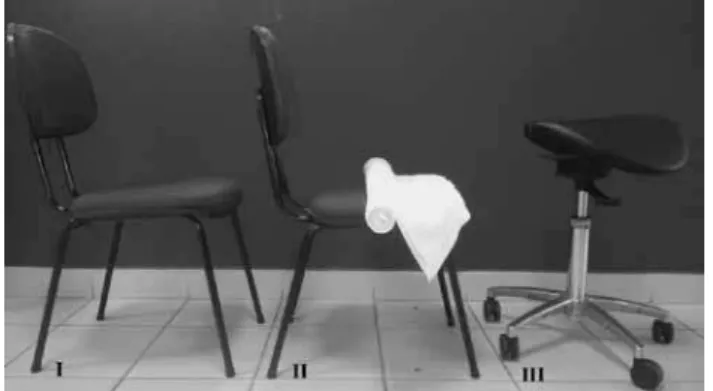
Figure 1 – The seats analyzed in the study: (I) Standard, (II) Ischial support and (III) Salli.
Seats
The igure 1 illustrates the seat types analyzed in this study Standard – This seat is a typical ofice chair. It shows a back tilt which seems to increase the backward tilt and invert lumbar lordosis.
Ischial Support - Although the description of this seat type was not found in the literature review, it is known that many physiotherapists recommend to their patients the use of ischial support made by a towel roll over the chair. This support has the function of a wedge to avoid the backward pelvic tilt and the consequent stress in the lumbar spine.
Salli – In this seat type the subject stay seated as if mounted in a cell. As described in the instructions, the ideal angle between trunk and thigh is 135o, and the set is designed to allow a forward
pelvic tilt. This seat type has an average height 25-40 cm more than standard height seat17.
General Procedures
Initially, subjects responded the ODI and RMDQ, and both were used to determine that subjects did not have low back pain.
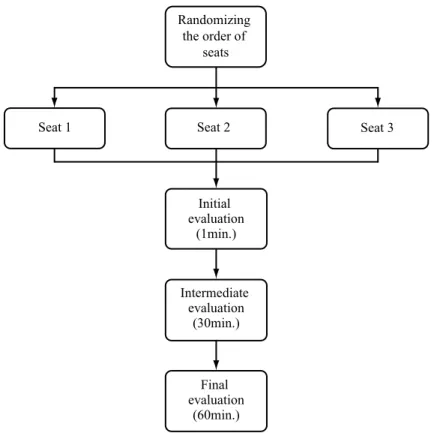
This study was performed with three different types of seat, and all subjects were submitted to the data acquisition during three days, one day for each type of seat. The order of the type of seat which would be used during the trial was randomized. After they responded to the questionnaires and the order of seats were randomized, the subjects were evaluated individually, so that identiication of the spinous processes of T1, T5, T10, L3 and S2 was made where the kinematic markers were placed (igure 2). Thus, it was possible to monitor the lumbar, thoraco-lumbar and thoracic angles during the trials, according to the method used by Claus, Hides, Moseley, Hodges18.
Figure 2 – Illustrative image showing the kinematic markers used to measure lumbar, thoraco-lumbar and thoracic angles (adapted from Claus et al., 2009).
Randomizing the order of
seats
Seat 1 Seat 2 Seat 3
Initial evaluation
(1min.)
Intermediate evaluation
(30min.)
Final evaluation
(60min.)
Figure 3 – Diagram illustrating the sequence of the evaluation in the study.
Adjusting the height of seat
When the Salli type seat was analyzed, it was made an adjust-ment on the table’s height in order to keep the same proportion
the seat to the inferior border of the table). This distance was used to elevate the table for the Salli type seat trials, and this was done to keep the same proportion of the table’s height with the seats used in this study.
The distance from the subject to the video camera sup-ported by a tripod over the table was standardized in all trials, and a perpendicular analysis was carried out. Two adhesive tapes were ixed on the wall in a place which could be visible at the camera’s screen. These tapes measure 15 cm in length and were placed forming a 90º angle between each other, and they were used to make the distance and angle calibrations at the video system.
Kinematic analysis procedure
The digital video iles were opened in the Kinovea software for kinematic analysis.Each ile has 1-minute length. Since the recording was performed on data from 14 subjects in three stages (pre, middle and post) and in three different types of seats (standard, support and salli), there were 126 iles to be processed and analyzed.
In each ile, a section of 1 second containing 10 frames in which there was no movement of the subject was selected. In this section, the tools to measure the angles were used, and they were considered as following: lumbar angle with anterior vertex, thoraco-lumbar angle and thoracic angle with posterior vertex, as illustrated in igure 2.
The angle data were registered in a spreadsheet in addition to the subjects’ data, including the scores obtained in the subjective scales for statistical analysis.
In order to make better comparisons with the literature data, and also, to improve interpretation of the measured angles with the spine curves, the angle values initially described in the software were submitted to the following operations and interpretations:
• Lumbar Angle – (-180o), values < 0 => lumbar kyphosis;
• Thoraco-lumbar Angle – (-180o), values > 0 => lower thoracic
ky-phosis; and,
• Thoracic Angle – (-180o), values > 0 => upper thoracic kyphosis.
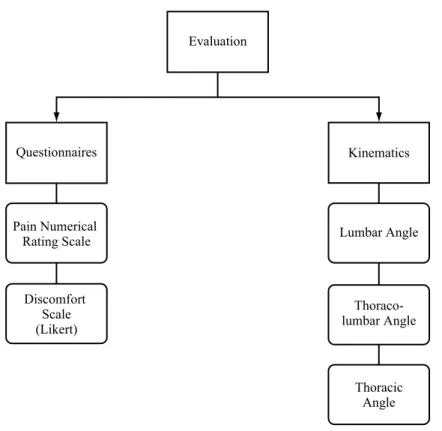
The design of the study is shown in igure 4.
Evaluation
Questionnaires
Pain Numerical Rating Scale
Discomfort Scale (Likert)
Kinematics
Lumbar Angle
Thoraco-lumbar Angle
Thoracic Angle
Figure 4 – Diagram of the trials evaluations by questionnaires and kinematic analysis.
Statistical Analysis
For the sample analysis, the Shapiro-Wilk W normality test was used.
It was performed a multiple analysis of variance (MANOVA) for the mean comparisons considering two factors: the seat type (standard, ischial support and salli) and instant (pre, middle and post), and ive dependent variables (discomfort, PNRS, lumbar angle, thoraco-lumbar angle and thoracic angle).
Results
Table 1 shows the MANOVA results considering the main effect of the analyzed factors, which are the seat and instant. It was observed that there was a signiicant effect (p<0.005) in the seat and instant factors, but not between factors.
The igure 5 shows the scores for discomfort and pain (PNRS) obtained for each type of seat (standard, ischial sup-port and salli), considering all instants. It was observed that there was a signiicant difference in the discomfort variable when comparing support with salli, which showed more dis-comfort than the irst one. In the same way, the pain variable was signiicantly higher in the salli type seat, compared to the support (p<0.005).
* **
salli support
standard
Type of Seat
discomfort pain
S
cores
0,0 0,2 0,4 0,6 0,8 1,0 1,2 1,4 1,6
Figure 5 – Scores from discomfort scale and Pain Numerical Rating Scale (PNRS) obtained in each type of seat (standard, ischial support
and salli). *signiicant difference in relation to the discomfort vari
-able on the support seat; **signiicant difference in relation to the PNRS variable on the ischial support seat.
The igure 6 shows the values of lumbar, thoraco-lumbar and thoracic angles obtained in the three types of seat ana-lyzed (standard, support and salli) considering all instants. It was observed that the lumbar angle for the salli seat showed signiicantly higher than standard and support seats. Also, the thoraco-lumbar angle was signiicantly lower in the salli seat compared to support seat (p<0.005).
Figure 7 shows the discomfort and pain scores obtained on each trial instant (pre, middle and post). It was observed that discomfort variable at the middle and post instants were signiicantly higher than pre instant. Also, the pain score at post instant was signiicantly higher than pre instant (p<0.05).
An
gle (
deg
re
es)
-4 -2 0 2 4 6 8 10 12 14 16 18 20
standard support salli
Type of Seat
* ** lumbar thoracolumbar thoracic
Figure 6 – Lumbar, thoraco-lumbar and thoracic angles recorded in the tree seat types (standard, ischial support and salli). *signiicant
difference in relation to standard and ischial support seats; **signii
-cant difference in relation to ischial support seat.
pre middle post
Trial Instant
0,0 0,2 0,4 0,6 0,8 1,0 1,2 1,4 1,6
S
core
s
discomfort
pain **
*
*
Figure 7-Scores of discomfort and pain obtained in each instant of trial (pre, middle and post).* and ** signiicantly higher than pre instant. Table 1 - Summary of all effects (seat x instant).
Lambda Wilks’ Rao’s R df 1 df 2 p-level
1- Seat 0.70 3.59 12 224 0.000
2- Instant 0.64 4.64 12 224 0.000
1-2 0.77 1.25 24 391 0.194
Discussion
instants (at the 1 st, 30th and 60th minutes) in order to observe the changes along time.
In order to standardize the sample, it was studied only the female subjects from the same group, and also, it was applied the ODI and RMDQ to know a possible inluence of a previous pain which affects the ADL or provokes some disability, respectively. The results shows that, even in healthy subjects, there is some variation in the scores which are not distributed in a normal curve. Such variation revealed a diversity of conditions in the spine, even in a group of subjects considered healthy, which can explain the absence of more speciic results that could indicate the best seat type. Thus, the previous condition revealed in the questionnaires, even following the literature criteria which lead to the inclusion criteria in this study, can suggest that each subject has preference for a seat type according to the previous discomfort degree in the spine.
The results in the table 1 shows that there was a signiicant effect when the factors seat type and instant are analyzed, but not when both factors were analyzed together. So, the results were analyzed as isolated factors only.
In the analysis of igure 5 it was observed that discomfort and pain were higher in the salli compared to the others seats.
As described by manufacturers17, the subtle change in
the manner of seating can provoke pain or discomfort in the initial use, or even after it, as a period of adaptation of usage. Nevertheless, this result is in accordance with Vergara and Page16 which afirm that lordotic postures with forward leaned
pelvis and low mobility are the principal causes of the increase of discomfort at the seated posture. However, results from a study showed that the dynamic chair increased upper body and chair movements as compared to the conventional chair in ofice tasks and nearly all subjects rated between 7 and 9 on the 1-10 comfort scale, indicating good to high comfort19.
The results showed more pain and discomfort in the salli seat, but a better preservation of the lumbar curve, since the subjects kept their lordosis in this seat, as seen in the positive angles in igure 6. One possibility that could explain such paradox is that the discomfort or pain would come from ischial tuberosities and the buttock soft tissues. Søndergaard, Olesen, Søndergaard, Zee, Madeleine6 investigated the correlation between discomfort
per-ception and postural control during a prolonged sitting posture through dislocation of the center of pressure and changes in the lumbar curvature. They observed that the biggest discomfort founded was in the buttock, and they suggest an association between the prolonged pressure on tissue and the discomfort at sitting posture. The salli seat is made with two-part saddle, and the distance between them is 6 cm. So, depending on the diameter between the ischios, they can touch on the highest spot of the seat, where the pressure can be higher, causing the discomfort.
Another aspect that could provoke the biggest discomfort in the salli seat is related to the table’s height. Since the purpose of this study was not to evaluate the effect of the table’s height, it was standardized 21 cm above the salli seat. Perhaps, if the subjects could adjust the table’s height they would have had less discomfort and/or pain in this seat type, as it was described by Annetts et al.10 in a saddle type seat with hydraulic adjustment of the table.
The ischial support seat showed less pain and discomfort
than standard and salli seat. This could be found due to the biggest contact area, which was distributed in the towel roll, and, as consequence, less pressure on the ischial tuberosities. According to Maksous, Lin, Bankard, Hendrix, Hepler, Press14,
this fact can help to decrease the muscular activity, and so, to prevent low back pain.
Another reason that could explain why less discomfort and pain in the ischial support seat was found is that it may keep the pelvis with less tilt than standard seat, and consequently less overload in the spine. Although both seats did not keep the lumbar lordosis (igure 6), the ischial support could help many people with low back pain, since it produces less discomfort and could preserve the lumbar lordosis if a manual facilitation and a verbal command would be performed by a physiotherapist Claus, Hides, Moseley, Hodges18, through a speciic training of sitting posture.
In the analysis of the spine angles shown at igure 6, it was observed that lumbar angle kept lordosis only in the salli seat, as the standard and support seat allowed the inversion of the lumbar lordosis. Such inding is in accordance to the manufacturers’ purpose Salli17 which suggest a seat elevation to provoke a 135º
angle between thigh and trunk, and this can be added to the fact that there is a forward bending of the seat, which can avoid the pelvic backward tilt and keep lumbar lordosis. Previous stud-ies have demonstrated that seats such as Back App, Balans™ Multi-Chair and Saddle Chair, which have similar characteristics to Salli Sway™, allow bigger angles between trunk and thigh and promote a forward tilt of the seat, which can keep lumbar lordosis8,11,10. The results of the present study show that salli
seat can keep lumbar curve.
The thoraco-lumbar angle was also smaller in the salli seat which is compatible with a decreased kyphosis in the lower aspect of thoracic spine.
It was observed that salli seat promoted lumbar lordosis and a decrease in lower thoracic kyphosis. But, there is a paradox in the results when comparing the results shown in igure 5 (subjective scores) to those shown in igure 6 (spine curves): more discomfort and pain but more preserved spine curves. This can be attributed to the duration of the analysis, probably a 4 hour working period could reveal more discomfort and/or pain related to inversion of lumbar lordosis. Another possibility for this paradox can be attributed to a lack of adaptation period to the use of salli seat. A similar inding occurred in dynamic chairs during a digitation task in Annetts et al.10 study, due to
the lack of familiarization with the chair’s concept.
In the analysis of results shown in igure 7, which assesses the effect of time in the discomfort and pain scores (considering all seats analyzed), it was clearly seen that there is a progres-sive increase in discomfort and pain along time. Such inding is in accordance to other studies which encountered strong relationship between sitting posture in periods longer than 90 minutes and progressive increase in discomfort6,16. So, it is
suggested that long periods in sitting posture should be avoided independently on the seat type.
Conclusions
The salli seat provokes higher lumbar angles, which is compat-ible with the lumbar lordosis maintenance, compared to standard and ischial support seats. In the same way, salli seat provokes lower thoraco-lumbar angles than standard and ischial support seats, which is compatible with less kyphosis in the lower thoracic spine.
Paradoxically, the ischial support provoked less discomfort and pain than salli seat.
As the time at sitting posture increases, the highest discom-fort score is referred.
References
1. Szczygieł E, Zielonka K, Mętel S, Golec J. Musculo-skeletal and
pulmonary effects of sitting position – a systematic review. Annals of Agricultural and Environmental Medicine. 2017;24(1):8-12.
2. Wilmot EG, Edwardson CL, Achana FA, Davies MJ, Gorely T,
Gray LJ, et al. Sedentary time in adults and the association with diabetes, cardiovascular disease and death: systematic review and meta-analysis. Diabetologia. 2012;55(11):2895-905.
3. Shrestha N, Kukkonen-Harjula KT, Verbeek JH, Ijaz S, Hermans
V, Bhaumik S. Workplace interventions for reducing sitting at work. Cochrane Database Syst. Rev. 2016;3:CD010912. 4. Shenoy S, Aruin AS. Effect of Chair Design on Feed-Forward
Postural Control in Sitting. Mot. Control. 2007;11(4):309-21. 5. Mörl F, Bradl I. Lumbar posture and muscular activity while sitting
during ofice work. J. Electromyogr. Kinesiol. 2013;23(2):362-8.
6. Søndergaard KHE, Olesen CG, Søndergaard EK, Zee M,
Madeleine P. The variability and complexity of sitting pos-tural control are associated with discomfort. J. of Biomech. 2010;43(10):1997-2001.
7. Nachemson AL. Disc pressure measurements. Spine. 1981;6(1):93-7.
8. O’Sullivan K, McCarthy R, White A, O’Sullivan L, Dankaerts W. Can we reduce the effort of maintaining a neutral sitting posture? A pilot study. Man. Ther. 2012;17(6):566-71.
9. Bennett DL, Gillis DK, Portney LG, Romanow M, Sanchez
AS. Comparison of Integrated Electromyographic Activity and Lumbar Curvature During Standing and During Sitting in Three Chairs. Phys. Ther. 1989;69(11):902-13.
10. Annetts S, Coales P, Colville R, Mistry D, Moles K, Thomas B, et al. A pilot investigation into the effects of different ofice chairs on spinal angles. Eur. Spine J. 2012;21(Suppl2):165-70.
11. Frey JK, Tecklin JS. Comparison of Lumbar Curves when Sitting
on the WestnofaBalans® Multi-Chair, Sitting on a Conventional Chair, and Standing. Phys. Ther. 1986;66(9):1365-69.
12. Vigatto R, Alexandre NMC, Filho HRC. Development of a Brazilian Portuguese Version of the Oswestry Disability Index: Cross-Cultural Adaptation, Reliability, and Validity. Spine. 2007;32(4):481-6.
13. Costa LOP, Maher CG, Latimer J, Ferreira PH, Pozzi GC, Ribeiro
RN. Psychometric Characteristics of the Brazilian-Portuguese Versions of the Functional Rating Index and the Roland Morris Disability Questionnaire. Spine. 2007;32(17):1902-07.
14. Makhsous M, Lin F, Bankard J, Hendrix RW, Hepler M, Press
J. Biomechanical effects of sitting with adjustable ischial and lumbar support on occupational low back pain: evaluation of sitting load and back muscle activity. Musculoskelet. Disord. 2009;10(17):1-11.
15. Williamson A, Hoggart B. Pain: a review of three commonly used pain rating scales. J. Clin. Nurs. 2005;14(7):798-804.
16. Vergara M, Page A. Relationship between comfort and back pos-ture and mobility in sitting-pospos-ture. Appl. Ergon. 2002;(1)33:1-8. 17. Salli ® - Sit Happy. 2012. Instruction Manual. Finland (Instruction
Manual, 8 p.).
18. Claus AP, Hides JA, Moseley GL, Hodges PW. Is ‘ideal’ sitting
posture real?: Measurement of spinal curves in four sitting pos-tures. Man. Ther. 2009;14(4): 404-8.
19. Grooten WJ, Äng BO, Hagströmer M, Conradsson D, Nero
H, Franzén E. Does a dynamic chair increase ofice workers’ movements? – Results from a combined laboratory and ield study. Appl. Ergon. 2017;60:1-11.
Corresponding author
Rubens Correa Araújo
Universidade de Taubaté, Clínica de Fisioterapia, Rua Marechal Arthur da Costa e Silva, 1055, Centro, Taubaté, SP, Brasil.
Email:rubens.araú[email protected]
Manuscript received on March 14, 2017
Manuscript accepted on May 7, 2017