COGNITIVE ASPECTS OF ATHLETE ACTIVITY
Alexander N. Veraksa,
Sergey V. Leonov
Lomonosov Moscow State University MoscowArticle is devoted to the issues of symbolic mediation and diagnostic of time per-ception in sport. Distinction between iconic and symbolic mediation is discussed. Evidences of efective implementation of symbolic mediation in sport are exam-ined. Means of optimization of sportsmen and sportswomen training by the in-strumentality of symbol are considered. The results of time perception diagnostic of Russian synchronized swimmers are described. It was shown that sportswomen are greatly varied in accuracy and stability of reproduction of long (2–5 sec) and es-timation of short (less than 250 ms) time intervals, which were illed with diferent contents – ticks of metronome, persistent sound, pressuring the button and etc. The improvement of individual characteristics of time perception is an important psychological resource of sports achievements increase.
Keywords: sport psychology, symbol, icon, image, situation of uncertainty, syn-chronized swimming, time perception.
Challenging the achieved results in some sports today requires great, if not superhuman, eforts. Despite of, the use of physical resources is al-ready close to genetically conditioned limitations. For these reasons, the usage of psychological resources in high achievement sports is consid-ered to have prospects, with a special emphasis on the development of an athlete cognitive abilities. his article presents the study of the cognitive aspects of athlete: iconic and symbolic mediation and perception of time.
Iconic and symbolic mediation in sports
symbolic relections. However, there is still no commonly accepted dis-tinction between iconic mediation and symbolic mediation.
We assume that iconic mediation difers from symbolic mediation. Unlike with icon or sign, the use of a symbol is particularly connected with the emergence of the situation of uncertainty. Icon, in turn, has a certain meaning and therefore is used in certain situations (situations, when the structure is clear to a subject, i.e. is described with a system of meanings). herefore, in this case external characteristics of an icon aren’t very important to a subject. Efective system proposed by G. Mar-tin and S. Palmer (Palmer, 1992) in igure skaMar-ting can serve as an example. According to G. Martin, four components are required for efective ig-ure skating skills: key words, denoting certain skating elements; mental performance of igures, actualization of emotions that correspond with certain elements of a performed pattern; equalizing time of mental and actual igure performances. S. Palmer, in her turn, assumed that athlete’s drawing sequence of igure elements would be equally efective.
In D. Garza and D. Feltz (Garza, and Feltz, 1998) experiment 27 fe-male igure skaters (10 to 18 years old) were divided into two groups. he irst group used the drawing method. At irst, sportswomen listed all elements of their respective programs, chose key words, and imagined their performance. hen the performance music was turned on and ig-ure skaters drew their patterns while saying aloud key words, describing igure elements. he music assisted in synchronizing the speed of draw-ing with the speed of actual performdraw-ing on the ice. At this sportswomen were asked to place key elements of their pattern in accordance with their spatial performance on the ice. Figure skaters from the irst experi-mental group had been practicing according to this technique daily for four weeks. At the same time sportswomen from the second group did various stretching exercises. Coaches came to a conclusion that sports-women from the irst experimental group have signiicantly improved their jumps and spins compared to the athletes from the second one. Moreover, sportswomen from the irst group have also showed improve-ments in their self-esteem. hus, icon representation can be used as an efective tool in athletes training. It is important to note that at this point we talk about iconic representation, because in this experiment a draw-ing works as a distinct model of a situation.
On the other hand, a symbolic image, while emerging in a situation of uncertainty, becomes vivid for a subject with its external form and
rich image content, which, when addressed by mind, comes to the fore-front. he content of a symbol is concentrated in its outward symbolic surface on which cognitive activity of a person is transferred from an actual situation. his is possible because igurative content of a sym-bol allows interpretation of meanings. We assume that by analyzing a symbol, one can reveal its meaning enclosed within a structure of rela-tions between symbol elements. Deining such a structure, a subject can transform the latter into a structure of relations between the elements of a given situation, which, in turns, leads to its deinition and therefore eliminates uncertainty (Veraksa, 2006; 2007; 2009).
Athlete training can be compared with an educational process, as both of these cases assume mastering certain content for certain achievements. In our research we have tested the hypothesis that sym-bolic mediation can be successfully applied to learning new notions in cases when igurative content of a symbol corresponds with an actual situation. his hypothesis was tested while teaching schoolchildren mathematical notions in order to apply aterwards the research results to the ield of sports.
he experiment
Studies aimed at mastering mathematical notion “function” and its graphic representation were held on the 4th grade pupils of secondary school (according to the curriculum, this subject is normally taught in the 6th grade). Experiment included 49 children (average age 10 years and 2 months). Studies were held in three groups equalized by the re-sults of Raven Progressive Matrix Test (Color Form).
Six 40-minute studies were held in each of three groups during 3 weeks of the experiment. At the irst stage of the experiment all children were asked to solve a task “From point A to point B bicyclist is going with the speed of 10 km/h. he distance between these two points is 50 km. Ater how many hours one should depart on a bus going with the speed of 40 km\h to get to point B faster than the bicyclist?” None of pupils could solve this task: this educational situation thus appeared as a situation of uncertainty.
For each group there was a specially designed program.
“func-tion” notion and corresponding algorithms for task solving). he main goal of the program was to get children to “suddenly discover” the idea of transformation. For this reason an image of a magical country was introduced where fairies did magic and could turn everything into ev-erything and likewise transform themselves. Introduction of the new deinition (particularly “function”) created situation of uncertainty and therefore the image we have described above was introduced for sym-bolic mediation of the respective part of mathematics as an aid in solv-ing this situation of uncertainty by children. hen a transition was made from the symbolic image to the educational content by the establish-ment of correspondence between them. For that we have invented ways of graphical depiction of transformations done by a magic wand so that later children could proceed to a similar table entry of transformation of an independent variable by its function.
In the controlling group the work was based upon unproductive symbolization. his group was used in the experiment to eliminate in-luence of emotional involvement and additional motivation factors. he studies were likewise devoted to a magical country, but the content of studied stories about its inhabitants (while literally including theme of mathematics, for example, stories about bears going to a math class), lacked any connection with the introduced notion of function. he sec-ond control group was taught by traditional curriculum. Ater all six studies were over (no later than in three days), pupils were given a test with ive tasks on graphical solving (for successful solving of each task a pupil was awarded one mark).
Discussion of the results
here were found no statistically signiicant discrepancies among the results of children passed Raven Test that itted the interval of 50-95 percentiles. For children within an interval of 25-50 percentiles, statisti-cal discrepancies by Manna-Whitney criterion were found at the level of signiicance of 0.01. Discrepancies between average results of experi-mental group participants and the irst control group amounted to 1.5 points; for the experimental group and the second control group – 1.63 points (in favor of experimental group). his data shows that produc-tive symbolic mediation in cogniproduc-tive activity can be efecproduc-tively used for people having diiculties with applying iconic mediation. At the same time, low indexes of irst control group indicate that emotional
involve-ment alone is not suicient for an efective transition from symbolic to iconic mediation.
However, using symbol doesn’t always resolve the situation of un-certainty and allow to make transition to meanings – widespread are the cases when a symbol facilitates settlement of a problem situation and transmits emotional tension connected with it. To illustrate just stated we’ll give the following example. he work of I. E. Josephs (Josephs, 1998) is concentrated on studying behavior of people who lost their close ones. Among numerous examples of people behavior in a situation like this the author shows how grave becomes a symbol of a departed person. hrough their attitude towards this place people reconcile themselves to a situation of death of a close person: they look ater the grave, establish special rituals which express special feelings to a deceased, share their worries and tell the latest news from their life (a vivid example of this is a case of 76 year-old man who came to his father’s grave to tell him about a recent purchase of a new car). Such behavior, in our opinion, demon-strates orientation within igurative content of a symbol that allows cop-ing with one’s emotions and adaptcop-ing to the changed world.
about it. If you’re not nervous you’re not going to swim well… I think the nerves bring out the best in you, and I soon realized that I wanted to feel this way” (Hanton, and Jones, 1999, p. 9). According to the au-thors of this research, athletes eventually came to a notion of a “positive anxiety” which was an indicator of athlete’s readiness to a competition. Interpretation of anxiety in studies of G. Jones was described as one of the characteristics of top athletes. For example, elite swimmers difered signiicantly in relation to this index – in their group 85% of partici-pants considered anxiety as an indicator of readiness to a performance, while only 53% of regular athletes viewed anxiety this way (Jones, Han-ton, and Swain, 1994).
L. Hardy questioned a conclusion made by a number of authors about athlete cognitive anxiety. He notes that there is a widespread no-tion that anxiety hampers any activity, including sportive ones. How-ever, for example, according to one of the classical research of American Olympians, the successful ones used anxiety as a stimulus to a successful performance (Mahoney, 1977).
he research of L. Hardy and C. Paritt (Hardy, and Paritt, 1991) studied efectiveness of basketball players throws one day before and two days ater the start of an important tournament. As it turned out, athletes while in a state of high cognitive anxiety showed either extreme-ly low or extremeextreme-ly high results, whereas athletes in a state of low cog-nitive anxiety showed average results. L. Hardy claims that deliberate emergence of an athlete into an uncomfortable situation of uncertainty can raise his or her successfulness. We assume that this is true because in a situation of uncertainty a special role belongs to symbolic mediation which, as it was studied earlier, can either facilitate or inhibit successful-ness of an activity.
We also should point out numerous cases of athlete’s intuitive refer-ence to symbols when confronting uncertain situations, which mani-fests itself, for example, in their religiousness. herefore there is a reason for such organizations as Brotherhood of Christian Athletes, Center for Sport and Jewish Life in America, Christians in Sport of Great Britain.
Conclusions
1. Emergence of a symbolic image in a situation of uncertainty allows settlement of emotional tension connected with it through its transfer-ence into a symbolic area. Any new situation alike an athlete encounters
with (including mastering new movement) it is natural to assume that an absent of an image can negatively afect orientation in this situation.
2. Symbolic image, in contrast to an icon, doesn’t have a single mean-ing, one of its features is emotional tension caused by a discrepancy be-tween the real situation and a igurative content of a symbol. It could be stated that its usage can facilitate motivation of athletes.
3. A symbolic image in a situation of uncertainty can serve as a basis for formation of adequate image of a situation.
4. One of the tasks of sport psychology, connected with athlete’s forms of representation study, is working out a technology of facilitation of productive symbolization in situations of uncertainty.
Time perception in sport
From 50th years in Russia the methods of diagnostics and evaluation of time perception are intensively studied as methods of development and of perfection the sense of time (Gellerstein, 1958; Fraisse, 1961; El-kin, 1962; Tsukanov, 2000; Strelkov, 2001; Bespalov, and Leonov, 2008). In research of Gellerstein (1958) it was revealed that training of tempo-ral perception inluenced sportsmen accuracy and speed of executable movements, eliminated premature or deferred starts. In work of B. Be-spalov and S. Leonov (BeBe-spalov, and Leonov, 2008) with sportswomen of synchronized swimming the special professional tasks exploring the sense of time were constructed taking into consideration features of that sport.
Participants and Procedure
Participants (N=14) and one of the team’s coach. he average re-spondent age was 17, the coach was 50 years old. All rere-spondents were female.
Experiment 1
At the second variant of the procedure the presented interval was 1,67 sec., and it was set by 6 clicks of metronome. he frequency of stim-ulus was 180 clicks in a minute. In other respects the procedure was the same.
Measures
he sense of time was diagnosed by three indexes: 1) integral accu racy of reproduction the intervals – Vm; 2) average relative error = (tav – tset) / tset; 3) average Tau-index τav = tav/ tset = εset +1. tset– duration of the setting interval, tset – the average duration (between ten reproduction intervals).
As a measure of integral inaccuracy of reproduction time intervals we used modiied coeicient of variation Vm:
2
( )
∑ − σ
= trepr tset n= set
m
tset tset
V
Reproduction of the interval consists of two stages: receiving the stimulus and following reproducing of it.
Results and discussion
Individual’s means of Vm and Tau-index are showed in Table 1. Par-ticipants are ordered in an increasing way by the amount of ∆τ-ср – the diference between Tau-index in the irst and second variants of the ex-periment 1. he diferences between group’s means are not signiicant (p = 0,29 and 0,73 respectively). But coeicients of correlation between Vm in the irst and seconds variants of tasks are 0,82 (p<0,001), for Tau-index – r (τav-1 * τav-2)= 0,9 (p < 0,001). It means that test is reliable and psychological mechanisms of fulillment such test are similar.
Sportswomen who over reproduced presented intervals (Tau-index more than 1) had small and negative ∆τср and vice versa (see Table 1). he index ∆τсрhad negative correlation with means of Tau-index in the irst and second variants of the test: r (∆τ-ср * τср-1) = –0,78; (р < 0,01and
r (∆τ-ср * τср-2) = –0,44; р < 0,1.
his result can be explained by the inluence of two factors: “quan-tity of the clicks” in the limited time interval (4 and 6) and “frequency of the clicks” (120 and 180 click/min).
As it has been shown in works of H. Shifman (2003), P. Fraisse (1978) the interval illed with most clicks of metronome is perceived as
longer stimulus than interval illed with less clicks. Hence it is possible to expect that the diference of Tau-index in the irst and second variants of the experiment 1 should be positive and signiicant. But this tendency appeared to be not common for all participants. his fact compelled us to make an assumption about the inluence of factor “quantity of clicks” on Tau-index. Intervals illed with clicks of most frequency were repro-duced shorter than intervals illed with less frequency. Probably high frequency of metronome’s clicks impels some sportswomen to increase inner score during reproduction of the interval and as a result to under-reproduct the intervals.
We have conirmed our suggestions in a study on diagnostics of in-ner score of sportswomen of synchronized swimming (Bespalov, and Subjects
Variant 1 4 clicks of metronome, frequency 120 clicks/min
Variant 2 6 clicks of metronome,
fre-quency 180 clicks/min
Diferences between Tau-index and Vm in
the 1 and 2 variants
Vm–1 Τav–1 SD τav–1 Vm–2 Τav–2 SD τav–2 ∆τ–av =τav–2 – τav–1
Sh. В. 0,22 1,2 0,015 0,08 1,05 0,011 –0,15*
С. А. 0,34 1,3 0,033 0,19 1,16 0,015 –0,14*
В. D. 0,28 1,25 0,022 0,19 1,13 0,044 –0,12*
Z. Е. 0,09 1,03 0,016 0,09 0,93 0,009 –0,09*
А. В. 0,15 1,04 0,047 0,1 0,97 0,023 –0,07
С. М. 0,12 0,91 0,01 0,14 0,88 0,005 –0,03
В. К. 0,17 1,15 0,01 0,15 1,13 0,012 –0,02
P. Е. 0,06 1 0,007 0,09 1,01 0,022 0
coach 0,1 1,07 0,010 0,1 1,08 0,009 0,01
М. D. 0,05 0,98 0,004 0,06 1 0,01 0,02
О. А. 0,04 0,99 0,004 0,04 1,01 0,005 0,02
P. С. 0,12 1,09 0,002 0,19 1,17 0,011 0,08*
Т. L. 0,22 0,8 0,008 0,14 0,9 0,02 0,1*
Y. А. 0,4 0,63 0,013 0,28 0,74 0,007 0,12*
mean 0,15 1,06 0,01 0,12 1,03 0,02 –0,01
Tabl e 1
Parameters of Vm and Tau-index in the irst and second variants of the test 1
Leonov, 2008). It turned out that during listening of the same musical fragment inner scores of sportswomen of synchronized swimming dif-fered from each other. But coeicient of correlation between inner score and the frequency of inner score (Tau-index) in the irst variant of the experiment 1 is 0.5 (р = 0.15), the coeicient of correlation between frequency and diference of Tau-index is 0.7 (p=0,02).
hus the efect of frequency which is located on the stage of produc-ing interval usproduc-ing inner score could be estimated by the diferences of Tau-index in the irst and second variants of the experiment 1.
Efect_ frequency clicks ~ τav-1 (120-clicks/min) – τav-2 (180- clicks/min)
he factor’s efect of quantity of clicks is proportional to the difer-ence of Tau-index in the irst and second variants of the experiment 1.
Efect_ quantityclicks ~ τav-2 (6- clicks) – τav-1 (4- clicks)
It is possible that factors “quantity” and “frequency” could be mixed i.e. they could appear simultaneously, but with diferent value. hey could compensate each other partly. hat’s why we evaluated only dif-ference of these efects.
∆τ-av = τav-2 – τav-1 ~ efect of_ quantityclicks –efect of_frequencyclicks
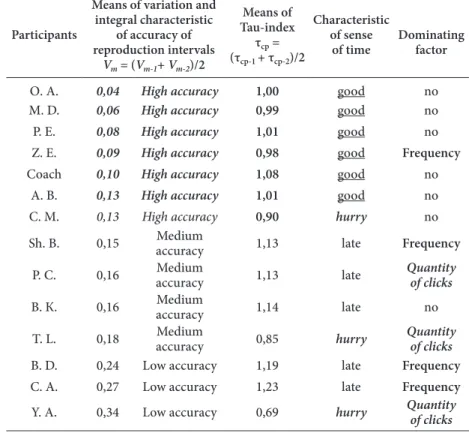
If index < 0, it means that factor of frequency dominates, If Tau-index > 0 – factor of quality prevailed. Individual’s results are presented in the Table 2.
he group was divided into 3 subgroups on the basis of value of Tau-index. In the irst subgroup there were sportswomen with good sense of time (Tau-index is between 0.95 and 1.05), second subgroup – “hurry” sportswomen: Tau-index < 0,95, third subgroup – “delayed” sports-women, Tau-index > 1,05.
Factors of “frequency” and “quantity of clicks” do not inluence sportswomen with good sense of time. It may be caused by the fact of absolute compensation of these contrary factors (if the efects are equal) or the lack of inluence of these factors on sportswomen (see Table 2).
Sportswomen who work in pairs have similar results with ones part-ner (SD, Vm, Tau-index).
Factor of “frequency” dominates at Sh.B. и Z.B., T.L. and Y.А. – fac-tor of “quantity of clicks” partly compensates their insigniicant “haste” (15% and 31%) at reproduction intervals.
Tabl e 2
Accuracy of reproduction intervals and dominating factors in test 1
Participants
Means of variation and integral characteristic
of accuracy of reproduction intervals
Vm = (Vm-1+ Vm-2)/2
Means of Tau-index
τср = (τср-1 + τср-2)/2
Characteristic of sense
of time
Dominating factor
О. А. 0,04 High accuracy 1,00 good no
М. D. 0,06 High accuracy 0,99 good no
P. Е. 0,08 High accuracy 1,01 good no
Z. Е. 0,09 High accuracy 0,98 good frequency
Coach 0,10 High accuracy 1,08 good no
А. В. 0,13 High accuracy 1,01 good no
С. М. 0,13 High accuracy 0,90 hurry no
Sh. В. 0,15 accuracyMedium 1,13 late frequency
P. С. 0,16 accuracyMedium 1,13 late Quantity of clicks
В. К. 0,16 Medium
accuracy 1,14 late no
Т. L. 0,18 Medium
accuracy 0,85 hurry
Quantity of clicks
В. D. 0,24 Low accuracy 1,19 late frequency
С. А. 0,27 Low accuracy 1,23 late frequency
Y. А. 0,34 Low accuracy 0,69 hurry Quantity of clicks
Experiment 2
he purpose of that procedure was to measure the inluence of fac-tors on the sense of time.
At the irst variant participant should reproduce the “empty” inter-val by pressing the button and keeping it till the end of the interinter-val. he length of the interval was 2 sec., the reproducing interval was “illed”.
Coeicients of correlations between Vm1 and Vm2 are not signii-cant (r = 0,15, р =0,62).
At the same time diferences of means (Vm1 and Vm2) are signii-cant (р <0,001). It means that mechanisms of solving temporal tasks are diferent.
his diference was caused by the inluence on Tau-index two fac-tors at the irst variant of the experiment 2: 1) interval that was to be reproduced “illed” with continuous sound; 2) interval that was to be reproduced “illed” with motor act (pressing the button). Both factors are located on the stage of reproduction.
At the second variant of the experiment 2 the “illed” interval (by continuous sound) inluenced Tau-index on the stage of perception. As it has been showed in work of J.H. Wearden (Wearden, et al., 2007) the
interval illed with sound seemed longer than empty one. Hence the duration of the reproducing interval increases, i.e. factor of “illed” (by continuous sound) brings in a positive contribution to ∆sound – relative error. It may be presented in a model of average relative error in the sec-ond variant of the experiment 2: εav-2 = εav-0 + ∆sound, where εav-0 – relative error without factor “illed” with sound (if the presented and produced interval were empty), ∆sound – efect of factor “illed” with sound.
In the irst variant of the experiment 2 the model for relative er-ror is εav-1 = εav-0 – ∆sound – ∆pressing. It means that factors of “illed” and “pressing the button” afect in coordination and diminish relative er-ror on ∆sound and ∆pressing. Objective duration of the producing interval diminishes because interval illed with perception of sound or pressing the button is subjective overestimated. he negative impact of the fac-tors “illed” with sound and “pressing the button” on the εav-1is caused by localization them on the stage of production.
Comparing these models by the relative error of reproduction inter-vals in the irst and second variant of the experiment 2: (εav-1 = εav-0 –
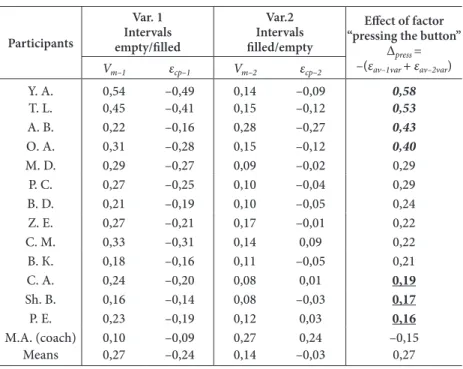
– ∆ sound – ∆press)и (εav-2 = εav-0 + ∆sound) we can deine ∆press. he inluence of this factor on the relative error: ∆press = –(εav-1var + εav-2var).
Means of factor “pressing” are presented in the Table 3. Participants are ordered in decreasing way by the amount of ∆press anddivided in three subgroups. his factor inluences all sportswomen but the coach. It may be explained by the fact that the coach used special cognitive strategy to fulill experimental task: the coach helped herself counting by swinging with her leg. In that situation her attention was not focused on the conditions of the task. According to her: “I didn’t realize pressing the button of anything else but counting. his explanation was based on the assumption of relexive foundation the sense of time.
Any movements will inluence the estimation of producing tempo-ral intervals if it is realized by a subject.
Conclusions
1. he accuracy and reliability reproduction of time intervals de-pend on the context and the duration of these intervals. It was shown that “fullness” of the intervals with rhythmic sounds, movements of hand inluences on sportswomen. his should be taken into consider-ation when the training process is directed in order to develop the syn-chronous movements.
Tabl e 3
Parameters of Vm and Tau-index in the irst and second variants of the experiment 2
Participants
Var. 1 Intervals empty/illed
Var.2 Intervals illed/empty
Efect of factor “pressing the button”
∆press=
–(εav–1var+ εav–2var)
Vm–1 εср–1 Vm–2 εср–2
Y. А. 0,54 –0,49 0,14 –0,09 0,58
Т. L. 0,45 –0,41 0,15 –0,12 0,53
А. В. 0,22 –0,16 0,28 –0,27 0,43
О. А. 0,31 –0,28 0,15 –0,12 0,40
М. D. 0,29 –0,27 0,09 –0,02 0,29
P. С. 0,27 –0,25 0,10 –0,04 0,29
В. D. 0,21 –0,19 0,10 –0,05 0,24
Z. Е. 0,27 –0,21 0,17 –0,01 0,22
С. М. 0,33 –0,31 0,14 0,09 0,22
В. К. 0,18 –0,16 0,11 –0,05 0,21
С. А. 0,24 –0,20 0,08 0,01 0,19
Sh. В. 0,16 –0,14 0,08 –0,03 0,17
P. Е. 0,23 –0,19 0,12 0,03 0,16
М.А. (coach) 0,10 –0,09 0,27 0,24 –0,15
2. Sportswomen who work in pairs have similar indexes on the sense of time. Hence one of the psychological resources of increasing synchronism is to select sportswomen with similar characteristics con-cerning the sense of time. he diagnostics of the sense of time should be undertaken by the multiple-factor instrumental principles with follow-ing analyze of scaleable factors. In the task of the reproduction of the intervals they could be located on the stage of presentation or reproduc-tion of intervals.
3. Factors “frequency” and “quantity” of the clicks of metronome are located on the diferent stages. he irst factor is located on the stage of producing interval, the latter – on the stage of presentation. hese fac-tors particularly inluence the sense of time of sportswomen. he irst one shortens the subjective length of the producing interval (interval with more frequency is produced faster): the latter increases subjective duration of presentation interval (interval with most quantity seems longer to the participant).
4. Factor “fullness” with the continuous sound can be located at any stages. If it is on the stage of presentation of the interval, it increases the subjective length. If this factor is located on the stage of producing interval it shortens duration.
5. “Fullness” of the producing interval achieved by the continuous button pressing leads to shortening the objective length in comparison with “empty” interval. Factor “fullness” in terms of the the motor act inluences the estimation of the interval if the participant pays attention to it. It reveals relexive foundations of the sense of time.
References
Bespalov, B.I., and Leonov, S.V. (2008). Diagnostika chuvstva vremeni u sports-menok vy`sshej kvaliikacii po sinkhronnomu plavaniyu [he diagnostic of the sense of time of sportswomen of synchronized swimming]. Vestnik Moskovskogo universite-ta, 14. Psikhologiya, 1.
Bespalov, B.I., and Strelkov, Yu.K. (2006). “Hronoskop 2006” – psihodiagnos-ticheskij pribor dlya izucheniya vremennyh harakteristik deyatel’nosti cheloveka [“Hronoskop 2006” – the psychodiagnitic device for studying temporal characteristics of person’s activity]. In Materialy` I Mezhdunarodnoj nauchno-prakticheskoj konfer-encii “Lichnostnyj resurs sub``ekta truda v izmenyayushhejsya Rossii” [Proceedings I International Conference “Personal resource entity working in a changing Russia”]. Stav-ropol’, Moskva.
DeLoache, J.S. (2000). Dual representation and young children’s use of scale mod-els. Child development, 2.
Dmitrieva, A.S. (1974). Fiziologiya vy`sshej nervnoj deyatel’nosti [he physiology of the Higher Nervous Activity]. Moskva.
Elkin, D.B. (1962). Vospriyatie vremeni [Time perception]. Moskva.
Fraisse, P. (1978). Vospriyatie i ocenka vremeni [Perception and evaluation of time]. In P. Fraisse, J. Piaget E` ksperimental’naya psihologiya [Experimental psycholo gy]. VI.
Freud, S. (1999). Vvedenie v psikhoanaliz [Introduction to psychoanalysis]. St. Pe-tersburg.
Garza, D., and Feltz, D. (1998). Efects of Selected Mental Practice on Performance, Self-Eicacy and Competition Conidence of Figure Skaters. he Sport Psychologist, 12.
Gellerstein, S.G. (1958). Chuvstvo vremeni i skorost’ dvigatel’noj reakcii [he sense of time and speed of motor act]. Moskva.
Hanton, S., and Jones, G. (1999). he Acquisition and Development of Cognitive Skills and Strategies: 1.Making the Butterlies Fly in Formation. he Sport Psychologist, 13.
Hardy, L., and Paritt, C.G. (1991). A catastrophe model of anxiety and perfor-mance. British Journal of Psychology, 82.
Jones, G., Hanton, S., and Swain, A.B.J. (1994). Intensity and Interpretation of Anxiety Symptoms in Elite and Nin-Elite Sports Performers. Personality and Individ-ual Diferences, 17.
Josephs, I.E. (1998). Constructing one’s self in the city of the silent: dialogue, sym-bols, and the role of “as-if ” in self-development. Human development, 41.
Jung, C.G. (1998). Izbrannoe [Collection of works]. Minsk.
Mahoney, M.J., and Avener, M. (1977). Psychology of the elite athlete: An explor-atory study. Cognitive herapy and Research, 1.
Moiseeva, N.I., et al. (1985). Vospriyatie vremeni chelovekom i ego rol’ v sportivnoj deyatel’nosti [he time perception and its role in sports activity]. Moskva.
Palmer, S. (1992). A Comparison of Mental Practice Techniques as Applied to the Developing Competitive Figure Skater. he Sport Psychologist, 6.
Piaget, J. (1969). Izbrannye psikhologicheskie trudy`. Psikhologiya intellekta. Genezis chisla u rebenka. Logika i psikhologiya [Selected psychological works. Psychology of intellect. Genesis of a number in a child. Logic and psychology]. Moskva.
Shifman, H. (2003). Oshhushhenie i vosprijyatie [Sensation and perception]. Moskva. Strelkov, Yu.K. (2001). Inzhenernaya i professional’naya psikhologiya [Engineering and professional psychology]. Moskva.
Veraksa, A.N. (2007). Simvolicheskoe i znakovoe oposredstvovanie v pozna-vatel’noj deyatel’nosti [he symbolic and signiicant oposredstvovanie in cognitive ac-tivity]. Psikhologiya. Zhurnal vysshej shkoly ekonomiki, 4. P. 124-131.
Veraksa, A.N. (2008). Osobennosti simvolicheskogo oposredstvovaniya u mlad-shikh shkol’nikov. [Features of symbolic mediation in early school-age children]. Psik-hologicheskaya nauka i obrazovanie, 1.
Veraksa, A.N. (2009). Rol’ simvolicheskogo oposredstvovaniya v poznavatel’noj deyatel’nosti mladshih shkol’nikov (na primere osvoeniya opredeleniya funkcii na urokakh matematiki) [he role of symbolic mediation in cognitive activity in primary school (acquisition of the function concept). Vestnik Moskovskogo universiteta, 14. Psikhologiya, 1.