
Atmos. Chem. Phys., 15, 9983–9996, 2015 www.atmos-chem-phys.net/15/9983/2015/ doi:10.5194/acp-15-9983-2015
© Author(s) 2015. CC Attribution 3.0 License.
Diesel-related hydrocarbons can dominate gas phase reactive carbon
in megacities
R. E. Dunmore1, J. R. Hopkins1,2, R. T. Lidster1, J. D. Lee1,2, M. J. Evans1,2, A. R. Rickard1,2, A. C. Lewis1,2, and J. F. Hamilton1
1Wolfson Atmospheric Chemistry Laboratories, Department of Chemistry, University of York, Heslington,
York, YO10 5DD, UK
2National Centre for Atmospheric Science, University of York, Heslington, York, YO10 5DD, UK
Correspondence to:J. Hamilton ([email protected])
Received: 11 March 2015 – Published in Atmos. Chem. Phys. Discuss.: 31 March 2015 Revised: 12 August 2015 – Accepted: 27 August 2015 – Published: 7 September 2015
Abstract. Hydrocarbons are key precursors to two priority air pollutants, ozone and particulate matter. Those with two to seven carbons have historically been straightforward to ob-serve and have been successfully reduced in many developed cities through air quality policy interventions. Longer chain hydrocarbons released from diesel vehicles are not consid-ered explicitly as part of air quality strategies and there are few direct measurements of their gaseous abundance in the atmosphere. This study describes the chemically comprehen-sive and continuous measurements of organic compounds in a developed megacity (London), which demonstrate that on a seasonal median basis, diesel-related hydrocarbons repre-sent only 20–30 % of the total hydrocarbon mixing ratio but comprise more than 50 % of the atmospheric hydrocarbon mass and are a dominant local source of secondary organic aerosols. This study shows for the first time that 60 % of the winter primary hydrocarbon hydroxyl radical reactivity is from diesel-related hydrocarbons and using the maximum incremental reactivity scale, we predict that they contribute up to 50 % of the ozone production potential in London. Comparing real-world urban composition with regulatory emissions inventories in the UK and US highlights a previ-ously unaccounted for, but very significant, under-reporting of diesel-related hydrocarbons; an underestimation of a fac-tor∼4 for C9species rising to a factor of over 70 for C12
during winter. These observations show that hydrocarbons from diesel vehicles can dominate gas phase reactive carbon in cities with high diesel fleet fractions. Future control of ur-ban particulate matter and ozone in such locations requires
a shift in policy focus onto gas phase hydrocarbons released from diesels as this vehicle type continues to displace gaso-line world-wide.
1 Introduction
With an increasing proportion of the world’s population liv-ing in cities, risliv-ing from only 3 % in the 1800’s to over 47 % by the end of the 20th Century (Gaffney and Marley, 2009), the impact of urban air pollution has become a significant factor in global health (Harrison et al., 2012). The costs of air pollution are high even in those locations that have seen con-siderable improvements in air quality over the past decades (Chameides et al., 1992); in the UK exposure to particulate matter (PM) alone is estimated to reduce life expectancy on average by around 7–8 months, with a cost to society esti-mated at up to GBP 20 billion per year (House of Commons Environmental Audit Committee, 2012).
Primary urban air pollution emissions are dominated by PM, nitrogen oxides (NOx), carbon monoxide (CO) and volatile organic compounds (VOCs). Many of these species can react in the atmosphere to create secondary pollutants, such as ozone (O3), oxygenated VOCs (OVOCs), peroxy
Air quality in London has been controlled and monitored for over 60 years, making it in theory one of the better under-stood atmospheres of the world’s megacities. Current mea-surements in London focus on assessing national compli-ance with legally prescribed air quality standards, and this includes the hydrocarbons 1,3-butadiene and benzene. How-ever, compliance measurements in themselves are insuffi-cient to fully describe the chemical and physical processes occurring in the urban atmosphere (McMeeking et al., 2012), and a particular weakness lies in speciating the many differ-ent classes of carbon compounds in urban air.
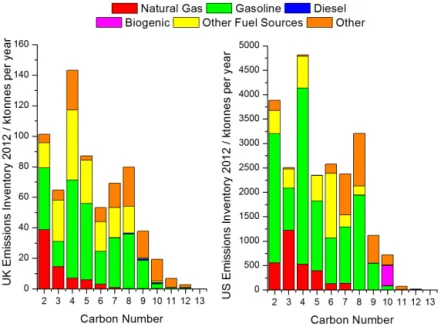
The past 2 decades have seen declining concentrations of most smaller hydrocarbons in European and US cities, a result of tighter regulation of sources such as vehicle ex-haust, evaporation and solvents (von Schneidemesser et al., 2010; Warneke et al., 2012), better control of natural gas leakage and an overall switch from gasoline to diesel pow-ered vehicles. Current national emissions estimates suggest that the bulk of organic emissions to air are associated with smaller hydrocarbons, and this has driven policy, regulation and observation strategies for compliance. Figure 1 shows Government-estimated emissions for the UK (left) and US (right), categorised into the dominant emission sources. It is clear that based on current emission inventories, gaseous organic emissions from diesel appear to represent a negligi-ble fraction of reactive carbon released into the atmosphere. The demand for diesel fuel is expected to increase by 75 % between 2010 and 2040 and by 2020 it is expected to over-take gasoline as the number one transport fuel used world-wide (Exxon Mobil, 2014). The environmental impacts of this change are evaluated in part based on the national emis-sion inventories that underpin Fig. 1.
The efficiency with which O3 and SOA can be formed
from diesel or gasoline emissions is dependent on the mass of available organic carbon, and the reactivity and volatil-ity of that material (Gros et al., 2007; Jimenez et al., 2009; Donahue et al., 2012). To quantify this requires individual speciation of VOCs in order that each property can be prop-erly estimated. The key urban sources of organic compounds include combustion products, unburnt fuels and evaporative emissions of fuels and solvents, all of which are highly com-plex, often propagating the original complexity of fossil fu-els into the air. Whilst each VOC has a unique set of re-action mechanisms, in general terms, as the carbon number increases, the relative complexity of reactions and yields of SOA and O3also increase (Hamilton and Lewis, 2003). The
organic mixture in air is complicated further by the presence of secondary oxygenated products. This requires a combined approach to investigate VOC composition, such as using two different gas chromatography systems.
Several recent field studies have investigated the relative importance of gasoline, diesel and biogenic emissions in gen-erating SOA (Gentner et al., 2012; Bahreini et al., 2012; Gor-don et al., 2013; Platt et al., 2013; GorGor-don et al., 2014a, b; Jathar et al., 2014; Ensberg et al., 2014). These have been
carried out predominately in the US, particularly in Califor-nia, where current diesel usage is rather low by global stan-dards. The US diesel fleet is dominated by heavy-duty vehi-cles, leading to a difference in the source strength of diesel and gasoline engines between weekdays and the weekend. In contrast, this trend is not observed in London (see Supple-ment and Fig. S1), which has a different vehicle fleet com-position, with 60 % diesel fuel use, and a large number of diesel buses operating at similar times to domestic vehicles. It is also important to consider that London and Los Ange-les (arguably the world’s most well-studied city for air pol-lution) have significant differences in terms of urban geog-raphy, population density, commuting patterns, amount of green space/trees and upwind sources (expanded in the Sup-plement and Table S1). Specifically, the high population den-sity in central London, and the fact that many vehicle jour-neys both begin and end in central London (rather than radial vehicle commuting); resulting in the central London atmo-sphere experiencing both cold and warm start vehicle emis-sions. Also worth noting is that there is no large upwind source of BVOCs in London, rather the natural emissions are distributed rather homogeneously across the city (Fig. S2).
This work uses high-resolution VOC measurements to in-vestigate the abundance and trends of diesel-related hydro-carbons in the atmosphere at a typical urban background site in London. By comparison to the emission inventories, we highlight a severe underestimation in the impact of gaseous VOC emissions from diesel on urban air quality that is likely replicated across Europe and other cities globally where diesel vehicle use is high.
2 Experimental
2.1 Clean air for London campaign
Two 5-week campaigns were conducted as part of the Na-tional Environment Research Council (NERC) funded Clean Air for London (ClearfLo) project in January/February and July/August 2012 at an urban background site (see Fig. S3) based at Sion Manning School in North Kensington, Lon-don. For more information about this site and the ClearfLo project refer to Bigi and Harrison (2010) and Bohnenstengel et al. (2014) respectively.
2.2 Gas chromatography measurements
Two gas chromatography (GC) instruments were used dur-ing the ClearfLo campaign, a dual channel GC-flame ionisa-tion detector (DC-GC-FID) and a comprehensive two dimen-sional GC (GC×GC-FID). Outside air was sampled from
a manifold at 4 m from the ground through a condensation finger in an ethylene glycol bath held at−30◦C, to remove
R. Dunmore et al.: Diesel-related hydrocarbons can dominate gas phase reactive carbon in megacities 9985
Figure 1.Total mass by carbon number and functionality from UK 2012 (left) and US 2011 (right) emission inventories. The carbon number and functionality of emissions have been estimated by applying the speciated inventory of emission sources of Passant (2002) to the most recent estimates of non-methane hydrocarbon source apportionment for each country (full details can be found in the Supplement).
The DC-GC-FID was operated by the National Centre for Atmospheric Science (NCAS) Facility for Ground Atmo-spheric Measurements (FGAM) with the instrument set up and calibration described in Hopkins et al. (2003). In brief, the system has three GC columns that operate in parallel, where after sampling and desorption the flow is split 50:50;
one column is an aluminium oxide (Al2O3) Porous Layer
Open Tubular (PLOT, 50 m, 0.53 mm id) for non-methane hydrocarbons (NMHCs) analysis; and the other column is ac-tually two LOWOX columns in series (10 m, 0.53 mm id) for OVOC analysis.
The GC×GC-FID is comprised of a Markes TT24-7
thermal desorption (TD) unit with an air server attach-ment (Markes International, Llantrisant, UK) and an Agi-lent 7890 GC (AgiAgi-lent Technologies, Wilmington, DE, USA) equipped with an FID operating at 200 Hz. The TD unit sam-pled at a rate of 100 mL min−1for 55 min, giving a total sam-ple volume of 5.5 L. The trap temperature was set to−10◦C,
held for 3 min, then on injection heated at 100◦
C min−1to 200◦
C to ensure all analytes of interest were desorbed. The GC×GC-FID system first dimension column was
a BPX-5 (25 m×0.15 mm, 0.4 µm df), at 50 psi, combined
with a second dimension column of a BP-20 (5 m×0.25 mm,
0.25 µm df), at 23 psi (SGE, Australia), with column pres-sures controlled using the Agilent 7890 EPC. The total trans-fer flow valve modulator incorporated a 6-port, 2-way di-aphragm valve (Valco Instruments, Houston, TX, USA), with actuation achieved using a solenoid valve, controlled by soft-ware written “in house”. The modulator was held at 120◦C throughout the run and had a modulation period of 5 s, with 4.7 s sample and 0.3 s injection times. The chromatographic
and modulation configuration of the GC×GC-FID system is
detailed in Lidster et al. (2011). During the injection of sam-ple, liquid carbon dioxide (CO2) was sprayed onto the first
2 cm portion at the head of the first dimension column for 60 s to re-focus the sample.
An oven temperature programme was developed which optimised separation and resolution of compounds of in-terest. The initial oven temperature was 30◦C, held for 1 min, ramped at 2.5◦C min−1to 130◦C, held for 1 min then ramped at 10◦C min−1to 200◦C, and held for 1 min; giving a total run time of 50 min. This, combined with the TD run time, gave a total analysis time of 55 min.
During the summer campaign, some parameters had to be changed. Ambient temperatures were higher in comparison to the winter, meaning the oven temperature programme had to be altered to allow the oven to reach its minimum tem-perature. The initial oven temperature was changed to 35◦
C held for 2 min and the final temperature of 200◦
C was held for 2 min. All other oven parameters were kept the same. Due to a sensitivity drop, the TD sampling rate was increased to 200 mL min−1 for 55 min, to give a total sample volume of 11 L.
2.3 Supporting measurements
3 Observations of hydrocarbons in urban air
The two GC instruments individually quantified 78 VOCs (36 aliphatics, 19 monoaromatics, 21 oxygenated and 2 halogenated), as well as many hundreds more included in a lumped carbon number assessment from 2667 samples (1352 winter and 1315 summer). The DC-GC instrument measured volatile VOCs, C1–C7 hydrocarbons and a
se-lection of OVOCs, with effective saturation concentrations (Nannoolal et al., 2004, 2008) ranging from 3×10⁷ to
1.4×10¹²µg m−3. The GC×GC-FID instrument measured
the less volatile VOC fraction (effective saturation concen-tration range of 1.8×10⁶to 2.4×10⁹µg m−3), with
hydro-carbons from C6to C13, plus a large group of OVOCs (from
C3 onwards). There was some overlap in species measured
by both instruments, with good agreement seen (e.g. benzene R20.92, slope 1.070±0.013,see Fig. S4).
The number of possible structural isomers increases expo-nentially with carbon number (Goldstein and Galbally, 2007) and beyond around C9 it becomes impossible to accurately
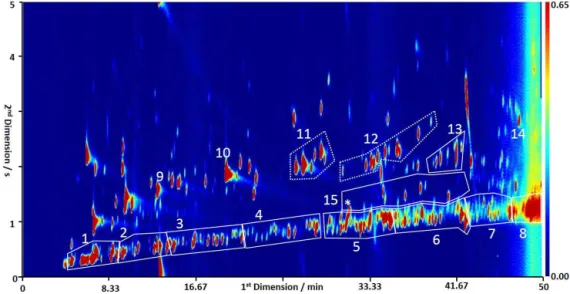
identify the structure of every hydrocarbon present in air. Using the retention behaviour of each compound on chro-matographic columns it is however possible to assign indi-vidual species to particular chemical classes and function-alities. Here we group according to carbon number and ba-sic functionality, an example of which can be seen in Fig. 2. The C2−C6volatility range contains both primary
hydrocar-bon emissions, with isomers quantified individually, along with several oxygenated compounds. Between C6 to C13,
a wide range of hydrocarbon and OVOC species, including the n-alkanes,α-pinene, limonene, monoaromatics with up to 3 substituents and naphthalene were quantified individu-ally (see Fig. S5 and Table S2).
3.1 Grouping of unresolved complex mixtures
In previous studies using GC-FID, the larger hydrocarbon fraction, where diesel VOC emissions are predominately found, is part of an unresolved complex mixture (UCM). One method used to estimate the relative amounts of VOCs in this region, is to identify the n-alkane (which is often observed as a well-defined peak above a raised baseline) and then in-tegrate the area above the blank baseline between two con-secutive linear alkanes (using an FID) or to use them/z57 fragment ion to represent primary intermediate VOC (IVOC) (Zhao et al., 2014). In reality, this gives an estimate of the total or alkyl containing IVOC loading within this volatility range and will not only include the hydrocarbon fraction with that specific carbon number but other compounds as well (i.e. lower carbon number aromatics, OVOCs). This study details the improved resolution of VOCs using GC×GC to allow for
a more stringent grouping of the UCM by carbon number and functionality, rather than by volatility.
Higher carbon number aliphatic compounds (C6-C13,
pre-dominantly alkanes with some alkenes and cycloalkanes),
C4 substituted monoaromatics and C10 monoterpenes have
been grouped together and the combined class abundance es-timated using a response ratio to the corresponding straight-chainedn-alkane, 1,3-diethyl benzene andα-pinene respec-tively. The group boundaries are shown in Fig. 2, where for example, box 7 corresponds to the C12 aliphatic group and
encompasses alkanes, cyclic alkanes and alkenes. Only the material within the box is integrated within this retention window. This is a clear improvement over the 1-D case, as there are a considerable number of peaks, with a higher 2nd dimension retention time, in Fig. 2 that would co-elute with the aliphatic group if the entire retention window was co-sampled (i.e. aromatics, oxygenates and other hetero atom containing species). The number of individual isomer peaks that could be isolated in the aliphatics grouping increased from 9 for the C6group to 40 for C10(shown in Fig. 6, black
squares). A full table of the observed isomer peaks and group mass concentrations is provided in Table S3.
Unfortunately, the separation of the linear alkanes, branched alkanes, cyclic aliphatic and alkenes on the GC×GC chromatogram is not sufficient at higher carbon
numbers to allow them to be more fully resolved. This is a direct consequence of the use of the cryogen free and field deployable valve modulator, which when used in total trans-fer mode, where the flow in the first column slows during the modulation pulse, imposes restrictions on the column di-mensions and internal diameters that can be used (Lidster et al., 2011). Also, given the temperature constraints on this instrument, it is likely that the GC×GC not only misses a
fraction of the C13 aliphatic group but may also be
under-reporting the number of isomers in the higher carbon number groups. This would explain why the number of isomers de-creases after C11aliphatics, rather than increases as would be
expected. The aliphatic groups have diurnal behaviour (dis-cussed in the next section) that indicate a dominant traffic-related source. Fuel composition measurements suggest there is unlikely to be significant quantities of alkenes from traf-fic related sources; gasoline contains around 3–4 wt C% of alkenes, and diesel contains negligible quantities (Gentner et al., 2012).
3.2 Diurnal behaviour
The average diurnal behaviour of a selection of VOCs, O3
and NOx, are shown in Fig. 3. VOCs with an anthropogenic source (e.g. ethane, toluene, C4 substituted monoaromatics
and C13aliphatics) have higher mixing ratios in winter,
con-sistent with reduced rates of photochemical removal in the northern European winter and a lower boundary layer height. Toluene and NOxare strong indicators of traffic related emis-sions, and both have diurnal profiles with rush hour peaks, commonly observed in urban areas (Borbon et al., 2001; Par-rish et al., 2009; Gaffron, 2012). The profiles of the higher carbon number species, C4substituted monoaromatics and
R. Dunmore et al.: Diesel-related hydrocarbons can dominate gas phase reactive carbon in megacities 9987
Figure 2.Typical GC×GC-FID chromatogram from 25 July 2012, demonstrating the grouping of compounds. The retentions on the first and second columns are thexandyaxis respectively, with the intensity of the compound shown by the coloured contours. Labelled peaks and groups are identified as follows, with the dashed and solid lines indicating compounds that were identified individually and as a group respectively; (1–8) aliphatic groups from C6to C13, (9) benzene, (10) toluene, (11) C2 substituted monoaromatics, (12) C3 substituted
monoaromatics, (13) C4substituted monoaromatics, (14) naphthalene, and (15) C10monoterpenes with * corresponding toα-pinene which
is the start of that group. The remaining compounds, not enclosed in a box contain hetero-atoms, primarily oxygenates. The grouping of compounds was accomplished using the lasso technique in Zoex GC image software (Zoex, USA). This technique allows the software to calculate the area of all peaks included in the lasso.
indicative that this is their major source. Those species with a dominant biogenic source (e.g. isoprene andα-pinene) are higher in summer, due to increased emission. The winter pro-files of isoprene andα-pinene show possible anthropogenic sources, traffic and cleaning products respectively.
3.3 Reactivity and mass calculations of grouped compounds
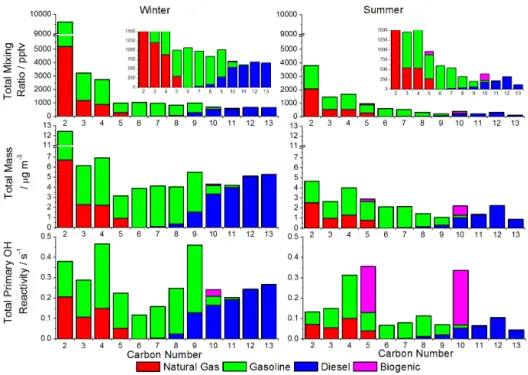
Figure 4 shows the relative emission source contributions of compounds to the total hydrocarbon mixing ratio (top), mass concentration (middle) and primary hydrocarbon hydroxyl radical (OH) reactivity (bottom), calculated by carbon num-ber, and split according to emission source. For each sample, the mass concentration (µg m−3) and primary hydrocarbon OH reactivity (s−1, see Supplement Sect. S1.7 for explicit details on the calculation of OH reactivity) were calculated and a seasonal median calculated using the mixing ratios of the individual components and the summation of all further unidentified species within the ten class groups, not includ-ing the OVOCs. OH reactivity is defined as the total pseudo first order rate coefficient for loss of OH when reacting with VOCs in the atmosphere. This is important in urban atmo-spheres that are VOC limited, such as London, as the reac-tion of VOCs with the OH radical is the driving force for the formation of O3and other secondary pollutants.
The Passant (2002) speciated emissions inventory was used to determine the main emission sources for each com-pound. For C2to C5, the main source is either natural gas
us-age or leakus-age, followed by road transport use. From C6
on-wards, the main emission source was classified as road trans-port or other fuel usage categories (i.e. filling of petrol sta-tions). To determine the percentage contributions from diesel or gasoline fuel usage, the detailed fuel characterisation of Gentner et al. (2012) was used with a value of 60 % diesel use in the UK (Department of Energy and Climate Change, 2014).
Although the summer data have been shown throughout the remainder of the article, care should be taken when inter-preting the impacts. It is likely that the summer observations are made up of “residual” VOCs remaining after transport from emission source and subsequent photochemical reac-tions. This could lead to a small overestimation of the contri-bution of diesel-related hydrocarbons and an underestimation of some species, particularly the OVOCs.
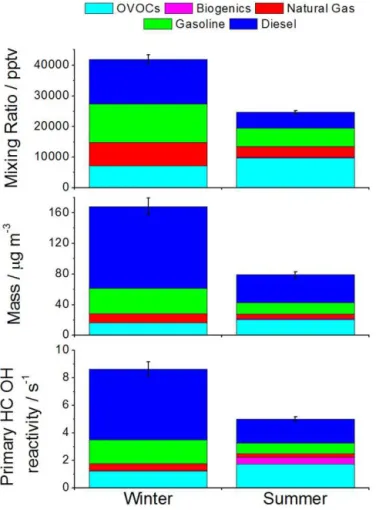
The winter has generally higher abundances of hydrocar-bons, with summer showing a marked increase in the bio-genic source compounds. In both winter and summer, in mixing ratio terms, the distribution is dominated by high-volatility species (over 85 % of the total) primarily from nat-ural gas and gasoline sources. When viewed in terms of mass concentration, however, the distribution of combined natural gas and gasoline vs. diesel is closer to 70:30 % in winter and
77:23 % in summer, the latter due to the increased loss rates
R. Dunmore et al.: Diesel-related hydrocarbons can dominate gas phase reactive carbon in megacities 9989
Figure 4.Seasonal median values for hydrocarbon mixing ratio, mass concentration and primary hydrocarbon OH reactivity in London air grouped by carbon number and potential emission source.
In order to calculate primary hydrocarbon OH reactivity of diesel emissions, rate constants have to be estimated as each individual species is not uniquely identified and because the rate constants (and subsequent chemistry) are un-measured in the majority of cases for hydrocarbons larger than C8.
The nearest straight-chain alkane rate constant (Atkinson and Arey, 2003) is applied to all carbon in that aliphatic grouping. This will lead to a conservative estimate of re-activity since cycloalkanes and alkenes would be expected to react faster (i.e. the kOH for the reaction of n-dodecane
is 1.32×10⁻¹¹cm3molecule−1s−1, compared to that of
1-dodecene which is 5.03×10⁻¹¹cm3molecule−1s−1
(As-chmann and Atkinson, 2008), for further details see Sup-plement Sect. S1.7 and Table S4). For the C4 substituted
monoaromatic and C10 monoterpene groups, the rate
con-stants of 1,3 diethyl benzene andα-pinene respectively were used.
3.4 Calculation of unmeasured diesel emissions
The GC measurements stop at C13, however diesel typically
has a range of hydrocarbons from C9to C22 that peaks with n-hexadecane as the most abundant compound. Using the ob-served distribution of C10−C13, allows for an estimate to
be made of the remaining, unobservedNMHC fraction of gaseous diesel emissions in the C14−C22 range, using the
fuel composition-based emission factors for the gas phase compounds from Gentner et al. (2013). Assuming no atmo-spheric loss, a reasonable approximation in winter, it is esti-mated that the GC×GC-FID technique observes around 25–
30 % of the total gaseous hydrocarbon emissions from diesel sources. It is then possible to estimate a seasonal average un-measured gas phase NMHC mass concentration from diesel sources in London as 76.1–97.8 µg m−3in winter and 26.8– 34.3 µg m−3 in summer. These values can be compared to typical primary organic aerosol measurements of 1 µg m−3 (Zhang et al., 2011; Young et al., 2015), indicating that, in ambient air, diesel-related emission of hydrocarbons are overwhelmingly (a factor of 100) to the gas phase, consistent with laboratory and tail pipe studies (Gordon et al., 2013). In contrast, using gasoline liquid fuel speciation, the combined GC approach can observe approximately over 98 % of the mass of gasoline.
Figure 5.Contributions of emission source to total mixing ratio, mass and OH reactivity for winter and summer. Diesel is the sum-mation of measured and calculated, with error bars indicating the uncertainty of the unobserved diesel NMHC fraction.
loss due to photochemical ageing and so the values are an underestimate of the fuel sources. These diesel-related hy-drocarbons may be partly responsible for the “missing” OH reactivity observed between measurements of OH lifetime vs. the value calculated from observed sinks in many studies (Yoshino et al., 2006, 2012).
3.5 Comparison to emissions inventories
Assuming that the winter observations are made “at source” (hence atmospheric losses and lifetime differences can be ne-glected), the measurement location is representative of an urban setting, and the UK inventory correctly estimates the emission for toluene (based on direct flux comparisons made in London by Langford et al., 2010), there appears to be a significant inventory under-reporting for the higher car-bon number species. When normalising to toluene, the UK national emissions inventory, which is believed to use best-practice international reporting methodologies, under-reports by a factor of 4.6 for C9species, rising to a factor of 74 for
C12 compounds (see Fig. 6). Given the clear traffic diurnal
Figure 6.Winter emissions inventory underestimation (left axis and blue columns) and the number of isomers included in each grouped set of compounds (right axis and black squares). Grey line shows a factor of 1, i.e., inventory emission estimation is consistent with the observations.
profiles of the C10−C13 species (seen in Fig. 3m for C13
aliphatics), which essentially encompasses only diesel fuel, the most likely source of these species is gaseous emissions from the diesel vehicle fleet, either evaporative, tailpipe or a combination of the two. These observations provide the first direct evidence of significant diesel hydrocarbons in Lon-don’s ambient air, something that could previously only be inferred from liquid fuel measurements and exhaust studies.
3.6 Ozone formation potentials
At present, there is insufficient kinetic and mechanistic data to allow for the accurate modelling of the impact diesel hydrocarbons will have on photochemical ozone. Unlike Los Angeles, which is typically impacted by intense single-day episodic photochemical ozone events, in London (and NW Europe), higher ozone levels are usually the result of regional-scale multi-day formation. Therefore, different con-trol strategies and reactivity scales, which take into account trans-boundary transport, have been developed and applied in Europe. Photochemical ozone creation potentials (POCPs, e.g. Derwent et al., 1998) have been derived using idealised 5-day photochemical trajectory model runs over Europe, in-corporating detailed chemical degradation schemes of the emitted VOCs (Saunders et al., 2003). Individual POCP val-ues depend upon emissions along the trajectory, the reactivity of the VOC and its propensity to form ozone, i.e. the number of C-C and C-H bonds in the reactive species. Calvert et al., (2008), using the Master Chemical Mechanism (MCMv3.1, http://mcm.leeds.ac.uk/MCM) and speciated emission inven-tories (Passant, 2002), with little speciation of alkanes above C9, found that alkanes dominated POCP-weighted
R. Dunmore et al.: Diesel-related hydrocarbons can dominate gas phase reactive carbon in megacities 9991 for slightly more than the aromatics (29 %) and significantly
more than the alkenes (20 %) and oxygenates (17 %) (Calvert et al., 2000). They also note that this is in marked contrast with that found on the urban scale in Los Angeles, where alkanes contribute little to the intense episodic ozone for-mation observed. The work presented here shows that emis-sion inventories severely underestimate the amount of alka-nes emitted from diesel sources, hence these have not been included in previous studies on ozone formation. Based on the POCP results of Calvert et al. (2000) for shorter chain alkanes, and considering the high OH reactivity of larger hy-drocarbons, incorporating the diesel-related aliphatics into future calculations is likely to have a significant impact on regional ozone formation in Europe, and likely elsewhere.
However, despite the lack of chemical information avail-able, we can make an assessment of the effects that the new diesel VOC observations have on local ozone productivity by calculating the O3Formation Potential (OFP) of each
emis-sion source using a Maximum Incremental Reactivity (MIR) scale, as determined by Carter (2010) using the SAPRC-07 mechanism. The MIR scale is based upon 1-day photochem-ical simulations in a box moving over an urban basin and subject to ozone precursor emissions. The NOx concentra-tions are adjusted so that the final ozone concentration in a simulation showed the maximum sensitivity to changes in emissions of organic compounds; these conditions give the MIR. MIRs represent relatively high NOx conditions, often experienced in US cities, where control of the emissions of VOCs is the most effective means of reducing ozone forma-tion (Carter, 2010).
MIR values for a range of important VOC emission classes (alkanes, alkenes, aromatics, oxygenates) compare well to POCP values calculated using detailed MCMv3.1 chemistry in a 1 day US urban photochemical trajectory model, giving us confidence in the tuned SAPRC-07 chemistry for predict-ing photochemical ozone formation under typical 1-day high NOx, high ozone conditions (Derwent et al., 2010). However, caution must be observed when applying MIR scales to other conditions (i.e. NW Europe), as previously discussed.
For those species included in one of the carbon number and functionality VOC groups, a weighted MIR value has been calculated assuming a composition of 95 % branched alkane and 5 % alkene. The calculated, unobserved diesel emissions were given an MIR value based on the weighted contributions of the different compound classes from the diesel fuel gaseous emission speciation in Gentner et al. (2013).
The calculated OFP values for summer and winter are shown in Fig. 7, with a clear seasonal difference in the impor-tance of different emission sources. The winter is dominated by emissions from diesel (over 45±4.6 %). In contrast, the
summer shows a marked increase in contribution from oxy-genated species, rising from 18 % in winter to 40 % in sum-mer. Gentner et al. (2013) concluded that gasoline emissions contributed the majority of potential O3formation, however
Figure 7.Contribution of emission sources to ozone formation po-tential, where diesel is representative of total diesel emissions and the error bars show the uncertainty of the unobserved diesel fraction calculation.
given that gasoline is the primary fuel used in the US (quoted at 73–90 % of total fuel use; Gentner et al., 2012) this is not surprising. Whereas in the UK, diesel fuel accounts for an av-erage of 60 % of total fuel use and as such would be expected to contribute a larger percent towards O3formation.
Given that many of the higher carbon number species, likely emitted from the combustion of diesel, are not cur-rently included in emissions inventory and as such are missing from many model chemical mechanisms (e.g. MCMv3.3.1), a more rigorous reactivity analysis is not pos-sible (e.g. POCPs discussed previously). It is pospos-sible to infer from this analysis however, that as winter diesel emissions contribute nearly 50 % of the OFP and over 60 % of primary hydrocarbon OH reactivity, it is likely that they would have a large impact on the overall reactivity and chemistry of the urban atmosphere.
3.7 Potential impacts on SOA formation
Figure 8.Potential SOA mass estimates. Upper: mean VOC mass concentration [VOC] shown by black columns, and the corresponding SOA yields (Y) for the VOC precursors in blue circles. Lower: potential SOA mass concentration [SOA], calculated as the product of mean VOC mass and SOA yields. Winter shown on left and summer shown on right hand side panels.
by conventional instrumentation. Jathar et al. (2014), used simulation chamber data and source-specific SOA yield pa-rameterisations for these unspeciated emissions to estimate that, in the US, 90 % of SOA was from biomass burning and gasoline sources, with 85 % of the SOA coming from unspe-ciated organic emissions.
There is a clear need to improve measurements of larger hydrocarbons that represent a large part of what is referred to in other studies as unspeciated chemicals. In this study, the uncertainty in the unspeciated fraction has been reduced by grouping ambient observations of VOCs by carbon number and functionality. The>C9aliphatic groups are dominated
by diesel emissions at this location and so the SOA source strength can be more accurately determined. The potential contributions of the higher hydrocarbons to SOA forma-tion has been estimated by multiplying the median measured VOC mass concentration (Fig. 8, top panel, black columns) by the corresponding SOA yield (Fig. 8, top panel, blue cir-cles) (Zhang et al., 2014). The yields applied were measured in high NOxchamber studies (VOC0/NOx(ppbC ppb−1) of 0.5) with an organic aerosol mass COA of 10 µg m−3,
rep-resentative of urban areas (Zhang et al., 2014; Presto et al., 2010). Here it is assumed that NMHCs with less than six car-bons and aqueous chemistry of water soluble oxidation prod-ucts, such as glyoxal, do not contribute to SOA mass (Knote et al., 2014). In both winter and summer, the observed lev-els of aliphatic compounds from diesel sources have the po-tential to form significant quantities of SOA (Fig. 8, bottom panel, red columns). If a diesel SOA yield of 0.15 is applied
to the total diesel emissions (as calculated previously), then gas phase emissions from diesel engines represent the domi-nant traffic related precursor source of urban SOA in a Euro-pean megacity such as London, where the use of diesel fuel is prevalent, in line with previous studies in the US (Gen-tner et al., 2012). Each cubic metre of air contains sufficient gas phase hydrocarbons to potentially produce 14.4–17.6 and 4.9–6.1 µg of SOA in winter and summer following atmo-spheric oxidation.
R. Dunmore et al.: Diesel-related hydrocarbons can dominate gas phase reactive carbon in megacities 9993 4 Conclusions
From the results presented, it is possible to conclude that cur-rent inventories and emissions estimates do not adequately represent emissions of gas phase higher carbon number species from the diesel fleet under real-world conditions and in a developed urban environment. The calculated impact of these species is significant, particularly in terms of OH reac-tivity, ozone formation potential and SOA production.
In the last decade, there has been a steady shift in fuel use in many locations. For example, in the UK diesel fuel use as a fraction of total fuel has risen from 52 % in 2005 to 62 % in 2011 (see Fig. S7 and Table S7) (Department of Energy and Climate Change, 2014). Although the UK may be considered typical of Europe (where diesel use varies be-tween 45–80 %) (European Commission, 2012), the average US value was around 29 % diesel use (US Energy Informa-tion AdministraInforma-tion, 2014) in 2013, with the understanding of other geographical regions currently being poor.
This shift to an increasingly diesel-powered fleet in many developed cities, as a response to energy efficiency drivers, has therefore shifted the balance of hydrocarbons in urban air from short to long chain compounds, and these observa-tions provide direct atmospheric evidence of this effect in London. Previous air quality assessments of diesel-related hydrocarbons in the atmosphere are few in number, and as discussed previously, have been made only in the US where geographic characteristics and vehicle fleet composition are very different to London, and Europe more widely. In many cities the impact of diesel hydrocarbons remains to be deter-mined, but this work demonstrates that it will likely be signif-icant in locations with substantial diesel fleets. An improve-ment in measureimprove-ment infrastructure appears to be essential if this source is to be quantified more widely or the impacts of policy evaluated.
Understanding the impact of this change is significantly hindered however by a lack of appropriate physico-chemical data for individual longer chain hydrocarbons. There are al-ready very significant policy challenges for many developed cities relating to the control of NO2from modern diesel
vehi-cles, and this study indicates that there may also be a similar, but currently un-recognised, policy challenge to control re-active carbon emissions and their contributions to secondary pollutants.
The Supplement related to this article is available online at doi:10.5194/acp-15-9983-2015-supplement.
Author contributions. R. E. Dunmore and J. R. Hopkins analysed the GC data and J. D. Lee made the O3and NOx measurements. R. T. Lidster and J. F. Hamilton developed the GC×GC-FID in-strument. A. R. Rickard provided insight into the kinetics and
pho-tochemical ozone creation potentials. R. E. Dunmore, J. F. Hamil-ton, A. C. Lewis and M. J. Evans wrote the paper. All authors con-tributed towards the final version of the paper.
Acknowledgements. R. E. Dunmore would like to thank NERC (NE/J500197/1) for PhD funding and to acknowl-edge David Carslaw for his assistance using Openair and Richard Derwent for assistance with the NAEI. All authors would like to acknowledge NERC for funding the Clearflo project (NE/H002112/1), and the efforts of all participants in the field experiment in supporting these measurements. We would like to acknowledge Stephen Belcher for project co-ordination.
Edited by: F. Keutsch
References
Aschmann, S. and Atkinson, R.: Rate constants for the gas-phase reactions of OH radicals with E-7-tetradecene, 2-methyl-1-tridecene and the C7–C141-alkenes at 295±1 K, Phys. Chem.
Chem. Phys., 10, 4159–4164, doi:10.1039/B803527J, 2008. Atkinson, R. and Arey, J.: Atmospheric degradation of
volatile organic compounds, Chem. Rev., 103, 4605–4638, doi:10.1021/cr0206420, 2003.
Bahreini, R., Middlebrook, A., de Gouw, J., Warneke, C., Trainer, M., Brock, C., Stark, H., Brown, S., Dube, W., Gilman, J., Hall, K., Holloway, J., Kuster, W., Perring, A., Prévôt, A., Schwarz, J., Spackman, J., Szidat, S., Wagner, N., Weber, R., Zotter, P., and Parrish, D.: Gasoline emissions domi-nate over diesel in formation of secondary organic aerosol mass, Geophys. Res. Lett., 39, L06805, doi:10.1029/2011GL050718, 2012.
Bigi, A. and Harrison, R.: Analysis of the air pollution climate at a central urban background site, Atmos. Environ., 44, 2004–2012, doi:10.1016/j.atmosenv.2010.02.028, 2010.
Bohnenstengel, S. I., Belcher, S. E., Aiken, A., Allan, J. D., Allen, G., Bacak, A., Bannan, T. J., Barlow, J., Bed-dows, D. C. S., Bloss, W. J., Booth, A. M., Chemel, C., Co-ceal, O., Di Marco, C. F., Dubey, M. K., Faloon, K. H., Flem-ing, Z. L., Furger, M., Gietl, J. K., Graves, R. R., Green, D. C., Grimmond, C. S. B., Halios, C. H., Hamilton, J. F., Harri-son, R. M., Heal, M. R., Heard, D. E., Helfter, C., Herndon, S. C., Holmes, R. E., Hopkins, J. R., Jones, A. M., Kelly, F. J., Kot-thaus, S., Langford, B., Lee, J. D., Leigh, R. J., Lewis, A. C., Lidster, R. T., Lopez-Hilfiker, F. D., McQuaid, J. B., Mohr, C., Monks, P. S., Nemitz, E., Ng, N. L., Percival, C. J., Prévôt, A. S. H., Ricketts, H. M. A., Sokhi, R., Stone, D., Thorn-ton, J. A., Tremper, A. H., Valach, A. C., Visser, S., Whal-ley, L. K., Williams, L. R., Xu, L., Young, D. E. E., and Zotter, P.: Meteorology, air quality, and health in London: the ClearfLo project, B. Am. Meteorol. Soc., online first, doi:10.1175/bams-d-12-00245.1, 2014.
Calvert, J. G., Derwent, R. G., Orlando, J. J., Tyndall, G. S., and Wallington, T. J.: Mechanisms of Atmospheric Oxidation of the Alkenes, Oxford University Press, New York, 2000.
Carslaw, D. and Rhys-Tyler, G.: New insights from comprehen-sive on-road measurements of NOx, NO2and NH3from vehicle
emission remote sensing in London, UK, Atmos. Environ., 81, 339–347, doi:10.1016/j.atmosenv.2013.09.026, 2013.
Carslaw, D. and Ropkins, K.: openair – an R package for air quality data analysis, Environ. Modell. Softw., 27–28, 52–61, doi:10.1016/j.envsoft.2011.09.008, 2012a.
Carslaw, D. and Ropkins, K.: openair – data analysis tools for the Air Quality Community, The R Journal, 4, 20–29, 2012b. Carter, W.: SAPRC-07 Atmospheric Chemistry Mechanisms and
VOC Reactivity Scales, available at: http://www.engr.ucr.edu/ ~carter/SAPRC/ (last access: 10 February 2015), 2010. Chameides, W., Fehsenfeld, F., Rodgers, M., Cardelino, C.,
Mar-tinez, J., Parrish, D., Lonneman, W., Lawson, D., Rasmussen, R., Zimmerman, P., Greenberg, J., Middleton, P., and Wang, T.: Ozone precursor relationships in the ambient atmosphere, J. Geophys. Res.-Atmos., 97, 6037–6055, doi:10.1029/91JD03014, 1992.
Department of Energy and Climate Change: Road transport energy consumption at regional and local authority level, available at: www.gov.uk/government/statistical-data-sets/road-transport-energy-consumption-at-regional-and-local-authority-level(last access: 10 February 2015), 2014.
Derwent, R., Jenkin, M., Saunders, S., and Pilling, M.: Photochemi-cal ozone creation potentials for organic compounds in northwest Europe calculated with a master chemical mechanism, Atmos. Environ., 32, 2429–2441, doi:10.1016/S1352-2310(98)00053-3, 1998.
Derwent, R., Jenkin, M., Pilling, M., Carter, W., and Kaduwela, A.: Reactivity scales as comparative tools for chemical mecha-nisms, J. Air Waste Manage., 60, 914–924, doi:10.3155/1047-3289.60.8.914, 2010.
Donahue, N. M., Kroll, J. H., Pandis, S. N., and Robinson, A. L.: A two-dimensional volatility basis set – Part 2: Diagnostics of organic-aerosol evolution, Atmos. Chem. Phys., 12, 615–634, doi:10.5194/acp-12-615-2012, 2012.
Ensberg, J., Hayes, P., Jimenez, J., Gilman, J., Kuster, W., de Gouw, J., Holloway, J., Gordon, T., Jathar, S., Robinson, A., and Seinfeld, J.: Emission factor ratios, SOA mass yields, and the impact of vehicular emissions on SOA formation, Atmos. Chem. Phys., 14, 2383–2397, doi:10.5194/acp-14-2383-2014, 2014. European Commission: EU Transport in Figures, available at:
http://ec.europa.eu/transport/facts-fundings/statistics/doc/2012/ pocketbook2012.pdf (last access: 10 February 2015), 2012. Exxon Mobil: The Outlook for Energy: A view to 2040, Tech. rep.,
Exxon Mobil Corporation, Texas, 2014.
Gaffney, J. and Marley, N.: The impacts of combustion emissions on air quality and climate – from coal to biofuels and beyond, At-mos. Environ., 43, 23–36, doi:10.1016/j.atmosenv.2008.09.016, 2009.
Gaffron, P.: Urban transport, environmental justice and human daily activity patterns, Transport Policy, 20, 116–129, 12th World Con-ference on Transport Research (WCTR)/14th World ConCon-ference of the Air-Transport-Research-Society (ATRS), Lisbon, Portu-gal, 11–15 July 2010, 2012.
Gentner, D., Isaacman, G., Worton, D., Chan, A., Dallmann, T., Davis, L., Liu, S., Day, D., Russell, L., Wilson, K., Weber, R., Guha, A., Harley, R., and Goldstein, A.: Elucidating secondary organic aerosol from diesel and gasoline vehicles through de-tailed characterization of organic carbon emissions, P. Natl. Acad. Sci. USA, 109, 18318–23, doi:10.1073/pnas.1212272109, 2012.
Gentner, D., Worton, D., Isaacman, G., Davis, L., Dallmann, T., Wood, E., Herndon, S., Goldstein, A., and Harley, R.: Chemi-cal composition of gas-phase organic carbon emissions from mo-tor vehicles and implications for ozone production, Environ. Sci. Technol., 47, 11837–11848, doi:10.1021/es401470e, 2013. Goldstein, A. and Galbally, I.: Known and unexplored organic
con-stituents in the Earth’s atmosphere, Environ. Sci. Technol., 41, 1514–1521, doi:10.1021/es072476p, 2007.
Gordon, T., Tkacik, D., Presto, A., Zhang, M., Jathar, S., Nguyen, N., Massetti, J., Truong, T., Cicero-Fernandez, P., Mad-dox, C., Rieger, P., Chattopadhyay, S., Maldonado, H., Mar-icq, M. M., and Robinson, A.: Primary gas- and particle-phase emissions and secondary organic aerosol production from gaso-line and diesel off-road engines, Environ. Sci. Technol., 47, 14137–14146, doi:10.1021/es403556e, 2013.
Gordon, T. D., Presto, A. A., May, A. A., Nguyen, N. T., Lip-sky, E. M., Donahue, N. M., Gutierrez, A., Zhang, M., Mad-dox, C., Rieger, P., Chattopadhyay, S., Maldonado, H., Mar-icq, M. M., and Robinson, A. L.: Secondary organic aerosol for-mation exceeds primary particulate matter emissions for light-duty gasoline vehicles, Atmos. Chem. Phys., 14, 4661–4678, doi:10.5194/acp-14-4661-2014, 2014a.
Gordon, T. D., Presto, A. A., Nguyen, N. T., Robertson, W. H., Na, K., Sahay, K. N., Zhang, M., Maddox, C., Rieger, P., Chattopadhyay, S., Maldonado, H., Maricq, M. M., and Robin-son, A. L.: Secondary organic aerosol production from diesel ve-hicle exhaust: impact of aftertreatment, fuel chemistry and driv-ing cycle, Atmos. Chem. Phys., 14, 4643–4659, doi:10.5194/acp-14-4643-2014, 2014b.
Gros, V., Sciare, J., and Yu, T.: Air-quality measurements in megac-ities: focus on gaseous organic and particulate pollutants and comparison between two contrasted cities, Paris and Beijing, CR Geosci., 339, 764–774, doi:10.1016/j.crte.2007.08.007, 2007. Hamilton, J. and Lewis, A.: Monoaromatic complexity in urban air
and gasoline assessed using comprehensive GC and fast GC-TOF/MS, Atmos. Environ., 37, 589–602, doi:10.1016/S1352-2310(02)00930-5, 2003.
Harrison, R. M., Dall’Osto, M., Beddows, D. C. S., Thorpe, A. J., Bloss, W. J., Allan, J. D., Coe, H., Dorsey, J. R., Gallagher, M., Martin, C., Whitehead, J., Williams, P. I., Jones, R. L., Lan-gridge, J. M., Benton, A. K., Ball, S. M., Langford, B., He-witt, C. N., Davison, B., Martin, D., Petersson, K. F., Hen-shaw, S. J., White, I. R., Shallcross, D. E., Barlow, J. F., Dun-bar, T., Davies, F., Nemitz, E., Phillips, G. J., Helfter, C., Di Marco, C. F., and Smith, S.: Atmospheric chemistry and physics in the atmosphere of a developed megacity (London): an overview of the REPARTEE experiment and its conclusions, Atmos. Chem. Phys., 12, 3065–3114, doi:10.5194/acp-12-3065-2012, 2012.
R. Dunmore et al.: Diesel-related hydrocarbons can dominate gas phase reactive carbon in megacities 9995 and oxygenated volatile organic compounds (OVOCs), J.
Envi-ron. Monitor., 5, 8–13, doi:10.1039/b202798d, 2003.
House of Commons Environmental Audit Committee: Air Quality: A Follow-up Report, Ninth Report, Tech. rep., House of Com-mons, London, The Stationery Office Limited, 2012.
Jathar, S., Gordon, T., Hennigan, C., Pye, H. T., Pouliot, G., Adams, P., Donahue, N., and Robinson, A.: Unspeciated organic emissions from combustion sources and their in-fluence on the secondary organic aerosol budget in the United States, P. Natl. Acad. Sci. USA, 111, 10473–10478, doi:10.1073/pnas.1323740111, 2014.
Jimenez, J. L., Canagaratna, M. R., Donahue, N. M., Pre-vot, A. S. H., Zhang, Q., Kroll, J. H., DeCarlo, P. F., Allan, J. D., Coe, H., Ng, N. L., Aiken, A. C., Docherty, K. S., Ulbrich, I. M., Grieshop, A. P., Robinson, A. L., Duplissy, J., Smith, J. D., Wil-son, K. R., Lanz, V. A., Hueglin, C., Sun, Y. L., Tian, J., Laakso-nen, A., RaatikaiLaakso-nen, T., RautiaiLaakso-nen, J., Vaattovaara, P., Ehn, M., Kulmala, M., Tomlinson, J. M., Collins, D. R., Cubison, M. J. E., Dunlea, J., Huffman, J. A., Onasch, T. B., Alfarra, M. R., Williams, P. I., Bower, K., Kondo, Y., Schneider, J., Drewnick, F., Borrmann, S., Weimer, S., Demerjian, K., Salcedo, D., Cot-trell, L., Griffin, R., Takami, A., Miyoshi, T., Hatakeyama, S., Shimono, A., Sun, J. Y., Zhang, Y. M., Dzepina, K., Kim-mel, J. R., Sueper, D., Jayne, J. T., Herndon, S. C., Trim-born, A. M., Williams, L. R., Wood, E. C., Middlebrook, A. M., Kolb, C. E., Baltensperger, U., and Worsnop, D. R.: Evolution of Organic Aerosols in the Atmosphere, Science, 326, 1525–1529, doi:10.1126/science.1180353, 2014.
Knote, C., Hodzic, A., Jimenez, J. L., Volkamer, R., Orlando, J. J., Baidar, S., Brioude, J., Fast, J., Gentner, D. R., Goldstein, A. H., Hayes, P. L., Knighton, W. B., Oetjen, H., Setyan, A., Stark, H., Thalman, R., Tyndall, G., Washenfelder, R., Waxman, E., and Zhang, Q.: Simulation of semi-explicit mechanisms of SOA for-mation from glyoxal in aerosol in a 3-D model, Atmos. Chem. Phys., 14, 6213–6239, doi:10.5194/acp-14-6213-2014, 2014. Langford, B., Nemitz, E., House, E., Phillips, G. J.,
Famu-lari, D., Davison, B., Hopkins, J. R., Lewis, A. C., and He-witt, C. N.: Fluxes and concentrations of volatile organic com-pounds above central London, UK, Atmos. Chem. Phys., 10, 627–645, doi:10.5194/acp-10-627-2010, 2010.
Lee, J. D., Moller, S. J., Read, K. A., Lewis, A. C., Mendes, L., and Carpenter, L. J.: Year-round measurements of nitro-gen oxides and ozone in the tropical North Atlantic ma-rine boundary layer, J. Geophys. Res.-Atmos., 114, D21302, doi:10.1029/2009JD011878, 2009.
Lidster, R., Hamilton, J., and Lewis, A.: The application of two to-tal transfer valve modulators for comprehensive two-dimensional gas chromatography of volatile organic compounds, J. Sep. Sci., 34, 812–821, doi:10.1002/jssc.201000710, 2011.
McMeeking, G. R., Bart, M., Chazette, P., Haywood, J. M., Hopkins, J. R., McQuaid, J. B., Morgan, W. T., Raut, J.-C., Ryder, C. L., Savage, N., Turnbull, K., and Coe, H.: Air-borne measurements of trace gases and aerosols over the Lon-don metropolitan region, Atmos. Chem. Phys., 12, 5163–5187, doi:10.5194/acp-12-5163-2012, 2012.
Nannoolal, Y., Rarey, J., Ramjugernath, D., and Cordes, W.: Esti-mation of pure component properties: Part 1. EstiEsti-mation of the normal boiling point of non-electrolyte organic compounds via
group contributions and group interactions, Fluid Phase Equi-libr., 226, 45–63, doi:10.1016/j.fluid.2004.09.001, 2004. Nannoolal, Y., Rarey, J., and Ramjugernath, D.: Estimation of pure
component properties: Part 3. Estimation of the vapor pressure of non-electrolyte organic compounds via group contributions and group interactions, Fluid Phase Equilibr., 269, 117–133, doi:10.1016/j.fluid.2008.04.020, 2008.
Odum, J. R., Jungkamp, T. P. W., Griffin, R. J., Forstner, H. J. L., Flagan, R. C., and Seinfeld, J. H.: Aromatics, reformulated gaso-line, and atmospheric organic aerosol formation, Environ. Sci. Technol., 31, 1890–1897, doi:10.1021/es960535l, 1997. Parrish, D., Kuster, W., Shao, M., Yokouchi, Y., Kondo, Y.,
Goldan, P. D., de Gouw, J., Koike, M., and Shirai, T.: Comparison of air pollutant emissions among mega-cities, Atmos. Environ., 43, 6435–6441, doi:10.1016/j.atmosenv.2009.06.024, 2009. Passant, N.: Speciation of UK emissions of non-methane volatile
organic compounds, Tech. rep., AEA Technology Report ENV-05452002, Culham, Abingdon, UK, 2002.
Platt, S. M., El Haddad, I., Zardini, A. A., Clairotte, M., Astorga, C., Wolf, R., Slowik, J. G., Temime-Roussel, B., Marchand, N., Ježek, I., Drinovec, L., Moˇcnik, G., Möhler, O., Richter, R., Barmet, P., Bianchi, F., Baltensperger, U., and Prévôt, A. S. H.: Secondary organic aerosol formation from gasoline vehicle emis-sions in a new mobile environmental reaction chamber, Atmos. Chem. Phys., 13, 9141–9158, doi:10.5194/acp-13-9141-2013, 2013.
Presto, A., Miracolo, M., Donahue, N., and Robinson, A.: Secondary organic aerosol formation from high-NOx photo-oxidation of low volatility precursors:n-alkanes, Environ. Sci. Technol., 44, 2029–2034, doi:10.1021/es903712r, 2010. R Development Core Team: R: A Language and Environment for
Statistical Computing, R Foundation for Statistical Computing, Vienna, Austria, available at: http://www.R-project.org/ (last ac-cess: 19 June 2014), 2012.
Robinson, A., Donahue, N., Shrivastava, M., Weitkamp, E., Sage, A., Grieshop, A., Lane, T., Pierce, J., and Pan-dis, S.: Rethinking Organic Aerosols: Semivolatile Emis-sions and Photochemical Aging, Science, 315, 1259–1262 doi:10.1126/science.1133061, 2007.
Saunders, S. M., Jenkin, M. E., Derwent, R. G., and Pilling, M. J.: Protocol for the development of the Master Chemical Mech-anism, MCM v3 (Part A): tropospheric degradation of non-aromatic volatile organic compounds, Atmos. Chem. Phys., 3, 161–180, doi:10.5194/acp-3-161-2003, 2003.
US Energy Information Administration: Petroleum and Other Liq-uids, 2014.
von Schneidemesser, E., Monks, P., and Plass-Duelmer, C.: Global comparison of VOC and CO observations in urban areas, Atmos. Environ., 44, 5053–5064, doi:10.1016/j.atmosenv.2010.09.010, 2010.
Warneke, C., de Gouw, J., Holloway, J., Peischl, J., Ryerson, T., At-las, E., Blake, D., Trainer, M., and Parrish, D.: Multiyear trends in volatile organic compounds in Los Angeles, California: five decades of decreasing emissions, J. Geophys. Res.-Atmos., 117, D00V17, doi:10.1029/2012JD017899, 2012.
observations in the urban atmosphere of Tokyo, Atmos. Environ., 40, 7869–7881, doi:10.1016/j.atmosenv.2006.07.023, 2006. Yoshino, A., Nakashima, Y., Miyazaki, K., Kato, S.,
Suthawa-ree, J., Shimo, N., Matsunaga, S., Chatani, S., Apel, E., Green-berg, J., Guenther, A., Ueno, H., Sasaki, H., Hoshi, J., Yokota, H., Ishii, K., and Kajii, Y.: Air quality diagnosis from compre-hensive observations of total OH reactivity and reactive trace species in urban central Tokyo, Atmos. Environ., 49, 51–59, doi:10.1016/j.atmosenv.2011.12.029, 2012.
Young, D. E., Allan, J. D., Williams, P. I., Green, D. C., Flynn, M. J., Harrison, R. M., Yin, J., Gallagher, M. W., and Coe, H.: Inves-tigating the annual behaviour of submicron secondary inorganic and organic aerosols in London, Atmos. Chem. Phys., 15, 6351– 6366, doi:10.5194/acp-15-6351-2015, 2015.
Zhang, Q., Jimenez, J., Canagaratna, M., Ulbrich, I., Ng, N., Worsnop, D., and Sun, Y.: Understanding atmospheric or-ganic aerosols via factor analysis of aerosol mass spec-trometry: a review, Anal. Bioanal. Chem., 401, 3045–3067, doi:10.1007/s00216-011-5355-y, 2011.
Zhang, X., Cappa, C., Jathar, S., McVay, R., Ensberg, J., Kleeman, M., and Seinfeld, J.: Influence of vapor wall loss in laboratory chambers on yields of secondary or-ganic aerosol, P. Natl. Acad. Sci. USA, 111, 5802–5807, doi:10.1073/pnas.1404727111, 2014.


![Figure 8. Potential SOA mass estimates. Upper: mean VOC mass concentration [VOC] shown by black columns, and the corresponding SOA yields (Y ) for the VOC precursors in blue circles](https://thumb-eu.123doks.com/thumbv2/123dok_br/18320577.349732/10.918.195.715.100.466/figure-potential-estimates-concentration-columns-corresponding-precursors-circles.webp)
