DOI: 10.1590/1808-057x201704680
*Article presented at the XVI International Conference in Accounting, São Paulo, SP, Brazil, July 2016.
Efects of IFRS adoption on tax avoidance*
Renata Nogueira Braga
Universidade de São Paulo, Faculdade de Economia, Administração e Contabilidade, Departamento de Contabilidade e Atuária, São Paulo, SP, Brazil
Received on 11.12.2016 – Desk acceptance on 01.09.2017 – 2nd version approved on 05.18.2017
ABSTRACT
his study investigates the association between mandatory International Financial Reporting Standards (IFRS) adoption and corporate tax avoidance. In this study, tax avoidance is deined as a reduction in the efective corporate income tax rate through tax planning activities, whether these are legal, questionable, or even illegal. hree measures of tax avoidance are used and factors at the country and irm level (that have already been associated with tax avoidance in prior research) are controlled. Using samples that range from 9,389 to 15,423 publicly-traded companies from 35 countries, covering 1999 to 2014, it is found that IFRS adoption is associated with higher levels of corporate tax avoidance, even when the level of book-tax conformity required in the countries and the volume of accruals are controlled, both of which are considered potential determinants of this relationship. Furthermore, the results suggest that ater IFRS adoption, irms in higher book-tax conformity environments engage more in book-tax avoidance than irms in lower book-book-tax conformity environments. It is also identiied that engagement in tax avoidance ater IFRS adoption derives not only from accruals management, but also from practices that do not involve accruals. he main conclusion is that companies engage more in tax avoidance ater mandatory IFRS adoption.
1. INTRODUCTION
The introduction of an international accounting standard aims to harmonize the inancial information companies present. The hope is that mandatory International Financial Reporting Standards (IFRS) adoption increases transparency and comparability in the preparation and presentation of general purpose inancial statements, thus enabling the capital and credit markets to function more eiciently (Brüggemann, Hitz, & Sellhorn, 2013). In light of the expected beneits of IFRS adoption, more than 120 countries have already adopted this set of international norms (IFRS Foundation, 2017). While various studies seek to identify whether there are informational beneits from IFRS adoption and what these are, the taxation related efects of this adoption have been scarcely explored. Simone (2015) notes that there is little research examining the relationship between IFRS adoption and tax planning.
his study therefore investigates the taxation efects of IFRS adoption; more speciically, whether IFRS adoption around the world is associated with higher levels of tax avoidance among publicly-traded companies. It also investigates: (i) how the relationship between mandatory IFRS adoption and corporate tax avoidance behaves in high and low book-tax conformity environments; and (ii) whether IFRS adoption has an impact on companies’ engagement in tax avoidance through accruals management, practices that do not involve accruals, or both.
Initially, the idea of adopting a new accounting standard would not lead to consequences in the area of taxation, especially considering that the aim of IFRS is to provide more useful information to users in general and that such a set of norms does not aim to serve any speciic needs, such as those of tax authorities. However, alterations in taxable income and in tax planning activities, especially in activities that increase levels of tax avoidance, may have occurred with the adoption of IFRS.
With IFRS adoption, countries with a high level of book-tax conformity that used local generally accepted accounting principles (GAAP) as a basis or starting point for calculating taxable income, and/or that had strong links between reported earning and taxable income, needed to deine their rules for elaborating inancial statements for tax purposes. Many jurisdictions that adopted IFRS for the purposes of preparing and presenting inancial statements continued to require the local GAAP to be kept as a starting point for calculating taxes (Deloitte, 2010). Along these lines, Chan, Lin, and Mo (2010), Chan, Lin, and Tang (2013), Chen and Gavious (2015),
and Karampinis and Hevas (2013) have identiied that ater IFRS adoption some distancing occurred between the rules for the preparation and presentation of general purpose inancial statements and those for taxation purposes; that is, there was a reduction in the level of book-tax conformity.
Atwood, Drake, Myers, and Myers (2012), Chan et al. (2010, 2013), Desai (2005), and Tang (2015) indicate that a decrease in the level of book-tax conformity increases the level of corporate tax avoidance. Researchers that have identiied this relationship have mainly based their indings on the fact that managers in high conformity environments face a book-tax trade-of in which any decision to discretionarily reduce taxable income afects the value of the proit that will be reported to external users. According to Desai (2005), Hanlon, Laplante and Shevlin (2005), and Hanlon and Shevlin (2005), when the level of book-tax conformity decreases, managers do not face the book-tax trade-of and there is thus no longer this greater constraint on them reporting proits in the most convenient way. Strong evidence that IFRS adoption may have afected tax avoidance levels can thus be identiied via the indirect relationship between these two variables; IFRS adoption has reduced required levels of book-tax conformity and lower book-tax conformity is associated with greater tax avoidance.
Another condition that may establish a relationship between mandatory IFRS adoption and increased levels of tax avoidance is the possible increase in discretionary and non-discretionary accruals identiied ater IFRS adoption. Ahmed, Neel, and Wang (2013) and Lin, Riccardi, and Wang (2012) documented an increase in the aggressiveness of accruals ater IFRS adoption. Atwood et al. (2012), Frank, Lynch, and Rego (2009), and Wilson (2009) identiied that greater aggressiveness of accruals is associated with increased tax avoidance. Given that an increase in accruals was identiied ater IFRS adoption and that aggressiveness of accruals is associated with a higher level of tax avoidance, then IFRS adoption may have indirectly contributed to increasing tax avoidance. Other evidence that IFRS adoption can afect the activities that increase tax avoidance was identiied by Simone (2015). his author found an increase in proit transfers for taxation purposes, from jurisdictions with higher tax burdens to jurisdictions with lower tax burdens, ater the adoption of IFRS.
improved transparency, investments between countries, comparability of inancial statements, reduced cost of capital, and an increase in foreign analysts. More recent studies attribute the occurrence of at least one of the beneits mentioned to other factors, such as changes in a country’s enforcement. It is noted that the literature on IFRS has sought to identify the impacts of adopting this accounting standard on the quality of inancial information and its repercussions. his study thus intends to ill gaps in the scarce literature on IFRS adoption and its taxation efects.
Hanlon et al. (2005) verified that both reported earnings and taxable income provide additional information for investors. hus, it is of key importance
for investors and capital market users to know whether taxable income, which provides information used in the decision-making process of resource allocation, is being manipulated to reduce tax expenses. Knowing if IFRS adoption is associated with a higher level of tax avoidance is also of interest to the governments of countries adopting the new set of accounting norms and countries that are thinking about adopting them, since it enables them to know how the behavior of the revenues derived from corporate income tax may have been or are afected by IFRS adoption. he study can thus contribute to the literature on this topic, which is of interest to governments, companies, and investors, and which contains little empirical evidence.
2. LITERATURE REVIEW AND HYPOTHESIS
2.1 Tax Avoidance
There are no universally accepted definitions or constructs for tax avoidance, which is a challenge for research in the area. he term can mean diferent things to diferent people. he lack of a universally accepted deinition should not, however, prevent research on the topic; on the contrary, the more better studies are carried out, the greater the possibility of an acceptable deinition taking form (Hanlon & Heitzman, 2010).
For Slemrod (2004), tax avoidance is deined as legal actions that aim to reduce tax liabilities. he limitation of the deinition to only legal actions is debated, especially in light of the argument of the diiculty in determining which activities executed in order to reduce tax burdens are legal and which are not (Atwood et al., 2012; Dyreng, Hanlon, & Maydew, 2008; Hanlon & Heitzman, 2010). Supporting the discussions regarding the diiculty in distinguishing between legal and illegal activities, Dyreng et al. (2008) note the existence of many areas in which tax law is unclear, especially for complex transactions, which can result in questionable interpretations.
Hanlon and Heitzman (2010) therefore mention that they do not technically distinguish the legal act of avoiding taxation from the illegal act, for two reasons: (i) most of the behaviors in question revolve around transactions that are generally considered as technically legal and (ii) the legality of tax avoidance transactions is generally determined ater the fact. Along these far-reaching lines, Chen, Chen, Cheng, and Shevlin (2010) deine tax avoidance as management that aims to reduce taxable income through tax planning activities, whether these are legal, questionable, or even illegal. he term tax
avoidance, as in Atwood et al. (2012), Dyreng et al. (2008), and Hanlon and Heitzman (2010), is used in this study as a generic term, covering the terms “tax non-compliance”, “tax sheltering”, “tax evasion”, and “tax aggressiveness”, since there is no intention to suggest any irregularity on the part of companies, but rather to learn if they are able to avoid paying corporate income tax.
2.2 IFRS and Tax Avoidance
According to the IFRS Foundation Constitution (2013), the aim of the International Accounting Standards Board(IASB) is to develop, by taking the public interest into account, a single set of high quality, comprehensible, executable, and globally accepted accounting standards based on clearly articulated principles. hese standards should require high quality, transparent, and comparable information in order to help investors, capital market participants around the world, and accounting information users to take economic decisions. In observing the aim of the IASB, it is noted that the focus of IFRS is to enable inancial statements to be elaborated in a way that they provide useful information for the economic decision-making of users in general, and that IFRS are not intended to serve the speciic needs of tax authorities.
statements and maintaining local GAAP as the basis for calculating taxable income, thus reducing the level of conformity, and (iii) creating standards for tax purposes independent of the GAAP used, thus reducing the level of conformity. In adopting IFRS, countries with a low level of conformity could: (i) use IFRS to prepare and present general purpose inancial statements and maintain the already existing legislation for tax purposes, thus maintaining a low level of conformity or (ii) also start using IFRS as the basis for calculating taxable income, thus increasing the level of conformity.
It is therefore veriied that depending on the level of book-tax conformity and the country’s decision to maintain or modify this level of conformity ater adopting IFRS, companies’ taxable income could be afected. According to Deloitte (2010), many jurisdictions that adopted IFRS with the aim of preparing and presenting inancial statements continued to require the local GAAP to be kept as the basis for calculating tax. hus, the studies from Chan et al. (2010, 2013), Chen and Gavious (2015), and Karampinis and Hevas (2013) mention that ater IFRS adoption, there was some distancing between the inancial statements for general purposes and those for tax purposes. One of the factors that could explain the decision of countries to keep the old local rules for calculating tax is the fact that IFRS gives managers greater discretion in choosing the accounting methods that best relect companies’ economic and inancial reality (Chan et al., 2010) in order to achieve the goal of making inancial statements more useful for external users. he discretion given to managers to choose the methods to be used in preparing of general purpose inancial statements is questioned and generally not accepted by tax authorities for calculating taxable income. he reduction in the level of book-tax conformity experienced by various countries when IFRS was adopted may have had an impact on the activities that increase levels of tax avoidance, given that there is empirical evidence that a low level of conformity can lead to an increase in the level of tax avoidance (Atwood et al., 2012; Chan et al., 2010, 2013; Desai, 2005; Tang, 2015).
When there is a high level of book-tax conformity, an increase in inancial earnings generally implies an increase in taxable income, thus resulting in a higher level of tax liabilities for companies, which they would presumably prefer to avoid (Hanlon et al., 2005). hus, a reduction in taxable income generally implies a reduction in the accounting earning reported in the capital markets (Hanlon & Shevlin, 2005). If companies opt for transactions that generate book-tax diferences in order to achieve the best of both worlds (high reported earnings and low taxable income), it could raise suspicions that one or possibly both
measures of earnings have been opportunistically reported (Hanlon et al., 2005). In contrast, when the level of book-tax conformity is low, managers do not face the book-book-tax trade-of and there is thus not the greater constraint to report earnings in the most convenient way for them. In this setting, companies more easily avoid paying tax by using strategies that create book-tax diferences, which are less costly strategies. As a result, companies located in countries with a low level of book-tax conformity tend to engage more in tax avoidance (Atwood et al., 2012).
Another indirect relationship between IFRS adoption and levels of tax avoidance can be established via increases in discretionary and non-discretionary accruals. Greater aggressiveness of accruals was identiied ater the adoption of IFRS (Ahmed et al., 2013; Lin et al., 2012). his increase in the aggressiveness of accruals may be due to the greater lexibility given to managers ater IFRS adoption, since this set of accounting standards is based on principles and does not have any detailed guides for implementation. Given that managers have incentives to exploit accounting discretion in their favor, increased discretion ater IFRS adoption will probably lead to more earnings management, ceteris paribus (Ahmed et al., 2013).
Atwood et al. (2012) suggest that tax avoidance and earnings management are like two sides of the same coin, given that managers have incentives for both: increasing reported earnings and decreasing taxable income. Frank et al. (2009) thus show a strong positive relationship between tax avoidance and aggressiveness in the preparation and presentation of general purpose inancial statements. he authors found that if a company has the possibility of managing its reported earnings upwards and its taxable income downwards in the same period, it will engage in this behavior. Given that IFRS adoption is related to an increase in the aggressiveness of accruals and that a higher level of aggressiveness of accruals is positively associated with a higher level of tax avoidance, IFRS adoption may have contributed to an increase in tax avoidance.
discretionary and/or non-discretionary, remains in the long run, then the company is avoiding taxation on this overestimated reported earnings, thus relecting the practice of tax avoidance (Hanlon & Heitzman, 2010).
IFRS adoption can also afect the level of tax avoidance of entities due to other factors. Simone (2015) veriied that subsidiary companies in the European Union became more involved in proit transfers for tax reasons ater the adoption of IFRS, estimating that on average those subsidiaries that mandatorily adopted IFRS transferred 11.5% more proit in relation to subsidiaries in the pre-adoption years and subsidiaries that did not adopt IFRS. he European Union countries follow the guidelines of the Organization for Economic Cooperation and Development(OECD) for setting transfer pricing. he preferred method is to obtain information on speciic contractual terms celebrated with or by independent companies for comparable transactions. Since the
availability of this information is limited, multinational entities generally use reference transfer prices, identifying a set of observable, economically comparable, and independent companies, which use similar accounting standards to compare proit margins. hus, the adoption of a single standard such as IFRS by various jurisdictions expands the set of companies that can be used as potential references and can enable multinational entities to choose more favorable references to support transfer pricing with tax advantages (Simone, 2015).
Based on the reasons mentioned, which show that mandatory IFRS adoption may have positively afected levels of corporate tax avoidance, the following hypothesis is formulated:
H1: mandatory IFRS adoption is associated with a higher level of tax avoidance.
3. METHODOLOGY
3.1 Regression Model Speciication
In order to test the efect of IFRS adoption on tax avoidance, the following model was used:
���������,� =��+ ����+�1�����,�+ � ����������,�,�+��,�
in which: i indexes irm; t indexes time (year); j indexes country; TaxAvoid = measure of tax avoidance (models 2, 3, and 4 presented below); αt = year-ixed efect; αind = industry-ixed efect based on the classiication of 30
industries from Fama-French; IFRS = dummy variable that takes the value of 1 ater mandatory IFRS adoption by country j and 0 in other cases; and Control = control variables at the country level and at the irm level.
3.1.1 Dependent variable — tax avoidance
he irst metric for tax avoidance used in this study indicates the total taxation that a company is able to avoid
in relation to the amount calculated by applying the tax rate in the company’s country of origin on pre-tax earnings before exceptional items. his metric was proposed by Atwood et al. (2012):
��
1
�,�=
∑
�����
�
�
�,��
�−2
−
∑
��−2���
�,�∑
��−2�����
�,�in which: i indexes irm; t indexes time (year); PTEBX – pre-tax earnings before exceptional items; τ = home-country statutory corporate income tax rate; and CTP = current tax payable.
PTEBX is the value of pre-tax earnings (Item PI — code referring to the Compustat databases, which are the reference for the following items in this article) minus the value of exceptional items (Item SPI). he values for τ were collected manually from EY (2015), KPMG (2015), and the Tax Foundation (2015). CTP is the current tax expense (Item TXC) minus the variation in income tax payable (Item TXP). If there are no data regarding current tax expenses, total tax expenses minus deferred tax expenses (Item TXT — Item TXDI) are used, if available.
As in Atwood et al. (2012), TA1 was estimated using
a three year window, since this period was considered adequate for reducing the efects of items that are reverted in only one year and does not restrict the size of the sample like the use of a ive or 10 year window would. To calculate the TA1 variable, three consecutive years of positive PTEBX are required.
he other tax avoidance metrics (TA2 and TA3) used in this study were based on the proposal from Tang (2013). To estimate tax avoidance, the diference between the home-country statutory corporate income tax rate and the the current efective tax rate were used, with the efective rate being measured by dividing the current tax expense by pre-tax earnings before exceptional items (model 3) and by dividing the current tax expense by operating cash low (model 4).
��
2
�,�=
�
�,�−
���
�,������
�,���
3
�,�=
�
�,�−
���
�,����
�,�in which: CTE = current tax expense; OCF = operating cash low. All of the other variables have already been previously deined.
To measure the CTE, irst data on the current tax expense (Item TXC) were used, and in cases in which such data were not available, the total tax expense minus the deferred tax expense (Item TXT — Item TXDI) was used. τ and PTEBX were measured in the same way as in model 2. OCF is earnings before extraordinary items (Item IB) minus total accruals. Total accruals were measured in the following way: the variation in current assets that
are not cash low (Item ACT — Item CHE) minus the variation in the current liabilities that are not loans and inancing (Item LCT — Item DCL) minus depreciation (Item DP). In agreement with Tang (2015), observations with a negative OCF were eliminated. Efective rates of current tax expense with a value of greater than 1 were substituted by 1. To measure the variables TA1, TA2, and TA3, observations with a negative current tax expense were eliminated. To remove the inluence of potential outliers, the winsorize technique was used for the variables TA1, TA2, and TA3 in the 1st and 99th percentiles for each year.
2
3
3.1.2 Control variables.
Control variables that have already presented a signiicant association with tax avoidance in previous studies were used. he control variables were divided into control variables at the country level and at the irm level. At the country level, the following were controlled: (i) home-country statutory corporate income tax rate, collected manually from the EY (2015), KPMG (2015), and Tax Foundation (2015) websites, and (ii) institutional factors: legal enforcement (LegEnf), investor rights (InvRig), and ownership concentration (OwnConc), developed by Kaufmann and Kraay (2015), Djankov, La Porta, Lopez-de-Silanes, and Shleifer (2008), and La Porta, Lopez-de-Silanes, Shleifer, and Vishny (1998), respectively. he LegEnf variable is calculated as the average of three variables: regulatory quality, rule of law, and the level of corruption in a country. It varies from -2.5 to +2.5 and the lower it is, the lower the legal enforcement in the country. he InvRig variable is an indicator of investor rights; it varies from 0 to 6 and the higher the indicator, the greater investor rights. he OwnConc variable represents the ownership concentration in a country, and the higher it is, the greater that ownership concentration.
At the irm level the following were controlled: (i) proitability (Pre-TaxROA), measured as pre-tax earnings before exceptional items (Item PI — Item SPI) divided by lagged total assets; (ii) irm size (LogSize), using the
natural log of total assets; leverage (Leverage), calculated as total debt (Item DLTT + Item DLC) divided by total assets (Item AT); and (iv) growth in sales (SalesGrth), as the variation in revenue divided by lagged revenue (variation in Item REVT divided by Item REVT lagged). To measure the LogSize variable, all of the assets were converted into dollars using the daily conversion rate available from the Institutional Brokers’ Estimate System (I/B/E/S) database. For all of the other control variables at the irm level, the winsorize technique was used in the 1st and 99th percentiles for each year.
3.2 Book-Tax ConformityRegression Model
Given that IFRS adoption may have caused a reduction in book-tax conformity, which in turn may cause in an increase in tax avoidance, it was veriied how the association between IFRS adoption and tax avoidance behaves when the level of conformity between reported earnings and taxable income is kept constant and whether this association differs in high and low conformity environments. To do so, the level of book-tax conformity in the countries over the years was measured using the metric proposed by Atwood, Drake, and Myers (2010). he authors modeled book-tax conformity as the amount of the variation in the current tax expense that is not explained by the variation in pre-tax earnings.
���
�,�=
�
0+
�
1����
�,�+
�
2���
�,�+
�
�,�in which: i indexes irm; t indexes time (year); CTE = current tax expense; PTBI = pre-tax earnings; DIV = total dividends; and e = error.
In the original model there was also the ForPTBI variable, which is the estimated pre-tax foreign earnings. he authors, however, estimated the model without this variable and the results were qualitatively similar. Due to the permanence of the results without this variable and the limitation of the databases used, in which the data needed to estimate it were not available, the variable was removed from the model. CTE is the total tax expense (Item TXT) minus the deferred tax expense (Item TXDI). If there are no data regarding the TXDI or TXT, the current tax expense (Item TXC) is used, if available. Total dividends (Item DVT) were included in the model to control for potential cross-sectional diferences in the current tax expenses related to the distribution of dividends. For
countries with fewer than eight observations with DIV ≠ 0 in a particular year, the values that were diferent to zero in that year are set equal to zero. In cases in which there are missing values, it is assumed that DIV is equal to zero. In order to control diferences in the cross-sectional scale, CTE, PTBI, and DIV are divided by average total assets (Item AT). All of the irm-year observations with negative PTBI or CTE were removed. In order to remove potential outliers, the winsorize technique was used in the 1st and 99th percentiles of the variables CTE, PTBI, and DIV for each year.
he estimated model is for country-year in order to enable changes in tax rates and in book-tax conformity between countries and within the same country over time. A higher (lower) root mean-squared error (RMSE) indicates lower (higher) book-tax conformity. For the regression analysis, the countries were ranked (decreasing
ranking) every year based on the RMSE from model 5. As in Atwood et al. (2010), the highest RMSE in the year was ranked as 0 and the lowest RMSE in the year was ranked as n-1, in which n is the number of countries included in that year. hen it was divided by n-1 so that the ranking scale varied between 0 and 1; those countries with higher
positions in the ranking in a given year have greater book-tax conformity. he scaled result of the ranking is the BTaxC variable.
To verify how the association between IFRS adoption and tax avoidance behaves when the level of book-tax conformity is kept constant, the following model was used:
��������
�,�=
�
�+
�
���+
�
1����
�,�+
�
2�����
�,�+
� �
��������
�,�,�+
�
�,�in which: BtaxC = level of book-tax conformity required, measured in accordance with model 5. All of the other variables have already been previously deined.
To verify if the association between mandatory IFRS
adoption and tax avoidance difers between high and low book-tax conformity environments, model 7 was used, and then the diference of coeicient test was carried out between coeicients α1 and α2 of the following model.
in which: HighBTaxC = 1 if BTaxC is above the median and 0 if it is below the median; LowBTaxC = 1 if BTaxC is below the median and 0 if it is above the median. All of the other variables have already been previously deined.
To determine the countries that are above and below the median, an increasing ranking of the countries that compose the sample was carried out based on the average book-tax conformity required for each country during the study period. he countries below the ranking median are those that present low book-tax conformity and the countries above the ranking median are those that present high book-tax conformity.
3.3 Regression Model with Accruals
In order to achieve the objective of verifying whether IFRS adopted has had an impact on companies’ engagement in tax avoidance through accruals management, practices that do not involve accruals, or both, total accruals is included in regression model 6. By including total accruals it is possible to control the relationship between an increase in the aggressiveness of accruals and tax avoidance and between an increase in reported earnings through accruals ater IFRS adoption and tax avoidance.
��������
�,�=
�
�+
�
���+
�
1��������ℎ�����
�,�+
�
2�������������
�,�+
�
3�����
�,�+
� �
��������
�,�,�+
�
�,���������
�,�=
�
�+
�
���+
�
1����
�,�+
�
2�����
�,�+
�
3������
�,�+
� �
��������
�,�,�+
�
�,�in which: TotAcc = total accruals. he other variables have already been previously deined.
TotAcc is calculated in accordance with Atwood et al. (2012) and is obtained using the sum of the variation in working capital that is not cash low (ΔWC), the variation in net non-current operating assets (ΔNCO), and the variation in net inancial assets (ΔFIN). WC is measured using current operating assets (Item ACT — Item CHE) minus current operating liabilities (Item LCT — Item DLC) divided by total average assets [(Item ATt + Item ATt-1)/2].
NCO is obtained from non-current operating assets (Item AT — Item ACT — Item IVAEQ — Item IVAO) minus non-current operating liabilities (Item LT — Item LCT — Item DLTT) divided by total average assets. FIN is measured by inancial assets (Item IVST + Item IVAEQ + Item IVAO) minus inancial liabilities (Item DLTT + Item DLC + Item FUSEO) divided by total average assets. To control potential outliers, the winsorize technique was applied in the 1st and 99th percentiles of the variables ΔWC, ΔNCO, and ΔFIN for each year.
6
7
3.4 Sample Selection and Data
he study sample was selected based on all of the irm-year observations, from 1999 to 2014, with data available from the Compustat Global and North America databases, in order to compute the variables in the models used in the study. All the observations from countries that are not in Djankov et al. (2008) and La Porta et al. (1998) were eliminated, since these studies developed metrics for the institutional factors that were used as control variables at the country level in this study, and all of the observations for the countries that did not adopt IFRS in the time interval studied. Subsequently, all of the observations for companies from the inancial sector were eliminated, since in various countries the timeframe for IFRS adoption for this sector is diferent. For companies that changed reporting currency during the period analyzed, the irm-year observations from the year prior to the change in currency were eliminated,
given the existence of control variables calculated based on the variation in a particular item.
Finally, following the research protocol adopted by Atwood et al. (2012), in order to generate greater comparability of the results at least 20 useful observations per country-year were required. Applying these criteria generated a sample composed of observations for 35 countries, which in terms of economic representativeness were responsible for 36.5% of global gross domestic product (GDP) in 2015, according to he World Bank (2017).
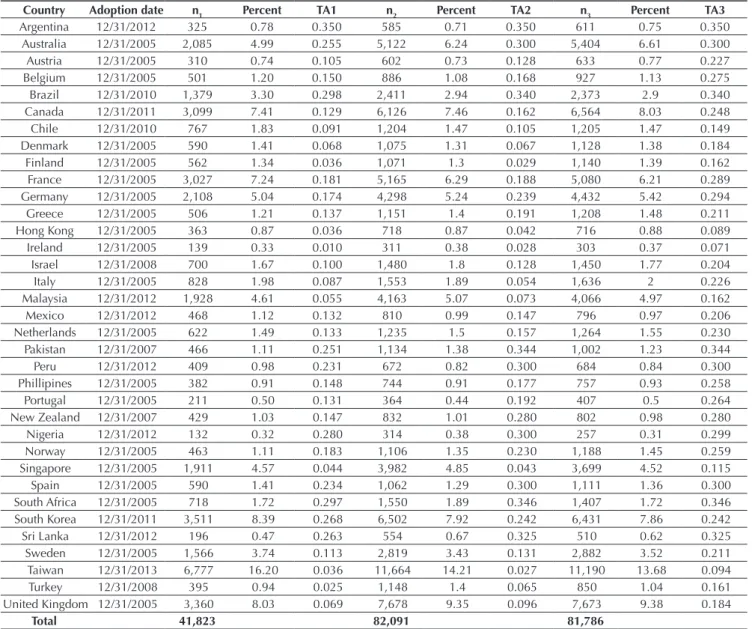
he beginning of the study period was set in accordance with the year in which there are available data regarding the corporate income tax rate for the sample countries. he period was extended to 2014 to include most countries that have already adopted IFRS in the study. Table 1 presents all of the sample countries and the year of IFRS adoption for each one.
4. RESULTS
4.1 Descriptive Statistic
Table 1 presents the median for the dependent variables in the study in an individualized way for each one of the 35 countries analyzed. To estimate the median for the dependent variable TA1, 41,823 observations of 9,389 companies included in regression model 1 were used. To estimate the median for the dependent variable TA2 (TA3), 82,091 (81,786) observations of 14,766 (15,423) companies included in regression model 1 were used. As in Atwood et al. (2012), the median for the TA1 variable is high (low) for Australia, South Africa, and South Korea (Hong Kong and Singapore). Besides these countries, in this study, Argentina, Brazil, Nigeria, Pakistan, and Sri Lanka (Finland, Ireland, Taiwan, and Turkey) also present a high (low) median for the TA1 variable.
Table 1 Sample composition, International Financial Reporting Standards adoption date, and median for the dependent variables.
Country Adoption date n1 Percent TA1 n2 Percent TA2 n3 Percent TA3
Argentina 12/31/2012 325 0.78 0.350 585 0.71 0.350 611 0.75 0.350
Australia 12/31/2005 2,085 4.99 0.255 5,122 6.24 0.300 5,404 6.61 0.300
Austria 12/31/2005 310 0.74 0.105 602 0.73 0.128 633 0.77 0.227
Belgium 12/31/2005 501 1.20 0.150 886 1.08 0.168 927 1.13 0.275
Brazil 12/31/2010 1,379 3.30 0.298 2,411 2.94 0.340 2,373 2.9 0.340
Canada 12/31/2011 3,099 7.41 0.129 6,126 7.46 0.162 6,564 8.03 0.248
Chile 12/31/2010 767 1.83 0.091 1,204 1.47 0.105 1,205 1.47 0.149
Denmark 12/31/2005 590 1.41 0.068 1,075 1.31 0.067 1,128 1.38 0.184
Finland 12/31/2005 562 1.34 0.036 1,071 1.3 0.029 1,140 1.39 0.162
France 12/31/2005 3,027 7.24 0.181 5,165 6.29 0.188 5,080 6.21 0.289
Germany 12/31/2005 2,108 5.04 0.174 4,298 5.24 0.239 4,432 5.42 0.294
Greece 12/31/2005 506 1.21 0.137 1,151 1.4 0.191 1,208 1.48 0.211
Hong Kong 12/31/2005 363 0.87 0.036 718 0.87 0.042 716 0.88 0.089
Ireland 12/31/2005 139 0.33 0.010 311 0.38 0.028 303 0.37 0.071
Israel 12/31/2008 700 1.67 0.100 1,480 1.8 0.128 1,450 1.77 0.204
Italy 12/31/2005 828 1.98 0.087 1,553 1.89 0.054 1,636 2 0.226
Malaysia 12/31/2012 1,928 4.61 0.055 4,163 5.07 0.073 4,066 4.97 0.162
Mexico 12/31/2012 468 1.12 0.132 810 0.99 0.147 796 0.97 0.206
Netherlands 12/31/2005 622 1.49 0.133 1,235 1.5 0.157 1,264 1.55 0.230
Pakistan 12/31/2007 466 1.11 0.251 1,134 1.38 0.344 1,002 1.23 0.344
Peru 12/31/2012 409 0.98 0.231 672 0.82 0.300 684 0.84 0.300
Phillipines 12/31/2005 382 0.91 0.148 744 0.91 0.177 757 0.93 0.258
Portugal 12/31/2005 211 0.50 0.131 364 0.44 0.192 407 0.5 0.264
New Zealand 12/31/2007 429 1.03 0.147 832 1.01 0.280 802 0.98 0.280
Nigeria 12/31/2012 132 0.32 0.280 314 0.38 0.300 257 0.31 0.299
Norway 12/31/2005 463 1.11 0.183 1,106 1.35 0.230 1,188 1.45 0.259
Singapore 12/31/2005 1,911 4.57 0.044 3,982 4.85 0.043 3,699 4.52 0.115
Spain 12/31/2005 590 1.41 0.234 1,062 1.29 0.300 1,111 1.36 0.300
South Africa 12/31/2005 718 1.72 0.297 1,550 1.89 0.346 1,407 1.72 0.346
South Korea 12/31/2011 3,511 8.39 0.268 6,502 7.92 0.242 6,431 7.86 0.242
Sri Lanka 12/31/2012 196 0.47 0.263 554 0.67 0.325 510 0.62 0.325
Sweden 12/31/2005 1,566 3.74 0.113 2,819 3.43 0.131 2,882 3.52 0.211
Taiwan 12/31/2013 6,777 16.20 0.036 11,664 14.21 0.027 11,190 13.68 0.094
Turkey 12/31/2008 395 0.94 0.025 1,148 1.4 0.065 850 1.04 0.161
United Kingdom 12/31/2005 3,360 8.03 0.069 7,678 9.35 0.096 7,673 9.38 0.184
Total 41,823 82,091 81,786
Note: Adoption date: mandatory IFRS adoption date for the inancial statements closed after December 31 [Deloitte (2015),
IFRS Foundation (2017) and PwC (2014)]; n1, n2, n3: number of observations considered in the calculation of the median for variables TA1, TA2, and TA3 (tax avoidance measures), respectively; Percent: percentage of observations for a particular country in relation to the sample.
Source: Elaborated by the authors.
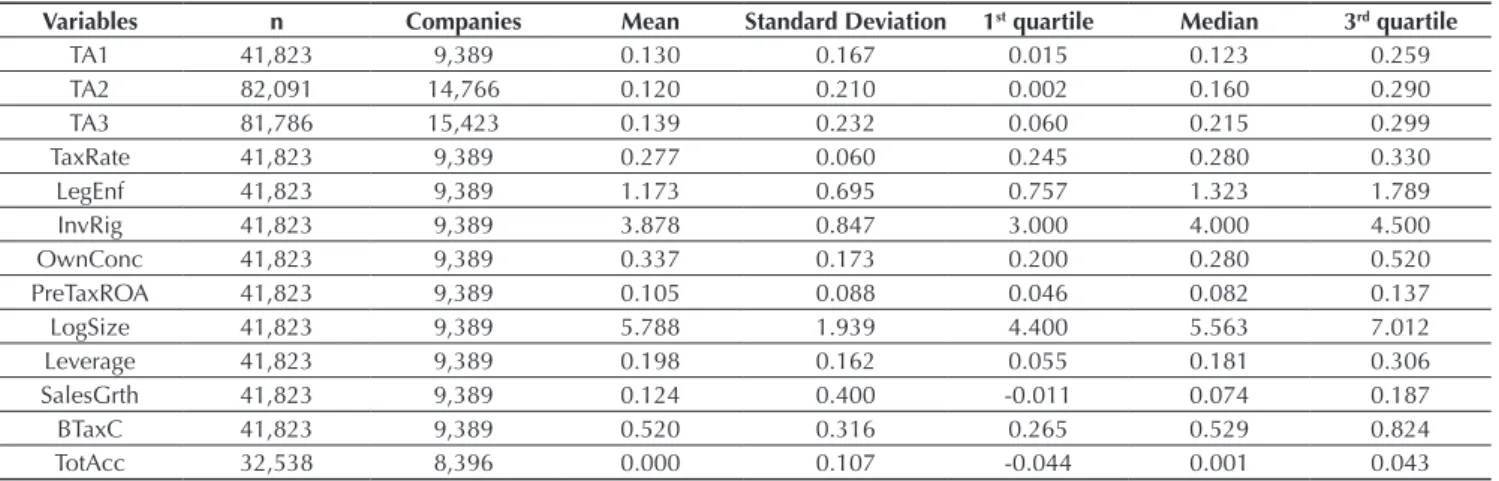
Table 2 presents the descriptive statistics for the variables for the whole sample. he averages for the dependent variables are similar and are 13% for TA1, 12% for TA2, and 13.9% for TA3. Compared with the 8.4% average found byAtwood et al. (2012), the higher level of tax avoidance for the study sample and period is evident. A reduction in the average corporate income tax rate is noted compared with previous studies. he average tax rate in Atwood et al. (2012) is 37.2%, in Tang (2015)
Table 2 Descriptive statistic
Variables n Companies Mean Standard Deviation 1st quartile Median 3rd quartile
TA1 41,823 9,389 0.130 0.167 0.015 0.123 0.259
TA2 82,091 14,766 0.120 0.210 0.002 0.160 0.290
TA3 81,786 15,423 0.139 0.232 0.060 0.215 0.299
TaxRate 41,823 9,389 0.277 0.060 0.245 0.280 0.330
LegEnf 41,823 9,389 1.173 0.695 0.757 1.323 1.789
InvRig 41,823 9,389 3.878 0.847 3.000 4.000 4.500
OwnConc 41,823 9,389 0.337 0.173 0.200 0.280 0.520
PreTaxROA 41,823 9,389 0.105 0.088 0.046 0.082 0.137
LogSize 41,823 9,389 5.788 1.939 4.400 5.563 7.012
Leverage 41,823 9,389 0.198 0.162 0.055 0.181 0.306
SalesGrth 41,823 9,389 0.124 0.400 -0.011 0.074 0.187
BTaxC 41,823 9,389 0.520 0.316 0.265 0.529 0.824
TotAcc 32,538 8,396 0.000 0.107 -0.044 0.001 0.043
Note: BTaxC: measure of book-tax conformity; companies: number of irms observed; LegEnf: measure of legal enforcement;
InvRig: measure of investor rights; Leverage: measure of leverage; LogSize: measure of irm size; OwnConc: measure of ownership concentration; PreTaxROA: measure of proitability; SalesGrth: measure of sales growth; TA1, TA2, TA3: measures of tax avoidance; TaxRate: home-country statutory corporate income tax rate; TotAcc: measure of total accruals.
Source:Elaborated by the authors.
he (non-tabulated) collinearity test was carried out and an average variance inlation factor (VIF) of 1.39 and a highest VIF of 1.57 were found. A VIF below 10 is generally accepted, which suggests that the models used in this study do not present multicollinearity problems. Heteroskedasticity (Wald test) and autocorrelation (Wooldridge test) tests were carried out, which indicated that the models do not present heteroskedasticity and autocorrelation problems.
4.2 Multivariate Tests
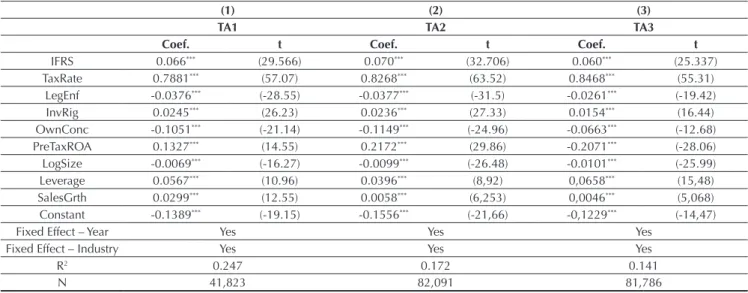
Table 3 presents the result for the association between IFRS adoption and tax avoidance. Consistent with H1, IFRS adoption is positively associated with tax avoidance for all three forms of measurement of this variable. his result indicates that, on average, the companies started to engage more in tax avoidance ater mandatory IFRS adoption.
Consistent with previous studies, it was found that TaxRate is positively associated with tax avoidance, indicating that the higher the corporate income tax rate, the more companies engage in tax avoidance. With regards to the institutional variables, a negative association was found between the LegEnf and OwnConc variables and tax avoidance and a positive association was found between InvRig and tax avoidance. his result suggests that tax avoidance is lower in countries with high legal enforcement and a high ownership concentration, which is in line with previous studies, and higher in countries with high investor protection.
When Slemrod (2004) discusses the economic model of the demand for tax evasion, he presents the probability
of detecting evasion and punishment as one of the determining points for deciding to evade tax. In the area of empirical studies, Tang (2015) found that the stronger a country’s legal enforcement, the less companies engage in tax avoidance. Atwood et al. (2012), Badertscher, Katz and Rego (2013), and Chen et al. (2010) highlight that companies with a high ownership concentration tend to avoid taxation less. he authors argue that, in general, companies with a high ownership concentration are more concerned with the costs of evading taxes, such as the cost of penalty and of damage to the company’s image.
he indication found in this study that high investor protection is associated with greater company engagement in tax avoidance diverges from the results found in previous studies, possibly because of the diference in sample and time of the studies or the way of measuring the variable. In the study from Tang (2015), no signiicant association was veriied between these two variables. Atwood et al. (2012) controlled investor rights with another two institutional characteristics (ownership concentration and legal system) using a factor that was negatively associated with tax avoidance.
PreTaxROA and tax avoidance identiied in regression 3 may derive from the direct relationship between the metrics for these two variables. PreTaxROA takes pre-tax earnings as its numerator, the TA3 variable takes OCF as its denominator, and pre-tax earnings and OCF have a direct relationship, which can be both negative and positive.
Rego (2003) highlights that bigger companies have a higher efective income tax rate; that is, they engage in less tax avoidance, which is in agreement with the
negative association between irm size and tax avoidance found in this study. Atwood et al. (2012) also identiied a negative association between LogSize and tax avoidance and showed that this result is consistent with the behavior of bigger companies, which act to reduce potential political costs. As in Atwood et al. (2012), a positive association was found between Leverage and tax avoidance and between SalesGrth and tax avoidance, suggesting that the higher the degree of leverage and the growth in sales of a particular company, the more it engages in tax avoidance.
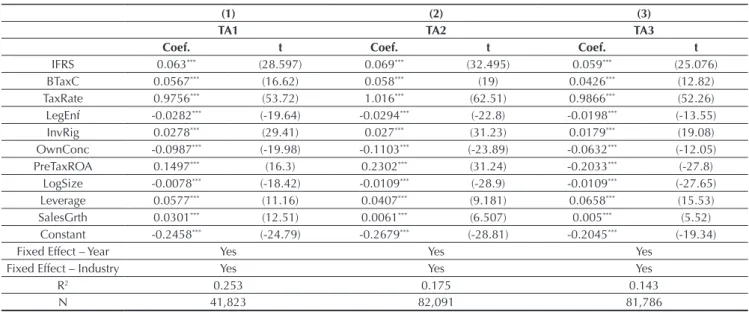
Table 4 presents the result for the association between IFRS adoption and tax avoidance ater controlling for book-tax conformity. One of the main arguments of this study is that IFRS adoption can afect levels of tax avoidance because it causes a reduction in the level of book-tax conformity and there is evidence that companies in countries with low conformity present greater tax avoidance. However, the evidence found in this study indicates that there is a positive association between book-tax conformity and tax avoidance; that is, the higher the level of conformity between reported earnings and taxable income, the greater companies’ engagement in tax avoidance practices. his association can be explained
by the fact that when a company located in a high book-tax conformity environment decides to engage in book-tax avoidance, it can change its accounting choices and report lower accounting earnings in order to pay less tax. Previous studies suggest that irms subjected to a higher level of book-tax conformity alter their accounting choices to avoid taxation costs (Hanlon et al., 2005; Hanlon, Maydew, & Shevlin, 2008). hus, in environments of high conformity between reported earnings and taxable income, if a company has more incentives to pay less tax than to report higher proits to the market, it will engage in tax avoidance and consequently reduce its accounting earnings.
Table 3 Effects of International Financial Reporting Standards adoption on tax avoidance
(1) (2) (3)
TA1 TA2 TA3
Coef. t Coef. t Coef. t
IFRS 0.066*** (29.566) 0.070*** (32.706) 0.060*** (25.337)
TaxRate 0.7881*** (57.07) 0.8268*** (63.52) 0.8468*** (55.31)
LegEnf -0.0376*** (-28.55) -0.0377*** (-31.5) -0.0261*** (-19.42)
InvRig 0.0245*** (26.23) 0.0236*** (27.33) 0.0154*** (16.44)
OwnConc -0.1051*** (-21.14) -0.1149*** (-24.96) -0.0663*** (-12.68)
PreTaxROA 0.1327*** (14.55) 0.2172*** (29.86) -0.2071*** (-28.06)
LogSize -0.0069*** (-16.27) -0.0099*** (-26.48) -0.0101*** (-25.99)
Leverage 0.0567*** (10.96) 0.0396*** (8,92) 0,0658*** (15,48)
SalesGrth 0.0299*** (12.55) 0.0058*** (6,253) 0,0046*** (5,068)
Constant -0.1389*** (-19.15) -0.1556*** (-21,66) -0,1229*** (-14,47)
Fixed Effect – Year Yes Yes Yes
Fixed Effect – Industry Yes Yes Yes
R2 0.247 0.172 0.141
N 41,823 82,091 81,786
Note: this table presents ordinary least squares (OLS) regressions that test the effect of IFRS adoption on tax avoidance. The
standard errors are robust in terms of heteroskedasticity.
LegEnf: measure of legal enforcement; IFRS: dummy variable for IFRS adoption; InvRig: measure of investor rights; Leverage: measure of leverage; LogSize: measure of irm size; OwnConc: measure of ownership concentration; PreTaxROA: measure of proitability; SalesGrth: measure of sales growth; TA1, TA2, TA3: measures of tax avoidance; TaxRate: home-country statutory corporate income tax rate.
***: 1% statistical signiicance.
Table 4 Effects of International Financial Reporting Standards adoption on tax avoidance with book-tax conformitycontrol
(1) (2) (3)
TA1 TA2 TA3
Coef. t Coef. t Coef. t
IFRS 0.063*** (28.597) 0.069*** (32.495) 0.059*** (25.076)
BTaxC 0.0567*** (16.62) 0.058*** (19) 0.0426*** (12.82)
TaxRate 0.9756*** (53.72) 1.016*** (62.51) 0.9866*** (52.26)
LegEnf -0.0282*** (-19.64) -0.0294*** (-22.8) -0.0198*** (-13.55)
InvRig 0.0278*** (29.41) 0.027*** (31.23) 0.0179*** (19.08)
OwnConc -0.0987*** (-19.98) -0.1103*** (-23.89) -0.0632*** (-12.05)
PreTaxROA 0.1497*** (16.3) 0.2302*** (31.24) -0.2033*** (-27.8)
LogSize -0.0078*** (-18.42) -0.0109*** (-28.9) -0.0109*** (-27.65)
Leverage 0.0577*** (11.16) 0.0407*** (9.181) 0.0658*** (15.53)
SalesGrth 0.0301*** (12.51) 0.0061*** (6.507) 0.005*** (5.52)
Constant -0.2458*** (-24.79) -0.2679*** (-28.81) -0.2045*** (-19.34)
Fixed Effect – Year Yes Yes Yes
Fixed Effect – Industry Yes Yes Yes
R2 0.253 0.175 0.143
N 41,823 82,091 81,786
Note: this table presents ordinary least squares (OLS) regressions that test the effect of IFRS adoption on tax avoidance,
controlling the level of book-tax conformity in the countries. The standard errors are robust in terms of heteroskedasticity. BTaxC: measure of book-tax conformity; LegEnf: measure of legal enforcement; IFRS: dummy variable for IFRS adoption; InvRig: measure of investor rights; Leverage: measure of leverage; LogSize: measure of irm size; OwnConc: measure of ownership concentration; PreTaxROA: measure of proitability; SalesGrth: measure of sales growth; TA1, TA2, TA3: measures of tax avoidance; TaxRate: home-country statutory corporate income tax rate.
***: 1% statistical signiicance.
Source: Elaborated by the authors.
Another possible explanation for the positive association between book-tax conformity and tax avoidance may be due to the loss of an alternative measure of performance when there is high conformity between reported earnings and taxable income, which probably
causes a reduction in the ability to detect tax avoidance, given that previous studies have identiied the use of book-tax diferences to detect tax avoidance (Badertscher, Phillips, Pincus, & Rego, 2009).
he efect of IFRS adoption on tax avoidance remains the same ater the book-tax conformity control. It is noted that the magnitude and direction of the IFRS variable coeicient is similar to the magnitude and direction of the coeicient of this same variable when there was no control for the level of book-tax conformity (Table 3). his result indicates that, independent of the level of book-tax conformity required in the country, companies started to engage more in tax avoidance ater IFRS adoption.
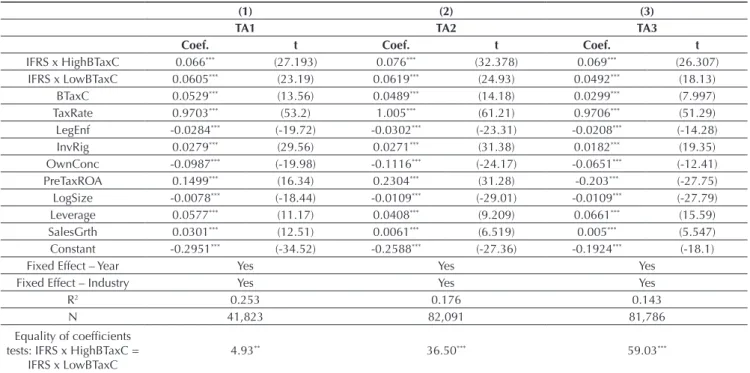
The tests of coefficient equality reveal that the relationship between mandatory IFRS adoption and tax avoidance is signiicantly more positive for irms in countries with a high level of book-tax conformity. hese results indicate that ater IFRS adoption, companies in countries with a higher level of conformity between reported earnings and taxable income started to engage more in tax avoidance than companies in countries with a lower level of conformity. his result can be explained by the fact that when engaging in tax avoidance, companies in countries with high book-tax conformity tend to opt for practices that do not generate book-tax diferences (so as not to raise suspicions that the earnings were reported opportunistically), such as transferring proits to jurisdictions with lower tax burdens, and IFRS adoption has facilitated this type of operation. Simone (2015) identiied an average increase in proit transfers for tax reasons ater IFRS adoption, given that the adoption of a single accounting standard by various countries has facilitated this type of transfer.
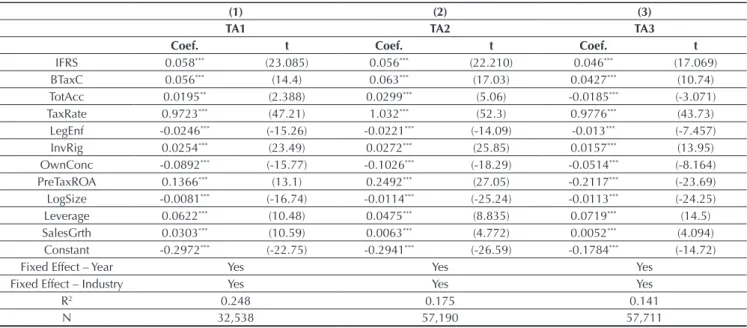
Table 6 presents the result for the association between IFRS adoption and tax avoidance controlling for book-tax conformity and total accruals. It is veriied that the positive association between mandatory IFRS adoption and tax avoidance persists even when two possible explanatory factors for this relationship are controlled. his result indicates that, keeping the level of book-tax conformity and accruals constant, companies started to engage more in tax avoidance ater IFRS adoption.
It is shown in Table 6 that total accruals are positively associated with tax avoidance in two of the regressions (1 and 2), which is consistent with Atwood et al. (2012) and indicates that part of the tax avoidance is achieved through accruals. For one of the regressions (3), total accruals are negatively associated with tax avoidance. his negative association can be explained by the inverse relationship between the metrics for these two variables. For the TA3 variable measurement, the higher the OCF, the higher the TA3 variable, and the higher the OCF, the lower total accruals are, thus identifying an inverse
Table 5 Differentiated effects of International Financial Reporting Standards adoption on tax avoidance in high and low book-tax
conformityenvironments
(1) (2) (3)
TA1 TA2 TA3
Coef. t Coef. t Coef. t
IFRS x HighBTaxC 0.066*** (27.193) 0.076*** (32.378) 0.069*** (26.307)
IFRS x LowBTaxC 0.0605*** (23.19) 0.0619*** (24.93) 0.0492*** (18.13)
BTaxC 0.0529*** (13.56) 0.0489*** (14.18) 0.0299*** (7.997)
TaxRate 0.9703*** (53.2) 1.005*** (61.21) 0.9706*** (51.29)
LegEnf -0.0284*** (-19.72) -0.0302*** (-23.31) -0.0208*** (-14.28)
InvRig 0.0279*** (29.56) 0.0271*** (31.38) 0.0182*** (19.35)
OwnConc -0.0987*** (-19.98) -0.1116*** (-24.17) -0.0651*** (-12.41)
PreTaxROA 0.1499*** (16.34) 0.2304*** (31.28) -0.203*** (-27.75)
LogSize -0.0078*** (-18.44) -0.0109*** (-29.01) -0.0109*** (-27.79)
Leverage 0.0577*** (11.17) 0.0408*** (9.209) 0.0661*** (15.59)
SalesGrth 0.0301*** (12.51) 0.0061*** (6.519) 0.005*** (5.547)
Constant -0.2951*** (-34.52) -0.2588*** (-27.36) -0.1924*** (-18.1)
Fixed Effect – Year Yes Yes Yes
Fixed Effect – Industry Yes Yes Yes
R2 0.253 0.176 0.143
N 41,823 82,091 81,786
Equality of coeficients tests: IFRS x HighBTaxC =
IFRS x LowBTaxC
4.93** 36.50*** 59.03***
Note: this table presents ordinary least squares (OLS) regressions that test the effect of IFRS adoption on tax avoidance in high
and low book-tax conformity environments. It also presents the tests of coeficient equality for the variables IFRS x HighBTaxC and IFRS x LowBTaxC. The standard errors are robust in terms of heteroskedasticity.
BTaxC: measure of book-tax conformity; LegEnf: measure of legal enforcement; IFRS x HighBTaxC: interaction between the dummy variables for IFRS adoption and for countries with a high level of conformity; IFRS x LowBTaxC: interaction between the dummy variables for IFRS adoption and for countries with a low level of conformity; InvRig: measure of investor rights; Leverage: measure of leverage; LogSize: measure of irm size; OwnConc: measure of ownership concentration; PreTaxROA: measure of proitability; SalesGrth: measure of sales growth; TA1, TA2, TA3: measures of tax avoidance; TaxRate: home-country statutory corporate income tax rate.
**, ***: 5% and 1% statistical signiicance, respectively.
Table 6 Effects of International Financial Reporting Standards adoption on tax avoidance controlling for book-tax conformity and accruals
(1) (2) (3)
TA1 TA2 TA3
Coef. t Coef. t Coef. t
IFRS 0.058*** (23.085) 0.056*** (22.210) 0.046*** (17.069)
BTaxC 0.056*** (14.4) 0.063*** (17.03) 0.0427*** (10.74)
TotAcc 0.0195** (2.388) 0.0299*** (5.06) -0.0185*** (-3.071)
TaxRate 0.9723*** (47.21) 1.032*** (52.3) 0.9776*** (43.73)
LegEnf -0.0246*** (-15.26) -0.0221*** (-14.09) -0.013*** (-7.457)
InvRig 0.0254*** (23.49) 0.0272*** (25.85) 0.0157*** (13.95)
OwnConc -0.0892*** (-15.77) -0.1026*** (-18.29) -0.0514*** (-8.164)
PreTaxROA 0.1366*** (13.1) 0.2492*** (27.05) -0.2117*** (-23.69)
LogSize -0.0081*** (-16.74) -0.0114*** (-25.24) -0.0113*** (-24.25)
Leverage 0.0622*** (10.48) 0.0475*** (8.835) 0.0719*** (14.5)
SalesGrth 0.0303*** (10.59) 0.0063*** (4.772) 0.0052*** (4.094)
Constant -0.2972*** (-22.75) -0.2941*** (-26.59) -0.1784*** (-14.72)
Fixed Effect – Year Yes Yes Yes
Fixed Effect – Industry Yes Yes Yes
R2 0.248 0.175 0.141
N 32,538 57,190 57,711
Note: this table presents ordinary least squares (OLS) regressions that test the effect of IFRS adoption on tax avoidance
controlling by book-tax conformity and total accruals. The standard errors are robust in terms of heteroskedasticity.
BTaxC: measure of book-tax conformity; LegEnf: measure of legal enforcement; IFRS: dummy variable for IFRS adoption; InvRig: measure of investor rights; Leverage: measure of leverage; LogSize: measure of irm size; OwnConc: measure of ownership concentration; PreTaxROA: measure of proitability; SalesGrth: measure of sales growth; TA1, TA2, TA3: measures of tax avoidance; TaxRate: home-country statutory corporate income tax rate; TotAcc: measure of total accruals.
***: 1% statistical signiicance.
Source: Elaborated by the authors.
relationship between the way the TA3 and TotAcc variables are being measured.
It is observed that the result for mandatory IFRS adoption is essentially the same as for mandatory IFRS adoption in the regression in model 1, when there was no control for accruals. his result suggests that the positive association between IFRS adoption and tax avoidance is not only driven by engagement in tax avoidance through accruals management, but also by other mechanisms that do not involve accruals.
An increase in reported earnings, keeping the value
of corporate income tax constant, and depending on the metric used, can result in an increase in tax avoidance, independently of the company being engaged in practices to reduce the value of income tax, which makes the use of total accruals essential for controlling this possible mechanical relationship. he result found indicates that the positive association between mandatory IFRS adoption and tax avoidance does not derive from a mechanical relationship resulting from possible increases in accruals occurring ater IFRS adoption.
4.3 Robustness Tests
New tests were carried out to verify whether the results are robust for the temporal variation in the tax avoidance metrics proposed by Tang (2015) and the tax enforcement control. he TA2 and TA3 variables were estimated anually. However, Atwood et al. (2012) argue that there can be a signiicant variation from one year to the next in the efective tax rate and that considering annual tax avoidance does not minimize the efects of items that are reversed in only one year. Based on these arguments, the TA2 and TA3 variables were estimated over three years and all of the regression models were adjusted for the new tax avoidance variables, with all of the results remaining constant, with the exception of one
of the tests of coeicient equality, which did not present any signiicance.
5. CONCLUSION
he main aim of this study is to identify the association between mandatory IFRS adoption around the world and levels of tax avoidance. Using three diferent metrics for tax avoidance and controlling factors at a country and irm level that have shown an association with tax avoidance in previous studies, results were found that suggest an increase in companies’ involvement in tax avoidance ater mandatory IFRS adoption.
he study also seeks to investigate how the relationship between mandatory IFRS adoption and tax avoidance behaves when the level of book-tax conformity is kept constant, and how this relationship behaves in countries with high and low book-tax conformity. he results found indicate that ater mandatory IFRS adoption companies started to engage more in tax avoidance even when the level of conformity between reported earnings and taxable income is kept constant. However, ater IFRS adoption, those companies in countries with higher levels of book-tax conformity started to engage more in book-tax avoidance than those in countries with lower levels of book-tax conformity.
his study also aims to discover if IFRS adoption has an impact on companies’ engagement in tax avoidance through accruals management practices, practices that do not involve accruals management, or both. he results found indicate that part of the tax avoidance is due to accruals management practices; however, the increase in engagement in tax avoidance by companies ater IFRS adoption is also due to other mechanisms that do not involve accruals management, for example, operations in tax havens and profit transfers to subsidiaries in jurisdictions with lower tax burdens.
It is therefore concluded that ater mandatory IFRS adoption companies start to engage more in tax avoidance, using both practices that involve accruals management and those that do not. he association between IFRS adoption and increased tax avoidance showed signiicance independently of the level of book-tax conformity required
in the country and the volume of company accruals. his study contributes to the literature on the efects of IFRS adoption and on the determinants of tax avoidance, as it identiies taxation efects for IFRS adoption and shows that the adoption of one accounting standard is associated with a higher level of company tax avoidance. It also contributes to the current debate about the costs and beneits of diferent levels of book-tax conformity, by identifying that independently of the level of conformity between reported earnings and taxable income, the level of tax avoidance increased ater IFRS adoption. his study presents interesting results for governments, investors, and other market participants, in that it shows greater company engagement in tax avoidance ater IFRS adoption.
Hanlon and Heitzman (2010) highlight that the tax avoidance metrics that are used for the efective tax rate, even if measured over the long run, relect all of the transactions that have any efect on a company’s tax liabilities and do not distinguish between real activities that have tax beneits, activities carried out speciically to reduce taxation, and tax beneits obtained via lobbying activities. his factor is presented as a limitation of this study. Another limitation of the study is the lack of any control for the incentives given to managers, given that previous studies have already shown that there is a relationship between these incentives and levels of tax avoidance.
REFERENCES
Ahmed, A. S., Neel, M., & Wang, D. (2013). Does mandatory adoption of IFRS improve accounting quality? Preliminary evidence. Contemporary Accounting Research, 30(4), 1344-1372.
Atwood, T. J., Drake, M. S., & Myers, L. A. (2010). Book-tax conformity, earnings persistence and the association between earnings and future cash lows. Journal of Accounting and Economics, 50(1), 111-125.
Atwood, T. J., Drake, M. S., Myers, J. N., & Myers, L. A. (2012). Home country tax system characteristics and corporate tax avoidance: international evidence. he Accounting Review,
87(6), 1831-1860.
Badertscher, B. A., Katz, S. P., & Rego, S. O. (2013). he separation of ownership and control and corporate tax avoidance. Journal of Accounting and Economics, 56(2-3), 228-250.
Badertscher, B. A., Phillips, J. D., Pincus, M., & Rego, S. O. (2009). Earnings management strategies and the trade‐of between tax beneits and detection risk: to conform or not to conform? he Accounting Review, 84(1), 63-97.
Brüggemann, U., Hitz, J.-M., & Sellhorn, T. (2013). Intended and unintended consequences of mandatory IFRS adoption: a review of extant evidence and suggestions for future research.
European Accounting Review, 22(1), 1-37.
Chan, K. H., Lin, K. Z., & Mo, P. L. L. (2010). Will a departure from tax-based accounting encourage tax noncompliance? Archival evidence from a transition economy. Journal of Accounting and Economics, 50(1), 58-73.
Chan, K. H., Lin, K. Z., & Tang, F. (2013). Tax efects of book-tax conformity, inancial reporting incentives, and irm size.
Journal of International Accounting Research, 12(2), 1-25. Chen, E., & Gavious, I. (2015). he roles of book-tax conformity
and tax enforcement in regulating tax reporting behaviour following International Financial Reporting Standards adoption. Accounting and inance (early view; online irst). Retrieved from http://dx.doi.org/10.1111/aci.12172. Chen, S., Chen, X., Cheng, Q., & Shevlin, T. (2010). Are family
irms more tax aggressive than non-family irms? Journal of Financial Economics, 95(1), 41-61.
De George, E. T., Li, X., & Shivakumar, L. (2016). A review of the IFRS adoption literature. Review of Accounting Studies, 21(3), 898-1004.
Deloitte (2010). CFO insights: IFRS: select tax considerations. Retrieved from http://www.iasplus.com/en/binary/ usa/1012cfotaxconsider.pdf.
Deloitte (2015). Retrieved from http://www.iasplus.com/en/ jurisdictions.
Desai, M. A. (2005). he degradation of reported corporate proits. Journal of Economic Perspectives, 19(4), 171-192. Djankov, B. S., Ganser, T., Mcliesh, C., Ramalho, R., & Shleifer,
A. (2010). he efect of corporate taxes on investment and entrepreneurship. American Economic Journal: Macroeconomics 2, 2(July), 31-64.
Djankov, B. S., La Porta, R., Lopez-de-Silanes, F., & Shleifer, A. (2008). he law and economics of self-dealing. Journal of Financial Economics, 88(3), 430-465.
Dyreng, S. D., Hanlon, M., & Maydew, E. L. (2008). Long‐run corporate tax avoidance. he Accounting Review, 83(1), 61-82. EY. Worldwide corporate tax guide. Retrieved from http://www.
ey.com/GL/en/Services/Tax/Worldwide-Corporate-Tax-Guide---Country-list.
Frank, M. M., Lynch, L. J., & Rego, S. O. (2009). Tax reporting aggressiveness and its relation to aggressive inancial reporting. he Accounting Review, 84(2), 467-496. Hanlon, M., & Heitzman, S. (2010). A review of tax research.
Journal of Accounting and Economics, 50(2-3), 127-178. Hanlon, M., & Shevlin, T. (2005). Book-tax conformity for
corporate income: an introduction to the issues. Tax Policy and the Economy, 19, 101-134.
Hanlon, M., Laplante, K. S., & Shevlin, T. (2005). Evidence for the possible information loss of conforming book income and taxable income. he Journal of Law and Economics,
48(October 2005), 407-442.
Hanlon, M., Maydew, E. L., & Shevlin, T. (2008). An unintended consequence of book-tax conformity: a loss of earnings informativeness. Journal of Accounting and Economics, 46 (2-3), 294-311.
IFRS Foundation (2017). Use around the world: analysis of the IFRS jurisdiction proiles. Retrieved from http://www.ifrs. org/Use-around-the-world/Pages/Analysis-of-the-IFRS-jurisdictional-proiles.aspx.
IFRS Foundation Constitution (2013). Constitution — Revised and approved by the Trustees. Retrieved from http://www. ifrs.org/he-organisation/Governance-and-accountability/ Constitution/Documents/IFRS-Foundation-Constitution-January-2013.pdf.
Karampinis, N. I., & Hevas, D. L. (2013). Efects of IFRS adoption on tax-induced incentives for inancial earnings management: evidence from Greece. he International Journal of Accounting,
48(2), 218-247.
Kaufmann, D., & Kraay, A. (2015). he Worldwide Governance Indicators Project. Retrieved from http://info.worldbank.org/ governance/wgi/index.aspx#home.
KPMG. Tax rates online. Retrieved from http://www.kpmg.com/ global/en/services/tax/tax-tools-and-resources/pages/tax-rates-online.aspx.
La Porta, R., Lopez-de-Silanes, F., Shleifer, A., & Vishny, R. (1998). Law and inance. he Journal of Political Economy, 106(6), 1113-1155.
Lin, S., Riccardi, W., & Wang, C. (2012). Does accounting quality change following a switch from U.S. GAAP to IFRS? Evidence from Germany. Journal of Accounting and Public Policy, 31, 641-657.
PWC. (2014). IFRS adoption by country. Retrieved from http:// www.pwc.com/us/en/issues/ifrs-reporting/publications/assets/ pwc-ifrs-by-country-2014.pdf.
Simone, L. D. (2015). Does a common set of accounting standards afect tax-motivated income shiting for multinational irms?
Journal of Accounting and Economics, 61(1),145-165. Slemrod, J. (2004). he economics of corporate tax selishness.
National Tax Journal, LVII(4), 877-899.
Tang, T. Y. H. (2015). Does book-tax conformity deter opportunistic book and tax reporting? An international analysis. European Accounting Review, 24(3), 441-469.
Tax Foundation (2015). Corporate income tax rates around the world. Retrieved from http://taxfoundation.org/article/ corporate-income-tax-rates-around-world-2014.
he World Bank (2017). GDP ranking. Retrieved from http://data. worldbank.org/data-catalog/GDP-ranking-table.
Wilson, R. J. (2009). An examination of corporate tax shelter participants. he Accounting Review, 84(3), 969-999.
Correspondence address:
Renata Nogueira Braga
Universidade de São Paulo, Faculdade de Economia, Administração e Contabilidade, Departamento de Contabilidade e Atuária
Avenida Professor Luciano Gualberto, 908 – CEP: 05508-010 Cidade Universitária – São Paulo – SP – Brasil