scores obtained by schools from the state of Espírito Santo in the
nationwide exam Prova Brasil, using multiple linear regression
Bruno Luiz Américo
Universidade Federal do Espírito Santo / Postgraduate programme in Management Vitória / ES — Brazil
Adonai José Lacruz
Universidade Federal do Espírito Santo / Postgraduate programme in Management Vitória / ES — Brazil
his article describes the relationship between the school environment and its performance. he study observed the score obtained in the nationwide school evaluation exam called Prova Brasil (2013) by the schools that are part of Espírito Santo’s educational system, analyzing them through multiple linear regression. he sample consisted of 244 schools and 10 environmental variables were analyzed, of which 3 formed the regression model by the stepwise method: Index of Teacher Regularity, Indicator of Teacher Stress and Abandonment Rate. he variables obtained 47.9% of association with the score obtained in Prova Brasil and explained 22% of the score’s variation. In addition, the variables are subject to management from civil servants working in the state’s educational system. he indings reinforce the importance of the school environment, as well as of the teacher, as a way to reduce — through the school — the efects of the unfavorable family and social background.
Keywords: public administration; educational policies; school management; school context; school performance.
Contexto e desempenho escolar: análise das notas na Prova Brasil das escolas capixabas por meio de regressão linear múltipla
O presente estudo descreve a relação entre o “contexto” e o “desempenho” escolar mensurado por meio das notas mais recentes (2013) da Prova Brasil das escolas do sistema estadual de ensino do Espírito Santo, por meio de regressão linear múltipla. A amostra foi composta por 244 escolas e foram analisadas 10 variáveis contextuais, das quais três compuseram o modelo de regressão pelo o método stepwise: Índice de Regularidade Docente, Indicador de Esforço Docente e Taxa de Abandono. Essas variáveis obtiveram um grau de associação de 47,9% com a nota na Prova Bra-sil e explicaram 22% da sua variação; e estão sob a gerência dos gestores públicos da rede estadual de educação do Espírito Santo. Os achados do estudo reforçam a importância do “contexto” escolar, bem como do “professor”, como forma de reduzir os efeitos da conjuntura familiar e social desfavorável por meio da atuação da organização escolar.
Palavras-chave: administração pública; políticas educacionais; gestão escolar; contexto escolar; desempenho escolar.
Contexto y rendimiento escolar: análisis de las notas en el Examen Brasil de escuelas del estado de Espírito Santo por medio de regresión linear múltiple
El presente estudio describe la relación entre el “contexto” y el “rendimiento” escolar mensurado por las notas más recientes del Examen Brasil (2013) de las escuelas del sistema de educación del estado de Espírito Santo, a través de regresión lineal múltiple. La muestra consistió en 244 escuelas y se analizaron 10 variables contextuales, de las cuales tres han compuesto el modelo de regresión por el método stepwise: Índice de Regularidad del Maestro, Indicador de estrés del Maestro y Tasa de Abandono. Estas variables obtienen un grado de pertenencia a un 47,9% con la nota del Examen Brasil y explican el 22% de la variación; y están bajo la gestión de los gestores públicos del estado de la educación de Espírito Santo. Los resultados del estudio reforzar la importancia del “contexto” de la escuela, así como del “profesor”, como un modo de reducir los efectos desfavorables de la conjuntara familiar y social por medio de la actuación de la organización escolar.
Palabras clave: administración pública; políticas educativas; gestión escolar; contexto escolar; rendimiento escolar.
DOI: http://dx.doi.org/10.1590/0034-7612160483
Article received on February 29, 2016 and accepted on February 22, 2017.
1. INTRODUCTION
he present article analyzes the performance of students from the inal years of public elementary
schools in the state Espírito Santo (ES),1 in the national test Prova Brasil2 of 2013, in relation to the
“context” in which each school performed the teaching and learning process, aiming at contributing to the public education network of ES.
Ministerial Order No. 931, of March 21, 2005, established the Prova Brasil, which is part of the
discursive worldwide concern around large-scale national assessments that measure quality in
educa-tion around the globe — in addieduca-tion to quantity and expansion. Prova Brasil evaluates students from
rural and urban areas in the initial (4th and 5th years) and inal years (8th and 9th years) of public primary education in Portuguese and mathematics. his is a census evaluation, in which students of Brazilian schools with more than 20 students enrolled in the initial and inal years of elementary school take the test. his evaluation, carried out every two years, presents nominally the results of schools and municipalities.
Prova Brasil can be understood as a strategy that allows the Brazilian government to evaluate the quality of public school education and, at the same time, to hold each of these organizations, as well as leaders and teachers, responsible for the students’ results (Fernandes and Gremaud, 2009). his movement, which in the world of management is conventionally called accountability, is structured around the notion that society has the right to hold public employees accountable for the service
rendered quality. Nevertheless, the accountability carried out by Prova Brasil focuses on the
dissem-ination of results and setting of goals. Good practices are not rewarded, just as schools, principals and teachers with low performance are not penalized (Bonamino and Sousa, 2012; Hanushek and Raymond, 2005).
he political discourse claims that Prova Brasil indicates where resources should be spent, as well
as points out pedagogical and management practices capable of improving students’ performance and teaching quality. However, scholars argue that the average improvement in the quality of education is based on inequity between students and student groups (Lee and Bryk, 1989; Fuller and Clarke, 1994; Franco et al., 2007; Soares and Alves, 2003). According to Soares and Alves (2003), large-scale educa-tional evaluations allow not only the production of eicacy of Brazilian education networks, but also the production of educational equity. For these authors, eiciency is not performed homogeneously in the national education system, because this system favors school performance of “white people”, who are mostly part of more privileged social strata. To that end, school organization produces, through large-scale evaluations, eicacy and inequality in the same movement, increasing the diference
be-tween social and racial groups. According to Oliveira (2011), Prova Brasil can lead to the redeinition
of the programmatic content around the subjects required by this evaluation. In this correlation, for Bonamino and Sousa (2012), the “preparatory” for the accomplishment of standardized evaluations applied in large scale can entail the narrowing of the school curriculum.
he issue presented by the present research concerns a controversial topic, the Prova Brasil,
which, as few other questions, manages to be part of the public interest and specialized knowledge
areas (Psychology, Sociology, Anthropology, Didactics, Education, Philosophy, Public and Private Management), as well as politics and society. In particular, multiple relationships are investigated
between the Prova Brasil grades of 2013 of the students of the inal years of public elementary schools
in Espírito Santo and the contextual indicators of these schools. Following is the theoretical basis on which the discussion will be founded.
2. THEORETICAL GROUNDING
Diferent civilizations, empires, dynasties, countries and blocks of countries have understood the role of school institutions very diferently from time to time. According to Nogueira and Nogueira (2004), until the middle of the twentieth century, the school had as its central role to overcome the economic backwardness, authoritarianism and privileges attached to traditional societies. At that time, the school was understood as a means to build a just, modern and democratic society (Nogueira and Nogueira, 2004). he optimistic assumption that a free public school ofered to all would guarantee equal opportunities was gradually challenged in the 1960s by studies that began to recognize the impact of factors that extrapolate school institutions, such as social and cultural origins of the students (e.g. Bourdieu and Passeron, 1964; Stone, 1965; Coleman et al., 1966; Karmel, 1966).
Despite the studies, the accumulated statistics, and the growing speculations about educational systems in the 1960s and 1970s, research undertaken since the 1980s has sought to discredit the idea that the school would have no efect on the performance of its students (e.g. Rutter et al., 1979; Brookover, 1979; Mortimore et al., 1988; Ribeiro, 1991; Lee, Bryk and Smith, 1993; Sammons, Hillman and Mortimore, 1995). Among the studies that have attempted to question Coleman Report’s pessimism and social, cultural, and economic determinism, Fiteen housand Hours, Rutter and partners (1979) may represent the most compelling statement that the school “makes a diference”. he study, developed in twelve high schools in London, had its name inspired by the question that
[...] is almost a dozen years during a formative period of their development children spend almost as much of their waking life at school as Home. Altogether, this works out at some 15,000 hours [...] during which schools and teachers may have an impact on the development of the children in their care. [Rutter et al., 1979:1]
this sense, the school came to be understood not as a place that reproduces the social and cultural origin of the student, but as an institution where cultures, customs, practices, debates, polemics, curricula, policies, and subjectivities are (re)invented (e.g. Anyon, 1981; Hall and Sandler, 1982; Apple, 1982; Everhart, 1983; Weis, 1988; Fine, 1991).
In the midst of this worldwide movement around the management, function, quality, equity, and performance of the school institution, currently academics from Brazil and elsewhere sought to empirically encompass elements that are likely to collaborate with greater emphasis on building more efective schools and adequate to modernity (e.g. Willms and Somers, 2001; Albernaz, Ferreira and Franco, 2002; Soares, 2002; Soares, 2005; Rivkin, Hanuskek and Kain, 2005; Soares and Andrade, 2006; Sobreira and Campos, 2008; Alves and Soares, 2013).
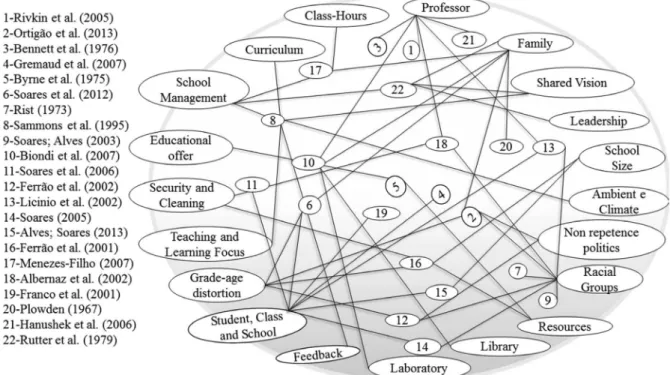
Based on the analysis of research and literature reviews, classiied as relevant by Google Scholar, we summarize in igure 1 variables related to schools capable of promoting a teaching-learning process of quality and equitable for its students. Figure 1 does not distinguish between “schooling”, “unit of analysis” or “studied population”, since it aims only to map factors, as pointed out in the literature, associated with school success. In spite of this, consideration of the method, results, and discussion around these variables should be considered if the investigations and revisions of igure 1 are used to formulate conclusions as well as to compare results and analyses.
FIGURE 1 STUDIES AND EXPLANATORY VARIABLES OF STUDENT PERFORMANCE
he Prova Brasil provides information on the school’s “context” — (1) socioeconomic level and (2) teacher training — of the educational units which carried out the assessment, together with its
grades. However, the scores of the Prova Brasil are presented (nominally by school) together with
indicators about the school context without the likely relations between “performance” and “school” circumstance being described. hus, based on igure 1, the present study sought in the National Institute of Studies and Educational Research (Inep) other variables on the school “context” to en-rich the proposed analysis, which are: (1) average pupils per class; (2) average daily class hours; (3) age-series distortion rates; (4) yield rates; (5) teacher regularity; (6) teacher efort; (7) complexity of school management.
hus, the general objective of this article is to analyze and describe the relationship between the
scores of the Prova Brasil of 2013 of the inal year’s students of the state elementary schools of Espírito
Santo and the contextual indicators of these schools presented by INEP. his objective is pursued, since it is imperative to analyze the extent to which this “context” is associated with the “performance”
of the schools of the Espírito Santo´s state network.
3. METHODOLOGICAL PROCEDURES
In order to analyze the grades obtained in the Prova Brasil of the year 2013 of the students of the
inal years of the public elementary schools of Espírito Santo, a descriptive cross-sectional study was
developed using quantitative strategies (Creswell, 2010).
To estimate possible determinants of the grades obtained in the Prova Brasil of 2013, indicators
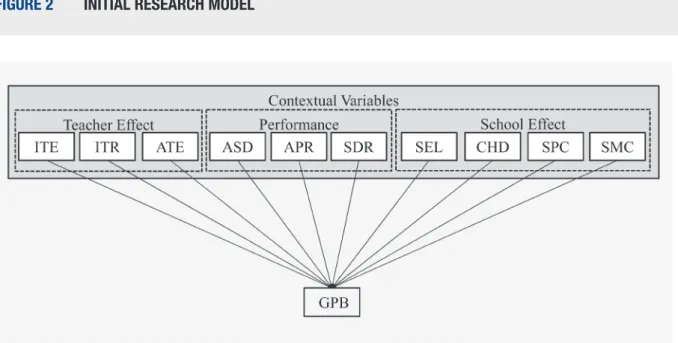
were selected from the “context” in which each educational entity developed the their teaching pro-cess, which emerged from theoretical foundation (section 2). Chart 1 shows the constitutive and operational deinitions (grade obtained from the applied scale) of the variables.
CHART 1 DESCRIPTION OF THE VARIABLES OF THE INITIAL RESEARCH MODEL
Variables Description
Dependent
Grades of the
Prova Brasil of
2013
GPB Interval (0 to 10)
Proiciency average in Portuguese and standardized mathematics for a range of 0 to 10. The grade of the school corresponds to the average of the students’ grades.
Independent (school context for the Prova Brasil of 2013)
Students per
class SPC Ratio
Average number that corresponds to the division of the number of enrollments by the number of classes of the school.
Class hours
per day CHD Ratio
Average number of class hours per day.
Age-series
distortion rate ASD Ratio
Age-series distortion rates.
Approval rate APR Ratio Approved students rate.
Variables Description
Independent (school context for the Prova Brasil of 2013)
Students per
class SPC Ratio
Average number that corresponds to the division of the number of enrollments by the number of classes of the school.
Class hours
per day CHD Ratio
Average number of class hours per day.
Age-series
distortion rate ASD Ratio
Age-series distortion rates.
Approval rate APR Ratio Approved students rate.
Dropout rate SDR Ratio Student’s dropout rate.
Index of Teacher Regularity
ITR Interval (0 to 5)
Observation of teachers’ permanence in schools. The closer to 0, the more irregular is the teacher’s attachment to the school, the closer to 5, the more regular.
Indicator of the teacher effort
ITE Ratio
Percentage of teachers per level of effort. The characteristics considered to measure the level of effort are: number of schools, shifts, students and periods that the teacher imparts. Schools are classiied as level 1 (up to 25 students, a single shift, school, and stage) to level 6 (more than 400 students, in three shifts, in two/three schools and periods). The sum of the percentages of levels 4, 5 and 6 is used as the explanatory variable. Indicator of school management complexity SMC Interval (1 to 6)
Characteristics to measure the SMC: school size; number of shifts, stages and modalities offered. Level 1 represents the least complexity of school management, while level 6 is the largest.
Socioeconomic level of students
SEL Ratio
Simple arithmetic mean of the SEL of students, within a deined range based on household goods, income, utilities services and family education level, in order to provide an overview of the standard of living of the students.
Adequacy of teacher education
ATE Ratio
It goes from group 1 (undergraduate or baccalaureate with a pedagogic complementation in the subject that teaches) to group 5 (without superior education). The percentage of disciplines is considered as an explanatory variable, in each period, given by teachers of level 1.
Source: Elaborated by the authors.
FIGURE 2 INITIAL RESEARCH MODEL
Source: Elaborated by the authors.
he research population is composed of 497 public schools, urban and rural, of the 78
municipal-ities in the state of Espírito Santo. In Brazil, the Federal Constitution of 1988, and the Law of
Guide-lines and Basis for National Education3 of 1996, provide that national education must be organized
through “educational systems”, according to political and administrative dependence. herefore, the present research ofers useful information so that public managers of the state education network of ES, can elaborate, implement and evaluate laws, policies and educational plans.
Likewise, our research was motivated by the intensiication of policies that promote closing classes and schools in ES, on the grounds that there is a growing demographic decline and school dropout (Arpini, 2016). However, the economic and demographic approach employed to close classes and schools, due to the low density of students, does not make sense in the presence of school dropouts. In the absence of massive educational public policies to reduce dropout and reintegration of graduates, closing classes and schools means accepting the failure of the ES public education system.
Consulting the online platform to access Brazilian educational data (QEdu),4 it was veriied that in
2010 there were 552 public schools in ES (QEdu, 2016a) and in 2014 only 492 schools (QEdu, 2016b). he closure of public schools intensiied in 2015, leading to protests, reports, studies and opinions from experts and policymakers. In 2016, a Public Civil Action of the Public Prosecutor’s Oice of
Espírito Santo5 questioned the closure of public schools, with a request of anticipation of guardianship,
against the state of Espírito Santo.
Also, the low performance in the Prova Brasil of 2013 of the students of the inal years of public
elementary schools (14% in mathematics and 26% in Portuguese in the 9th year) compared to the initial years (39% in mathematics and 46% in 5th year), led to the reduction of the research by excluding
3 Law of Guidelines and Bases of National Education (LDB). 4 Check out the site at: <www.qedu.org.br>.
the results of 9th grade students. In addition, the same phenomenon occurs nationally; while 12% of
the 9th grade students learned the “adequate” mathematics and 25% Portuguese, 42% of the 5th grade
students learned math and 47% Portuguese in the Prova Brasil of 2013. In the inal years the average
grade of public schools in the state of Espirito Santo has remained below the national average. For all
this, the question arises about possible determinants of this underperformance in the Prova Brasil
of 2013 of the students of the inal years of public elementary schools in the ES education system. Data collection was carried out on the Inep website between September and December of 2015. he most recent data at the time of the collection corresponded to the year 2013. It is clariied that
the public consultation of the grades of Prova Brasil, unlike the data of the independent variables,
had to be consulted school by school. he procedure was done manually based on the code of the
497 public schools in the state of Espírito Santo.
In order to understand the relationship between the “contextual” variables and the “performance”
in the Prova Brasil of 2013 of the students of the inal years of public elementary schools in the state of
Espírito Santo, multiple linear regressions were used. Additionally, for the regression model variables, the stepwise method was used; a strategy usually selected for descriptive studies, in which the aim is only to describe little-known relationships among variables, not to explain them, due to the absence of a consistent theory about the studied phenomena and of empirical support; or when there is a high number of possible independent variables, being convenient to know which are the relevant variables.
In the stepwise method, only variables that signiicantly contribute to the adjustment of the regression model are incorporated. he contribution of each variable is established by contrasting, from the partial correlations, the hypothesis of independence between this variable and the depen-dent variable. In the present study, the rule for entry and removal of variables to the model was thus
established: input p-value <0.05 and output p-value> 0.10.
It should be emphasized that the assumptions made by the multiple linear regression model were validated by applying tests on: the independence of the stochastic perturbation term (Durbin-Watson test), homoscedasticity of the stochastic perturbation term (Breusch- Pagan), normal distribution of the stochastic perturbation term (Kolmogorov-Smirnov test) and absence of multicollinearity between independent variables (variance inlation factor — VIF and condition index). Also, the size
of the multiple regression efect was veriied by Cohen’s f2 index.
In the data processing, the sotware SPSS 20 (tests of assumption6 validation and multiple linear
regression) and GPower 3.1 (statistical power of the test and Cohen’s f2) were used.
he data collected through the Inep website revealed that of the 497 schools in the state of Espírito
Santo, 249 (located in 71 of the 78 municipalities) had data related to the grades in the Prova Brasil
of the students of the inal years of elementary. Of these, 244 schools had data for all the independent variables considered in this study (igure 2). A sample was then selected based on this criterion, rather than engaging into techniques for the treatment of missing values, since the sample represents 98% of the total number of schools that were reduced from the study (inal years of elementary school).
6 It is clariied that in the processing of the Breusch-Pagan test, a macro written by Ahmad Daryanto was used speciically for syntax of
4. RESULTS
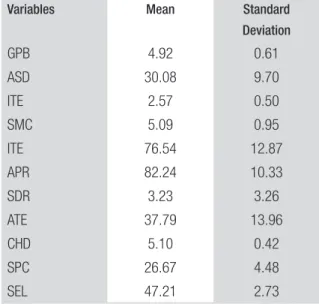
Before starting the procedures to extract measures, the study undertakes the characterization of the variables, in order to broaden the understanding of the results (table 1).
TABLE 1 DESCRIPTIVE STATISTICS OF THE VARIABLES OF THE INITIAL RESEARCH MODEL
Variables Mean Standard
Deviation
GPB 4.92 0.61
ASD 30.08 9.70
ITE 2.57 0.50
SMC 5.09 0.95
ITE 76.54 12.87
APR 82.24 10.33
SDR 3.23 3.26
ATE 37.79 13.96
CHD 5.10 0.42
SPC 26.67 4.48
SEL 47.21 2.73
Source: Elaborated by the authors.
he Prova Brasil grades (GPB) of the students from the inal years of public elementary schools that make up the sample are slightly dispersed (CV = 12.4%). he dispersion around the mean of the 10 independent variables can be considered low to moderate, except for the variable SDR, whose dispersion is quite high (CV = 100.9%), denoting a highly heterogeneous proile of schools in relation to the school dropout rate.
Otherwise, the correlation analysis presented in table 2 showed that of the 10 studied independent variables, 5 did not have statistically signiicant correlations, at the 0.05 level with the dependent variable.
TABLE 2 CORRELATIONS
Variables GPB ASD ITE SMC ITE APR SDR ATE CHD SPC SEL
GPB 1
ASD -0.331** 1
ITE 0.392** -0.329** 1
Variables GPB ASD ITE SMC ITE APR SDR ATE CHD SPC SEL
SMC -0.019 0.167** 0.040 1
ITE 0.099 0.047 -0.068 0.184** 1
APR
0.225** -0.483** 0.039 -0.181** -0.149* 1
SDR -0.259** 0.460** -0.074 0.079 0.112* -0.502** 1
ATE 0.035 -0.057 -0.032 0.034 0.012 0.021 -0.020 1
CHD 0.005 -0.029 -0.013 -0.260** -0.433** 0.101 -0.037 -0.001 1
SPC -0.153** 0.003 -0.172** 0.127* -0.035 -0.091 -0.011 0.022 -0.042 1
SEL 0.013 0.111* -0.217** -0.097 -0.049 -0.054 -0.125* 0.016 0.139* 0.322** 1
* Signiicant at the 0.01 level. ** Signiicant at the 0.05 level. Source: Elaborated by the authors.
he correlation test leads to the identiication of ive independent variables as candidates for the
regression model: ASD (r = 0.331, p-value <0.05), ITR (r = 0.392, p-value <0.05), APR (r = 0.225,
p-value <0.05), SDR (r = -0.259, p-value <0.05), and SPC (r = -0.153, p-value <0.05), since the others do not have statistically signiicant correlations with the dependent variable (GPB). his considerable reduction reinforces the decision to use the stepwise estimation procedure. In addition, there are few statistically signiicant correlations between independent variables, and all of them (except for the relationship between APR and SDR) can be classiied as low (0.1 <r ≤ 0.3) or moderate (0.3 <r ≤ 0.5), by the criterion of Miles and Shevlin (2001), which reinforces the choice of this set of predictors.
Additionally, there was no statistically signiicant correlation between the Socioeconomic Level
of the Students (SEL) and the Prova Brasil grades (GPB), as initially expected, due to other indings
(e.g. Alves and Soares, 2013). Perhaps the way in which this variable was operationalized (by Inep itself), in a range of clusters deined on the basis of a multiple scale from diferent attributes (household goods, income, utilities services and family education level), did not allow capturing a statistically signiicant association from the data used by the present research, which represent the hierarchical level “school”. Studies have suggested that indicators, linked to the SEL construct, impact (positively/negatively) on the student performance in large-scale national evaluations, but perhaps the construct itself, just as it was operationalized, it did not allow to capture associations present between its indicators and the selected dependent variable (GPB). Due to the link of this study with Organizational Studies, the data related to school organization was privileged, and the hierarchical level “students” was not analyzed.
When working with the average grade of the school in the Prova Brasil, in relation to the contextual
and organizational variables, and not with the individual grades of students identiied by “gender”, “color” and/or “race”, it was not possible to analyze the diferences between the school’s “social” groups in relation to the performance in large-scale educational evaluations (e.g. Soares and Alves, 2003). However, by emphasizing the “organizational” hierarchical level, it was possible to highlight new cor-relations between the independent variables of “school” and “school context” (especially with regard
he independent variable with the highest relation intensity to the dependent variable is ITR. In
fact, among the eight schools with the best ITR, six scored higher than average in the Prova Brasil
of 2013, while from the eight schools with the worst teacher regularity index, six had below-average grades in the same evaluation. However, no strong correlation was observed in any variable (r > 0.5).
Among the independent variables, only the statistically signiicant association between the APR
and SDR variables was classiied as strong (r = - 0.502, p-value <0.05). his is an expected relationship,
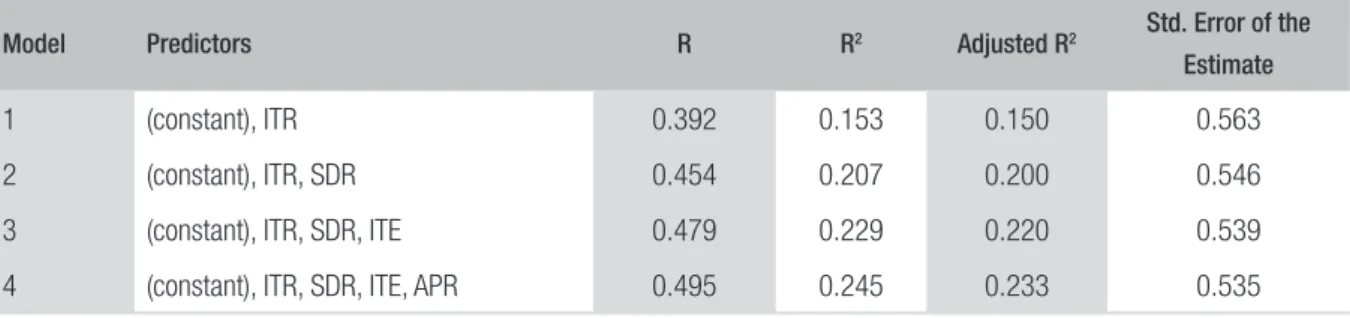
since both of them compose, in association with failure statistics (which was not integrated into the list of independent variables due to their perfect negative correlation with the APR variable), the school performance rate (igure 2). For the construction of the best regression model, the stepwise method was used. As shown in table 3, four models were suggested through this method, being model 4 the
one with the greatest explanatory power (adjusted R2 = 0.233).
TABLE 3 SUMMARY OF MULTIPLE LINEAR REGRESSION MODELS — STEPWISE METHOD
Model Predictors R R2 Adjusted R2 Std. Error of the
Estimate
1 (constant), ITR 0.392 0.153 0.150 0.563
2 (constant), ITR, SDR 0.454 0.207 0.200 0.546
3 (constant), ITR, SDR, ITE 0.479 0.229 0.220 0.539
4 (constant), ITR, SDR, ITE, APR 0.495 0.245 0.233 0.535
Source: Elaborated by the authors.
To evaluate the results in a better way, the assumptions made by the multiple linear regression model are veriied. Table 4 presents the results of VIF, to validate the absence of multicollinearity among the regressors; and the condition index, for the evaluation of joint collinearity problems.
TABLE 4 VALIDATION OF ASSUMPTIONS — REGRESSORS
Model Multicollinearity
Variables VIF Dimension Condition
Index
1 (constant) 1 1.000
ITR 1.000 2 10.316
Model Multicollinearity
Variables VIF Dimension Condition
Index
2
(constant) 1 1.000
ITR 1.006 2 2.559
SDR 1.006 3 11.964
3
(constant) 1 1.000
ITR 1.009 2 2.889
SDR 1.017 3 10.208
ITE 1.016 4 18.977
4
(constant) 1 1.000
ITR 1.009 2 3.119
SDR 1.345 3 11.458
ITE 1.028 4 14.822
APR 1.353 5 33.636
Source: Elaborated by the authors.
he VIF denotes absence of multicollinearity (VIF <5), according to a criterion suggested by Gujarati (2000). However, the condition index indicated that in model 4 the variables would present collinearity problems if they stay together, also as proposed by Gujarati (2000), so values above 30 imply severe multicollinearity. his can be explained by the strong statistically signiicant correlation between the APR and SDR variables (table 2), which composes the performance construct (igure 2), so that the introduction of the APR variable ampliies the efects of multicollinearity, reducing the contribution of the variable SDR to the regression model.
For this reason, it is understood that the most eicient model is model 3, because the adjusted
R2 value increases, reducing the standard error of the estimate (table 3), without increasing the joint
collinearity above the accepted level (table 4). In addition, the incremental predictive efect of the APR variable on the dependent variable (controlling the other independent variables of model 3) is
only 1.6% . hat is, model 4 increased R2 in relation to model 3 by only 1.6%.
TABLE 5 VALIDATION OF ASSUMPTIONS — STOCHASTIC DISRUPTION TERM
Homocedasticity Independence Normality
Breusch-Pagan Durbin-Watson Kolmogorov-Smirnov
LM Sig. D Estatística Sig.
0.662 0.882 1.965 0.031 0.2
Source: Elaborated by the authors.
he value was 1.965 for the Durbin-Watson statistic. In the table of critical values dL e dU of the
Durbin-Watson test, there were no values for n = 244, considering then the approximate values for n
= 240, with a signiicance level of 0.05. As dU≅ 1.8053 <1.965 <2.1947 ≅ 4 - dU, there is no evidence
to reject the null hypothesis. hus, it is assumed that the stochastic perturbation term is independent. However, in relation to table 5, the Kolmogorov-Smirnov test does not allow rejection of the null
hypothesis of the normal distribution of the stochastic term (p-value = 0.2), which can assume the
normality assumption; and the Breusch-Pagan test does not allow rejection of the null hypothesis of
the stochastic perturbation term (p-value = 0.882).
Regarding table 3, the variables Index of Teacher Regularity (ITR), dropout rate (SDR) and index
of teacher efort (ITE) (model 3), obtained a degree of association of 47.9% with the variable Prova
Brasil grades (GPB) — that is, the multiple correlation between the dependent variable and the
predictor score. In turn, the adjusted coeicient of determination (adjusted R2) of 0.22 shows that
22% of the variations in the Prova Brasil grades are explained by the joint variation of the variables
chosen by model 3. hus, by comparing the suggested models, it is noted that model 4 has a greater predictive efect, presenting an adjusted coeicient of determination higher than the other models; nonetheless, for the joint collinearity problem (table 4), model 3 was chosen.
Although the adjusted coeicient of determination may seem low (adjusted R2 = 0.22), it is
com-mon to apply values of this order in practical applications of multiple regression analysis in the social sciences. For example, the studies of Mazulo (2015) and Alves and Soares (2013), which respectively
obtained adjusted R2 = 0.219 and 0.31. In addition, considering there are other unpredicted variables
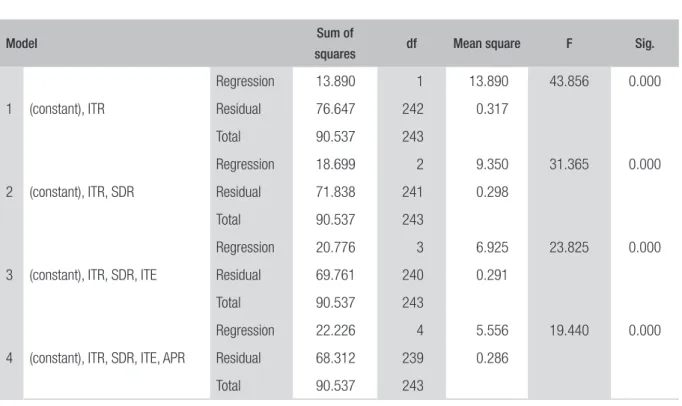
in the initial research model that could interfere with the results, it can be argued that the indings of the study are important elements for understanding the question of the present research and for its contribution to future studies. By means of the Anova analysis (table 6), which provides the sta-tistical test for the general adjustment of the model in terms of the F ratio, it is veriied the evidence that allows rejecting the null hypothesis that claims the coeicient of determination is equal to zero.
hus, at least one of the independent variables inluences the grades of the Prova Brasil (∃βj ≠ 0 E).
Consequently, the statistical signiicance of the model is attested. In other words, the use of the ITR, SDR and ITE variables reduces the square error that would occur if only the mean of the variable GPB
was used to predict the dependent variable by 23%
(
20,776)
90,537 ,and such reduction is considered
TABLE 6 ANOVA
Model Sum of
squares df Mean square F Sig.
1 (constant), ITR
Regression 13.890 1 13.890 43.856 0.000
Residual 76.647 242 0.317
Total 90.537 243
2 (constant), ITR, SDR
Regression 18.699 2 9.350 31.365 0.000
Residual 71.838 241 0.298
Total 90.537 243
3 (constant), ITR, SDR, ITE
Regression 20.776 3 6.925 23.825 0.000
Residual 69.761 240 0.291
Total 90.537 243
4 (constant), ITR, SDR, ITE, APR
Regression 22.226 4 5.556 19.440 0.000
Residual 68.312 239 0.286
Total 90.537 243
Source: Elaborated by the authors.
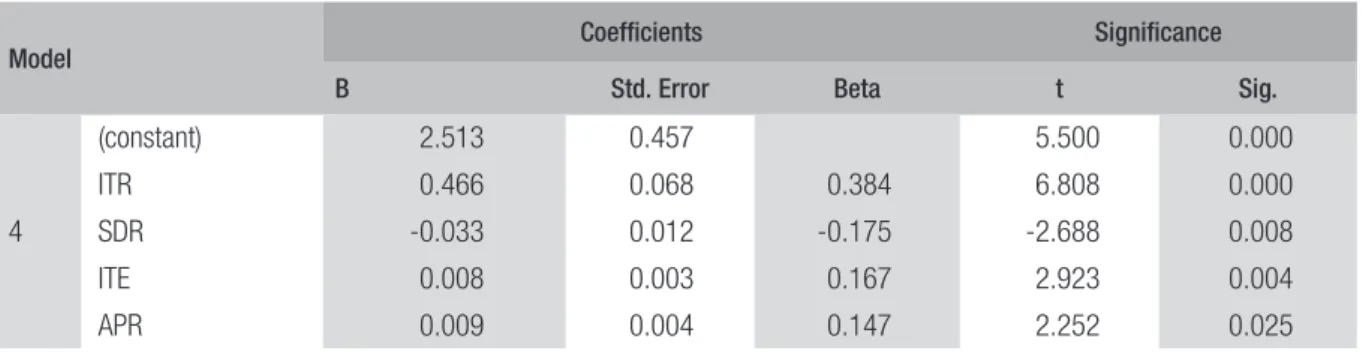
In table 7 we can verify the standardized coeicients (Beta) of the variables present in the con-struction of the multiple linear regression model.
TABLE 7 COEFFICIENTS
Model Coeficients Signiicance
B Std. Error Beta t Sig.
1 (constant) 3.704 0.188 19.746 0.000
ITR 0.474 0.072 0.392 6.622 0.000
2
(constant) 3.897 0.188 20.705 0.000
ITR 0.454 0.070 0.375 6.510 0.000
SDR -0.043 0.011 -0.231 -4.017 0.000
3
(constant) 3.324 0.284 11.715 0.000
ITR 0.465 0.069 0.384 6.742 0.000
SDR -0.046 0.011 -0.248 -4.331 0.000
ITE 0.007 0.003 0.153 2.673 0.008
Model
Coeficients Signiicance
B Std. Error Beta t Sig.
4
(constant) 2.513 0.457 5.500 0.000
ITR 0.466 0.068 0.384 6.808 0.000
SDR -0.033 0.012 -0.175 -2.688 0.008
ITE 0.008 0.003 0.167 2.923 0.004
APR 0.009 0.004 0.147 2.252 0.025
Source: Elaborated by the authors.
Analyzing the beta weights of the variables (standardized regression coeicients), it is of particular interest the inverted signal of the SDR variable, suggesting that an increase over this variable has a
negative impact on the Prova Brasil grades, which was already observed when analyzing the bivariate
correlation (table 2), and the positive sign of the ITE variable, since it is intuitively expected that the
lower the teaching efort, the higher the grades of the Prova Brasil. Although the combined
collin-earity could be classiied as moderate (10 ≤ condition index ≤ 30), the inclusion of the ITE variable in model 3 increased the condition index from 10,208 to 18,977 (table 4), so that an inversion of the sign can be attributed to the ITE variable to multicollinearity.
It is also observed (table 7) that the beta weights of the variables, although not large, have a sub-stantial impact on the general regression model and are statistically signiicant, since through the t test it is possible to reject the hypothesis that the coeicients are equal to zero.
he beta weights (expressed in a standardized scale) represent a means to evaluate the relative
importance of the individual variables in the general grade of Prova Brasil. he most relevant variable
was ITR, followed by SDR and ITE. It is diicult to classify the variables as high or low; however, the observation of the relative magnitude indicates Index of Teacher Regularity (ITR) has a more visible efect (2.5 times more) than teacher efort (ITE). hus, once the regularity of the faculty members can be increased, solely by the permanence of the teachers in the same school, it represents the most
direct, coeteris paribus, to increase the Prova Brasil grades. A cause and efect relationship cannot be
assumed, but schools with higher presence regularity of its faculty members had higher grades in the
Prova Brasil. One can also present the results of multiple linear regression diagrammatically (igure 3).
FIGURE 3 FINAL RESEARCH MODEL
Source: Elaborated by the authors.
hrough the classiication criterion proposed by Cohen (1988) for regression, the size of the efect is
considered average (f2 = 0.30). he statistical power of the test was then calculated. Assuming a level
of signiicance of 0.05, the statistical power was approximately 1.00, indicating very low probability of type II error. As explained by Hair and colleagues (2009), in multiple regression, statistical power refers to the probability of detecting as statistically signiicant a speciic level of coeicient of deter-mination or regression for a given sample size and level of signiicance. For example, considering a
statistical signiicance level of 5% and 80% of power, a sample of 250 observations would detect R2
values greater than or equal to 6% (Hair et al., 2009).
Finally, regarding the generalization of the results, the adjusted R2 test reveals little loss in
predic-tive power when compared to R2 (0.229 and 0.220, respectively — see table 3), which suggests a lack
of over-adjustment. In addition, with three variables in the model, the minimum number of sample sizes is given according to the proportion of 50 observations per variable in the statistical variable (n = 244). According to the criterion proposed by Hair and partners (2009), the recommended level, by the proportion between observations and independent variables in the statistical variable, for the generalization of results in multiple regression, using stepwise procedure, is at least 50 to 1, because this technique only selects the strongest relationships within the dataset and is more likely to become a speciicity of the sample.
herefore, it is assumed that the results are not speciic to the sample used in the estimation, but generalizable to the population — although it was not admissible, due to limitation in the data set, to carry out a direct validation by the evaluation of the correspondence of the results of another sample of the population, since partitioning the sample into analysis and test samples would not allow to meet the minimum proportions of number of observations per independent variable, being possible to advocate in its favor, given that this model is established from the sample that represents 98% of
the schools where there were data referring to the Prova Brasil grades of the inal years of public
elementary schools.
5. DISCUSSION
he Index of Teacher Regularity (ITR), which refers to the permanence of teachers in schools, is the most relevant explanatory variable of our model. he Indicator of Teacher Efort (ITE), another independent variable of the model, can also be associated to the “teacher efect” in the performance of the ES state schools in the Brazil Test 2013.
A counterpoint to the results of the present study is ofered by Menezes-Filho (2007:15), who states “[...] neither the time in school nor the fact of teaching in more than one school afects student performance”. On the other hand, Felicio and Biondi (2007) have identiied that the absence of rota-tion and the experience in the classroom afect positively, in research on the determinants of student performance in Mathematics of the initial years of the fundamental of the public network.
Regarding the explanatory variable Dropout Rate (SDR), there is also a literature dedicated to analyzing the school low, the population’s access to school, to evidence the “pedagogy of repetition” and to question educational indicators (Teixeira de Freitas, 1947; Fletcher, Ribeiro and Costa, 1988; Klein and Ribeiro, 1991, 1995; Fletcher and Castro, 1993). According to Fernandes and Natenzon (2003), who analyze the association between the drop in school performance, observed through the System of Evaluation of Basic Education (Saeb) 1995-1999, and the reduction of repetition / dropout rates in the period, the performance of students in the 4th year of elementary school has declined, while the performance of those of the appropriate age for the 4th year has increased. For these au-thors, this fact shows that correction in the school low, for the period, is associated with a worse performance of the students.
For Menezes-Filho (2007), social programs against abandonment worsen the performance of schools and those against repetition positively inluence student learning. In contrast, Ferrão, Beltrão and Santos (2002), when applying multilevel regression models to the Saeb results, suggest that: there is no derogative quality efect attributable to non-repetition policies; Students with a low socioeconomic level with automatic promotion does not perform inferior; And students with age-grade mismatch learn less than students of adequate age. hese authors indicate, in consonance with the results of the present research, that abandonment, which leads to school backwardness, has the potential to impair student performance. Ferrão, Beltrão and Santos (2002) also study the impact of non-repetition policies on the quality of education. hese authors, based on a review of the seminal works of the 1950s on the harmful efects of repetition for the student and the school, and the pro-posals for continuing education in the 1980s, are dedicated to investigating the occurrence (or not) of a “diferent” performance of those students who take advantage of non-repetition policies: “[...] the results of the models suggest that, with regard to public schools, the existence of a substantially derogatory efect on the quality of education attributable to policies of non-repetition was not found” (Ferrão, Beltrão and Santos, 2002:47-48).
signiicant independent variables of our model (ITR and ITE) have the potential to positively impact students’ approval (motivation, non-abandonment, performance). In other words, the present study suggests the importance of massive public educational policies of continuity based on the quality of the teaching of the network. For, according to their research, even if non-approval loses force in explaining school dropout, it can still be understood as a barrier to the ideal progression of students and to their insertion in high school.
6. FINAL CONSIDERATIONS
In the Brazilian literature, numerous other studies have been carried out to identify the relationship
between factors and variables linked to the school, students, families and the notes of Prova Brasil.
Some studies, based on data from this exam, were fostered by organizations such as INEP and the Ministry of Education (e.g. Felicio and Biondi, 2007), Inep and the World Bank (e.g. Parandekar, Oliveira and Amorim, 2008) and by the United Nations Educational, Scientiic and Cultural Organization (Unesco) (e.g. Soares et al., 2012). Empirically demonstrating that the practices of “schools” are exploited by political, economic, cultural, social, scientiic and culture interests and processes associated with educational merits (Aggleton and Whitty, 1985; Gillborn, 1997; McCarthy, 1990).
he present study collaborates with this research network around large-scale national educational evaluations by providing empirical evidence for the ES statewide network on the impact of the Index of Teacher Regularity (ITR), the Indicator of Teacher Efort (ITE) and the Dropout Rate (SDR) in the
Prova Brasil of 2013 performance. here is statistical evidence that the permanence of the teacher in a same school has a positive impact on students’ scores in the Brazil Test and that a higher (still) dropout rate of the state schools in Produce an opposite efect.
herefore, we understand that the state school closure policy undertaken by the State Government of Espírito Santo has the potential to negatively afect the dropout rate, in addition to violating consti-tutional and infraconsticonsti-tutional principles and norms, as stated in the Public Civil Action of January 29 2016 that was referred to in the third section. his action came from the undersigned, iled with the MPES by the students themselves (Civil Inquiry No. 2015.0034.7269-57). It is important to note that the MPES makes its representation based on the “process” of closing schools and not possible impact of the closure of schools.
hus, there is an educational backwardness and a disregard for the state government with the reversal of the increasing dropout rate — 61,702 “students” aged four to 17 remained out of school in the ES in 2014, according to the National Household Sample Survey (PNAD). Although this number extrapolated the home of 100,000 children out of school in 2005, in 2014 there was a worsening in this situation, since in 2013 there were 51,000 “students” out of the classroom. Stu-dents “out” of the school are scholars who “dropped out” of school. herefore, the data collected by the PNAD corroborate the present research, since they demonstrate the passivity of the State of
here is no school closure, what exists is an enrollment organization that happens every year, accor-ding to the demand that is identiied in each region [...]. We have 500 schools in the state network, we have 4,000 classrooms to serve 370,000 schools and we only serve 260,000. [Arpini, 2016]
However, the dropout rate (QEdu, 2016c), which implies promoting strategies to contain school dropout, balancing supply and demand, to use the terms of Exmo. Mr. Secretary of State for Educa-tion, and not the closure of schools.
herefore, instead of limiting our contribution to the indication of the impact of explanatory
variables on the performance of students from the state schools of the ES in the Prova Brasil of 2013,
we present the results of the study to Exma. Ms. Maria Cristina Rocha Pimentel, Attorney General
who iled a Public Civil Action that questioned the closure of state schools against the State of Espírito
Santo. In this way, we ofer signiicant quantitative inputs to support the Public Civil Action iled by MPES against the closure of classes, shits and schools of the state public network. his because the
state school closure policy undertaken by the State Government of Espírito Santo has the Potential of
negatively impacting the abandonment rate, and, consequently, the performance of the Prova Brasil of
the state network of the ES. he present work contributes to the argument of the MPES that, in itself, was not referenced as a kind of “substitute” for the empirical analysis undertaken by this research.
Otherwise, the indicator of school management complexity, even if not included in the model, is widely recognized in the literature as a factor that impacts school performance (e.g. Lee, Bryk and Smith, 1993; 2007; Alves and Soares, 2013). For future studies, it may be relevant to better describe and specify the components that shape the management complexity indicator, relating the performance of the students of a school with the existence or not of: full time enrollment; Multi classes (students of diferent series and stages); assistants/monitors/translators.
It is also worth noting that there are results that oppose our observation that the number of class hours does not afect student performance, as is the case of Menezes-Filho (2007). his author, how-ever, came to a similar result to ours, that the size of the class does not inluence — a inding that does not justify the closure of schools.
Finally, despite the incontrovertible impact of students’ socioeconomic status on school perfor-mance, as previously explained in sections 1, 2 and 4, the observation of the sample of this study, which only includes schools with SEL of 2 to 4 (out of a total of levels from 1 to 7) and with data dispersion very concentrated around the mean (CV = 5.8%) — see table 1 —, suggests that this explanatory
variable does not signiicantly impact the results of the students of the state network of Espírito
Santo in Prova Brasil of 2013, opening space for future research to ind other ways to operationalize this dimension, as we have already suggested in topic 4. Brazilian education ofers countless data, not only at the hierarchical level of the school, but also of its students. he “micro data” of Brazilian education ofer a way out of the inequalities of school performance among students (from diferent social classes, colors, races), as well as to work together data at the hierarchical levels of “students” and “schools”. However, the present study opted to ofer an overview of the data in the hierarchical organizational level, which is unusual, making it possible to problematize contextual variables of the
Likewise, in this section, we decided to expand the contribution of this study by mapping and
presenting educational public policies of the Espírito Santo’s state-level network that contribute to:
(1) the homogenization of the data on the age-grade distortion rate, the dropout rate and the ade-quacy of the teacher training of the school population of the studied ES state network (table 1); and (2) improvement of regularity and teacher efort indexes, as well as reduction of dropout (relevant
explanatory variables). One of these state educational policies is Escola Viva, which proposes a new
model for high school, aiming, among other educational objectives, to reduce the rate of distortion of the high school age, which is even worse than in elementary school, as it is possible to understand by graph 1.
GRAPH 1 RATE OF PERFORMANCE OF THE STATE NETWORK SCHOOLS OF ES IN 2014
Source: From QEdu (2016c).
It is important to note that Escola Viva does not represent a massive public educational policy,
Looking for other educational public policies of the state of Espírito Santo with potential to revert the increase of the age-school distortion, the present study identiied: (1) reform and construction of 56 state schools, which are paralyzed, and in progress; (2) quarterly evaluations of the state
educa-tion network (Paebes TRI, Alfa 1a e 2a onda) to promote quality education; (3) Future Youth; (4) new
measures in the selection and training of directors of the state public network; (5) partnership with 78 ES municipalities to guarantee literacy for children up to eight years of age; (6) “school portfolios”, which aims to recover and relocate furniture, as well as modernize and standardize the purchase of furniture for the whole State; (7) integrated school maintenance system; (8) State Direct Money in School Program (Pedde); (9) Public Private Partnership, aiming at the construction and operation of non-pedagogical services. here are also the following projects, actions and state programs in progress
for the Capixaba elementary education: (1) Acceleration of Learning, which aims at the continuous
training of teams of the State Secretariat of Education (Sedu) and elementary schools ES to reduce the age-grade distortion rate of students in grades 2-4 of elementary school, with emphasis on recurrent cases; (2) Country Coordinators; (3) Learning Support; (4) Read, Write and Count; (5) More Time in School; (6) Read, Holy Spirit; (7) Culture in School; (8) Sport at School; (9) Teaching to Learn; (10) Urban Youth; (11) Science in School; (12) Justice in school. With respect to the teacher (regularity, efort and adequacy), the following policies, programs and projects were found: (1) New policy of pro-gression and functional ascension; (2) Internship Program Teacher Training; (3) Continuing Education Program (Freire platform); (4) Permanent State Forum to Support Teacher Training; (5) Sedu Award — good practices in Education; (6) Institutional Scholarship Program. Before mentioning the extent to which “new studies” can evaluate the investment made by the programs and policies punctuated in the previous paragraphs, the efects of the “academic” indings of this research are discussed on the “practice”. he present study pointed out that 3 contextual variables have the potential to impact the performance of students in educational evaluations applied on a large scale in the state education
network of Espírito Santo, namely: Index of Teacher Regularity (ITR), Indicator of Teacher Efort (ITE)
and Dropout Rate (SDR). hese variables reinforce the importance of the school context as well as the teacher as a way to reduce the efects of the unfavorable family and social environment through the performance of the school organization; And, are under the management of the public managers
of the state education network of Espírito Santo. herefore, in an empirical way, new/future research
can analyze whether the inancial investment expended by such programs, projects and policies (and others not identiied) contributed to the rates of age-grade, adequacy, efort and teacher regularity, as well as with the production of equity and educational quality by the ES web. hus, it would be possible to indicate initiatives with a greater impact on the “quality” and “quantity” of education in the ES, favoring the decision-making process around the strategic task of allocating public resources.
In reference to methodological aspects, the present study analyzed the impact of student and school
factors on the Brazil 2013 test of state schools in the state of Espírito Santo, using averages, rates, and
REFERENCES
AGGLETON, Peter J.; WHITTY, Geoff. Rebels without a cause? Socialization and subcultural style
among the children of the new middle classes.
Socio-logy of Education, v. 58, n.1, p. 60-72, 1985.
ALBERNAZ, Ângela; FERREIRA, Francisco H. G.; FRANCO, Creso. Qualidade e equidade no ensino
fundamental brasileiro. Pesquisa e Planejamento
Econômico, v. 32, n. 3, p. 45-59, 2002.
ALVES, Maria Teresa Gonzaga; SOARES, José Fran-cisco. Contexto escolar e indicadores educacionais: condições desiguais para a efetivação de uma política
de avaliação educacional. Educação e Pesquisa, v. 39,
n. 1, p. 177-194, 2013.
ANYON, Jean. Social class and school knowledge.
Curriculum Inquiry, v. 11, n. 1, p. 3-42, 1981.
APPLE, Michael (Ed). Cultural and economic
repro-duction in education: essays on class, ideology and the state. London: Routledge, Kegan and Paul, 1982.
ARPINI, Naiara. Justiça exige a reabertura de
es-colas, mas governo do ES nega fechamento. G1 ES.
Available at: <http://g1.globo.com/espirito-santo/ educacao/noticia/2016/03/justica-exige-reabertura-de-escolas-mas-governo-do-es-nega-fechamento. html>. Accessed on: 10 Mar. 2016.
BERNSTEIN, Basil. Education cannot compensate
for society. New Society, v. 15, n. 387, p. 344-351,
1970.
BIONDI, Roberta Loboda; FELÍCIO, Fabiana de.
Atributos escolares e o desempenho dos estudantes: uma análise em painel dos dados do Saeb. Brasília: Inep, 2007.
BONAMINO, Alicia; SOUSA, Sandra Zákia. Três gerações de avaliação da educação básica no Brasil.
Educação e Pesquisa, v. 38, n. 2, p. 373-388, 2012.
BOURDIEU, Pierre; PASSERON, Jean-Claude. Les
héritiers, lés étudiants et la culture. Paris: Minuit, 1964.
BROOKOVER, Wilbur B. School social systems and
student achievement: schools can make a diference. New York: Praeger, 1979.
COHEN, Jacob. A power primer. In: KAZDIN, A. E.
(Org.). Methodological issues and strategies in clinical
research. Washington: APA, 1988.
COLEMAN, James S. et al. Equality of educational
opportunity. Washington, 1966. Available at: <http:// iles.eric.ed.gov/fulltext/ED012275.pdf>. Accessed on: 25 Jan. 2016.
CRESWELL, John W. Projeto de pesquisa: métodos
qualitativo, quantitativo e misto. Porto Alegre: Art-med, 2010.
EVERHART, Robert B. Reading, writing, and
resis-tance: adolescence and labor in a junior high school. Boston: Routledge and Kegan Paul, 1983.
FERNANDES, Reynaldo; GREMAUD, Amaury Patrick. Qualidade da educação: avaliação,
indica-dores e metas. In: VELOSO, F. et al. (Org.). Educação
básica no Brasil: construindo o país do futuro. Rio de Janeiro: Elsevier, 2009. p. 213-238.
FERNANDES, Reynaldo; NATENZON, Paulo Es-teban. A evolução recente do rendimento escolar das crianças brasileiras: uma reavaliação dos dados
do Saeb. Estudos em Avaliação Educacional, v. 14,
n. 28, p. 3-21, 2003.
FERRÃO, Maria Eugênia; BELTÃO, Kaizô Iwakami; SANTOS, Denis Paulo dos. Políticas de não-repe-tência e a qualidade da educação: evidências obtidas
a partir da modelagem dos dados da 4a série do
Saeb-99. Estudos em Avaliação Educacional, v. 13,
n. 26, p. 47-74, 2002.
FINE, Michelle. Framing dropouts: notes on the
po-litics of an urban high school. Albany: Suny Press, 1991.
FLETCHER, Philip R.; CASTRO, Cláudio de M.
Mitos, estratégias e prioridades para o ensino de 1o
grau. Estudos em Avaliação Educacional, v. 4, n. 8,
p. 39-56, 1993.
FLETCHER, Philip R.; RIBEIRO, Sérgio Costa. A educação na estatística nacional. In: SAWYER, D.
O. (Org.). PNADs em foco: anos 80, [S.L.]: Abep,
1988, p. 13-41. Available at: <http://www.abep.org. br/~abeporgb/publicacoes/index.php/livros/article/ view/2/84>. Accessed on: 21 Jan. 2016.
FRANCO, Creso et al. Qualidade e equidade em educação: reconsiderando o signiicado de “fatores
intraescolares”. Ensaio: Avaliação e Políticas Públicas
em Educação, v. 15, n. 55, p. 277-298, 2007.
and the inluence of classroom tools, rules, and
pedagogy. Review of Educational Research, v. 64,
n. 1, p. 119-157, 1994.
GILLBORN, David. Ethnicity and educational per-formance in the United Kingdom: racism, ethnicity,
and variability in achievement. Anthropology &
Education Quarterly, v. 28, n. 3, p. 375-393, 1997.
GUJARATI, Damodar N. Econometria básica. São
Paulo: Makron Books, 2000.
HAIR, Joseph F. et al. Análise multivariada de dados.
Porto Alegre: Bookman, 2009.
HALL, Roberta M.; SANDLER, Bernice R. he
clas-sroom climate: a chilly one for women? Washington, DC: Association of American Colleges, 1982. Avai-lable at: <http://iles.eric.ed.gov/fulltext/ED215628. pdf>. Accessed on: 21 Jan. 2016.
HANUSHEK, Eric A.; RAYMOND, Margaret E. Does school accountability lead to improved student
performance? Journal of Policy Analysis and
Mana-gement, v. 24, n. 2, p. 297-327, 2005.
HANUSHEK, Eric A.; RIVKIN, Steven G. Teacher quality. In: HANUSHEK, Eric A.; WELCH, Finis.
Handbook of the economics of education. Amsterdam: Elsevier, 2006. v. 2, p. 1051-1078.
JENCKS, Christopher et al. Inequality: a
reassess-ment of the efect of family and schooling in
Ame-rica. New York: Basic Books, 1972.
JENSEN, Arthur. How much can we boost IQ and
scholastic achievement. Harvard Educational
Re-view, v. 39, n. 1, p. 1-123, 1969.
KARMEL, Peter H. Some arithmetic of education.
Critical Studies in Education, v. 9, n. 1, p. 1-34, 1966.
KLEIN, Ruben; RIBEIRO, Sergio C. A pedagogia da
repetência ao longo das décadas. Ensaio: Avaliação
e Políticas Públicas em Educação, v. 3, n. 6, p. 55-62, 1995.
KLEIN, Ruben; RIBEIRO, Sérgio C. O censo educa-cional e o modelo de luxo: o problema da repetência.
Revista Brasileira de Estatística, v. 52, n. 197-198, p. 5-45, 1991.
LEE, Valerie E.; BRYK, Anthony S. A multilevel model of the social distribution of high school
achievement. Sociology of Education, v. 62, n. 3,
p. 172-192, 1989.
LEE, Valerie E.; BRYK, Anthony. S.; SMITH, Julia. B.
he organization of efective secondary schools.
Re-view of Research in Education, v. 19, p. 171-267, 1993.
MAZULO, Emerson S. Análise da proiciência em matemática por meio de regressão linear múltipla.
Revista Intersaberes, v. 10, n. 21, p. 613-625, 2015.
MCCARTHY, Cameron. Race and curriculum: social
inequality and the theories and politics of diference in contemporary research on schooling. Bristol: Falmer Press, 1990.
MELLO, Guiomar Namo de. Escolas eicazes: um
tema revisitado. Brasília: MEC/SEF, 1994.
MENEZES-FILHO, Naércio Aquino. Os
determi-nantes do desempenho escolar do Brasil. [S.L.]: IFB; Ibmec-SP; FEA-SP, 2007. Available at: <www.todos- pelaeducacao.org.br/arquivos/biblioteca/f4e8070a-8390-479c-a532-803bbf14993a.pdf>. Accessed on: 20 Jan. 2016.
MILES, Jeremy; SHEVLIN, Mark. Applying
regres-sion and correlation: a guide for students and rese-archers. London: Sage, 2001.
MORTIMORE, Peter et al. School matters: the junior
years. Berkeley: University of California Press, 1988.
NOGUEIRA, Maria Alice; NOGUEIRA, Cláudio M. Martins. A escola e o processo de reprodução das desigualdades sociais. In: NOGUEIRA, Maria
Alice; NOGUEIRA, Cláudio M. Martins Bourdieu &
a educação. Belo Horizonte: Autêntica, 2004. cap. 4.
OLIVEIRA, Ana Paula de M. A Prova Brasil como
política de regulação da rede pública do Distrito Fe-deral. Dissertação (mestrado) — Universidade de Brasília, Brasília, 2011.
PAIVA, Vanilda; JUNQUEIRA, Célia; MULS, Leo-nardo. Prioridade ao ensino básico e pauperização
docente. Cadernos de Pesquisa, n. 100, p. 109-119,
1997.
PARANDEKAR, Suhas D.; OLIVEIRA, Isabel de A.
R. de; AMORIM, Érica P. Desempenho dos alunos
na Prova Brasil: diversos caminhos para o sucesso educacional nas redes municipais de ensino. Brasília: Inep, 2008.
PLOWDEN, Bridget. Children and their primary
org.uk/documents/plowden/plowden1967-1.html>. Accessed on: 21 Jan. 2016.
QEdu. Espírito Santo — censo — taxas de rendimento.
Available at: <www.qedu.org.br/estado/108-espiri-to-santo/taxas-rendimento>. Accessed on: 22 Feb. 2016c.
QEdu. Espírito Santo — matrículas e
infraes-trutura — 2010. Available at: <www.qedu.org. br/estado/108-espirito-santo/censo-escolar?y ear=2010&localization=0&dependence=0&educa-tion_stage=0&item=dependencias>. Accessed on: 22 Feb. 2016a.
QEdu. Espírito Santo — matrículas e
infraes-trutura — 2014. Available at: <www.qedu.org. br/estado/108-espirito-santo/censo-escolar?y ear=2014&localization=0&dependence=2&educa-tion_stage=0&item=dependencias>. Accessed on: 22 Feb. 2016b.
RIBEIRO, Sérgio C. A pedagogia da repetência.
Estudos Avançados, v. 5, n. 12, p. 7-21, 1991.
RIVKIN, Steven G.; HANUSHEK, Eric A.; KAIN, John F. Teachers, schools, and academic
achieve-ment. Econometrica, v. 73, n. 2, p. 417-458, 2005.
RUTTER, Michael et al. Fiteen thousand hours:
secondary schools and their efects on children. Cambridge: Harvard University Press, 1979.
SAMMONS, Pam; HILLMAN, Josh; MORTIMORE,
Peter. Key characteristics of efective schools: a review
of school efectiveness research. London: Institute of Education, 1995. Available at: <http://iles.eric. ed.gov/fulltext/ED389826.pdf>. Accessed on: 25 Jan. 2016.
SANTOS, Luciola L. de C. P. Políticas públicas para o ensino fundamental: Parâmetros Curriculares Nacionais e Sistema Nacional de Avaliação (Saeb).
Educ. Soc., v. 23, n. 80, p. 346-347, 2002.
SOARES, José Francisco. Qualidade e equidade na educação básica brasileira: fatos e possibilidades. In: BROCK, Colin; SCHWARTZMAN, Simon. (Org.).
Os desaios da educação no Brasil. Rio de Janeiro: Nova Fronteira, 2005. cap. 3.
SOARES, José Francisco; ALVES, Maria Teresa G. Desigualdades raciais no sistema brasileiro de
educação básica. Educação e Pesquisa, v. 29, n. 1,
p. 147-165, 2003.
SOARES, José Francisco; ANDRADE, Renato Júdice de. Nível socioeconômico, qualidade e equidade
das escolas de Belo Horizonte. Ensaio: Avaliação
e Políticas Públicas em Educação, v. 14, n. 50, p. 107-126, 2006.
SOARES, José Francisco et al. Exclusão intraescolar
nas escolas públicas brasileiras: um estudo com dados da Prova Brasil 2005, 2007 e 2009. Brasília: Unesco, 2012.
SOARES, Sergei. Os fatores que determinam o
suces-so educacional. Pesquisa e Planejamento Econômico,
v. 32, n. 3, p. 385-394, 2002.
SOBREIRA, Rogério; CAMPOS, Bruno César. Investimento público em educação fundamental e a qualidade do ensino: uma avaliação regional dos
resultados do Fundef. Rev. Adm. Pública, v. 42, n. 2,
p. 327-347, 2008.
SOUZA, André P. de et al. Fatores associados ao luxo escolar no ingresso e ao longo do ensino médio
no Brasil. Pesquisa e Planejamento Econômico, v. 42,
n. 1, p. 5-39, 2012.
STONE, Richard. A model of the educational system.
Minerva, v. 3, n. 2, p. 172-186, 1965.
TEIXEIRA DE FREITAS, Mário Augusto. A
escola-ridade média no ensino primário brasileiro. Revista
Brasileira de Estatística, v. 8, n. 30-31, p. 295-474, 1947.
WEIS, Lois. Class, race, and gender in American
education. Albany: Suny Press, 1988.
WILLMS, J. Douglas; SOMER, Marie-Andre. Family, classroom, and school efects on childrens
educatio-nal outcomes in Latin America. School Efectiveness
and School Improvement, v. 12, n. 4, p. 409-445, 2001.
WOODHALL, Maureen. he economics of
edu-cation. Review of Educational Research, v. 37, n. 4,
Bruno Luiz Américo
Doctoral student in Management at the Universidade Federal do Espírito Santo (Ufes). Capes Scholarship holder. Email: [email protected].
Adonai José Lacruz