Electrochemical Characterization of Thin Passive Films on Nb
Electrodes in H
3PO
4Solutions
Sonia R. Biaggioa, Nerilso Bocchia, Romeu C. Rocha-Filhoa*,
and Francisco E. Varelab
a
Departamento de Química, Universidade Federal de São Carlos, C.P. 676,
13560-970 São Carlos - SP, Brazil
b
Instituto de Investigaciones Fisicoquímicas Teóricas y Aplicadas (INIFTA), Facultad
de Ciencias Exactas, Universidad Nacional de La Plata, Sucursal 4,
Casilla de Correo 16, (1900) La Plata, Argentina
Received: April 7, 1997; July 30, 1997
The electrical and semiconducting properties of thin anodic passive films potentiostatically formed (1 V ≤ Ef≤ 5 V vs. sce) on polycrystalline niobium electrodes in aqueous 0.5 mol/L H3PO4 solutions (pH 1.3) were studied, at room temperature, using electrochemical impedance spectros-copy. The data were analysed with a transfer function using a non-linear fitting routine, assuming that the resistance of the film is coupled in series with the faradaic impedance of the Nb(0) → Nb(V) reaction, and these in parallel with the capacitance of the passive film/electrolyte interface. The relative permittivity of the films was estimated as about 44. The number concentration of donors (ND) in the films was found to decrease with Ef (i.e., with increasing film thickness). A flat band potential value of -0.72 V was also obtained from Mott-Schottky plots.
Utilizando-se a espectroscopia de impedância eletroquímica, foram estudadas as propriedades elétricas e semicondutoras de filmes anódicos passivos formados potenciostaticamente (1 V ≤ Ef≤ 5 V vs. ecs) sobre eletrodos de nióbio policristalino em soluções aquosas de H3PO4 0,5 mol/L (pH 1,3), a temperatura ambiente. Os dados foram analisados com uma função de transferência usando uma rotina de ajuste não-linear, supondo que a resistência do filme está acoplada em série com a impedância faradaica da reação Nb(0) → Nb(V) e estas em paralelo com a capacitância da interface filme/eletrólito. A permissividade relativa dos filmes foi estimada como cerca de 44. Encontrou-se que a concentração em número de doadores (ND) nos filmes decresce com Ef (isto é, à medida que a espessura do filme aumenta). A partir de gráficos de Mott-Schottky, também obteve-se um valor de -0,72 V para o potencial de banda plana.
Keywords: niobium, anodic oxide, semiconducting properties, potentiostatic growth, impedance spectroscopy
Introduction
Being a valve metal, niobium passivates with a high corrosion resistance in most common aqueous media1-4. The passive films, constituted of amorphous niobium pentoxide3, can be easily thickened by anodic polarisation3-7; the oxide growth occurs by high-field ion migration in the film8,9. Amorphous niobium pentoxide has a density10 of 4.74 g cm-3 and a rather high concentration of oxygen vacancies (1019
cm-3) that, injected at the metal/oxide interface, act as donor states and make the oxide an n-type semiconductor11,12; Di Quarto et al.4, studying films of various thickness (21 nm ≤ d
≤ 210 nm) formed in 0.5 mol/L H2SO4, determined their
relative permittivity as being equal to 42. Niobium pentoxide crystals have a band gap of 3.4 eV13.
Although anodic films of niobium have been quite extensively studied (most of the data in the literature are for
high-voltage anodised niobium), there is no report in the literature of a systematic study of the impedance behaviour of thin films (< 20 nm). Recently we have investigated the electrical and semiconducting properties of thin anodic films of tungsten14,15, zirconium16 and tin-indium al-loys17,18. Herein we are extending these systematic inves-tigations to niobium; thus, the main purpose of this work was to characterise the electrochemical behaviour and elec-trical properties of thin anodic passive films potentiostati-cally formed on niobium in aqueous 0.5 mol/L H3PO4
solutions, using electrochemical impedance spectroscopy. The influence of film thickness on the semiconducting properties of the thin films was investigated.
Experimental
Polycrystalline niobium rods (99.98% purity, 0.70 cm diameter) included in epoxy resin were used as working electrodes. Prior to each experiment, the electrodes were mechanically polished down to 600 grit silicon carbide paper. The counter electrode was a cylindrical platinum grid placed around the working electrode. A saturated calomel electrode (sce), coupled to a Luggin probe, was used as reference for all potential measurements. The ex-periments were carried out at room temperature (25 °C) in 0.5 mol/L H3PO4 aqueous solutions (pH 1.3), prepared
from AR grade chemicals and purged with N2 prior and
during each experiment.
In order to characterise different redox processes occur-ring on the niobium electrode, triangular potential scans were performed between preset cathodic (Es,c) and anodic
(Es,a) switching potentials at different scan rates v, using an
Eco Chemie Autolab/GPES potentiostat/galvanostat sys-tem.
The impedance behavior study was done on thin Nb2O5
films potentiostatically grown. This gowth was carried out at a given formation potential (Ef) until steady-state
cur-rents were reached, usually after ca. 1 h; Ef was set between
1 V and 5 V (vs. sce). For each film, electrochemical impedance data were acquired in the 5 mHz ≤ f ≤ 10 kHz frequency range, at Ef; an rms AC signal modulation of
30 mV was used. In order to obtain data to analyse the semiconducting properties of the films, high-frequency impedance data (100 Hz ≤ f ≤ 10 kHz) were acquired at several potentials increasingly more negative than Ef. An
Eco Chemie frequency response analyser module, coupled to the Autolab/GPES potentiostat/galvanostat system, was used to perform all the impedance measurements.
Results and Discussion
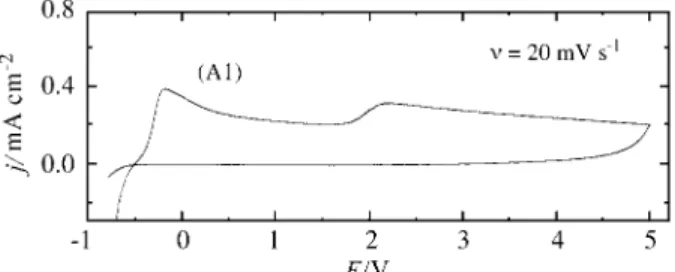
Voltammetric dataA voltammogram of Nb in 0.5 mol/L H3PO4 obtained
between Es,c = -0.8 V and Es,a = 5 V (vs. sce) at v = 20 mV
s-1 is shown in Fig. 1. The positive-going potential scan
exhibits a well-defined anodic current peak (A1) at about -0.20 V, followed by a wide passive potential region that is characteristic of the growth of anodic films on valve metals. The voltammogram also exhibits a step-wise increase of the anodic current when the electrode potential is ca. 1.8 V; this increase was previously reported by Di Quarto et al.12 for voltammograms obtained on niobium in sulphuric acid solutions and was tentatively assigned to the onset of oxygen evolution. No significant oxygen evolution was noticed, however; further studies in several acid solutions are now in progress in order to better characterise this oxidation process19. As the voltammetric scan is reversed, the current decreases sharply and no cathodic current con-tributions corresponding to the electroreduction of surface oxides are observed; at about -0.6 V, hydrogen evolution begins.
Although a detailed analysis of the voltammogrammes is out of the scope of this paper, chemical and thermody-namic considerations add information supporting that peak A1 is related to the oxidation of the electrode surface to Nb2O51,20-22. It is important to mention, however, that the
peak A1 potential, -0.20 V, differs considerably from -0.97 V corresponding to the Nb/Nb2O5 reversible electrode
po-tential20. The latter potential was estimated from standard Gibbs energy data of both products and reactants for the oxidation of Nb at pH 1.3. The tendency of niobium to form very stable oxygen compounds1,20 strongly suggests that, during the surface preparation, an irreversible oxidation process occurs at the electrode surface involving niobium suboxides12. Moreover, the detection of a surface film formed before anodisation was reported by several authors4,12,21,22; Di Quarto et al.4 estimated the thickness of this pre-film as being about 4 nm. Thus, the presence of this previously formed film might determine a shift of the electrode oxidation potential to a value more positive than that for the Nb/Nb2O5 reversible process.
Electrochemical impedance data
The impedance profile of the passivated Nb electrodes was found to depend on both Ef and the operational
poten-tial (E < Ef) at which the impedance spectra were obtained.
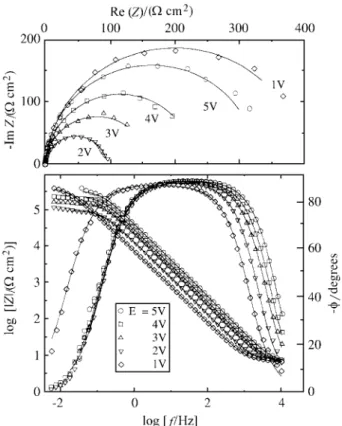
Typical complex-plane and Bode plots obtained at different Ef values are shown in Fig. 2. In the 10 mHz - 10 kHz
frequency range, only one capacitive semicircle is present for all Ef values. The corrosion resistance, defined as Rp =
limω →0 [Z(jω)], becomes smaller as Ef is decreased from 5
V to 2 V and then becomes larger for Ef = 1 V. These
variations in the value of Rp are in agreement with the
voltammetric profile shown in Fig. 1, in which a step-wise variation in the anodic current was observed at about 1.8 V. As pointed out by Bai and Conway23, a detailed transfer function interpreting the whole impedance spectra cannot be elucidated by means of steady-state techniques alone, especially when the electrode process involves a multi-electron transfer process such as Nb(0) → Nb(V), since information about intermediate reaction steps is not avail-able. However, impedance data are diagnostically useful, as they can provide a variety of information, in particular on the main reactions contributing to the faradaic current at the reacting interface and on the electrical characteristics of the anodic films on the metal electrode14-18.
An appropriate transfer function interpreting the com-plete set of experimental data, in the 1 V ≤ Ef ≤ 5 V
potential range, should include the resistance of the passive film (Rox) in series with the faradaic impedance of the Nb(0) → Nb(V) oxidation process represented by the charge transfer resistance of the process (Rct), and these in parallel
with the capacitance (C) of the metal/passive
film/electro-lyte system. Thus, the impedance spectra will be discussed according to the following transfer function:
Z(jω)= RΩ + Rox+ Rct 1 + jωC (Rox+ Rct)
(1)
where ω is the angular frequency (2πf), and the high-fre-quency limit, RΩ, is the ohmic resistance of the electrolyte. Unfortunately, resistances Rct and Rox are in series in Eq. 1
and, consequently, cannot be determined separately. How-ever, since Rct < Rox for this case, one can assume that the
value of Rox is directly accessible through the fitting
proce-dure and that the value of Rct is, thus, inaccessible. The
experimental spectra are satisfactorily described by trans-fer function (1) if an appropriate choice of parameters is made; the theoretical functions obtained from the parame-ters fitted with a complex non-linear least-squares algo-rithm are depicted as continuous lines in Fig. 2. The values obtained for the different parameters at the potentials Ef are
shown in Table 1. As can be seen from this table, the value of C decreases with increasing Ef; this capacitance can be
seen as a series combination of the oxide (Cox) and the
Helmholtz layer capacitances (CH), i.e.:
1 C=
1 Cox+
1
CH (2)
The values of Cox were obtained through Eq. 2,
assum-ing a conservative constant value4 of 20 µF cm-2 for CH.
Figure 3 shows that the relationship between Cox-1 and Ef
is linear; consequently, Cox can be directly correlated with
the thickness d of the passive film using the formula for a parallel plane condenser:
Cox = ε rε0
d (3)
where εr denotes the relative permittivity of the film and εo
the permittivity of vacuum. Di Quarto et al.4 determined by optical methods that the thickness d of anodically grown Nb2O5 films increases linearly with the applied formation
potential Ef, i.e.:
d = α(Ef − E0) (4)
where E° is the potential at which the film starts to grow and α is the anodising ratio.
From eqs. 3 and 4 one obtains
1 Cox=
α εrε0
(Ef− E0) (5)
If an average anodising ratio α of 2.2 nm V-1 is as-sumed4, the relative permittivity of the thin passive films can be estimated from the slope of the Cox-1 vs. Ef plot
shown in Fig. 3 as being about 44. This value agrees quite well with the one previously reported by Di Quarto et al.4 Figure 2. Complex-plane and Bode plots obtained for thin anodic Nb2O5
(εr = 42) for thicker films grown galvanostatically in
sul-phuric acid solutions. Finally, the estimation of E° from Fig. 3 (see Eq. 5) yields a value close to -0.55 V, a value more cathodic than the potential corresponding to anodic peak A1 observed in the voltammograms and consistent with the zero-current potential obtained for niobium in this electrolyte (see Fig. 1).
The values of Rox obtained for the different formation
potentials are also shown in Table 1. They increase with Ef,
except for the value obtained at Ef = 1 V, which is
excep-tionally high. As pointed out above, for potentials greater than 1.8 V an additional contribution to the anodic current appears in the voltammograms of Nb in H3PO4. The
sig-nificant decrease in the value of Rox when Ef is varied from
1 V to 2 V indicates that the properties of the passivating film greatly change; as mentioned before, this matter is being further studied. For 2 V ≤ Ef ≤ 5 V, Rox steadily
increases, reflecting the increasing film thickness. It is expected that for a passive layer grown at a certain Ef, the faradaic reaction associated with the formation of
the film should decrease if the electrode operational poten-tial is shifted to a value E < Ef. As pointed out previously15,
this happens because the faradaic reaction decreases sharply for fields lower than the film formation field. Thus,
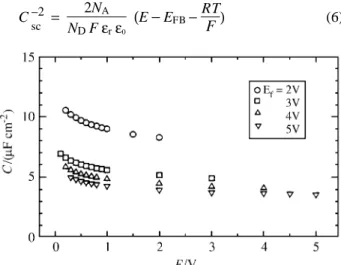
from impedance spectra obtained at E < Ef , the values of C decrease with increasing E (see Fig. 4) until they become nearly constant at potentials close to Ef. This constant
value, which was found to be dependent on the film thick-ness, i.e., Ef, coincides with the value of C obtained from
the whole impedance spectra at Ef fitted with Eq. 1. The
change in the value of C with E can be explained by assuming that the passive layers formed on niobium behave as non-stoichiometric semiconducting films. Taking into account the large band gap of Nb2O5 films (3.4 eV), large
anodic polarisations induce space charge layers that en-compass the whole film, leading to a constant capacitance, whose value reflects both the thickness and the relative permittivity of the film according to Eq. 3. Then, the whole thin film is in deep depleted conditions, with surface charges at both the oxide/solution and the metal/oxide interfaces13-15, and Cox is the capacitance available. On the
other hand, at the lower operational potentials, C can be assumed as corresponding to the space charge capacitance (Csc) of the semiconductor Nb2O5 film in the depleted
region, after taking into account the value of CH (20 µF
cm-2). Hence, for the films grown at different Ef, C
in-creases as Ef becomes less positive (Fig. 4).
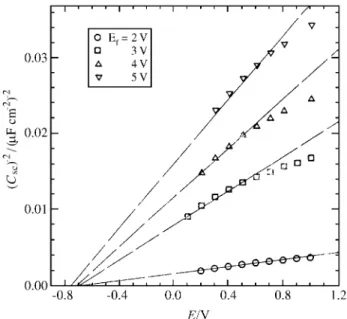
The Mott-Schottky plots (Csc-2 vs. E) for the Nb2O5
films formed in H3PO4 are shown in Fig. 5. From these
results, which clearly characterise an n-type semiconductor behaviour of the oxide film, it is possible to determine the number concentration of donors (ND) in the space charge
region as well as to estimate the flat band potential (EFB)
for the films grown at each anodic potential. This was done using the above calculated value of the relative permittivity of the Nb2O5 films formed in H3PO4 and the well-known
Mott-Schottky relationship:
C−2 sc =
2NA ND F εrε0
(E− EFB−RT
F) (6)
Figure 3. Inverse of the oxide capacitance Cox as a function of the formation potential Ef (vs. sce), for thin anodic Nb2O5 films formed on Nb electrodes in 0.5 mol/L H3PO4 (pH 1.3).
Table 1. Dependence of the value of the transfer function parameters RΩ, Rox and C on the formation potential Ef (vs. sce), for thin anodic Nb2O5 films formed on Nb electrodes in 0.5 mol/L H3PO4 (pH 1.3). These values were obtained by fitting the transfer function to the data shown in Fig. 2 with a complex non-linear least-squares algorithm (see text).
Ef/V RΩ/Ω cm2 Rox/kΩ cm2 C/mF cm-2
1 7.9 400 16.9
2 7.4 95 10.3
3 7.4 160 6.3
4 7.3 233 4.8
5 7.3 330 3.4
where NA is the Avogadro constant, F the Faraday constant, T the thermodynamic temperature and R the molar gas constant.
As shown in Table 2, ND decreases with Ef (i.e.,
increas-ing film thickness), indicatincreas-ing that the average number concentration of donors becomes smaller as the film be-comes thicker. This behaviour, which is similar to the one previously reported14,15 for thin WO3 films anodically
grown on tungsten in several electrolytes, can be partially due to a higher contribution from the surface states on decreasing the film thickness. However, an influence of the thickness on the ND value as a consequence of a higher
defect concentration in thin films cannot be excluded. Nevertheless, the values obtained for ND are consistently
larger than the ones reported by Di Quarto et al.4 for thicker films.
From Fig. 5 and using Eq. 6, EFB can be estimated as
about -0.72 V. This value is somewhat more negative than the values previously reported for thicker Nb2O5 films
galvanostatically grown on Nb electrodes in 0.5 mol/L
H2SO4, EFB≈ 0.2 V (vs. sce)4, and in 0.1 mol/L oxalic acid, EFB≈ -0.2 V (vs. sce)24.
Although some doubts have been raised concerning the application of the Mott-Schottky theory to amorphous semiconductors4,11,25, the non-linearity of the Csc-2 vs. E
plots at potentials far from the flat band potential is an expected fact for thin semiconducting films subjected to high electric fields. As mentioned above, for potentials far from EFB, the thickness of the space charge layer becomes
equal to the film thickness, and the capacitance of the interface behaves according to Eq. 5.
Acknowledgments
This work was made possible by grants from FAPESP - Fundação de Amparo à Pesquisa do Estado de São Paulo (Brazil), including a visiting-scientist fellowship to F. E. Varela; support from CNPq - Conselho Nacional de Desen-volvimento Científico e Tecnológico (Brazil) is also grate-fully acknowledged.
References
1. Udupa, H.V.K.; Venkatesan, V.K. In Encyclopedia of Electrochemistry of the Elements; Bard, A.J., Ed.; Marcel Dekker: New York, 1974; Vol. 2, Chapter 3. 2. D’Alkaine, C.V.; de Souza, L.M.M.; Nart, F.C.
Cor-rosion Sci. 1993, 34, 109.
3. Young, L. Anodic Oxide Films; Academic Press: Lon-don, 1961.
4. Di Quarto, F.; Piazza, S.; Sunseri, C. Electrochim. Acta 1990, 35, 99.
5. Goruk, W.S.; Young, L.; Zobel, F.G.R. In Modern Aspects of Electrochemistry; Bockris, J.O’M., Ed.; Plenum Press: New York, 1966; Vol. 4, Chapter 3. 6. Gomez, M.A.B.; Onofre, S.; Juanto, S.; Bulhões,
L.O.S. J. Appl. Electrochem. 1991, 21, 1023. 7. Hurlen, T.; Bentzen, H.; Hornkjøl, S. Electrochim.
Acta 1987, 32, 1613.
8. Dignam, M.J. In Comprehensive Treatise of Electro-chemistry; Bockris, J.O’M.; Conway, B.E.; Yeager, E.; White, R.E., Eds.; Plenum Press: New York, 1981; Vol. 4, Chapter 5.
9. Davies, J.A.; Domeij, B.; Pringle, J.P.S.; Brown, F. J. Electrochem. Soc. 1965, 112, 675.
10. Murti, D.K.; Kelly, R. Thin Solid Films 1976, 33, 149. 11. Di Quarto, F.; Sunseri, C.; Piazza, S. Ber. Bunsenges.
Phys. Chem. 1986, 90, 549.
12. Di Quarto, F.; Piazza, S.; Sunseri, C. J. Chem. Soc., Faraday Trans. 1 1989, 85, 3309.
13. Morrison, S.R. Electrochemistry at Semiconductor and Oxidized Metal Electrodes; Plenum: New York, 1980; Chapter 2.
Table 2. Values of the donor number concentration (ND) as a function of the formation potential Ef (vs. sce), for thin Nb2O5 films anodically grown on Nb electrodes in 0.5 mol/L H3PO4 (pH 1.3).
Ef/V ND/(1020 cm-3)
2 14
3 2.8
4 2.0
5 1.5
14. Biaggio, S.R.; Rocha-Filho, R.C.; Vilche, J.R.; Varela, F.E.; Gassa, L.M. J. Braz. Chem. Soc. 1994, 5, 123.
15. Biaggio, S.R.; Rocha-Filho, R.C.; Vilche, J.R.; Varela, F.E.; Gassa, L.M. Electrochim. Acta 1997, 42, 1751. 16. Biaggio, S.R.; Bocchi, N.; Rocha-Filho, R.C.;
Tan-zella, F.L., in preparation.
17. Ybarra, G.O.; Moina, C.A.; Hernández, L.F.; Varela, F.E.; Vilche, J.R. Materials Science Forum 1995, 192-194, 711.
18. Moina, C.A.; Varela, F.E.; Hernández, L.F.; Ybarra, G.O.; Vilche, J.R. J. Electroanal. Chem. 1997, 427, 189.
19. Biaggio, S.R.; Bocchi, N.; Rocha-Filho, R.C.; Varela, F.E., in preparation.
20. Udupa, H.V.K.; Venkatesan, V.K.; Krishnan, M. In Standard Potentials in Aqueous Solutions; Bard, A.J.; Parsons, R.; Jordan, J., Eds.; Marcel Dekker: New York, 1985; Chapter 17, pp 526-537.
21. Grundner, M.; Halbritter, J. J. Appl. Phys. 1980, 51, 397.
22. D’Alkaine, C.V.; de Souza, L.M.M.; Nart, F.C. Cor-rosion Sci. 1993, 34, 117.
23. Bai, L.; Conway, B. E. J. Electrochem. Soc. 1990, 137, 3737.
24. Heusler, K.E.; Schulze, M. Electrochim. Acta 1975, 20, 237.
25. Di Quarto, F.; Piazza, S.; Sunseri, C. Ber. Bunsenges. Phys. Chem. 1987, 91, 437.