Article
J. Braz. Chem. Soc., Vol. 22, No. 6, 1024-1032, 2011. Printed in Brazil - ©2011 Sociedade Brasileira de Química 0103 - 5053 $6.00+0.00
A
*e-mail: [email protected], [email protected]
Sensitive Single Step Fluorimetric Method for Monitoring Solid-Phase Reactions on
Polystyrene Resin-Bound Chloride Groups
Georgina E. Pina-Luis,*,a Marco A. Zazueta Gómez,a Ignacio A. Rivero Espejela and
Marta E. Díaz-Garcíab
aCentro de Graduados e Investigación, Instituto Tecnológico de Tijuana, P.O. 1166,
22000 Tijuana-B.C., México
bDepartamento de Química Física y Analítica, Facultad de Química, Universidad de Oviedo,
Av. Julián Clavería 8, 33006 Oviedo, España
Espectroscopia de luorescência tem sido usada para monitorar a conversão química de resinas ligadas a grupos cloreto. Os peris tempo-concentração de diferentes reações envolvendo a incorporação de derivados de hidroxifeniletanona (HPE) à resina Merriield e 2-aminobencilalcool (ABA) à resina clorosulfonada são mostrados. A avaliação do progresso da reação foi feita usando-se um marcador luorescente imobilizado (dansil hidrazina) e por medidas diretas de luorescência da espécie formada em cada etapa das reações nos grãos da resina. Não foram observadas diferenças signiicativas entre estes dois métodos. Os resultados mostraram que medidas diretas na fase sólida sem o uso de marcadores luorescentes representam uma análise simples, rápida, não destrutiva e de baixo custo para o monitoramento do progresso de reações em resinas cloradas, a qual permite não somente o estudo da cinética de reação, mas também proporciona uma ferramenta valiosa para a quantiicação analítica de resina ligada a cloreto, sem nenhuma preparação da amostra, exceto a transferência do grão da resina de cada estágio reacional, do frasco reacional para a célula de luxo, para a medida de luorescência.
Fluorescence spectroscopy has been used to monitor the chemical conversion of resin-bound chloride groups. The time-concentration proiles of different reactions involving the incorporation of hydroxyphenylethanone (HPE) derivatives to Merriield resin and 2-aminobencylalcohol (ABA) to a chlorosulphonate resin are shown. The evaluation of the reaction progress was made using an immobilized luorescent tracer (dansyl hydrazine) and by direct luorescence measurements of the species formed on each step of the reactions on resin beads. Signiicant differences between these two methods were not observed. The results demonstrate that direct measurements on solid phase without using luorescent markers represent a single step, rapid, non destructive and low cost analysis by monitoring reaction progress on chlorinated resins, which allows not only the study of reaction kinetics but also provides a valuable tool for the analytical quantiication of chloride resin bound, without any sample preparation, except the transfer of resin bead of each reaction stage from the reaction vessel to the low cell for the luorescent measurement.
Keywords: monitoring solid phase reaction, luorescence, kinetics
Introduction
Solid phase organic synthesis (SPOS) continues to play an important role in combinatorial chemistry, not only in the preparation of new drugs but in the development of materials with molecular recognition properties.1-7 In spite
of its extensive use, a critical step in this ield is the lack of analytical techniques for monitoring the reaction progress.
the years to ind quick and reliable ways for monitoring solid phase reactions.
Classical techniques for following the course of reactions, such as TLC are clearly not applicable in the solid phase mode, while techniques for direct monitoring such as, elemental analysis8,9 and other methods as FT-IR,10,12
FT-Raman,13 NMR,14-17 MS,18 X-ray photoelectron (XP)
spectroscopy,19 and electrochemical impedance (ESI),20
may result expensive and destructive analysis, or/and need time consuming sample preparation, e.g. for compression molding of KBr pellets and for high drying of samples. ATR-FTIR (attenuated total relection Fourier transform infrared) spectroscopy,21 allows the direct characterization
of solid support, but requires the corresponding equipment complement that is not always available. ESI-MS (electrospray ionization mass spectrometry) offers high sensitivity for analyzing compound released from a resin bead. However, because of the structural diversity of organic compound libraries, many compounds do not have the appropriate ionization properties to be analyzed by ESI-MS. An analytical construct, which contains an amine that enhances electrospray ionization properties and an isotope label, was developed.22
In the last years several researchers have rediscovered simple colorimetric tests,23-28 that allow the evaluation
of the presence of functional group on a variety of solid supports. Although these colorimetric methods are simple and low cost, they are generally indicative and should be used exclusively to monitor the progress of reaction. In addition they require the destruction of a small sample of resin for each assay and extensive time.
So, despite of the efforts made in the development of new methods for monitoring the reaction progress on solid phase, many of the reported procedures involve several stages in their implementation, or/and may result expensive and destructive analysis, or/and may consume a long time of sample preparation. Then, the development of methods that can be carried out in a one step is a true challenge.
Fluorimetric analysis have won great popularity in the last years since they are simple, sensitive and non destructive analysis.29-32 As part of interest of our group of
solid phase organic synthesis (SPOS), in the development of new solid-phase synthetic methods, we are looking for an easy analytical method for monitoring the reaction progress, that not only attends the study of kinetic reaction, but also allows quantifying the resin-loading. In a previous work,32
we have reported the use of a luorescent tracer (dansyl chloride) as a useful tool for the determination of resin-bound hydroxyl groups, for the study reaction kinetics and for monitoring the progress of reactions. In this paper the progress of chlorinated resin conversion in two reactions:
(i) the attachment of hydroxyphenylethanone (HPE) on Merriield resin to obtain methoxyphenylethanone (MPE) resin (Scheme 1), and (ii) the reaction of chlorosulfonate resin with 2-aminobencyl alcohol (ABA) to obtain N -(2-(hydroxymethyl)phenyl)sulfonamide resin, followed by conversion to the chlorinated resin (Scheme 2) is showed. Our new approach demonstrated that direct measurements on solid phase without using luorescent markers give good results and represent a single step, simple, rapid, non destructive and low cost analysis by monitoring reaction progress on chlorinated resins and for the study reaction kinetics and analytical quantiication of chloride resin bound, without any sample preparation, except the transfer of resin bead in each reaction stage from the reaction vessel to the low cell for the luorescent measurement.
Results and Discussion
Preparation of methoxyphenylethanone-resin and methoxyphenylethylidene-dansyl-hydrazine resin
PS-chlorometyl resin, known as Merriield resin, is a useful starting material extensively used in solid phase synthesis.33,34 Evaluation of the reaction conversion degree
through the chloride group substitution is carried out generally by Volhard titration35 after treatment with an
amine, which is a long and tedious method. The feasibility of using luorescence spectroscopy to monitor the reaction of hydroxyphenylethanone (HPE) with Merriield resin in real-time has been examined. The general solid phase route, which is shown in Scheme 1, begins with the attachment of HPE derivatives 2 (a-c) to Merriield resin 1, through a nucleophilic displacement of the chloride group catalyzed by K2CO3, using dimethylformamide as solvent to give the
analysis. The corresponding cuasi molecular ions [M+H]+
were obtained conirming the presence of the MPE on the polymer support.
Fluorimetric characterization
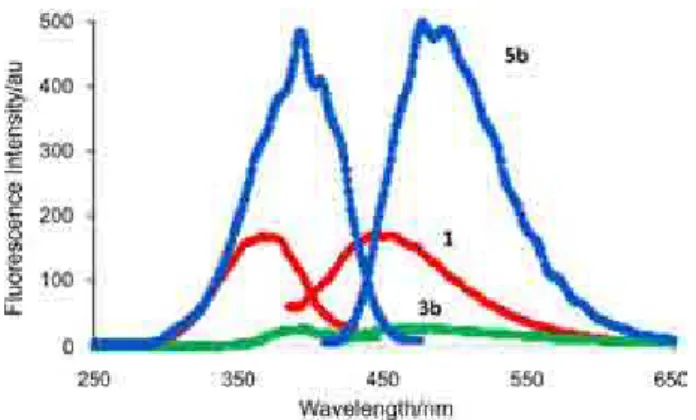
The fluorescence spectral behavior of the starting material, intermediates and inal products were studied in order to evaluate the structural changes at different stages. Resins were transferred to a conventional low-through luorescence cell, and spectra were obtained directly from the dry resin beads. Fluorescence spectra of Merriield resin 1, 1-(3-methoxyphenyl)ethanone resin 3b and 1-(3-methoxyphenyl)ethylidene-dansyl-hydrazine resin 5b are shown in Figure 1. There are marked differences in the spectrum between the unmodiied resin and the inal products, indicating an effective incorporation of MPE into the resins. The luorescence spectra of Merriield resin 1 (λ
exc = 374 nm,
λ
em = 454 nm) correspond to π*- π electronic transitions
of the polymeric matrix based on polystyrene cross linked with divinyl benzene. The luorescence spectra of resin 3b (λ
exc = 386 nm, λem = 460 nm) are shifted from those of
Merriield resin, due to π*-n transition of low intensity which
appears at longer wavelength corresponding to the carbonyl groups. The electronic delocalization of the π system is not
suficient to induce luorescence due to π*-π transition,
thus a decrease in luorescence intensity is observed. The incorporation of dansyl probes gives rise to an increase in the luorescence intensity, (in agreement with their high quantum yield), a red shift fluorescence spectra (λ
exc = 396 nm,
λ
em = 497 nm) and shorter Stoke’s shift in comparison
with spectra of the dansyl label in solution (λ
exc = 340 nm,
λ
em = 525 nm, in methanol). The latter is a consequence of
the inluence of the local molecular viscosity of polymer, preventing a suficiently fast relaxation to a state of minimum energy, as compared with a homogenous solution.
A very small particle size of the resin can lead to a high compacting degree. In this condition a reduction of luorescence intensity caused by inner ilter effect could be appreciated. We work with 75-150 µm (100-200 mesh) resins, which under the reaction conditions did not show a signiicant change of particle size. We veriied this by measuring the luorescence of resins beads before and after of a “blank” reaction, which includes all the reagents except the modiier reagent of the resin. Fluorescence intensity variations of the resin were not observed, indicating that inner ilter effects and undesired reactions have not taken place.
Kinetics of the reaction on solid-phase
The evaluation of reaction progress was made measuring the luorescence on resin beads before and after the luorescent tracer molecule immobilization. The reaction kinetic of the 3-MPE resin 3b formation was followed irst by incorporation of the dansyl hydrazine luorophore probe (dansyl:resin, 1:1). The excitation and luorescence spectra of 3-MPED modiied resin 5b at different reaction times are shown in Figure 2A. As observed, luorescence intensity at maximum emission wavelength increases as reaction time increases up to 6 h, indicating the incorporation of the luorescent probe. Reaction kinetics was also followed by luorescence spectroscopy without any manipulation of 3-MPE resin 3b, except to transfer it to a conventional low-through luorescence cell. As illustrated in Figure 2B, under the experimental conditions, the luorescence spectra of 3-MPE resin 3b at different reaction times show a decrease of luorescence intensity as reaction time increases, indicating the incorporation of MPE on the resin (carbonyl groups). Above 6 h luorescence
Scheme 1. Preparation of modiied resins 3(a-c) and 5(a-c).
Cl + HO
C O
CH3
O C
O
CH3
+
N SO2
O C
N
CH3
N NHSO2
K2CO3
DMF
Acetic Acid 15% DMF
1 2(a-c) 3 (a-c)
4
5 (a-c)
HN H2N a = 1-(2-hydroxyphenyl)ethanone
b = 1-(3-hydroxyphenyl)ethanone
c = 1-(4-hydroxyphenyl)ethanone
Figure 1. Fluorescence spectra of Merriield resin 1 (λ
exc = 374 nm, λem = 454 nm), 1-(3-methoxyphenyl) ethanone resin 3b (λexc = 386 nm,
λ
intensity remains constant. It shows that the variation of luorescence intensity with reaction time has a similar behavior by both methods and suggests the possibility of evaluating reaction kinetics without any transformation of the resin.
The results obtained in the evaluation of reaction progress by direct measurements of luorescence intensity, were validated by the volumetric Volhard method. In Figure 3 reaction kinetics of the HPE incorporation on Merriield resin using: Direct measurements of luorescence intensity on resin beads and Volhard method for the evaluation of chloride substitution (%) is presented. As observed, evaluation of the reaction kinetics by luorescence spectroscopy, demonstrated a greater sensitivity, since this method allows establishing the difference between the time-concentration proile of 3b and 3c formation, while the Volhard method gives similar results.
Kinetics of the reaction of MPE resin formation on solid phase showed that the time course of the reaction itted a pseudo-irst-order reaction rate equation. The data were analyzed according to rationalizations reported in a previous work,32 by itting the equation:
[R−MPE]
t = [ R−Cl]o (1−e-kt) (1)
where [R−MPE]
t is the concentration of
methoxyphenyl-ethanone inmobilized at any time and [R−Cl]
o is the initial
concentration of reactive sites. According to the reaction:
R−Cl + HPE → R−MPE
(HPE is in large excess)
it was possible to quantify the rate constant k, by monitoring the luorescence of the system, taking into account that at any time, the observed luorescence intensity of a given sample was equal to the sum of luorescence intensities of the species present. Merriield resin and MPE resin were the only luorescent since free HPE had been removed by washing.
Then, under the experimental conditions:
Io = a[R−Cl] at t = 0 (2)
It = b[R−MPE] at any time (3)
where a and b are functions of the concentration of R−Cl
and R−MPE, respectively.
Equations 1, 2 and 3 may be combined into the form:
log(It/I0) = log b/a − kt/2.303 (4)
Figure 2. (A) Fluorescence spectra of 1-(3-methoxyphenyl)ethylidene-dansyl-hydrazine resin 5b (dansyl:resin = 1:1) at different reaction times.
λ
exc = 396 nm. (B) Fluorescence spectra of 1-(3-methoxyphenyl) ethanone resin 3b at different reaction times. λexc = 386 nm.
Plots of log(It/I0) versus tresulted in straight lines from
which the kvalues were obtained for the derivative under study. Kinetic data are collected in Table 1.
The rate constant for 2-MPE resin 3a formation was 4.5 times higher than for 4-MPE resin 3c and 7.5 times higher than for 3-MPE resin 3b. The signiicant increase in reactivity of 2-HPE derivative toward nucleophilic displacement of the chloride group may be attributed to the position of hydroxyl group in the aromatic ring (orto effect). In addition, the higher rate constant for orto- and para-MPE resin formation is favored by resonance effect.
The kinetic parameters obtained by both methods (Volhard and proposed method) were compared statistically for a signiicance level of 95%. Signiicant differences were not observed.
Determination of the resin loading
Merriield resin was loaded with varying equivalents of 3-HPE and the emission spectra were obtained at
λ
exc = 380 nm. The spectral maxima were independent of
the probe concentrations, and peak intensity decreased continuously with the concentration of the 3-HPE. Figure 4 shows the variation of luorescence intensity measured at a wavelength of maxima emission (460 nm) with the HPE/resin (mmol g-1) ratio. This ratio is a useful tool for
estimate the HPE fractional occupancy in the resin. From the data in Figure 4, it can be observed that luorescence intensity exhibits a linear dependence on the amount of the HPE attached to the resins. The luorescence intensity will be directly proportional to the extent of reaction occurred. At a given HPE/resin ratio, fluorescence intensities reached a minimum limiting value, indicating saturation at reactive sites. By extrapolation of the linear segments of each curve, the intersection point would be a measure of the corresponding resin-bound chloride groups. Thus, the value of mmol g-1 resin for Merriield PS resin was
found (1.43) and is in good agreement (accuracy within 1-5%) with the loading values reported by the manufacturer (1.41 mmol g-1). These resultsare consistent with the fact
that all binding sites are accessible to 3-HPE.
Preparation of N-(2-(hydroxymethyl)phenyl)sulfonamide resin
PS−TsCl is a chlorosulfonate polystyrene resin,
which is a resin-bound equivalent to tosyl chloride. This resin can readily react with nucleophiles to give a variety of sulfonyl functional polymers, which can be used as polymeric supports, reagents and catalysts in organic synthesis.36 The loading of primary alcohols to PS−TsCl
resin, may be monitored using a laborious bead staining test. To check for residual sulfonyl chloride groups on the resin, a few beads may be sampled, washed and treated appropriately to determine if the reaction is complete. In this work a new luorimetric method is used to monitor the reaction of PS−TsCl with 2-aminobencyl alcohol (ABA)
and the posterior conversion to the chlorinated resin. The route for the synthesis, which is shown in Scheme 2, began by attaching 2-ABA 7 to chlorosulphonate resin 6, through a nucleophilic displacement of the chloride group using dichloromethaneas solvent to give the N-(2-(hydroxymethyl)phenyl)sulfonamide resin 8. Conversion of the hydroxyl resin to the chlorinated one was carried out with triphosgene (BTC) and triphenyl phosphine in dichloromethane as described in experimental section to produce the N-(2-(chloromethyl)phenyl)sulfonamide resin 9.
Fluorescence characterization
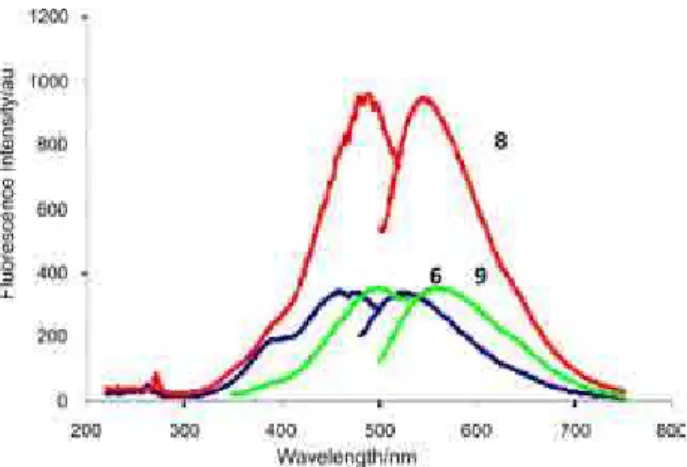
The luorescence spectral behavior of starting material, intermediates and inal products were studied in order to evaluate the structural changes at different steps. Resins were transferred to a conventional low-through luorescence cell, and spectra were obtained directly from the dry resin beads. The luorescence spectra of chlorosulphonate resin 6, N-(2-(hydroxymethyl)phenyl)
Table 1. Kinetics parameters resulting of HPE incorporation on Merriied resin
Methoxyphenylethanone derivative Fluorescence method K×10-5 / s-1
2-methoxyphenylethanone 51.84
4-methoxyphenylethanone 11.52
3-methoxyphenylethanone 6.9
sulfonamide resin 8 and N-(2-(chloromethyl)phenyl) sulfonamide resin 9 are shown in Figure 5. There are marked differences in the spectrum from the “blank” resin (unmodiied) to the inal products, indicating an effective incorporation of the ABA into the resins. The luorescence spectra of resin 8 (λ
exc = 490 nm, λem = 547 nm) are
shifted to that of chlorosulphonate resin 6 (λ
exc = 460 nm,
λ
em = 528 nm) and an increase of the luorescence intensity
with a greater luorescence eficiency of the corresponding unmodiied resin is shown.
This behavior is due to the substitution of chlorine in the resin by an aromatic ring, which increases the conjugation extent of the π electronic system in the resin.
The subsequent chlorination reaction leads to a decrease in the luorescence intensity due to the effect of chlorine, which acts as a heavy atom, favoring the intersystem crossing and deactivating the luorescence.
Determination of the resin loading
Resin 6 was loaded with varying equivalents of the aminobenzyl alcohol (ABA), and the excitation and
emission spectra were recorded. The spectral maxima were independent of the probe concentrations, and peak intensity increased continuously with the concentration of ABA. In Figure 6 the variation of luorescence intensity measured at maxima emission wavelength (547 nm) with the ABA/ resin (mmol g-1) ratio is presented. It can be observed that
luorescence intensity exhibits a linear dependence on the amount of alcohol attached to the resins, even at high loadings of the ABA, and no self-quenching or reabsorption effects were observed. Since only the attached ABA is luorescent (beads were subjected to repeated washings), the luorescence intensity will be directly proportional to the extent of reaction occurred. At a given ABA/resin mmol g-1
ratio, luorescence intensities reached a limiting value, indicating saturation at reactive sites. By extrapolation of the linear segments of each curve, the intersection point would be a measure of the corresponding resin-bound hydroxyl groups. Thus, the value of mmol g-1 resin for
chlorosulphonate PS resin was found (1.61 mmol g-1) and is
in good agreement (accuracy within 1-5%) with the loading values reported by the manufacturer (1.64 mmol g-1). These
resultsare consistent with the fact that all binding sites are accessible to aminobenzyl alcohol.
Additionally, the luorescence spectra of the ABA binding to resin at different reaction times were analyzed. According to fluorescence monitoring, reaction is completed at 20 min. Analysis by Volhard method, showed 100% of conversion at 20 min.
Kinetics of a chlorination reaction on solid-phase
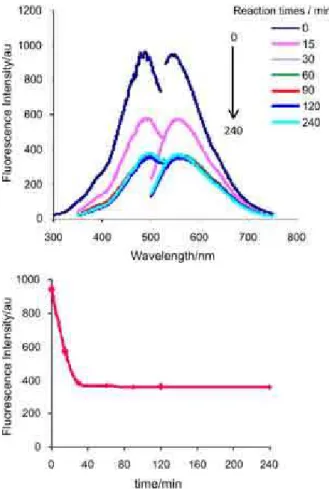
The chlorination reaction was carried out as described in the experimental section. The reaction was stopped at different times as speciied, and the luorescence spectra of the chlorinated resins were recorded. It was observed that the luorescence intensity of the unlabeled (“blank” resin) decreases while the chlorination reaction is taking place. However, the native luorescence intensity decreases as
Scheme 2. Preparation of modiied resins 8 and 9.
NH2
OH DCM S
N H O O
OH S
Cl O O
S N H
O O Cl
BTC/Ph3P DCM +
6 7 8
9
Figure 5. Fluorescence spectra of chlorosulphonate resin 6 (λexc = 460 nm,
λ
em = 528 nm), N-(2-(hydroxymethyl) phenyl) sulfonamideresin 8 (λexc = 490 nm, λem = 547 nm) andN-(2-(chloromethyl)phenyl)sulfonamide resin 9 (λexc = 506nm, λem = 555nm).
the OH groups were substituted by chlorine. As illustrated in Figure 7A, under the experimental conditions, the fluorescence spectra of N-(2-(hydroxymethyl)phenyl) sulfonamide resin 8 show a decrease of the luorescence intensity as chlorination reaction time increases. Above 50 min the luorescence intensity remains constant. In Figure 7B the dependence of luorescence intensity at maximum emission wavelength with reaction time is presented. These results were validated using Volhard method.
The kinetics data analysis indicated a pseudo irst-order rate constant of 4.98 × 10⁻⁴ s-1 for the N-(2-(hydroxymethyl)
phenyl)sulfonamide chlorination reaction.
Conclusions
In conclusion, a single step, easy, fast and highly sensitive luorescent method was successfully used to evaluate the different reaction steps and to determine not only if the reaction has proceeded to completion, but also the kinetics of different reactions by direct measurement
of luorescence on solid phase without using a luorescent tracer. The proposed method reduces the time and the cost of the analysis, since it eliminates reactions steps and reagents, is not destructive and does not require expensive equipment. The method also proved to be useful in the determination of the loading of Merriield resin and chlorosulphonate resin. The approach offers a real time insight into chemistry taking place on the resin and can be extended to monitor a variety of reactions on solid supports, and in conjunction with a well-established technique such as low analysis, basic studies on solid-phase become possible.
Experimental
Merriield resin (1.41 mmol g-1 Cl) and chlorosulphonate
resin (1.64 mmol g-1 Cl) used in this work were purchased
from Argonaut Technologies Inc. (USA). All other reagents, unless otherwise specified, were purchased from Aldrich Chem. Co. (St. Louis, USA). Infrared (IR) spectra were recorded on a Perkin Elmer FT-IR 1600 spectrometer (USA). Mass spectra were obtained on a Hewlett Packard 5989 MS spectrometer (USA) at 70 eV by direct insertion. The Fluorescence spectra were recorded on a spectroluorometer Shimadzu RF-5301 PC (Kyoto, Japan). Beads were washed free of any starting materials and solvents and were placed into a Hellma model 176.52 low-through cell (Müllheim, Germany) for luorimetric analysis.
General method for the synthesis of methoxyphenylethanone on Merriield resin 3(a-c)
Merriield resin (1.0 g, 1.4 mmol) was expanded during 15 min in 10 mL of DMF. Then, K2CO3 (4.83 g, 35 mmol),
hydroxyphenylethanone 2 (a-c) (0.95 g, 7 mmol) and 10 mL of DMF were added. The mixture was heated at 75 oC under constant stirring during 10 h, after which the
resin was iltered and washed with H2O (3×30 mL), MeOH
(3×20 mL) and CH2Cl2 (3×20 mL). Finally, the resin was
dried under reduced pressure.
2-Methoxyphenylethanone resin 3a
Recovery: 90%. Conversion (Volhard): 100%. FTIR (KBr) ν
max/cm-1: 3025 (C−H Ar), 1675 (C=O), 1596 (C=C),
1268 (C−O). FI= 28 au,λ
em = 460 nm, λexc = 386 nm.
ESI-MS: [M+H]+ = 133.
3-Methoxyphenylethanone resin 3b
Recovery 90%. Conversion (Volhard): 100%. FTIR (KBr) ν
max/cm-1: 3024 (C−H Ar), 1684 (C=O), 1594 (C=C),
Figure 7.(A) Fluorescence spectra of N-(2-(hydroxymethyl)phenyl) sulfonamidechlorination at different reaction times. λ
1268 (C−O). FI = 52 au,λ
em = 460 nm, λexc = 386 nm.
ESI-MS : [M+H]+ = 133.
4-Methoxyphenylethanone resin 3c
Recovery: 82%. Conversion (Volhard): 100%. FTIR (KBr) ν
max/cm
-1: 3025 (C-H Ar), 1675 (C=O), 1597 (C=C),
1252 (C-O). FI = 30 au,λ
em = 460 nm, λexc = 386 nm.
ESI-MS :[M+H]+ = 133.
General method for the synthesis of 1-(methoxyphenyl) ethylidene-dansyl-hydrazine resin 5(a-c)
Methoxyphenylethanone resin 3(a-c) (200 mg, 0.28 mmol) was expanded during 15 min in 1.25 mL of DMF. Then a solution of dansyl hydrazine (33 mg, 0.125 mmol) dissolved in 1 mL of glacial acetic acid 15% in DMF was added and the mixture stirred in a sonic bath for 2 h. The resin was iltered and washed with DMF (2×10 mL), MeOH (3×10 mL) and CH2Cl2 (1×10 mL).
Finally the resins were dried under reduced pressure. Measurements of luorescence intensity were obtained directly from the resin beads.
1-(2-Methoxyphenyl)ethylidene-dansyl-hydrazine resin 5a
FTIR (KBr) ν
max/cm-1: 3446, 3019, 2920, 1654, 1605,
1490, 1455, 1330, 1150. FI = 530 au,λ
em = 497 nm,
λ
exc = 396 nm.
1-(3-Methoxyphenyl)ethylidene-dansyl-hydrazine resin 5b
FTIR (KBr) ν
max/cm
-1: 3442, 3020, 2945, 1654, 1605,
1490, 1466, 1320, 1130. FI= 612 au, λ
em = 497 nm,
λ
exc = 396 nm.
1-(4-Methoxyphenyl)ethylidene-dansyl-hydrazine resin 5c
FTIR (KBr) ν
max/cm-1: 3450, 3024, 2960, 1654, 1605,
1495, 1455, 1350, 1177. FI = 515 au,λ
em = 497 nm,
λ
exc = 396 nm.
General method for the synthesis of N-(2-(hydroxymethyl) phenyl)sulfonamide resin 8
Chlorosulfonate polystyrene (PS-Ts-Cl) resin (1.0 g, 1.64 mmol) was expanded during 10 min in 2 mL of CH2Cl2 with 3drops of TEA. Then, 2-aminobencyl alcohol
(0.605 g, 4.92 mmol) in 10 mL of CH2Cl2 was added. The
mixture was stirred during 2 h in ultrasonic bath after which the resin was iltered and washed with CH2Cl2 (3 × 20 mL)
and MeOH (3 × 20 mL). Finally the resin was dried under reduced pressure. FTIR (KBr) ν
max/cm-1: 3373, 3045,
1595, 1499, 1470, 1340, 1130. FI = 743 au,λ
exc = 490 nm,
λ
em = 547 nm. [M+H]+ = 123. Conversion (Volhard): 100%.
General method for the chlorination of N-(2-(hydroxymethyl) phenyl)sulfonamide resin
Conversion of hydroxyl resins to chlorinated ones was carried out according to the chlorination method described elsewhere.34 Triphosgene (BTC) (1.46 g) was added with
constant stirring to a solution of triphenylphosphine (3.47 g) dissolved in CH2Cl2 at 0 °C (1:2.7 stoichiometric
molar ratio), then the mixture was stirred for 20 min at 20 °C, after which the solvent was removed in a vacuum. The crude white solid obtained was dissolved in 20 mL of CH2Cl2 to obtain the chlorination reagent solution. The
N-(2-(hydroxymethyl)phenyl)sulfonamide resin (150 mg), placed in a reactor, was swollen in CH2Cl2 (5 mL) and
shaken for at least 30 min, then the vessels were drained, and the chlorination reagent solution (1 mL = 1 equiv. chlorination solution) was added to the resins. The reaction was allowed to proceed for 0, 10, 30, 60, 90, 120 and 240 min. FTIR (KBr) ν
max/cm-1: 3040, 1593, 1489, 1465,
1330, 1140. FI = 360 au, λ
exc = 506 nm, λem = 555 nm.
ESI-MS : [M+H]+ = 141.
Acknowledgments
The authors gratefully acknowledge inancial support from the CONACYT (Consejo Nacional de Ciencia y Tecnología, Proyect 67862) and the DGEST (Dirección General de Estudios Superiores Tecnológicos, Proyect 309.06-P). We also acknowledge Dr. Miguel Parra-Hake for valuable comments in the manuscript.
References
1. Hudson, D.; J. Comb. Chem. 1999, 1, 403. 2. Dolle, R. E.; J. Comb. Chem. 2001, 3, 477. 3. Dolle, R.E.; J. Comb. Chem. 2002, 4, 370.
4. Hermkens, P. H. H.; Ottenheijm, H. C. J.; Rees, D.; Tetrahedron 1996, 52, 4527.
5. Díaz-García, M. E.; Pina-Luis, G.; Rivero, I. A.; TrAC, Trends Anal. Chem. 2006, 25, 112.
6. Rivero, I. A.; González, T.; Pina-Luis, G.; Díaz-García, M. E.;
J. Comb. Chem.2005, 6, 46.
7. Vélez López, E.; Pina Luis, G.; Suárez-Rodríguez, J. L.; Díaz-García, M. E.; Rivero, I. A.; Sens. Actuators, B2003,90, 256. 8. Mazur, S.; Jayalekshmy, P.; J. Am. Chem. Soc. 1979, 101, 677. 9. Yan, B.; Jewell, C. F.; Myers, S. W.; Tetrahedron1998, 54,
11755.
10. Yan, B.; Gremlich, H. U.; Moss, S.; Coppola, G. M.; Sun,Q.; Liu, L.; J. Comb. Chem. 1999, 1, 46.
12. Antonow, D.; Graebin, C. S.; Eiler-Lima, V. L.; J. Braz. Chem. Soc. 2004, 15, 782.
13. Altava, B.; Burguete, M. I.; Garcıa-Verdugo, E.; Luis, S. V.; Vicent, M. J.; Tetrahedron 2001, 57, 8675.
14. Seeberger, P. H.; Beebe, X.; Sukenick, G. D.; Pochapsky, S.; Danishefsky, S. J.; Angew. Chem., Int. Ed. 1997, 366, 491. 15. Jamieson, C.; Congreve, M. S.; Hewitt, P. R.; Scicinski, J. J.;
Ley, S. V.; J. Comb. Chem. 2001, 3, 397.
16. Fernandez-Forner, D.; Huerta, J. M.; Ferrer, M.; Casals, G.; Ryder, H.; Giralt, E.; Albericio, F.; Tetrahedron Lett. 2002, 43, 3543.
17. Le Roy, I.; Mouysset, D.; Mignani, S.; Vuilhorgne, M.; Stella, L.; Tetrahedron 2003, 59, 3719.
18. Rousselot-Pailley, P.; Ede, N. J.; Lippens, G.; J. Comb. Chem. 2001, 3, 559.
19. Yoo, S.-e.; Gong, Y.-D.; Seo, J.-s.; Sung, M. M.; Lee, S. S.; Kim, Y.; J. Comb. Chem.1999, 1, 177.
20. Hutton, R. S.; Adams, J.P.; Trivedi, H. S.; Analyst2003, 128,
103.
21. Hwang J. Y.; Lee, D-H.; Yoo, S-E.; Gong Y-D.; Macromol. Chem. Symp. 2002, 15, 565.
22. Lorthioir, O.; Carr R. A. E.; Congreve, M. S.; Geysen, M. H.; Kay, C.; Marshall, P.; McKeown S. C.; Parr, N. J.; Scicinski, J. J.; Watson S. P.; Anal. Chem. 2001, 73, 963.
23. Galindo, F.; Altava, B.; Burguete, M. I.; Gavara, R.; Luis, S. V.;
J. Comb. Chem. 2004,6, 859.
24. Shannon, S. K.; Barany, G.; J. Comb. Chem. 2004,6, 165. 25. Gaggini, F.; Porcheddu, A.; Reginato, G.; Rodriquez, M.;
Taddei, M.; J. Comb. Chem. 2004,6, 805.
26. Cho, J. K.; White, P. D.; Klute, W.; Dean, T. W.; Bradley, M.;
J. Comb. Chem. 2003,5, 632.
27. Cournoyer, J. J.; Kshirsagar, T.; Fantauzzi, P. P.; Figliozzi, G. M.; Makdessian, T.; Yan, B.; J. Comb. Chem. 2002,4, 120. 28. Amo, V.; Mc Glone, A. P.; Foster, C.; Anthony P. Davis, A. P.;
J. Comb. Chem. 2005, 7, 1.
29. Shaughnessy, K. H.; Kim, P. H.; Hartwig, J. F.; J. Am. Chem. Soc. 1999, 121, 2123.
30. Walsh, D. P.; Pang, C.; Parikh, P. B.; Kim, Y. S.; Chang, Y. T.;
J. Comb. Chem. 2002, 4, 204.
31. Yan, B.; Liu, U.; Astor, C. A.; Tang, Q.; Anal.Chem.1999, 71,
4564.
32. Pina-Luis, G.; Badía, R.; Díaz-García, M. E.; Rivero, I. A.;
J. Comb. Chem. 2004,6, 391.
33. Merriield, R. B.; J. Am. Chem. Soc.1963, 85, 2149. 34. Obrecht, D.; Villalgordo, J. M.; Solid-Supported Combinatorial
and Parallel Synthesis of Small Molecular-Weight Compound Libraries, Tetrahedron Organic Series, vol. 17, Pergamon Press: Oxford, 1998.
35. Harris, D. C.; Quantitative Chemical Analysis, 5th ed.; W.H.
Freeman and Company: New York, 1999.
36. Rueter, J. K.; Nortey, S. O.; Baxter, E. W.; Leo, G. C.; Reitz, A. B.; Tetrahedron Lett. 1998, 39, 975.