Implementation of a perioperative management protocol for
Implementation of a perioperative management protocol for
Implementation of a perioperative management protocol for
Implementation of a perioperative management protocol for
Implementation of a perioperative management protocol for
patients undergoing orthopedic surgery
patients undergoing orthopedic surgery
patients undergoing orthopedic surgery
patients undergoing orthopedic surgery
patients undergoing orthopedic surgery
Avaliação dos resultados da implantação de um protocolo de cuidados
Avaliação dos resultados da implantação de um protocolo de cuidados
Avaliação dos resultados da implantação de um protocolo de cuidados
Avaliação dos resultados da implantação de um protocolo de cuidados
Avaliação dos resultados da implantação de um protocolo de cuidados
perioperatórios em pacientes submetidos à cirurgia ortopédica
perioperatórios em pacientes submetidos à cirurgia ortopédica
perioperatórios em pacientes submetidos à cirurgia ortopédica
perioperatórios em pacientes submetidos à cirurgia ortopédica
perioperatórios em pacientes submetidos à cirurgia ortopédica
LUIZ EDUARDO IMBELLONI – TSA/SBA1; DOUGLAS M. P. TEIXEIRA2; THATIANY MONTEIRO COELHO2; DANIELLY GOMES2; RAFAELA LOPES BRAGA2;
GERALDO BORGESDE MORAIS FILHO, MSC2; ALBERTODA SILVA2
A B S T R A C T A B S T R A C T A B S T R A C T A B S T R A C T A B S T R A C T
Objective Objective Objective Objective
Objective: To evaluate the initial results after the implementation of perioperative protocol in patients over 60 years of age undergoing surgical treatment for femur fractures. MethodsMethodsMethodsMethodsMethods: We conducted a prospective study of patients older than 60 years who were hospitalized with femur fracture. They were operated under spinal anesthesia and analgesia by lumbar plexus blockade. Data evaluation was performed before arrival in the operating room during surgery, in the post-anesthesia recovery room and in the ward the next morning of the operation. ResultsResultsResultsResultsResults: 105 patients underwent various types of surgical corrections of the femur. The hospital stay ranged from three to 86 days. Fasting ranged from 9h15min to 19h30mn. Hypotension occurred in 5.7%. The duration of motor blockade ranged from 1h45min to 5h30imn. Maltodextrin feeding ranged from 50min to 3h45min and the time spent in the post-anesthetic care unit ranged from 50 minutes to 4 hours. Onset of oral intake in the ward ranged from 4hto 8h15min. The duration of anesthesia ranged from 14 to 33 hours. No patient required a urinary catheter, nor was transferred to the ICU. All patients were able to be discharged on the first postoperative day. ConclusionConclusionConclusionConclusion: The use of a protocolConclusion to accelerate the postoperative period may reduce the fasting time, length of hospital stay and provide faster i discharge n elderly patients with femur fractures.
Key words: Key words: Key words: Key words:
Key words: Orthopedics. Anesthesia, spinal. Fasting. Perioperative care.
INTRODUCTION
INTRODUCTION
INTRODUCTION
INTRODUCTION
INTRODUCTION
T
he number of elderly in the world is growing rapidly. Elderly patients are usually more vulnerable to the adverse effects of anesthesia and surgery, due to the combination of the decline in organ function, the change in the pharmacokinetics and pharmacodynamics of drugs and the presence of comorbidities 1. Elderly patientsundergoing orthopedic surgery often receive regional anesthesia. Simple spinal anesthesia, combined spinal and epidural blockade and continuous spinal techniques are often used to femur and hip operations 2.
The nutritional status influences the appearance of increased risk of postoperative complications and mortality in patients with hip fracture3. In Brazil, the Brazilian
Hospital Nutrition Examination Survey (Hospital IBRANUTRI) found that almost 50% of inpatients in public Health System (Unified Health System-SUS) are moderately or severely malnourished 4.
The introduction of a system for rapid recovery in elective operations have achieved a significant
momentum in recent years, after the initial description of the method 5. Though the principles of this new
multidisciplinary approach was originally developed and integrated for colorectal surgery 6, they have also been used
in various other surgical procedures 6-14, promoting a better
recovery of patients, resulting in a decrease in operative morbidity and hospital stay, pointing to new perspectives in the use of methods aiming to reduce perioperative management of surgical complications, and especially the short recovery of patients.
The surgical treatment of femoral fractures in patients older than 60 years hospitalized in Governor Mangabeira Tarcisio Burity Hospital Complex (CHMGTB) is performed only when the patient can be posteriorly transferred to the Intensive Care Unit (ICU). Based on the results of several studies 6-14, implementing the ACERTORPE project (Accelerating
Total Recovery in Orthopaedics) was proposed to shorten the perioperative recovery of elderly patients undergoing surgery for repair of femoral fractures, and involved the services of Anesthesiology, Orthopedics, Nutrition, Nursing, Physiotherapy, Psychology and Social Work.
The purpose of this descriptive study was to evaluate the initial results after implantation of such perioperative protocol in patients over 60 years of age who underwent surgical treatment of femur fractures.
METHODS
METHODS
METHODS
METHODS
METHODS
For six months, we prospectively studied patients aged over 60 years undergoing corrective operations of femur fractures. The protocol was approved by the Ethics in Research Committee (CAAE: 09061312.1.0000.5179) and all patients were informed, agreed to participate in the program and signed the consent form. During the pre-anesthetic visit the project was fully explained to the patient and family.
We included normovolemic patients, without neurological disease, without coagulation disorders, without infection at the lumbar puncture sites (L2-L3, L3-L4), who did not present with agitation and/or delirium, were not using indwelling catheters, who had hemoglobin levels > 10 g% and were not admitted to the ICU. Two hundred and seven patients of both genders were hospitalized with femur fractures. Of those, 105 fulfilled the inclusion criteria.
Patients included in the study were fed the day before surgery, were operated up to 2 PM on the next day, and remained in the post-anesthesia care unit (PACU) until the end of the block, when they received 200mL maltodextrin. After 30 to 60 minutes, if patients accepted oral feeding without nausea or vomiting, they were sent to the infirmary, without intravenous hydration and free oral diet Patients remained with salinized venous catheters for injection of antibiotics, analgesics and other venous medications.
All patients received standardized anesthesia. They were not premedicated in the ward. After venipuncture with a 18G catheter, an infusion with Ringer’s lactate in parallel with 6% hydroxyethylamine was initiated. Cefazolin 2g and dexamethasone 10mg were administered intravenously. The monitoring in the operating room consisted of continuous ECG, blood pressure and noninvasive pulse oximetry. No patient used bladder catheterization. After intravenous sedation with ketamine (0.1 mg.kg-1) and
midazolam (0.5 to 1 mg) cleaning of the skin with chlorhexidine and skin infiltration with1% lidocaine, spinal puncture was performed with the patient in the lateral decubitus or sitting position, in the midline via the L2-L3 or L3-L4 interspaces, using a 25, 26 or 27 G Quincke type needle without introducer or a 27 G Whitacre type needle with introducer. After outflow of cerebrospinal fluid (CSF) confirming the correct position of the needle, 7.5 to 15 mg of 0.5% isobaric bupivacaine were administered in speed 1mL.15s-1. Patients were immediately placed in supine
position for early operation. Hypotension (SBP decrease > 30% of ward pressure) was treated with etilefrine (2mg
intravenously) as bradycardia (HR <50bpm) was treated with atropine (0.50 mg intravenously). At the end of the operation the patients received tenoxicam 40 mg and dipyrone 40mg.kg-1 in 50 mL of Ringer’s lactate.
Postoperative analgesia was achieved by blocking the anterior (inguinal) or posterior (psoas compartment) lumbar plexus . In patients scheduled for the first procedure of the day the block was performed before spinal anesthesia in the post-anesthesia care unit (PACU), and the others, at the end of the surgical procedure in the operating room. Blocking was performed with 50mm (inguinal) or 100mm (psoas) needle connected to a peripheral nerve stimulator (Stimuplex ®, B.Braun, Melsungen AG) set to release a square pulsed current of 0.5 mA, with a frequency of 2 Hz, looking to obtain contraction of the quadriceps femoris muscle. Once the contraction was achieved, we injected 20ml of 0.5% levobupivacaine in enantiomeric excess + 20ml of 2% lidocaine with epinephrine + 10mL of distilled water in the blockade performed before surgery, or 20 mL of 0.5% levobupivacaine in enantiomeric excess + 30ml of distilled water at the end of the operation. Analgesia was assessed by pinprick and cold testing to determine the extent of sensory block in the anterior thigh (quadriceps muscle) after the block in the PACU and on the morning next to the operation, the time of the first painful complaint being recorded. The patients were moved to the room with no intravenous hydration with salinized venous catheter and received 100mg tramadol b.i.d., 20 mg tenoxicam b.i.d., 1g dipyrone q.i.d. and 1g cefazolin q.i.d.
Data evaluation was conducted in four study time points: 1) before arrival to the operating room: a) assessment of the nutritional status of patients using the classification of Lipschitz 15; b) length of hospital stay until
the date of the procedure; c) number of surgery suspension; and d) time of fasting; 2) During the surgical procedure: a) dose of anesthetic used; b) volume resuscitation with Ringer’s lactate and 6% hydroxyethylamine; c) need of blood replacement; d) hypotension and correction with ethylephrine; e) bradycardia and correction with atropine; and f) surgical time (from venipuncture until the end of the operation); 3) In the PACU: a) blocking time (end of the motor block); b) time till food reintroduction (from end of surgery until oral maltodextrin); c) length of stay in the PACU (from end of operation until PACU discharge); d) feeding time (from end of surgery until oral feeding in the infirmary); e) incidence of nausea and vomiting; 4) In the ward on the morning of the first postoperative day: a) duration of analgesia provided by the blockade; b) acceptability of oral feeding and time to first meal; c) need of urinary catheter; d) mental confusion. e) need for reintroduction of intravenous hydration; and f) discharge conditions.
RESULTS
RESULTS
RESULTS
RESULTS
RESULTS
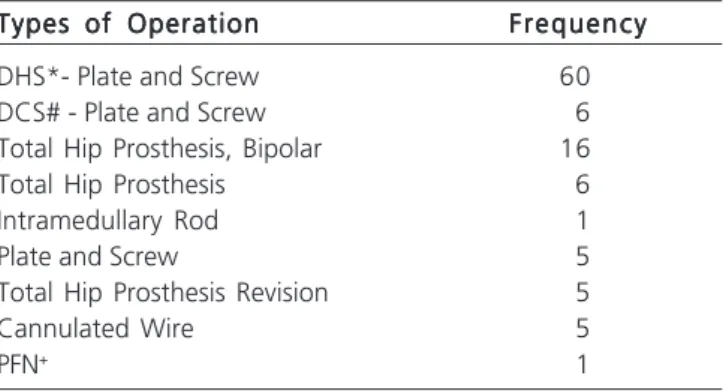
One hundred and five patients underwent various types of surgical correction in the femur, 63.8% of whom were female (Table 1). The mean ages, weights and heights are shown in Table 2. Eighty-six patients were ASA II and 14 ASA III, accounting for 95% of patients.
As for nutritional assessment, low weight was found in 14 patients (13.4%), normal weight in 64 patients (60.9%), overweight in 26 (24.7%) and obesity in one (0.9%). The mean hospital stay until operation was 20 ± 15 days, ranging from three to 86 . Fifty patients entered directly in the project. Of the remaining 55 patients, 22 (21%) had they procedure suspended once, 23 (21.9%) twice, nine (8.5%) three times and one patient (0.9) five times. The mean fasting time was 13h30min, the lowest time being 9h15min and the longest 19h30min.
All patients underwent spinal anesthesia, with no need for general anesthesia complementation. Dural puncture was performed in the sitting position in 69 patients and in the left lateral decubitus in 26 . The needles used were 25G Quincke 44 times, 26G Quincke 20 times, 27G Quincke 21 times, all without introducer, and in ten patients a 27G Whitacre sheath was used. In 79 patients the puncture was performed at L3-L4 and in 26 between L2-L3. The average dose of 0.5% isobaric bupivacaine was 10.93 ± 2.40 mg; the dose of 7.5 mg was used in 20
patients, 10 mg in 42 patients, 12.5 mg in 27 and 15mg in 16. The average replacement with Ringer’s lactate during the procedure was 1069 ± 186 mL, and of hydroxyethylamine, 529 ± 107 mL. Blood replacement was required in 17 patients (16.1%). Hypotension occurred in six patients (5.7%), easily remedied with a single dose of ethylephrine. No cases of bradycardia were observed. The mean operative time (from venoclysis until the end of the operation) was 1h58min ± 37min, ranging from 55 minutes to 4h15min. The lumbar plexus block before the procedure was performed in 45 patients (42.8%), and at the end of the procedure, in 60 (57.2%).
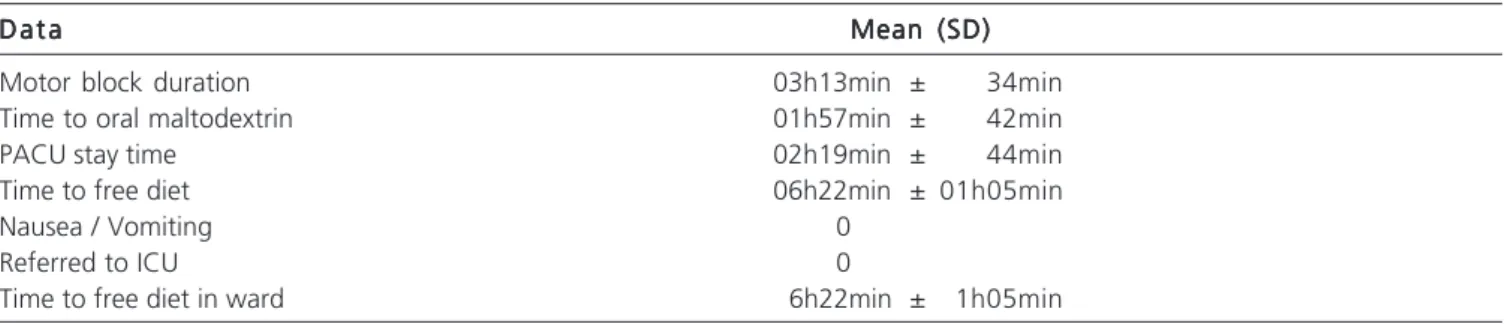
The duration of motor block ranged from 1h45min to 5h30min, onset of feeding with maltodextrin ranged from 40min to 3h45min, and length of stay in this unit ranged from 50 minutes to 4 hours. All patients displayed good acceptance of oral maltodextrin and none had nausea and vomiting in this unit. All patients resumed oral feeding in the ward between 4h and 8h15min after the operation (Table 3).
The mean duration of analgesia was 22h6min ± 3h99min, ranging from 14 to 33 hours. Patients required neither the use of long-term urinary catheters, nor to empty the bladder once. No patient was transferred to the ICU. Only one patient required intravenous hydration due to a drop in blood pressure that recovered with 1000mL Ringer’s lactate. In assessing the first postoperative day, no patient showed mental confusion and all 105 patients were able to be discharged.
DISCUSSION
DISCUSSION
DISCUSSION
DISCUSSION
DISCUSSION
This project aimed to improve the outcome of orthopedic patients, accelerating their recovery after the operation. Its success depends on a multidisciplinary team and on multimodal methods to optimize the passage of the patient through the hospital, in order to accelerate postoperative recovery, reduce complications, adverse events and mortality. The best quality of analgesia, the immediate return of feeding with maltodextrin, around two hours in the recovery room, and free diet between 4h and 8h15min after the operation, contributed to changes in the previously used service conducts. All patients were able to be discharged on the morning of the first postoperative day.
Femur and hip fractures are common injuries and the leading cause of death among elderly patients. These patients constitute an important workload, not only for the surgical wards and operating departments, but for the health care system as a whole. Given the increasing number of elderly people in the world, the management of these patients will become increasingly important in the future. Perioperative care is also becoming more complex, with an increasing number of patients in use of specific medications for concurrent diseases and for the prevention
Table1 Table1 Table1 Table1
Table1 - Types of surgical procedures performed.
Types of Operation Types of Operation Types of Operation Types of Operation
Types of Operation FrequencyFrequencyFrequencyFrequencyFrequency
DHS*- Plate and Screw 60
DCS# - Plate and Screw 6
Total Hip Prosthesis, Bipolar 16
Total Hip Prosthesis 6
Intramedullary Rod 1
Plate and Screw 5
Total Hip Prosthesis Revision 5
Cannulated Wire 5
PFN+ 1
*Dynamic Hip Screw #Dynamic condylar screw
+Proximal Femoral Nail
Table 2 Table 2 Table 2 Table 2
-Table 2 - Demographic data of patients.
D a t a D a t a D a t a D a t a
D a t a Mean ± SDMean ± SDMean ± SDMean ± SDMean ± SD
Age (years) 78.72 ± 10.29
(Min – Max) (60 – 100)
Weight (kg) 62.59 ± 12.06
(Min – Max) (34 – 93)
Height (cm) 158.14 ± 9.81
of thromboembolism. The anesthesiologist must take this into account when planning anesthesia and analgesia techniques.
The purpose of the pre-anesthetic visit was to reduce patient and family anxiety and to provide a detailed explanation of the project. Patients and family members were encouraged to ask questions about the project, and this was considered an essential element in its implementation.
The average in-hospital time before the operation was performed was 20 days. This finding is important because it is known that patients with femur fractures are restricted to the bed and can develop infections, chronic pain and have their nutritional status aggravated. Unlike the IBRANUTI study 4, the nutritional status found on the
day of the operation was of patients with normal weight comprising more than 60% of cases. Due to its good correlation with morbidity and mortality, to the ease of obtaining data and to its importance, the use of the classification applied in this study 15 has been suggested for
elderly patients 16.
Changes in nutritional status contribute to increased morbidity and mortality. Thus, malnutrition predisposes to a number of serious complications, including susceptibility to infection, wound healing deficiency, respiratory failure, cardiac insufficiency, decreased protein synthesis in the liver, with production of abnormal metabolites, decreased glomerular filtration and production gastric secretion 17.
The absence of a strict protocol of hospitalization and surgery has resulted in the suspension of surgery on the appointed day. Of the total 105 patients, 50 entered directly in the project, their operations having not been suspended. The remaining 55 patients underwent the unpleasant situations of having their surgery suspended by the lack of beds in ICU or suitable material, which ranged from one to five times. This is extremely important because one of the major concerns of patients and families is the cancellation on the day of the operation, resulting in a negative experience for all 18. The impact of a
multidisciplinary project and the importance of pre-anesthetic assessment aimed at decreasing cancellations on the day of operation. Thus, all 105 patients who
participated in the project had their surgery performed on the appointed day.
Virtually all Anesthesiology societies of the world advocate fasting of clear fluids two hours before the procedure and light meal without fat six hours before. However, this approach is not followed by most professionals, who require a fasting period of up to eight hours. Another important aspect is that the conventional fasting time is often prolonged by delays in operations, change of schedule, lack of materials, among other cau-ses. An important finding of this study is that the average duration of fasting was found to be around 14 hours, slightly lower than that found in General Surgery, which was 16 hours 8.
All patients underwent spinal anesthesia using 0.5% isobaric bupivacaine , with a mean dose 10.92 mg. This resulted in a low incidence of hypotension (6.3%) and no cases of bradycardia. The use of colloids (6% hydroxyethylamine) during the procedure contributed to a decrease in the incidence of hypotension, in line with findings of hip arthroplasty 19. Another important fact, with the
inclusion of strict criteria, blood replacement was required in 17 patients (16.1%), results similar to 17% in total hip arthroplasty 19.
The average use of 10 mg of isobaric bupivacaine reflected an average duration of motor block of 3h13min, allowing maltodextrin to be introduced orally around two hours after the operation, corresponding to a PACU stay of, on average, 2h19min. The use of maltodextrin did not cause nausea and vomiting and allowed the reintroduction of free diet, on average, 6h22min after the surgery. Early food reintroduction in gastrointestinal operations can be conducted without risks and potential benefits to patients, such as early discharge, lower incidence of infectious complications and decreased costs 20. This study showed
that, in orthopedic surgery, early feeding did not increase the incidence of nausea and vomiting.
Any operation with accelerated rehabilitation that causes early discharge and improves the patient’s experience can be considered a fast operation. Effective relief of postoperative pain is a prerequisite for a prompt recovery and a key part of the successful implementation of a project to accelerate discharge. To address these issues,
Table 3 -Table 3 -Table 3 Table 3
-Table 3 - Data evaluated in the PACU.
D a t a D a t aD a t a D a t a
D a t a Mean (SD)Mean (SD)Mean (SD)Mean (SD)Mean (SD)
Motor block duration 03h13min ± 34min
Time to oral maltodextrin 01h57min ± 42min
PACU stay time 02h19min ± 44min
Time to free diet 06h22min ± 01h05min
Nausea / Vomiting 0
Referred to ICU 0
one should use a protocol involving regional anesthesia, both for surgery and for postoperative analgesia, with decreased use of intrathecal opioids that may be associated with nausea, vomiting and drowsiness. Pain control is arguably the most important aspect that stimulates all the post-operative care for each member of the multidisciplinary team. This control was performed with lumbar plexus block with levobupivacaine in enantiomeric excess, with the injection before the procedure in some patients and in others immediately after surgery. The mean duration of analgesia was around 22 hours, ranging from 14 to 33, results similar to the ones of other work with the same type of operation
21. At the dose used, all patients had residual analgesia on
the next day, without any degree of motor blockade. The best pain control allowed patients to return to normal activities as soon as possible. Patients were given food and drink around six hours after surgery, already in the presence of their families in the ward, after removal of the intravenous hydration.
Urinary retention increases with age, with a risk of 2.4 times in patients older than 50 years, prevails in men (4.7%) over women (2.9%) 22 and varies with the type of
surgical treatment and intraoperative hydration 22. Urinary
retention often occurs in patients in whom spinal morphine is used and there is no difference between the doses used and the need for catheterization 23. The ACERTORPE
project included the non-use of opioids in spinal anesthesia to avoid bladder catheterization, routinely adopted in this type of surgery in the hospital prior to the project implementation. Likewise, there were restrictive hydration during surgery. This resulted in the lack of need for perioperative bladder catheterization in all patients.
The trauma of orthopedic surgery is followed by intense pain, catabolism, loss of the function of various organs and an increased risk of thromboembolism and decreased cognitive function. These events may contribute to the need for prolonged hospitalization. Postoperative confusion and delirium are common, occurring in 50% of elderly patients after surgical repair of fractures of the femur and hip, and may 24 or may not 25 be associated with increased mortality.
In the present study, there was no confusion and delirium in review on the first postoperative day.
The optimization of the individual components of the perioperative care reduces the need for hospitalization, morbidity and prolonged convalescence, with subsequent reduced costs 26. The concept of fast-track,
or accelerated postoperative recovery, evolved during the past two decades and this work on its implementation, it showed evidence of its benefits. Nonetheless, the implementation of this approach by the medical staff was not widespread. The difficulties in implementing a project of acceleration in orthopedic surgery may be due to a lack of knowledge or even a reluctance to introduce evidence-based concepts. However, this seems unlikely, since most employees aspire to provide their patients with the best possible care and comfort during their stay 27.
Early feeding after operations involving resection and intestinal anastomosis can be conducted without the risks and with potential benefits to patients, such as early discharge, low incidence of infectious complications and cost reduction 21. Recent studies indicate that the use of a
carbohydrate-enriched liquid solution determined higher satisfaction, reduced irritability, lower incidence of vomiting, increase in pH, better gastric emptying and especially a lower organic response to surgical stress 28,29. These facts
were observed in this study by the increased satisfaction of patients feeding already in the PACU, allowing them to return to the ward without intravenous hydration, and without nausea and vomiting.
The project focused on the assessment of hospi-tal stay, early feeding, the use of urinary catheter, non-admittance to the ICU, better control of postoperative pain, blood transfusion strategies, early rehabilitation, prevention of thromboembolism and aspects of humanization of care to elderly patients. We conclude that the use of these measures may improve fasting time, the time of reintroduction of oral feeding and decrease the duration of hospitalization, providing earlier discharge in elderly patients with femur fractures and quicker return to family life, working as a humanization treatment to the elderly.
R E S U M O R E S U M O R E S U M O R E S U M O R E S U M O
Objetivo: Objetivo: Objetivo: Objetivo:
Objetivo: avaliar os resultados clínicos iniciais após a implantação de protocolo perioperatório em pacientes com mais de 60 anos de idade submetidos ao tratamento cirúrgico de fratura do fêmur. Métodos:Métodos:Métodos:Métodos:Métodos: estudo prospectivo com pacientes com idade superior a 60 anos que foram internados com fratura de fêmur. Operados sob raquianestesia e analgesia através do bloqueio plexo lombar. A avaliação dos dados foi realizada antes da chegada ao centro cirúrgico, durante o procedimento cirúrgico, na sala de recuperação pós-anestésica e, na enfermaria, na manhã seguinte da operação. Resultados:Resultados:Resultados:Resultados:Resultados: os 105 pacientes foram submetidos a diversos tipos de correção cirúrgica no fêmur. A internação variou de três a 86 dias. O jejum variou de 9h15min a 19h30min. Hipotensão arterial ocorreu em 5,7%. A duração do bloqueio motor variou de 1h45min a 5h30min, a alimentação com maltodextrina variou de 50min a 3h45min e o tempo de permanência na sala de recuperação pós-anestésica variou de 50min a 4 horas. A alimentação oral na enfermaria variou de 4h a 8h15min. A duração da analgesia variou de 14 a 33 horas. Nenhum paciente necessitou de sonda vesical de demora, nem foi encaminhado à UTI. Todos os pacientes tinham condições de alta hospitalar no primeiro dia de pós-operatório. Conclusão:
Conclusão: Conclusão: Conclusão:
Conclusão: a utilização de um projeto de aceleração do pós-operatório pode diminuir o tempo de jejum, a duração da internação e proporcionar alta hospitalar mais rápida em pacientes idosos com fratura de fêmur.
Descritores: Descritores: Descritores: Descritores:
REFERENCES
REFERENCES
REFERENCES
REFERENCES
REFERENCES
1. Harwood TN. Optimizing outcome in the very elderly surgical patient. Curr Opin Anaesthesiol. 2000;13(3):327-32.
2. Imbelloni LE, Beato L. Comparison between spinal, combined spinal-epidural and continuous spinal anesthesia for hip surgery in elderly patients: a retrospective study. Rev Bras Anestesiol. 2002;52(3):316-25.
3. Koval KJ, Maurer SG, Su ET, Aharonoff GB, Zuckerman JD. The effects of nutritional status on outcome after hip fracture. J Orthop Trauma. 1999;13(3):164-9.
4. Waitzberg DL, Caiaffa WT, Correia MI. Hospital malnutrition: the Brazilian national survey (IBRANUTRI): a study of 4000 patients. Nutrition. 2001;17(7-8):573-80.
5. Basse L, Hjort Jakobsen D, Billesbølle P, Werner M, Kehlet H. A clinical pathway to accelerate recovery after colonic resection. Ann Surg, 2000;232(1):51-7.
6. Kehlet H, Mogensen T. Hospital stay of 2 days open sigmoidectomy with a multimodal rehabilitation programme. Br J Surg, 1999;86(2):227-30.
7. Nygren J, Hausel J, Kehlet H, Revhaug A, Lassen K, Dejong C, et al. A comparison in five European Centers of case mix, clinical management and outcomes following either conventional or fast-track perioperative care in colorectal surgery. Clin Nutr, 2005;24(3):455-61.
8. Aguilar-Nascimento JE, Bicudo-Salomão A, Caporossi C, Silva RM, Cardoso EA, Santos TP. Acerto pós-operatório: avaliação dos re-sultados da implantação de um protocolo multidisciplinar de cui-dados peri-operatórios em cirurgia geral. Rev Col Bras Cir. 2006;33(3):181-7.
9. Basse L, Raskov HH, Hjort Jakobsen D, Sonne E, Billesbølle P, Hendel HW, et al. Accelerated postoperative recovery programme after colonic resection improves physical performance, pulmonary function and body composition. Br J Surg, 2002;89(4):446-53. 10. Breuer JP, von Dossow V, von Heymann C, Griesbach M, von
Schickfus M, Mackh E, et al. Preoperative oral carbohydrate administration to ASA III-IV patients undergoing elective cardiac surgery. Anesth Analg, 2006;103(5):1099-108.
11. Kehlet H, Dahl JB. Anaesthesia, surgery, and challenges in postoperative recovery. Lancet. 2003;362(9399):1921-8. 12. Maltby JR, Pytka S, Watson NC, Cowan RA, Fick GH. Drinking
300mL of clear fluid two hours before surgery has no effect on gastric fluid volume and pH in fasting and non-fasting obese patients. Can J Anaesth. 2004;51(2):111-5.
13. Holland-Cunz S, Günther P. Fast tracking in pediatric surgery. Chirug. 2009;80(8):719-23.
14. Wainwright T, Middleton R. An orthopaedic enhanced recovery pathway. Curr Anaesth Crit Care. 2010;21(3):114-20.
15. Lipschitz DA. Screening for nutritional status in the elderly. Prim Care. 1994;21(1):55-67.
16. Cervi A, Franceschini SCC, Priore SE. Análise crítica do uso do índice de massa corporal para idosos. Rev Nutr. 2005;18(6):765-75.
17. McWhirter JP, Pennington CR. Incidence and recognition of malnutrition in hospital. BMJ. 1994;308(6934):945-8.
18. Moran M, Khan A, Sochart DH, Andrew G. Evaluation of patient concerns before total knee and hip arthroplasty. J Arthroplasty. 2003;18(4):442-5.
19. Hamaji A, Hajjar L, Caiero M, Almeida J, Nakamura RE, Osawa EA, et al. Volume replacement therapy during hip arthroplasty using hydroxyethyl starch (130/0.4) compared to lactated ringer decreases allogeneic blood transfusion and postoperative infection. Rev Bras Anestesiol. 2013;63(1):27-44.
20. Lewis SJ, Egger M, Sylvester PA, Thomas S. Early enteral feeding versus “nil by mouth” after gastrointestinal surgery: systematic review and meta--analysis of controlled trials. BMJ. 2001;323(7316):773-6.
21. Imbelloni LE, Beato L, Beato C, Cordeiro JA. Analgesia pós-opera-tória para procedimentos cirúrgicos ortopédicos de quadril e fêmur: comparação entre bloqueio do compartimento do psoas e blo-queio perivascular inguinal. Rev Bras Anestesiol. 2006;56(6):619-29.
22. Baldini G, Bagry H, Aprikian A, Carli F. Postoperative urinary retention: anesthetic and perioperative considerations. Anesthesiology. 2009;110(5):1139-57.
23. Jacobson L, Chabal C, Brody MC. A dose-response study of intrathecal morphine: efficacy, duration, optimal dose, and side effects. Anesth Analg. 1988;67(11):1082-8.
24. McCusker J, Cole M, Abrahamowicz M, Primeau F, Belzile E. Delirium predicts 12-months mortality. Arch Intern Med. 2002;162(4):457-63.
25. Furlaneto ME, Garcez-Leme LE. Impact of delirium on mortality and cognitive and functional performance among elderly people with femoral fractures. Clinics. 2007;62(5):545-52.
26. Kehlet H, Wilmore DW. Evidence-based surgical care and the evolution of fast-track surgery. Ann Surg. 2008;248(2):189-98. 27. Knops AM, Vermeulen H, Legemate DA, Ubbink DT. Attitudes,
awareness, and barriers regarding evidence-based surgery among surgeons and surgical nurses. World J Surg. 2009;33(7):1348-55. 28. Kehlet H, Wilmore DW. Multimodal strategies to improve surgical
outcome. Am J Surg. 2002;183(6):630-41.
29. Nygren J, Thorell A, Ljungqvist O. Preoperative oral carbohydrate nutrition: an update. Curr Opin Clin Nutr Metab Care. 2001;4(4):255-9.
Received on 08/04/2013
Accepted for publication 20/05/2013 Conflict of interest: none.
Source of funding: none.
Address for correspondence: Address for correspondence:Address for correspondence: Address for correspondence:Address for correspondence: Luiz Eduardo Imbelloni