Atención Primaria
www.elsevier.es/ap0212-6567/$ - see front matter © 2013 Elsevier España, S.L. Todos los derechos reservados.
Incluida en MEDLINE, EMBASE, SCOPUS y SCIENCE CITATION INDEX EXPANDED
Publicación Oficial de la Sociedad Española de Medicina de Familia y Comunitaria
Mayo 2013 Vol. 45. Especial Congreso 1
Sociedad Española de Medicina de Familia y Comunitaria www.semfyc.es
ISSN: 0212-6567
www.elsevier.es/ap
SCIENTIFIC ARTICLES
Nutritional status in preschool children: current trends
of mother’s body perception and concerns
Graça Aparício
a,*, Madalena Cunha
a, João Duarte
a, Anabela Pereira
b,
Jorge Bonito
c, Carlos Albuquerque
aaHealth School, Polytechnic Institute of Viseu, Portugal
bUniversity of Aveiro, Portugal
cUniversity of Évora, Portugal
MISIJ project funded by FCT‑Monitoring health indicators in children and adolescents: Impact of health education‑ Reference PTDC/ CPE‑CED/103313/2008‑ and CI&DETS FCT‑PEstOE/CED/UI4016/2011
* Correspondence author.
E-mail: [email protected] (G. Aparício).
KEYWORDS Weight status; Body image; Mother’s perception; Overweight children Abstract
Background: Studies in several countries indicate that parents show little concern and aren’t
much aware of the nutritional status of their children, and have the tendency to underestimate the overweight which may present a difficulty when promoting healthier life styles. The aim of this study was to identify maternal body image perceptions in preschool children and analyze its relationship with nutritional status and family social demographic variables.
Methods: A transversal and descriptive study was developed in a sample of 1424 preschool
chil-dren and their mothers living in several parts of Portugal. The chilchil-dren were weighted and measured by trained personnel, the BMI was calculated and the nutritional status was classified according to the NCHS referential (CDC, 2000).1 Mother’s real and ideal body image perception
from their children was evaluated according to Collins’ body image silhouettes (1991).2
Results: The ideal and real perception was translated in a negative index on both children’s
genders, however 67.2% of the mothers revealed accuracy of perception, while 22.3% had a negative and 12.8% a positive discrepancy, being this significant concerning gender and age of the children. Children’s actual weight status (ie, 60.2% normal weight, 16.9% overweight, 17.4% obese and 5.5% underweight) was significantly different from their parents’ perceptions (ie, 52.3% normal weight, 27.5% overweight 0.6% obesity and 19.6% underweight) explaining in 25.9% the variability of this perception. Globally 42.3% has no discrepancy but 44.3% thinks that children were thin and 13.4% heavier. This difference is significant concerning the age and scho-larship of the mothers but has no relation with the income and residence.
Conclusion: Despite signs of a positive trend, mothers continue to show difficulty in recognizing
the children’s nutritional status, so effective public health strategies to increase parents’ awareness could be the first step in an effort to prevent childhood obesity.
Background
Nowadays, obesity is considered one of the major problems in public health affecting adults and children and has taken epidemical proportions mostly in the mediterranean regions, which includes Portugal, occupying in this subject an unfavorable position (Moreira 2007).3
In its development, genetic and environmental causes have been pointed out, being those, according to the evidences, the strongest determinant factors.4 In the
context of children’s obesity the parents are considered as having a main role, due to their impact in the construction of a family food environment, not only by precociously appeasing to the food context of the children, but also by establishing the emotional environment as meals are concerned.5 Related to this subject, the parent’s perception
of the body image of their children and their nutritional status has been analyzed, because it is considered that an incorrect parent’s perception or unaware of their children’s overweight are less likely to the adoption of preventive strategies or treatments facing this condition.6,7
The body image is a multidimensional construct and its development takes place in a cultural context, where the ethnical / cultural groups differ in their understanding and valorization.8 Due to the fact that usually women take the
primary responsibility for caring, feeding and the children education, the beliefs that women have concerning their own body image, has implications on the perception and response to their children’s body image, having this pattern variability according to their ethny9 cultural beliefs,10 and
social economic conditions.6,7,11,12
Studies developed with latin‑american population, point out that many mothers of obese children, believe their sons be healthy, although these same parents are willing to believe that obese children in general should be taken to a nutritionist or doctor to help solving the weight problem.13
While analyzing the cultural factors, it would be gainful to use qualitative analyses6,11 that allow to explore some
cultural aspects that are more deeply‑rooted, such as the belief that the “chubby” child is healthier and a sign of the mother’s competence and because parents believe that while growing, their children’s weight will tend to be distributed in a uniform manner. These cultural beliefs are deeply‑rooted in many countries, such as in Portugal.
Although there are no certainties that increasing parent’s awareness concerning of children’s nutritional status is a way of preventing overweight in children, evidence indicate that the parental monitoring of these conditions, may prevent less healthy behaviours among children and teenagers. Therefore, this study is willing to 1) identify mother’s perception concerning the real and ideal image of their preschool child and 2) analyze its relation with the children’s nutritional status and with social demographic variables.
Material and methods
Transversal and descriptive study, developed in the Health School/Polytechnic Institute of Viseu ‑ Portugal, in the context of a wider project (MISIJ‑Monitoring of Infant ‑ Juvenile Health Indicators: Impact on Education for Health FCT reference PTDC/CPE‑CED/103313/2008. This includes 1424 children between 3 and 6 years old, average age 4.58 years old (SD = 0.990), and their mothers, average age 34.47 years old (SD = 5.29), living in several parts of Portugal. The selection of the children’s sample took in consideration as inclusion criteria living with the mother and not presenting a base chronic illness, not mentioning the potential overweight.
A social demographic questionnaire was used and a child anthropometric evaluation was made, with weight, height and BMI percentile for age and gender. In order to classify the nutritional status the NCHS referential was used, (CDC, 2000): low weight < 5; normal weight > 5 < 85; pre‑obesity ≥ 85 < 95; obesity ≥ 95.
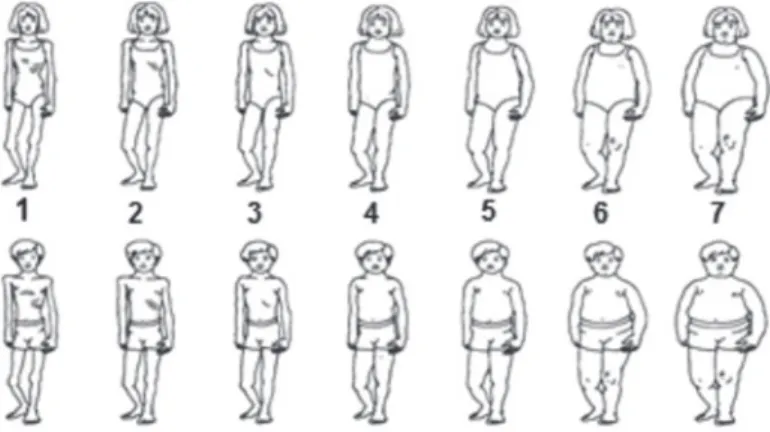
In order to evaluate the mother’s perception of the real and ideal body image of the child, was used the “Body
Silhouette Chart” de Collins, (1991),2 adapted by Aparício‑
Costa (2009)14 (Fig. 1). The chart consists of seven children’s
silhouette, male and female, with numbers from 1 to 7, which corresponds to the score of each image.
In the application, the mothers are asked to point out the image they consider the best one to represent their child’s silhouette (real perception) and the one they would like to be (subjective ideal). The obtained index translates the difference between the real and ideal perception. A positive score indicates a distorted perception, as the corporal real image is
higher than the subjective ideal (positive discre pancy); a negative score also indicates a distorted percep tion where the real image is thinner than the ideal corporal image (negative discrepancy). The zero score (0) indicates no discrepancy.
The silhouettes 1 and 2 represent low weight; 3 normal weight; 4 and 5 represent pre‑obesity; 6 and 7 obesity.
On the data analysis measures of central and dispersion trends were used and non distinctive measures such as test
t Student were applied, Chi‑Square, Odds Ratio and Linear
Multiple Regression, and the level of statistic significance was defined in p = 0.05. The data was analyzed with the SPSS - Statistical Package for Social Sciences (Version
21.0 for Windows) program.
Results
Children’s nutritional status
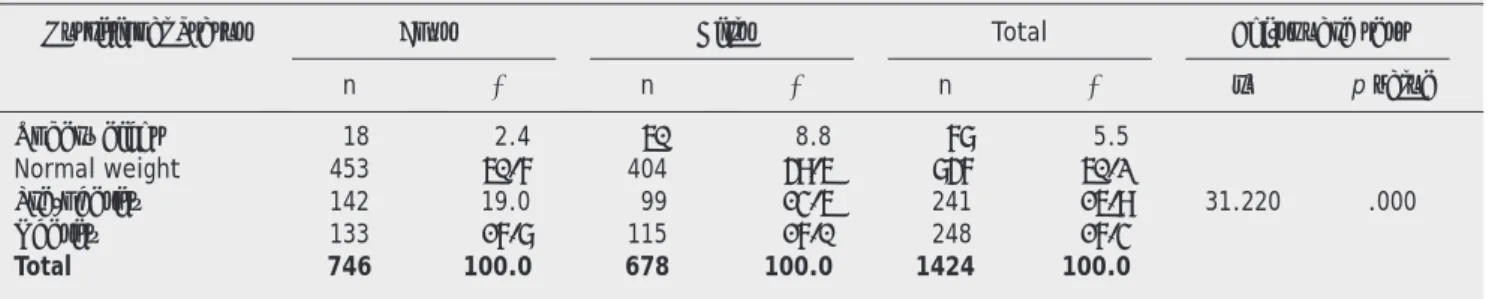
The BMI is highest in boys (men BMI: x¯ = 16.76; dp = 1.79; women BMI: mean = 16.49; SD = 1.88), without significance (t = 1.319; p = .187). The nutritional status was normal in 60.2% of the children, 5.5% presented low weight, 16.9% pre‑obesity, (19.0% male, 14.6% female) and 17.4% obesity, higher in male (17.8%). The overweight (pre‑obesity and obesity) is significantly superior in boys (36,8% versus 31.6%) (x2 = 31.220; p = .000) (Table 1).
Mothers’ concern that their children may become
overweighed or obese
Among mothers, 53.8% feel from concerned to very much
concerned and 46,2% show few or no concern that their son
may become pre‑obese or obese, specially regards their boys (30.2%). No statistic significance was found related to the mothers’ concern and the children’s gender (x2 = 6.885;
p = .142), age (x2 = 5.388; p = .944) and residence (x2 = 4.931;
p = .294). Only scholarship revealed to be significant (x2 = 37.934; p = .000), with the distinction of mothers with
the basic scholarship who showed from concern to very much
concern (39.5% e 20.9% respectively) from the ones with higher
educational studies who showed not much concern (36.2%).
Real versus ideal mothers’ perception
The mother’s real perception of her children’s body images varied between the image 1 and 6 for both genders, with average on the normal weight indicative silhouette (women
x¯ = 3.10; SD = .847; men x¯ = 3.15; SD = .823), not dependent of the children’s gender (t = 1.507; p = .118). The ideal perception, which is the image that the mothers would like their children to have, varied from the image 1 to 5, which is to say, that none mothers pointed out as ideal image the representative silhouettes of obese children (Images 6 and 7), although with an average slightly higher than the real image (women x¯ = 3,17; SD = .667; men x¯ = 3.29; SD = .620) and depending on gender (t = 2.610; p = .010).
The difference between the real and ideal perception was translated in a negative index for both genders (global: x¯ = −.110; SD = 0.666), indicating a discrepancy of mother’s perception, which globally consider the image of their children thinner than they wanted their children to be. Table 2 shows that the majority (67.2%) pointed out the same image concerning the real and ideal subjective, assuming non discrepancy of perception, while 22.3% keep negative discrepancy, with a significative difference concerning gender (p = .026) and children’s age (p = .013), that the adjusted residual located in the positive discre‑ pancy in girls and in 6 year old children, this is to say, that these mothers would ideally like their daughters to have a thinner figure.
The discrepancy between the real and ideal perception varied yet significantly as the residence area and mother’s scholarship, being on rural areas and that present negative discrepancy (p = .006), this is to say that they would like their children to be a little more chubby, and to those who have basic education (p = .000), opposing to the ones from the city, with higher education and the families with high incomes (p = .008), who revealed without perception discrepancy.
Children’s BMI and mother’s real perception
By analyzing the relationship between body image mothers perception and the real nutritional status of the children, it is noted that 52.3% of the mothers see their children as having normal weight, 27.5% pre-obesity, 19.6% low weight and only 0.6% obesity.
In Figure 2 it is possible to see the difference between the mother’s real perception of the children body image and their nutritional status.
In spite of the noted differences of perception, the linear regression indicates that the higher the children’s BMI, the higher the silhouette pointed out by the progenitors (r = .509; p = .000), which allows us to consider that the children’s BMI predicts the mother’s perception (F = 475,838;
Table 1 Children’s nutritional status by gender classified by NCHS, (CDC 2000) cut‑off points
Nutritional Status Boys Girls Total Chi‑square test
n % n % n % x2 p value Underweight 18 2.4 60 8.8 78 5.5 Normal weight 453 60.7 404 59.6 857 60.2 Pre‑obesity 142 19.0 99 14.6 241 16.9 31.220 .000 Obesity 133 17.8 115 17.0 248 17.4 Total 746 100.0 678 100.0 1424 100.0
p = .000; t = 21,814; p = .000), explaining in 25.9% the varia‑ bility of that perception.
Through the analysis of the Odds Ratio we can still infer that the probability of children to have pre‑obesity and to be understood in that manner by the mothers is five times higher (OR = 5.387; IC 95% = 4.201‑6.907).
The difference between the mother’s perception and the children’s BMI depends on children’s gender and age, being placed, according to the adjusted residual, in girls and in 4 year olds where the mothers reveal positive discrepancy and in 5 year olds where this one was negative. On the other hand, older mothers (≥ 40 years old) see the image of their children as thinner than the one they truly have, while the ones who have basic education overestimate that percep‑ tion, existing no difference concerning the household income (Table 3).
Discussion
The prevalence of overweight in Portugal, mostly on pre‑ school children supports the pertinence of the factors analysis that may pose a difficulty to the implementation of strategies to its prevention. This study intended to identify possible discrepancies between real and ideal mother’s perception concerning the body image of the preschool children and differences with the nutritional status analy zing,
moreover, the relation with social demo graphic charac‑ teristics.
While confronting the results of this study with the ones from other authors, taking into consideration the produced inferences, due to the respective method diversity, speci‑ fically in the measurement instruments used and in the different sample amplitudes. Moreover, limitations related to the subjectivity associated to the identification of the silhouettes and respective score must be considered.
Table 2 Discrepancy between real and ideal mother’s perception by children’s sex and age
Real and ideal mother’s perception
Negative discrepancy Without discrepancy Positive discrepancy Chi‑square test
n % n % n % x2 p value
Child’s demographic profile
Sex Boys 172 23.1 511 68.5 63 8.4 Girls 145 21.4 446 65.8 87 12.8 7.324 .026 Age (years) 3 53 22.2 172 72.0 14 5.9 4 97 23.4 284 68.4 34 8.2 5 103 21.5 317 66.3 58 12.1 16.057 .013 6 64 21.9 184 63.0 44 15.1
Mother’s demographic profile
Age (years)
≤ 25 31 36.0 47 54.7 8 9.3
26‑32 126 26.6 291 61.4 57 12.0
33-39 89 18.8 332 70.0 53 11.2 27.440 .000
≥ 40 71 18.2 287 73.6 32 8.2
School education (years)
4 31 36.0 47 54.7 8 9.3 6/9 126 26.6 291 61.4 57 12.0 27.440 .000 12 89 18.8 332 70.0 53 11.2 15 71 18.2 287 73.6 32 8.2 Total 317 22.3 957 67.2 150 10.5 Household income (n = 1280) Low 176 23.8 474 64.0 91 12.3 Medium 58 22.2 180 69.0 23 8.8 13.863 .008 High 51 18.3 209 75.2 18 6.5
Figure 2 Children’s weight categories by measured BMI and
mother’s perceptions. 70 60 50 40 30 20 10 0
underweight normal weight pre-obesity obesity 19,6 5,5 60,2 52,3 27,5 16,9 17,4 0,6 Mother’s perceptions Measured BMI
The investigation indicated that among the studied children 34.3% showed overweight (including 17.4% obesity) which is globally higher than what is reported in Portugal to this age group, but may indicate, on the other hand, not only its increase but also the regional variations of the problem. Studies developed in the same age group in the area of the Beira Interior15 found globally a prevalence of
overweight of 27.7% (12% obesity), while later on, in a EPObIA16 study representative in a regional level, the pre‑
valence was 35.5% (13% obesity) (WHO cut‑offs 2006 and 2007), having the authors noted a trend of greater preva‑ lence in children of the north of Portugal (39.3%). In the center region in 201117 it was identified 31.3% of over weight
(12.4% obesity). In spite of these oscillations, several studies point out the dimension of the problem in this age group and its trend which don’t show, so far, any signs of slowing down.
Assuming that the acknowledgement that overweight is a disease and admitting this problem in children, may be considerate the first step to the development of healthier life habits.6 In this context, the current analysis of the
mother’s concern related to the possible children over‑ weight revealed that opinions are divided, and more mothers demonstrate concern that their girls become over‑ weighed, which reveals, on one hand an approach with the nutritional status, because in the study the prevalence of overweight is superior in boys, and on the other hand, comparatively to previous studies announces a progressive
changing trend on the parents’ concern, possibly indicating a greater awareness concerning the problem of children’s obesity. On a study that took place in 200917 with 234
chil-dren and their parents, an inverse position was identified, due to, from the mothers and fathers that were studied, most of them felt not much/no concern with that condition, results that were similar to what was documented in previous studies.6,7,11,18 This parents’ position allowed to
admit the underlying cultural influences, mostly of latin countries, where it is acknowledged that “a plumper child is healthier and a sign of greater maternal competence”.
As far as the difference between the perception of the real and ideal image is concerned, in this study and previous ones, it is still noted a tendency of mothers to underestimate the nutritional status of the child and reveal the desire to be “plumper”, results confirmed by the obtained average negative score. The difference of perception was still signifi cative but positive concerning the daughters, which leaves underlying the desire that they were thinner. Other authors7,6,18‑20 have suggested that as far as the daughters
are concerned, there is a more appropriate perception trend of the body image which may indicate a greater conso nance with the social standards of the ideal body, more strongly imposed to the female gender than boys.
When comparing the real perception of the mothers with the nutritional status of the children evaluated by the BMI percentile, the results indicate a mother’s trend to under‑ estimate the true nutritional status, because they are not
Table 3 Children’s nutritional status, mother’s perception and socio‑demographic profile
Real and ideal mother’s perception
Negative discrepancy Without discrepancy Positive discrepancy Chi‑square test
n % n % n % x2 p value
Child’s demographic profile
Sex Boys 335 44.9 330 44.2 81 10.9 Girls 296 43.7 272 40.1 110 16.2 9.175 .010 Age (years) 3 99 41.4 102 42.7 38 15.9 4 152 36.6 183 44.1 80 19.3 5 245 51.3 190 39.7 43 9.0 33.424 .000
Mother’s demographic profile 6 135 46.2 127 43.5 30 10.3
Age (years)
≤ 25 35 49.3 26 36.6 10 14.1
26‑32 178 41.7 199 46.6 50 11.7
33-39 285 42.3 288 42.8 100 14.9 13.279 .039
≥ 40 133 52.6 89 35.2 31 12.3
School education (years)
4 33 38.4 35 40.7 18 20.9 6/9 225 47.5 180 38.0 69 14.6 12.215 .057 12 207 43.7 216 45.6 51 10.8 15 166 42.6 171 43.8 53 13.6 Total 631 44.3 602 42.3 191 13.4 Household income (n = 1280) Low 322 57.5 315 56.9 104 62.7 Medium 118 21.1 116 20.9 27 16.3 2.473 .650 High 120 21.4 123 22.2 35 21.1
aware of the existence of obesity on their children, (only 0.6% point out the representative images of this condition), and an underestimated perception, because they place a greater percentage of children with low weight. Comparable results were described in other investigations6,7,11,18,20
Jeffrey18 and He & Evans6, documented on their studies
respectively that 75% and 38% of the parents weren’t able to identify in an accurate way their children’s nutritional status and didn’t recognized the presence of obesity. The qualitative analysis of the data given by the parents, allowed He & Evans6 to fundament this distortion in beliefs
that the children with overweight are recognized by parents as being “strong” or “solid” rather than “fat”. In another investigation with a group of Spanish mothers,10 this discre‑
pancy was discovered in 61% of the mothers having no relation with this age and academic level. As far as previous studies developed in Portugal are concerned17,19 it is acknow‑
ledged an evolution in the accuracy of the perception of children mostly the ones with pre‑obesity, however, still not much accurate in extreme weight.
It has been admitted that one of the causes of the distortion of the children’s body image is based on the belief that with growth, the weight tends to distribute more equally and becomes normal, or this may be associated with denial feelings and reluctance or desensibilization in admitting a weight problem.11,18 These cultural beliefs are
deeply‑rooted in many countries, Portugal included. The study of the influence of the social demographic variables in the perception of the children’s body image has shown clear contradictory results6,10,11 being, however, the
low scholarship and household income, associated with a greater distortion of that perception by the parents. Equally, in the present investigation it was noted a discre‑ pan cy depending on mother’s age and scholarship, but with no relationship with the family income, and was seen that older mothers show a higher tendency to underestimate the child weight, while the ones that have lower scholarship an tendency to overestimate the weight of their children is noted. Nowadays, child obesity has been considered a transverse problem to the several social classes,18 which is
corroborated in this investigation, due to the fact that the nutritional status of the studied children has no relation with the scholarship level and age of the mothers. There‑ fore, the results of this association indicate the need to valorize the family characteristics as the underlying beliefs, in activities that are willing to enhance the awareness concerning the nutritional status of the children. One example of these beliefs, frequent in previous generations and pointed out in focus group21 studies, is the preference
by big and strong children, associated to the idea that they are healthier, belief that may be underlying to this association with older mothers.
Therefore, due to the fact that behaviours related to children’s health in preschool age are mostly under the influence and control of their parents, it is considered complex to face in an effective manner the epidemic of childhood obesity particularly in Portugal, without improving the parents’ understanding of the consequences of this problem in children’s health, reinforcing the importance of integrating in the promotion of health activities and nutritional orientation programs, the cultural aspects, as empiric indicators, such as beliefs and family attitudes, that
may influence the perception of the nutritional status of children.
It is believed still important to teach parents about the process and stages of child growth and its influence on feeding behavior, improving self‑confidence in their role, with consequent mutual benefits.
The partnership work of health professionals, orientated and focused on family, which integrates an active partici‑ pation of the parents, will be the key to family‑orien ted lifestyle changes and also one of the essential elements to integrate in the management and balance of the nutritional status in pediatric group.
What is known about the subject
Parents did not recognize that their children are overweight or obese, specially their boys, and this misperceptions may depends on ethnic and cultural groups.
Helping parents to be aware of the nutritional status of their children may become the first step to the prevention of childhood overweight and the key to the definition of healthier life styles.
What is new about this study
This study confirms that in a sample of Portuguese mothers of preschool children only 42.3% recognized that their children are overweight, while 44.3% underestimate the real child nutritional status, mostly on 5 year old boys and 13.4% overestimate it, mostly on girls. Moreover, it is conclu ded that the perception discrepancy depends on the family’s social demographic variables, such as age and mother’s education.
Due to previous studies that took place in Portugal it is possible to note a progressive improvement in the accuracy of the perception of parents concerning this subject.
Conflict of interests
The authors declare that there are no conflicts of interests.
Acknowledgements
Project MISIJ funded by FCT (PTDC/CPE‑CED/103313/2008) and CI&DETS FCT (PEstOE/CED/UI4016/2011).
References
1. Centers for Diseases Control and Prevention (CDC). National Center for Health and Statitics. Clinical Growth Charts [Inter‑ net]. GA, USA: CDC; [Revisão 2000 Março 22; consult. 2008 Junho 4]. Retrieved from http://www.cdc.gov/nchs/about/ major/nhanes/growthcharts/clinical_charts.htm
2. Collins ME. Body figure perceptions and preferences among preadolescent children. Journal of Eating Disorders. 1991;10: 199-208.
3. Moreira P. Overweight and obesity in Portuguese children and adolescents. Journal of Public Health. 2007;15:155‑61. 4. Guedes EP, Carraro L, Godoy‑Matos A, Lopes AC. Obesidade:
logia. Projecto Directrizes. Sociedade Brasileira de Clínica Médica; 2005.
5. Birch LL, Fisher JO, Grimm‑Thomas K, Markey CN, Sawyer R, Johnson SL. Confirmatory factor analysis of the child feeding questionnaire: a measure of parental attitudes, beliefs and practices about child feeding and obesity proneness. Appetite. 2001;36:201‑10.
6. He M, Evans A. Are parents aware that their children are overweight or obese? Do they care? Canadian Family Physician. 2007;53:1493‑9.
7. Gualdi‑Russo E, Albertini A, Argnani L, Celenza F, Nicolucci M, Toselli S. Weight status and body image perception in Italian children. Journal of Humann Nutrition Diet. 2008;21:39‑45. 8. Powell AD, Kahn AS. Racial‑differences in womens desires to be
thin. International Journal of Eating Disorders. 1995;17:191‑5. 9. Birch LL, Fisher JO. Mothers’ child‑feeding practices influence
daughters’ eating and weight. American Journal of Clinical Nutrition. 2000;71:1054‑61.
10. Hackie M, Bowles CL. Maternal perception of their overweight children. Public Health Nursing. 2007;24:538‑46.
11. Baughcum AE, Leigh BA, Chamberlin A, Deeks CM, Powers SW, Robert C. Whitaker R. C. Maternal perceptions of overweight preschool children. Pediatrics. 2000;106:1379‑87.
12. Jackson D, McDonald G., Mannix, Faga P., Firtko A. Mothers’ perceptions of overweight and obesity in their children. Austra‑ lian Journal of Advanced Nursing. 2005;23:8‑11.
13. MacArthur LH, Anguiano R, Gross KH. Are household factors putting immigrant Hispanic children at risk for becoming
overweight: a community‑based study in eastern North Carolina. Journal of Commun Health. 2004;29:387‑404. 14. Aparício Costa MG. Obesidade infantil: práticas alimentares e
percepção materna de competências Projecto de Doutora‑ mento]. Aveiro: Universidade de Aveiro; 2009.
15. Duarte E. Estilos de vida familiar e peso excessivo na criança em idade pré‑escolar na região da Beira Interior. In do Carmo, Santos e Vieira (Ed.), Obesidade em Portugal e no Mundo (pp. 139‑159). Lisboa: Faculdade de Medicina da Universidade de Lisboa; 2008.
16. Miranda AC, Santos O, Araújo J, Ramos E, Lopes C, Carreira M, Galvão‑Teles A. Prevalência da obesidade infanto‑juvenil e perí‑ metros da cintura em Portugal: resultados do EPOBiA. Revis ta de Endocrinologia, Diabetes e Obesidade (ENDO). 2010;4:246. 17. Aparício MG, Cunha M, Duarte J, Pereira A. Olhar dos pais sobre
o estado nutricional das crianças pré‑escolares. Millenium. 2011;40:99-113.
18. Jeffery AN, Voss LD, Metcalf SB, Alba S, Wilkin TJ (2005). Parents’ awareness of overweight in themselves and their children: cross sectional study within a cohort (EarlyBird 21). BMJ. 2005;330:23‑4.
19. Aparício MG. Obesidade infantil: práticas alimentares e percep‑ ção materna de competência [Tese de Doutoramento]. Aveiro: Universidade de Aveiro; 2012.
20. Gualdi‑Russo E, Manzon VS, Masotti S, Toselli S, Albertini FC, Zaccagni L. Weight status and perception of body image in children: the effect of maternal immigrant status. Nutrition Journal. 2012;11:85.