67
ABSTRACT
BACKGROUND AND OBJECTIVES: Pain evaluation and the choice of the analgesic best providing its control are extreme-ly important for patients’ quality of life. his study aimed at de-scribing the characteristics which make meperidine unfeasible for pain management, at calling the attention to the incidence of its prescriptions and to the need of a multidisciplinary educative action aiming at decreasing its use, in addition to presenting two opioids as options for analgesia.
CONTENTS:National or international scientiic and govern-mental publications between the years 1997 and 2013 used in this study report that meperidine is not indicated for pain management, primarily due to its short action time, presence of neurotoxic metabolite (normeperidine) and possibility of rapidly developing tolerance.
CONCLUSION: According to analyzed data, meperidine was the most widely used opioid for analgesic or was among the most prescribed analgesics. his fact shows the real need for an educa-tive multidisciplinary action to promote awareness of meperi-dine risks and to decrease its prescription. According to searched literature, morphine and methadone have longer action time and higher analgesic potency, with metabolites which are less toxic and noxious for patients as compared to meperidine.
Keywords: Analgesia, Meperidine, Methadone, Morphine, Pain.
RESUMO
JUSTIFICATIVA E OBJETIVOS: A avaliação da dor e a es-colha do analgésico que mais bem provenha o seu controle são de extrema importância para a qualidade de vida do paciente. O objetivo deste estudo foi elucidar as características que inviabili-zam a administração da meperidina para o tratamento da dor, at-entar para a incidência de sua prescrição e a necessidade de uma
Meperidine: opioid not indicated for analgesia*
Meperidina: opioide não indicado para analgesia
Andresa Graciutti Botan1, Simone Aparecida Biazzi de Lapena1
*Received from Paulista University, São José dos Campos, SP, Brazil.
1. Paulista University, São José dos Campos, SP, Brazil. Submitted in May 13, 2014.
Accepted for publication in January 18, 2015. Conlict of interests: none – Sponsoring sources: none.
Correspondence to: Andresa Graciutti Botan
Rua Professora Aurora Paes da Costa, 65 – Vila Antônio Augusto 12287-220 Caçapava, SP, Brasil.
E-mail: [email protected]
© Sociedade Brasileira para o Estudo da Dor
ação educativa multidisciplinar visando à redução do seu uso e apresentar dois opioides como opções de escolha para a analgesia. CONTEÚDO: As publicações cientíicas e governamentais de âmbito nacional ou internacional entre os anos de 1997 e 2013 utilizadas neste artigo relatam que a meperidina não é indicada para o tratamento da dor devido, principalmente, ao seu curto tempo de ação, presença de metabólito neurotóxico (normeperidi-na), e a possibilidade de desenvolver tolerância rapidamente. CONCLUSÃO: Segundo os dados das pesquisas analisadas, a meperidina foi o opioide mais utilizado para analgesia ou es-tava entre os analgésicos mais prescritos. Esse fato relata a real necessidade de uma ação multidisciplinar educativa em prol da conscientização sobre os riscos presentes no tratamento com a meperidina e da diminuição da sua prescrição. De acordo com a literatura consultada, a morina e a metadona apresentam maior tempo de ação e potência analgésica com metabólitos menos tóxicos e prejudiciais ao paciente que a meperidina.
Descritores: Analgesia, Dor, Meperidina, Metadona, Morina.
INTRODUCTION
Pain is defined as sensory, emotional, subjective, personal and unpleasant experience related to real or potential tissue injury1.
Pain evaluation is critical for its adequate control, since sever-al studies have shown that non-relieved pain limits individu-als in their daily activities, changes mood, exacerbates pain fear, thus afecting the quality of life (QL) of patients and their caregivers2.
he World Health Organization (WHO) recommends strong opioids to manage acute or severe chronic pain, associated or not to non-opioids, adjuvants or non-pharmacological tech-niques, aiming at improving pain and QL1,3.
Meperidine is a strong opioid, however due to some unique features WHO itself and the authors of national and inter-national articles or governmental publications published be-tween 1997 and 2013 and searched in this study, report the non-recommendation of its use for analgesia and suggest its replacement by other opioids.
his study aimed at deining the features which make meperi-dine unfeasible for pain management, at calling the attention for the incidence of its prescription and the importance of a multidisciplinary educative action to decrease its use, since there is the option of other strong opioids with less toxicity, in addition to introducing morphine and methadone as op-tions for analgesia.
Rev Dor. São Paulo, 2015 jan-mar;16(1):67-70 REVIEW ARTICLE
68
Botan AG and Lapena SA
Rev Dor. São Paulo, 2015 jan-mar;16(1):67-70
CONTENTS
Meperidine (or petidine) is a synthetic opioid which, for be-ing structurally similar to morphine, atropine, cocaine and histamine, has several pharmacological efects, such as analge-sic, spasmolytic, general anesthesia and mild anti-histaminic activity4.
It acts by binding to Mu (μ) and Kappa (κ) opioid receptors5, being 10 times less potent than morphine6.
Meperidine administration route is primarily intramuscular, but it is also well absorbed in the gastrointestinal tract; its action lasts from two to four hours being biotransformed in the liver where, by the N-demethylation process, forms its primary metabolite, normeperidine (or norpetidine), and is excreted by the urine5.
Normeperidine half-life is between 14 and 21h, it has twice more stimulating efects which potentially toxic in the central nervous system (CNS) and has just half the analgesic proper-ties of meperidine1,3.
After meperidine administration, due to its short action time, painful sensation reappears and a new dose is necessary, how-ever normeperidine produced as from the irst dose will add to that of the second dose, and so on. By the cumulative efect and due to its long plasma half-life, this metabolite may reach dangerously toxic levels7.
Prolonged administration results in normeperidine buildup, which is hepatotoxic8, and acts stimulating the CNS generat-ing myoclonus, delirium, more severe psychomotor agitation and seizures1,7.
here may be meperidine metabolites buildup in patients with kidney or liver failure1.
Among major reasons for using meperidine there are its easy availability, short action time, for not inducing miosis9 and also due to the belief that such short-action opioid will cause less dependence10.
Physical dependence and withdrawal symptoms are as severe as those of morphine11. However, in early dependence, re-ports that after just some few doses there is already an im-perious will of not living without this opioid, together with more severe intoxication symptoms, make meperidine a more hazardous drug for the development of tolerance and addic-tion1,11,12.
Garcia & Santos11 report that several authors mention the drug addiction potential with the use of meperidine and mention a study evaluating hospital admission cases due to dependence, which had the following results: 457 admittedly meperidine addicted individuals, of whom 288 have become dependent after contact with this opioid without previous use of any other substance.
For acute pain management, when morphine muscarinic ef-fects are not desirable, meperidine may erroneously be the drug of choice7. Some authors advocate meperidine as the best solu-tion to control shivering at the end of surgical and anesthetic procedures, however, this shivering may be prophylactically prevented by directly warming part of the body and the surgi-cal bed with thermal mattresses and blankets and by
maintain-ing operatmaintain-ing room temperature between 21º and 24º C7. During the 1980s, the follow-up of meperidine complications has recommended lower total daily dose, especially in situa-tions where repeated doses were prescribed, and since in fol-lowing years science was unable to establish safe levels for this opioid, not even for young adults with normal kidney func-tions, several authors started to advocate the non-prescription of meperidine7.
he International Association for the Study of Pain (IASP), the WHO and other entities recommend restricted use of me-peridine to manage acute pain and its replacement, whenever possible, by other less toxic opioids; and strongly condemn its use to manage chronic pain, which in addition to toxicity may also induce chemical dependence because the develop-ment of tolerance to meperidine is very fast and may appear even with a single dose1,7.
However, this restriction or replacement seems not to be oc-curring because available studies report excessive meperidine consumption in Brazilian and other developing countries hospitals3.
A study13 has observed meperidine and morphine prescrip-tion proile in a hospital and has concluded that the most frequently used opioid was meperidine, being present in 90% of evaluated prescriptions, especially to manage postoperative pain.
According to data of the II Home Survey on the use of Psy-chotropic Drugs in Brazil in 2005, meperidine was the second most used opioid reported by respondents11.
According to Moura, Ribeiro & Magalhães report15, meperi-dine is among the 10 most prescribed opioids in the studied hospital.
In the study by Calil & Pimenta16, addressing relationships between analgesic pattern and trauma severity, meperidine was the most prescribed opioid, being present in 10.4% of all analgesic prescriptions.
A study17 has observed pain incidence in cosmetic surgeries and analgesia and has concluded that the most prescribed an-algesic was meperidine.
In their studies, Souza & Alves Neto18 have evaluated physi-cians’ knowledge about pain management and their analgesic approaches and have shown that a high percentage of physi-cians (29.57%) used meperidine.
A study19 aiming at understanding nurses perception about opioid administration for non-malignant chronic pain relief has observed that a relevant number of nurses (26.7%) has mentioned meperidine as an opioid to relief such pain. Among currently used opioids for labor analgesia, meperidine is the most widely used and studied20,21. In most studies, me-peridine shows a certain level of analgesia, however in a large number of cases it has insuicient response, leading some au-thors to suggest that it acts much more as sedative than as analgesic21. here is also a report of adverse efects, such as mother nausea, vomiting and dizziness or neonate respiratory depression20-22.
69
Meperidine: opioid not indicated for analgesia Rev Dor. São Paulo, 2015 jan-mar;16(1):67-70
active metabolite, the dose excreted in the milk may buildup in the infant causing behavioral depression, diiculty to suck breast milk or seizure23,24.
According to a study23, meperidine may be replaced by mor-phine as post-delivery analgesic, because mormor-phine has a higher analgesic power and induces less sedation. In addition, the concentration of its metabolite in the milk is considered compatible with breastfeeding.
he percentage of meperidine prescription as compared to the prescription of other opioids during hospital stay is used as hospital quality standard and accreditation in developed countries, being accepted up to 20% of meperidine prescrip-tion among total opioids in emergency settings, and up to 10% for hospitalization sectors, being that in institutions where these percentages are exceeded, physicians receive ther-apeutic update courses with emphasis meperidine7.
he implementation of the educational multidisciplinary pro-tocol to decrease meperidine prescription in the Israelite Hos-pital Albert Einstein was efective because it has signiicantly contributed to decrease its consumption3.
In 2006, the Ministry of Health has recommended the exclu-sion of meperidine from the National List of Essential Drugs (RENAME) due to the presence of the neurotoxic metabolite normeperidine, its short action time and for being three times more expensive than morphine without having therapeutic advantages25.
Morphine acts as exogenous agonist of Mu (μ), Kappa (κ) and Delta (δ) opioid receptors, being considered the stan-dard of all central action analgesics and used to manage severe chronic and acute pain1,5,26,27.
Morphine has action duration of four to six hours, half-life of three to four hours, being biotransformed in the liver and originating metabolites: morphine-3-glucorunide and mor-phine-6-glucorunide5,28.
Morphine-3-glucorunide is considered inactive due to poor ainity with opioid receptors1. Morphine-6-glucorunide is considered active with plasma half-life of two hours, being a potent μ receptors agonist, which may contribute to mor-phine analgesic efect1,29.
here may be morphine metabolites buildup in patients with kidney failure27.
Oral morphine is less potent than injectable morphine be-cause the absorption is fast and incomplete, being soon me-tabolized and obtaining approximately 1/5 to 1/3 of plasma concentration reached by injectable parenteral route, so infu-sion pumps or scheduled release capsules may be used aiming at patients’ wellbeing1,30,31.
Plummer et al.32 results have indicated that morphine was more efective to control postoperative pain as compared to meperidine.
In a systematic review, most authors use morphine as irst line opioid and methadone as second option33.
Methadone is a synthetic opioid agonist of Mu, Delta and Kappa opioid receptors and antagonist of N-methyl-D-aspar-tate (NMDA) receptors. It was initially used to prevent and control opioid withdrawal syndrome, which has stigmatized
it, creating a certain resistance to its use as analgesic1,26. Oral methadone absorption is fast and almost complete26. Its analgesic efect, with is ive to ten times higher than mor-phine, in general lasts for six to eight hours26.
Primary methadone metabolites, “EDDP” (2-ethylene-1,5 di-methyl 3-3 diphenylpyrrolidine) and “EMDP” (2 ethyl 5 di-methyl 3-3 diphenyl pyrroline) are inactive and excreted especially by feces, and urine, being that renal excretion decreases along time allowing its use in patients with chronic kidney disease26,34. Methadone should be carefully prescribed due to its long plas-ma half-life of 13 to 50h, needing frequent follow up and grad-ual dose evolution, if needed, until the efective dose is found1. Methadone induces less nausea, constipation and sedation as compared to morphine and its euphorizing efect and psychic and physical dependence rates are lower as compared to other opioids26.
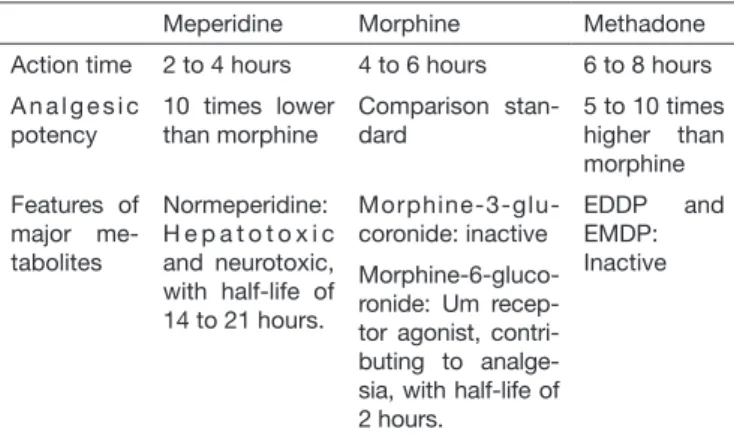
Salamonde et al.35 have observed patient controlled analgesia at home with methadone and have concluded that this opioid is a safe and efective option, not inducing signiicant side efects. Ribeiro, Schmidt & Schmidt26 have reported that methadone may be an option to treat chronic pain, especially in the pres-ence of neuropathic pain, due to antagonism on NMDA recep-tor. In this study26, authors have also stated that methadone is efective and safe to treat cancer-related painful syndromes. Table 1 was structured based on researched information and shows meperidine features which make unfeasible its use to manage pain, and helps the relationship and comparison with the options of studied opioids: morphine and methadone.
Table 1. Comparison among meperidine, morphine and methadone
Meperidine Morphine Methadone
Action time 2 to 4 hours 4 to 6 hours 6 to 8 hours
A n a l g e s i c potency
10 times lower than morphine
Comparison stan-dard
5 to 10 times higher than morphine
Features of major me-tabolites
Normeperidine: H e p a t o t o x i c and neurotoxic, with half-life of 14 to 21 hours.
Morphine-3-glu-coronide: inactive
EDDP and EMDP:
Inactive
Morphine-6-gluco-ronide: Um recep-tor agonist, contri-buting to analge-sia, with half-life of 2 hours.
EDDP = 2-ethylene-1,5 dimethyl 3-3 diphenylpyrrolidine; EMDP = 2 ethyl 5 me-thyl 3-3 diphenyl pyrroline; NMDA: N-meme-thyl-D-aspartate.
CONCLUSION
70
Botan AG and Lapena SA
Rev Dor. São Paulo, 2015 jan-mar;16(1):67-70
Morphine and methadone were introduced as alternatives for analgesia. Both opioids, according to data of researched lit-erature, have longer action time and more analgesic potency with less toxic and noxious metabolites as compared to me-peridine, allowing a more efective pain management and bet-ter quality of life.
REFERENCES
1. II Consenso Nacional de Dor Oncológica. 1ª ed. São Paulo: Moreira Junior; 2011. 176p. 2. da Silva YB, Pimenta CA. [Analysis of nursing registries of pain and analgesia in
hos-pitalized patients]. Rev Esc Enferm USP. 2003;37(2):109-18. Portuguese. 3. Minson FP, Sardá Júnior J, Ferracini FT, Lopes AC, Fernandes Júnior CJ. [Decreased
use of petidine in a private hospital with the implementation of a multiprofessional educative program]. Rev Dor. 2011;12(1):35-8. Portuguese.
4. Korolkovas A, Burckhalter JH. Química farmacêutica. Rio de Janeiro: Guanabara Koogan; 2008. 783p.
5. Howland RD, Mycek MJ. Farmacologia ilustrada. 3ª ed. Porto Alegre: Artmed; 2007. 551p.
6. Pardos PC, Martínez IG. Utilidad de la meperidina en anestesiología. Rev Esp Anes-tesiol Reanim. 2000;47(4):168-76.
7. Oliveira Júnior JO. Meperidina: uma droga aguardando merecida jubilação. 2009. Disponível em: <http://www.dor.org.br/news/02072009/meridinacompleto.pdf>. 8. Ferreira DT, Faccione M. Opiáceos, opioides de ação analgésica e antagonistas.
Semi-na: Ciências Exatas e Tecnológicas. 2005;26(2):125-36.
9. Latta KS, Ginsberg B, Barkin RL. Meperidine: a critical review. Am J her. 2002;9(1):53-68.
10. Kopf A, Patel NB. Guia para o tratamento da dor em contextos de poucos recursos. USA: IASP Press; 2010. 401p.
11. Garcia JBS, Santos CEC. Meperidina. In: Cavalcanti IL, Cantinho FAF, Vinagre RCO. Anestesia Venosa. Rio de Janeiro: Sociedade de Anestesiologia do Estado do Rio de Janeiro (SAERJ); 2004. 143-59p.
12. Lemonica L. Bases farmacológicas para uso clinico dos opióides. Prática Hospitalar. 2008;56:129-35.
13. Daudt AW, Hadlich E, Facin MA, Aprato RM, Pereira RP. [Opiates in pain manage-ment: correct or underestimated use? Data from a university hospital]. Rev Ass Med Brasil. 1998;44(2):106-10. Portuguese.
14. OBID. Observatório Brasileiro de Informações sobre Drogas. II Levantamento Do-miciliar sobre o uso de Drogas Psicotrópicas no Brasil 2005. Analgésicos Opiáceos. 2005. Disponível em: < http://www.obid.senad.gov.br/portais/OBID/biblioteca/do- cumentos/Dados_Estatisticos/populacao_brasileira/II_levantamento_nacional/Subs-tancia/326834.pdf>.
15. Moura CS, Ribeiro AQ, Magalhães SM. Avaliação de interações medicamentosas po-tenciais em prescrições médicas do Hospital das Clínicas da Universidade Federal de Minas Gerais (Brasil). Rev Lat Am J Pharm. 2007;26(4):596-601.
16. Calil AM, Pimenta CA. [Relationship between trauma severity and analgesia standards used in traic accident victims]. Rev Esc Enferm USP. 2009;43(2):328-34. Portuguese.
17. da Silva AP, Moraes MW. [Incidence of postoperative pain after aesthetic plastic sur-gery]. Rev Dor. 2010;11(2):136-9. Portuguese.
18. de Sousa CF, Alves Neto O. Peril do manuseio da dor no Hospital das Clínicas de Goiânia. Rev Dor. 2009;10(3):231-5.
19. Posso MB, Giaretta VM, Santanna AL, Ranzani RC, Gouvea AL. [Nurses’ percep-tion of the management of chronic non-malignant pain with opioids]. Rev Dor. 2013;14(1):7-11. Portuguese.
20. Cunha AA. [Analgesia and anesthesia during labour and delivery]. Femina. 2010;38(11):599-06. Portuguese.
21. Soares EC, Lucena MR, Ribeiro RC, Rocha LL, Vilas Boas WW. [Remifentanil as analgesia for labor]. Rev Bras Anestesiol. 2010;60(3):340-46. Portuguese. 22. Baraldi AC, Almeida AM, Panobianco MS, Mamede FV. [he use of obstetric
epidu-ral analgesia: a metanalysis]. Rev Enferm UERJ. 2007;15(1):64-71. Portuguese. 23. de Souza PM, Murad K, Gonçalves ATS, Veleda NF, Corrêa R, Oliveira AC, et al.
Comparativo de efetividade da meperidina e morina: utilização no pós-parto. In: Souza PM, Araujo BG, Silva LP. Farmacologia Clínica: textos informativos. Brasília; 2012. 38-40p.
24. de Souza PM, Murad K, Gonçalves ATS, Veleda NF, Corrêa R, Oliveira AC, et al. Analgesia no pós-parto. In: Souza PM, Araujo BG, Silva LP. Farmacologia Clínica: textos informativos. Brasília; 2012. 33-7p.
25. Comare. Parecer de Exclusão da Comissão Técnica e Multidisciplinar de Atualização da Relação Nacional de Medicamentos Essenciais – Relação Nacional de Medicamen-tos Essenciais. Rename: Ed. Brasília; 2006. 1p.
26. Ribeiro S, Schmidt AP, Schmidt SR. [Opioids for treating non malignant chronic pain: the role of methadone]. Rev Bras Anestesiol. 2002;52(5):644-51. Portuguese. 27. Mencía SB, López-Herce JC, Freddi N. [Analgesia and sedation in children: practical
approach for the most frequent situations]. J Pediatr. 2007;83(Suppl2):S71-82. Por-tuguese.
28. Rang HP, Dale MM, Ritter JM, Flower RJ. Farmacologia. 6ª ed. Rio de Janeiro: Else-vier; 2007. 829p.
29. Vaughan CW, Connor M. In search of a role for the morphine metabolite morphi-ne-3-glucuronide. Anesth Analg. 2003;97(2):311-2.
30. Rafa RB. Analgesic, antipyretic and anti-inlammatory drugs. In: Remington JP. he science and practice of pharmacy. 21st ed. Philadelphia (USA): Lippincott Williams &
Wilkins; 2006. 1524-42p.
31. COREN. Conselho Regional de Enfermagem de São Paulo – Parecer COREN-SP PRCI 99066/2012: Realização pelo enfermeiro de procedimento de recarga de bomba de morina implantável. 2012.
32. Plummer JL, Owen H, Ilsley AH, Inglis S. Morphine patient-controlled analgesia is superior to meperidine patient-controlled analgesia for postoperative pain. Anesth Analg. 1997;84(4):794-9.
33. Kraychete DC, Sakata RK. [Use and rotation of opioids in chronic non-oncologic pain]. Rev Bras Anestesiol. 2012;62(4):558-62. Portuguese.
34. Baño MD, López ML, Agujetas M, Muñoz V, Guillén JL. De la metadona al LAAM: Nuevos periles terapéuticos. Utilidad de la monitorización terapéutica (MT). Adic-ciones. 2001;13(3):305-14.