Copyright © 2007 by Sociedade Brasileira de Pediatria
O
RIGINALA
RTICLEEffect of evaporation and pasteurization in the
biochemical and immunological composition
of human milk
Lucylea P. M. Braga,1 Durval B. Palhares2
Abstract
Objective:To assess the effects of evaporation and pasteurization of human milk on its biochemical and
immunological composition and on its osmolarity.
Methods:The samples of mature human milk were categorized into four study groups: in natura human milk,
pasteurized human milk, human milk evaporated at 70% of the baseline volume and human milk pasteurized and evaporated at 70%, with 12 different samples of milk in each group. The samples were used to determine the concentrations of sodium, potassium, calcium, phosphorus, magnesium, protein, fat, lactose, immunoglobulin A and osmolarity.
Results:The pasteurization of human milk did not show statistically significant changes in the concentration of sodium, potassium, calcium, phosphorus, magnesium, protein, fat, lactose, or in osmolarity; however, it showed remarkable reduction in the mean concentration of immunoglobulin A. Evaporation had a mean increase of 38% in the concentration of sodium, potassium, calcium, phosphorus, magnesium, protein, fat and lactose and mean reduction of 45% in the concentration of immunoglobulin A, without significant change in osmolarity in unprocessed milk.
Conclusion:By evaporation at 70% of the baseline value of human milk, it is possible to obtain human milk that
meets the nutritional requirements recommended for preterm infants, except for calcium and phosphorus.
J Pediatr (Rio J). 2007;83(1):59-63:Human milk, evaporation, nutritional requirements.
Introduction
The nutrition of preterm infants was not an interest in many cultures, since these infants were seen as weak or
unacceptable, with a frequently fatal outcome. Improve-ment in neonatal care of preterm infants and the establishment of intensive care units provided these infants with better chances of survival, requiring greater concern with their nutrition and development. The nutrition of these
children plays an important role in neonatal care in that it is responsible for their immediate survival and for their growth and development in the medium and long run.1
Specific formulas for very-low-birth weight infants have
been developed to meet the requirements of this population, in which failure to thrive is quite common.2
Several studies have demonstrated that preterm infants fed nonfortified human milk, after hospital discharge, show a lower growth rate and lower bone mass density than formula-fed infants.3
1. Mestre. Professora, Curso de Medicina, Universidade para o Desenvolvimento do Estado e da Região do Pantanal (UNIDERP), Campo Grande, MS, Brasil.
2. Doutor. Professor titular, Departamento de Pediatria, Faculdade de Medicina, Universidade Federal de Mato Grosso do Sul (UFMS), Campo Grande, MS, Brasil.
Manuscript received Feb 13 2006, accepted for publication Sep 13 2006.
Article based on the first author’s master’s thesis, under the guidance of the second author, Graduate Program in Medicine, with a major in Pediatrics, Universidade Federal de Mato Grosso do Sul (UFMS), Campo Grande, MS, Brazil.
Suggested citation:Braga LP, Palhares DB. Effect of evaporation and pasteurization in the biochemical and immunological composition of human milk. J Pediatr (Rio J). 2007;83(1):59-63.
doi 10.2223/JPED.1578
In addition to the concern with growth, the effect on brain development of preterm infants is of paramount importance. Diets containing long-chain polyunsaturated fatty acids have yielded good results at the early stage of development. Only human milk provides adequate amounts of fat and essential fatty acids for children’s development.4
Studies have shown that nutrients in human milk do not provide sufficient amounts of protein, sodium, phosphate and calcium to sustain the proper growth of these preterm infants.5,6This has encouraged the development of new
nutritional options for these infants, especially using human milk as a way to maintain their biological value.
Dialysis and ultrafiltration have been used as fractioning method and later fortification of human milk;7,8however,
these methods are complex and require sophisticated and costly equipment.
Evaporation of human milk consists in removing some amount of water, thus increasing its concentration. Santos, in 1994, used the evaporation technique and, later, precipitation and removal of lactose, to use the end product as human milk additive.9
Human milk is stored in milk banks after pasteurization, which consists of thermal treatment and quick cooling of expressed human milk, in order to inactivate 100% of pathogenic microorganisms and 99.9% of the saprophytic microbiota.10
Given the importance of maintaining the properties of human milk in the nutrition of preterm infants, the aim of the present study was to assess the effects of pasteurization and evaporation of human milk on its biochemical and immunological properties and on its osmolarity. Moreover, it aimed to assess whether evaporation at 30% of its water could make milk meet the nutritional requirements of very-low-birth weight infants.
Methods
This was an experimental study carried out at the Milk Bank of the Teaching Hospital of Universidade Federal de Mato Grosso do Sul (UFMS), Brazil, at the Food Technology Laboratory of UFMS and at the Animal Nutrition Laboratory of Embrapa and at the Laboratory of Immunology of Faculdade de Ciências Médicas de São Paulo, Brazil.
The milk samples were obtained from a pool of volunteering donors, collected by manual expression, with a minimum lactation period of 30 days. Twelve different random samples of human milk were included in the study. Each sample was divided into four aliquots, resulting in four study groups: in natura (INHM), pasteurized (PHM),
evaporated at 70% of the baseline volume (EHM) and pasteurized and evaporated at 70% (PEHM).
The decision to have four study groups allows comparing the effects of pasteurization and evaporation on human milk and, later, combining these two processing methods to obtain pasteurized and evaporated human milk.
For the sake of biochemical analysis (sodium, potassium, calcium, phosphorus, magnesium, protein, fat and lactose), the samples were stored in glass vials previously washed with soap and water and treated with nitric acid at 5%; for the immunological analysis (immunoglobulin A – IgA), they were stored in snap-cap sterile polyethylene vials.
Processing methods included pasteurization11 and
evaporation9at 70%. A rotary vacuum evaporator, which
allows for controlled water removal, was used for evaporation of human milk. In this study, we opted for a 30% water removal at 40 ºC.
For the biochemical analysis of sodium, potassium, calcium, phosphorus and magnesium, the human milk samples were submitted to nitric perchloric acid digestion,12,13 and readings were made using a flame
photometer (sodium and potassium), an atomic absorption spectrophotometer, at a wavelength of 422.7 nm (calcium), photocolorimetry, at a wavelength of 420 nm (phosphorus), an atomic absorption spectrophotometer, at a wavelength of 285.2 nm (magnesium).
Protein and fat concentrations were determined by the method of Nakai & Le;14 lactose concentration was
determined by the method of Barnett & Tawab;15IgA levels
were determined by Mancini’s method.16
All tests were performed in triplicate.
The osmolarity of human milk was measured by an Advanced Digimatic Osmometer Model 3DII.
The study protocol was approved by the Research Ethics Committee of Universidade Federal de Mato Grosso do Sul, Brazil.
The analysis of variance for repeated measures was used to compare the mean concentrations of sodium, potassium, calcium, phosphorus, magnesium, protein, fat, lactose, IgA and osmolarity across pairs. The Tukey-Kramer test was used to compare the study groups regarding each of the nutrients. The significance level was estab-lished at 5%.
Results
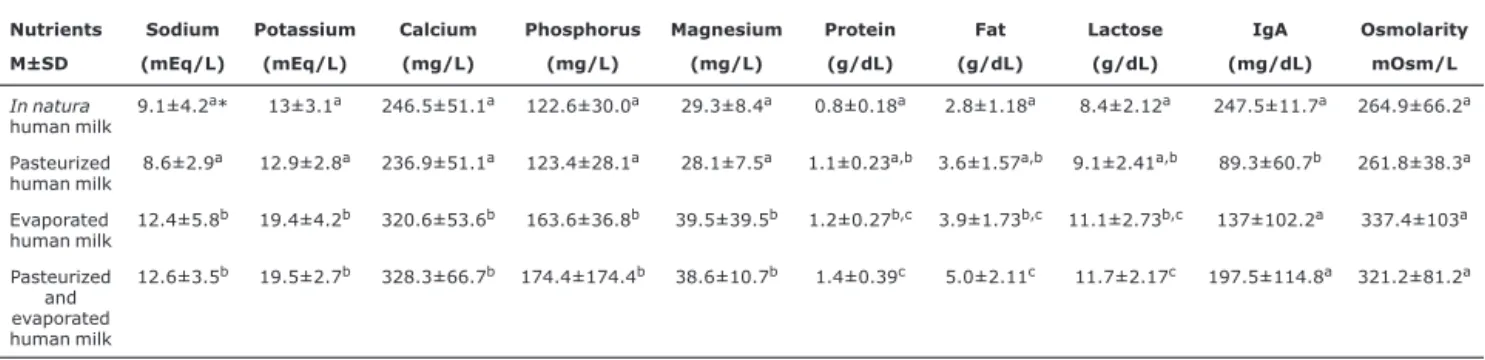
The comparison of the mean concentrations of nutrients between the INHM and PHM groups revealed that pasteurization did not significantly reduce the mean concentration of sodium, potassium, calcium, magnesium, phosphorus, protein, fat and lactose. The reduction in the mean concentration of IgA in the INHM group comparatively to the PHM group amounted to 64%, and was statistically significant (p < 0.05) (Table 1).
The comparison of the results obtained from the INHM and the EHM groups showed that the evaporation of 30% of the water increased the mean concentration of sodium, potassium, calcium, phosphorus, magnesium, protein, fat and lactose by 38%, with statistically significant difference for all the nutrients mentioned before. The reduction of approximately 45% in the mean concentration of IgA relative to the INHM group was not statistically significant (p > 0.05) (Table 1).
Pasteurization and evaporation at 70% of human milk, compared to in natura human milk, yielded statistically similar results to those of the EHM group.
The osmolarity across the four study groups did not show statistically significant differences.
Discussion
Human milk provides adequate nutrition for full-term newborns, resulting in good growth and development, also increasing their immunity and improving the mother-child emotional status. Nevertheless, in preterm newborns, human milk cannot provide a sufficient amount of some nutrients, and their nutritional requirements are therefore unmet.17
In this study, two methods were used for the processing of human milk: pasteurization and evaporation. Pasteurization is used for thermal inactivation of pathogenic
microorganisms, allowing its storage in a milk bank. In this study, a rotary vacuum evaporator was used for the removal of 30% of the water. Vacuum plays a key role, since the lower the pressure, the lower the temperature necessary for the boiling of human milk.18 The temperature used for
evaporation was 40 °C, since at this temperature, the natural properties of human milk are little affected.19
The samples of mature human milk used for the analyses were obtained from milk bank donors, without identifying them and classifying them according to their nutritional status, socioeconomic background, time of milk collection, among other factors that could interfere in the concentration of nutrients.
The comparison between the INHM and PHM groups did not reveal any significant difference for the nutrients analyzed, except for IgA, showing that pasteurization reduces its concentration by 64%.
Mature human milk contains approximately 7 mEq/L of sodium.20In this study, the mean concentration of sodium
inin naturamilk (9.1 mEq/L) and in pasteurized milk (8.6 mEq/L) was higher than that described in the literature, possibly due to the fact that mothers living in this region ingest more sodium than the recommended allowance.21
Evaporation of human milk, obtained through the rotary vacuum evaporator, is not so complex and has a low cost. After the removal of 30% of water from human milk, all the biochemical components analyzed increased by 38%, showing that more accurate volume meters for control of evaporated water volume and of evaporated milk are necessary during the evaporation process.
Evaporation of human milk reduced the mean concentration of IgA by 45%; however, when compared to
in naturahuman milk, there was no statistically significant
Table 1- Mean and standard deviation of sodium, potassium, calcium, phosphorus, magnesium, protein, fat, lactose, immunoglobulin A and osmolarity in thein natura, pasteurized, evaporated and pasteurized and evaporated human milk groups
Nutrients
M±SD
Sodium
(mEq/L)
Potassium
(mEq/L)
Calcium
(mg/L)
Phosphorus
(mg/L)
Magnesium
(mg/L)
Protein
(g/dL)
Fat
(g/dL)
Lactose
(g/dL)
IgA
(mg/dL)
Osmolarity
mOsm/L
In natura human milk
9.1±4.2a* 13±3.1a 246.5±51.1a 122.6±30.0a 29.3±8.4a 0.8±0.18a 2.8±1.18a 8.4±2.12a 247.5±11.7a 264.9±66.2a
Pasteurized human milk
8.6±2.9a 12.9±2.8a 236.9±51.1a 123.4±28.1a 28.1±7.5a 1.1±0.23a,b 3.6±1.57a,b 9.1±2.41a,b 89.3±60.7b 261.8±38.3a
Evaporated human milk
12.4±5.8b 19.4±4.2b 320.6±53.6b 163.6±36.8b 39.5±39.5b 1.2±0.27b,c 3.9±1.73b,c 11.1±2.73b,c 137±102.2a 337.4±103a
Pasteurized and evaporated human milk
12.6±3.5b 19.5±2.7b 328.3±66.7b 174.4±174.4b 38.6±10.7b 1.4±0.39c 5.0±2.11c 11.7±2.17c 197.5±114.8a 321.2±81.2a
M = mean; SD = standard deviation.
difference. This lack of significance may be due to the small sample size, since in some comparisons (IgA and osmolarity), in which the variables had a high standard deviation, a type II error (false-negative) was more likely to happen. For instance, in the case of comparisons of IgA levels between groups, statistical power decreased to 76%.
The INHM group had a mean osmolarity of 264.9 mOms/L, which is in agreement with the scientific literature.22After evaporation of 30% of water from human
milk, mean osmolarity increases to 337.4 mOsm/L, which may be acceptable for preterm infants.22
According to Schanler, additives increase the osmolarity of human milk, but do not cause intolerance of these additives in preterm infants. With the additive, osmolarity increases to 400 mOsm/L, but the osmolarity of the gastrointestinal tract contents amounts to approximately 600 mOsm/L.22
In the PEHM group, the results for biochemical elements and osmolarity were similar to those of the EHM group. However, the mean concentration of IgA was reduced by only 20%, when it was expected to have a reduction similar to that of the PHM and EHM groups. This can be explained by the number of analyzed samples, since IgA results varied considerably in this study.
By observing the changes in biochemical and immunological composition and in the osmolarity of human milk during its pasteurization and evaporation, and by analyzing the nutritional requirements recommended for preterm infants by the American Academy of Pediatrics23in
1998 , by the ESPGHAN Committee on Nutrition24in 2006
and by the Nutrition Committee of the Canadian Pediatric Society,25 our conclusion is that pasteurized and
evaporated human milk can meet the recommended requirements of sodium, potassium, magnesium, protein, fat and lactose, but that it does not meet calcium and phosphorus requirements.
New studies should be carried out to assess the possible use of pasteurized and evaporated human milk, and to evaluate possible effects on the metabolism and growth of preterm infants submitted to this diet.
References
1. Gross SJ, Slagle TA.Feeding the low birth weight infant.Clin Perinatol. 1993;20:193-209.
2. Carver JD. Advances in nutritional modifications of infant formulas.Am J Clin Nutr. 2003;77:1550S-4S.
3. Carver JD.Nutrition for preterm infants after hospital discharge.
Adv Pediatr. 2005;52:23-47.
4. Uauy R, Mena P.Requirements for long-chain polyunsaturated fatty acids in the preterm infant. Curr Opin Pediatr. 1999;11:115-20.
5. Kumar SP, Sacks LM.Hyponatremia in very low-birth-weight and human milk feedings.J Pediatr. 1978;93:1026-7.
6. Greer FR, Steichen JJ, Tsang RC. Calcium and phosphate
supplements in breast milk – related rickets. Results in very low birth-weight-infant.Am J Dis Child. 1982;136:581-3.
7. Moro G, Fulconis F, Minoli I, Pohlandt F, Raiha N.Growth and plasma aminoacid concentrations in very low birthweight infants fed either human milk protein fortified human milk or a whey-predominant formula. Acta Paediatr Scand. 1989;78:18-22.
8. Itabashi K, Hayashi T, Tsugoshi T, Masano H, Okuyama K.
Fortified preterm human milk for very low birth weight infants.
Early Hum Dev. 1992;29:339-43.
9. Santos MM. Preparo de um concentrado de leite humano especial para recém-nascido pré-termo [dissertação]. Ribeirão Preto: Faculdade de Medicina de Ribeirão Preto, Universidade de São Paulo; 1994.
10. Almeida JAG. Composição e síntese do leite humano. In: Santos Jr. LA, org. A mama no ciclo gravídico puerperal. Rio de Janeiro: Atheneu; 2000. p. 101-4.
11. Young FS, Heicher DA, Uemura HS, Sia CC. The effects of freezing and pasteurization on human milk. Hawaii Med J. 1979;38:330-2.
12. Salinas JG, Garcia R. Métodos químicos para el análisis de suelos ácidos y plantas forrajeras. Cali, Colômbia: CIAT; 1985.
13. Moraes JFV, Rabelo NA. Um método simples para a digestão de amostras de plantas. Brasília, DF:
EMBRAPA-DDT/EMBRAPA-CNPAF; 1986.
14. Nakai S, Le AC. Spectrophotometric determination of protein and fat in milk simultaneously. J Dairy Sci. 1970;53:276-8.
15. Barnett AJG, Tawab GAA. A rapid method for determination of lactose in milk and cheese. J Sci Food Agric. 1957;8:437-41.
16. Mancini G, Carbonara AO, Heremans JF. Immunochemical
quantitation of antigens by single radial immunodiffusion.
Immunochemistry. 1965;2:235-54.
17. Kuschel CA, Harding JE.Multicomponent fortified human milk for promoting growth in preterm infants.Cochrane Database Syst Rev. 2004;(1):CD000343.
18. Hunziker OF. Condensed milk and milk powder. 15th ed. La Grange, III: [author]; 1935.
19. Barrois-Larouze V, Jorieux S, Aubry S, Grimonprez L, Spik G. Effects of different heat treatments on some human milk constituents. In: Williams AF, Baum JD, editors. Human milk banking. Nestlé Nutrition Workshop series. New York; Raven Press; 1984. p. 113-21.
20. Calil VM, Leone CR, Ramos JL. Composição nutricional do colostro de mãe de recém-nascido de termo adequados para a idade gestacional. II- Composição nutricional do leite humano nos diversos estágios da lactação. Vantagem em relação ao leite de vaca.Pediatria (São Paulo). 1992;14:14-23.
22. Schanler RJ.Suitability of human milk for the low birth weight infant.Clin Perinatol. 1995;22:207-22.
23. American Academy of Pediatrics, Committee on Nutrition. Pediatric nutrition handbook. 4th ed. Elk Grove Village, III: American Academy of Pediatrics; 1998.
24. Aggett PJ, Agostoni C, Axelsson I, De Curtis M, Goulet O, Hernell O, et al.Feeding preterm infants after hospital discharge: a commentary by the ESPGHAN Committee on Nutrition.J Pediatr Gastroenterol Nutr. 2006;42:596-603.
25.Nutrient needs and feeding of premature infants. Nutrition
Committee, Canadian Paediatric Society. CMAJ.
1995;152:1765-85.
Correspondence:
Lucylea Pompeu Muller Braga Rua Boipeva, 225, Carandá Bosque I
CEP 70032-560 – Campo Grande, MS – Brazil Tel.: +55 (67) 3029.3058