An explorative analysis of the socialization of positive
emotions: Insights from the consulting field
Stephan Kaiser1and Gordon Müller-Seitz1 Katholische Universität Eichstätt-Ingolstadt Wirtschaftswissenschaftliche Fakultät, Germany
Abstract. Common accounts on socialization are predominantly slanted towards cognitive conceptions. When emotions are considered, most of the time emphasis lays upon negative emotions. Against this background, this study refines prior research in two ways. First, we offer an emotion-oriented perspective of socialization processes. Second, we concentrate on the socialization of positive emotions. We confirm these assumptions by means of an explorative case study in the field of consulting firms. Results suggest that positive emotions play a crucial role throughout the different socialization phases, and can manifest themselves over time in a virtuous cycle. In addition, conventional notions on socialization agents are refined by this research, while arguing that clients ought to be taken similarly into consideration. The article concludes by offering managerial implications, as well as suggestions for future research activities with regard to the socialization of positive emotions.
Key-words:positive emotions, socialization, consulting, case study
Resumo. As perspectivas correntes sobre socialização apresentam uma visão predominantemente cognitiva do assunto. Mesmo nos casos em que as emoções são levadas em conta, a maior parte das vezes a ênfase é colocada nas emoções negativas. Contrariamente a este quadro, este estudo refina a investigação de duas grandes formas. Primeiro, oferecemos uma perspectiva do processo de socialização orientada para as emoções. Segundo, concentramo-nos na socialização das emoções positivas. De seguida, confirmamos os nossos pressupostos através de um estudo de caso exploratório no campo das empresas de consultoria. Os resultados sugerem que as emoções positivas desempenham um papel crucial ao longo das diferentes fases de socialização, e podem manifestar-se ao longo do tempo, num ciclo virtuoso. Para além disso, refinamos as noções convencionais sobre os agentes de socialização, ao mesmo tempo que defendemos uma inclusão dos clientes neste processo. O artigo conclui com um conjunto de implicações para a gestão, bem como com sugestões para futuros estudos relativos à socialização das emoções positivas.
Palavras-chave:emoções positivas, socialização, consultoria, estudo de caso.
1. Introduction
Emotions such as anger, pride, or happiness constitute ubiquitous phenomena, and therefore, can also be found in the organizational realm (Fineman, 1993). Moreover, emotions are significant, since they influence the performance of employees on an individual as well as on a collective level
1 Correspondence concerning this article should be addressed to Stephen Kaiser, Katholische Universität Eichstätt – Ingolstadt,
(Ashkanasy, 2003). Against this background, two observations are rather astonishing: First, organizational research tends to neglect emotions per se due to the dominance of rational oriented conceptions of human behavior (Rafaeli & Worline, 2001; Sturdy, 2003). Second, those publications that pay reference to emotions predominantly concentrate (un)intentionally upon negative emotions such as anger, fear or negative emotion-related factors.
The accounts on socialization are similarly slanted, most of the time towards cognitive oriented conceptions (cf. van Maanen & Schein, 1979). For the purpose of this article, the socialization during adulthood is decisive by nature, since it deals with the process by which a person acquires the values, skills, knowledge, and interpretation, as well as orientation patterns that are needed in order to assume the role ascribed to one’s position (Turner, 1956). In this context, it is worth mentioning that conceptions of the secondary phase tend to concentrate predominantly upon cognitive aspects. Therefore, apart from a few prominent exceptions (e.g. Ashforth, Saks & Lee, 1998), one can thus state a “scarcity of empirical work on the socialization of emotion” (Scott & Myers, 2005:68).
Based upon these considerations, in this paper, we aim at relating these two phenomena to one another by delineating and analyzing the role of positive emotions as an important factor for socialization-related processes. Thereby, we refine existing accounts in two ways. First, we argue that positive emotions are an inherent part of socialization processes. Second, we claim that socialization agents are not only confined to the organizational realm. In particular, clients can play a vital role when it comes to socializing novices. In order to accentuate our notion, we examine relationships within the field of consulting firms.
The procedure of this paper is as follows: Following a brief depiction of the conceptual background (2), the methodological approach is characterized (3). The socialization of emotions is elucidated by means of interweaving theoretical notions and insights from our case study subsequently (4). Thereafter, the implications of our findings are outlined (5). The paper concludes with a summary, critical reflections, and suggestions for future research (6).
2. Conceptual Backgrounds
2.1. Positive Emotions as “Terra Incognita”
Although multiple inter- and intradisciplinary definitions of human emotions abound and no consensus exists (Kleinginna & Kleinginna, 1981), we will predominately focus upon insights of psychological provenance, as psychology provides most detailed analyses of the various facets of emotions. Thereby, we will contrast emotions to neighboring phenomena to clarify the contours (A). Moreover, we will set forth our understanding of positive and negative emotions (B).
(A) Despite differing approaches in psychology, most scientists agree that emotions manifest in a rapid triadic reaction, composed of an affective, cognitive, and physiological components (Frijda, 1986). The affective component relates to the innate perception of the situation, oftentimes referred to as feeling (e.g. the innate joy when experiencing a success). In contrast, the cognitive component implies the evaluation of the situation whereby an external (e.g. an action undertaken by a colleague) or internal (e.g. the sheer thought about a certain colleague) stimulus is identified, which leads to the elicitation of the emotion. The third component corresponds to the physiological reaction, also termed expressive-behavioral component (e.g. blushing while feeling ashamed). Taking a look at publications dealing with emotions, one soon realizes that there exists confusion concerning the usage of related terms (e.g. feelings, affect or mood). In order to avoid confusion, the research at stake differentiates between the various terms. As indicated above, feelings are deemed the innate experience of emotions. Furthermore, following the general Anglo-Saxon conventions, affect constitutes the umbrella term for emotions and moods (Robbins, 2005). Thereby, it is assumed that emotions, in contrast to moods, always have a stimulus and are rather short-lived (e.g. minutes or hours in comparison to days in the case of moods; Gray & Watson, 2001). A metaphor from Gestalt psychology, might illustrate this further, arguing that emotions can be assessed as “figure” and moods as the “background”, making the latter one rather durable tinges of ones own experiences (Wertheimer, 1912). Finally, it is argued that affects can be subsumed as “states”, whereas phenomena such as temperaments are “traits”, i.e. permanent, oftentimes even life-long characteristics of a person. Though these distinctions are quite plausible in theory, we contend that at least the line between emotions and moods is quite blurred in praxis.
(B) To clarify the research at hand, we have to define what is “positive” about positive emotions, thereby contrasting them to “negative” emotions. Following the common perception of positive emotions, all those variants are subsumed that imply subjectively experienced pleasant or beneficial emotional experiences. Hereof, one has to distinguish those emotional experiences that people perceive as objectionable or unpleasant, e.g. anxiety or desperation. Moreover, in contrast to negative emotions, positive emotions oftentimes lack specific action tendencies (Fredrickson, 1998). Whereas anxiety is likely to lead to actions such as flight or surrender, there exist no specific actions ensuing from joy. In addition, positive emotions are more intricate to observe (Ekman, 1992), fewer in number (de Rivera, Possel, Verette & Weiner, 1989) and more difficult to differentiate from each other (Ekman & Friesen, 1984).
At last, one ought to mention that this conception implies a couple of simplifications. Although they are intuitively viable, in theoretical and practical accounts, it appears that they are oftentimes taken for granted and reflection only scarcely takes place. Despite being disregarded in the following argumentation, they are noted in order to show that they are recognized and reflected upon. Drawn from the research process, it becomes clear that emotions are oftentimes ambivalent. For instance, hope is experienced “with mixed emotions”. On the one hand, it leads to positive emotions when desiring an improvement. On the other hand, fear of a negative outcome remains omnipresent.
Furthermore, emotions can assume a definite shape that we term ”Janus-headedness”. This description seeks a contrast to conventional perceptions of emotions, where a unidirectional conception prevails, i.e. positive emotions imply positive implications, negative emotions lead to negative consequences. In contrast to these assumptions, we would like to direct the attention to the inherent ambiguity of emotions. In allusion to Roman methodology, where the two-headed god Janus represents diverse perspectives or change, we propose that emotions do not necessarily constitute unidirectional effects. For instance, disproportionately displayed pride about an achievement might elicit envy from other colleagues (Lazarus & Cohen-Charash, 2004). In a similar vein, fear of losing one’s workplace could mobilize employees or foster cooperation among previously hostile departments.
2.2. Notions about Socialization in Organizations
Socialization is an umbrella term for all those structures and processes that convey values, norms, skills, knowledge, and interpretation, as well as orientation patterns (van Maanen & Schein, 1979). Organizational socialization is generally defined as a particular dimension that deals with these aspects in connection with prospective, current, or past organizational members and their respective organization. In the organizational realm, diverse socialization agents are crucial. For instance, not only the immediate colleagues or one’s own superior are deemed important. Moreover, other groups such as customers or suppliers can be crucial (Auster, 1996).
In the course of this process, two “parties” are actually interacting with one another. On the one hand, the organization influences their employees through various means. This notion has been dominant in the discourse on socialization in the 70s and 80s. On the other hand, each employee also plays a decisive role while he or she has to accept and exert the respective role (Wanous, 1980). This interesting criterion did not enter the research agendas in the academic domain until the beginning of the 1980s. Therefore, we argue that organizational socialization constitutes a reciprocal process. In a similar vein, occupational socialization concerns the same aspects but takes on a different perspective, i.e. that of whole professions. As for the purpose of this paper we concentrate upon organizational socialization, though differences are assumed to be of minor relevance. Hence, some of the theoretical notions might stem from insights about occupational socialization while the differences are expected to be negligible.
3. Methodological Approach
3.1. Research Context
In this paper, we focus on consulting firms as a specific type of industry. Consulting firms represent a type of Professional Services Firms (PSFs), which epitomize a typical and pure form of service (Stutz, 1988). As PSFs show some prominent criteria, the following discussion intends to elaborate the distinctive characteristics of professional service firms and consulting firms, in particular.
Concerning the organizational structure, PSFs show relatively flat hierarchies (Løwendahl, 1997; Maister, 1997). They are vertically structured as a so-called „professional pyramid“, that is top-down composed of three levels, namely seniors/partners, project managers and juniors, i.e. novices. Moreover, the knowledge intensity of the services provided by PSFs constitutes a striking characteristic. Hence, the highly skilled consultants represent themselves a strategic asset for PSFs. Apart from that, the personal interaction between the professionals and their clients is of utmost importance. This implies that PSFs cannot solely rely on the “technical” knowledge of their employees, but social competence or emotional intelligence are crucial as well, in order to establish a long-lasting and successful relationship.
The ”purity” of the services provided by consultants becomes apparent when it comes to the extensive integration of the client. The significance of this facet gains momentum since the success of each project is highly dependent on the proper conception of the essential details of the situation or problem on behalf of the professionals. While every solution is customized, this accounts for the high degree of heterogeneity and variability of the service provided, an aspect that will be particularly relevant later on when dealing with the concept of the “zone of tolerance” in detail.
Furthermore, the services that PSFs provide are highly intangible. Due to the knowledge-gap between professional and client, it is difficult for the client to determine the quality of the service delivered by the PSF, which entails a two-fold risk for the client. First, there is a risk concerning the quality. For instance, it is frequently the case that the propagated or imposed measurements of the professionals are irreversible (e.g. in the case of designing a novel corporate strategy). Second, a financial risk can be the direct consequence of opportunistic behavior on behalf of the PSFs (e.g., when the adequate remuneration cannot be estimated).
3.2. Data Collection and Analysis
Our research is based on qualitative data from different consulting firms that is intended to supplement our theoretical deliberations. Due to the explorative nature of our topic, we chose a case study approach that is in line with the ideas proposed by Eisenhardt (1989) and Yin (2003). This design ought to enhance our contextual understanding of this less researched phenomenon. Therefore, the authors collected data from five different sources in several encounters with consulting firms between April 2003 and October 2005.
First, qualitative empirical data were gathered by means of semi-structured interviews with employees from different hierarchies in different consulting firms, varying in length between 45–60 minutes (eight interviews). Most of the data gathering procedures were conducted in German subsidies of the respective companies. Second, the authors had informal conversations with professionals, most of the time off-site. In these cases, the conversation took place in a more comfortable atmosphere, which gave us the chance to discuss issues that participants might have been reluctant to air on-site. Third, we attended various presentations, lectures, and seminars of
consulting firms. Some of these were public, although a few of these were also addressed to an internal audience, e.g. at a client’s site. Fourth, archival material (e.g. publicly available brochures or internet sites) was collected throughout the research process in order to improve our understanding of the aims of the consulting firms, as well as aspirations of the novices. Finally, one of the authors had the chance to attend an informal training session, where potential recruits were invited to participate. Concerning all our sources and findings we agreed to protect participant’s anonymity. As a result, only those statements or findings per se are revealed, where consent was explicitly given by the respective participants or the data was publicly observable (e.g. in the case of advertisements). With regards to data analysis, we started the research process by separately analyzing the transcribed interviews and the other documents we gathered. We then worked jointly to combine the qualitative data with insights from previous studies. Thereby, existing theoretical frameworks guided our analysis, in particular the differentiation between three phases of socialization, and the existence of internal socialization agents. However, novel categories emerged in the course of analyzing the data. First and foremost, among the unanticipated categories was the overall topic of this contribution, the socialization of emotions, in particular positive emotions. Another example concerns clients or subordinates as socialization agents, an aspect that has to the best of our knowledge received only scarce attention. As for the finalization of this paper, we integrated only those categories we jointly agreed with. Therefore, some categories are broader than others, a consequence that ensued from sorting the data jointly and aligning them subsequently with the theoretical frameworks. This observation merits attention insofar, as some facets could not be specified. For instance, there was no consensus about the intrapersonally different time span of the socialization process – if this could be determined at all.
4. Explorative Insights from the Field of Consulting
4.1. The Phases of Socialization
Following the common tenor in organizational research, organizational socialization can be conceptualized as a process. Thereby, three major phases can be identified, the anticipatory (1), encounter (2), and metamorphosis (3) stages (e.g. Ashforth, Saks & Lee, 1998).
(1) The anticipatory phase concerns the period where potential professionals gather informa-tion about their prospective job assignments. The socializainforma-tion of positive emoinforma-tions can result from the desired employer but also from other institutions or persons.
– In those cases where the socialization is initiated by the focal organization, the most relevant aspects are external communication, and the design of the selection procedures. Measurements of the external communication can take the form of advertisements. The aim would be the elicitation of pleasant anticipations. For instance, The Boston Consulting Group
promotes slogans throughout Germany that appeal to potential employees stating, “Have more confidence in you. We do”. Such an appeal can contribute to positive emotions prior to entering the company, since they can foster the self-esteem and confidence of the candidates who might soon be among the chosen candidates. Thereby, the habitus (Bourdieu, 1977) is likely to be already preformed at the same time.
In addition, the selection procedures can likewise have innate impacts. One potential measurement that fosters the socialization of positive emotions is the execution of assessment centres. In the course of these evaluation programs, the candidates face situations and tasks that resemble the daily activities of consultants. For those candidates that enjoy accomplishing the various challenging tasks, anticipatory socialization has successfully taken place. The experience of flow due to solving the tasks, and – maybe even more important – the distinctive remarks that these tasks represent the “daily activities that are fun and challenging” as one professional aired, contribute to the socialization of positive emotions. Furthermore, the dress code – apart from the obligatory “casual Fridays” – can be described as formal, which might have an impact insofar, as pride and a feeling of superiority can ensue. In a similar vein, the interior design is also quite elegant and luxurious in most instances. These facets might also elicit positive emotions while potential candidates are impressed and moved by the way it “feels to be a consultant”.
– In contrast, socialization can also be enabled by other institutions or socialization agents than the focal consulting firm. Although consulting firms tend to hire students and professionals from different academic backgrounds, the majority of students that work for strategically oriented consulting firms graduated from a business school. In this connexion, we argue that these institutions presume at least partially, the role of “institutions of socialization”. For instance, in business schools oftentimes “socializing” or “how to behave in a business environment” are part of the curriculum.
In the same way, parents might function as socialization agents while shaping the positive emotions that are inextricably intertwined with the aspired habitus. One aspect that epitomizes this observation is the fact that the parents already start to chose the dress of their children accordingly and teach them how to behave properly in the respective environments. This is likely to elicit and foster the young professionals’ pride (cf. Pratt & Rafaeli, 1997; Rafaeli et al., 1997; Rafaeli & Pratt, 1993 for a related discussion with regards to the emotional impact of dresses).
(2) During the entry phase, the novices become familiar with their work environment and tasks they are supposed to accomplish. In this stage, the employees learn to reduce their cognitive and emotive dissonances. Therefore, they are accustomed to various standardizations. In the consulting firms we analyzed these are always conveyed in the form of an obligatory orientation program that aims at conveying a positive image of the respective consulting firm, thereby ideally evoking positive emotions.
A number of different orientation programs exist which all serve the same purpose: giving the new professionals orientation and support in order to enable positive emotions, as well as diminishing negative emotions, e.g. initial stress. Among the well-known programs are mentorship or trainee programs. However, the socialization is not always boldly advertised, sometimes the program is rather subtly marketed. A common type of program that aims at infusing positive emotions rather inconspicuously is the so called boot camp. These camps usually take place at the beginning of the career of a professional and he will get to know the basic knowledge and skills of being a consultant, but also the idiosyncrasies of the company in question. Thereby, the new professional will not only learn the necessary business-related skills, but also the implicit norms and rules of being a consultant. For instance, in the case of The Boston Consulting Group the entrants are supposed to learn “Business-Basics”, “BCG-Basics” and “People-Basics”. As for this paper, the people purposes are most important, since – among related aspects – they explicitly aim at conveying how to build informal networks. This leads to getting acquainted with the upcoming assignments. In this connexion, it is noteworthy that even at this point in time, the novices are reminded that all these aspects are part of the daily life and supposed to be assessed as fun or as a pleasant experience. One informal gesture that fosters the feeling of being “one family” is the fact that consultants usually refer to one another by their first name. Additionally, fun is explicitly advocated as being an inherent part of those boot camps.
(3) Finally, the metamorphosis phase concludes the socialization of positive emotions, i.e. it can be assumed that the accomplishment of this phase implies the successful socialization of the new professionals (Berger & Luckmann, 1966). This indicates that a so-called symmetry exists: the positive emotions experienced by the novices are in accordance with those intended by the organization. By nature, this does not entail that positive emotions are socialized in exactly the same way. It is rather likely that there will be a symbiosis of idiosyncratic factors, as well as the impact of the intended socialization. However, we argue that the outcome of this phase is the adoption of a specific habitus (cf. also Iellatchitch, Mayrhofer & Meyer, 2003). According to our conception, the respective habitus is a highly firm and industry specific approach.
4.2. The Zone of Emotional Indifference
As for the long-term effects of the socialization of positive emotions, subsequent to the metamorphosis phase, there exists a related, though distinct phenomenon, which we term “zone of emotional indifference”. This is an important aspect in order to explain the stabilizing impact of positive emotions in the long run. In order to illustrate that concept we need to make a small detour to the realm of services management (A), where our notion originates, before we turn our attention to positive emotions again (B).
(A) In their seminal paper, Zeithaml et al. (1993) tried to reconstruct the way customers assess the performance during service encounters provided by companies (Zeithaml, Berry & Parasuraman,
1993), a conception that seems to be transferable to our research context. The authors propose that customers usually expect beforehand that the service will vary in nature and quality since every service encounter is unique and situational factors are usually a determinant that could not be controlled entirely. Hence, they recognize and accept variations in service to a certain extent, a phenomenon they termed “zone of tolerance”. Within this zone, customers are likely to be rather passive and accepting, when the service matches their expectations of average service. If service exceeds the zone of tolerance, it meets the so-called “desired service”. This category is based upon personal needs and wants, expectations that are derived from previous encounters as well as personal beliefs. Berry specified this category by stating that it represents mixed expectations that vary between “can be” and “should be” (Berry, 1999:132). In contrast, if the service falls short of meeting the expected service provision, i.e. does not fall into the zone of tolerance, less-than-adequate service is provided. This category comprises the minimum of acceptable service. By nature, even the desired service can be exceeded or the adequate service undershot. Whereas meeting or even exceeding the desired service is likely to lead to positive word-of-mouth, negative word-of-mouth can easily ensue from just meeting the adequate service expectations or failing to meet the lowest expectations.
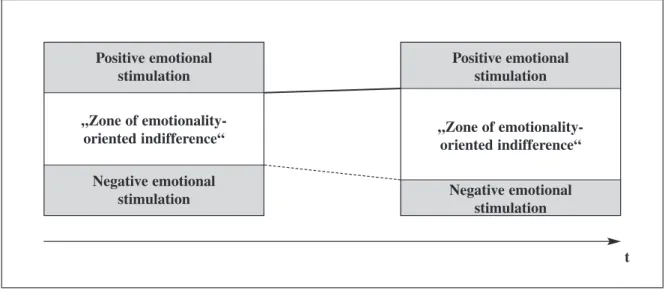
(B) Despite the significance and lasting impact this framework has even nowadays, for the purpose of the present paper it can be criticized for its primary cognitive orientation. Emotions have been omitted, a fact that is addressed, as well when it comes to customer satisfaction (Rust & Oliver, 2000). Hence, a transfer to the PFSs realm at stake is deemed as necessary, particularly in order to elucidate the long-term effects and dynamics of emotions, which are shown in figure 1.
Fig. 1: Long-term variations in the zone of emotion-oriented indifference in the case of a virtuous
cycle.
Source: own considerations adapted from Zeithaml, Berry & Parasuraman (1993).
Positive emotional stimulation
„Zone of emotionality-oriented indifference“
Negative emotional
stimulation Negative emotional
stimulation Positive emotional stimulation „Zone of emotionality-oriented indifference“ t
At the beginning of the overall process, one has to assume the occurrence of an interpersonal encounter, e.g. between consultant and client. For means of illustration, this encounter will consist only of two people interacting with one another, while the figure shows the subjective experience and evaluation of the professional. Hereby, we assume three potential consequences with regard to the emotional realm. First, the event might be barely noticed from an emotion-oriented stance by the professional if the interaction with the client met one’s expectations. In this case, the interaction took place in a manner that did not evoke emotions to a high extent - a situation that falls within the “zone of emotional indifference”. Nevertheless, an interpersonal exchange might elicit emotions, leading to a stimulation of positive emotions, for instance, a positive surprise like seldom heard laud from the client. In contrast, it is also possible that an event triggers negative emotions, e.g. when a professional perceives a decision made by the client as unfair.
Bearing this in mind, we further argue that certain dynamics regarding emotions exist in the long run. In particular, we assume that the zone of emotional indifference is likely to widen. In this connection, no specific time frame can be given due to the fact that each employee individually constructs his reality. However, in most cases the zone of indifference seemed to widen after the first few years. This assertion is derived from various findings, both theoretical and empirical in nature that can be applied to our setting accordingly. For instance, insights from partnership research consistently indicate that close relationships stabilize over time (Gottman, 1979; Gottman, 1998; Mikulincer & Shaver, 2005). In these instances, it has been frequently shown that interpersonal relationships dispose of emotion-related buffers. That implies that over time, events tend to become less often emotionally eliciting. In a similar vein, it has been shown that elder people are less likely to experience as intensively and frequently emotions as they did in former times (Kunzmann, Stange & Jordan, 2005).
4.2. The Socialization Agents
When it comes to the different socialization agents, it is plausible to consider all people the respective employee is interacting with during work, or rather those he has a close collaboration with. Hence, predominantly internal individuals (A) are likely to act as socialization agents, i.e. the leader and colleagues, but also subordinates, as well as clients (B).
(A) At first, one might consider the superior as a socialization agent. However, the superior is by far not the only socialization agent. We rather assume that every person interacting with the respective novice can have an impact on the socialization of positive emotions, albeit the influence might individually differ between persons. As we will argue later on, also the clients exert an impact upon the socialization of positive emotions in the case of consulting. Bearing these notions in mind, a distinction between the agents can be drawn in terms of their relationship to the organization, i.e. there are internal (i.e. belonging to the focal organization), as well as external (i.e. persons that are not employed by the consulting firm) socialization agents.
As for internal socialization agents, three primary groups can be identified according to their hierarchical status - superiors, colleagues, and subordinates.
– Due to their status and the ascribed power, superiors, in our case called project managers or, on a more senior level, partners, are perhaps the most influential socialization agents for young professionals. The theoretical background in terms of power and status has already been observed by Kemper (1978), who analysed these factors in depth. He argues that power, as conceptualized by Weber (1985), is the ability to exert one’s own control upon another person’s action. In contrast to power, status can lead to the same results as power but it is based on compliance. Bearing this in mind, we assume that due to hierarchical differences, the project manager might have an influential impact on professionals due to the power ascribed to the respective position, as well as potential positive effects that can similarly stem from status.
– In addition, fellow professionals can also contribute to the socialization of positive emotions. Most of the time this concerns immediate colleagues, but also professionals from other functional practices or project teams may be influential, though this is rather seldom the case or the extent is in general rather small. One of the common concepts in consulting is the so-called mentorship. In these instances, an experienced professional (e.g. partner) introduces the novice colleague to the respective practices. Moreover, he will help his mentee when he experiences problems, not only job-related, but also private ones. Taken together, these measures might foster the successful socialization of the new professionals.
– One’s own subordinates might also become a source of socialization. For instance, we discovered that enthusiastic employees might be emotionally contagious, whereby this might not only affect colleagues but also superiors. However, this effect was much less observed than the reciprocal one. On the one hand, this can be explained by the different status. On the other hand, superiors seldom seem to get authentic feedback, due to fear of repercussions on behalf of the novices/subordinates.
(B) In contrast, clients and suppliers might be considered as further, external socialization agents. Due to our research context, we are not able to make suggestions about the potential impact of suppliers, only those of the clients. Clients are interesting to observe insofar as they are usually not considered in accounts on socialization of organizational entrants. Similar to the effects described above, also the clients seemed to be able to be emotionally contagious (cf. also Barsade, 2002; Hatfield et al., 1994). At this point, we can only speculate about the underlying mechanisms for this observation. However, it seems plausible to hold the “client first” orientation of consulting firms responsible for this claim. The following statement underscores this:
“For me, the real joy lies in connecting with the client as a person and finding a few clients with whom I desperately want to be successful” (McKinsey, 2006).
In addition, the performance appraisal made by the client might exert an impact since a stake of the overall remuneration of the professional is linked to the respective performance feedback. Although the effects of the monetary compensation should not be overestimated, joy or pride might be a consequence when receiving a substantial bonus that can be traced back to the positive performance appraisal from a client.
5. Managerial Implications of this Research
Since positive emotions are assumed to be predominantly goal congruent with the aims of the organization for the purpose of this paper, the following section sketches potential options for handling positive emotions. We assume that the implications drawn do not solely apply to the PSFs realm, but to organizations in general. Hereby, alluding to Popper’s “social engineering” (Popper, 1963), one could speak of “engineering emotions” in order to stimulate a realistic and critical debate on this kind of intervention into a social system. This remark is intended to indicate that it is considered as adequate to examine positive emotions from a managerial stance in order to foster the understanding of organizational life and how to take actively part in its formation.
As shown, professionals are subject to various sources of socialization. We thereby presume that positive emotions could be at least partially influenced. For instance, when it comes to socialization agents, oftentimes the PSF are consciously matching sociodemographic factors of professionals and clients (in a similar vein: Mills & Moshavi, 1999:53f.). This might be worth pursuing in order to facilitate the professional-client interactions. As for the organizational cultivation of positive emotions, we propose to distinguish different modes of an emotional socialization, depending on the format as well as the rule type of socialization.
The format can be either formal or informal (Rafaeli & Sutton, 1987:26f.). A formal way of conveying “appropriate” emotions can be training measurements as proposed on the operative level, culminating in a distinctive habitus. Conventional approaches we observed consist of rhetoric-oriented trainings, and training courses dealing with appropriate conduct. Another option concerns the introduction of collective arrangements such as mission statements, mottos, or credos. For instance, one of the consulting firms considered uses such mottos and communicates them internally, as well as externally. A more prominent example from a different industry is the Ritz-Carlton Hotel group, where every employee has a card that reminds him or her of the company’s ideals (Ritz-Carlton Hotel Group, 2006). In contrast, informal options constitute the socialization via corporate culture. Hereby, employees adapt the demanded emotional behavior implicitly while working with colleagues (Scott & Myers, 2005). We were able to observe such patterns. One of our interviewees stated that he learned tremendously during presentations given by his project manager, in particular from the professional distance he kept while dealing with the client’s employees (Ashforth, Saks & Lee, 1998; Mills & Moshavi, 1999).
Coding emotional norms exhibit various rule types. Alluding to our own observations from the field as well as the theoretical insights of Hochschild (1983), these can take three generic forms,
namely emotion-, manifestation- and correspondence rules. Emotion rules advert to the emotive/ /feeling-related experience as such, e.g. genuine sympathy in the case of proposing or conducting layoffs at the client’s firm. In contrast, manifestation rules allude to the expressive-behavioral component of emotions. For instance, a senior partner is expected to announce even the worst scandal in a composed and “controlled” or emotionally intelligent manner. An outburst of fury would be interpreted as misconduct. Ultimately, correspondence rules are targeted for emotionally congruent behavior in interaction processes. For example, in the case of a project team’s success it is expected to be pleased with the achievements and join the collective joyful atmosphere. Deviant behavior would appear in those cases of being quite peculiar and subsequent collaboration might be impaired.
6. Concluding Remarks
This study represents one of the first steps toward an emotional oriented research agenda in organizational socialization, combining theoretical notions and insights gathered from qualitative data in the field of consulting. Three significant contributions of this research can be identified: First, emotions are an essential part of organizational socialization processes. In this connection, it is deemed worth mentioning that this is not restricted to negative emotions, but positive emotions as well. Second, we showed that positive emotions can culminate in a virtuous cycle in the course of socialization. This can result in a deepened relationship between the novice and the respective socialization agent. Third, regarding socialization agents, intraorganizational members are almost exclusively taken into account in the literature. Our results suggest that this perspective ought to be partially refined by incorporating extraorganizational persons as well. Due to the sophisticated features of the consulting industry, we discovered that clients play a pivotal role in the socialization of novices, too. This finding is of particular importance for managerial practice insofar as it demands careful measurements. For instance, a matching between professional and client according to each personal preferences and sociodemographics might be worth considering.
This study investigated the socialization of positive emotions primarily from a theoretical line of reasoning, albeit supported by qualitative data. This orientation makes it contestable from a positivistic stance, as further deductive re-examinations might deliver more “hard facts”. Assessing this criticism constructively, we draw two central implications for future research. Although our explorative research brought supporting evidence. First, different research contexts are needed to clarify the validity of our claims. Hence, not just in the case of consulting but also other PSFs, as well as different industries in general might deliver further intriguing insights. Second, deductive re-examinations are evaluated as valuable and therefore support our claims more substantially.
In a similar vein, laying the emphasis only on positive emotions would mean to focus only on one side of the coin rather than having an ambilateral view and include negative emotions as well. However, bearing in mind that positive emotions have attracted less interest than negative emotions, an illumination of this topic is considered worthwhile.
References
Ashforth, B. E., Saks, A. M., & Lee, R. T. (1998). Socialization and Newcomer Adjustment. The Role of Organizational Context. Human Relations, 51, 897-926.
Ashkanasy, N. (2003). Emotions in organizations: A multilevel-perspective. In F. Dansereau, & F. Yammarino (Eds.), Research in multi-level issues. Volume 2. Multi-level issues in organizational behavior and strategy(pp. 9-54). Oxford: Oxford University Press.
Auster, C. (1996). The Sociology of Work: Concepts and Cases. Thousand Oaks: Pine Forge.
Barsade, S. G. (2002). The Ripple Effect: Emotional Contagion and Its Influence on Group Behavior. Administrative Science Quarterly, 47, 644-675.
Berger, P., & Luckmann, T. (1966). The Social Construction of Reality: A Treatise in the Sociology of Knowledge. New York: Anchor.
Berry, L. (1999). Discovering the Soul of Service. New York: The Free Press.
Bourdieu, P. (1977). Outline of a Theory of Practice. Cambridge: Cambridge University Press.
de Rivera, J., Possel, L., Verette, J., & Weiner, B. (1989). Distinguishing elation, gladness, and joy. Journal of Personality and Social Psychology, 57, 1015-1023.
Eisenhardt, K. (1989). Building Theories from Case Study Research. Academy of Management Review, 14, 532-550.
Ekman, P. (1992). An Argument for Basic Emotions. Cognition and Emotion, 6, 169-200.
Ekman, P., & Friesen, W. (1984). Unmasking the face: A guide to recognizing emotions from facial clues. Palo Alto, CA: Consulting Psychologists Press.
Fineman, S. (1993). Organizations as Emotional Arenas. In S. Fineman (Ed.), Emotion in Organizations (pp. 9-35). Thousand Oaks: Sage.
Fredrickson, B. (1998). What Good Are Positive Emotions? Review of General Psychology, 2, 300-319. Frijda, N. (1986). The Emotions. Cambridge: Cambridge University Press.
Gottman, J. (1979). Marital Interaction: Empirical Investigations. New York: Academic Press.
Gottman, J. (1998). Psychology and the Study of Marital Processes. Annual Review of Psychology, 49, 169-197. Gray, E., & Watson, D. (2001). Emotion, mood, and temperament: similarities, differences, and a synthesis. In
R. Payne, & C. Cooper (Eds.), Emotions at Work. Theory, research and applications for management (pp. 21-43). Chichester: Wiley & Sons.
Hatfield, E., Cacioppo, J. T., & Rapson, R. L. (1994). Emotional Contagion. Cambridge: Cambridge University Press.
Hochschild, A. (1983). The Managed Heart: Commercialization of Human Feeling. Berkeley: University of California Press.
Iellatchitch, A., Mayrhofer, W., & Meyer, M. (2003). Career fields: a small step towards a grand career theory? International Journal of Human Resource Management, 14, 728-750.
Kemper, T. (1978). Toward a sociology of emotions: some problems and some solutions. The American Sociologist, 13, 30-41.
Kleinginna, P., & Kleinginna, A. (1981). A Categorized List of Emotion Definitions, with Suggestions for a Consensual Definition. Motivation and Emotion, 5, 345-356.
Kunzmann, U., Stange, A., & Jordan, J. 2005. Positive Affectivity and Lifestyle in Adulthood: Do You Do What You Feel?. Personality and Social Psychology Bulletin, 31, 574-588.
Lazarus, R., & Cohen-Charash, Y. (2004). Discrete emotions in organizational life. In R. Payne, & C. Cooper (Eds.), Emotions at Work. Theory, research and applications for management (pp. 45-81). Chichester: Wiley & Sons.
Løwendahl, B. (1997). Strategic Management of Professional Service Firms. Kopenhagen: Handelshojskolens. Maister, D. (1997). Managing the professional service firm. New York: The Free Press.
McKinsey (2006). About us. Retrieved October 16, 2006, from http://www.mckinsey.com/aboutus/whoweare. Mikulincer, M., & Shaver, P. (2005). Attachment theory and emotions in close relationships: Exploring the
attachment-related dynamics of emotional reactions to relational events. Personal Relationships, 12, 149-168.
Mills, P., & Moshavi, D. (1999). Professional concern: managing knowledge-based service relationships. International Journal of Service Industry Management, 10, 48-67.
Popper, K. (1963). The Open Society and Its Enemies. Volume 1. The Spell of Plato. Princeton: Princeton University Press.
Pratt, M. G. & Rafaeli, A. (1997). Organizational Dress as a Symbol of Multilayered Social Identities. Academy of Management Journal, 40, 862-898.
Rafaeli, A., Dutton, J., Harquail, C. V. & Mackie-Lewis, S. (1997). Navigating by attire: The use of dress by female administration employees. Academy of Management Journal, 40, 9-45.
Rafaeli, A. & Pratt, M. G. (1993). Tailored meanings: On the meaning and impact of organizational dress. Academy of Management Review, 18, 32-55.
Rafaeli, A., & Sutton, R. (1987). Expression of Emotion as Part of the Work Role. Academy of Management Review, 12, 23-37.
Rafaeli, A., & Worline, M. (2001). Individual emotion in work organizations. Social Science Information, 40, 95-123.
Ritz-Carlton Hotel Group (2006). About Us. Retrieved January 1, 2006, from http://www.ritzcarlton.com/ /coroporate/about_us/gold_standards.asp.
Rust, R., & Oliver, R. (2000). Should We Delight the Customer? Journal of the Academy of Marketing Science, 28, 86-94.
Scott, C., & Myers, K. (2005). The Socialization of Emotion: Learning Emotion Management at the Fire Station. Journal of Applied Communication Research, 33, 67-92.
Sturdy, A. (2003). Knowing the Unknowable? A Discussion of Methodological and Theoretical Issues in Emotion Research and Organizational Studies. Organization, 10, 81-105.
Stutz, H. (1988). Management Consulting. Organisationsstrukturen am Beispiel einer interaktiven Dienstleistung. Bern: Paul Haupt.
Turner, R. (1956). Role-Taking, Role Standpoint, and Reference-Group Behavior. American Journal of Sociology, 61, 316-328.
van Maanen, J., & Schein, E. (1979). Toward a Theory of Organizational Socialization. Research in Organizational Behavior, 1, 209-264.
Wanous, J. (1980). Organizational entry: Recruitment, selection and socialization of newcomers. Reading/ /Massachusetts: Addison Wesley.
Weber, M. (1985). Wirtschaft und Gesellschaft. Tübingen: J.C.B. Mohr.
Wertheimer, M. (1912). Experimentelle Studien über das Sehen von Bewegung. Zeitschrift für Psychologie, 61, 161-265.
Yin, R. (2003). Case Study Research. Thousend Oaks: Sage.
Zeithaml, V., Berry, L., & Parasuraman, A. (1993). The Nature and Determinants of Customer Expectations of Service. Journal of the Academy of Marketing Science, 21, 1-12.