Account
J. Braz. Chem. Soc., Vol. 22, No. 7, 1197-1205, 2011.
Printed in Brazil - ©2011 Sociedade Brasileira de Química
0103 - 5053 $6.00+0.00
A
c
*e-mail: [email protected]
#Present address: Centro Universitário Estadual da Zona Oeste (UEZO), Av. Manuel Caldeira de Alvarenga 1203, 23070-200, Rio de Janeiro, Brazil.
Carbocations on Zeolites.
Quo Vadis
?
Claudio J. A. Mota* and Nilton Rosenbach Jr.#
Instituto de Química and INCT de Energia e Ambiente, Universidade Federal do Rio de Janeiro, Cidade Universitária, CT Bloco A, 21941-909 Rio de Janeiro-RJ, Brazil
A natureza dos carbocátions adsorvidos na superfície da zeólita é discutida neste artigo, destacando estudos experimentais e teóricos. A adsorção de halogenetos de alquila sobre zeólitas trocadas com metais tem sido usada para estudar o equilíbrio entre alcóxidos, que são espécies covalentes, e carbocátions, que têm natureza iônica. Cálculos teóricos indicam que os carbocátions são mínimos (intermediários) na superfície de energia potencial e estabilizados por ligações hidrogênio com os átomos de oxigênio da estrutura zeolítica. Os resultados indicam que zeólitas se comportam como solventes sólidos, estabilizando a formação de espécies iônicas.
The nature of carbocations on the zeolite surface is discussed in this account, highlighting experimental and theoretical studies. The adsorption of alkylhalides over metal-exchanged zeolites has been used to study the equilibrium between covalent alkoxides and ionic carbocations. Theoretical calculations indicated that the carbocations are minima (intermediates) on the potential energy surface and stabilized by hydrogen bonds with the framework oxygen atoms. The results indicate that zeolites behave like solid solvents, stabilizing the formation of ionic species.
Keywords: zeolites, carbocations, alkoxides, catalysis, acidity
1. Introduction
Zeolites are crystalline aluminosilicates with pores of molecular dimensions. Their structure are constructed by the interconnection of tetrahedral SiO4 and AlO4
− units,
forming pores and cages of different geometries. Hence, zeolites have molecular sieve properties, allowing only specific molecules to diffuse inside their pores. For instance, zeolite Y or Faujasite (Figure 1), with pore diameter of 7.4 Å, permits the entrance of molecules with sizes similar to neopentane, whereas ZSM-5 (Figure 1), with channels in the range of 5.3 to 5.6 Å, is able to adsorb molecules up to the size of cyclohexane.1
The AlO4− units in the zeolite framework must be
compensated by cations to keep the electronic neutrality of the material, but these cations are not part of the framework and can be easily exchanged. For instance, zeolite Y is usually synthesized in the sodium form (NaY); meaning that each framework aluminum atom is compensated by a sodium cation. Nevertheless, the sodium ions can be exchanged by other mono, di and even trivalent cations.
Thus, NH4Y can be prepared by exchange of the NaY
with ammonium salt solutions. An acidic material can be obtained by calcination of the ammonium-exchanged zeolites, releasing NH3 as by-product. These protonic zeolites are widely used in catalysis, being important catalysts in oil reining and petrochemistry.2
Acidic zeolites are used in cracking, alkylation and isomerization of hydrocarbons. It is believed that they protonate hydrocarbon molecules to form carbocations as intermediates. However, there still exists controversy concerning the nature of the carbocations on the zeolite surface. The structure plays a signiicant role and some experimental and theoretical results pointed out that covalent alkoxides (Figure 2) are the real intermediates on zeolite-catalyzed reactions, whereas ionic carbocations
Figure 1. Representation of the structures of Faujasite or zeolite Y (A)
would be just transition states. In this account, we will discuss experimental and theoretical results to address responses to the fundamental question about the nature of carbocations on zeolites.
2.
In Situ
Solid State NMR Spectroscopic
Experiments with Oleins and Alcohols
The structure of carbocations could be studied in details with the use of superacid media3 and nuclear magnetic
resonance (NMR) spectroscopy. This approach4 was
developedby Olah in the 1960’s and allowed the direct spectroscopic observation of many carbocations in solution. The planar geometry of the carbenium ions could be conirmed and the dynamics of carbocation rearrangement could be studied within the NMR time scale.5 These studies
made NMR spectroscopy a powerful tool for the in situ
observation of carbocations in solutions.
With the development of magic angle spinning (MAS) and related techniques,6 solid state NMR became an important
tool for the study of catalysts and catalytic reactions. In 1989, Gorte and co-workers7 and Haw et al.8 independently
reported the observation of reactive intermediates on the zeolite surface with the use of 13C solid state NMR. They
developed speciic devices9 to allow adsorption of the
reactants and spectroscopic measurements in the absence of water and other impurities. Gorte and co-workers7
studied the adsorption and reaction of tert-butanol
over HZSM-5 zeolite, whereas Haw et al.8 focused on the
propene/HY system. In both studies, the main conclusion was that no ionic carbocation was observed within the time scale of the NMR experiments. For instance, the
13C NMR spectra of the isopropyl and tert-butyl cation in
superacid solution present a peak relative to the cationic carbon around 320-330 ppm.4 However, on zeolites the
most deshielded peaks were observed in the range of 250 ppm, far below the region of simple carbocationic species. A peak at about 88 ppm in the 13C NMR spectrum
of propene over HY was ascribed to a covalent species, named alkoxide, in which the carbon atom is attached to the framework oxygen atom (Figure 2). The alkoxides were identiied as long-living intermediates on the zeolite surfaces, and after these experiments many authors believed they are the real intermediates on zeolite-catalyzed reactions.
A point that stressed this belief was the fact that even indirect evidences for the formation of a short-lived ionic carbocation could not be obtained from the spectroscopic experiments. Haw published10 an elegant study on the
adsorption of different 13C labeled propene over AlBr 3 and
HZSM-5. Using either propene-1-13C or propene-3-13C
they observed essentially the same NMR spectrum over HZSM-5, with intense peaks in the region of 30 ppm, ascribed to methyl groups. By contrast, when using propene-2-13C an intense peak at 88 ppm was observed near
room temperature, which is consistent with the formation of the alkoxide. In the experiments over the zeolite, no significant scrambling of the 13C atom was observed,
differently of the results over AlBr3. Scrambling is a strong
indication that a short-lived isopropyl cation was formed over AlBr3 but not over HZSM-5, because 13C scrambling
is observed in the NMR spectrum of this carbocation in superacid solution.11
The peak at 250 ppm, observed in the early experiments of Haw and Gorte, was ascribed to conjugated cyclopropenyl cations. These type of carbocations are formed through complex condensation reactions and can be spectroscopically observed even in sulfuric acid solutions,12 due to their charge
delocalization, which stabilizes the carbocation.
In summary, solid state NMR experiments did not ind evidences for the formation of simple alkyl carbocations, such as the tert-butyl and isopropyl cations over the zeolite
surface at room temperature. Instead, covalent alkoxides were observed as long-lived intermediates and can undergo condensation reactions to more complex structures upon reaction with the excess of oleins present in the system.
3. Early Theoretical Studies using Finite
Clusters
The irst theoretical studies of carbocations on zeolites appeared in the 1990’s. The complexity of the zeolitic system, with many atoms to describe the unit cell, and the computational capabilities of that period limited the theoretical approach used in the early studies. Thus, most of the works were based on the inite cluster approach, where only a part of the zeolite structure was considered, notably the acid site. Hartree-Fock (HF) methods were irstly used, but they were soon supplanted by density functional theory (DFT) calculations, which provide description of electron correlation, at reasonably accepted computational costs.
In 1991, Kazansky and Senchenya13 published a study of
ethene protonation over an Al(OH)3H2O cluster representing
the acid site of the zeolite. The results indicated a concerted mechanism, with the proton being transferred to the double bond simultaneously with the nucleophilic attack of the
oxygen atom into the other carbon atom of double bond. Although the cluster used to represent the acid site was oversimpliied, there were important highlights from this study, such as the simultaneous participation of two oxygen atom in the protonation process. Later on, the minimum structure used to represent the zeolite acid site was the H3Si-OH-Al(OH)2-O-SiH3 inite cluster (HT3), where T
stands for Si or Al atom. Although it better describes the acid site in terms of the electronic coniguration, it did not include the effects of the zeolite cavity and, by this way, it did not represent any particular zeolitic system. Studies of the protonation of ethene, propene and isobutene, using HT3 clusters and HF level of theory, appeared in the
literature.14,15 The results pointed out for a concerted process,
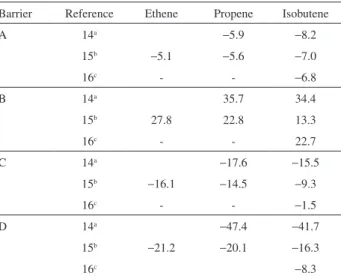
forming an alkoxide as the inal product. The transition state however, resembles a carbenium ion and the activation energy was straightforward related with the structure of the hydrocarbon. Table 1 shows the calculated energy for the adsorption of the oleins to an HT3 cluster at different level
of calculations, whereas Figure 3 shows the energy proile. One can see that, regardless of the level of theory used in the calculations, the activation energy decreases on going from ethene to isobutene, which relects the stability of the respective carbocation in the transition state. The stability of the alkoxide follows an opposite trend, indicating steric repulsions between the methyl groups and the T3 cluster.
Calculation of the relative stability of butoxide isomers16
afforded a comparison among the primary, secondary and tertiary alkoxides. Table 2 shows the energy difference indicating the lower stability of the tert-butoxide, which is
due to the steric repulsion between the methyl groups and the framework atoms. The steric effects associated with the attachment of an alkyl group to the framework oxygen atom could be highlighted on a larger zeolite cluster, describing a real part of the zeolite Y structure. We carried out a study with a T30 cluster,17 comprising the hexagonal prism
and the sodalite cage of the zeolite. The results indicated that the lexibility of the zeolite framework is limited and bulky alkyl groups experience strong repulsions with the
framework. In addition, different adsorption sites on the zeolite structure could be investigated. Nevertheless, the use of semi-empirical methods at that time limited the scope of the results, providing only a qualitative trend.
The spectroscopic studies that characterized the alkoxides as long-living intermediates over the zeolite surface, together with calculations of hydrocarbon protonation with inite clusters, which conirmed the spectroscopic indings, led many authors to believe that the alkoxides were the real intermediates on hydrocarbon reactions over zeolites. Therefore, theoretical studies of cracking,18 isomerization19
and hydride transfer,20 considering the alkoxides as
intermediates, appeared in the literature, although the calculations sometimes pointed out for highly energetic barriers. Simple alkyl carbocations were then considered only transition states over the zeolite surface.
4. Alkylhalides as Source of Carbocations on
Zeolites
Most of the spectroscopic studies to characterize the nature of carbocations on zeolites were carried out with
Table 1. Calculated energy (kcal mol-1) for the protonation of oleins over
an HT3 cluster at different levels of calculations
Barrier Reference Ethene Propene Isobutene
A 14a −5.9 −8.2
15b −5.1 −5.6 −7.0
16c - - −6.8
B 14a 35.7 34.4
15b 27.8 22.8 13.3
16c - - 22.7
C 14a −17.6 −15.5
15b −16.1 −14.5 −9.3
16c - - −1.5
D 14a −47.4 −41.7
15b −21.2 −20.1 −16.3
16c −8.3
aHF/3-21G; bMP2(fc)6-31G(d,p)//HF/6-31G(d,p); cB3LYP/6-31G(d,p).
Figure 3. Energy proile for the protonation of oleins over an HT3 cluster.
Table 2. Calculated enthalpy difference between the butoxy isomers on
a T3 inite cluster, at B3LYP/6-31G(d,p)
Alkoxy Intermediate ∆H / (kcal mol-1)
n-butoxy +0.2
sec-butoxy 0.0
iso-butoxy +0.7
oleins or alcohols over acidic zeolites. Although this system is closer to what would be found in oil reining processes, such as cracking or alkylation, the presence of secondary reactions sometimes mask the results. The high concentration of oleins and the presence of acidic sites favor complex condensation reactions. The peak around 250 ppm in the 13C NMR of solid state propene over HY8
exempliies this process. However, the most dramatic situation arises from the studies with the tert-butoxide.
Although the formation of the tert-butoxide was considered
in the irst studies7 of tert-butanol over HZSM-5, further
investigation21 with isobutene over acidic zeolites revealed
that, in fact, the tert-butoxide is not a long-living species,
yielding complex condensation reactions with the oleins in the medium to afford higher molecular weight intermediates. This trend was also conirmed by infrared studies22 of tert-butanol and isobutene over acidic zeolites,
which pointed out for a rapid dimerization process. Thus, the tert-butoxide was never spectroscopically characterized
as a long-living intermediate over the zeolite surface. To minimize the problems associated with the condensation process when using oleins or alcohols over acidic zeolites, we started working with alkylhalides over metal-exchanged zeolites. The main idea was that the metal cations on zeolites might behave as weak Lewis acid sites, complexing with the halide and giving rise to adsorbed carbocations, either covalent alkoxides or ionic carbocation species.
We initially applied the method for the study of different butoxides over NaY zeolite using in situ infrared spectroscopy
at different temperatures.23 Whereas n-butyl and sec-butyl
chlorides afforded spectra consistent with the formation of the respective alkoxides, the tert-butyl chloride showed a complete
different behavior. A sharp band at 1639 cm-1, relative to C=C
stretching, was observed even at −125 oC (Figure 4). The
spectrum at this temperature is consistent with the formation of adsorbed isobutene, indicating a fast proton elimination as the tert-butyl chloride was admitted to the medium. As the
temperature increases, the oleinic band broadens suggesting the presence of oligomers. Indeed, the spectrum at room temperature is similar to the infrared spectrum observed in the adsorption of tert-butanol or isobutene over acidic zeolites,22
which pointed out for a dimerization reaction. Thus, the tert
-butoxide was not spectroscopically characterized even with the use of tert-butyl chloride and NaY, indicating the high
reactivity of the system.
DFT calculations using a NaT3 cluster supported
the experimental results. For the n-butyl and sec-butyl
chlorides, formation of the respective alkoxide was the lower energy barrier process, whereas elimination to afford 1-butene and 2-butene, respectively, was signiicantly more energetic. On the other hand, calculations with the
tert-butyl chloride afforded only isobutene as product
and all attempts to characterize the tert-butoxide were
unsuccessful. These results were in close agreement with the experimental indings.
Figure 5 A shows the transition state for alkoxide formation from the n-butyl chloride, showing a resemblance
with an SN2 mechanism. The departure of the chloride ion
takes place at the opposite side of the nucleophilic attack. On the other hand, the transition state of proton elimination from tert-butyl chloride resembles an E2 mechanism
(Figure 5 B), with departure of the chloride simultaneous to proton transfer to the zeolite.
Although the use of alkylhalides did not prevent oligomerization in tertiary systems, it proved to be useful to study the formation and reactivity of alkoxides on zeolites. The metal cation also plays a role in the reactivity of the system.24 The use of alkylhalides and metal-exchanged
zeolite in alkylation,25 and natural gas conversion to oleins26
or methanol,27 are practical applications of the concepts
developed in the more fundamental spectroscopic and theoretical studies.
Figure 4. Infrared spectra of tert-butyl chloride over NaY: (A) NaY prior adsorption; (B) adsorption at −125 oC; (C) adsorption at −105 oC;
(D) adsorption at −90 oC; (E) adsorption at –60 oC; (F) adsorption at 25 oC;
(G) NaY after heating to 400 oC and evacuating to 10-4 Torr. Reprinted from
5. Theoretical Studies Considering the Zeolite
Cavity
The inite cluster approach used in the irst studies of carbocations on zeolites does not describe the electronic and steric effects associated with the entire zeolite cavity, which might favor ionic carbocations. The covalent C-O bond in the alkoxides imposes some steric repulsion with the zeolite framework, and it is possible that these species would be high in energy on zeolites of constrained pore environment.
The advances in theoretical methods and computers permitted a more precise description of the zeolitic system in recent years, especially with the inclusion of the whole cavity. It is of special importance the development of methods based on periodic boundary conditions (PBC) calculations,28 where a box containing
the system is replicated by translation throughout space to form an ininite lattice, and the ONIOM scheme,29 where
different parts of the system are treated at different levels of theory.
With the inclusion of the zeolite cavity it became clear the importance of steric constraints on the relative stability of the alkoxides, especially on zeolites in which the pore walls are signiicantly curved, such as Chabazite.30
Calculations31 indicated that the tert-butyl cation could be
characterized as minimum on the potential energy surface on certain zeolite structures, but the energy difference between the carbocation and the tert-butoxide depends,
mainly, on short-range effects and local steric constraints.32
Most of the theoretical studies using periodical and ONIOM methods relied on less complex zeolite structures, like Chabazite and Ferrierite, or curved structures, such as Mordenite. Nevertheless, the industrial most important zeolite catalyst is Faujasite or zeolite Y. This material is the main ingredient of cracking catalysts, responsible for the production of high-octane gasoline and liqueied petroleum gas (LPG). Thus, it is important to study the
carbocation/alkoxide system on this particular zeolite structure. We have carried out an ONIOM study33 on
the protonation of isobutene over a large cluster model of zeolite Y, comprising 288 atoms (Si84O132H72), which
corresponds to two coupled supercavities. The coordinates were obtained from the crystallographic data available in the literature.34 The acid site and the organic moiety
were treated by ab initio methods, whereas the rest of the
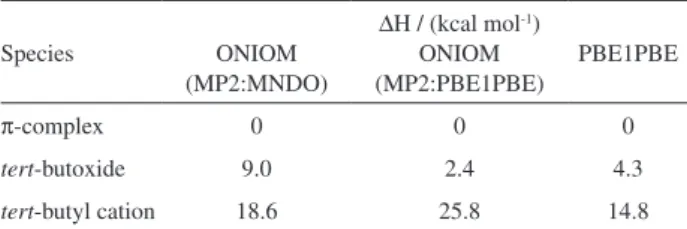
zeolite structure was treated by the semiempirical MNDO method. Table 3 shows the enthalpy difference between the isobutene π-complex, the tert-butoxide and the tert
-butyl cation, at different levels of theory. In all cases, the
π-complex was found to be the most stable species, but we
were able to characterize the tert-butyl cation as a discrete
intermediate on the zeolite surface. The energy difference between the carbocation and the alkoxide depends on the level of theory. The stabilization of the tert-butyl cation is
mostly due to short-range interactions, such as hydrogen bonding and electrostatic effects, whereas the alkoxide is more sensitive to dispersion interactions. It is interesting to note that the tert-butoxide is higher in energy compared
with the isobutene π-complex, in agreement with our
spectroscopic observation23 of the adsorption of tert-butyl
chloride over NaY.
Figure 6 shows the calculated structure of the tert-butyl
cation inside the zeolite Y cavity. One can see the hydrogen bond interactions between the tert-butyl cation and the
framework oxygen atoms, which is an important source of stabilization of carbocations on the zeolite surface.
6. Rearrangement and Nucleophilic Substitution
on Alkylhalides: the Bicyclobutonium Cation
Although the theoretical studiesconsidering the entire zeolite cavity have demonstrated that the tert-butyl cation
can be an intermediate on zeolite-catalyzed reactions, they pointed out to a signiicant energy difference with respect to the alkoxide. Thus, it was not clear if carbocations were really involved in the reaction mechanism, or if they are formed only at high temperatures, typically of oil reining
Figure 5. Calculated transition state for alkoxide formation from the adsorption of n-butyl chloride (A) and proton elimination from the
adsorption of tert-butyl chloride (B) over NaY, at B3LYP/6-31G(d,p). Reprinted from reference 23 with copyright permission from Royal Society of Chemistry.
Table 3. Calculated enthalpy difference for the i-C4H9+π-complex, alkoxide
and carbocation adsorbed on the zeolite Y pore cavity, at different levels of theory
Species ONIOM (MP2:MNDO)
∆H / (kcal mol-1)
ONIOM (MP2:PBE1PBE)
PBE1PBE
π-complex 0 0 0
tert-butoxide 9.0 2.4 4.3
(e.g. 400-500 oC) or on particular zeolite structures,
where steric constraints play a decisive role. To show that equilibrium between covalent alkoxides and ionic carbocations can occur, even at room temperature, we decided to carry out a study with a small cyclic system. The cyclopropylcarbinyl chloride undergoes a rearrangement when solvolyzed in polar solvents to yield three isomeric compounds.35 This chemistry was extensively studied in
solution by J. D. Roberts, who proposed the involvement of the bicyclobutonium cation (Figure 7). This ion has a three-center two electron bond, permitting the nucleophilic attack at three different positions. Therefore, if the same kind of rearrangement occurs on zeolites, it would be a strong evidence for the formation of the bicyclobutonion cation.
Upon exposing the cyclopropylcarbinyl halide (chloride or bromide) to NaY at room temperature, we were able to observe cyclobutyl and allylcarbinyl halides, together with the unreacted cyclopropylcarbinyl halide.36 The
characterization of rearranged products is consistent with formation of the bicyclobutonium cation and internal return of the halide ion. We also carried out the reaction of cyclopropylcarbinyl chloride with NaY impregnated with NaBr. Besides the rearranged chlorides, we were able to
observe cyclopropyl, cyclobutyl and allylcarbinyl bromides among the products. They were formed upon the nucleophilic attack of the bromide ion to the bicyclobutonium cation. The nucleophilic substitution and rearrangement were irst-order in relation to the cyclopropylcarbinyl chloride, being independent of the concentration of the impregnated bromide. All these inding are unequivocal evidences for a mechanism involving ionization of the cyclopropylcarbinyl chloride to the bicyclobutonium cation. Internal return of the chloride anion affords the rearranged alkylchlorides and nucleophilic attack by the bromide anion impregnated inside the zeolite cavity gives rise to the alkylbromides (Scheme 1).
The experimental results were supported by theoretical calculations, which indicated that the bicyclobutonium cation is an intermediate inside the zeolite Y cavity. The calculations, at PBE1PBE/6-31G(d,p):MNDO level of theory, identiied, at least, three possible C4H7+ cations
on zeolite Y. The relative stability of the carbocations is directly related with the strength of the hydrogen bond with the zeolite structure (Figure 8), stressing the short range stabilization of these species.
Figure 6. Structure of the tert-butyl cation adsorbed on Y zeolite surface determined at ONIOM(MP2(FULL)/6-31G(d,p):MNDO) level. Reprinted
from reference 33, with permission from Elsevier.
Figure 7. Pictorial representation of the structure of the bicyclobutonium
cation showing the three-center bond.
Scheme 1. Rearrangement and nucleophilic substitution of the cyclopropylcarbinyl chloride over NaY impregnated with NaBr. Adapted from reference 36.
Figure 8. Most stable C4H7+ species, the bicyclobutonium cation, on
An interesting discovery that came with this study was the halogen switch reaction. When we concomitantly adsorbed tert-butyl bromide and cyclopropylcarbinyl
chloride over NaY zeolite, we were able to observe among the products tert-butyl chloride, cyclopropylcarbinyl,
cyclobutyl and allylcarbinyl bromides (Scheme 2). The same type of result occurs with tert-butyl chloride and
cyclopropylcarbinyl bromide on NaY. The reaction was interpreted in terms of nucleophilic substitution, with attack of the chloride or bromide leaving group to the formed carbocations. This occurs inside the zeolite cage due to the pore coninement effect,37 which permits the close
proximity among the different species inside the pores. In liquid solutions, the substrate is completely surrounded by the solvents molecules, impairing the proximity between two different ionogen molecules. Thus, upon ionization either the solvent or the leaving group (internal return) attacks the formed carbocation. However, on zeolites, the pore structure permits the concentration of two different alkylhalide molecules inside the cavities, allowing the formed carbocations to interact with two different leaving groups (nucleophiles).
7. Concluding Remarks. Where Are We Going?
There are unequivocal evidences, both from theoretical calculations and experimental studies with alkylhalides, that simple alkyl carbocations can be intermediates on the zeolite surface. Although the relative stability among the ionic carbocation, the covalent alkoxide and the olein π-complex is still a matter of debate and might be
dependent on the zeolite structure, there is no doubt that the three species might be in equilibrium during zeolite-catalyzed reactions. Stabilization of the carbocations is mostly due to short-range interactions, such as hydrogen bonding and electrostatic forces. This picture may change the way people develop better zeolite catalysts, because instead of increasing the acid strength, the focus may be the modiication of the structure or the pore environment towards the better stabilization of the carbocation. The acid strength is one of the factors, but certainly not the only one. In recent calculations, we observed that the bicyclobutonium cation becomes more stable than the respective alkoxides when a monomeric LiCl is considered inside the cavity. This indicates that the carbocations can
interact with other species inside the cavity, besides the framework oxygen atoms. It is known that ultrastable Y zeolites (USY), produced upon partial steam dealumination of the framework that also leads to formation of extra-framework aluminum (EFAL), present a high catalytic activity for hydrocarbon cracking.38 Many authors explain39
this behaviour to a synergistic effect between Bronsted and Lewis acid sites, the later being associated to the EFAL species. Nevertheless, the synergy between both acid sites has been questioned in some theoretical studies,40
which indicated that hydrogen bonding stabilization of the deprotonated zeolite plays a major role. It is possible that the EFAL species may stabilize the formation of the carbocation through hydrogen bonding, as well as providing additional electrostatic stabilization. In fact, some acidity measurements41 indicated a same acid strength
distribution in Y zeolites, regardless of the presence of EFAL. Therefore, the focus must be on the intermediate species, such as carbocations, rather than on the initial state of the zeolite (acidity).
We believe that zeolites may act as solid solvents. An important property of solvents42 is the ionizing ability, with
the presence of electron-pair donor (EPD) and electron-pair acceptor (EPA) sites in the structure. We may consider the oxygen atoms of the framework structure of zeolites as EPD centers, whereas the metal cations act as EPA centers. In this sense, zeolites may be explored in other ields, rather than catalysis and adsorption. They provide a good environment for carrying out ionic reactions, especially for less polar substrates that are insoluble in water or other polar media. Scheme 3 shows a general picture for ionic reactions on zeolites, highlighting the equilibrium among the isobutene
π-complex, the tert-butoxide and the tert-butyl cation on
the surface. Whereas the alkoxides and the π-complexes
should be thermodynamically more stable than the ionic carbocations, many reactions, including cracking, isomerization, alkylation and nucleophilic substitution (shown in the scheme), occur through the involvement of carbocationic intermediates. The future experimental studies will be focused on the relation between the zeolite structure, and its acidity, with regard to the stabilization of carbocations. On the other hand, the theoretical studies will have to advance on the understanding of the short-range stabilization of carbocations, as well as giving inputs of the lifetime of such intermediates within the zeolite pore environment.
One may inally argue if the study of cyclopropylcarbinyl chloride rearrangement on NaY may be extended to acidic zeolites, which are the most important for industrial purposes. Table 4 show the kinetics of the cyclopropylcarbinyl chloride rearrangement on sodium,
Scheme 2. Halogens switch reaction over zeolite Y. Adapted from
Scheme 3. Equilibrium among the π-complex, alkoxide and the
carbocation over the zeolite surface. It is also highlighted nucleophilic substitution reactions occurring from the carbocation. Adapted from reference 33.
ammonium and protonic Beta zeolite at 28 oC. One can see
that the rearrangement occurs over ammonium and protonic zeolite Beta, although the reactions are signiicantly slower than over NaBeta. We are still investigating this system, but it will certainly shed more light into the mechanism of carbocation formation over protonic zeolites.
Acknowledgements
Authors acknowledge inancial support from CNPq and FAPERJ.
Claudio J. A. Mota was born in Rio de Janeiro, Brazil. He studied Chemical Engineering at the Universidade Federal do Rio de Janeiro (UFRJ), where he also obtained his PhD degree in Organic Chemistry. After working for 11 years at the Petrobras R&D Center, he moved to the Institute of Chemistry of the UFRJ, where he presently coordinates the Laboratory of Hydrocarbon Reactivity, Biomass and Catalysis (LARHCO). He is a research fellow of CNPq and FAPERJ. In 2007, he received the Technology Award of the Brazilian Chemical Industry Association (ABIQUIM). His research interests are focused on zeolite chemistry and catalysis, with emphasis on the fundamental aspects and applications to biomass conversion. He is author and co-author of over 70 scientiic publications and 12 patents.
Nilton Rosenbach is graduated in Chemical Engineering from the Universidade do Estado do Rio de Janeiro. He obtained his PhD degree from the Universidade Federal do Rio de Janeiro and was a postdoctoral fellow at the Institut Charles Gerhardt (Université Montpellier 2), France. Presently, he is an Assistant Professor at the Centro Universitário Estadual da Zona Oeste (UEZO) in Rio de Janeiro. His research activities are mainly focused on molecular modeling of porous materials used in catalysis, gas storage and drug delivery systems.
References
1. Luna, F. L.; Schuchardt, U.; Quim. Nova2001, 24, 885. 2. Corma, A.; Chem. Rev. 1995, 95, 559.
3. Olah, G. A.; Prakash, G. K. S.; Molnár, A.; Sommer, J.;
Superacid Chemistry, 2nd ed., Wiley: New York, 2009.
4. Olah, G. A.; Angew. Chem., Int. Ed.1973, 12, 171.
5. Vogel, P.; Carbocation Chemistry, Elsevier: Amsterdam, 1985.
6. Haw, J. F.; Anal. Chem.1988, 60, 559a.
7. Aronson, M. T.; Gorte, R. J.; Farneth, W. E.; White, D.; J. Am. Chem. Soc.1989, 111, 840.
8. Haw, J. F.; Richardson, B. R.; Oshiro, I. S.; Lazo, N. D.; Speed, J. A.; J. Am. Chem. Soc.1989, 111, 2052.
9. Munson, E. J.; Ferguson, D. B.; Kheir, A. A.; Haw, J. F.;
J. Catal.1992, 136, 504.
10. Nicholas, J. B.; Xu, T.; Haw, J. F.; Top. Catal.1998,6,
141.
11. Sauders, M.; Vogel, P.; Hagen, E. L.; Rosenfeld, J. C.; Acc. Chem. Res.1973, 6, 53.
12. Deno, N. C.; Richey, H. G.; Hodge, J. D.; Wisotsky, M. T.;
J. Am. Chem. Soc.1962, 84, 1498.
13. Kazansky, V. B.; Senchenya, I. N.; Catal. Lett.1991, 8, 317;
Kazansky, V. B.; Acc. Chem. Res.1991, 24, 379
14. Viruela-Martin, P.; Zicovich-Wilson, C. M.; Corma, A.; J. Phys. Chem.1993, 97, 13713.
15. Esteves, P. M.; PhD Thesis, Universidade Federal do Rio de
Janeiro, Brazil, 1999. Information available from the authors under request.
16. Correa, R. J.; Mota, C. J. A.; Phys. Chem. Chem. Phys.2002,
4, 375.
17. Mota, C. J. A.; Esteves, P. M.; de Amorim, M. B.; J. Phys. Chem.
1996, 100, 12418.
18. Rigby, A. M.; Kramer, G. J.; van Santen, R. A.; J. Catal. 1997,
170, 1.
19. Rigby, A. M.; Frash, M. V.; J. Mol. Catal. A: Chem. 1997, 126, 61; Frash, M.; Kazansky, V. B.; Rigby, A. M.; van Santen, R. A.;
J. Phys. Chem. B1998, 102, 2232.
Table 4. Kinetics of the cyclopropylcarbinyl chloride rearrangement over zeolite Beta at 28 oC
Zeolite k / 10-3 min-1
NaBETA 1.8
NH4BETA 0.5
20. Boronat, M.; Viruela, P.; Corma, A.; J. Phys. Chem. A1998,
102, 9863.
21. Lazo, N. D.; Richardson, B. R.; Schettler, P. D.; White, J. L.; Munson, E. J.; Haw, J. F.; J. Phys. Chem. 1991, 95, 9420.
22. Kondo, J. N.; Wakabayashi, F.; Domen, K.; J. Phys. Chem. B
1998, 102, 2259; Ishikawa, H.; Yoda, E.; Kondo, J.; Wakabayashi,
N. F.; Domen, K.; J. Phys. Chem. B1999, 103, 5681; Kondo, J. N.; Ishikawa, H.; Yoda, E.; Wakabayashi, F.; Domen, K.;
J. Phys. Chem. B1999, 103, 8538.
23. Correa, R. J.; Mota, C. J. A.; Phys. Chem. Chem. Phys.2002,
4, 4268.
24. Correa, R. J.; Mota, C. J. A.; Appl. Catal., A 2003, 255, 255.
25. Bidart, A. M. F.; Borges, A. P. S.; Nogueira, L.; Lachter, E. R.; Mota, C. J. A.; Catal. Lett.2001, 75, 155; Rosenbach Jr., N.;
Mota, C. J. A.; J. Braz. Chem. Soc.2005, 16, 691; Bidart, A. M. F.; Borges, A. P. S.; Chagas, H. C.; Nogueira, L.; Lachter, E. R.; Mota, C. J. A.; J. Braz. Chem. Soc.2006, 17, 758. 26. Noronha, L. A.; Mota, C. J. A.; Catal. Today2005, 101, 9.
27. Fernandes, D. R.; Rosenbach Jr, N.; Mota, C. J. A.; Appl. Catal., A2009, 367, 108.
28. Martin, R. M.; Electronic Structure: Basic Theory and Practical Methods, Cambridge University Press: UK, 2004.
29. Dapprich, S.; Komáromi, I.; Byun, K. S.; Morokuma, K.; Frisch, M. J.; THEOCHEM1999, 1, 461.
30. Rozanska, X.; van Santen, R. A.; Demuth, T.; Hutschka, F.; Hafner, J.; J. Phys. Chem. B2003, 107, 1309.
31. Sinclair, P. E.; Vries, A.; Sherwood, P.; Catlow, C. R. A.; van Santen, R. A.; J. Chem. Soc. Faraday Trans. 1998, 94, 3401;
Boronat, M.; Viruela, P. M.; Corma, A.; J. Am. Chem. Soc.2004,
126, 3300; Tuma, C.; Sauer, J.; Angew. Chem., Int. Ed.2005,
44, 4769.
32. Boronat, M.; Corma, A.; Appl. Catal., A2008, 336, 2; Tuma,
C.; Sauer, J.; Phys. Chem. Chem. Phys.2006, 8, 3955. 33. Rosenbach Jr., N.; dos Santos, A. P. A.; Franco, M.; Mota, C.
J. A.; Chem. Phys. Lett.2010, 485, 124.
34. Baerlocher, W. M.; Olson, D. H.; Atlas of Zeolite Framework Types, Elsevier: Amsterdam, 2001.
35. Roberts, J. D.; Mazur, R. H.; J. Am. Chem. Soc.1951, 73, 2509;
Mazur, R. H.; White, W. N.; Semenov, D. A.; Lee, C. C.; Silver, M. S.; Roberts, J. D.; J. Am. Chem. Soc.1958, 81, 4390.
36. Franco, M.; Rosenbach Jr., N.; Ferreira, G. B.; Guerra, A. C. O.; Kover, W. B.; Turci, C. C.; Mota, C. J. A.; J. Am. Chem. Soc.2008, 130, 1592.
37. Sastre, G.; Corma, A.; J. Mol. Catal. A: Chem. 2009, 305, 3.
38. Wang, Q. L.; Giannetto, G.; Guisnet, M.; J. Catal.1991,130, 471. 39. Fritz, P. O.; Lunsford, J. H.; J. Catal.1989,118, 85.
40. Mota, C. J. A.; Bhering, D. L.; Rosenbach Jr., N.; Angew. Chem., Int. Ed.2004, 43, 3050.
41. Biaglow, A. I.; Parrillo, D. J.; Kokotailo, G. T.; Gorte, R. J.;
J. Catal.1994, 148, 213.
42. Reichardt, C.; Solvent and Solvent Effects in Organic Chemistry, VCH-Verlag: Weinheim, 1988.