Alberto Consolaro1
How to cite this article: Consolaro A. Obesity and orthodontic treatment: is there any direct relationship? Dental Press J Orthod. 2017 May-June;22(3):21-5. DOI: https://doi.org/10.1590/2177-6709.22.3.021-025.oin
Submitted: April 13, 2017 - Revised and accepted: April 19, 2017
» The authors report no commercial, proprietary or financial interest in the products or companies described in this article.
Contact address: Alberto Consolaro E-mail: [email protected]
Obesity and orthodontic treatment: is there
any direct relationship?
1 Full professor at the Dental School of Bauru, Universidade de São Paulo
(FOB-USP) and in the Post-graduation program at the Dental School of Ribeirão Preto, Universidade de São Paulo (FORP-USP).
Obesity is a wide-spread condition directly or indirectly connected with an increase in the prevalence of a variety of hu-man diseases. It afects over 50% of the western overall population. In 2017, a thorough analysis of 204 studies on obesity and cancer revealed that the condition increases the risk of the following types of cancer: stomach, colon, rectal, bile duct, pancreatic, esophagus, breast, endometrial, ovarian, kidney and multiple myeloma. The irst study aiming at establishing a connection between obesity and the rate of induced orthodontic tooth movement was conducted by Saloom et al; however, it could not efectively nor signiicantly reveal any direct inluence or efect. Despite being identiied during the irst week, diferences could not be explained and treatment time remained unchanged. In spite of lack of studies in the literature on the connection between obesity and the rate of induced tooth movement, in clinical practice, courses or specialized train-ing, we should not have protocols changed nor adopt any measures or expect signiicant diferences between normal-weight and obese individuals. It should be emphasized that unsuccessful cases or cases of root resorption associated with treatment should not be assigned to obesity, since scientiic data is insuicient to do so.
Keywords: Obesity. Orthodontic movement. Induced tooth movement. Orthodontics. DOI: https://doi.org/10.1590/2177-6709.22.3.021-025.oin
A obesidade representa uma epidemia que afeta mais de 50% da população ocidental e está, direta ou indiretamente, relacio-nada com o aumento na prevalência de algumas doenças humanas. Em 2017, em uma análise minuciosa de 204 trabalhos so-bre a obesidade e o câncer, observou-se que ela aumenta os riscos de câncer de estômago, cólon, reto, vias biliares, pâncreas, esôfago, mama, endométrio, ovário, rim e mieloma múltiplo. O primeiro trabalho que procurou relacionar a obesidade com a velocidade de movimentação dentária ortodôntica foi apresentado por Saloom et al., mas não conseguiu demonstrar, de forma efetiva e signiicativa uma inluência ou efeito direto. As diferenças ocorreram apenas na primeira semana, e sem explicação, mas o tempo total do tratamento não foi alterado. Na prática clínica, em aulas ou nos treinamentos de especia-listas, não devemos — tendo em vista a ausência na literatura que correlacione a obesidade e a velocidade da movimentação dentária induzida — mudar protocolos, adotar medidas ou ter expectativas de diferenças signiicativas entre pessoas com peso normal e obesas. Ressalta-se, ainda, que casos de insucesso e/ou de reabsorções radiculares associadas ao tratamento nesses pacientes não devem ser atribuídos à obesidade, pois não há base cientíica para isso.
Obesity has been considered a wide-spread condition in the last 20 years. It is directly or indirectly connected with an increase in the prevalence of a variety of human diseases, such as malignant neoplasm, as identiied among 900,000 Americans analyzed between 1982 and 1998.1 The authors conducting the study assessed the connec-tion established between 57,145 deaths due to cancer with the Body Mass Index (BMI) of those individuals. Those with a BMI over 40 had the risk of dying from cancer increased in 52% in comparison to those who had a BMI between 20 and 24.9 — which is considered within nor-mal standards. Among women, the risk was increased in 62%. The most prevalent types of cancer were: esopha-gus, colon, rectal, liver, vesicle, bile duct, pancreatic, kid-ney, multiple myeloma and non-Hodgkin’s lymphoma. In the USA, obesity accounted for 20% of cancer deaths among women and 14% among men.
Importantly, this type of study requires a high num-ber of individuals in order to represent the overall popula-tion, as the number of variables is considerably high. The connection established between obesity and cancer might be considered of greater importance in comparison to the connection between cancer and smoking, especially because ¾ of the American population is overweight or obese. In 2017, Kyrgiou et al11 from the Imperial College London presented a thorough analysis of 204 studies on obesity and cancer, revealing that the condition efectively increases the risk of the following types of cancer: stom-ach, colon, rectal, bile duct, pancreatic, esophagus, breast, endometrial, ovarian, kidney and multiple myeloma.
The connection established between obesity and other diseases can be explained by the following hy-potheses:
1st) One of the major hypothesis explains obesity-related diseases by the increased secretion of hormones produced by adipocytes commonly referred to as fat cells. The term “hormone” can be used as reference to any mediator/substance released at its production site, capable of reaching further and yet producing an efect which can be referred to as endocrine action.
In their host, adipocytes produce metabolically ac-tive proteins and adipokines, afecting metabolic func-tion and inlammatory response,15 including proinlam-matory leptins,24 resistin21 and anti-inlammatory adipo-nectin.20 Therefore, the adipose tissue might afect the intensity and resolution of inlammatory processes in a number of tissues.9,17
Obesity also afects systemic metabolism in bones through hormonal mechanical systems and inlamma-tory interactions,12 as well as by increasing mineral bone density.18 It has been demonstrated that tooth eruption speed is higher among obese individuals.13
In addition, those individuals present a higher risk of chronic periodontitis10,22 inducing variations among meta-bolic and inlammatory markers, when compared to nor-mal-weight individuals.16 Nevertheless, obese teenagers reported having contributed less when submitted to long orthodontic treatments with ixed appliances.14,23
2nd) The second hypothesis about obesity inducing other chronic diseases is relative to inlammation found in adipose tissues.4,5 In fact, this inlammatory process is referred as such, but it actually represents an increased concentration of macrophages among adipocytes. It is even questionable whether such increased accumulation of macrophages in the adipose tissue can be efectively identiied as inlammation as initially stated by Hota-misligil8 in 2006 — considering that macrophages are also cells present in connective tissues.
Inflammation with clusters of macrophages in adi-pose tissues exist to eliminate fragments of cell dying due to apoptosis, the mechanism by which old cells die and tissues are renewed. The higher the number of adipocytes, the greater the population of inflam-matory or immune cells at the site, which would sub-sequently lead to inflammation in order to have the affected region repaired.
At the time of repair, mediators stimulate cells to proliferate at a higher rate, thus increasing the chances of proliferation-related mistakes and the risk of malig-nant neoplasm. The higher amount of hormones re-leased by adipocytes and inlammation with a view to reaching repair at site must be directly associated with other illnesses, namely: heart attack, diabetes, cancer and autoimmune diseases.
Nevertheless, BMI is not the only trait used to assess cases of obesity. Waist circumference2 is used as well, since apple-shaped bodies signal that fat is accumulat-ed among one’s abdominal viscera, which is way more harmful. On the other hand, pear-shaped patients have fat accumulation distributed focally, for instance, in their hips, without necessarily having fat accumulated in their abdomen.
Results achieved by Cerhan et al2 in 2004 with analyses carried out in 11 studies involving 650,386 people in total have proved waist circumference measurement as a method used to assess patients under risk of obesity. Male patients with waist circumference greater than 110 cm presented mortality rates 52% higher than those with waist circum-ference lower than 90 cm. As for female patients, those with waist circumference greater than 95 cm presented with mortality rates 80% higher than those with measures lower than 75 cm. Obesity-related illnesses and efects have been associated with waist and hip-bone circumference.
Based on the aforementioned data, BMI might and should be considered as an obesity criterion; however, it is not seen as the best one used to assess mortality rates and induction to other illnesses: without fat accumula-tion in one’s abdomen, risks are much lower.
OBESITY AND ORTHODONTIC TREATMENT: NO DIRECT CONNECTION!
Extrapolating findings on the influence of obe-sity to periodontal and bone tissues during orth-odontic movement requires some degree of caution. Variables regarding obesity itself and patients’ over-all health, in addition to variables regarding tooth movement, are plenty. Whenever great variability is involved, studies on a high number of people to be observed throughout time, usually for many years, are required.
Several studies have revealed lack of direct con-nection between systemic factors, endocrine disor-ders as well as heredity and phenomena observed during orthodontic movement, in terms of speed and induced root resorption rates.6,7 One of the major reasons is regarding some degree of normality con-cerning phenomena found during orthodontically induced tooth movement, particularly in terms of bone metabolism. During orthodontic movement, the periodontal ligament experiences a greater deal of cell stress and increased cell and tissue activity at site in comparison to inflammation. Inflammation is triggered at site only as a result of excess force.
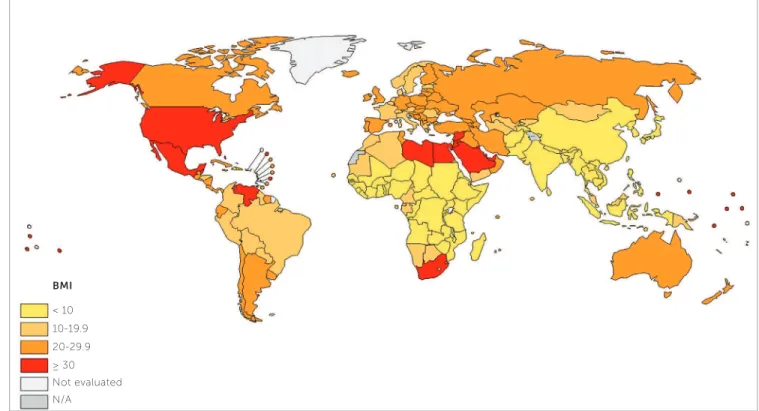
Figure 1 -Worldwide distribution of the percentage of obese population with BMI above 30 (source: WHO data5,11,12 in 2014).
Not evaluated 20-29.9 < 10
N/A ≥ 30 10-19.9
Another reason for being cautious in extrapolat-ing the effects of obesity on orthodontic movement is relative to the role played by cementoblasts, a type of cell which does not respond to bone turnover media-tors due to lacking cell membrane recepmedia-tors.3 This is a natural characteristic which ensures that teeth remain preserved in the ongoing process of bone contouring.
Recently, Saloom et al19 sought to obtain evi-dence showing that tooth movement in obese pa-tients would occur within a shorter period of time up to the moment when alignment would be achieved by means of fixed appliances. However, in order to gather such probable data, the authors compared 28 normal-weight adolescents with 27 obese ones, a quite small sample of patients, especially if obesity-related variables as well as parallel diagnoses and orth-odontic movement-related variables were taken into consideration. Obesity type, waist circumference and adipose tissue accumulation site were not assessed nor compared as they should have. Results involving all 55 patients – 27 males and 28 females with mean age of 15.1 years – were quite inconsistent, as stated by the authors themselves. Gingival and dental plaque build-up indexes were increased among obese patients. In addition to tooth movement, the authors measured a number of biochemical markers in patients’ saliva. Results revealed no diferences among groups, thus not allowing them to draw any conclusive evidence based on their indings.
The analysis carried out by Saloom et al19 reveals an increase in the rate of tooth movement, especial-ly during the first week, but the rate of orthodontic alignment finishing remained the same. In the last paragraph, the article concludes: Obese patients need less time for completion of tooth alignment in com-parison to normal-weight patients; however, such finding is not statistically significant. Orthodontic movement rate during the first week was significantly increased in the obese group. Nevertheless, the pe-riod that goes from one week to finished alignment was not significantly different between groups.
In short, it is possible to conclude, based on the authors’ statements, that this prospective study inves-tigated tooth alignment in obese and normal-weight
patients undergoing orthodontic treatment with fixed appliance, and obese patients required less time for completion of tooth alignment in comparison to nor-mal-weight patients; however, such finding was not statistically significant.
Taking the epidemiological extent of obesity into account, as well as its multiple consequences, any ind-ing and evidence of inluences it exerts over orthodon-tically induced tooth movement require samples to be uniform in terms of diagnosis and treatment plan, in addition to treatment extent and time and more precise criteria on the type of obesity. Above all, the number of patients comprising the sample should be rather considerable. Meanwhile, experimental studies carried out with obese animals should likely present limitations and there should be some degree of caution when extrapolating their outcomes to humans.
FINAL CONSIDERATIONS
The first study aiming at establishing a connec-tion between obesity and the rate of induced orth-odontic tooth movement was conducted by Saloom et al;19 however, it could not effectively nor signifi-cantly reveal any direct influence or effect. Despite being identified during the first week, differences could not be explained and treatment time remained unchanged.
In spite of lack of studies in the literature on the connection between obesity and the rate of induced tooth movement, in clinical practice, courses or specialized training, we should not have protocols changed nor adopt any measures or expect significant differences between normal-weight and obese indi-viduals. It should be emphasized that unsuccessful cases or cases of root resorption associated with treat-ment should not be assigned to obesity, since scien-tific data is insufficient to do so.
REFERENCES
1. Calle EE, Rodriguez C, Walker-Thurmond K, Thun MJ. Overweight,
obesity, and mortality from cancer in a prospectively studied cohort of U.S. adults. N Engl J Med. 2003 Apr 24;348(17):1625-38.
2. Cerhan JR, Moore SC, Jacobs EJ, Kitahara CM, Rosenberg PS, Adami HO,
et al. A pooled analysis of waist circumference and mortality in 650,000 adults. Mayo Clin Proc. 2014 Mar; 89(3):335-45.
3. Consolaro A. Reabsorções dentárias nas especialidades clínicas. 3ª ed. Maringá: Dental Press; 2012.
4. Consolaro A. Inlamação e reparo. 2a ed. Maringá: Dental Press; 2015.
5. Deng T, Lyon CJ, Bergin S, Caligiuri MA, Hsueh WA. Obesity,
inlammation, and cancer. Annu Rev Pathol. 2016;11:421-49.
6. Francischone TRCG. Reabsorção dentária: determinação de sua
freqüência em pacientes com endocrinopatias [tese]. Bauru (SP): Universidade de São Paulo; 2002.
7. Furquim LZ. Perfil endocrinológico de pacientes ortodônticos com
e sem reabsorções dentárias [tese]. Bauru (SP): Universidade de São Paulo; 2002.
8. Hotamisligil GS. Inlammation and metabolic disorders. Nature.
2006;444(7121):860-7.
9. Issa RI, Griin TM. Pathobiology of obesity and osteoarthritis: integrating biomechanics and inlammation. Pathobiol Aging Age Relat Dis. 2012 May 9;2(2012). pii: 17470.
10. Keller A, Rohde JF, Raymond K, Heitmann BL. Association between periodontal disease and overweight and obesity: a systematic review. J Periodontol. 2015 June;86(6):766-76
11. Kyrgiou M, Kalliala I, Markozannes G, Gunter MJ, Paraskevaidis E, Gabra H, et al. Adiposity and cancer at major anatomical sites: umbrella review of the literature. BMJ. 2017 Feb 28;356:j477.
12. López-Gómez JJ, Pérez Castrillón JL, de Luis Román DA. Impact of obesity on bone metabolism. Endocrinol Nutr. 2016 Dec;63(10):551-9. 13. Must A, Phillips SM, Tybor DJ, Lividini K, Hayes C. The association
between childhood obesity and tooth eruption. Obesity (Silver Spring). 2012 Oct;20(10):2070-4.
14. Neeley WW 2nd, Gonzales DA. Obesity in adolescence: implications in orthodontic treatment. Am J Orthod Dentofacial Orthop. 2007 May;131(5):581-8.
15. Ouchi N, Parker JL, Lugus JJ, Walsh K. Adipokines in inlammation and metabolic disease. Nat Rev Immunol. 2011 Feb;11(2):85-97.
16. Papageorgiou SN, Reichert C, Jäger A, Deschner J. Efect of overweight/ obesity on response to periodontal treatment: systematic review and a meta-analysis. J Clin Periodontol. 2015 Mar;42(3):247-61.
17. Pierpont YN, Dinh TP, Salas RE, Johnson EL, Wright TG, Robson MC, et al. Obesity and surgical wound healing: a current review. ISRN Obes. 2014(2014):638936.
18. Salamat MR, Salamat AH, Janghorbani M. Association between obesity and bone mineral density by gender and menopausal status. Endocrinol Metab (Seoul). 2016 Dec;31(4):547-58.
19. Saloom HF, Papageorgiou SN, Carpenter GH, Cobourne MT. Impact of obesity on orthodontic tooth movement in adolescents: a prospective clinical cohort study. J Dent Res. 2017;1-8.
20. Scherer PE, Williams S, Fogliano M, Baldini G, Lodish H. A novel serum protein similar to C1q, produced exclusively in adipocytes. J Biol Chem. 1995 Nov 10;270(45):26746-9.
21. Steppan CM, Bailey ST, Bhat S, Brown EJ, Banerjee RR, Wright CM, et al. The hormone resistin links obesity to diabetes. Nature. 2001 Jan 18;409(6818):307-12.
22. Suvan J, D’Aiuto F, Moles DR, Petrie A, Donos N. Association between overweight/obesity and periodontitis in adults: a systematic review. Obes Rev. 2011 May;12(5):e381-404.
23. von Bremen J, Lorenz N, Ruf S. Impact of body mass index on oral health during orthodontic treatment: an explorative pilot study. Eur J Orthod. 2016 Aug;38(4):386-92.