Original Article
Artigo Original
Leah Nevo1
Chaya Nevo1
Gisele Oliveira1
Keywords
Voice Multilingualism
Language Speech Speech Acoustics Speech Perception
Descritores
Voz Multilinguismo Linguagem Fala Acústica da Fala Percepção da Fala
Correspondence address: Gisele Oliveira
Graduate Program in Speech-Language Pathology, Touro College
902 Quentin Road, Brooklyn, NY 11223, USA. E-mail: [email protected]
Received: 04/06/2015
Accepted: 05/01/2015
Study carried out at the Graduate Program in Speech-Language Pathology, Touro College – Brooklyn (NY), USA. (1) Graduate Program in Speech-Language Pathology, Touro College – Brooklyn (NY), USA.
Conlict of interests: nothing to declare.
A comparison of vocal parameters in
adult bilingual Hebrew-English speakers
Comparação de parâmetros vocais em adultos
bilíngues falantes de Hebraico e Inglês
ABSTRACT
Purpose: There has been growing research on the effects of language on voice characteristics; however, few studies have examined the impact of language on vocal features within bilinguals. This study aimed to compare vocal parameters among bilingual Hebrew/English speaking individuals when speaking in Hebrew versus English. Methods: Forty bilingual participants (17 males and 23 females) between the ages of 23–60 years were asked to spontaneously speak about a neutral topic. Voice samples were digitalized into a tablet for perceptual and acoustic analyses of selected parameters. Results: Results show that there are changes in resonance, glottal attack, fundamental frequency variation and speech rate when adult bilingual speakers talk in Hebrew as compared to English. Conclusion: These indings provide evidence that language plays a role in affecting vocal characteristics of bilingual individuals when they speak different languages.
RESUMO
INTRODUCTION
Although the physiological production of voice is es-sentially universal, the characteristics of voice are varied and dynamic across human speakers. Gender, age and weight are among the factors that are most reported to inluence the vocal characteristics of an individual(1-5). In order to better understand the heterogeneous nature of voice, researchers should consider other factors that may contribute to differences in vocal features among individuals, such as language impact.
There has been growing research on the effects of language on voice characteristics(6-21). When listeners were asked to discriminate whether two speech samples were produced by the same bilingual speaker, listeners were less accurate in their judgment when the speaker switched between English and Finnish, English and German and English and Mandarin as compared to matched-language samples (e.g. English-English, Finnish-Finnish)(6). This supports the hypothesis that language plays a role in changing vocal features. In addition to the linguistic factors that inluence voice characteristics, such as segmental and supra-segmental properties, anatomical differences related to race/ethnicity and socio-cultural norms that are both closely related to one’s language are suggested to result in characteristic variations as well(7-18).
The inluence of culture on voice was explored in popu-lations who spoke the same language, but differed in their cultural or ethnic backgrounds. Following voice analysis, research conclusions indicated differences in vocal parameters between cultural populations, particularly in fundamental frequency (F0) and perturbation measures, which conirms the role of sociocultural elements in the varying measures of voice output(19-21). Cross-population studies that have looked at the effect of language on vocal features have also discovered differences, primarily in mean F0 and fundamental frequency range. While a cross-language comparison of mean F0 in languages such as Dutch and Japanese attributed the varying acoustical voice measures to cultural norms(8,10), others have related these indings to differences in linguistic and phono-logical systems, such as in the comparison of tonal and stress languages (i.e. Mandarin and English, respectively) or English and German(11-14). However, by comparing vocal features in dif-ferent speakers, researchers neglected to control for inherent variables among these speakers, such as personality, anatomi-cal and other inter-individual differences.
One possible way to control for these variables is to ex-amine the inluence of language on voice among bilinguals. Examining changes in a speaker’s voice, when the same individual produces one language and then another, will lead to improved validity in results and better isolate language as a factor in voice output. Few studies in the literature exam-ine the impact of language on voice characteristics within bilinguals. Overall, existing research on bilingual speakers of Russian/English, German/English, Catalan/Spanish and Cantonese/English has revealed a difference in acoustic vo-cal parameters, particularly in mean F0 and F0 range, when comparing the speaker’s voice output in each language(9,14-18).
Based on these conclusions, it is important to extend re-search to other languages as well. The study’s objective was to compare select vocal parameters among bilingual Hebrew-English speaking individuals when speaking in Hebrew versus in English. While other studies have exclusively analyzed acoustic voice measurements, this study aimed to perform a combination of acoustic and perceptual analyses on automatic connected and spontaneous speech samples. These speech tasks were used for analysis, since reading tasks (e.g. a selected reading passage) may not relect the subject’s true vocal nature in conversation(9,22). Perceptual analysis of bilinguals’ voices will corroborate anecdotal evidence that people can perceive differences in voice characteristics when individuals switch between luent languages.
Previous studies have looked at a more restricted age range, such as children, young adults, and the elderly. The current study examine individuals in their young and middle adulthood, between the ages of 23–60, at which point voice is reported to have stabilized(23). The researchers hypothesize that there are changes in select vocal parameters when adult bilingual Hebrew speakers talk in Hebrew as compared to English, following both acoustic and perceptual analyses. A more speciic prediction is that females will demonstrate with an increased mean F0, or pitch, when speaking in Hebrew compared to English and that males will demonstrate with a lower mean F0, or pitch, when speaking in Hebrew versus English.
METHODS
Participants
Forty bilingual Hebrew/English speakers, including 17 males and 23 females between the ages from 23 to 60 (mean: 43.625), participated in the study. All participants were judged to be luent in Hebrew and Standard American English. Fluency was determined by the participants’ ability to coherently speak the language in lengthy conversations with few pauses and in a wide variety of contexts(24). They were recruited from the Brooklyn, NY, area and lived in the United States for an average of 30.07 years at the time of recording, the minimum being 11 years. Individuals were excluded from the study if they reported any known hearing deicits, voice, speech or language disorder, or if they were judged to be insuficiently luent in either Hebrew or English. Additionally, at the time of recording, none of the participants exhibited any cold-like symptoms or upper respiratory problems. They were pre-screened for these conditions in order to preclude any variable that can interfere with the validity of the results. All participants signed an Informed Consent approved by the Touro College, School of Health Science Institutional Review Board (#1337).
Procedures
speech samples were acquired when the participants counted from one to ten in both Hebrew and English. These samples were collected in order to obtain baseline data of their voice quality. Finally, each participant was asked to spontaneously answer an open-ended question on a neutral topic (i.e. describe today’s weather), in both Hebrew and English, at a comfortable pitch and loudness. Spontaneous connected speech samples were obtained to relect the participants’ true vocal nature when speaking in both languages.
Perceptual analysis
Speech samples were analyzed blindly by a Speech-Language Pathologist trained in the area of voice with a voice rating protocol developed for the purpose of this research. A total of 160 randomized samples were analyzed (40 automatic counting and 40 spontaneous speech Hebrew samples, 40 auto-matic counting and 40 spontaneous speech English samples). Intra-rater reliability was established using Kappa reliability measurements of the judge’s re-test of 20 randomized samples (ten Hebrew samples and ten English samples). The intra-rater analysis yielded a Kappa measure of 0.789 (p<0.001), indicat-ing substantial intra-rater agreement. The parameters selected for analysis were voice quality, pitch, resonance and rate in the recordings. Voice quality was assessed in regards to presence or absence of vocal roughness, breathiness, strain and vocal fry. These characteristics were marked on a 0–4 rating scale, with 0 indicating absence and any other rating indicating a presence of the vocal characteristic. Other voice characteristics were rated on a nominal scale, more speciically, glottal attack was characterized as adequate, soft, or hard; pitch was rated as either adequate, low or high; resonance was rated as adequate, nasal, oral or throaty; and rate was rated as either adequate, slow, or fast.
Acoustic analysis
The voice recordings were acoustically analyzed using PRAAT Software to obtain measurements of select vocal pa-rameters, including mean F0, F0 variation, pauses per minute and words per minute (rate of speech). The duration of each speech sample was calculated, with the total mean duration of Hebrew samples measured at 7.8 s (7.5 for females; 8.3 for males) and total mean duration of English samples measured at 7.9 s (7.7 for females; 8.0 for males), and used to calculate the pauses per minute in the speech samples, indicating the amount of voice breaks in the sample as well as words per minute indicating the participants’ rate of speech. F0 variation measures were obtained through subtracting maximum and minimum F0 ranges indicated in the PRAAT analysis.
Statistical analyses were performed using Statistical Package for the Social Sciences (SPSS) software, version 22 (SPSS Inc., Chicago, IL, USA). The data from the perceptual ratings of Hebrew and English samples were compared by using the Wilcoxon signed ranks test for non-parametrical variables. The test analyzed both language samples for statistically signii-cant differences in pitch, resonance, rate (duration of the irst
20 words), and overall voice quality during automatic count-ing and spontaneous speech tasks. The means of the acoustic parameters were then obtained for the total population, males and females and were compared in both language tasks using paired samples Student’s t-test for parametrical variables. The Pearson and Spearman correlation tests were used for checking correlations of parametric and non-parametric vari-ables, respectively.
RESULTS
Perceptual analysis
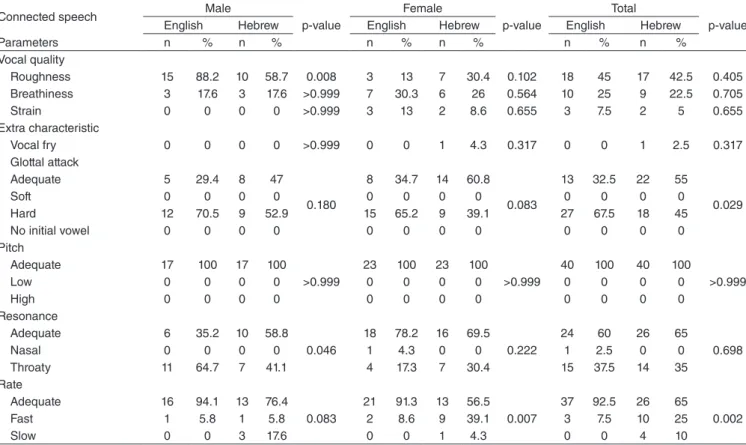
Results of the Wilcoxon signed ranks test for non-paramet-rical variables revealed signiicant changes in perceptual voice characteristics of the population during tasks of connected counting and spontaneous speech in Hebrew and English (Tables 1 and 2). Speciically, in the counting task, the total bilingual Hebrew/English population demonstrated signiicant differences in glottal attack (p=0.029). While 45% of the total population was judged as having hard glottal attack in their Hebrew counting samples, 67.5% of the same group exhibit-ed hard glottal attack while counting in English. Additionally, females exhibited a statistical tendency towards glottal attack changes in Hebrew versus English counting (p=0.083). In Hebrew, 39.1% of females exhibited hard glottal attack compared to 65.2% of the same female group that were judged to have a hard glottal attack when counting in English (Table 1).
Signiicant changes in rate were revealed for the total population (p=0.002), females (p=0.007) and a statistical ten-dency was indicated for males: p=0.083 during the counting tasks. Of the total population, 65% demonstrated adequate rate in Hebrew compared to 92.5% when the group counted in English. Twenty-ive percent of the total population was judged as having a fast rate while counting in Hebrew compared to 7.5% of the sample when counting in English. Ten percent of the Hebrew counting samples was characterized as having a slow rate, while none of the English samples were rated as slow. Amongst the female population, 56.5% were judged to have an adequate rate during the Hebrew counting task in contrast to 91.3% of the female sample when counting in English. Changes in rate were further demonstrated when comparing 31.9% of females who were judged as having a fast rate when counting in Hebrew to 8.6% of the females who were observed as having fast rate in English counting. Slow rate was detected in 4.3% of the female population while counting in Hebrew and was absent in the English counting samples.
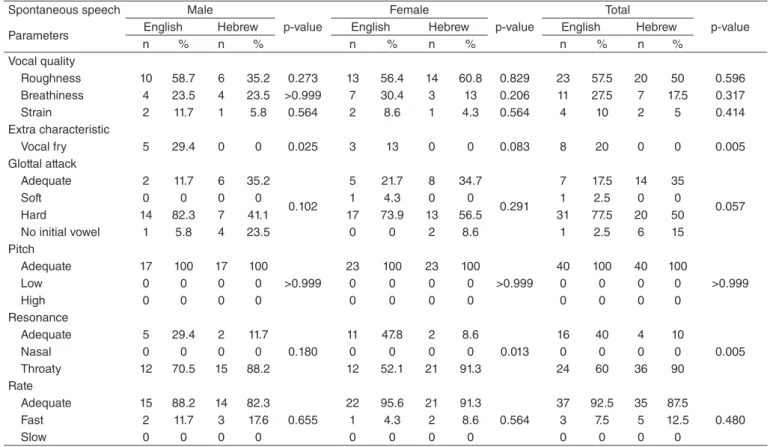
counting in English. Additional signiicant changes found in the male population were in areas of resonance (p=0.046) and roughness (p=0.008); 58.8% were judged to have an adequate resonance while counting in Hebrew compared to 35.2% in English. A throaty resonance was rated in 41.1% of the male population while counting in Hebrew versus 61.7% in English. As mentioned earlier, roughness signiicantly varied when comparing male speakers counting in Hebrew and English. In Hebrew samples, 58.7% of males were judged as having a rough vocal quality during counting compared to 88.2% of the male sample in English counting (Table 1). In the spontane-ous speech samples, adult Hebrew/English bilingual speakers demonstrated changes in resonance, glottal attack and vocal fry when comparing both language samples (Table 2). More speciically, statistically signiicant changes in resonance were found amongst the total population (p=0.005) and the female sample (p=0.013). Ninety percent of the total population was identiied as having a throaty resonance when speaking spon-taneously in Hebrew compared to 60% of the same population when speaking in English. Amongst the female group, 91.3% were characterized as having a throaty resonance while speak-ing in Hebrew compared to 52.1% of the same sample when speaking in English.
There was a greater incidence of hard glottal attack in English than in Hebrew during spontaneous speech for the total population (p=0.057). Fifty percent of the total popu-lation was judged to have hard glottal attack in Hebrew in comparison to 77.5% in English. Vocal fry was also indicated as having a higher incidence in English than in Hebrew for
the total population (p=0.005) and in males (p=0.025), while females had a signiicant tendency to produce vocal fry in English compared to in Hebrew (p=0.083). The presence of vocal fry was absent in all spontaneous speech Hebrew samples compared to 20% of the total population, 29.4% of males and 13% of females that were judged to exhibit vocal fry during spontaneous English speech. No signiicant changes were noted when comparing overall vocal quality, pitch and rate in adult bilingual Hebrew/English speakers when speaking spontane-ously in Hebrew versus English (Table 2).
Correlation testing of perceptual vocal parameters, includ-ing roughness, breathiness, strain, vocal fry, glottal attack, pitch, resonance and rate, was analyzed using Spearman’s correla-tion for non-parametric variables to determine the strength of a monotonic relationship with the age the participants arrived in the USA. For the male population, a moderate negative correlation was found within the spontaneous speech Hebrew samples in relation to roughness (r=-0.525, p=0.031), relect-ing a decreased association with roughness while speakrelect-ing Hebrew for those who arrived later in the USA. For the female population, signiicant correlations were found in the counting samples that indicated a moderate positive relationship between the age participants arrived in the USA and the perception of vocal strain in Hebrew counting samples (r=0.469, p=0.032) and a moderate negative relationship for the two variables in English counting samples (r=-0.456, p=0.038). This relects a likely relationship of: the older the female participant was when arriving at the USA, the greater the detection of vocal strain was while counting in Hebrew, while the perception of vocal strain
Connected speech Male
p-value
Female
p-value
Total
p-value English Hebrew English Hebrew English Hebrew
Parameters n % n % n % n % n % n %
Vocal quality
Roughness 15 88.2 10 58.7 0.008 3 13 7 30.4 0.102 18 45 17 42.5 0.405 Breathiness 3 17.6 3 17.6 >0.999 7 30.3 6 26 0.564 10 25 9 22.5 0.705
Strain 0 0 0 0 >0.999 3 13 2 8.6 0.655 3 7.5 2 5 0.655
Extra characteristic
Vocal fry 0 0 0 0 >0.999 0 0 1 4.3 0.317 0 0 1 2.5 0.317
Glottal attack
Adequate 5 29.4 8 47
0.180
8 34.7 14 60.8
0.083
13 32.5 22 55
0.029
Soft 0 0 0 0 0 0 0 0 0 0 0 0
Hard 12 70.5 9 52.9 15 65.2 9 39.1 27 67.5 18 45
No initial vowel 0 0 0 0 0 0 0 0 0 0 0 0
Pitch
Adequate 17 100 17 100
>0.999
23 100 23 100
>0.999
40 100 40 100
>0.999
Low 0 0 0 0 0 0 0 0 0 0 0 0
High 0 0 0 0 0 0 0 0 0 0 0 0
Resonance
Adequate 6 35.2 10 58.8 0.046
18 78.2 16 69.5 0.222
24 60 26 65
0.698
Nasal 0 0 0 0 1 4.3 0 0 1 2.5 0 0
Throaty 11 64.7 7 41.1 4 17.3 7 30.4 15 37.5 14 35
Rate
Adequate 16 94.1 13 76.4 0.083
21 91.3 13 56.5 0.007
37 92.5 26 65
0.002
Fast 1 5.8 1 5.8 2 8.6 9 39.1 3 7.5 10 25
Slow 0 0 3 17.6 0 0 1 4.3 0 0 4 10
decreased in samples of English counting. A moderate positive correlation was also found for the age female participants ar-rived in the USA and the rate in the Hebrew spontaneous speech samples (r=0.469, p=0.032). Once again, this corroborates a typical bilingual speaking pattern in which participants who arrived in the USA at a later age were associated with speaking Hebrew at an increased rate, most likely due to a irst language dominance in Hebrew.
Acoustic analysis
Results of the Student’s t-test for the acoustic analysis revealed some signiicant changes in acoustic voice parameters when com-paring spontaneous speech samples of adult bilingual Hebrew/ English speakers (Table 3). Pauses per minute were signiicantly higher when adult bilinguals spoke in English (mean=131.9) than in Hebrew (mean=118.9) for the total population (p=0.034).
When breaking down the total sample by gender, males demonstrated an increased mean F0 when speaking in English (mean=126.1) as compared to Hebrew (mean=122) (p<0.001),
as well as an increased F0 variation when speaking in English (mean=282.5) (p=0.034). Females were shown to have statis-tically signiicant changes in their mean F0 when comparing Hebrew/English samples (means=197.7 and 188.6, respec-tively) (p<0.001). In contrast to indings from the male sample, females demonstrated a decreased mean F0 when speaking in English (mean=188.6) versus Hebrew (mean=197.7). No statis-tically signiicant changes were noted in words per minute when comparing Hebrew and English spontaneous speech samples in adult bilingual Hebrew/English speakers for the total popula-tion (means=107.1 and 147.8, respectively) (p=0.101), males (means=110.1 and 154.4, respectively) (p=0.25) and females (means=104.8 and 142.9, respectively) (p=0.315).
Correlation measures were analyzed to determine if the age the participants arrived in the USA were predictive of vocal pa-rameter values studied in the research. For correlation analysis of acoustic vocal parameters, Pearson correlation for parametric variables was used to analyze the relationship between the age the participants arrived in the USA and duration, mean F0, F0 variation, pauses per minute and words per minute (WPM).
Parameters
Male
p-value
Female
p-value
Total
p-value English Hebrew English Hebrew English Hebrew
Mean SD Mean SD Mean SD Mean SD Mean SD Mean SD
Mean F0 126.1 21.7 122 19.4 <0.001 188.6 21.6 197.7 28.5 <0.001 – – – – – F0 variation 282.5 138 187.1 136.8 0.034 263.8 112 226.3 91.1 0.239 – – – – – Pauses/min 126.8 35.5 118.8 34.7 0.224 135.7 36.1 118.9 38.1 0.095 131.9 35.7 118.9 36.3 0.034 WPM 154.4 33.9 110.1 29.3 0.250 142.9 30.5 104.8 30.3 0.315 147.8 32.1 107.1 29.6 0.101
Caption: SD = standard deviation; F0 = fundamental frequency; WPM = words per minute
Table 3. Paired samples Student’s t-test for parametrical acoustic variables (spontaneous speech task) Spontaneous speech Male
p-value
Female
p-value
Total
p-value Parameters English Hebrew English Hebrew English Hebrew
n % n % n % n % n % n %
Vocal quality
Roughness 10 58.7 6 35.2 0.273 13 56.4 14 60.8 0.829 23 57.5 20 50 0.596 Breathiness 4 23.5 4 23.5 >0.999 7 30.4 3 13 0.206 11 27.5 7 17.5 0.317
Strain 2 11.7 1 5.8 0.564 2 8.6 1 4.3 0.564 4 10 2 5 0.414
Extra characteristic
Vocal fry 5 29.4 0 0 0.025 3 13 0 0 0.083 8 20 0 0 0.005
Glottal attack
Adequate 2 11.7 6 35.2
0.102
5 21.7 8 34.7
0.291
7 17.5 14 35
0.057
Soft 0 0 0 0 1 4.3 0 0 1 2.5 0 0
Hard 14 82.3 7 41.1 17 73.9 13 56.5 31 77.5 20 50
No initial vowel 1 5.8 4 23.5 0 0 2 8.6 1 2.5 6 15
Pitch
Adequate 17 100 17 100
>0.999
23 100 23 100
>0.999
40 100 40 100
>0.999
Low 0 0 0 0 0 0 0 0 0 0 0 0
High 0 0 0 0 0 0 0 0 0 0 0 0
Resonance
Adequate 5 29.4 2 11.7 0.180
11 47.8 2 8.6
0.013
16 40 4 10
0.005
Nasal 0 0 0 0 0 0 0 0 0 0 0 0
Throaty 12 70.5 15 88.2 12 52.1 21 91.3 24 60 36 90
Rate
Adequate 15 88.2 14 82.3 0.655
22 95.6 21 91.3 0.564
37 92.5 35 87.5
0.480
Fast 2 11.7 3 17.6 1 4.3 2 8.6 3 7.5 5 12.5
Slow 0 0 0 0 0 0 0 0 0 0 0 0
A moderate negative correlation between the age participants arrived in the USA and WPM in spontaneous speech English samples was found for the total population (r=-0.509, p=0.001) and for males (r=-0.637, p=0.006). This indicates that the par-ticipants who arrived in the USA at a later age were associated with a slower rate of speech in English which is relective of a typical bilingual pattern when speaking in the second language.
DISCUSSION
The results of our study further contribute to research indings that language is a contributing factor to varying vocal characteristics. The study aimed to determine whether vocal parameters differ when bilingual Hebrew-English speakers spoke in Hebrew as compared to English. Following perceptual and acoustic analyses of speech samples, changes in perceptual vocal characteristics, such as resonance, the presence of vocal fry and glottal attack and acoustic measures of mean F0, F0 variation, pauses/minute were noted when comparing both languages during spontaneous speech.
Perceptual analysis of voice parameters among bilingual Hebrew/English speakers was signiicant for the increased pres-ence of hard glottal attack and vocal fry in the total population and males when the subjects spoke in English versus Hebrew. Hard glottal attack refers to forceful collision of vocal folds upon initial production of a vowel. During perceptual analysis, the judge reported that there were fewer opportunities to assess glottal attack in Hebrew than in English due to a decreased production of vowels at initial position in words. While this may have potentially resulted in an increased incidence of hard glottal attack detected in the English samples, the sig-niicantly greater incidences of hard glottal attack exhibited by the bilingual sample when counting in English compared to in Hebrew serve to corroborate our indings in spontaneous speech. The counting samples were edited to include automatic counting from 1–8 in both languages. When comparing the frequency of initial vowels of both languages during this task, Hebrew presented with more initial vowels than English. This strengthens evidence that the higher incidence of hard glottal attack in spontaneously spoken English may be attributed to language-related cultural factors and not inluenced by inher-ent phonological structures of the language that can decrease opportunity for perceptual observance of glottal attack.
A further inding that demonstrates changes in perceptual vocal quality was the increased perception of roughness among males while counting in English compared to in Hebrew. While this perceptual change was not noted in spontaneous speech, it is possible that, within automatic speaking tasks, such as counting, the presence of certain vocal quality characteristics is more easily perceived than in spontaneous speaking tasks in which the speaker may use compensatory vocal measures that can mask those characteristics. Previous research has found similar results in which different speaking tasks yielded differ-ent perceptual voice quality results(22,26,27). While further studies in perceptual vocal quality differences between languages are needed to clarify the understanding of linguistic impact on vocal characteristics, it can be suggested that differing vocal
mechanism behaviors that were found to be inluenced by language in this study (e.g. increased hard glottal attack and vocal fry in English) may have impacted the likelihood of deviant vocal characteristics to be observed in English than in Hebrew. Findings related to changes in vocal quality features are supported in the literature in bilingual studies of English/ Cantonese and Catalan/Spanish that indicated differences in vocal quality revealed through spectral analysis when compar-ing bilcompar-ingual language samples(17,18).
The signiicant presence of vocal fry in the total population and males, as well as the tendency for women to produce vocal fry compared to the complete absence of vocal fry across the population when speaking Hebrew, may be attributed to cultural factors. Vocal fry, or “creaky voice”, refers to a distinct low vi-bratory pattern produced at the vocal folds. Recent research has identiied vocal fry as a current vocal trend in American English, particularly amongst female speakers, but also in males, that is not necessarily attributed as pathological voice behavior(28,29). This may support a cultural-based explanation of an absence of vocal fry when the same subjects spoke in Hebrew compared to the appearance of vocal fry when speaking in English. The change in vocal parameters in this instance may signify a kind of vocal code switching when bilingual Hebrew/English speakers speak in English compared to Hebrew, given that recent studies have indicated vocal fry as a culturally-accepted vocal norm in Standard American English(28,29).
A inal signiicant perceptual inding was an increase in the perceptual assessment of throaty resonance in Hebrew amongst the total population and in females when compared to a more adequate resonance in English during spontaneous speech. The change in resonance characteristics can be attributed to differ-ences in the linguistic and phonological system of Hebrew. For instance, uvularized and pharyngealized phonemes (e.g. /χ/, /ʁ /, /ħ/ and / ʕ /) are characteristic of Hebrew which may relate to the difference in back resonance when compared to the more often nasalized or frontal resonance of English due to co-articulatory nasalization(30). Future study can focus on corroborating perceptual indings on resonance with acoustic correlates by using spectral analysis to analyze formant changes amongst the Hebrew/English samples.
German and bilingual English/Catalan(8-18). In contrast to mean F0 changes in males, females were found to have an increased mean F0 when speaking in Hebrew compared to English. This too supports the researchers’ hypothesis based on anecdotal evidence that females may, at times, seem to exhibit a higher-pitched voice in Hebrew than when speaking in English.
From our indings, it is dificult to determine whether the change in acoustic vocal parameters is a result of code-switching to adjust to learned cultural norms of expected pitch or based on fundamental linguistic differences between Hebrew and English that inluence physiological voice production. However, by focusing on a bilingual population in which the same speaker’s voice was assessed in Hebrew and English spon-taneous speaking tasks, changes in acoustic voice parameters were isolated to language impact, rather than to confounding variables such as age, personality or other personal factors which may explain such voice changes in a cross-language study. Although mean F0 changes were found to be statistically signiicant when comparing Hebrew/English speech samples of the same speaker, the perceptual correlate of pitch was not found to have signiicant changes when comparing both lan-guage samples using perceptual ratings.
In this study, the judge was asked to rate pitch using broad rating categories of low, adequate or high. This kind of rating may be appropriate to detect changes in deviant pitch charac-teristics between language samples. However, when comparing perceptual differences of pitch in the same speaker, perhaps a rating scale that is more sensitive to subtle changes that can be perceived in pitch, such as 1–10 rating scale or visual analog scale similar to that used by the Consensus Auditory-Perceptual Evaluation of Voice (CAPE-V), may be implemented to bet-ter corroborate acoustical indings. For the total group, it was shown that, when bilingual speakers spoke in Hebrew, they had greater pauses/minute than when they spoke in English. While this can be attributed to either the cultural/linguistic nature of the languages, it can also be explained by possibly stronger language dominance in English than in Hebrew in some of the participants.
A statistical comparison of speech sample durations in both languages was discounted from the study. Findings from paired samples Student’s t-test revealed that English spontane-ous speech samples were signiicant longer in duration than Hebrew spontaneous speech samples amongst the total popula-tion, males and females (p<0.001). In this case, the linguistic structure of both languages should be considered to account for these indings. The sample group was asked to speak about the weather in both Hebrew and English so that the content of the speech samples should be similarly matched.
Generally, Hebrew appeared to combine a greater amount of morphological units into one word, so that fewer words were produced to convey the same message when compared to English. Hebrew and English possess different morphologi-cal rule systems, such that a comparison of a sentence with identical content in both languages may not always yield a 1:1 word correlation. For instance, when the subjects were asked to produce a spontaneous speech sample related to the weather, in English the sentence “The weather today is very cold” is
broken down into six words compared to the same content said in Hebrew ― “Mezeg-avir hayom kar me’od”, which would yield four words and a shorter sample duration. Therefore, while this study indicates an increased duration of speech in English than in Hebrew, it is questionable whether the calculation was inluenced by the greater amount of words produced in English to convey a more concisely spoken message in Hebrew. Further, perceptual analysis indings in the automatic counting samples supported that Hebrew counting is perceived to be spoken at a faster rate than English counting. No statistical changes in rate were perceived in the spontaneous speech samples. While these results were consistent across the population, the results must be interpreted with caution. The judge’s unfamiliarity with Hebrew may have inluenced the perception of Hebrew as a faster language than English. Future studies may consider judges that are familiar with both or neither languages in order to more subjectively assess possible rate differences when comparing language samples.
By controlling for inter-individual differences with the use of bilingual participants, this study has isolated differences in the linguistic and phonological systems of the languages as a possible cause for variation in vocal characteristics, such as resonance and mean F0, as well as possible cultural inlu-ences that may relate to the presence of vocal fry in English in contrast to Hebrew. The differences in vocal parameters across languages indicated in this study corroborate results from previous research that reported acoustical differences in voice when comparing languages among bilinguals(9,14-18). Our study expands these indings by revealing that perceptual analysis of cross-language samples in bilingual Hebrew/English speakers has also indicated vocal feature changes, speciically in resonance and in certain vocal quality characteristics. This veriies anecdotal evidence that people can perceive differ-ences in voice characteristics when individuals switch between proicient languages.
a native-like luency in both languages(30). Additionally, an even larger sample of participants with more controlled levels of bilingualism may yield more reined results as to the differing vocal characteristics in Hebrew versus English.
Future studies may want to extend research to other languages and control for differences that may result from varying levels of bilingualism in their sample population. This can be achieved by surveying balanced bilingual’ populations, who possess equal dominance in both lan-guages. Additionally, while this study analyzed differences in vocal parameters in bilingual Hebrew/American English speakers, the population was specifically fluent in Standard American English, which is likely to possess varying vocal characteristics to other dialectal forms of English found across the USA(30). A cross-comparison of bilingual speakers with second language proficiency amongst vary-ing English dialects would be interestvary-ing to study in order to better note vocal differences in bilinguals related to linguistic structures of Standard American English versus cultural dialectal factors.
As mentioned earlier, future studies may want to look at perceptual voice differences in bilinguals using judges who are either familiar or unfamiliar with both languages to increase subjectivity of analysis of vocal parameters, such as rate of speech, resonance, pitch and vocal quality. Additionally, since many bilingual studies have revealed statistical changes in mean F0 and F0 variation between languages, it would be interesting to corroborate results per-ceptually with a rating scale that may be sensitive to changes in pitch within the same speaker when switching languages.
In conclusion, examination of differences in vocal pa-rameters when adult bilingual speakers talk in Hebrew as compared to English reveals differences in both perceptual and acoustical measures of voice. These results contribute to the accumulating research on the influence of language on vocal characteristics. Evidence from these studies will have important implications for clinicians to be aware of cultural-linguistic impact on voice production when assess-ing voice and to be sensitive to the existence of varyassess-ing vocal norms across languages. Specifically, when describ-ing characteristics of an individual’s voice that may appear pathological, clinicians should consider in their differential diagnosis whether the feature may be related to the linguistic or cultural properties of that individual’s language(12,28,29).
Voice differences attributed to a cultural/linguistic element carry practical implications for the administration of accent modiication therapy and professional accent training in which professionals may better assist clients in matching the voice characteristics of the target language, such as a possible increase in intonation and pitch for male speakers when speaking in English as compared to Hebrew or alterations in resonance as indicated in the present study.
*All authors contributed to the study and/or manuscript. All are responsible for the contents and warrant that he or she had a signiicant participation in the work and has reviewed the updated manuscript submitted for consideration. CN and LN were in charge of the project and were responsible
for data collection; GO responded for the study design and for general guidance and correction of the inal manuscript; all authors contributed to the elaboration of the manuscript.
REFERENCES
1. Brockmann M, Storck C, Carding PN, Drinnan MJ. Voice loudness and gender effects on jitter and shimmer in healthy adults. J Speech Lang Hear Res. 2008;51(5):1152-60.
2. Dommelen WV, Moxness B. Acoustic parameters in speaker height and weight identiication: sex-speciic behaviour. Lang Speech. 1995;38(Pt 3):267-87. 3. Ramig LA, Ringel RL. Effects of physiological aging on selected
acoustic characteristics of voice. J Speech Hear Res. 1983;26(1):22-30. 4. Stathopoulos ET, Huber JE, Sussman JE. Changes in acoustic
characteristics of the voice across the life span: measures from individuals 4-93 years of age. J Speech Lang Hear Res. 2011;54(4):1011-21. 5. Awan SN. The aging female voice: acoustic and respiratory data. Clin
Linguist Phon. 2006;20(2-3):171-80.
6. Wester M. Talker discrimination across languages. Speech Commun. 2012;54:781-90.
7. Andrianopoulos MV, Darrow K, Chen J. Multimodal standardization of voice among four multicultural populations formant structures. J Voice. 2001;15(1):61-77.
8. Van Bezooijen R. Sociocultural aspects of pitch differences between Japanese and Dutch women. Lang Speech. 1995;38(Pt 3):253-65. 9. Altenberg EP, Ferrand CT. Fundamental frequency in monolingual
English, bilingual English/Russian, and bilingual English/Cantonese young adult women. J Voice. 2006;20(1):89-96.
10. Dolson M. The pitch of speech as a function of linguistic community. Music Perception: an Interdisciplinary Journal. 1994;1:321-31. 11. Eady SJ. Differences in the F0 patterns of speech: tone language versus
stress language. Lang Speech. 1982;25:29-42.
12. Gordon M, Ladefoged P. Phonation types: a cross-linguistic overview. J Phonetics. 2001;29:383-406.
13. Keating P, Kuo G. Comparison of speaking fundamental frequency in English and Mandarin. J Acoust Soc Am. 2012;132(2):1050-60. 14. Mennen I, Schaefler F, Docherty G. Cross-language differences in
fundamental frequency range: a comparison of English and German. J Acoust Soc Am. 2012;131(3):2249-60.
15. Ng ML, Chen Y, Chan EY. Differences in vocal characteristics between Cantonese and English produced by proficient Cantonese-English bilingual speakers — a long-term average spectral analysis. J Voice. 2012; 26(4):e171-6.
16. Ng M, Hsueh G, Leung CS. Voice pitch characteristics of Cantonese and English produced by Cantonese-English bilingual children. Int J Speech Lang Pathol. 2010;12(3):230-6.
17. Kwan CY. Acoustical differences in vocal characteristics between Cantonese and English produced by Cantonese-English bilingual adult speakers [Internet]. HKU Scholars Hub. 2010 [cited 2015 Apr 23]. Available from: http://hub.hku.hk/handle/10722/173698
18. Bruyninckx M, Harmegnies B, Llisterri J, Poch D. Language-induced voice quality variability in bilinguals. J Phonetics. 1994;22:19-31. 19. Walton JH, Orlikof RF. Speaker race identiication from acoustic cues in
the vocal signal. J Speech Hear Res. 1994;37(4):738-45.
20. Awan SN, Mueller PB. Speaking fundamental frequency characteristics of white, African American, and Hispanic kindergartners. J Speech Hear Res. 1996;39(3):573-7.
21. Deutsch D, Le J, Shen J, Henthorn T. The pitch levels of female speech in two Chinese villages. J Acoust Soc Am. 2009;125(5):EL208-13. 22. McAllister A, Brandt SK. A comparison of recordings of sentences and
spontaneous speech: perceptual and acoustic measures in preschool children’s voices. J Voice. 2012;26(5):673.e1-5.
23. Boltezar I, Burger Z, Zargi M. Instability of voice in adolescence: pathologic condition or normal developmental variation? J Pediatr. 1997;130(2):185-90. 24. Kormos J, Dénes M. Exploring measures and perceptions of luency in
25. Laufer A, Baer T. The emphatic and pharyngeal sounds in Hebrew and in Arabic. Lang Speech. 1988;31(Pt 2):181-205.
26. Solé M. Phonetic and phonological processes: the case of nasalization. Lang Speech. 1992;35:29-43.
27. Piske T, MacKay IR, Flege JE. Factors affecting degree of foreign accent in an L2: a review. J Phonetics. 2001;29:191-215.
28. Wolk L, Abdelli-Beruh NB, Slavin D. Habitual use of vocal fry in young adult female speakers. J Voice. 2012;26(3):e111-6.
29. Abdelli-Beruh NB, Wolk L, Slavin D. Prevalence of vocal fry in young adult male American English speakers. J Voice. 2014;28(2):185-90. 30. Jacewicz E, Fox RA, O’Neill C, Salmons J. Articulation rate across