INTRODUCTION
C
olorectal cancer (CRC) is the most common ma-lignancy of the digestive tract1. For epidemio-logical purposes, included in this group are also the malignant anal canal neoplasms (ACN).In recent decades, there has been great progress in treating these malignancies, with the incorporation of multimodal therapy with chemo-therapy and radiochemo-therapy. In ACN, for example, the exclusive chemoradiation therapy is curative in up to 85% of cases, reserving surgery only for recurrence or persistent disease2. For CRC, although radiother-apy and chemotherradiother-apy do not have a exclusive cu-rative role, they have shown benefit in the context of adjuvant or neoadjuvant therapy. Surgery remains as the only well-established treatment with curative
potential, also representing a rescue option in recur-rence cases3. Extensive pelvic resections rise as the only possibility of cure for patients with extensive locoregional recurrence despite conservative surgical treatment, and in cases with invasion of adjacent or-gans. They comprise genito-urinary tract resections (pelvic exenteration – PE) and composite resections, including bone segments or soft tissue4.
PE was first described by Brunschwig 5, in 1948, being set as a high mortality surgery that con-sisted of removing all the pelvic organs, including the urinary system (bladder, distal urethra and prostate gland), the reproductive one (uterus, vagina) and rec-tosigmoid. Combined resections are characterized by the removal of organs or segments that do not in-clude the ones mentioned above, such as the sacrum or coccyx, perineal skin, vulva etc.
Extended pelvic resections for the treatment of locally advanced
and recurrent anal canal and colorectal cancer: technical aspects
and morbimortality predictors aftet 24 consecutive cases
Ressecções pélvicas alargadas no tratamento do câncer colorretal e de canal anal
localmente avançado ou recidivado: análise dos aspectos técnicos e fatores de
morbimortalidade em 24 casos consecutivos
José Wilson Benevides de Mesquita neto1; davy Bruno MaChado1; dárCio JÂnio MaCedo2; diego FonseCa Cordeiro3; eurivaldo valentede Brito3; MarCelo leite vieira Costa4
A B S T R A C T
Objective: to evaluate the profile of morbidity and mortality and its predictors related to extensive pelvic resections, including pelvic exenteration, to optimize the selection of patients and achieve better surgical results. Methods: we performed 24 major resections for anorectal pelvic malignancy from 2008 to 2015 in the Instituto do Câncer do Ceará. The factors analyzed included age, weight loss, resected organs, total versus posterior exenteration, angiolymphatic and perineural invasion, lymph node metastasis and overall and disease-free survival. Results: the median age was 57 years and the mean follow-up was ten months. Overall morbidity was 45.8%, with five (20.8%) serious complications. There were no deaths in the first 30 postoperative days. The median overall survival was 39.5 months, and disease-free survival, 30.7 months. Concomitant resection of the bladder was an isolated prognostic factor for higher risk of complications (87.5% vs. 26.7%, p = 0.009). Angiolymphatic invasion and lymph node metastasis did not reach significance with respect to disease-free survival. Conclusion: treatment of advanced anorectal tumors is challenging, often requiring combined resec-tions, such as cystectomy and sacrectomy, and complex reconstructions. The magnitude of the operation still carries a high morbidity rate, but is a procedure considered safe and feasible, with a low mortality and adequate locoregional tumor control when performed in referral centers.
Keywords: Neoplasms. Rectal Neoplasms. Recurrence. Anal Canal. Pelvic Exenteration.
Today, pelvic resections are carried out safe-ly and with low mortality in many centers around the world, while their morbidity persists, ranging around 60% in cases requiring bladder resection4.
The objective of this study is to evaluate clinical and epidemiological aspects, technical details and prognostic factors of complications related to such large resections, to optimize treatment and se-lection of candidates for these procedures, providing a greater chance of cure, less morbidity and better quality of life.
METHODS
We conducted a retrospective cohort study including all cases of enlarged pelvic resections of the Departamento de Oncologia Digestiva in the period from January 1st, 2008 to October 1st, 2015, at the Hospital Haroldo Juaçaba of the Instituto do Cânc-er do Ceará (HHJ-ICC). We included only patients matching the following eligibility criteria: a) surgery conducted by HHJ-ICC staff; b) rectosigmoidectomy with or without abdominoperineal amputation of the rectum, associated with one or more procedures re-quired due to direct tumor invasion: hysterectomy, cystectomy, prostatectomy, sacrectomy, coccyx re-section vulvectomy, colpectomy, extensive perineal resection of soft tissue requiring flap rotation; and
c) primary site set to rectosigmoid or anal canal. All data were recorded in a specific protocol form.
The variables analyzed were: gender, age, diagnosis, symptoms and weight loss, body mass index (BMI), type of surgery, blood transfusion, ad-mission to the intensive care unit, method of recon-struction of the gastrointestinal and urinary tract, mortality and morbidity, lymph node involvement, angiolymphatic and perineural invasion, overall sur-vival (OS) and disease-free sursur-vival (DFS).
The type of resection has been classified as: a) classic total pelvic exenteration (TPE): removal of the rectosigmoid with the bladder (in man) and the uterus (in female); b) classic posterior pelvic exenter-ation (PPE): resection of the rectosigmoid and uterus in women; c) other extended resections (OER): other resections not classified in the previous classifications.
For analysis of morbidity, when the OER cases also included pelvic exenteration, we classified them as TPE or PPE plus the specification of the addi-tional segment removed.
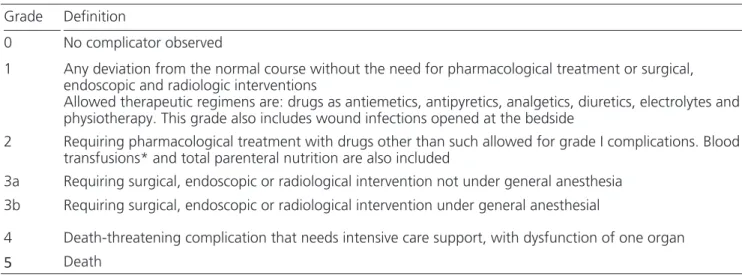
Operative mortality was defined as death within 30 days of surgery. Morbidity was rated ac-cording to the scale of Dindo-Clavien6, with modifi-cations, taking into account the clinical outcome and the therapy employed for resolution (Table 1).
For grouping of categorical variables, the complications were defined as minor (Clavien grades Table 1. Degree of complications according to the Dindo-Clavien scale
Grade Definition
0 No complicator observed
1 Any deviation from the normal course without the need for pharmacological treatment or surgical, endoscopic and radiologic interventions
Allowed therapeutic regimens are: drugs as antiemetics, antipyretics, analgetics, diuretics, electrolytes and physiotherapy. This grade also includes wound infections opened at the bedside
2 Requiring pharmacological treatment with drugs other than such allowed for grade I complications. Blood transfusions* and total parenteral nutrition are also included
3a Requiring surgical, endoscopic or radiological intervention not under general anesthesia 3b Requiring surgical, endoscopic or radiological intervention under general anesthesial
4 Death-threatening complication that needs intensive care support, with dysfunction of one organ
5 Death
1 or 2) and major (grades 3 or 4). We also split the category of major complications, separating them into non-severe (grade 3a) and severe (grades 3b and 4). The inclusion of this subdivision is justified by the fact that there is an important practical difference in the management of complications grades 3a and 3b.
We present results as median, mean and standard deviation, absolute and relative frequency. Categorical variables were compared within groups using the chi-square and Fisher’s exact tests, as ap-propriate. All statistical analysis was performed with SPSS Statistics® software19. We considered a p value of 0.05 as significant. We also used a spread-sheet software to assist in the tabulation of data and preparation of graphics.
The work was approved by the Ethics in Research Committee of the Hospital Haroldo Juaçaba-Instituto do Câncer do Ceará, Opinion No 006/2011 of 24/02/2011.
RESULTS
From January 1st, 2008 to October 1st, 2015 we held 24 extended pelvic resections in the Departamento de Oncologia Digestiva of the Institu-to do Câncer do Ceará for the treatment of colon, rectum and anus cancer exclusively. The same surgi-cal team performed all procedures.
Twenty patients (83.3%) were female and four (16.7%) were male. The age ranged from 35 to 74 years, with a median of 57 years. In 14 (70%) cases we could obtain anthropometric data of the first hospitalization. The weight ranged from 37 to 65.5 kg (mean 51.7 and median 51.5), and the BMI, 16.23 to 31.57 kg/m2 (average 23.44 and median 22.5) (Table 2).
All patients were symptomatic, the period of time between onset of symptoms and the first visit ranging from two to 120 months. The most com-mon symptom was rectal bleeding, reported by 19 (79.2%) patients, followed by pain in 17 (70.8%) and weight loss in 14 (58.3%).
In relation to multimodal therapy, all 24 (100%) patients underwent radiotherapy or chemo-therapy during the course of treatment. Eighteen
Table 2. Characteristics of the 24 patients who underwent pelvic exenteration.
Total of patients (n) 24 (100%)
Gender
Female 20 (83,3%)
Male 4 (16,7%)
Age (median) 57 (35-74)
BMI (n) 14
Malnourished (< 18,5 kg/m2) 2 (14,2%)
Eutrophic (18,5-24,9) 7 (50%)
Overweight (25-29,9) 3 (21,4%)
Obesity (>29,9) 1 (7,1%)
Tumor site
Superior rectum 1 (4,2%)
Middle rectum 7 (29,2%)
Lower rectum 8 (33,3%)
Sigmoid 1 (4,2%)
Multicentric (colon e rectum) 1 (4,2%)
Anal canal 6 (25%)
Symptomatology
Time of symptoms 6 (2-120)
Abdomino-pelvic pain 17 (70,8%)
Visible tumor 2 (8,3%)
Asthenia 3 (12,5%)
Weight loss (>10% in 6 months) 14 (58,3%)
Hematochezia 19 (79,2%)
Rectovaginal fistula 3 (12,5%)
Rectovesical fistula 1 (4,2%)
Complementary treatment
Neoadjuvant radiochemotherapy 18 (75%)
Preoperatively CEA (n = 14) 3,55 (1,05-122,7) Complications
Respiratory complications 4 (16,7%)
Surgical site infection 6 (25%)
Abdominal wall dehiscence 4 (16,7%)
Acute renal failure 2 (8,3%)
Prolonged ileum 1 (4,2%)
Urinary retention 3 (12,5%)
Fistula of the urinary
reconstruction 1 (4,2%)
Colostomy necrosis 1 (4,2%)
(75%) patients underwent concomitant chemora-diotherapy before surgery, complementing systemic therapy postoperatively. Six (25%) underwent only adjuvant chemotherapy. The regimens were 5-fluo-rouracil (5-FU) with leucovorin (LV), with or without oxaliplatin, 5-FU with cisplatin (CDDP) and capecit-abine alone.
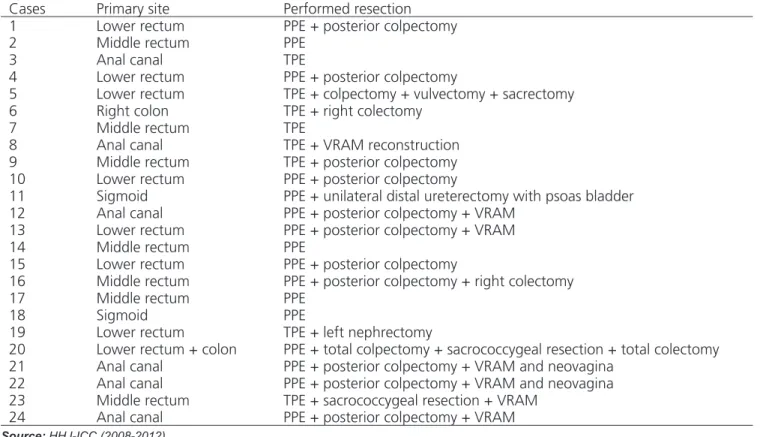
Regarding the extent of resection, each case is detailed in Table 3. Additional organs removed in extended resections were: uterus and appendages, vagina, prostate and bladder, sacrum in the S3 level and below, coccyx, perineum and buttocks skin, vulva, right colon and kidney. The most commonly used soft tissue reconstruction method was the vertical myocu-taneous flap of the rectus abdominis (VRAM) in seven cases, with construction of neovagina in two patients.
As for the reconstruction of the gastroin-testinal tract, the preservation of the anus sphinc-ter with a primary anastomosis was possible in nine (37.5%) cases. We performed a double-barreled wet colostomy (DBWC) in five (20.8%) patients and iso-lated terminal colostomy in ten (41.6%).
Seven (29.1%) patients received intraoper-ative blood transfusion, with a number of packed red blood cells that ranged from two to four.
The overall morbidity was 45.8%, with 17 postoperative complications in 11 patients; of these, five (20.8%) were severe complications (grades 3b and 4). There were no deaths in the first 30 days after surgery (Table 2).
Postoperative histopathologic study showed the size of the main injury ranging from 0.1 to 12 cm, number of lymph nodes resected from zero to 32 (mean 13, median 14.5) and residual margins free of disease in all cases.
The mean follow-up was ten months, ranging from one to 56. Mean overall survival was 39.5 months, and disease-free survival, 30.7, being 32.7 months for patients with CRC and 15.7 for the ones with ACN, without statistical significance (p = 0.319). Blood transfusion, angiolymphatic inva-sion and lymph node metastasis did not reach signif-icance with respect to overall or disease-free survival (Figure 1).
Table 3.Location of the primary tumor and the type of surgery performed.
Cases Primary site Performed resection
1 Lower rectum PPE + posterior colpectomy
2 Middle rectum PPE
3 Anal canal TPE
4 Lower rectum PPE + posterior colpectomy
5 Lower rectum TPE + colpectomy + vulvectomy + sacrectomy
6 Right colon TPE + right colectomy
7 Middle rectum TPE
8 Anal canal TPE + VRAM reconstruction
9 Middle rectum TPE + posterior colpectomy
10 Lower rectum PPE + posterior colpectomy
11 Sigmoid PPE + unilateral distal ureterectomy with psoas bladder
12 Anal canal PPE + posterior colpectomy + VRAM
13 Lower rectum PPE + posterior colpectomy + VRAM
14 Middle rectum PPE
15 Lower rectum PPE + posterior colpectomy
16 Middle rectum PPE + posterior colpectomy + right colectomy
17 Middle rectum PPE
18 Sigmoid PPE
19 Lower rectum TPE + left nephrectomy
20 Lower rectum + colon PPE + total colpectomy + sacrococcygeal resection + total colectomy
21 Anal canal PPE + posterior colpectomy + VRAM and neovagina
22 Anal canal PPE + posterior colpectomy + VRAM and neovagina
23 Middle rectum TPE + sacrococcygeal resection + VRAM
24 Anal canal PPE + posterior colpectomy + VRAM
Source: HHJ-ICC (2008-2012).
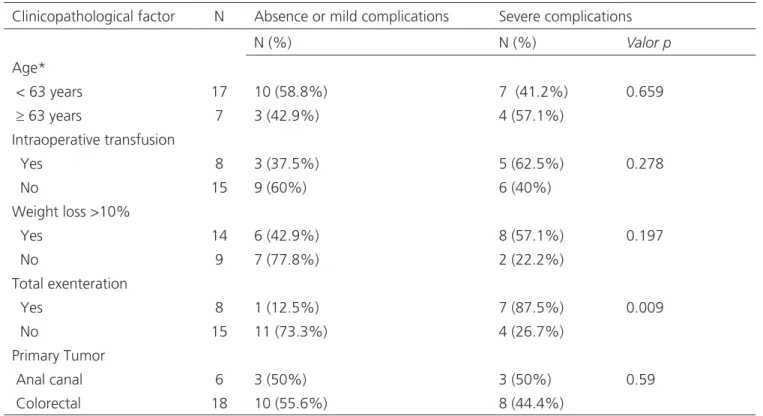
In the analysis of morbidity clinicopatho-logical factors, we ovserved concomitant cystectomy (TPE) as the only factor that reached statistical signif-icance for the presence of major complications, with a complication rate of 87.5% (p = 0.009, OR 19.5 [95% CI 1.7-209.5]). Age greater than 63 years (p = 0.659), intraoperative transfusion (p = 0.278) and weight loss greater than 10% in six months (p = 0.197) did not reach statistical significance as to overall morbidity (Table 4).
DISCUSSION
Large pelvic resections may represent the only possible cure treatment for advanced colorectal cancer, as well as for selected ACN cases. In general, surgery is the en bloc removal of the rectosigmoid to-gether with the compromised adjacent organs, most commonly the genito-urinary tract (uterus and ap-pendages, bladder and prostate) but often even more complex resections are required, such as colpectomy, vulvectomy or sacrectomy.
The first series of enlarged pelvic resections were published in the mid-twentieth century and fo-cused specifically on PE. At the time, they displayed very high mortality, ranging from 14 to 26.9% in pa-tients undergoing TPE for primary CRC7,8.
In recent years, however, there was a drastic reduction in surgical mortality, and today this ranges from 0-10% in specialized centers9,10. Among the
main factors that contributed to the improvement in surgical mortality, we highlight the better patients selection, the adequacy of the urinary reconstruction technique and the better perioperative care.
Despite the marked improvement in mor-tality over the years, depending on the radicality re-quired in the enlarged pelvic resections, these can also become mutilating procedures, carrying a high average morbidity rate of 30 to 60%, with a possible decrease in patients’ quality of life11.
Nonetheless, when considering other types of treatment for advanced or recurrent anorectal tu-mors, the results are even more disappointing, with palliative radiotherapy associated with a median sur-vival of 14 months and an average pain control time of only three months for CRC4. PE, on its turn, as a treatment for such cases, exhibits excellent symp-tomatic control, and five-year OS ranging from 10 to 30%11,12. Reported results from the Memorial Sloan-Kettering Cancer Center (MSKCC) in patients undergoing TPE for CRC showed specific cancer sur-vival of 49 months, with a 40% sursur-vival at five years, ranging from 77% for locally advanced primary CRC cases and 28% for relapses 13,14.
In this study, the median overall survival was 39.5 months, similar to that reported by another Brazilian study12, of 37.7 months, although we can not make a direct comparison, since six (25%) of this study’s cases are primary of the anal canal. Still, the benefit of extended pelvic resection is evident in the locoregional treatment of locally advanced or recur-rent anorectal cancer, especially when compared to other treatment modalities.
In this study, six (25%) patients had re-lapsed ACN, a higher frequency than that reported in other national series, in which the rescue extended surgery was indicated due to ACN recurrence in only 4.3% of cases15.
er surgical mortality observed in elderly patients as depicted in some older studies7. Being a major sur-gery, often leaving important consequences for life, such as colostomy or definite urostomy and urinary incontinence, there is always a selection bias of pa-tients who will be submitted to this procedure, the procedure’s risk-benefit and life expectancy being weighed, and the age often continuing as a limiting factor.
Regarding nutritional status, we obtained anthropometric data from medical records of 14 patients, of whom 50% were eutrophic. Two pa-tients (14.2%) had malnutrition, while other four (28.5%) were characterized as overweight or obese by the BMI.
Although the proportion of patients with malnutrition according to the World Health Orga-nization classification16 is small in this study, it is important to highlight the fact that in 14 (58.3%) cases there was weight loss higher than 10% in six months, which, as Waitzberg17, is indicative of se-vere malnutrition, increasing the incidence of fistu-lae and decreased cellular immunity function, with
greater susceptibility to infectious complications. In this work, there were 57.1% of complications in the group with weight loss versus 22.2% in patients who did not have significant weight change, although this did not reach statistical significance (p = 0.197), pos-sibly due to the small sample size .
All patients were symptomatic, with objec-tive complaints such as chronic pain, severe bleeding and fistula, the time between the symptoms and the first visit to the reference service varying from two to 120 months, with a median of six months. Costa et al. showed similar results, with a total of 15 (100%) symptomatic patients, seven of whom have two or more symptoms18. Two of our patients had fistulas (rectovaginal or rectovesical). Both were female and had communication of the fistula path to the but-tocks skin. In both cases, as also reported by Costa et al.18, the operation solved the symptoms of pain, bleeding, and fistula, with a clear improvement in quality of life (Figure 2).
As for the technical aspects, it is important to note that although Brunschwig5 has described and de-tailed TPE, radical pelvic resections can never be
consid-Table 4. Morbidity factors associated with pelvic exenteration
Clinicopathological factor N Absence or mild complications Severe complications
N (%) N (%) Valor p
Age*
< 63 years 17 10 (58.8%) 7 (41.2%) 0.659
≥ 63 years 7 3 (42.9%) 4 (57.1%)
Intraoperative transfusion
Yes 8 3 (37.5%) 5 (62.5%) 0.278
No 15 9 (60%) 6 (40%)
Weight loss >10%
Yes 14 6 (42.9%) 8 (57.1%) 0.197
No 9 7 (77.8%) 2 (22.2%)
Total exenteration
Yes 8 1 (12.5%) 7 (87.5%) 0.009
No 15 11 (73.3%) 4 (26.7%)
Primary Tumor
Anal canal 6 3 (50%) 3 (50%) 0.59
Colorectal 18 10 (55.6%) 8 (44.4%)
Source: HHJ-ICC (2008-2012).
ered fully standardized surgeries, since wider resections may be required to achieve absence of residual disease, including dissections ouside the conventional anatom-ical planes, with, for example, ureterectomy with blad-der flap, sacrectomy, vulvectomy, etc. (Figure 3).
In this work, we carried out 16 PPEs and eight TPEs. Furthermore, additional resection was re-quired in 12 patients, as described in Table 3. Impor-tantly, in seven (29.1%) cases there was need of a myocutaneous flap rotation with perineal reconstruc-tion, a well-established technique for the synthesis of large perineal defects and filling of the pelvic hol-low. In two patients, reconstruction with VRAM flap provided the maintenance of sexual ability through the making of a neovagina. All procedures were per-formed in the same surgical time by a single team.
Even with all perioperative quality evolu-tion, in this study the overall morbidity resulting from necessary resections and reconstructions still
persist-ed at a level of 45.8%. In univariate analysis, the only factor that showed significance for the increase in complications was the realization of total pelvic ex-enteration, with a complication rate of 87.5% (p = 0.012). Similar results were previously described19, with 76.9% morbidity related to radical cystectomy in patients with irradiated pelvis.
The morbidity difference between TPE and PPE found in this study is a well-established fact, the PPE morbidity being close to one of classical rectosig-moidectomy. Lohsiriwat et al. compared a group of patients treated with PPE with patients undergoing rectosigmoidectomy or rectal abdominoperineal re-section20. There was no difference between the num-ber of complications and hospital length of stay, the operative time (274 vs. 157min, p <0.001 ) and blood loss (769 vs. 203, p = 0.008) being higher for PPE. Thus, it is evident that there is a clear difference in sur-gical morbidity when adding resection of urinary tract. Regarding follow-up, 13 patients were free of disease at the last follow-up visit, and nine had recurrence diagnosis (including deaths by relapse). In the literature, the main determinants of survival are the presence of lymph node metastasis and an-giolymphatic invasion. Although there is a difference in survival dependent on these factors, there was no statistical significance, possibly due to the limiting sample and short follow-up time.
In conclusion, surgical treatment of locally advanced or recurrent colorectal cancer and anal ca-nal is a complex surgical procedure, which has on average 50% morbidity, reaching levels higher than 80% when adding the resection of the urinary tract Figure 2 - Rectovaginal fistula. B) Specimen with fistula orifice.
in an already irradiated pelvis. The evolution of the surgical technique and the quality of perioperative care associated with a careful selection of patients have been able to reduce surgical mortality to val-ues lower than 5% in specialized centers. Still, such procedures can present very high morbidity, espe-cially when associated with concomitant cystectomy, which greatly affects the profile of complications.
Candidates for surgery should be evaluated with a careful selection, since additional resections are often necessary, followed by complex reconstruc-tion procedures. Although there are few nareconstruc-tional publications on the subject, it is important to note that reported Brazilian series have satisfactory results, making extended pelvic resections feasible proce-dures in large specialized centers.
R E S U M O
Objetivos: avaliar o perfil de morbimortalidade e seus fatores preditivos relacionados às ressecções pélvicas extensas, incluindo a exenter-ação pélvica, com o intuito de otimizar a seleção dos pacientes e obtenção de melhores resultados cirúrgicos. Métodos: foram realizadas 24 grandes ressecções pélvicas por neoplasia maligna anorretal de 2008 a 2015 no Instituto do Câncer do Ceará. Os fatores analisados in-cluíram idade, perda de peso, órgão ressecados, exenteração total versus posterior, invasão angiolinfática e perineural, metástase linfonodal e sobrevida global e livre de doença. Resultados: a mediana de idade foi 57 anos e o tempo médio de seguimento foi dez meses. A mor-bidade global foi 45,8%, com cinco (20,8%) complicações graves. Não houve óbito nos primeiros 30 dias de pós-operatório. A sobrevida global média foi 39,5 meses e a sobrevida livre de doença foi 30,7 meses. A ressecção concomitante da bexiga foi fator prognóstico isolado com maior risco para complicações (87,5% vs. 26,7%, p=0.009). Invasão angiolinfática e metástase linfonodal não alcançaram significância com relação à sobrevida livre de doença. Conclusão: o tratamento dos tumores anorretais avançados é desafiador, necessitando frequen-temente de ressecções combinadas, como a cistectomia e sacrectomia, além de reconstruções complexas. A magnitude da cirurgia ainda carrega uma elevada taxa de morbidade, porém é um procedimento considerado seguro e factível, com uma baixa mortalidade e adequado controle locorregional tumoral quando realizado em centros de referência.
Descritores: Neoplasias. Neoplasias Retais. Recidiva. Canal Anal. Exenteração Pélvica.
REFERÊNCIAS
1. Ferlay J, Shin HR, Bray F, Forman D, Mathers C, Parkin DM. Estimates of worldwide burden of cancer in 2008: GLOBOCAN 2008. Int J Cancer. 2010;127(12):2893-917. 2. National Comprehensive Cancer Network. NCCN Guide-lines - anal carcinoma (version 2.2013). [base de dados na internet]. [acesso em 20 dez 2012]. Disponível em http://www.nccn.org/professionals/physician_gls/pdf/ anal.pdf
3. National Comprehensive Cancer Network. NCCN Guide-lines – rectal cancer (version 4.2013). [base de dados na internet]. [acesso em 20 dez 2012]. Disponível em http:// www.nccn.org/professionals/physician_gls/pdf/rectal.pdf 4. Wells BJ, Stotland P, Ko MA, Al-Sukhni W, Wunder J,
Ferguson P, et al. Results of an aggressive approach to resection of locally recurrent rectal cancer. Ann Surg Oncol. 2006;14(2):390-5.
5. Brunschwig A. Complete excision of pelvic viscera in the male for advanced carcinoma of the sigmoid invading the urinary bladder. Ann Surg. 1949;129(4):499-504.
6. Dindo D, Demartines N, Clavien PA. Classification of surgical complications: a new proposal with evalua-tion in a cohort of 6336 patients and results of a sur-vey. Ann Surg. 2004;240(2):205-13.
7. Boey J, Wong J, Ong GB. Pelvic exenteration for lo-cally advanced colorectal carcinoma. Ann Surg. 1982;195(4):513-8.
8. Lopez MJ, Standiford SB, Skibba JL. Total pelvic exentera-tion. A 50-year experience at the Ellis Fischel Cancer Cen-ter. Arch Surg. 1994;129(4):390-5; discussion 395-6. 9. Law WL, Chu KW, Choi HK. Total pelvic exenteration
for locally advanced rectal cancer. J Am Coll Surg. 2000;190(1):78-83.
10. De Wever I. Pelvic exenteration: surgical aspects and analysis of early and late morbidity in a series of 106 patients. Acta Chir Belg. 2011;111(5):273-81. 11. Kakuda JT, Lamont JP, Chu DZ, Paz IB. The role of
pelvic exenteration in the management of recurrent rectal cancer. Am J Surg. 2003;186(6):660-4. 12. Costa SRP, Teixeira ACP, Lupinacci RA. A
fatores prognósticos de sobrevida em 27 pacientes operados. Rev bras colo-proct. 2008;28(1):7-18. 13. Gannon CJ, Zager JS, Chang GJ, Feig BW, Wood
CG, Skibber JM, et al. Pelvic exenteration af-fords safe and durable treatment for locally advanced rectal carcinoma. Ann Surg Oncol. 2007;14(6):1870-7.
14. Jimenez RE, Shoup M, Cohen AM, Paty PB, Guillem J, Wong WD. Contemporary outcomes of total pel-vic exenteration in the treatment of colorectal can-cer. Dis Colon Rectum. 2003;46(12):1619-25. 15. Poletto AH, Lopes A, Carvalho AL, Ribeiro EA, Vieira
RA, Rossi BM, et al. Pelvic exenteration and sphinc-ter preservation: an analysis of 96 cases. J Surg On-col. 2004;86(3):122-7.
16. Organização Mundial da Saúde. BMI Database [ban-co de dados da internet]. Genebra; 2012 [acesso em 20 dez 2012]. Disponível em: www.who.int/bmi/ index.jsp
17. Waitzberg DL. Nutrição oral, enteral e parenteral na prática clínica. 4a ed. São Paulo: Atheneu; 2009.
Nu-trição em Cirurgia; p.1712-3.
18. Costa SRP, Antunes RCP, Paula RP, Pedroso MA, Fa-rah JFM, Lupinacci RA. A exenteração pélvica no trata-mento do câncer de reto estádio T4: experiência de 15 casos operados. Arq Gastroenterol. 2007;44(4):284-8. 19. Eisenberg MS, Dorin RP, Bartsch G, Cai J, Mi-randa G, Skinner EC. Early complications of cys-tectomy after high dose pelvic radiation. J Urol. 2010;184(6):2264-9.
20. Lohsiriwat V, Lohsiriwat D. Comparison of immedi-ate surgical outcomes between posterior pelvic ex-enteration and standard resection for primary rectal cancer: a matched case-control study. World J Gas-troenterol. 2008;14(15):2414-7.
Recebido em: 30/09/2015
Aceito para publicação em: 07/03/2016 Conflito de interesse: nenhum.
Fonte de financiamento: nenhuma.
Endereço para correspondência: