M
ASTER
’
S DEGREE IN
Accounting, Taxation and Corporate Finance
M
ASTER
’
S
F
INAL
P
ROJECT
D
ISSERTATION
T
HE EFFECT OF BANKING SUPERVISION ON THE RECOGNITION AND
DISCLOSURE OF IMPAIRMENT OF FINANCIAL ASSETS
D
ANIELA
R
EIS
A
LBUQUERQUE
S
UPERVISION:
P
ROF.
D
RA.
A
NAI
SABELA
BRANCHESP
EREIRA DEC
ARVALHOM
ORAISM
ASTER
’
S DEGREE IN
A
CCOUNTING
,
T
AXATION AND
C
ORPORATE
F
INANCE
M
ASTER
’
S
F
INAL
P
ROJECT
D
ISSERTATION
T
HE EFFECT OF BANKING SUPERVISION ON THE RECOGNITION AND
DISCLOSURE OF IMPAIRMENT OF FINANCIAL ASSETS
D
ANIELA
R
EIS
A
LBUQUERQUE
S
UPERVISION:
P
ROF.
D
RA.
A
NAI
SABELA
BRANCHESP
EREIRA DEC
ARVALHOM
ORAISi
A
BSTRACTThis paper investigates the role of banking supervision in the recognition and disclosure of impairment of financial assets. Specifically, disclosure practices are compared between countries whose supervisors present different approaches to loan loss provisioning and related with the recognized level of loan loss allowances. The sample includes 60 banks from 15 European Union countries. The respective supervisors were categorized as interventionist or non-interventionist to loan loss provisioning according to their interference with loan loss provisions’ disclosures. Financial data and disclosure practices were hand collected from the financial statements available in English for the financial years between 2012 and 2015 and indexes of disclosure were constructed. The results of univariate analysis and regression model show that banks whose supervisors have an interventionist approach to loan loss provisioning are the most compliant with IFRS 7 and provide additional impairment disclosures that are required by their national supervisor. However, these banks present a lower compliance with Pillar 3 in comparison with banks whose supervisors have a non-interventionist approach to loan loss provisioning. Country differences are persistent even after the taking over of European Union’s banking supervision by the European Central Bank, despite signs of improvement and harmonization of disclosures. Finally, recognition of loan loss provisions is found to be positively related with the level of disclosure.
Keywords: banks, impairment, loan loss provisions, loan loss allowances, supervisors,
ii
R
ESUMOO presente estudo investiga o papel da supervisão bancária no reconhecimento e divulgação das perdas por imparidade de ativos financeiros. Em concreto, é feita uma comparação das práticas de divulgação entre países cujos supervisores bancários apresentam diferentes abordagens à imparidade do crédito e estabelecida uma relação com o grau de reconhecimento destas perdas. A amostra é constituída por 60 bancos de 15 países da União Europeia. Os respetivos supervisores nacionais foram classificados como intervencionistas/não intervencionistas no processo de imparidade do crédito considerando a sua interferência nas divulgações destas perdas. Dados financeiros e práticas de divulgação foram recolhidas manualmente dos Relatórios e Contas disponíveis em inglês para os exercícios de 2012 a 2015, tendo sido construídos índices de divulgação. Os resultados das análises univariadas e das regressões lineares revelam que bancos cujo supervisor tem uma abordagem intervencionista ao processo de imparidade do crédito apresentam um maior cumprimento com a IFRS 7 e são sujeitos a divulgações adicionais exigidas pelos respetivos supervisores nacionais. Esses bancos, contudo, apresentam um menor cumprimento com o Pilar 3 comparativamente com bancos cujo supervisor apresenta uma abordagem não-intervencionista ao processo de imparidade do crédito. As diferenças entre países são persistentes, mesmo após o Banco Central Europeu assumir a responsabilidade pela supervisão bancária na União Europeia, não obstante dos sinais de melhoria e harmonização das divulgações. Por último, conclui-se que o reconhecimento das perdas por imparidade no crédito está positivamente relacionado com o seu nível de divulgação.
iii
A
CKNOWLEDGEMENTSI would like to express my gratitude to my dissertation supervisor Prof. Dra. Ana Morais for her continuous support, guidance, critical advice and patience and Prof. Dra. Inês Pinto for her valuable insights.
I also express my appreciation to other Professors who, throughout my bachelor and master’s degree at ISEG, have enriched me as a person and a professional, pushed me for better and instilled my interest in financial accounting.
Finally, yet importantly, I am very grateful to parents, grandparents, brother and boyfriend for their unconditional support in every aspect of my life. Thank you for everything. I would also like to thank my best friends for their friendship and understanding.
iv
T
ABLE OFC
ONTENTS Abstract ...i Resumo ... ii Acknowledgements ... iii List of Tables ... vList of Appendices ...vi
List of Abbreviations ... vii
1. Introduction ... 1
2. Literature Review and hypotheses development ... 4
2.1. IAS 39, loan loss provisioning and the financial crisis of 2008 ... 4
2.2. The role of banking supervision in loan loss provisioning ... 5
2.2.1. Banking supervisory approaches to loan loss provisioning ... 6
2.2.2. Banking supervision in the EU after the crisis ... 7
2.3. The role of disclosures ... 9
2.3.1. Disclosures as a market disciplining tool ... 9
2.3.2. Bank supervisors’ influence in the level of disclosure ... 11
2.4. The relationship between recognition and disclosure ... 12
3. Research design and sample ... 13
3.1. Methodology ... 13
3.2. Sample selection ... 15
4. Results ... 15
4.1. Group differences before and after the entry into force of the SSM: Descriptive statistics, means’ differences and multivariate results ... 15
4.2. Relationship between disclosure and LLPs recognition ... 21
5. Conclusions, limitations and future research ... 23
References ... 25
v
L
IST OFT
ABLESTable I Disclosure indexes: Means’ differences between groups ... 17 Table II Disclosure indexes: Multivariate results for group differences ... 18 Table III Disclosure Indexes Pre and Post SSM entry into force... 19 Table IV Disclosure Indexes: Multivariate Results pre and post SSM entry into force. 20 Table V Descriptive Statistics for the regression variables ... 21 Table VI Loan loss provisions and the level of total, IFRS 7 and Pillar 3 disclosures .. 23
vi
L
IST OFA
PPENDICESAppendix A Impaired and Past Due Disclosure Requirements Checklist ... 29
Appendix B Disclosure practices of the interventionist supervisory regime ... 30
Appendix C Disclosure Index of Paragraph 37b of IFRS 7 ... 34
vii
L
IST OFA
BBREVIATIONSAQR – Asset Quality Review
BCBS – Basel Committee on Banking Supervision EBA – European Banking Authority
ECB – European Central Bank EU – European Union
IAS – International Accounting Standard
IFRS – International Financial Reporting Standard LLPs – Loan Loss Provisions
NCAs – National Competent Authorities NPL – Non-performing Loans
1
1.
I
NTRODUCTIONLoans to customers are the main asset in commercial banks’ balance sheets. As such, loan loss provisions (LLPs) are the most important accrual item of commercial banks’ financial statements. The losses inherent to credit granted should be recognized in an accurate and timely manner in order not to overestimate the receivables from customers. Both the accounting and prudential frameworks regulate banks’ loan loss provisioning process. The two regimes are different but exert equal influence in shaping banks provisioning practices. International Financial Reporting Standard (IFRS) 7 – Financial Instruments requires disclosure of information within the scope of LLPs and, until the 31st of December of 2017, International Accounting Standards (IAS) 39 – Financial Instruments: Recognition and Measurement prescribed the measurement and recognition of LLPs. The standard was mandatorily superseded by IFRS 9 – Financial Instruments in the 1st of January of 2018 for all listed banks in the European Union (EU). There has been much debate concerning IAS 39 and its role on the banking financial crisis of 2008, which ultimately led to its replacement. More specifically, there has been fierce criticism on how it allowed banks to under provision LLPs and, therefore, to conceal losses from shareholders and regulators until the borrower defaulted. On the prudential sphere, LLPs are regulated by the Basel Committee on Banking Supervision (BCBS) pillars, the European Banking Authority’s (EBA) guidelines and by each country’s supervisory rules. The divergence in the treatment of expected and unexpected credit losses is the main source of conflict between accounting and supervision. Under the prudential rules all expected credit losses should be covered by LLPs as banks’ regulatory capital should only reflect the banks’ ability to absorb unexpected losses (Gaston and Song, 2014; Gebhardt and Novotny-Farkas, 2016; Ozili and Outa, 2017). However, according to IAS 39, credit losses could only be recognized if there was objective evidence of their occurrence, creating a gap between the LLPs that were registered in the financial statements and those considered for prudential calculations.
Despite the diverging objectives of regulation and accounting and the fact that the timeliness of loan loss recognition under IAS 39 magnified such differences, bank supervision plays a major role in the accounting quality of banks. Prior literature (Bikker and Metzemakers, 2005; Fonseca and González, 2008; Bischof, 2009; and Gebhardt and Novotny-Farkas, 2011, 2016) studies bank supervisors’ influence in accounting quality and how country-specific circumstances with respect to the regulatory and supervisory
2
environment affect the provisioning of banks. Two approaches of supervisory intervention in the measurement and treatment of LLPs are explored in the previous studies: the interventionist and the non-interventionist approaches. In interventionist supervisory regimes, supervisors were reported to require higher allowances beyond IAS 39 incurred losses to counteract its “too little, too late” issue. On the contrary, non-interventionist supervisors did not interfere with the loan loss provisioning process. Despite the intention to narrow differences between accounting and supervision, the different approaches pursued across the EU hindered the comparison of financial institutions performance and risks across jurisdictions. The Single Supervisory Mechanism (SSM) came as a response to the global financial crisis in 2014 and aims to unify and improve banking supervision in Europe and, thus, to resolve the heterogeneity in supervisory practices across the EU.
Literature on the relationship between LLPs’ recognition and the supervisory environment is broad. This study is motivated by the lack of empirical literature of bank disclosure on LLPs and its link with the supervisory framework. Specifically, literature on compliance with IFRS 7 is scarce. Bischof (2009) analyzes the effect of the standard’s first-time adoption and how it varied across countries that presented differences in the enforcement and interpretation of IFRS 7 by national banking supervisors. The author concludes that disclosure quality is not only dependent on the content of the accounting standard but also on its enforcement.
Banks are, by the very nature of its business, averse to disclosure. However, the public availability of timely and reliable information is needed because not all relevant financial information can be communicated through the amounts shown on the face of the financial statements. Disclosure of significant accounting policies and additional notes containing the details of the different items is needed to give users of financial statements an understanding of banks’ financial performance and exposures to risk. Banks are obliged to provide accounting disclosures on LLPs under the rules prescribed in IFRS 7. Additionally, for regulatory purposes, the disclosure requirement that allows for the assessment of risk exposures, and specifically, for the assessment of the details on LLPs and past due loans is comprised in the third and last pillar that constitutes the Basel frameworks. The accounting and regulatory norms are compulsory, but banks are also encouraged to consider the guidelines issued by the EBA as these assist in the convergence of supervisory practices. Interventionist supervisors request additional LLPs disclosures on financial assets beyond these frameworks as well.
3
Therefore, the objective of this paper is to investigate if the level of disclosure on LLPs is influenced by the supervisors’ intervention in the loan loss provisioning process. Supervisors are classified as interventionists if they require additional disclosure requirements beyond the accounting and the international prudential frameworks.
To that end, information is hand collected from consolidated financial statements for the period of 2012-2015. Disclosure indexes are constructed to analyze compliance with IFRS 7, Pillar 3 and the EBA’s guidelines, to assess if differences exist among countries and whether those differences remained after the entry into force of the SSM. Additional supervisory disclosure requirements are identified and described. Furthermore, this paper investigates the relationship between a bank’s disclosure level and its LLPs. Previous studies (Ahmed et. al., 2006; Frederickson et al., 2006; Libby et al., 2006; Clor-Proell and Maines, 2014; Muller et al., 2015) elaborate on the issue of recognition versus disclosure and find that these two accounting treatments are regarded as substitutes and are assigned different levels of reliability. Yet, recognition and disclosure are not substitutes in the accounting treatment of LLPs as it is prescribed in two standards – IAS 39 for recognition, until the end of 2017, and IFRS 7 for disclosure.
The sample comprises 60 banks from 15 different EU countries. Countries were grouped taking into consideration their supervisory approach to loan loss provisioning.
The main findings of the study are that banks from interventionist supervisory regimes are not only significantly more compliant with IFRS 7 disclosure requirements, but are also subject to extensive additional disclosure requirements on LLPs and past due loans by their national supervisors. Banks with non-interventionist supervisors present a higher compliance with the Pillar 3 disclosure requirements and with the EBA guidelines. However, group differences are only statistically significant for the IFRS disclosures. Further, the multivariate analysis reveals that banks that present higher disclosures also recognize more LLPs.
This study is useful for bank supervisors as it raises awareness about their influence in the recognition and disclosure of LLPs and for users of financial statements as insights are provided about the relationship between disclosure and the recognition of loan losses. Additionally, a contribution is made to the debate about EU-wide inconsistency in the application of IFRS 7 and of Pillar 3 disclosure requirements that hinders comparability of institutions’ level of risk.
The remainder of the paper is structured as follows. In Section 2 the literature review is subdivided into four parts: the first discusses loan losses under IAS 39, the second
4
presents prior research on the role of bank supervisors in the loan loss provisioning process, the third part elaborates on the role of disclosures as a market disciplining tool and the fourth presents the relationship between disclosure and recognition. Section 3 describes the research design and the sample. Section 4 presents the research results. Section 5 concludes.
2.
L
ITERATURER
EVIEW AND HYPOTHESES DEVELOPMENT2.1. IAS 39, loan loss provisioning and the financial crisis of 2008
Loans to customers constitute the greatest asset in commercial banks’ balance sheets. As such, correct and timely provisioning of the related credit losses are of utmost importance so that banks’ assets are not overvalued. One of the main accrual items of banks’ financial statements are the LLPs given their significant impact on bank performance and regulatory capital (Balla, Rose and Romero, 2012; Curcio, Simone and Gallo, 2017) and, thus, on bank stability (Fonseca and González, 2008). Gaston and Song (2014) state that even after the global financial crisis and all the regulatory reforms and rounds of organized stress testing, deleveraging, and balance sheet repair exercises, loan loss provisioning and asset quality remain key issues for banks.
IAS 39 Financial Instruments: Recognition & Measurement was an accounting standard issued by the International Accounting Standard Board, effective for all listed companies in EU countries for annual periods beginning on or after the 1st of January of 2005 until the 31st of December of 2017, which outlined the specific requirements for the
recognition and measurement of financial assets and financial liabilities. Under IAS 39, loans to customers were measured on an amortized cost basis, whose impairment losses affect the income statement.
The impairment losses of financial assets were based on incurred losses only, completely disregarding losses as a result of events expected to occur after the balance sheet date regardless of their likelihood (IAS 39.AG90 [2004]). Gebhardt and Novotny-Farkas (2011, 2016) justify this strict limitation to incurred losses only with the findings that loan loss accounting is a favored tool for earnings management but argue that less discretion also prevents banks from reporting “known losses” that are inherent to loan portfolios. This delay in loss recognition led to “too little” provisioning during good times, overvaluing banks’ assets, and magnified losses during cyclical downturns as these were recognized “too late”. The incurred-loss provisioning has, thus, a procyclical nature (Laeven and Majnoni, 2003; Bikker and Metzemakers, 2005; Bouvatier and Lepetit,
5
2008; Gebhardt and Novotny-Farkas, 2011; Balla, Rose and Romero, 2012). In favorable macroeconomic conditions, banks did not recognize LLPs for the higher expected credit risk related to the increasing lending volume because the probability of triggers events, which are a precondition for recognizing an impairment under IAS 39 rules, was low. This supported the delay in the recognition of losses, enabling banks to extend more credit. However, in the downturn, there was a culmination of trigger events with higher default rates, leading to increased LLPs. The contraction of capital and the increased riskiness of loans forced banks to cut lending and decreased financial stability (Gebhardt and Novotny-Farkas, 2011; Balla, Rose and Romero, 2012).
The standard, however, could be subjectively interpreted in a number of important areas – such as what were the impairment triggers for each loan portfolio, the inputs used in the loan loss provisioning calculations and, overall, how quickly impaired loans must had been written off. This gave banks wide latitude in selecting relevant objective evidence (Central Bank of Ireland, 2013; Gaston and Song, 2014), that is, despite the requisite for objective evidence, banks could have recognized LLPs in a more timely manner had they been sufficiently conservative in their provisioning practices. Thus, the adequacy of the IAS 39 is questionable as it left substantial room for judgement that resulted in insufficient provisions (Ryzhenkova, 2013; Gaston and Song, 2014).
2.2. The role of banking supervision in loan loss provisioning
Bank supervision and regulation are critical to accounting quality (Bikker and Metzemakers, 2005; Bischof, 2009; Gebhardt and Novotny-Farkas, 2011). Fonseca and González (2008) point out that bank regulation and supervision are intended to enhance financial stability by making financial statements more reliable. Gaston and Song (2014) defend that supervisors should be endowed with the authority to evaluate banks’ risk management practices, to step in to impose additional provisions when those are deemed insufficient, setting additional resources aside for the loan loss reserve and seek adequate disclosure of the information in the banks’ financial reports.
For EU countries implementing the IFRSs, banks’ loan loss provisioning practices were not influenced by IAS 39 alone. The national bank regulators must also follow the rules of the EU Capital Adequacy Directives, which are based on the recommendations of the BCBS. These two regimes were different but exerted equal weights in shaping banks’ loan loss provisioning practices. The Basel frameworks are a set of banking regulations which level the international regulation field with uniform rules and guidelines. The Basel II Accord was created with the intention to safeguard
6
banks’ solvency and stability by establishing risk and capital requirements that ensure a bank has adequate capital for the risk it exposes itself to through its lending, investment and trading activities. Basel II is based on three main pillars: minimal capital requirements, regulatory supervision and market discipline. The Basel II standards were implemented in the EU in the form of Directives 2006/48/EC and 2006/49/EC and all member states were required to transpose these directives into national legislation.
Despite supervisors’ reliance on reported accounting numbers for regulatory purposes, financial reporting and bank supervision pursue different objectives, which were reflected in the differences in the measurement and supervisory treatment of LLPs (Novotny-Farkas, 2016). Contrary to IAS 39, bank regulation adopted a forward-looking approach to loan loss provisioning. The reasoning was that banks should hold a minimum amount of regulatory capital that reflected the banks’ ability to absorb unexpected losses, as expected losses should be covered by the individual and general LLPs that are explicitly tied to the exposures they cover (Gaston and Song, 2014; Gebhardt and Novotny-Farkas, 2016; Ozili and Outa, 2017). Oppositely to the view of IAS 39, these expected losses implied that loan losses should be anticipated before they materialized. The requisite for objective evidence for impairment loss recognition under IAS 39 created a greater gap between accounting and the prudential rules regarding the loan loss provisioning process.
2.2.1. Banking supervisory approaches to loan loss provisioning
There is a lack of consistent and up-to-date information on the regulatory and supervisory approaches pursued in countries around the world and the changes brought about by the crisis (Čihák, Demirgüç-Kunt, Pería and Mohseni-Cheraghlou, 2012). However, bank regulators were aware of the cyclical pattern of bank lending and provisioning and that is why some supervisors in the EU advocated a forward-looking provisioning regime to reduce the procyclicality of banks’ regulatory capital and to reduce the gap between accounting and prudential rules. A few studies investigate supervisory practices in some EU countries and find that some supervisors interfere with banks’ loan loss provisioning and required banks to maintain higher allowances beyond incurred losses, keeping LLPs closer to the provisioning rules of bank regulators. These countries are classified by Gebhardt and Novotny-Farkas (2016) as interventionist regimes.
Gebhardt and Novotny-Farkas (2011, 2016), Bischof (2009) and Gaston and Song (2014) elaborate on LLPs recognition and disclosure practices of representative countries of the interventionist regime such as Portugal, Spain and Italy. The authors find evidence
7
that these countries were reluctant to accept the incurred loss approach and required banks to maintain more prudent provisioning practices even under IFRS by means of comprehensive instructions. These classifications are further supported by the 2012 Bank Regulation and Supervision Survey carried out by the World Bank1. The authors also elaborate on the non-interventionist approach to loan loss provisioning in which the supervisor does not interfere with banks’ loan loss accounting, but rather judges the overall compliance with the IFRSs. Ireland is identified as a representative country of this approach. However, Gaston and Song (2014) report that after the recent global financial crisis, supervisory intervention on LLPs has become more common in Ireland.
2.2.2. Banking supervision in the EU after the crisis
The National Bank of Serbia expressed, in their website, that the financial crisis of 2008 highlighted the uneven national implementation and regulatory arbitrage allowed by the international regulatory framework, the need to respond to the crisis homogeneously and to redesign the global regulatory and supervisory architecture. As a response to the institutional problems exposed by the global financial crisis, a single banking supervisory framework was decided in 2012, which is expected to implement a substantial shift in banking supervisory powers from EU national competent authorities (NCAs) to the European Central Bank (ECB). The SSM is the mechanism that grants the ECB the supervisory role to monitor the financial stability of banks based in participating nation states. Within the Eurozone, the ECB is responsible for roughly 130 financial institutions with holdings of 85% of the banking assets and began its supervisory role on the 4th November of 2014.
Prior to the operational start of the SSM, the ECB conducted a comprehensive assessment of the accuracy of the carrying value of banks’ assets, jointly with NCAs, participating banks and the EBA2. This comprehensive assessment, denominated by Asset Quality Review (AQR), sought to maintain a level playing field across the participating banks by providing guidance on a range of important inputs such as non-performing exposure definition, impairment triggers and provisioning approaches. The
1Portugal and Spain have minimum levels of specific provisions for loans and receivables set by the
regulator, regulatory requirements for general provisions on loans, the supervisor has the power to require banks to apply specific provisioning and/or write-off policies and to require banks to constitute provisions to cover actual or potential losses.
2 The EBA is an independent EU authority established on 1 January 2011 to ensure effective and consistent prudential regulation and supervision across the EU banking sector by providing a single set of harmonized prudential rules. This entity is also mandated to assess risks and vulnerabilities in the EU banking sector and plays a special role in the implementation of regulations pertaining to Basel standards. The EBA guidelines on Forbearance and NPLs started being applied in 2014.
8
harmonization in key areas of banks’ supervisory and regulatory treatment across the euro area resulted in aggregate adjustments to participating banks’ asset carrying values. Some of these adjustments stemmed directly from adjustments in which the previous practice of participating banks was explicitly non-compliant with accounting practice (European Central Bank, 2014). In the report of the first AQR, the ECB acknowledged that this adjustments differed by jurisdiction as consistent standards have been applied where previous approaches diverged.
Thus, the structural shortcomings of European institutions revealed by the crisis are expected to be address in a united way by ensuring consistency and efficiency of supervision across the Eurozone (Deloitte, 2014). In fact, the German Federal Ministry of Finance published an article in January of 2018 praising the SSM for its work over the past three years in harmonizing supervisory practices and smoothly and effectively bringing Europe closer to its objective of using consistent, high standards to supervise euro area banks. The article adds that the ECB and the NCAs agreed to uniform how national options and discretions are exercised throughout the entire Euro area.
However, some critics point out that the actual transfer of responsibilities between NCAs and the ECB has been a lengthy transition and the result of the new regime approach has been rather heterogeneous across the Eurozone, failing to deliver an integrated supervisory approach (Deloitte; 2014, 2015). The supervision of individual significant institutions is conducted by the Joint Supervisory Teams that are composed of staff both from the ECB and the respective NCA. Even though the ECB is the ultimate responsible for the supervision, there is a reliance on the knowledge and established practices of national supervisors. NCAs still advise national representatives on the ECB Supervisory Board in the preparation and implementation of supervisory decisions, transpose EU Directive into national law and adopt guidelines and standards issued by the ECB or by the EBA. NCAs can even propose draft decisions on their own initiative. It is also claimed that the roles of the NCAs will certainly not completely disappear but the ECB will also want to deliver on its objective to harmonize the supervisory approach across the Eurozone. The way the directly applicable EU rules or the local prudential regulations apply is driven by the ECB and differences in supervisory approach should be removed (Deloitte, 2014).
9
2.3. The role of disclosures
2.3.1. Disclosures as a market disciplining tool
Previous literature examines the relevance of disclosure as a way to increase transparency and to reduce information asymmetries among bank management, depositors, and regulators. Disclosure became a topic of greater interest as investors’ limited information on the risks held by financial intermediaries is generally understood as having amplified the financial crisis of 2008. Opacity in banks contributed to a general mispricing of risk, as investors badly misunderstood the risks inherent in structured products (Ilknur, 2015). Tadasse (2006) defends that banking systems are less vulnerable to crisis if supported by financial reporting regimes characterized by more comprehensive disclosure, more timely financial reporting, more informative reporting and more credible financial disclosure.
All financial instruments’ disclosure requirements are consolidated in IFRS 7, which became effective in Europe for financial years beginning in 1st of January of 2007. Appendix A presents the IFRS 7 impairment disclosure requirements applicable for loans to customers under IAS 39. The application guidance of IFRS 7, presented in its Appendix B, provides that the level of disclosure – the detail in satisfying the requirements of IFRS 7, how much emphasis it places on different aspects and how it aggregates the information displayed - is decided by the reporting entities. The application guidance also outlines the need to balance overburden financial statements with excessive detail and obscuring important information as a result of too much aggregation.
Literature about bank disclosure and compliance with IFRS 7 is scarce. Bischof (2009) presents theories that support the usefulness of disclosures and points out that bank disclosure is found to have been incomplete until today. The reluctance to disclose private information is particularly true for the banking industry given that one critical, and costly, aspect of banking is the utilization of private information to make credit decisions (Frolov, 2007). Part of banks value added is its ability to monitor and evaluate difficult-to-value assets (Rosengren, 1998; Frolov, 2007). This justifies the caution to go beyond minimal disclosure requirements or banks’ regular disclosure practices. Mandatory disclosure requirements are of importance given this lack of incentives to voluntary disclose information in the banking industry.
Further, disclosure is pointed out as a powerful market disciplining tool as it allows market participants to have better insights into the risk exposures of a bank by impounding banks’ risks in its market price, ultimately deterring banks’ insiders from
10
engaging in excessive risk taking (Goldstein and Sapra, 2013). The third pillar of the Basel II/III framework codified supervisory disclosure requirements for the first time and mandates extensive disclosure obligations for banks operating under this framework, emphasizing market discipline as a tool to increase bank stability, as timely informed rational actors are capable to also act as supervisors and enforcers of prudential regulation rules (Frolov, 2007; Fonseca and González, 2008; Deutsche Bundesbank, 2010; Novotny-Farkas, 2016). Rosengren (1998) points out the impossibility for outsiders with no access to loan files and no ability to monitor financial contracts to accurately evaluate a bank and Ozili and Outa (2017) identify LLPs as related to the informativeness of accounting disclosures in financial reports. One of the main building blocks of market discipline is the public availability of adequate, timely, consistent and reliable information on the bank’s financial performance and risk exposures, but also the market’s ability to process it properly (Avgouleas, 2009; Novotny-Farkas, 2016). Disclosure-based market discipline is a strong supervisory tool only if it is used to supplement the impact of protective rules, such as dynamic pre-provisioning obligations (Avgouleas, 2009). Better accounting disclosure, stricter regulations on bank activities, stricter official supervision and more private monitoring increase the reliability of bank financial statements (Fonseca and González, 2008). The increased emphasis on market discipline as a prudential tool is exemplified by its codification in Pillar 3 of the Basel II/III capital adequacy framework and in Part 8 of the Capital Requirements Regulation (Novotny-Farkas, 2015).
However, Frolov (2007) and Avgouleas (2009) share the view that the global financial crisis has exposed the limits of disclosure as an effective regulatory tool in financial markets. In certain matters, market discipline failed to constrain risk taking by banks, but in others the markets failed to understand risks that were fully disclosed. In the case of banks, disclosure-based market discipline failed mainly because of public rescues and deposit insurance. There was sufficient information about the abundance of easy credit and rising market prices, but the warning signals were ignored in favor of over-reliance on credit ratings. On the other hand, an individual banks’ risk exposure cannot be ascertained by just looking at its financial reports; the nature of the banking industry creates interconnectedness with other institutions whose monitoring is unfeasible. As a result, the effectiveness of individual institution monitoring by the market on the basis of disclosed data becomes of much lesser importance (Avgouleas, 2009).
Nonetheless, as supervisory disclosure under Pillar 3 of Basel II was first implemented in the 2008 financial year, it was unable to exert any market-disciplining
11
effects either in the run-up or during the outbreak of the crisis, justifying the focus of crisis resolution measures on disclosure as well (Deutsche Bundesbank, 2010; Basel Committee on Banking Supervision, 2015).
2.3.2. Bank supervisors’ influence in the level of disclosure
Bischof (2009) finds that the effect of IFRS 7 first-time adoption in the EU varied strongly due to differences in the enforcement and interpretation of the standard by national banking supervision. Some national authorities try to impose additional restrictions on banks that exceed or partly contradict the requirements of IFRS 7. Interventionist banking supervisors favor a uniform accounting practice within a country by providing detailed guidance on how to interpret the IFRSs. On the contrary, non-interventionist banking supervisors do not restrict disclosure choices, so the standards are interpreted at the firm level, considering the economic substance of a bank’s individual situation, even if this results in a heterogeneous accounting practice within a country. This again reflects the differences between the objectives of financial reporting and those of banking regulation and how disclosure choices provided by IAS 39 and IFRS 7 were dealt with. Therefore, to assess if country differences persisted, the following is conjectured:
H1: The level of disclosure on LLPs is higher in banks from interventionist supervisor countries.
The referred “level of disclosure on LLPs” comprises all mandatory and encouraged disclosures for banks of accounting and regulatory nature: IFRS 7, Pillar 3 of the Basel II and the EBA guidelines. In 2013, the EBA has provided supervisors with additional tools to assess on a comparable basis, across the EU, the level of forbearance activities and non-performing loans (NPLs). These important asset quality indicators that build on the existing concepts of impairment and default are, according to Gaston and Song (2014), two examples of inadequate guidance on important issues by the IFRS, which create the need to adopt supervisory measures to supplement accounting concepts and fill the gaps to mitigate divergences. Forbearance can be used to delay loss recognition, thereby masking asset quality deterioration, but it is one key tool available to banks to limit the impact of NPLs, if properly managed (BCE, 2017). The need for these guidelines arose from the difficulty to collect comparable data due to differences in national practices and the lack of harmonized definitions. In fact, a simplified version of the EBA’s final guidelines was adopted by the ECB to allow for the AQR as participating banks' definitions of NPLs and forbearance varied materially.
12
It is the nature of enforcement and legal institutions at the national level, instead of the content of accounting standards that determines accounting quality (Bischof, 2009). Harmonization, and thereby comparability, of bank disclosures cannot be achieved by a common content of accounting standards alone; it is also necessary to agree on a uniform approach to the enforcement of those standards. Deutsche Bundesbank (2010) also calls for a better synchronicity in the form of information disclosure regarding Pillar 3 as institutions are applying those principles differently. As claimed by Rosengren (1998), transparency can ameliorate problems, but it cannot prevent them. Therefore, considering the change in the supervisory framework in 2014 that aimed to unify banking supervision in the EU, the following is formulated:
H2: The level of disclosure on LLPs increased significantly after the entry into force of the SSM.
2.4. The relationship between recognition and disclosure
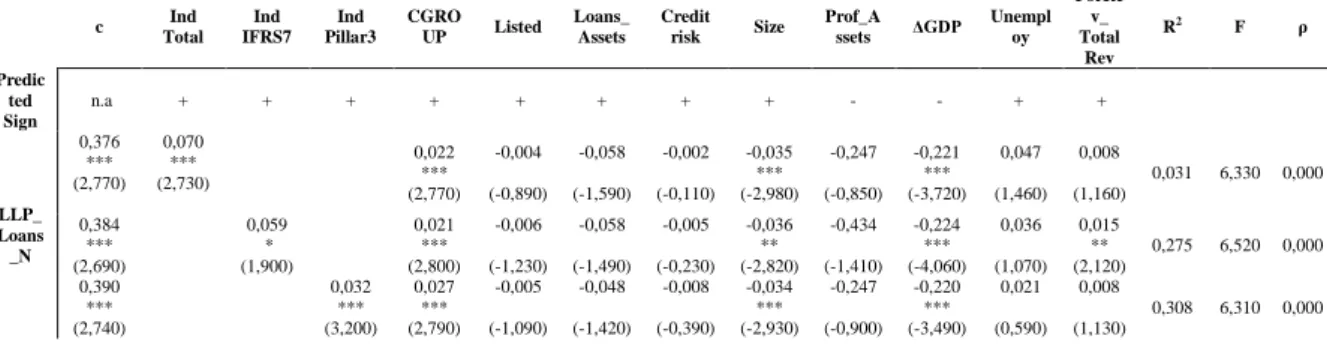
Recognition and disclosure are important issues in accounting. Ahmed et. al (2006), Frederickson et al. (2006), Libby et at. (2006), Clor-Proell and Maines (2014) and Müller et al. (2015) find that there are differences in perceived reliability of recognized versus disclosed amounts; however, despite users’ preference for the former, the two are not substitutes. Clor-Proell and Maines (2014) further conclude that managers generally exhibit less cognitive effort and more bias for disclosure than for recognition, thereby leading to differential reliability of recognized and disclosed estimates. Ahmed et. al (2006) provide evidence on how investor valuation of derivative financial instruments differs depending upon whether the fair value of these instruments is recognized or disclosed. Similarly, Müller et. al (2015) find a lower association between equity prices and disclosed relative to recognized investment property fair values. These studies analyze recognition and disclosure as two alternative accounting treatments. Recognition and disclosure are not, however, alternatives for the accounting treatment of loans to customers, as it is prescribed in two standards – one for recognition and other for disclosure. Considering the lack of timely recognition of LLPs under IAS 39, that collided with supervisors’ preference for forward-looking provision, and the role of disclosures as a market discipline tool, it is conjectured that supervisors might have induced banks to present higher disclosures to compensate for the impossibility of incorporating known future losses that did not fulfil IAS 39 impairment requirements to allow stakeholders to assess the banks’ risk exposures. Thus, the third hypothesis is as follows:
13
H3: The level of impairment related disclosures is positively associated with LLPs recognized in the Income Statement.
3. R
ESEARCH DESIGN AND SAMPLE3.1. Methodology
To investigate the level of compliance with the mandatory disclosures banks are subject to – IFRS 7 and Pillar 3 from the Basel framework – and with the EBA guidelines on NPLs and forbearance, three checklists were constructed (see Appendix A). Two country groups were formed, building on the prior literature presented above and on disclosed banks’ subjection to additional supervisory legislation on disclosure, which is presented in Appendix B. The two groups’ disclosure levels were compared to assess if the differences were significant and if such differences remained after the entry into force of the SSM. To verify if the results maintained considering additional variables that also influence the level of LLPs disclosures, multivariate analyses were further conducted for H1 and H2, respectively: (1) 𝐼𝑛𝑑𝐷𝐼𝑆𝐶 𝑖, 𝑁 = 𝛼 + 𝛽1 ∗ 𝐶𝐺𝑅𝑂𝑈𝑃 𝑖, 𝑁 + 𝛽2 ∗ 𝐿𝑖𝑠𝑡𝑒𝑑 𝑖, 𝑁 + 𝛽3 ∗ 𝐿𝑜𝑎𝑛𝑠 𝐴𝑠𝑠𝑒𝑡𝑠𝑖, 𝑁 + 𝛽4 ∗ 𝐶𝑟𝑒𝑑𝑖𝑡 𝑅𝑖𝑠𝑘 𝑖, 𝑁 + 𝛽5 ∗ 𝑆𝑖𝑧𝑒 𝑖, 𝑁 + 𝛽6 ∗ 𝑃𝑅𝑂𝐹 𝐴𝑠𝑠𝑒𝑡𝑠 𝑖, 𝑁 + 𝛽7 ∗ 𝛥𝐺𝐷𝑃 𝑖, 𝑁 + 𝛽8 ∗ 𝑈𝑛𝑒𝑚𝑝𝑙𝑜𝑦 𝑖, 𝑁 + 𝛽9 ∗ 𝐹𝑜𝑟𝑅𝑒𝑣 𝑇𝑜𝑡𝑎𝑙𝑅𝑒𝑣 𝑖, 𝑁 + ꜫ (2) 𝐼𝑛𝑑𝐷𝐼𝑆𝐶 𝑖, 𝑁 = 𝛼 + 𝛽1 ∗ 𝐶𝐺𝑅𝑂𝑈𝑃 𝑖, 𝑁 + 𝛽2 ∗ 𝐿𝑖𝑠𝑡𝑒𝑑 𝑖, 𝑁 + 𝛽3 ∗ 𝐿𝑜𝑎𝑛𝑠 𝐴𝑠𝑠𝑒𝑡𝑠𝑖, 𝑁 + 𝛽4 ∗ 𝐶𝑟𝑒𝑑𝑖𝑡 𝑅𝑖𝑠𝑘 𝑖, 𝑁 + 𝛽5 ∗ 𝑆𝑖𝑧𝑒 𝑖, 𝑁 + 𝛽6 ∗ 𝑃𝑅𝑂𝐹 𝐴𝑠𝑠𝑒𝑡𝑠 𝑖, 𝑁 + 𝛽7 ∗ 𝛥𝐺𝐷𝑃 𝑖, 𝑁 + 𝛽8 ∗ 𝑈𝑛𝑒𝑚𝑝𝑙𝑜𝑦 𝑖, 𝑁 + 𝛽9 ∗ 𝐹𝑜𝑟𝑅𝑒𝑣 𝑇𝑜𝑡𝑎𝑙𝑅𝑒𝑣 𝑖, 𝑁 + 𝛽10 ∗ 𝐷𝑈𝑀𝑀𝑌𝑆𝑆𝑀+ 𝛽11 𝐶𝐺𝑅𝑂𝑈𝑃 ∗ 𝐷𝑈𝑀𝑀𝑌𝑆𝑆𝑀+ ꜫ
Where the dependent variable IndDISC assumes IndTotal, IndIFRS 7, IndPillar3 or IndEBA in four regressions. CGROUP is the independent variable in both regressions that takes the value of 1 if the supervisor is interventionist and 0 if the supervisor is non-interventionist. Listed is a dummy variable that is attributed the value of 1 if the bank is listed and 0 otherwise. Nichols et al. (2005) find that public banks exercise a greater degree of accounting conservatism than private banks. Thus, listed banks are expected to register higher levels of disclosure than private ones. The ratio of loans to total assets (Loans_Assets) is used as a proxy of portfolio composition and provisions are expected to be positively related to the loans’ share. Loans to customers’ growth rate (CreditRisk) is used as a proxy of credit risk exposures and this indicator is expected to be positively associated with bank risk, given that rapid growth of bank lending is generally associated
14
with lower monitoring efforts and a deterioration of the quality of loan portfolios. The potential size effect is controlled for with the logarithm of total assets (Size), as larger banks are expected to better manage their risk exposure and therefore to provide higher disclosures. Banks that presented lower profits before impairments and provisions are expected to display higher LLPs given the procyclical nature of loan loss provisioning under IAS 39. Therefore the operating profits before provisions and impairment losses scaled by total assets (PROF_Assets) were included in the regressions. These control variables were chosen following Laeven and Majnoni (2003). Year control dummies (DUM13, DUM 14 and DUM 15) are also included.
The use of changes in GDP to capture changes in a country’s economic activity and of the unemployment rate is common across the literature (e.g. Bikker and Metzemakers, 2005). Consistent with prior studies, a negative relationship between LLP and changes in GDP is expected because banks increase provisions during recessionary periods, and keep fewer provisions during good economic periods (Laeven and Majnoni, 2003; Bikker and Metzemakers, 2005). Considering that the unemployment rate is higher when GDP is lower, the predicted correlation between this variable and the level of LLPs is positive. The ratio of foreign to total revenues is used as an internationalization indicator and is expected to be positively associated with LLPs. According to Buch et. al (2011) geographic diversification increases monitoring and information costs and, thus, risk. Considering the hypothesized positive relationship between LLPs recognition and disclosure, the last described three control variables are expected to present the same relationship with LLPs disclosures.
In equation (2), two additional variables were included. DUMMY_SSM is a dummy variable that takes the value of 1 for the period between 2014 and 2015, indicating the entry into force of the SSM. The interaction variable CGROUP * DUMMY_SSM is another independent variable that should determine if after the entry into force of the SSM the changes in disclosure practices were significantly different between groups.
Finally, the following econometric relationship was estimated to investigate supervisory influence on the relationship between recognition and disclosure of LLPs:
(3) 𝐿𝐿𝑃 𝐿𝑜𝑎𝑛𝑠𝑖, 𝑁 = 𝛼 + 𝛽1 ∗ 𝐼𝑛𝑑𝐷𝐼𝑆𝐶 𝑖, 𝑁 + 𝛽2 ∗ 𝐶𝐺𝑅𝑂𝑈𝑃 𝑖, 𝑁 + 𝛽3 ∗ 𝐿𝑖𝑠𝑡𝑒𝑑 𝑖, 𝑁 + 𝛽4 ∗ 𝐿𝑜𝑎𝑛𝑠 𝐴𝑠𝑠𝑒𝑡𝑠𝑖, 𝑁 + 𝛽5 ∗ 𝐶𝑟𝑒𝑑𝑖𝑡 𝑅𝑖𝑠𝑘 𝑖, 𝑁 + 𝛽6 ∗ 𝑆𝑖𝑧𝑒 𝑖, 𝑁 + 𝛽7 ∗ 𝑃𝑅𝑂𝐹 𝐴𝑠𝑠𝑒𝑡𝑠 𝑖, 𝑁 + 𝛽8 ∗ 𝛥𝐺𝐷𝑃 𝑖, 𝑁 + 𝛽9 ∗ 𝑈𝑛𝑒𝑚𝑝𝑙𝑜𝑦 𝑖, 𝑁 + 𝛽10 ∗ 𝐹𝑜𝑟𝑅𝑒𝑣 𝑇𝑜𝑡𝑎𝑙𝑅𝑒𝑣 𝑖, 𝑁 + ꜫ
15
Where the ratio of LLPs over loans to customers of bank i at time N is a function of IndDISC that assumes IndTotal, IndIFRS 7 or IndPillar3 in three regressions.
3.2. Sample selection
The sample was taken from the lists of significant supervised entities by the ECB. On 4 September 2014, the ECB published its final list of significant supervised entities and less significant institutions for the purposes of the Eurozone’s SSM.
From the 120 entities presented in the first list of September 2014, subsidiaries of parent banks located outside the sample countries were eliminated to avoid biases arising from the impact of their national enforcement institutions. This affected 21 banks. Subsidiaries of parent banks that were themselves included in the sample (11 banks) were also excluded in order not to double-count certain disclosure policies. Disclosures of a subsidiary in a different country are likely to be affected by the supervisory activities in the home country of the parent bank, biasing observations for the subsidiary’s country if it were included in the sample. Banks that were removed from the initial list and banks that were included afterwards were also excluded to guarantee a uniform analysis. Three German banks and one Dutch bank did not apply the IFRS for the period under analysis and were consequently not analyzed. Also, some financial statements were not available in English or not available for the 2011-2015 financial years so their banks’ disclosure policies or key indicators could not be analyzed due to practical impediments (this affected 15 banks in total). One bank whose reporting period did not coincide with the calendar year was not considered, as well as banks founded after 2012. One German bank was also not included due to its diverging business model. Finally, banks that were or are currently in liquidation were not subject to examination. A total of 60 banks from 15 different European countries were included in the final sample. Financial data and disclosure policies were hand collected from the financial statements available in English for the financial years comprising the 2012-2015 period. A total of 240 financial statements were thus evaluated in detail.
4.
R
ESULTS4.1. Group differences before and after the entry into force of the SSM: Descriptive statistics, means’ differences and multivariate results
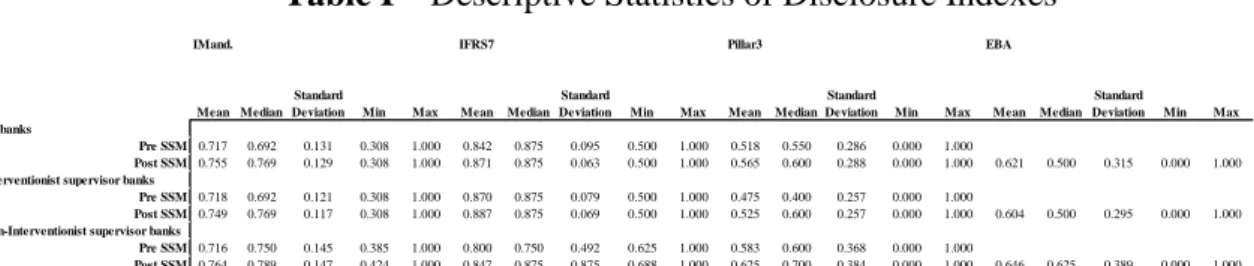
Table I provides descriptive statistics for the disclosure indexes. The aggregated mandatory disclosures – IFRS 7 and Pillar 3 – evolved positively with a significant increase after the entry into force of the SSM. This overall improvement was mainly
16
attributed to the increasing compliance with Pillar 3 whose biggest contributor was the interventionist group. This group, however, still presented lower indexes for this disclosure requirement in comparison with the interventionist group. In turn, non-interventionist supervisors’ banks were the main contributors to the increase in the individual IFRS 7 disclosure index This group, however, still presented lower indexes of compliance with the accounting standard than the interventionist supervisor group. These improvements suggest that the change in the supervisory framework might have pressured banks to improve their disclosure practices to uniform disclosures of EU banks.
Table I – Descriptive Statistics of Disclosure Indexes
The indexes were constructed using dummy variables where the value of 1 was attributed if the bank complied with the disclosure requirement or guideline for the year analyzed, and 0 otherwise. IMand. is the index for the aggregated mandatory disclosures. This index is the sum of IFRS 7 and Pillar 3 disclosure dummies divided by the total number of disclosure requirements of the two standards. IFRS 7 and Pillar 3 individual indexes are the sum of the disclosure dummies for the quantitative disclosure requirements on LLPs divided by the total number of disclosure requirements of each standard. The EBA guidelines disclosure index was constructed for 2014 and 2015 only as these were the years of its application that coincide with the period of analysis of this study. The dummy variables of the disclosure for NPLs and Forbearance were summed and divided by the two topics. Interventionist supervisor banks comprise Cyprus (1 bank), France (5 banks), Greece (4 banks), Ireland (3 banks), Italy (9 banks), Malta (1 bank), Portugal (3 banks), Slovenia (2 banks) and Spain (8 banks). Non-interventionist supervisory banks comprise Austria (3), Belgium (4), Finland (1), Germany (11), Luxembourg (1) and the Netherlands (4). The results of the descriptive statistics are presented for the aggregated periods before and after the entry into force of the SSM.
The EBA disclosure indexes were higher in banks with non-interventionist supervisors than for banks of the interventionist regime. The justification might be that banks from the latter group already presented their own indicators of NPLs and of forbearance, whilst some banks of the former have only introduced those concepts in their annual reports after the EBA issued the guidelines. While the application of these definitions constitutes a very important leap forward in terms of harmonization across the euro area banking sector, the degree of harmonization reached is not completely perfect due to factors such as different materiality thresholds across countries (European Central Bank, 2014). However, a solid basis of consistency has been implemented, implying a very significant improvement in comparability across banks from different jurisdictions.
The results, however, did not reveal full conformity with the compulsory disclosure requirements. To what concerns the Pillar 3 impairment and associated concepts’
IMand. IFRS7 Pillar3 EBA Mean Median
Standard
Deviation Min Max Mean Median Standard
Deviation Min Max Mean Median Standard
Deviation Min Max Mean Median Standard Deviation Min Max All banks
Pre SSM 0.717 0.692 0.131 0.308 1.000 0.842 0.875 0.095 0.500 1.000 0.518 0.550 0.286 0.000 1.000
Post SSM 0.755 0.769 0.129 0.308 1.000 0.871 0.875 0.063 0.500 1.000 0.565 0.600 0.288 0.000 1.000 0.621 0.500 0.315 0.000 1.000
Interventionist supervisor banks
Pre SSM 0.718 0.692 0.121 0.308 1.000 0.870 0.875 0.079 0.500 1.000 0.475 0.400 0.257 0.000 1.000
Post SSM 0.749 0.769 0.117 0.308 1.000 0.887 0.875 0.069 0.500 1.000 0.525 0.600 0.257 0.000 1.000 0.604 0.500 0.295 0.000 1.000
Non-Interventionist supervisor banks
Pre SSM 0.716 0.750 0.145 0.385 1.000 0.800 0.750 0.492 0.625 1.000 0.583 0.600 0.368 0.000 1.000
17
disclosures, banks were merely disclosing roughly half of the quantitative requirements. The cross-country differences might be explained by interventionist supervisor banks’ preferred focus on complying with their supervisors’ additional rules. In fact, in some interventionist regimes, the additional supervisory impairment disclosures not only overlap with the accounting and regulatory disclosures, but are also more extensive. However, the divergent compliance degrees with the mandatory disclosures between banking institutions are explained not only by the different business models and risk profiles of institutions, but also on the lack of guidance and prescribed formats for published information (EBA, 2014).
Notwithstanding an incomplete compliance, the fact that IFRS 7 is a binding accounting norm subject to auditing justifies the high conformity and the minor differences between groups. Bischof et. al (2011) reveals that sometimes preparers get away with substantial non-compliance with disclosure requirements, even in Western European countries with supposedly strong enforcement regimes. The most prevalent breach concerned paragraph 37b of the standard’s previous version. The common practice was disclosing generic triggers extracted from IAS 39 instead of concrete impairment triggers. Appendix D provides insights on banks’ practices in respect to this concrete impairment disclosure of IFRS 7.
Means’ difference tests were performed to assess if the disclosure practices of the two groups were significantly different. Table I presents the results. The differences in IFRS 7 disclosures are statistically significant at a 1% level and confirm that interventionist supervisors’ banks are significantly more compliant with the accounting standard than non-interventionist supervisors’ banks. The latter group is, however, at a 5% level, significantly more compliant with the Pillar 3 framework than the former.
Table I Disclosure indexes: Means’ differences between groups
Interventionist Non- Interventionist Means diff. P-value
No. Obs. 36 24
IMand. 0,725 0,734 -0,009 0,672
IFRS7 0,878 0,823 0,056 0,000***
Pillar3 0,500 0,604 -0,104 0,019**
EBA 0,601 0,646 -0,045 0,512
A total of 144 observations for the 36 banks from the nine countries classified as interventionist regimes and 96 observations for the 24 banks from the six countries identified as non-interventionist regimes were made. The four-year mean of each of the disclosure indexes was calculated and compared between interventionist and non-interventionist groups. **, *** indicates significance at 5% and 1% level, respectively.
18
To verify if the results are sustained considering additional variables that influence the level of LLPs, multivariate analyses were further conducted. Four linear regressions were constructed following equation (1) presented in section 3.1.
Table II Disclosure indexes: Multivariate results for group differences
Variables Pr ed ict ed S
ign IndMand. IndIFRS7 IndPillar3 IndEBA
Constant n.a 0,591* (1,960) 0,052*** (2,870) 0,749 (1,210) 0,118 (0,130) CGROUP + 0,887*** (2,970) 0,122*** (6,340) 0,039 (0,590) 0,021 (0,220) Listed + -0,461** (-2,200) -0,028** (-2,020) -0,077 (-1,540) -0,069 (-0,940) Loans_Assets + 0,069 (0,910) 0,142*** (3,050) -0,046 (-0,270) 0,713** (2,590) CreditRisk + -0,095 (-1,570) -0,089 (-1,370) -0,065 (-0,600) -0,184 (-0,580) Size + 0,010 (0,390) 0,021 (1,420) -0,012 (-0,230) 0,030 (0,390) Prof_Assets - -3,441** (-2,000) -1,063 (-0,770) -7,812** (-2,360) -1,257 (-0,220) ΔGDP - 0,030 (0,008) 0,058 (0,300) 0,012 (0,020) -0,107 (-0,130) Unemploy + -0,064*** (-2,700) -0,627*** (-3,530) -0,671 (-1,470) -1,414* (-1,870) ForRev_TotalRev + 0,166*** (3,820) 0,066** (2,230) 0,334*** (3,570) -0,183 (-1,230) Obs. 240 240 240 120 R-Squared 0,159 0,206 0,129 0,132 F-Test 3,840 5,230 3,820 1,39 P-value 0,000 0,000 0,000 0,1936
*, **, *** indicate significance at a 10%, 5% and 1% level, respectively. T-statistics is within brackets. Variables: Ind.Mand. Mandatory disclosures – IFRS 7 and Pillar 3; IndIFRS7 individual IFRS 7 disclosures; IndPillar3 individual Pillar 3 disclosures; IndEBA EBA disclosures. CGROUP dummy takes the value of 1 if supervisor is interventionist and 0 if non-interventionist; Listed dummy takes the value of 1 if the bank is listed and 0 otherwise; As control variables: Loans_Assets Portfolio composition; CreditRisk Loan growth; Size The natural logarithm of Assets; Prof_Assets Operating profit before provisions and impairment losses scaled by total assets; ΔGDP yearly GDP growth in each bank’s country; Unemploy the unemployment rate in each bank’s country; ForRev_Total Rev a bank’s ratio of foreign to total revenues. Year dummies are included but not reported.
Even though the regression results indicate that differences are only statistically significant for the accounting standard, it is once more confirmed that interventionist supervisors’ banks present significantly higher disclosures than non-interventionist supervisors’ banks. Therefore, H1 is confirmed.
19
Moreover, these banks are subject to extensive additional disclosures on loan losses and past due loans. Each country’s additional supervisory disclosure requirements are described in Appendix B. The findings for the Italian, Portuguese and Spanish banks’ additional disclosures align with previous literature, supporting these countries’ classification as interventionist regimes to loan loss accounting. Irish banks, however, presented extensive mandatory disclosures, namely about the factors considered in determining loan losses, as well as additional disclosures recommended by the Central Bank of Ireland, revealing an effort to be more transparent. Therefore, this country was considered in the interventionist group.
In order to assess whether the entry into force of the SSM had an effect on banks’ level of disclosure, means’ difference tests were performed. The results are presented in Table III. The 2012 and 2013 mean values for each disclosure index were compared with the 2014 and 2015 mean values. The comparison was made for the whole sample and for the two groups separately. The results are significant at a 10% level and indicate an increase in the mandatory disclosure index, aggregately, after the entry into force of the SSM. The results are explained by changes in the IFRS 7 disclosures – significant at a 10% level – and in the Pillar 3 disclosures – significant at a 5% level.
While interventionist supervisors’ banks presented no substancial changes in the IFRS 7 disclosures, the increase in these disclosures was statistically significant at a 5% level for the non-interventionist group. The statistics were stronger for the changes in Pillar 3 disclosures, for both groups, as compliance with this framework has a different enforcement – by being out of auditings’ scope, for example. The increase in Pillar 3 disclosures was significant at a 10% level for the interventionist group and at a 1% level for the non-interventionist group.
Table III Disclosure Indexes Pre and Post SSM entry into force
Before SSM After SSM Means diff.
All Int. Non-Int. All Int. Non-Int. All Int. Non-Int.
IMand. 0,717 0,718 0,716 0,755 0,749 0,764 0,038* 0,031 0,048**
IFRS7 0,842 0,870 0,800 0,871 0,887 0,847 0,029* 0,017 0,047**
Pillar3 0,518 0,475 0,583 0,565 0,525 0,625 0,047** 0,050* 0,042***
IMand. is the index for aggregated mandatory disclosures (IFRS 7 and Pillar 3). IFRS 7 and Pillar 3 are the individual indexes of disclosure. The 2012 and 2013 (before SSM entry) mean values were compared with the 2014 and 2015 (after SSM entry) mean values. *, **, *** indicate significance at a 10%, 5% and 1% level, respectively.
20
A multivariate analysis was conducted to confirm the above results. Three linear regressions were constructed in which the dependent variables were the mandatory disclosure indexes, individually and aggregately, and CGROUP was the independent variable.
Table IV Disclosure Indexes: Multivariate Results pre and post SSM entry into force
Variables Pr ed ict ed S
ign IndMand. IndIFRS7 IndPillar3
Constant n.a 0,5840* (1,930) 0,508*** (2,830) 0,755 (1,230) CGROUP + 0,103*** (2,830) 0,143*** (5,910) 0,040 (0,500) Listed + -0,046** (-2,220) -0,028** (-2,050) -0,077 (-1,550) Loans_Assets + 0,070* (0,920) 0,142*** (3,050) -0,046 (-0,270) CreditRisk + -0,101 (-1,700) -0,096 (-1,530) -0,070 (-0,650) Size + 0,011 (0,410) 0,022 (1,470) -0,012 (-0,220) Prof_Assets - -3,338** (-1,970) -0,949 (-0,690) -7,753** (-2,370) ΔGDP - 0,1320 (0,380) 0,177 (0,880) 0,073 (0,090) Unemploy + -0,625*** (-2,650) -0,606*** (-3,480) -0,654 (-1,440) ForRev_TotalRev + 0,166*** (3,810) 0,066** (2,250) 0,333*** (3,560) DUMMY_SSM + 0,057* (1,820) 0,052*** (2,790) 0,055 (0,780) CGROUP*DUMMY_SSM + -0,031 (-0,760) -0,043 (-1,650) -0,005 (-0,050) Year Dummies No No No Obs. 240 240 240 R-Squared 0,158 0,211 0,128 F-Test 4,090 6,050 4,160 P-value 0,000 0,000 0,000
*, **, *** indicate significance at a 10%, 5% and 1% level, respectively. T-statistics is within brackets. Variables: Ind.Mand. Mandatory disclosures – IFRS 7 and Pillar 3; IndIFRS7 individual IFRS 7 disclosures; IndPillar3 individual Pillar 3 disclosures. CGROUP dummy takes the value of 1 if supervisor is interventionist and 0 if non-interventionist; Listed dummy takes the value of 1 if the bank is listed and 0 otherwise; As control variables: Loans_Assets Portfolio composition; CreditRisk Loan growth; Size The natural logarithm of Assets; Prof Operating profit before provisions and impairment losses scaled by total assets; ΔGDP yearly GDP growth in each bank’s country; Unemploy the unemployment rate in each bank’s country; ForRev_Total Rev a bank’s ratio of foreign to total revenues; DUMMY_SSM takes the value of 1 for the 2014 and 2015 financial years and 0 for the 2012 and 2013 financial years. CGROUP*DUMMY_SSM is an interaction variable between CGROUP and DUMMY_SSM.
21
The results indicate that the change in the supervisory framework had an overall significant impact in disclosure practices, justified by the significant improvement in IFRS 7 disclosure practices, thereby partially confirming H2. The improvements, however, were not statistically different between groups.
4.2. Relationship between disclosure and LLPs recognition
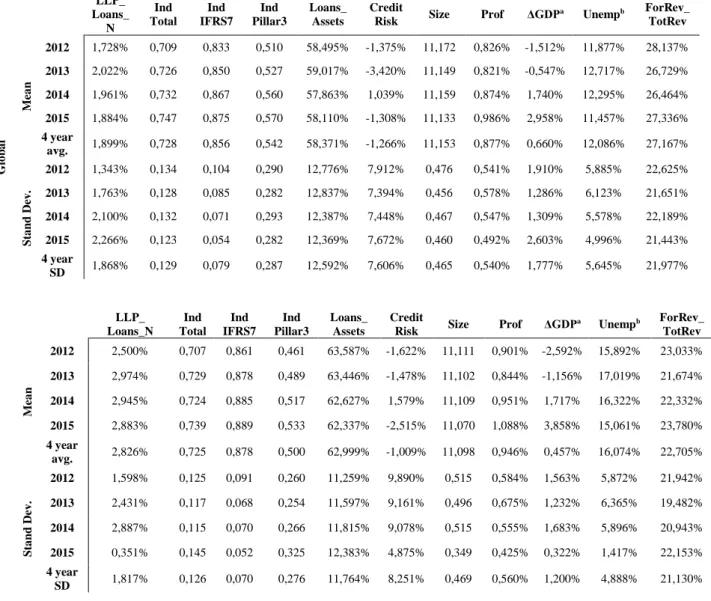
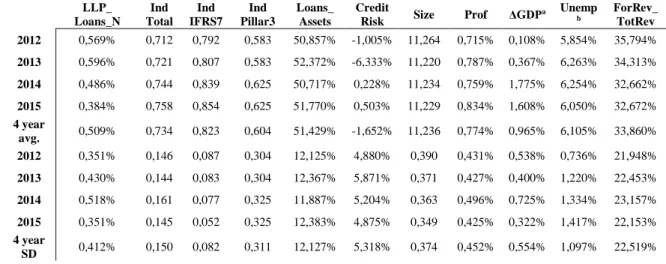
Table V presents some descriptive statistics for the variables used in the multivariate analyses. The ratio of LLPs to loans to customers was, on average, more than five times higher in the interventionist group than in the non-interventionist group, explained by the elevated credit risk of a higher proportion of loans to total assets. These banks also operated under a more fragile macroeconomic environment, as reflected in lower GDP growth rates and higher unemployment rates. However, and despite the smaller dimension and internationalization level, these banks were more profitable.
Table V Descriptive Statistics for the regression variables
LLP_ Loans_ N Ind Total Ind IFRS7 Ind Pillar3 Loans_ Assets Credit
Risk Size Prof ΔGDP
a Unempb ForRev_ TotRev Gl o b a l M ea n 2012 1,728% 0,709 0,833 0,510 58,495% -1,375% 11,172 0,826% -1,512% 11,877% 28,137% 2013 2,022% 0,726 0,850 0,527 59,017% -3,420% 11,149 0,821% -0,547% 12,717% 26,729% 2014 1,961% 0,732 0,867 0,560 57,863% 1,039% 11,159 0,874% 1,740% 12,295% 26,464% 2015 1,884% 0,747 0,875 0,570 58,110% -1,308% 11,133 0,986% 2,958% 11,457% 27,336% 4 year avg. 1,899% 0,728 0,856 0,542 58,371% -1,266% 11,153 0,877% 0,660% 12,086% 27,167% S ta n d D ev . 2012 1,343% 0,134 0,104 0,290 12,776% 7,912% 0,476 0,541% 1,910% 5,885% 22,625% 2013 1,763% 0,128 0,085 0,282 12,837% 7,394% 0,456 0,578% 1,286% 6,123% 21,651% 2014 2,100% 0,132 0,071 0,293 12,387% 7,448% 0,467 0,547% 1,309% 5,578% 22,189% 2015 2,266% 0,123 0,054 0,282 12,369% 7,672% 0,460 0,492% 2,603% 4,996% 21,443% 4 year SD 1,868% 0,129 0,079 0,287 12,592% 7,606% 0,465 0,540% 1,777% 5,645% 21,977% LLP_ Loans_N Ind Total Ind IFRS7 Ind Pillar3 Loans_ Assets Credit
Risk Size Prof ΔGDP
a Unempb ForRev_ TotRev In te rv en ti o n ist M ea n 2012 2,500% 0,707 0,861 0,461 63,587% -1,622% 11,111 0,901% -2,592% 15,892% 23,033% 2013 2,974% 0,729 0,878 0,489 63,446% -1,478% 11,102 0,844% -1,156% 17,019% 21,674% 2014 2,945% 0,724 0,885 0,517 62,627% 1,579% 11,109 0,951% 1,717% 16,322% 22,332% 2015 2,883% 0,739 0,889 0,533 62,337% -2,515% 11,070 1,088% 3,858% 15,061% 23,780% 4 year avg. 2,826% 0,725 0,878 0,500 62,999% -1,009% 11,098 0,946% 0,457% 16,074% 22,705% S ta n d D ev . 2012 1,598% 0,125 0,091 0,260 11,259% 9,890% 0,515 0,584% 1,563% 5,872% 21,942% 2013 2,431% 0,117 0,068 0,254 11,597% 9,161% 0,496 0,675% 1,232% 6,365% 19,482% 2014 2,887% 0,115 0,070 0,266 11,815% 9,078% 0,515 0,555% 1,683% 5,896% 20,943% 2015 0,351% 0,145 0,052 0,325 12,383% 4,875% 0,349 0,425% 0,322% 1,417% 22,153% 4 year SD 1,817% 0,126 0,070 0,276 11,764% 8,251% 0,469 0,560% 1,200% 4,888% 21,130%