Wavelet-domain elastic net for clustering on genomes strains
Leila Maria Ferreira
1, Thelma Sáfadi
2and Juliano Lino Ferreira
31
Programa de Pós-Graduação em Estatística e Experimentação Agropecuária, Departamento de Estatística,
Universidade Federal de Lavras (UFLA), Lavras, MG, Brazil.
2
Departamento de Estatística, Universidade Federal de Lavras (UFLA), Lavras, MG, Brazil.
3
Empresa Brasileira de Pesquisa Agropecuária (Embrapa) Pecuária Sul. Bagé, RS, Brazil.
Abstract
We propose to evaluate genome similarity by combining discrete non-decimated wavelet transform (NDWT) and elastic net. The wavelets represent a signal with levels of detail, that is, hidden components are detected by means of the decomposition of this signal, where each level provides a different characteristic. The main feature of the elastic net is the grouping of correlated variables where the number of predictors is greater than the number of observations. The combination of these two methodologies applied in the clustering analysis of theMycobacterium tuberculosis genome strains proved very effective, being able to identify clusters at each level of decomposition.
Keywords: Elastic net, genome, GC-content, cluster analysis, wavelet transform.
Received: February 01, 2018; Accepted: March 11, 2018.
Introduction
Mycobacterium tuberculosis(MTB), also called Ko-ch bacillus, is a species of the pathogenic bacterium of the genus Mycobacterium and the causative agent of most cases of tuberculosis (TB) (Tayloret al., 2003). TB is the ninth leading cause of death worldwide and the leading cause of death from a single infectious agent, ranking above HIV/AIDS. In 2016, there were an estimated 1.3 million TB deaths among HIV-negative people (down from 1.7 million in 2000) and an additional 374,000 deaths among HIV-positive people. An estimated 10.4 million people fell ill with TB in 2016: 90% were adults, 65% were male, 10% were people living with HIV (74% in Africa), and 56% were in five countries: India, Indonesia, China, the Philip-pines, and Pakistan. Drug-resistant TB is a continuing th-reat. In 2016, there were 600,000 new cases with TB resis-tance to rifampicin, the most effective first-line drug, of which 490,000 had multidrug-resistant TB (MDR). Almost half (47%) of these cases were in India, China, and the Rus-sian Federation (WHO, 2017).
By the end of 2016, extensively drug-resistant TB (XDR) had been reported by 123 WHO member states. Of these, 91 countries and five territories reported representa-tive data from continuous surveillance or surveys regarding the proportion of MDR cases that had XDR. Combining
their data, the average proportion of MDR cases with XDR was 6.2% (95% CI: 3.6–9.5%) (WHO, 2017)
Several studies are underway regarding the study of MTB strains in order to detect the mutations that the strains suffer when becoming drug resistant. Boehmeet al.(2010) studied an automated molecular test for MTB resistance to rifampin (RIF) in patients with suspected drug-sensitive or multidrug-resistant pulmonary tuberculosis. Perdigãoet al. (2010) performed a study to characterize the genetic chan-ges associated with the high number of XDR TB that threat-ens the control of TB worldwide. Zhouet al.(2017) investi-gated the association between genotype and drug resistance profiles of MTB strains circulating in China in a national drug resistance survey. Mülleret al. (2013) studied pro-grammatically selected multidrug-resistant strains drive and the emergence of extensively drug-resistant TB in South Africa. Smithet al.(2014) investigated the reduced virulence of an XDR outbreak strain of MTB in a murine model. Other related studies were done by Iwamotoet al. (2012), Sandegren et al. (2011), Buu et al. (2012), and Treviñoet al.(2015).
In order to extract information regarding the genome of MTB, one of the techniques used is the GC-content. This is an important parameter of bacterial genomes used to scan the basic composition of the genome, as well as to under-stand the evolution of the coded sequence. Hildebrandet al. (2010) showed that the GC-content is highly correlated to genomic GC-content, that is, there is selection on genomic base composition in many bacteria.
Send correspondence to Leila Maria Ferreira. Departamento de Estatística, Universidade Federal de Lavras (UFLA), P.O. Box 3037, 37200-000 Lavras, MG, Brazil. E-mail: [email protected].
The use of wavelet analysis in genomic data has been growing a growing field. One of the features of this analysis is the extraction of characteristics that are hidden, thus in-creasing the precision of the results. Conceptually, the wavelet transform is a technique for seeing and represent-ing a signal. This signal is decomposed in resolution levels, where each level adds details. Mathematically, it is repre-sented by a function oscillating in time or space. The method has sliding windows that expand or compress to capture low and high frequency signals, respectively (Per-cival and Walden, 2000). Its origin occurred in the field of seismic study to describe the disturbances arising from a seismic impulse (Morletet al., 1982).
Among the wavelet techniques, we used the discrete non-decimated wavelet transform (NDWT), which has as its main characteristic that it can work with any size of sig-nals/sequences. In this technique, the coefficients are trans-lation invariants, that is, the choice of origin is irrelevant, since all the observations are used in the analysis, a situa-tion that does not occur in the discrete decimated wavelet transform (DWT). Discrete wavelet transforms have been used to identify gene locations in genomic sequences (Ning et al., 2003), identifying long-range correlations, locating periodicities in DNA sequences (Vannucci and Liò, 2001), and for analysis of G+C patterns (Dodinet al., 2000).
The NDWT method can be used in any genome type, increasing the speed of the analysis, which is processed al-most in real time. Bao and Yuan (2015) created a wave-let-based feature vector (WFV) model that outperformed the other models in terms of both the clustering results and the running time, confirming that wavelets are an efficient method in the analysis of DNA sequences.
The clustering analysis that has been worked with genomic data is the elastic net, which is the regular regres-sion method that linearly combines the L1and L2penalties of the LASSO and Ridge regression methods. The main feature of this method is the grouping of correlated vari-ables where the number of predictors is greater than the number of observations. Elastic net employs a grouping ef-fect, in which strongly correlated predictors tend to be in or out of the model. Sáfadi (2017) showed that the wave-let-domain elastic net methodology was effective for clus-tering of time series data, that is, the interaction of wavelets with elastic net is an efficient method of grouping. Another characteristic of the method is the speed with which the analyses are processed. Molet al.(2009) proved that there exists a particular “elastic net representation” of the regres-sion function such that, if the number of data increases, the elastic net estimator is consistent not only for prediction but also for variable/feature selection, demonstrating the adap-tive capacity of the elastic net. Choet al.(2009) proposed a simple stepwise procedure that identifies disease-causing SNPs simultaneously by employing elastic net regulariza-tion, a variable selection method that allows addressing multicollinearity in the study of rheumatoid arthritis,
show-ing the efficiency of genetic data interaction with elastic net. The studies of Waldmannet al.(2013), Hughey and Butte (2015), Ayers and Cordell (2010), Ogutu et al. (2012), and Furqan and Siyal (2016) also show the signifi-cant relationship between genetic data interaction and elas-tic net.
In this work, the discrete non-decimated wavelet transform was applied to GC-content sequences; the de-tailed level coefficients are used to study similarities of MTB genome strains through elastic net methodology. The visualization of the graphs obtained with the elastic net al-lowed identifying the groupings of similar strains. The pro-posed methodology was applied to ten MTB sequences, with two being 2 drug-resistant, 6 six drug-susceptible, one multi drug-resistant and one extensively drug-resistant.
Material and Methods
In the analyses, the free software R (R Core Team, 2017) was used.
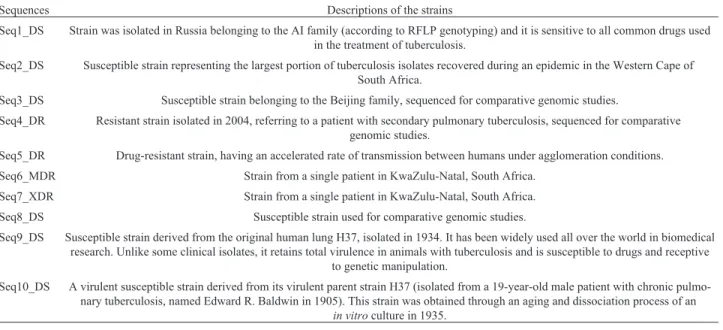
Table 1 shows the description of each strain of the MTB genome, obtained from the National Center for Bio-technology Information (NCBI, 2017). The methodology used was as follows:
1. The GC-content of all the sequences was evaluated using a sliding window of 10,000 base pairs (bp).
The GC-content is an important parameter of bacte-rial genomes used to scan the basic composition of the ge-nome as well as to understand the evolution of the coded sequence. Generally, the CG-content ranges from 25 to 75% in bacterial genomes (Mann and Chen, 2010). In the mammalian genome, approximately 50% of all genes are controlled by promoters with high GC-content. Changet al. (2015) examined a method for stable quantification of such GC-rich DNA sequences.
For each genome sequence, the GC-content is calcu-lated as the ratio of the sum of G and C bases divided by the sum of the A, G, C and T bases (Equation 1):
GCcontent nG nC nA nG nC nT
= +
+ + + (1)
where nA, nG, nC, and nT are the number of A, G, C and T nucleotide bases, respectively, in a sequence. The GC-content can also be calculated for a part of the sequence us-ing the window technique, wherein the GC-content is cal-culated for a fixed length of a specific window of the sequence. The determination of GC-content ratio helps in identifying gene-rich regions of the genome (Saini and Dewan, 2016). Theses gene-rich regions provide signifi-cant biological information about the genome. Chenget al. (2016) and Weiet al.(2016) worked with high GC-content aiming to develop new molecular markers, highlighting the importance of working with gene-rich regions.
A wavelet function is the interpretation of a short wave with rapid increase and decrease. The theory is based on the representation of functions in different scales and resolutions (time-scale), being considered one of its main characteristics (Daubechies, 1992).
In the analysis of wavelets, the oscillating window is called the mother wavelet. There are arbitrary translations and dilations, and thus the mother wavelet generates other wavelets (Hernadez and Weiss, 1996).
By definition: a wavelet is a functiony( )x ÎL2( )
R, such that the function family is given by Equation 2:
yj k y j
j
x k
, = ( - ),
-
-2 2 2 (2)
wherejandkare arbitrary integers on an orthonormal basis in Hilbert space L2( )R (Wojtaszczyk, 1997).
The characteristic of the discrete non-decimated wa-velet transform (NDWT) is to keep the same amount of data in the even and odd decimations on each scale and continue to do the so on each subsequent scale. The coefficients are translational invariants, that is, the circular displacement of the data is reflected in the same direction of the coefficients. Another feature is the ability to handle data of arbitrary size that does not require the sample size to be a power of two, which is what occurs in the discrete decimated wavelet transform (Nason, 2008). The main advantage of this me-thod is associated with zero-pass filters, which means that it operates circularly to the data allowing functionalities at different scales to be aligned with the sequence of the origi-nal data (Vannucci and Liò, 2001).
Percival and Walden (2000) highlight that the NDWT method can also be used to form a multiresolution analysis (MRA). The approximation coefficients and coefficients of details of MRA are such that circularly shifting the
time-series by any amount will circularly shit each approximation coefficients and coefficients of details by a corresponding amount. The NDWT method is computed using O N( log2N)multiplications.
The Daubechies wavelet is a family of orthogonal wavelets that define a discrete wavelet transformation, cha-racterized by a maximum number of null moments (degree of smoothing) for some given support. With each wavelet type of this class, there is a scaling function (called father wavelet), which generates an orthogonal multiresolution analysis.
According to Daubechies (1992), for each integerr, the orthonormal basis for L2
( )R is defined by Equation 3:
yr j k y j
r j
x k j k
, , = ( - ), , Î
-
-2 2 2 Z (3)
in which the functionyr( ) in Lx 2
( )R has the property that
yr (x k k- ) ÎZ is an orthonormal sequential basis in L2
( )R. Here,jis the scale index,kis the translation index, andris the filtering index.
3. The elastic net methodology was used at each level of decomposition, aiming at the identification of similar se-quences.
According to Zou and Hastie (2005), given a set of data with n observations and p predictors, considering y=(y , ,yn)
T
1 K , the response X=(x1Kxp) the matrix
model, where inxj =(x j, ,xnj)
T
1 K ,j=1,K,p, are the
pre-dictors, and considering that the response is centralized and the predictors are standardized, that is, correlated,
yi x x j
i n ij i n ij i n = = = = = = =
å
0å
0å
1 11 1
2 1
and for ,... , . (4)p
For anyl1el2fixed and non-negative, the elastic net
criterion is defined as:
Table 1- Descriptions of theMycobacterium tuberculosisstrains.
Sequences Descriptions of the strains
Seq1_DS Strain was isolated in Russia belonging to the AI family (according to RFLP genotyping) and it is sensitive to all common drugs used in the treatment of tuberculosis.
Seq2_DS Susceptible strain representing the largest portion of tuberculosis isolates recovered during an epidemic in the Western Cape of South Africa.
Seq3_DS Susceptible strain belonging to the Beijing family, sequenced for comparative genomic studies.
Seq4_DR Resistant strain isolated in 2004, referring to a patient with secondary pulmonary tuberculosis, sequenced for comparative genomic studies.
Seq5_DR Drug-resistant strain, having an accelerated rate of transmission between humans under agglomeration conditions.
Seq6_MDR Strain from a single patient in KwaZulu-Natal, South Africa.
Seq7_XDR Strain from a single patient in KwaZulu-Natal, South Africa.
Seq8_DS Susceptible strain used for comparative genomic studies.
Seq9_DS Susceptible strain derived from the original human lung H37, isolated in 1934. It has been widely used all over the world in biomedical research. Unlike some clinical isolates, it retains total virulence in animals with tuberculosis and is susceptible to drugs and receptive
to genetic manipulation.
Seq10_DS A virulent susceptible strain derived from its virulent parent strain H37 (isolated from a 19-year-old male patient with chronic pulmo-nary tuberculosis, named Edward R. Baldwin in 1905). This strain was obtained through an aging and dissociation process of an
L(l , l b1 2, )= -y Xb l b2 +l b , 2 2 1 2 (5) wherein
b2 =
å
b2j
j = 1 p
b b
1 =
å
jj = 1 p
.
The elastic net estimatorb$is the minimizer of Equa-tion 5
{
}
$
arg min ( , , .
b l l b
b
= L 1 2 (6)
This procedure can be seen as a penalized least
squa-res method. Leta l
l l =
+
2
1 2
, so solvingb$in equation 5 is
equivalent to the optimized problem
$ arg min , ( )
.
b b a b
ab
b
= - - +
+ £
y X 2
1 2 1 subject to for some t t (7)
The function (1-a b) 1+ab2 is called elastic net penalty and is a convex combination between the penalties that define the LASSO and Rigde estimation, respectively. Whena =1the elastic net becomes a simple Ridge regres-sion. Whena =0, we have the LASSO penalty, which is convex but not strictly convex. Whena =0 5. we have elas-tic net penalty. These arguments can be seen in Figure 1.
The Ridge regression estimator (keeping all predic-tors) is:
$
arg min ( ) .
b= ìí - b +l b î
ü ý þ
=
å
Yiå
i n j j X 2 1 2 (8)
The LASSO estimator (keeping the most significant predictors and removing the others) is:
$
arg min ( ) .
b= ìí - b +m b î
ü ý þ
=
å
Yiå
i n j j X 2 1 (9)
The elastic net is a combination of Ridge regression and LASSO; its estimator is given by
$
arg min ( )
( )
b b
l a b a b
= ìí
-î
+ æ - +
è ç ç ö ø ÷ =
å
å
å
Yi i n j j j j X 2 1 21 ÷üýï
þï.
(10)
Results and Discussion
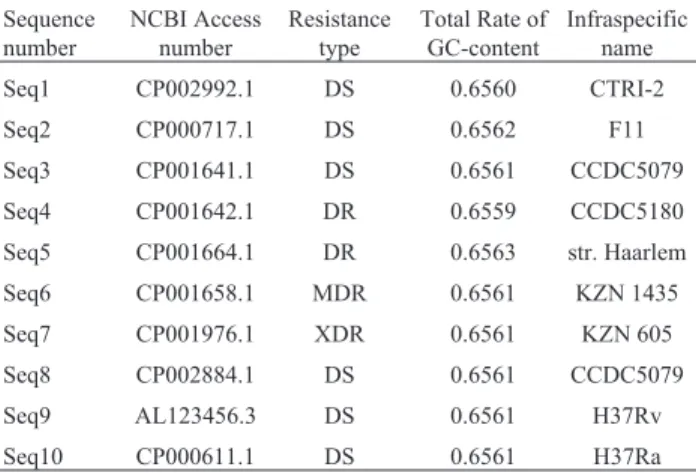
Table 2 contains the information for each sequence of strains of the MTB genome obtained from NCBI. Note that the GC-content total rate values are very close, indicating that there are no differences between the sequences.
Figure 2 shows the size and signal behavior visualiza-tion of each GC-content sequence. Note that the sequences show practically the same behavior. Thex-axis shows the amount of nucleotides of each sequence.
We applied the proposed methodology to the GC-content sequences. After comparing locality and smooth-ness of the decomposing wavelet, the Daubechies with 4 vanishing moments, db4, to the non-decimated wavelet de-composition was selected. The coefficients at each multi-resolution level are denoted by d1, d2, d3, d4, d5, and s5 with d1 being the level of the finest detail and s5 the smoothest level.
First, the elastic net was applied on the GC-content sequence and on the smooth level coefficients (s5, Figure 3), which revealed three groups (Figure 3a). The first group was composed of three members, the second of five, whe-reas the third one contained only Seq2_DS. Considering the
Figure 1- Geometry of the penalties. Source: Zou and Hastie (2005).
Table 2- Description of theMycobacterium tuberculosisgenome.
Sequence number NCBI Access number Resistance type
Total Rate of GC-content
Infraspecific name
Seq1 CP002992.1 DS 0.6560 CTRI-2
Seq2 CP000717.1 DS 0.6562 F11
Seq3 CP001641.1 DS 0.6561 CCDC5079
Seq4 CP001642.1 DR 0.6559 CCDC5180
Seq5 CP001664.1 DR 0.6563 str. Haarlem
Seq6 CP001658.1 MDR 0.6561 KZN 1435
Seq7 CP001976.1 XDR 0.6561 KZN 605
Seq8 CP002884.1 DS 0.6561 CCDC5079
Seq9 AL123456.3 DS 0.6561 H37Rv
Seq10 CP000611.1 DS 0.6561 H37Ra
smooth level coefficients, (Figure 3b) the first group is made up by the sequences Seq6_MDR and Seq7_XDR and the others are in the second group.
Comparing the formation of the groups without ND-WT with the groups formed with NDND-WT, referring to the smooth level of decomposition, we found that in the second group formed without NDWT the elastic net failed to dis-tinguish XDR and MDR strains from DS strains. This is a contradictory situation, since belong completely different strains. In the NDWT, referring to the smooth level of de-composition, this separation occurs very clearly, showing that the XDR and MDR strains are different in relation the other strains analyzed and between them are similar.
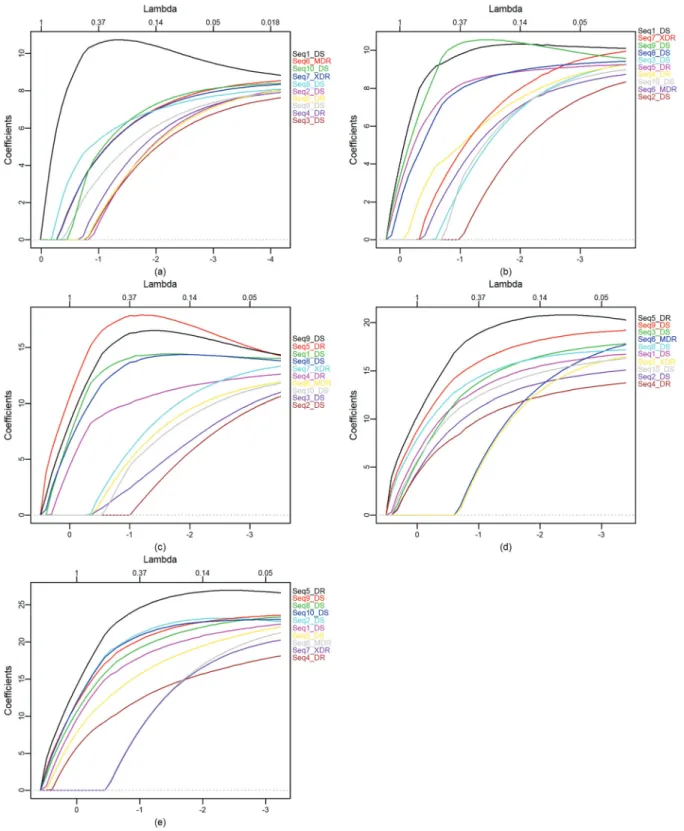
Considering each level of detail, the elastic net was applied to d1 to d5 coefficients. Figure 4 shows the elastic net plots on each level. We summarized the clustering ob-served in Table 3.
Table 3 shows that the 6-MDR and 7-XDR sequences were pooled at all levels of detail. These strains correspond to a single patient in KwaZulu-Natal, South Africa. At level
1, the highlight is for the 1-DS sequence that alone forms a group; this strain was isolated in Russia from the AI family (according to RFLP genotyping), and was sensitive to all common drugs used in the treatment of TB. For levels 2 and 3, the sequence 2-DS formed a group; this is a susceptible strain representing the largest portion of TB isolates from patients recovered during an epidemic in the Western Cape region of South Africa. Level 2 also highlights the 4-DR se-quence, which is a resistant strain isolated in 2004, refer-ring to a patient with secondary pulmonary TB, sequenced for comparative genomic studies.
The 5-DR sequence corresponds to a drug-resistant strain, with an accelerated rate of transmission between hu-mans under agglomeration conditions. The 8-DS sequence is a susceptible strain used for comparative genomic stud-ies. The 9-DS sequence is a susceptible strain derived from the original human lung H37, isolated in 1934. It has been widely used all over the world in biomedical research. Un-like some clinical isolates, it retains total virulence in ani-mals with TB and is susceptible to drugs and receptive to
genetic manipulation. These sequences appear grouped at all levels, except for the first detail level.
In addition, the DS (3 and 10) sequences appear grouped at all levels, except for the first level of detail. The sequence 3-DS is a susceptible strain belonging to a Beijing family, sequenced for comparative genomic studies, and the 10-DS sequence is an avirulent susceptible strain de-rived from its virulent parent strain H37 (isolated in 1905 from a 19-year-old male patient named Edward R. Baldwin who had chronic pulmonary TB). This strain was obtained in 1935 through an aging and dissociation process of anin vitroculture.
Concerning group formation, at levels 4 and 5 these groups were the same, forming two groups. At level 2, the largest number of groups were formed, totaling five. At this
level, a larger specification of the groups occurs, with two strains isolated.
Saini and Dewan (2016), based on the calculation of the energy of wavelet decomposition coefficients of com-plete genomic sequences, showed that the genomic se-quences of MTB could be grouped only into two groups. The first group with DS and DR sequences (lower energy) and the second group with MDR and XDR sequences (highest energy). Ferreira el al. (2017), considering the energy at each level of detail, were able to identify more than two groups, as particularities of 1 (DS), 3 (DS), and 4 (DR) sequences were detected with the proposed metho-dology.
Figure 3- Elastic net for: (a) signals of the GC-content sequences, (b) s5 coefficients.
Table 3- Formation of the groups at each level of decomposition.
Levels Groups
1 2 3 4 5
1 DS{1} DS{2, 3} DR{4, 5} DS{8, 9, 10}{6-MDR, 7-XDR}
2 DS{2} DS{3, 10} DR{4} {6-MDR, 7-XDR} DS{1, 8, 9} DR{5}
3 DS{2} DS{3, 10} {6-MDR, 7-XDR} DS{1, 8, 9} DR{4, 5}
4 {6-MDR, 7-XDR} DS{1, 2, 3, 8, 9, 10} DR{4, 5}
Conclusions
The combination of the NDWT and elastic net meth-odologies, applied in the analysis of clustering of the Myco-bacterium tuberculosisgenome strains, proved very effec-tive. Through this analysis, it was possible to see group formation at each level of decomposition.
Acknowledgments
The authors would like to thank CAPES (Coorde-nação de Aperfeiçoamento de Pessoal de Nível Superior) for the financial support.
References
Ayers KL and Cordell HJ (2010) SNP Selection in genome-wide and candidate gene studies via penalized logistic regression. Genet Epidemiol 34:879-891.
Bao JP and Yuan RY (2015) A wavelet-based feature vector model for DNA clustering. Genet Mol Res 14:19163-19172. Boehme CC, Nabeta P, Hillemann D, Nicol MP, Shenai S, Krapp F, Allen J, Tahirli R, Blakemore R, Rustomjee R et al. (2010) Rapid molecular detection of tuberculosis and ri-fampin resistance. N Engl J Med 363:1005-1015.
Buu TN, van Soolingen D, Huyen MNT, Lan NTN, Quy HT, Tiemersma EW, Kremer K, Borgdorff MW and Cobelens FGJ (2012) Increased transmission ofMycobacterium tuber-culosisBeijing genotype strains associated with resistance to streptomycin: a population-based study. PLoS One 7:e42323.
Chang GJ, Seyferty HM and Sen XZ (2015) Adaption of SYBR green-based reagent kit for real-time PCR quantitation of GC-rich DNA. Genet Mol Res 14:8509-8515.
Cheng JL, Qiu YM, Wei CL, Yang LQ and Fu JJ (2016) Develop-ment of novel SCAR markers for genetic characterization of
Lonicera japonica from high GC-RAMP-PCR and DNA
cloning. Genet Mol Res 15:gmr7737.
Cho S, Kim H, Oh S, Kim K and Park T (2009) Elastic-net regu-larization approaches for genome-wide association studies of rheumatoid arthritis.BMC Proc 3 Suppl 7:S25.
Daubechies I (1992) Ten Lectures onWavelets. Society for Indus-trial and Applied Mathematics, Philadelphia, 378 p. Dodin G, Vandergheynst P, Levoir P, Cordier C and Marcourt L
(2000) Fourier and wavelet transform analysis, a tool for vi-sualizing regular patterns in DNA sequences. J Theor Biol 206:323-326.
Ferreira LM, Sáfadi T and Lima RR (2017) Evaluation of genome similarities using the non-decimated wavelet transform. Ge-net Mol Res 16:gmr16039758.
Furqan MS and Siyal MY (2016) Elastic-net copula Granger cau-sality for inference of biological networks. PLoS One 11:e0165612.
Hernandez E and Weiss G (1996) A first course on wavelets. CRC Press, Boca Raton, 489 p.
Hildebrand F, Meyer A and Walker AE (2010) Evidence of selec-tion upon genomic GC-content in bacteria. PLoS Genetics 6:e1001107.
Hughey JJ and Butte AJ (2015) Robust meta-analysis of gene ex-pression using the elastic net. Nucleic Acids Research 43:1-11.
Iwamoto T, Grandjean L, Arikawa K, Nakanishi N, Caviedes L, Coronel J, Sheen P, Wada T, Taype CA, Shaw MAet al. (2012) Genetic diversity and transmission characteristics of Beijing family strains ofMycobacterium tuberculosisin Pe-ru. PLoS One 7:e49651.
Mann S and Chen YPP (2010) Bacterial genomic G+C composi-tion-eliciting environmental adaptation. Genomics 95:7-15. Mol C, Vito E and Rosasco L (2009) Elastic-net regularization in
learning theory. J Complex 25:201-230.
Morlet J, Arens G, Fourgeau E and Giard D (1982) Wave propa-gation and sampling theory- Part I: Complex signal and scat-tering in multilayered media. Geophysics 47:203-221. Müller B, Chihota VN, Pillay M, Klopper M, Streicher EM,
Coetzee G, Trollip A, Hayes C, Bosman ME, Pittius NCGv et al.(2013) Programmatically selected multidrug-resistant
strains drive the emergence of extensively drug-resistant tu-berculosis in South Africa. PLoS One 8:e70919.
Nason GP (2008) Wavelet methods in statistics with R. Springer, New York, 268 p.
Ning J, Moore CN and Nelson JC (2003) Preliminary wavelet analysis of genomic sequences. In: Proceedings of the IEEE computer society conference on bioinformatics. IEEE Com-puter Society, Stanford, pp 509-510.
Ogutu JO, Schulz-Streeck T and Piepho HP (2012) Genomic se-lection using regularized linear regression models: Ridge re-gression, lasso, elastic net and their extensions.BMC Proc 6 Suppl 2:S10.
Percival DB and Walden AT (2000) Wavelet methods for time se-ries analysis. Cambridge University Press, Cambridge, 611 p.
Perdigão J, Macedo R, Malaquias A, Ferreira A, Brum L and Por-tugal I (2010) Genetic analysis of extensively drug-resistant Mycobacterium tuberculosisstrains in Lisbon, Portugal. J Antimicrob Chemother 65:224-227.
Sáfadi T (2017) Wavelet-domain elastic net for clustering of volatilities. Int J Stat Econ 18:73-80.
Saini S and Dewan L (2016) Application of discrete wavelet trans-form for analysis of genomic sequences ofMycobacterium tuberculosis. SpringerPlus 5:64.
Sandegren L, Groenheit R, Koivula T, Ghebremichael S, Advani A, Castro E, Pennhag A, Hoffner S, Mazurek J, Pawlowski Aet al.(2011) Genomic stability over 9 years of an isoniazid resistant Mycobacterium tuberculosis outbreak strain in Sweden. PLoS One 6:e16647.
Smith KLJ, Saini D, Bardarov S, Larsen M, Frothingham R, Gan-dhi NR, Jacobs Jr WR, Sturm AW and Lee S (2014) Re-duced virulence of an extensively drug-resistant outbreak strain ofMycobacterium tuberculosis in a murine model. PLoS One 9:e94953.
Taylor GM, Stewart GR, Cooke M, Chaplin S, Ladva S, Kirkup J, Palmer S and Young DB (2003) Koch’s Bacillus – a look at the first isolate ofMycobacterium tuberculosisfrom a mod-ern perspective. Microbiology 149:3213–3220.
Treviño SF, Otero RM, Noriega ER, Díaz EG, Gómez HRP, García VB, Cabrera LV and González EG (2015) Genetic diversity ofMycobacterium tuberculosisfrom Guadalajara, Mexico and identification of a rare multidrug resistant Bei-jing Genotype. PLoS One 10:e0118095.
Vannucci M and Liò P (2001) Non-decimated wavelet analysis of biological sequences: Applications to protein structure and genomics. Sankhya: Indian J Stat 63:218-233.
Waldmann P, Mészáros G, Gredler B, Fuerst C and Sölkner J (2013) Evaluation of the lasso and the elastic net in ge-nome-wide association studies.Front Genet 4:270.
Wei CL, Cheng JL, Khan MA, Yang LQ, Imani S, Chen HC and Fu JJ (2016) An improved DNA marker technique for ge-netic characterization using RAMP-PCR with high-GC pri-mers. Genet Mol Res 15:gmr8721.
Wojtaszczyk P (1997) A Mathematical Introduction to Wavelets. Cambridge University Press, New York, 274 p.
Zou H and Hastie T (2005) Regularization and variable selection via the elastic net. J R Stat Soc Ser B 67:301-320.
Internet Resources
NCBI (2017) Mycobacterium tuberculosis. Genome,
https://www.ncbi.nlm.nih.gov/assem-bly/GCF_000224435.1/ (accessed 2 July 2017).
R Core Team (2017) R - a language and environment for statistical computing, https://www.R-project.org/ (accessed 10 June 2017).
WHO (2017) Global tuberculosis report 2017, http://www.who.int/tb/publications/global_report/en/ (ac-cessed 5 June 2017).
Associate Editor: Ana Tereza R. Vasconcelos