CUIDADO É FUNDAMENTAL
UNIVERSIDADE FEDERALDO ESTADODO RIODE JANEIRO. ESCOLADE ENFERMAGEM ALFREDO PINTO
R E V I S T A O N L I N E D E P E S Q U I S A RESEARCH
CUIDADO É FUNDAMENTAL
UNIVERSIDADE FEDERALDO ESTADODO RIODE JANEIRO. ESCOLADE ENFERMAGEM ALFREDO PINTO
DOI: 10.9789/2175-5361.2017.v9i1.193-199
DOI: 10.9789/2175-5361.2017.v9i1.193-199 | Santos DF; Castro DS; Lima EFA; et al. | The women’s perception on the...
Percepção de mulheres acerca da violência vivenciada
The women’s perception on the violence experienced
Percepción de mujeres acerca de la violencia vivida
Dherick Fraga Santos1; Denise Silveira de Castro2; Eliane de Fátima Almeida Lima3; Leônidas Albuquerque
Neto4; Maria Aparecida Vasconcelos Moura5; Franciéle Marabotti Costa Leite6 How to quote this article:
Santos DF; Castro DS; Lima EFA; et al.The women’s perception on the violence experienced. Rev Fund Care Online. 2017 jan/mar; 9(1):193-199. DOI: http://dx.doi.org/10.9789/2175-5361.2017.v9i1.193-199
ABSTRACT
Objective: To analyse the women’s perception on the violence experienced. Method: Qualitative study. Data was obtained through a semi-structured interview, and was analysed through the Content Analysis modality.
Results: Four thematic categories were identified from the analysis of the accounts of the 14 participating women: 34.8% of the accounts fit in the category Perception and Feelings about violence; 26.1% presented accounts on the category Perception of the Motives for the Experience of Violence; and also in the category Freedom Cessation; and 13.0% in the category Reflex of Violence on Health. Conclusion: There is a need for policies and actions that support and contribute to women’s freedom from violence, as well as the strengthening of intersectoral support networks, as violence poses a number of problems not only of socio-economic nature, but also damages the health of their victims.
Descriptors: Women’s health, Violence against women, Perception.
1 Nurse. Graduated from the Federal University of Espírito Santo. Vitória/ES, Brazil. E-mail: [email protected].
2 RN. PhD in Nursing. Professor at the Federal University of Espírito Santo. Vitória/ES, Brazil. E-mail: [email protected]. 3 RN. PhD in Nursing. Professor at the Federal University of Espírito Santo. Vitória/ES, Brazil. E-mail: [email protected]. 4 Master Nursing. Rio de Janeiro/RJ, Brazil. E-mail: [email protected].
5 RN. PhD in Nursing. Professor at the School of Nursing Anna Nery, Federal University of Rio de Janeiro. Rio de Janeiro/RJ, Brazil.
E-mail: [email protected].
RESUMO
Objetivo: Analisar a percepção de mulheres acerca da violência vivenciada.
Método: Estudo qualitativo. Os dados foram obtidos por meio de uma entrevista semiestruturada e analisados através da modalidade de Análise de Conteúdo. Resultado: A partir da análise dos relatos das 14 mulheres participantes do estudo foram identificadas 04 categorias temáticas. Sendo que 34,8% dos relatos se enquadram na categoria Percepção e sentimentos acerca da violência; 26,1% apresentaram relatos na categoria Percepção dos motivos da vivência da violência e na categoria Cessação da liberdade; e 13,0% na categoria Reflexo da violência sobre a saúde. Conclusão: Emerge a necessidade de políticas e ações que apoiem e contribuam para que as mulheres se desvencilhem da violência, bem como o fortalecimento das redes de apoio intersetoriais, já que a violência acarreta inúmeros problemas não apenas de caráter socioeconômico, mas também gera danos à saúde de suas vítimas.
Descritores: Saúde da mulher, Violência contra a mulher, Percepção. RESUMEN
Objetivo: Analizar la percepción de mujeres acerca de la violencia vivida.
Método: Estudio cualitativo. Los datos fueron obtenidos por medio de una entrevista cuasi-estructurada y analizados a través del Análisis del Contenido. Resultado: A partir del análisis y de relatos de las 14 mujeres participantes fueron identificadas 04 categorías temáticas. Siendo que 34,8% se encuadraran en la categoría Percepción y sentimientos sobre la violencia; 26,1% estaban en la categoría Percepción de los motivos de la vivencia de la violencia y en la categoría Cesación de la libertad; 13,0% en
la categoría Reflejo de la violencia sobre la salud. Conclusión:Surge la
necesidad de políticas que apoyen y que contribuyan para que las mujeres se libren de la violencia, así como el fortalecimiento de redes de apoyo intersectoriales, ya que la violencia acarrea inúmeros problemas, no apenas de carácter socio-económico, sino que también genera daños a la salud de las víctimas.
Descriptores: Salud de la mujer, Violencia contra la mujer, Percepción.
INTRODUCTION
Violence against women can be characterized as any action or omission based on gender that causes death, injury, physical, sexual or psychological and moral suffering or material damage to the woman, and can be practiced by people with or without family ties, which are or consider themselves related, joined by natural ties, by affinity or by express will, including aggregate sporadically.1
The phenomenon of violence against women is also characterized by gender oppression. This can be defined as a set of social, cultural, political, psychological, legal and economic characteristics attributed to people differently according to sex. As a result, the violence is considered often a normal or natural act, remaining invisible and unquestioned, converging to the undervaluing of the phenomenon and its effects.2
We realize that violence against women is a serious social and public health problem in Brazil. In recent decades, violence has earned a prominent place among the everyday concerns, generating government policies in several countries. Violence thus acquired an endemic character and has become a public health problem due to the number
of victims and the magnitude of organic and emotional consequences that produces.3
As for the evidence of the problem of violence against women, nationally and internationally, data have showed that one in five women experience some form of violence during her lifetime, and may suffer serious aggression and even death.4 (WHO, 2005). In Latin America, data5 indicate that violence against women by an intimate partner focuses on 25% to 50% of Brazil’s total female population and every 4 (four) minutes a woman is attacked in her own home by a person with whom they have affection relations.
It is worth noting that women who are abused physically and/or morally by their partners, or former partners, are in a situation in which find themselves deprived of rights and guarantees. There is a strongly plausible dimension in the complaint of discrimination, humiliation and injustice. This is not to believe that there are, for women, the expected gestures and aggressive demonstrations by men, but it is necessary to point out how the resignation to a victimized condition strengthens a position which women seek to get out: they are treated as object.6
Faced with the complex phenomenon of violence, it is also necessary that health professionals are aware and able to meet these characters in situations of violence, as the spaces for women care are also spaces for attracting violence that comes implied between demands that they bring, as care and gender violence are constructs loaded and experienced historically more by women.7
In this context we established the importance of the study of this issue to the practice of health professionals, aiming to deepen the knowledge of the experiences of women in situations of violence, and thus to make possible the expansion of the effective action of social support, either through professional intervention, subsidizing the implementation of public policies related to health, safety and psychosocial aspects of women. This study aimed to analyze the perception of women about the violence experienced.
METHOD
It is a descriptive research with a qualitative approach. The qualitative research captures the complexity of the phenomenon, to analyze the subjective and the objective of social subjects, according to their views of world.8 The study setting was the Multidisciplinary Support Center of Serra, located in Forum Dr. João Manuel Carvalho, in the city of Serra, Espírito Santo, which currently is intended to meet the sticks on Family and Domestic and Family Violence against Women. It noted that the staff of Multidisciplinary Support Center consists of five professionals, four social workers and a psychologist.
As subjects in this study there are women in situations of violence committed by an intimate partner and who were seen in the Support Multidisciplinary Center of Serra. These women were referred to this Center since filed a police report
at the Police Station for Woman Assistance in Serra. Therefore, the choice of this institution as the data collection point is justified because it is an environment in which they are women with proactive profile, which can demonstrate attitude to the problem and also previous movements of passivity.
The study sample was based on the data saturation criterion, i.e. the recurrence of information.9 Sampling saturation is a conceptual tool commonly used in qualitative research in different areas in the health field, among others. It is used to set the final size of the study sample, ceasing the capture of new components.10
Data collection was done at Support Multidisciplinary Center of Serra. Study participants were women who are over 18 years-old, who suffered some kind of violence and were treated at the institution. The women were asked, in the waiting room and in order of arrival at the service, to participate in the study. The gathering took place in a private room, only after it is answered by the multidisciplinary team in order not to disrupt the service flow.
Women were informed about the study objectives by reading the Clarified Consent Form. In view of the acceptance, it was requested to sign this document and then started the interview. It was guaranteed to the participants a copy of this consent form, signed by the researcher and by the interviewer. To ensure the confidentiality of information and the anonymity of the respondents, presentation of the results, the statements were coded by means of flower names.
The survey data were collected through semi-structured individual interviews, from a script with open questions, which included basic information such as: identification of participants (age, education, race/color, type of violence experienced, place of occurrence of violence and bond with the abuser) and open question about the perception of violence experienced, given the guiding question of the study, that is, “How do you perceive the situation of violence experienced?”.
The statements were recorded in electronic material and, after each interview, transcribed in full. Data were analyzed using content analysis method. This is constituted by a set of methodological tools increasingly subtle and constantly improving, which apply the “speeches” extremely diverse. The common factor of these multiple and multiplied techniques ranging from the frequency calculation to the extraction of translatable structures models. It is a controlled hermeneutics, based on deduction: the inference. While efforts to interpretation, content analysis oscillates between two poles of the rigor of objectivity and fruitfulness of subjectivity.11
Content analysis has three chronological poles that are pre-analysis, material exploration and treatment of material.11 The first stage is the stage of organization, where the initial reading and the development of indicators for the interpretation was used. In the second stage the data was encoded from the registration units. The last step was made categorization consisting of the classification of elements according to their similarities and differentiation, and then reassembly, due to common characteristics.12
By involving human beings in order to meet the proposed requirements established by Resolution 196/96 of the National Health Council, this study was submitted to the Ethics Committee of the Federal University of Espírito Santo (UFES) and was approved by the Opinion nº 195,469.
RESULTS AND DISCUSSION
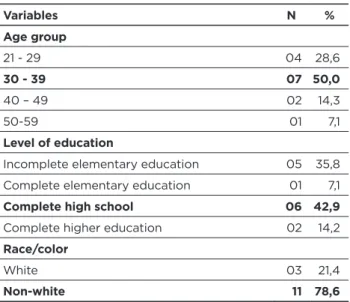
The group consisted of 14 women. The analysis of the socioeconomic characteristics of the participants showed that 50.0% of them were in the age group of 30 to 39 years-old, the average age being 34 years-years-old, with a minimum age of 21 years-old and maximum of 53 years-old. Regarding education, the majority of women (42.9%) had completed high school. These findings go against the study in a police station for Assistance to Women in Sobral, Ceará, who found a higher prevalence of women victims of violence in the age group 23-32 years-old and complete elementary school.13
Regarding race/color 78.6% refer themselves as non-white, similar to data shown by study of information from records of attendance of a specialized center of caring for women victims of violence, in the city of Rio de Janeiro. 14
When asked about the type of violence experienced, it is evident that 35.7% suffered psychological/moral and physical violence, a percentage similar to that of women victims of psychological/moral. It is noteworthy that 50.0% of assaults occurred at home; in 64.3% of cases, the assaulter was her ex-husband. This pattern corroborates data from IT department of public health system (2011),5 where statistics and records in the Police of Crimes against Women shows that 70% of the incidents occur at home and that the assaulter is the husband or intimate partner; and over 40% of violence resulting in serious bodily injury from punches, slaps, kicks, tying up, burns, beatings and bottlenecks.
Table 1 – Summary of characteristics of study participants.
Serra, Espírito Santo, 2013
Variables N % Age group 21 - 29 04 28,6 30 - 39 07 50,0 40 – 49 02 14,3 50-59 01 7,1 Level of education
Incomplete elementary education 05 35,8 Complete elementary education 01 7,1
Complete high school 06 42,9
Complete higher education 02 14,2
Race/color
White 03 21,4
Non-white 11 78,6
Variables N % Type of violence experienced
Psychological/moral 05 35,7 Psychological/moral and physical 05 35,7
Psychological/moral, physical and patrimonial 03 21,5 Psychological/moral, physical, patrimonial
and sexual 01 7,1
Location of occurrence
Domestic 07 50,0
Public way 03 21,4
Domestic and public way 03 21,4
Others 01 7,1 Aggressor Ex-husband 09 64,3 Ex-boyfriend 05 35,7 N – Absolute frequency % – Relative frequency
As for the themes that were discussed from the content analysis of the stories of 14 women in the study, it notes that 34.8% fall into the category Perception and feelings about violence; 26.1% were reported in the category Perception of reasons for the experience of violence and category Cessation of freedom; and 13.0% in the category Reflection of violence on health.
Perceptions and feelings about violence
Domestic violence in Brazil has affected many women, being a serious problem.15 The assaulters are usually predominantly male in violent marital relationships, and the main victims are women, thus, domestic violence is also a form of violence of gender.16
According to power relations, gender constitutes a category of analysis that explains the biological and social differences between men and women. The study of these relationships shows that the power is given unequally between the sexes, with women occupying subaltern positions.17 Therefore, gender violence, present in many intimate relations between men and women, destabilizes the balance of the relationship, which results in a positioning of women as object for the intimate partner.
In this context, women victims of violence experience different feelings such as surprise and hope for change in relation to the partner’s attitudes18, these are revealed in the “Perception and feelings about the violence,” according to the following statement:
“We can live together 10 or 20 years with the person and you will not know who he really is inside.” (Iris)
“We are wrong when we think we know the person, you never fully know the person. We know well when we live with him.” (Lily)
“I never thought, I never thought this would happen with me.” (Fuchsia)
“It is very difficult, because when we were both together he did not seem to be this person.” (Orchid)
“We always think that the person will change, and I was wrong, very wrong, and I realized this too late. And I think it was a great bullshit having this person in my life.” (Bonina)
The women who participated in this study expressed great disappointment with the intimate partner. The experience of a violent relationship takes most women to have a negative view about the relationship with the partner, defining it as bad and confrontational. The partner is described negatively, and assigned the violent, ignorant and aggressive characteristics, since often in moments of fights and assaults women talked about feelings of depreciation.19 This relationship can be best illustrated in the following lines:
“It was pretty bad; no woman imagines that she will suffer this type of aggression.” (Camellia)
“It was a very bad phase. It was a waste of time.” (Rosemary)
“It’s hard to be assaulted by a person you live with, the person talks about love. There’s no way to understand.” (Daisy) “A very bad thing, the aggression, the shame on the street, with friends.” (Orchid)
“He hurt me, had no pity. He said he liked me, I think that when someone likes a person he doesn’t do that sort of thing.” (Iris)
Perception of the reasons of violence
experience
In addition to the sexism being attributed to violence against women, other factors are mentioned to explain the aggressive attitude of man. These include alcohol, culture, changes in the partner’s behavior, sex, low education, the physical violence between the parents of women and sexual abuse in childhood.20 Another relevant fact is the higher incidence of domestic violence by users of psychoactive substances.21
It is found that some women tend to allocate and justify the partner’s violent behavior by external factors, thus,disregarding it for the violence experienced, for example, the family culture, alcohol use, drug use, financial difficulties, among others18. In the category “Perception of the reasons the violence experience” is noted in the reports of some women that part of the aggression only happens when their partners are drunk or on drugs:
“He started using drugs, and so began to be violent and while he was not in the use of the drug, I had no problem.” (Fuchsia)
“Since when he arrived drunk at home, he hit me, he did not let me sleep at home, so I had to go to my mother’s, because otherwise he would kill me.” (Iris)
It notes that the reasons for the aggression that lead to sexism, when it is a feeling and a man’s possession of practice on women, is marked by the desire to keep women in submission and tutored as exclusive property. The control of women and the rivalry between the men who compete are present in cases of exacerbation of the feelings of possession of moralism and the jealousy of aggression, whose peak triggers in serious injuries.22
The reports presented show continuity in the recurrence of attacks by ex-partners and ex-husbands. This suggests that male domination continues in such a way and entrenched that even separated, they feel masters of the fate of their ex-wife.22 In this regard, it is noted as one of the reasons for the perceived experience of violence the sense of ownership by the offender in relation to assailed:
“I understand it is totally unnecessary; I had no reason for this. Just by ending the relationship and he not accepting, he thinks I’m his property.” (Camellia)
“I see as a way of wanting to fight back what I did against him. I broke off a relationship in which he had many advantages, particularly financially. He wants anyway to harm me for something. Be chasing me, damaging me, surrounding me because of this disruption.” (Hydrangea) “After we parted he has totally changed. It was a lot difficult; I was not used to seeing that person in that way, and suddenly I faced the person fully aggressive on the street.” (Orchid)
“He did not accept the end; if I broke up I could not be with nobody else.” (Rose)
Cessation of freedom
This category highlights the role of violence in the cessation of freedom of women. Research about the reflection on domestic violence, with a focus on psychological violence,23 reveals that violence starts slow and silently, and progresses in intensity and consequences. The aggressor in first manifestations does not resort to physical attacks, but part to the restriction of individual freedom of the victim, advancing to the embarrassment and humiliation. Reports are highlighted, which show the loss of feel free to come and go:
“I tried to avoid leaving home. I always called a friend or someone to watch over, I avoided meeting him. If you watch a lot, you’re not only watching, because when you are not expecting, the person appears in some place.” (Orchid) “He took me the right to come and go. In a way I had to live only for him.” (Rosemary)
“Even now, during this time, I do not walk alone. I always have to be accompanied by someone. I do not have freedom to do what I want, have to limit sometimes. I want to go to a place and I cannot go because he may be there, or he may appear there.” (Camellia)
“I even stopped going out, you know, this messed with my psychological. When I see him, I get scared, I cannot sleep.” (Impatiens)
Among the many forms of domestic violence, there are the verbal assaults such as threats.24 When someone threatens, the attackers make women feel afraid to make some decisions, and cause fear and insecurity.25
Fear is a feeling present in the relationship of these women with their abusers companions. For the majority, fear is a feeling that paralyzes their habitual actions and destroys their perceptions in relation to the world. Therefore, the woman is isolated within herself, which increases the risk of developing a depression or exacerbated anxiety:
“There were threats, there was an embarrassment, and there was a violation of my physical. He told me that if I did not belong to him, I would not belong to anyone else. He said I could call the police, but one day he would found me.” (Fuchsia)
“You’re always worried that this person will be in the place you are, in family home, in the church, and what kind of scandal he can cause exposing you, to expose you in front of people.” (Hydrangea)
According to Maria da Penha Law (Law 11.340/2006),1 which creates mechanisms to restrain and prevent domestic and family violence, coercion of freedom is recognized as a form of psychological violence, and it is very harmful to the living of women in society, as it works almost like a private prison.
Exacerbated jealousy relates to other forms of psychological interpersonal violence that are the behaviors of controller character perpetrated by the partner against women, depriving them of their freedom of movement, including the prohibition to meet other people in their social environment or even family. This form of coercion and violence was also present in the discourse of some women interviewed in this study.
Reflection of violence on health
Violence against women has serious consequences to the victim, both in the physical, mental, reproductive and sexual level, which makes women more vulnerable to the need to treat their health.26 Women usually experience many forms of suffering in the midst of a silent and continuous process. Living with the aggressor causes tension and stress which potentially generate harmful effects on mental and physical health, with a real chance of becoming mentally ill.27
The literature points out that the victim-offender relationship is interpreted as unhealthy and harmful.27 It is noteworthy that often psychological damages of abuse are more serious than its physical effects. The experience of abuse devastates the women’s self-esteem, exposing her to a higher risk of suffering from mental problems such as depression, phobia, post-traumatic stress, and tendency to suicide, alcohol and drugs.21
The victim experiences a very strong sense of reliving the traumatic event, takes avoidant behavior, lives emotional apathy, have difficulty in sleeping, concentrating and scares easily.21
As pointed out by the women in this study, their daily life is nourished by suffering, injury, marks, fear, disease, pain, physical and psychological damage:
“I’m traumatizes; I have to take tranquilizer. From that moment I’m living by the power of tranquilizer. I went to the doctor, psychologist, to take medicine, because I can’t sleep at night.” (Jasmine)
“Because of this (violence) I had labyrinthitis problem. I even went to the hospital, I had to survive.” (Anise) “I was very beaten. I even broke my foot when I was running from him, afraid of him.” (Thistle)
Episodes of aggression committed against the women are very detrimental to their health, not by the weakness
of the female condition, but because often the aggressor is her intimate partner. What happens then is an inequality of forces, cowardly, where the woman could hardly defend herself against aggression. It is important to make clear that psychological violence through insults, name calling and abuse also contributes to the woman feeling emotionally and psychologically shaken; obviously this was not the attitude they expect from their partner. Thus, violence significantly affects the biopsychosocial integrity of women, generating a series of symptomatology and disorders of physical and psychological development.
An important step in combating this form of violence is the recognition, by the woman, of the severity of the acts and assaults committed against her, so they can seek for expert support. Many women only report the aggressor after years of ill-treatment when they come to a limit where they cannot stand. At this point, in most cases, the physical marks of interpersonal violence can still be cured by health promotion activities. The psychological damage is often more serious and also require expert attention so that we can promote at least the preservation of the mental faculties of the woman.
CONCLUSIONS
This study allows analyzing the perception of 14 women about the violence experienced. Data analyses were obtained in 4 categories: Perception and feelings about violence; Perception of the reasons of violence experience; Cessation of freedom, and Reflection of violence on health. All women perceive violence as something negative; however, so some tend to justify the partner’s violent behavior by external factors, thus taking his responsibility away. Amid the reports, we highlight the speeches that show that the relationship victim-offender generates consequences in the victims’ lives, reflecting negatively on their health, in their social and personal context, limiting their right to feel free.
It is worth noting that the study group was women who denounced the violence experienced, and even then, the results reveal, after the complaint, a fragility of the victim in relation to the aggressor. This finding highlights the need for policies and actions to support and help women to disentangle this phenomenon as well as the strengthening of inter-sectoral support networks, as violence leads to numerous problems not only of socio-economic character, but also generates damage health of victims.
This study also shows the need for better understanding of the perception of women about the violence experienced on the part of health professionals, especially nurses, which has care as their object of study, since this knowledge will allow the construction of strategies that enable the identification and disruption of this cycle of violence, contributing to the improvement of care for women.
It is worth highlighting the shortage of articles that discuss the perception of women as violence. Therefore, it is
essential to carry out more research to address this issue as well as possible ways to deal with this phenomenon.
REFERENCES
1. Brasil. Diário Oficial da União. Lei n. 11.340, de 7 de agosto de 2006. Dispõe sobre a violência doméstica contra a mulher. Brasília(DF);2006 .[cited 2011 Nov 20]. Available from: http://www. planalto.gov.br/ccivil_03/_ato2004-2006/2006/lei/l11340.html. 2. Souto CMRM, Braga VAB. Vivências da vida conjugal:
posicionamento das mulheres. Rev Bras Enferm. 2009; 62(5): 670-74. 3. Santi LN, Nakano MAS, Lettiere A. Percepção de mulheres em
situação de violência sobre o suporte e apoio recebido em seu contexto social. Texto Contexto Enferm. 2010 Jul-Set; 19(3):417-24. 4. World Health Organization (WHO). Addressing violence against
women and achieving the Millennium Development Goals. WHO [texto Internet]. 2005. [acesso em 2013 Ago 20]. Disponível em: www. who.int/gender/docu ments/MDGs&VAWSept05.pdf.
5. Brasil. Departamento de Informática do Sistema Único de Saúde. Dados sobre Violência contra a mulher. [online]. 2011. [acesso em 2012 Jul 19]. Disponível em: http://www.datasus.gov.br/cns/temas/ tribuna/violencia_contra_mulher.htm.
6. Cerruti MQ, Rosa MD. Em busca de novas abordagens para a violência de gênero: a desconstrução da vítima. Rev. Mal-Estar Subj.2008; 8 (4): 1047-76.
7. Guedes RN, Fonseca RMGS, Egry EY. Limites e possibilidades avaliativas da Estratégia Saúde da Família para a violência de gênero. Rev. Esc. Enferm. USP.2013; 47( 2): 304-11.
8. Nakano AMS. As vivências da amamentação para um grupo de mulheres: nos limites de ser “o corpo para o filho” e de ser “o corpo para si”. Cad. Saúde Pública. 2003;19(2): 355-63.
9. Lettiere A, Nakano AMS. Violência doméstica: as
possibilidades e os limites de enfrentamento. Rev. Latino-Am. Enfermagem.2011;19(6):1-8.
10. Fontanella BJB, Ricas J, Turato ER. Amostragem por saturação em pesquisas qualitativas em saúde: contribuições teóricas. Cad. Saúde Pública. 2008; 24(1): 17-27.
11. Bardin L. Análise de Conteúdo.70º ed. Lisboa, Portugal: LDA, 2009. 12. Caregnato RCA, Mutti R. Pesquisa qualitativa: análise de discurso versus
análise de conteúdo. Texto Contexto Enferm. 2006; 15(4): 679-684. 13. Oliveira EN, Freire MA, Jorge MSB, Barros HM. Perfil e sofrimento
de mulheres vítimas de violência atendidas em uma delegacia especializada. Rev. Rene. 2003; 4(2): 30-7.
14. Mota JC, Vasconcelos AG.G., Assis SG. Análise de correspondência como estratégia para descrição do perfil da mulher vítima do parceiro atendida em serviço especializado. Ciência & Saúde Coletiva. 2007; 12(3): 799-809.
15. Bruschi A, Paula CS, Bordin IAS. Prevalência e procura de ajuda na violência conjugal física ao longo da vida. Rev Saúde Pública. 2006;40(2): 256-64.
16. Narvaz M. Abusos sexuais e violências de gênero. In M. R. Nunes (Org.). Os direitos humanos das meninas e das mulheres: Enfoques feministas (pp. 29-33). Porto Alegre: Assembléia Legislativa do Rio Grande do Sul. 2002.
17. Fonseca RMGS. Equidade de gênero e saúde das mulheres. Rev Esc Enferm USP. 2005; 39(2): 450-59.
18. Ministério da saúde (BR). Secretaria de Políticas de Saúde. Violência intrafamiliar: Orientações para prática em serviço. Brasília (DF): MS; 2001.
19. Sagim MB, Alves ZMB, Delfino V, Vanturini FP. Violência doméstica: a percepção que as vítimas têm de seu parceiro, do relacionamento mantido e das causas da violência. Cogitare Enferm.2007;12(1):30-36. 20. D’oliveira AFPL, Schraiber LB, Junior IF, Ludermir AB, Portella AP,
Diniz CS, et al. Fatores associados à violência por parceiro íntimo em mulheres brasileiras. Rev Saúde Pública.2009;39(2): 299-310. 21. Day VP, Telles LEB, Zoratto PH, Azambuja MRF, Machado
DA, Silveira MB, et al. Violência doméstica e suas diferentes manifestações. R. Psiquiatr. 2003;25(sup.1):9-21.
22. Lamoglia CVA, Minayo MCS. Violência conjugal, um problema social e de saúde pública: estudo em uma delegacia do interior do Estado do Rio de Janeiro. Ciência & Saúde Coletiva. 2009; 14(2):595-604.
23. Silva LL, Coelho EBS, Caponi SNC. Violência silenciosa: violência psicológica como condição da violência física doméstica. Interface Comunic, Saúde, Educ.2007;11(21):93-103.
24. Moreira PCC. A necessidade de um tratamento diferenciado a violência doméstica. 2003. Monografia de Conclusão de Curso de Direito, Universidade Católica de Pelotas, Pelotas, 2003. 25. Wilhelm FA, Tonet J. Percepção sobre a violência doméstica na
perspectiva de mulheres vitimadas. Psicol. Argum. 2007;25(51): 401-12. 26. Nunes GF. O impacto da violência na saúde da mulher vitimizada:
uma revisão integrativa. [Monografia] Vitória (ES): Universidade Federal do Espírito Santo. Graduação em Enfermagem; 2012. 27. Oliveira EN, Jorge MSB. Pancada de amor dói e provoca
adoecimento: o experenciar da violência física em mulheres. Rev enferm UFPE [on line].2007 [acesso em 2012 Ago 22]; 1(1). Disponível em: www.revista.ufpe.br/revistaenfermagem/index.php/ revista/article/.../1264. Received on: 23/12/2015 Reviews required: No Approved on: 25/02/2016 Published on: 08/01/2017 _________
Author responsible for correspondence:
Franciéle Marabotti Costa Leite Universidade Federal do Espírito Santo Departamento de Enfermagem
Rua Marechal Campos, 1468 Maruípe, Vitória/ES, Brazil ZIP-code: 29040-090