ABSTRACT
abutments
Marcos Daniel Septímio LANZA1, Paulo Isaías SERAIDARIAN2, Wellington Correa JANSEN2, Marcos Dias
LANZA3
1- DDS, MSc, Graduate student (PhD), Department of Oral Rehabilitation, Bauru School of Dentistry, University of São Paulo, Bauru, SP, Brazil. 2- PhD in Restorative Dentistry, Professor, Graduation Program, Catholic University of Minais Gerais, Belo Horizonte, MG, Brazil.
3- PhD in Oral Rehabilitation, Professor, Graduation Program, Catholic University of Minais Gerais, Belo Horizonte, MG, Brazil.
Corresponding address: Marcos Daniel Septímio Lanza - Rua Neder Issa, 3-13 - Jardim Dona Sarah - 17 012-370 - Bauru - SP - Brasil - Phone: (14) 3208 0443 - (14) 8116 4242 - e-mail: [email protected]
O
bjectives: In some clinical situations, dentists come across partially edentulous patients, !! ! "# !!$ % ! % " &' ! (% ! ) " ' (** + % on the entire set, simulating functional mastication, for further analysis of the SEQV - !%!!." /&0 1 % % 2-34"536% 2-78"5)6%! ! " 9 ! & ; "< .%! functional mastication.Key words: Biomechanics. Dental implants. Partial denture. Dental mobility.
INTRODUCTION
The advent of titanium implants resulted in a ! in several clinical situations10. Although the original
! of completely edentulous patients, the need osseointegrated implants to partially dentate "0 in Oral Rehabilitation, but at no time, have osseointegrated implants been capable of resembling !!!"
The combined use of implants and teeth appeared in the mid 1980s23"#!
to partially edentulous patients, contradicting < HJ !% ! "K% distribution of the teeth in the arch may induce the adoption of combined prostheses13,14.
For decades, tooth-implant-supported dentures have been questioned because of the differences % H % atrophy of the periodontal ligament8,12, and the
high general risk of technical complications11,24,29.
!% ! H biomechanical dilemma3,19.
The possibility of connecting implants to teeth in % studied by several authors3,9,24! !
the tooth-implant bond does not have a negative . ! " #% H! ! #0U ! % ! !!% ! ! % number of implants placed.
Nevertheless, the connection of natural teeth and osseointegrated implants in a rigid denture !! ! ! % "# ! difference in the absorption and distribution of force " # !! because in tooth-supported dentures there is a system of cushioning causing a micro-movement of 100 to 300 μm due to the presence of the % ! the stresses of pressure into uniform traction on the alveolar cortical. In implants, the resultant stress is concentrated on the bone crest, and this different !!%! depends on the length of the pontic producing torque on the implant, causing loosening or fracture
!30.
0 ! % connections has been recommended, taking into consideration that this type of connection could ! !
! 14,16.
Nevertheless, other authors have reported that the semi-rigid connections are rarely indicated
12-13,16,18,22. This type of
connection does not improve the stress distribution % ! migration of the natural teeth6,12,16,21.
0 #0U ! ! %
!
!26.
Nevertheless, other authors have reported that #0U natural abutments to promote greater rigidity of this denture5,9,12.
# method (FEM) to evaluate the generation of stresses ! ! % used as abutments.
MATERIAL AND METHODS
] % Biomechanics has become an extremely useful tool for numerically assessing stresses and ! ! ! behavior of biomaterials and human tissues28.
In this study, the 3-D model of the FEM is an approximate representation of an in vivo geometry, ! !!! " 0 %' / 8"4 used to develop a model of a partially edentulous maxilla, conceived by means of 3-D FEM, in ! ! !" / % %!! !! !" 9 ! surface of a non-noble NiCr alloy, varying the number of teeth connected to an osseointegrated ITI Strauman® implant, 10.00 mm long, 4.1 mm in
%3"5"#! % !! ! ! ! %!! ! by means of a pontic, using rigid connection, in _ ! & ! ! (% ! ! ! )"
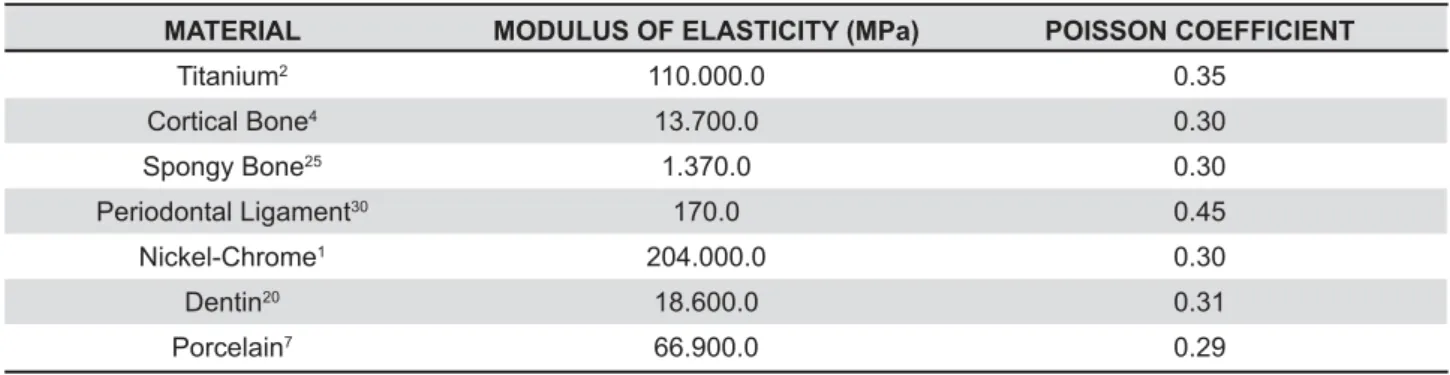
From the basic geometry created, the elastic % using approximate values found in the literature (Table 1). The elastic properties of the materials %
MATERIAL MODULUS OF ELASTICITY (MPa) POISSON COEFFICIENT
Titanium2 110.000.0 0.35
Cortical Bone4 13.700.0 0.30
Spongy Bone25 1.370.0 0.30
Periodontal Ligament30 170.0 0.45
Nickel-Chrome1 204.000.0 0.30
Dentin20 18.600.0 0.31
Porcelain7 66.900.0 0.29
is that the deformation of elastic bodies is proportional to the force applied. Furthermore, ! ! isotropic (equal in all directions).
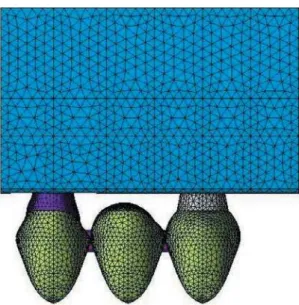
From the creation of the basic geometry, the ! )`4"*`w H )(7"()` and one implant (Model 1) and 529.930 knots and 757"w4* ) %!! to Figures 1 and 2.
# ! ! % % analysis of the distribution of forces to the bone !! "0 tests that the intensity of the bilateral and unilateral physiological force is 569 N and 430 N respectively27
! ! !
!% !! !29. In this
%!(**+ occlusal face of the entire prosthetic set, distributed uniformly according to the number of elements of the respective surfaces (Figures 3 and 4).
RESULTS
# ! % ! ! quantitatively in N/mm2 (MPa) and qualitatively.
The images generated by the program used in the present study made it possible to gain a broad ! % prosthetic components and associated structures.
The quantitative results are summarized in Table ) - "# maximum displacement (DMX) of the set.
In a qualitative analysis, it may be observed that the vertical displacement of % ! ! 8" K% added in the mesial region of this denture, a ! ! (Figure 6).
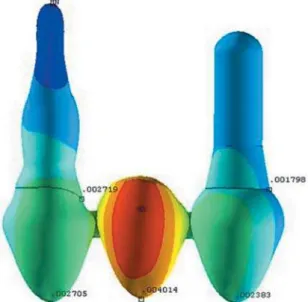
0 2- % observed that the maximum stress in the TISFDs ! ( 34"53 6% ! ) 78"5) 6% ! !% 4 5"0 ! % !! !! %! the maximum SEQV stress occurred on the mesial !H %~ ! !! % ()"(8 5"58
Figure 1- Finite element mesh Model 1
Figure 2- Finite element mesh Model 2
Figure 3- Nodal load of 100 N on the denture containing 3 elements
MPa for Models 1 and 2 respectively, as illustrated ` (*"0! ! %!! ! ! !%% ! ! ! "
In the analysis of equivalent stresses of Von
2- % the maximum stress is found in the same region ! %8*"*6( 34.14 MPa for Model 2 (Figures 11 and 12). This location of the maximum value in metal indicates . !"
In the electromyography study to assess the intensity of the bilateral and unilateral physiological !% !8w`
+ 37*+ 43. Thus,
according to Table 3, one may make a comparison ! .
Figure 5- Movement of the set in the occlusal-gingival direction (Model 1)
Figure 6- Movement of the set in the occlusal-gingival direction (Model 2)
Figure 7- Von Mises stress (SEQV) in Model 1
Figure 8- Von Mises stress (SEQV) in Model 2
LOCATION <=' ><<>? >@< >''>?
DMX (μm) SEQV (MPa) DMX (μm) SEQV (MPa)
TISFD 5.0 47.84 3.7 35.82
TOOTH 2.7 - 1.9
-IMPLANT 2.3 12.15 1.8 8.85
METAL 4.7 50.0 3.5 37.14
Table 2- Quantitative analysis
" # ! !! % (% !!(**+ than the one found for maximum physiological load.
DISCUSSION
Starting from a real principle proposed in the % ! ! implants must not be considered as the first alternative for rehabilitation and it is preferable to adopt planning of isolated implant-supported dentures14,23-24. Nevertheless, in case of anatomic
limitations that may require advanced surgical techniques at high costs or if teeth already require restorative interventions and are favorably !% ! !! dentures11,13-14,24,26.
# regard to the biomechanical challenge of the ! ! " ' have reported that this complication is due to the ! % mechanisms of absorption and dissipation of forces ! !! " K% biomechanical responses in the face of a force are completely different, and in tooth-implant-supported dentures, special care must be taken in planning to compensate this difference30. Therefore, some
authors have suggested semi-rigid connections21.
Nevertheless, according to the literature it is ! ! dentures, connections of the semi-rigid type generate more stress in the denture components15,16
so that the rigid connection has been preferred
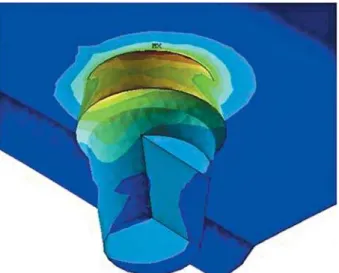
Figure 9- Von Mises stress (SEQV) in the implant region in Model 1
Figure 10- Von Mises stress (SEQV) in the implant and teeth in Model 2
Figure 11- Von Mises stress (SEQV) in the metallic infrastructure (Model 1)
Figure 12- Von Mises stress (SEQV) in the metallic infrastructure (Model 1)
MATERIALS 'BG %"!""* MPa
FLOW STRESS (SE) Mpa
SE / SEQV=K [! =
MODEL 1 MODEL 2 MODEL 1 MODEL 2 MODEL 1 MODEL 2
PORCELAIN 36.82 27.78 140 3.8 5.0 380 500
METAL 50.0 37.14 427 8.5 11.5 850 1150
IMPLANT 12.15 8.85 275 22.6 31.0 2260 3100
instead of the semi-rigid type6,18,21,22,24.
From analysis of the results, the present study ! ! !% % % ! ! % abutments must be used as retainers to support a pontic5,9 thereby improving the rigidity of the set.
This difference in stresses can also be explained by the fact that although the loading value had been 1% )"
According to the literature, the resulting stress in implants is concentrated on the bone crest29,
! % !2-occurred on the mesial side in the neck region of
%15,19.
It has been stated that the ideal !! % ! %
!26. This
! ! ! . the bar is proportional to the cube of the length !% % ! a greater displacement in the pontic region, and ! ! abutments.
CONCLUSIONS
According to the quantitative and qualitative analysis of the present study, it may be concluded that:
1. Tooth-implant-supported prostheses must ! and it is a feasible and biomechanically predictable treatment option;
2. The placement of additional teeth decrease the resultant stress values;
3. The type of alloy used in the metallic infrastructure plays a key role in denture displacement, and preference should be given to !"
4. The internal connection type of implant provides greater rigidity to the set (abutment/ ! ! levels.
REFERENCES
1- Automation Creations, Inc. Metal & Alloy Composition Search [homepage]. Blacksburg [cited 24 Nov. 2010]. Available &&$$""!$!$9 !" "
)< _ /%K%K"<! !! different implant-prosthetic concepts for edentulous maxillae. Int J Oral Maxillofac Implants. 1995;10:188-98.
3- Bidez MW, Misch CE. Clinical biomechanics in implant dentistry. In: Misch CE. Contemporary implant dentistry. St Louis: Mosby;1999. p. 303-16.
4- Carter DR, Hayes WC. The compressive behavior of bone as a !"< "(`448`&`83w)" 5- Clepper DP. Should natural teeth and osseointegrated implants ! 0 ] Maxillofac Implants. 1997;9:711-8.
6- Cordaro L, Ercoli C, Rossini C, Torsello F, Feng C. Retrospective !! ! ! ! periodontal supported. J Prosthet Dent. 2005;94:313-20. 7- Galloza A, Torres JJ, Torres J, Vargas VM, Vega OM. Biomechanics of implants and dental materials. Applications of engineering ! ! ! !*`)*(("_& of Puerto Rico; 2004. Available from: <http://academic.uprm. $$)**3$*3 " "
8- Hobkirk J, Tanner SRR. Load transmission in implants superstructures supported by natural teeth and osseointegrated dental implants. A preliminary report. Int J Periodont Rest Dent. 1999;3:101-5.
9- Ingberg A. Should natural teeth and osseointegrated implants ! 0 ] Maxillofac Implants. 1997;2:855-9.
10- Kay HB. Osseointegration-beyond tooth replacement: the intermobile cylinder (IMZ) as a stabilizing abutment in periodontal-prosthesis. Int J Periodont Rest Dent. 1989;9:395-415.
((; +%6~ <%# %<%% "'! !! 6U least 5 years. II: Combined tooth-implant-supported FPDs. Clin Oral Impl Res. 2004;15:643-53.
() ; <% / <" <! ! ! implants and teeth. In: Nevins M, Melloning JT. Implants therapy. Chicago: Quintessence; 1998. p.47-51.
13- Langer B, Sullivan DY. Osseointegration: its impact on the interrelationship of periodontics and restorative dentistry: part II. Int J Periodont Rest Dent. 1989;9:165-83.
14- Laufer Z, Groos M. Splinting osseointegrated implants and natural teeth in rehabilitation of partially edentulous patient. Part II: principles and applications. J Oral Rehabil. 1998;25:69-80. 15- Lin CL, Chang SH, Wang JC, Chang WJ. Mechanical interaction of an implant/tooth-supported system under different periodontal connections. J Dent. 2006;34:682-91.
(w; 9;% 9"+ ! ! !! !" 0 ] Maxillofac Implants. 2003;18:331-40.
17- Lin CL, Wang JC, Chang WJ. Biomechanical interactions in ! !& analysis. Clin Oral Impl Res. 2008;19:107-17.
18- Lindh LDS, Dahlgren S, Gunnarsson K, Josefsson T, Nilson H, 6%"# & retrospective multicentric study. Int J Prosthod. 2001;14:321-8. 19- Mennicucci G, Mossolov A, Mozzati M, Lorenzetti M, Preti G. Tooth-implant connections: some biomechanical aspects based "9 ]0/")**)(7&7733(" 20- Middleton J, Jones M, Wilson A. The role of the periodontal ligament in bone modeling: the initial development of a "']U !] 1996;109:155-62.
21- Naert IE, Duyck IG, Hosny MM, Steenberghe D. Freestanding and tooth-implant connected prostheses in the treatment or partially edentulous patients. Part I: an up 15 years clinical evaluation. Clin Oral Impl Res. 2001;12:237-44.
)76 0%.HU%6/%K 6"K! of the periodontium of abutment teeth combination implant/tooth "0 ]!0 "(```(3&73) 50.
24- Pjetursson BE, Lang NP. Prosthetic treatment planning on the ! ! !"]/")**5780&4)`" )8 % "+! porcelain interface bonding. Int J Prosthodont. 1999;12:547-52. 26- Tangeroud T, Grønningsaeter AG, Taylor A. Fixed partial dentures supported by natural teeth and Branemark system implants: a 3 years report. J Oral Maxillofac Implants. 2002;17:212-9.
27- Van Der Bilt A, Tekamp FA, Van Der Glas HW, Abbink JH. Bite force and electromyography during maximum unilateral and bilateral clenching. Eur J Oral Sci. 2008;116:217-22.
)5H+%] %_H#%0"+ element analyses: advances and challenges in dental applications. J Dent. 2008;36:463-71.
)` '%%9HU"0 ! characteristics of bioglass dental implants. J Biomed Mater Res. 1980;14:23-9.