ABSTRACT
effects of sulfur-based hemostatic agents and
gingival retraction cords handled with latex
gloves on the polymerization of polyvinyl siloxane
impression materials
Carlos Eduardo Palhares MACHADO1, Carlos Gramani GUEDES2
1- Master’s Degree in Health Sciences, University of Brasília, Brasília, DF, Brazil. 2- PhD, Professor, Department of Dentistry, University of Brasília, Brasília, DF, Brazil.
Corresponding address: Carlos Gramani Guedes - Universidade de Brasília - Campus Universitário Darcy Ribeiro - Faculdade de Ciências da Saúde - Departamento de Odontologia - Sala BN112 - 70910-000 - Asa Norte - e-mail: [email protected]
Received: October 22, 2009 - Modiication: August 26, 2010 - Accepted: October 26, 2010
O
bjectives: This study investigated the possible interactions between three additionsilicone materials (express®, Aquasil Ultra® and Adsil®), three hemostatic agents (ferric
sulfate, StatGel FS®; aluminum sulfate, GelCord®; and aluminum chloride, Hemostop®)
and gingival retraction cords previously handled with latex gloves to determine whether direct contact with medicaments or indirect contamination by latex in conditions similar
to those found in clinical practice inhibit or affect the setting of the impression materials.
Material and Methods: A portable device for the simultaneous test of several specimens was speciically developed for this study. Polymerization inhibition was analyzed by examination of the impressions and the molded surface. Ten trials were performed for each addition
silicone material used in the study, at a total of 240 study samples. Results: All the samples
tested (N=240) were nonreactive regardless of the type of combination used. Conclusions: Aluminum sulfate, ferric sulfate and aluminum chloride hemostatic solutions did not show any inhibitory potential on the addition silicone samples under study, and there were no changes in polymerization as a result of contact between addition silicone and retraction cords handled with latex gloves.
Key words: Dental materials. Dental prosthesis. Polyvinylsiloxane. Latex. Hemostatic agents.
INTRODUCTION
Addition silicone stands out among impression materials because of its excellent accuracy and stability7. However, regardless of its excellent properties and widespread acceptance, it is not
a perfect material15. Studies have reported on
undesirable consequences of the use of this material,
particularly due to its potential incompatibility with
sulfur-based substances and materials7,8. Inhibitory
changes have also been assigned to the contact
of addition silicone with other products used in
clinical dentistry, such as zinc-oxide eugenol temporary cements11, surfactants21, retraction cords contaminated with latex14 and glass-ionomer
cements17.
The direct or indirect contact with latex
gloves or rubber dams seems to increase the risk of polyvinylsiloxane polymerization inhibition5,6,9,13,16,18-20,22,25-27, which is an important
problem because latex gloves are some of the
protective gear most often worn by dental
professionals10.
Although scientiically conirmed, the mechanism of interaction between latex and addition silicone
Material Type Batch Manufacturer
Express TM Polyvinylsiloxane (Type 3 - ISO 4823) 6LXD1T1 3M ESPE Dental Products, St. Paul, USA
Aquasil Ultra Polyvinylsiloxane (Type 3 - ISO 4823) 60920 Dentsply Caulk, Milford, USA
Adsil Polyvinylsiloxane (Type 2 - ISO 4823) 706 Vigodent S/A, Rio de Janeiro, Brazil
Stat-Gel FS 15.5% Ferric Sulfate Gel 80109 Pascal International, Bellevue, USA
GelCord 25% Aluminium Sulfate Gel 120108 Pascal International, Bellevue, USA
Hemostop Aluminium Chloride 745830 Dentsply Caulk, Milford, USA
Supermax Premium Quality
Latex Gloves 6372 3316 Supermax Glove Manufacturing SDN,
Selangor, Malaysia
Roeko Retracto Non Impregnated Twisted Cord #2 107240 Coltène/Whaledent, Langenau, Germany
Figure 1- Materials used in the study
Because of the scarcity of data to explain inhibition, some reports have disseminated a
number of unproven facts about this issue, which
has raised suspicions that all sulfur-containing compounds may be a potential inhibition agent
when in contact with addition silicone. According to that, the possibility was raised that inhibition
of polymerization of addition silicone materials
may occur when in contact with sulfur-containing
hemostatic solutions, such as ferric sulfate and aluminum sulfate2,21,23.
Camargo, et al.3 (1993) evaluated the interaction
of medicaments used in gingival retraction and addition silicone and found that they did not affect
silicone polymerization. However, the echoes of
the previous reports may still be heard today in divergent opinions about such contamination.
This study investigated the possible interactions
between addition silicone materials from three
different suppliers (express®, Aquasil Ultra® and
Adsil®), three hemostatic agents (ferric sulfate,
StatGel FS®; aluminum sulfate, GelCord®; and
aluminum chloride, Hemostop®) and gingival
retraction cords previously handled with latex gloves to determine whether direct contact with medicaments or indirect contamination with latex in
conditions similar to those found in clinical practice inhibit or affect the setting of vinyl polysiloxane materials.
MATERIAL AND METhODS
Three different types of addition silicone, three hemostatic solutions (ferric sulfate, aluminum sulfate and aluminum chloride), latex gloves and
one brand of nonimpregnated twisted gingival
retraction cordwere used, as described in Figure 1. A portable device with four hollow metal cylinders ixed to an acrylic base was manufactured
for the tests (Figure 2). Inside each cylinder, a
piece of densely woven white cotton fabric was
placed. The cloth had good absorption properties for the analysis of impression quality by observing
its surface texture (Figure 2A). each cylinder had
4 windows through which the cloth, later soaked with the different hemostatic solutions, could be examined. Around the cylinder platform there was a groove for the tests with retraction cords (Figure
2B).
In order to avoid the contamination between samples, each cylinder was used to test only one
hemostatic solution: cylinder I had the aluminum sulfate samples (GelCord, Pascal International, Bellevue, WA, USA); cylinder II, the ferric sulfate samples (StatGel FS, Pascal International); cylinder III, the aluminum chloride samples (Hemostop, Dentsply Caulk, Milford, De, USA); and cylinder
IV, distilled water samples used as a control group. Distilled water was used because it is free of any
salts or impurities that might inhibit silicones. Moreover, it provided a humid environment for the control group and reduced the risk of false positive results due to the direct contact of non-polymerized
silicones with the dehydrated fabric.
After each impression trial, 2 tests were
performed in each cylinder, so that the hemostatic
solutions were tested separately in the windows
on the top of the cylinder, and the retraction cords
contaminated with latex, in the peripheral grooves
(Figure 3A). Overall, the device could hold tests for 8 samples for each impression.
The procedures for each of the trials are
described below:
The pieces of cloth were carefully positioned
inside the cylinders so that they could be seen in
the windows on the top of the cylinder.
Pieces of retraction cord (Roeko Retracto, C o l t è n e / W h a l e d e n t , L a n g e n a u , B a d e n
-Württemberg, Germany) were handled with latex
gloves (Supermax Premium Quality, Supermax Glove Manufacturing SDN, Selangor, Malaysia) for
1 min. After that, the cords were placed in Dappen dishes with hemostatic solutions and kept there
for 1 min.
Figure 2- Top view of device used in tests, made up of 4 cylinders that held the pieces of cloth. In the lower right-hand corner, detail of metal cylinder. The A arrow points to piece of cloth seen in the four windows of the central area of the cylinder; the B arrow points to the peripheral groove where the retraction cords were tested
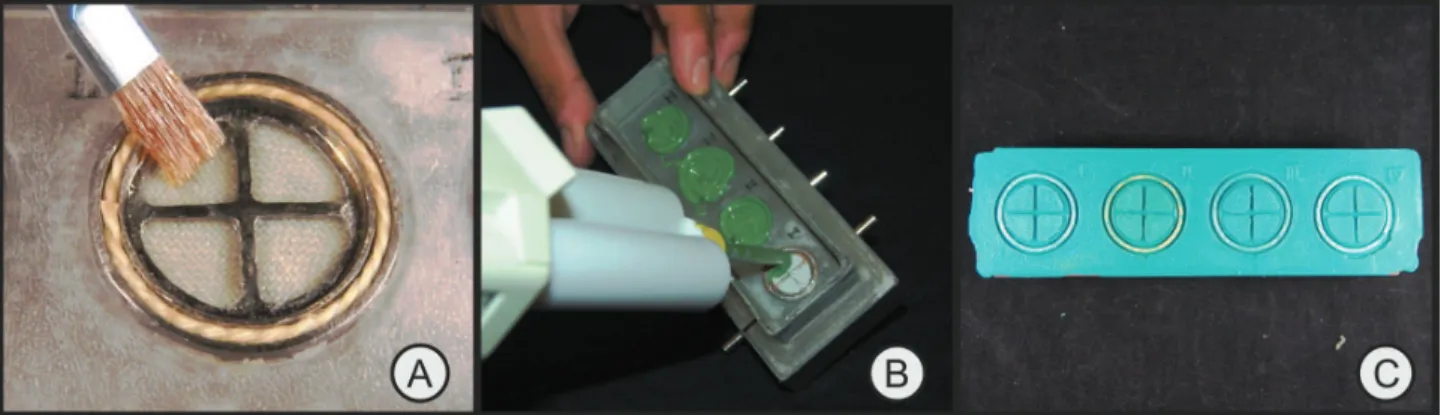
Figure 3- Sequence (A, B and C) of procedures for each impression trial
Number of samples (n) according to impression material
Material tested Cylinder Adsil Aquasil Ultra Express TOTAL
Aluminum sulfate I 10 10 10 30
Ferric sulfate II 10 10 10 30
Aluminum chloride III 10 10 10 30
Distilled water (control) IV 10 10 10 30
Retraction cord*+Aluminum sulfate I 10 10 10 30
Retraction cord*+Ferric sulfate II 10 10 10 30
Retraction cord*+Aluminum chloride III 10 10 10 30
Retraction cord*+Distilled water (control) IV 10 10 10 30
Total number of specimens tested 80 80 80 240
Figure 4- Summary of tests performed during the study
*Retraction cords that had been handled with latex gloves before tests.
cylinder according to the type of solution tested:
Hemostatic solutions were dispensed into the cylinders using brushes until saturation was visually
conirmed in the cloth weave (Figure 3A). Care was taken not to let it touch the area that held the
retraction cord.
Addition silicone was dispensed on the cylinders
in circular movements using a dispensing gun
and mixing tips. The impression material was dispensed into the cylinders within the working time
recommended by the manufacturers of the addition
silicones under study, and all trials were conducted in a room where the temperature was controlled at
20ºC (Figure 3B).
Removal from the mold was 7.5 min after impression of the last cylinder, which is suficient
time for setting of all materials tested according to the manufacturers’ recommendations (Figure 3C).
The latex gloves, the pieces of cloth, and the
pieces of retraction cord, as well as the hemostatic solutions, were replaced for each new trial. Ten trials were performed for each addition silicone brand
used in the study, totalizing 240 samples (Figure 4).
Polymerization inhibition was detected according
to the surface analysis of the impression and the molded surface, described in the literature as a
simple, practical and very eficient form to visualize
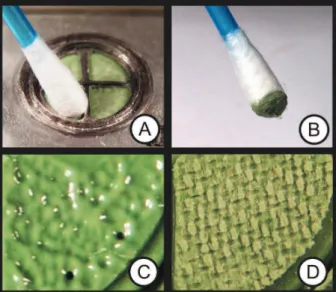
Figure 5- A and B show the effectiveness of the method used to detect residues of polymerized material on the surface of the piece of fabric and the impression; the color difference between the cotton tip and the residues of nonpolymerized material clearly indicate the occurrence of inhibition. C and D show the difference between a surface with incomplete (C) and complete (D) polymerization. C shows surface undulations and oiliness on impression, which resulted from polymerization caused by the direct contact with latex (used in previous tests). D shows complete polymerization, in which the material reproduces the fabric weave accurately
Material tested Adsil Aquasil Ultra Express TOTAL
Reactive Non reactive
Reactive Non reactive
Reactive Non reactive
Reactive Non reactive
Aluminum sulfate 0 10 0 10 0 10 0 (0%) 30 (100%)
Ferric sulfate 0 10 0 10 0 10 0 (0%) 30 (100%)
Aluminum chloride 0 10 0 10 0 10 0 (0%) 30 (100%)
Distilled water (control) 0 10 0 10 0 10 0 (0%) 30 (100%)
Cord*+Aluminum sulfate 0 10 0 10 0 10 0 (0%) 30 (100%)
Cord*+Ferric sulfate 0 10 0 10 0 10 0 (0%) 30 (100%)
Cord*+Aluminum chloride 0 10 0 10 0 10 0 (0%) 30 (100%)
Cord*+Distilled water (control) 0 10 0 10 0 10 0 (0%) 30 (100%)
TOTAL 0 80 0 80 0 80 0 (0%) 240 (100%)
*Retraction cords that had been handled with latex gloves before tests.
Figure 6- Results of tests in number of samples (N) signs of inhibition were found, the material was classiied as reactive. If no signs were found, the material was classiied as nonreactive. The signs of inhibition are listed below:
1- Residues of nonpolymerized material (oily substance) on the surface of the impression and support;
2- Rugosity of the impression surface; and,
3- Lack of detail reproduction on the surface of the impression.
The analysis of nonpolymerized material residues
that adhered to the surface was made using cotton tips that were rubbed onto the surface that had been in contact with the hemostatic solutions. The same method was used for the detection of
residues adhered to the surface of the pieces of
cloth. Residues or oiliness, when found, was easily
detected by observing the dies that adhered to the
fabric surface, which was in contrast with the white
surface (Figure 5A/B). The texture of the impression
surface and its capacity to reproduce details were
analyzed using close-up photographs (Figure
5C/D) and material scraping with smooth-tipped instrument. In cases of inhibition, it was possible
to see undulations on the impression surface, and material could be removed by scraping.
To analyze polymerization in the area of
contact with the retraction cords, a small caliber instrument was used for scraping. The test result was negative when visual inspection did not reveal
residues of nonpolymerized material (oiliness) on the impression surface. The retraction cords used
in each test were also inspected. For this purpose, cotton tips were rubbed against the cord surface after they were removed from their grooves. A
third method to detect changes in polymerization
due to the contact with contaminated cords was
the evaluation of the capacity of the impression material to reproduce form and surface texture. The material should be capable of reproducing the
weave of the twisted cords faithfully.
RESULTS
Figure 6 shows the number of reactive and
show that all the samples tested (N=240) were
nonreactive regardless of the type of combination used. No residues of nonpolymerized material adhered to the surfaces in any of the impressions or
pieces of fabric. Scraping tests were also negative for all samples. There was perfect reproduction of the fabric weave in all hemostatic solution groups, as well as of the retraction cord ibers contaminated by contact with latex gloves, which can be conirmed in Figure 7.
No statistical analyses were conducted because all tests were negative for 100% of the samples
tested.
DISCUSSION
One of the main uses of hemostatic agents
in combination with retraction cords is to control
humidity and bleeding from the gingival sulcus during impression, so that a usually hydrophobic material may faithfully reproduce the details of tooth preparation3. Therefore, this type of solution should be compatible with the material that will be used in reproducing oral structures. However,
aluminum sulfate and ferric sulfate used as hemostatic solutions, due to the presence of the sulfur radical in their molecular structure, raised the suspicion that they might inhibit polymerization of polyvinyl, such as in the case of sulfur incorporated during the process of vulcanization of latex gloves. Therefore, by analogy, sulfur found in the sulfate
radicals was thought to interact with the catalytic
sites of addition silicone materials and to block setting.
Although these suspicions were serious and involved sulfur solutions, few authors studied it directly. One of the few studies to focus on this
subject evaluated several solutions, including ferric and aluminum sulfates, and found that they did not have any inhibitory potential on silicone materials3. There were suggestions that clinical
reports to the contrary might be better explained by
contamination with latex found in gloves rather than
by the medicaments used for gingival retraction.
The results of our study are in agreement with those indings because silicone materials were
nonreactive to the hemostatic solutions tested here.
The reason why sulfur solutions did not react in
the polymerization of polyvinylsiloxane materials may be explained by the molecular position of sulfur atoms. The molecular analyses of these
solutions show that the sulfur in their composition
is in a state different from the one found in the
latex gloves, whose inhibition potential has already been conirmed in the literature1,4,7,8. Sulfur in the
sulfate solutions, contrarily to that found in latex gloves, has greater electrical stability, saturated by oxygen atoms, less reactive, and, therefore,
incapable of reacting with metal catalysts8. For this
reason, the mere presence of sulfur does not give
the material any inhibitory properties. To ind out whether a substance has any inhibition potential,
direct inhibition tests18 or molecular analysis of
the compound should be performed to provide indications about the degree of reaction of the element of interest.
After the conirmation of the inhibitory effects of the direct contact between polyvinylsiloxane and
products containing latex, studies about indirect contamination became important in the literature referring to addition elastomers. The principles of “indirect contamination” or “crossed contamination”
reside in the fact that all contact between two surfaces or materials is followed by exchanges of substances between them, even if only at a molecular level. To conirm this principle, the dental
literature has already demonstrated that sulfurous
materials may be exchanged between latex gloves
and the structures exposed to the gloves, such as teeth, soft tissues, gingival retraction cords and
dental ofice instruments5,9,12-14. According to other
authors, the sulfur transferred, in some cases,
would produce the same inhibitory effects triggered
by the latex gloves.
The inhibitory potential of indirect latex
contamination should not be downplayed. In a
previous study, the chemical analysis of the surface of vinyl gloves and gingival retraction cords, both
contaminated by latex gloves, showed that sulfur particles and sulfur chloride compounds were found
in all the samples analyzed. For the authors of that study, those particles should be able to interfere
in polyvinylsiloxane polymerization14. Another
study evaluated the inhibition of addition silicone
polymerization by direct and indirect contact with
latex gloves and found that 96% of the gloves tested inhibited silicone polymerization by direct contact and 40% by direct and indirect contact,
which is a contraindication for their use when
handling these materials.
Despite the several indings reported in the
literature, the results of the present study did not
show inhibition of polymerization in any of the polyvinylsiloxane samples that were exposed to contact with retraction cords previously handled with latex gloves. On the contrary, the elastomeric
material reproduced the cord texture accurately
in all samples (N=120), and there was no sign of
inhibition or retarded setting detected by visual analysis of the impressions or pieces of fabric. It may be inferred that the cord surfaces had sulfur
particles that would contaminate the silicone
catalyst14; however, the low concentration of this element seems to have been insuficient to trigger
The presence of reactive sulfur on the surface of the cords14 suggests that some type of change
in polymerization may have occurred in practice,
but was subclinical, and its detection using visual methods was either too complex or impossible. If this method were used in a clinical context, an equally complicated situation would arise, in which the dentist would be incapable of detecting
inhibitory effects of the contaminated cord because the phenomenon tends to occur at levels that are beyond visual detection. Therefore, as the purpose
of this study was to conduct an analysis according
to clinical and visual criteria, it is possible to assume that, in the study samples, the inhibitory potential of the cords indirectly contaminated by latex, although present and important, did not produce clinically relevant effects.
CONCLUSION
According to the study methods, it may be concluded that:
Aluminum sulfate, ferric sulfate and aluminum
chloride hemostatic solutions did not show any
inhibitory potential over the addition silicone materials under study.
There were no visual changes in polymerization in consequence of the contact between silicone materials and the cords handled with latex gloves.
Further studies should be conducted using more sensitive methods to address the possible disadvantages of the subclinical inhibition of polyvinylsiloxane polymerization.
REFERENCES
1- Baumann MA. The inluence of dental gloves on the setting of
impression materials. Br Dent J. 1995;179:130-5.
2- Burmann PA, Cardoso Pe. Moldagem com silicone de reação por
adição Aquasil: a otimização da moldagem ao alcance do Clínico.
Clinical Update Dentsply [serial on the Internet]. 2002 [cited on
19 jan 2011];3:1-8. Available from: URL: <http://www.dentsply. com.br/isogesac/imgcatalogo/clinical3_aquasildentística.pdf>
3- Camargo LM, Chee WW, Donovan Te. Inhibition of polymerization of polyvinyl siloxanes by medicaments used on gingival retraction cords. J Prosthet Dent. 1993;70:114-7.
4- Causton Be, Burke FJ, Wilson NH. Implications of the presence of dithiocarbamate in latex gloves. Dent Mater. 1993;9:209-13. 5- Chee WW, Donovan Te, Kahn RL. Indirect inhibition of polymerization of a polyvinyl siloxane impression material: a case report. Quintessence Int. 1991;22:133-5.
6- Cook WD, Thomasz F. Rubber gloves and addition silicone materials. Aust Dent J. 1986;31:140.
7- Donovan TE, Chee WW. A review of contemporary impression
materials and techniques. Dent Clin N Am. 2004;48:445-70. 8- Dunleavy JK. Sulfur as a catalyst poison. Platinum Metal Ver. 2006;50:110.
9- Fan PL. Retarding the setting of vinyl polysiloxane impressions. J Am Dent Assoc. 1991;122:114.
10- Gnaneswaran V, Mudhunuri B, Bishu RR. A study of latex and
vinyl gloves: performance versus allergy protection properties. Int J Ind ergonom. 2008;38:171-81.
11- Jones RH, Cook GS, Moon MG. effect of provisional luting agents on polyvinyl siloxane impression material. J Prosthet Dent. 1996;75:360-3.
12- Kahn RL, Donovan Te. A pilot study of polymerization inhibition of poly (vinyl siloxane) materials by latex gloves. Int J Prosthodont. 1989;2:128-30.
13- Kahn RL, Donovan Te, Chee WW. Interaction of gloves and
rubber dam with poly(vinyl siloxane) impression material: a
screening test. Int J Prosthodont. 1989;2:342-6.
14- Kimoto K, Tanaka K, Toyoda M, Ochiai KT. Indirect latex gloves contamination and its inhibitory effect on vinyl polysiloxane polymerization. J Prosthet Dent. 2005;93:433-8.
15- Mandikos MN. Polyvinyl siloxane impression materials: an update on clinical use. Aust Dent J. 1998;43:428-34.
16- Matis BA, Valadez D, Valadez e. The effect of the use of dental gloves on mixing vinyl polysiloxane putties. J Prosthodont. 1997;6:189-92.
17- Moon MG, Jarrett TA, Morlen RA, Fallo GJ. The effect of various base/core materials on the setting of a polyvinyl siloxane impression material. J Prosthet Dent. 1996;76:608-12.
18- Neissen LC, Strassler H, Levinson PD, Wood G, Greenbaum J. effect of latex gloves on setting time of polyvinylsiloxane putty impression material. J Prosthet Dent. 1986;55:128-9.
19- Noonan Je, Goldfogel MH, Lambert RL. Inhibited set of the
surface of addition silicones in contact with rubber dam. Oper
Dent. 1985;10:46-8.
20- Peregrina A, Land MF, Feil P, Price C. Effect of two types
of latex gloves and surfactants on polymerization inhibition of three polyvinylsiloxane impression materials. J Prosthet Dent. 2003;90:289-92.
21- Phillips RW. Skinner’s science of dental materials. Phyladelphia: WB Saunders; 1991. p. 154.
22- Reitz CD, Clark NP. The setting of vinyl polysiloxane and
condensation silicone putties when mixed with gloved hands. J
Am Den Assoc. 1988;116:371-5.
23- Sábio S, Franciscone PA, Mondelli J. effect of conventional and experimental gingival retraction solutions on the tensile strength and inhibition of polymerization of four types of impression materials. J Appl Oral Sci. 2008;16:280-5.
24- Touyz LZ, Rosen M. The effect of maize starch on setting time of vinyl polysiloxane putty impression materials. J Dent Assoc S Afr. 1989;44:377-9.
25- Vinyl polysiloxane impressions materials: a status report. Council on Dental Materials, Instruments, and equipment. J Am Dent Assoc. 1990;120:595-600.
26- Welfare RD. Problems with addition-cured silicone putty, letter
to the editor. Br Dent J. 1986;160:268-9.