QUALI TY OF LI FE ASSOCI ATED FACTORS I N CHI LEANS HOSPI TALS NURSES
1Len k a An dr ades Bar r ien t os2 Sandr a Valenzuela Suazo3
Andrades Bar r ient os L, Valenzuela Suazo S. Qualit y of life associat ed fact or s in Chileans hospit als nur ses. Rev Lat ino- am Enfer m agem 2007 m aio- j unho; 15( 3) : 480- 6.
This st udy is focused on know ing t he Qualit y of Life of hospit al nurses, and associat ed fact ors. People sur v ey ed ar e com posed of 100 fem ale nur ses fr om a hospit al, eight h r egion, Chile. The m easur ing m et hod is a quest ionnaire – orient ed t o know bio- social- dem ographic variables t hat influence nurses – and t he WHOQOL-BREF qualit y of life m easuring scale, validat ed in Chilean populat ion. Result s show t hat Dom ain Social Relat ionship ( m ean = 7 7 , 3 8 ) is per ceiv ed as t h e best by fem ale n u r ses, an d Ph y sical as t h e w or st ( m ean = 5 4 , 5 6 ) . Global Qu alit y of Lif e is seen as “ Good ” ( m ean = 3 , 9 9 ) an d Healt h Qu alit y of Lif e is p er ceiv ed as “ Con f or m in g ” ( m ean = 3 , 9 7 ) . Var iables pr edict ed f or Qu alit y of Lif e ar e: age, cou ple sit u at ion an d n igh t sh if t s. Giv en t h e r esu lt s, bein g a fem ale n u r se, an d h er t h r eefold r ole; n ew st u dies for deeper r esear ch , especially on t h ose v ar iables t hat w er e not st at ist ically r elev ant , ar e suggest ed.
DESCRI PTORS: qualit y of life; nur ses; hospit als
FACTORES ASOCI ADOS A CALI DAD DE VI DA DE ENFERMERAS HOSPI TALARI AS CHI LENAS
Est udio cuyo obj et ivo fue conocer la Calidad de Vida de enferm eras hospit alarias, y fact ores asociados. El universo, con el cual se t rabaj ó, est uvo const it uido por 100 enferm eras de un hospit al, oct ava región, Chile. El inst rum ent o const ó de un cuest ionario, cuya finalidad fue conocer variables biosociodem ográficas influyent es, y , la escala de m edición de Calidad de Vida WHOQOL- BREF, v alidada en población ch ilen a. Los r esu lt ados indican que el Dom inio Relaciones Sociales ( m edia= 7 7 , 3 8 ) es el m ej or per cibido por est as enfer m er as y , el peor , el Físico ( m edia= 54,56) . La Calidad de Vida Global, fue concept uada com o “ Buena” ( m edia= 3,99) , y, la Calidad de Vida en Salud, se per cibe “ Confor m e” ( m edia= 3,97) . Las v ar iables que r esult ar on pr edict or as par a la Calidad de Vida son: edad, sit uación de parej a y realizar t urnos de noche. Dado los result ados, la condición de m uj er de las enfer m er as y su t r iple r ol, se sugier en nuev os est udios que pr ofundicen, especialm ent e, en aquellas v ar iables que no r esult ar on est adíst icam ent e significat iv as.
DESCRI PTORES: calidad de v ida; enfer m er as; hospit ales
FATORES ASSOCI ADOS A QUALI DADE DE VI DA DE ENFERMEI RAS HOSPI TALARES CHI LENAS
O pr esent e est udo t eve por obj et ivo conhecer a qualidade de vida de enfer m eir as da ár ea hospit alar , assim com o, os fat ores associados. O universo com o qual se t rabalhou foi const it uído por 100 enferm eiras de u m h ospit al da oit av a r egião do Ch ile. Ut ilizou - se, com o in st r u m en t os, u m qu est ion ár io cu j a f in alidade f oi conhecer v ar iáv eis bio- sócio- dem ogr áficas influent es e a escala de m edição de qualidade de v ida WHOQOL-BREF, validada na população chilena. Os result ados indicam que o dom ínio relações sociais ( m édia= 77,38) é o m elh or per cebido por est as en f er m eir as e o pior é o f ísico ( m édia= 5 4 , 5 6 ) . A qu alidade de v ida global f oi ca t a l o g a d a co m o “ b o a ” ( m éd i a = 3 , 9 9 ) e a q u a l i d a d e d e v i d a em sa ú d e é p er ceb i d a co m o “ d en t r o d o s padr ões” ( m édia= 3 , 9 7 ) . As v ar iáv eis consider adas com o r equisit os par a a qualidade de v ida for am : idade, o fat o de ser casada ou t er com panheir o e os plant ões not ur nos. Consider ando- se os r esult ados, a condição de m ulher e sua t r íplice j or nada, são suger idos nov os est udos que apr ofundem , especialm ent e, aquelas v ar iáv eis que não se apr esent ar am est at ist icam ent e significat iv as.
DESCRI TORES: qualidade de v ida; enfer m eir as; hospit ais
1
Part e of t he proj ect DI UC N 204.082.031- 1.0, funded by I nvest igat ion Com it ion at Universit y of Concepción, Chile; 2 M.Sc in Nursing, Professor, e- m ail: [email protected]; 3 PhD in Nursing, Professor, e- m ail: [email protected]. Universit y of Concepción, Medical School, Nursing Depart m ent , Chile
I NTRODUCTI ON
C
h i l e i s a c o u n t r y g o i n g t h r o u g h ad em o g r ap h i c t r an si t i o n , m ar k ed b y a p r o g r essi v e lev eling of t he populat ion py r am id and an incr easing life ex pect ancy at bir t h in r ecent decades, r eachin g 78.3 years for wom en. The im proved survival t urns it increasingly im port ant t o raise people’s Qualit y of life. The WHO has defined t his com plex const ruct - Qualit y of life - as “ an individual’s percept ion of t heir posit ion in life in t he cont ext of t he cult ure and value syst em s i n w h i ch t h ey l i v e, an d i n r el at i o n t o t h ei r g o al s, ex pect at ions, st andar ds and concer ns”( 1 ).
As a r esult of w om en’s pr ox im it y t o nat ur e, du e t o t h eir r epr odu ct iv e f u n ct ion , t h ey h av e been hist orically at t ribut ed wit h t he care giving funct ion and t h eir g en d er socializat ion cen t er s on t h is con d u ct , which has ent ailed an addit ional work load. Moreover, t he sociocult ural barriers t hat t ake t he form of unequal o p p o r t u n i t i es i n t h e p o l i t i ca l , so ci a l , cu l t u r a l a n d eco n o m i c a r ea s n o t o n l y i m p ed e t h em f r o m f u l l y par t icipat ing, but also affect t heir Qualit y of life and t u r n i n t o a n o b s t a c l e t h a t l i m i t s t h e i r h u m a n dev elopm ent . As Nur sing is a “ fem inized” pr ofession, it s dev elopm en t ex per ien ces t h e sam e obst acles as w om en in gener al. On t he ot her hand, t he dem ands posed by w or k can su ppose a lack of at t en t ion f or fam ily r esponsibilit ies, w it h sev er e r eper cussions for t h ese pr ofession als’ pr iv at e life( 2 ). Th e possibilit y of harm onizing fam ily and j ob responsibilit ies const it ut es a fact or t hat needs t o be consider ed w hen analy zing Qualit y of life. Also, t hese pr ofessionals r epr esent a group wit h risks t hat em erge bot h from t heir condit ion as w om an, m ot her, w ife and/ or housew ife and fr om t h eir p r of ession al con d it ion . Th ese r isk s d er iv e n ot only from t he int eract ion bet ween bot h roles, but also from int erpersonal relat ionships at work and at hom e, fr om t heir per sonal r esour ces and fr om t he gener al cont ex t of t heir pr ofessional ex er cise.
I n Chile, the social and cultural changes needed t o m odify hist orical st andards of gender behavior have not occurred yet . Hence, nurses need t o perform t heir role as health professionals and, at the sam e tim e, cannot ignor e t he car e for t heir fam ily’s healt h, socializat ion and education of their children, adm inistration of fam ily r esour ces, r ealizat ion of feeding and hy giene- r elat ed tasks and regulation of their partners’ and their fam ilies’ affect ion, am ong ot hers.
As conform ism is not a fem ale charact erist ic, if necessary, an evaluat ion of Qualit y of Life in nurses
sh ou ld g en er at e a ch an g e. Ch an g es ar e b ased on dissat isfact ion, w hich dr iv es t he hum an being t o act and look for t he concr et e and int angible elem ent s t o t ransform t his feeling. The aut hors consider t hat it is im port ant t o st udy whet her nurses leave enough room and t im e t o( 3) “ cult ivat e” t heir own Qualit y of Life. To t he ext ent t hat t hese professionals feel sat isfied w it h t h ei r o w n Qu al i t y o f Li f e, t h ey w i l l b e cap ab l e o f t ransm it t ing t o t heir own cat egory and ot hers t he need t o u se p h y sical, p sy ch olog ical, social, sp ir it u al an d env ir onm ent al r esour ces t o live life fully.
Con sid er in g t h at n u r ses r ep r esen t a g r ou p of f em ale h ealt h agen t s w h ose im age of Qu alit y of Li f e g o e s b e y o n d t h a t o f o t h e r w o m e n , a n d a r e vulnerable in t heir Qualit y of Life as, m ost of t he t im e, t heir effort s t o achieve well- being are given t o ot hers, post pon in g t h eir ow n ph y sical, psy ch ological, social an d sp ir it u al car e, t h e r esear ch er s con sid er ed t h is gr oup as an im por t ant focus of st udy.
Th is m ot iv at ed t h e au t h or s t o get t o k n ow n u r ses’ Qu alit y of Lif e an d t h e f act or s t h at can b e associat ed w it h t his assessm ent .
MATERI AL AND METHODS
This is a descript ive and cross- sect ional st udy, whose universe consist ed of 126 nursing professionals hir ed at a public hospit al of high com plex it y, locat ed in t he region of Bío Bío in Chile. As 11 were m en and t he st udy focused on w om en, t he univ er se included t he 115 fem ale professionals. Aft er obt aining approval from t he Hospit al’s Review Board and considering t he f easib ilit y of w or k in g w it h t h e w h ole u n iv er se, t h e aut hors decided t o perform a census am ong t he st udy p ar t icip an t s. On e h u n d r ed p r of ession als v olu n t ar ily a cce p t e d t o p a r t i ci p a t e a n d g a v e t h e i r I n f o r m e d Co n sen t .
of a close relat ive. These variables allowed t he aut hors t o est ab l i sh t h e p a r t i ci p at i n g n u r ses’ p r o f i l e. Th e secon d p ar t con sist ed of t h e Qu alit y of Lif e scale WHOQOL- BREF, d er iv ed f r om t h e WHOQOL – 1 0 0 , issued by t he WHO.
Wit h r espect t o t h e qu alit y con t r ol of dat a, t h e i n st r u m en t ’ s v al i d i t y w as co r r o b o r at ed i n t h e Ch i l e a n p o p u l a t i o n , s h o w i n g t h a t i t i s a p t f o r applicat ion, w hile t he r eliabilit y calculat ion pr oduced a Cr onbach’s alpha coefficient of . 901.
This inst r um ent cont ains 24 it em s or facet s, cor r esponding t o four Dom ains t hat int er v ene in t he per cept ion of Qualit y of Life, besides t w o it em s t hat ar e separ at ely ex am ined and specifically cor r espond t o t he individual’s percept ion of his/ her Global Qualit y o f Li f e a n d Hea l t h - Rel a t ed Qu a l i t y o f Li f e. Th e 4 Dom ains t hat are assessed, each wit h it s own facet s, are: Physical ( Pain, energy, fat igue, m obilit y, act ivit ies, m edicat ion and work) Psychological ( Posit ive feelings, c o g n i t i o n , e s t e e m , b o d y, n e g a t i v e f e e l i n g s a n d spir it ualit y) , Social Relat ionships ( social r elat ionships, s o c i a l s u p p o r t a n d s e x u a l i t y ) a n d En v i r o n m e n t ( Se cu r i t y, h o m e , f i n a n ce , se r v i ce s, i n f o r m a t i o n , leisu r e, en v ir on m en t an d t r an sp or t ) . Th e scor es of t h e Dom ain s ar e r an k ed in a r isin g scale, t h at is, h i g h e r s c o r e s i n d i c a t e a b e t t e r Qu a l i t y o f Li f e p e r ce p t i o n . Th e r e f e r e n ce t i m e f o r t h e p e r so n a l per cept ion of t h e differ en t it em s is t w o w eek s. Th e m ean scor es of it em s in each Dom ain ar e u sed t o calcu lat e t h e Dom ain scor e. Th en , t h e m ean scor es ar e m u lt ip lied b y f ou r, so as t o t u r n t h ese v alu es com parable wit h t he scores used in t he WHOQOL- 100, and finally t ransform ed t o a scale from 0 – 100, wit h 0 as t he worst and 100 as t he best score. To assess quest ions 1 and 2, Global Qualit y of Life and Healt h-Relat ed Qualit y of Life, respect ively, a five- point Likert scale is used, in which 1 indicat es t he worst and 5 t he best per cept ion .
The inform at ion was processed wit h t he help o f SPSS ( St at i st i cal So f t w ar e f o r So ci al Sci en ces) v e r s i o n 1 2 . 0 a n d i n c l u d e d a u n i a n d b i v a r i a t e d e s c r i p t i v e a n a l y s i s a n d c o n t i n g e n c y t a b l e s . To com pare t he m ean scores, St udent ’s t - t est or variance analy sis ( ANOVA) w as used, as appr opr iat e.
RESULTS
The obt ained r esult s allow ed t he aut hor s t o est ablish t he pr ofile of t he 100 nur ses under st udy :
79% are younger t han 50 and 21% older; 70% has a r elat ion w it h a fix ed par t ner ; 51% t ak e car e of one, t w o o r t h r e e c h i l d r e n ; 2 0 % t a k e c a r e o f o t h e r relat ives; 50% work night shift s; 39% work in crit ical car e an d 5 5 % in g en er al car e; 9 % w or k a d ou b le j ourney; 72% have housew ork support ; 33% declare t hat t hey suffer from a chronic disease; 32% are fam ily h ead s an d 4 5 % ex p er ien ces or h as ex p er ien ced a disease or deat h of a close r elat iv e. I n accor dan ce w it h t he st udy quest ions, t he follow ing r esult s w er e ob t ain ed :
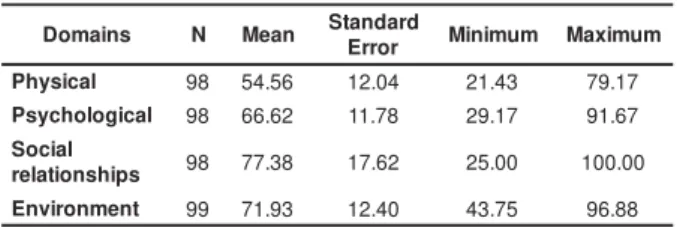
Table 1 – Nurses’ Qualit y of life according t o Dom ains, Con cepción , Ch ile. Decem ber 2 0 0 5
s n i a m o
D N Mean Standard
r o r r
E Minimum Maximum
l a c i s y h
P 98 54.56 12.04 21.43 79.17
l a c i g o l o h c y s
P 98 66.62 11.78 29.17 91.67
l a i c o S
s p i h s n o i t a l e
r 98 77.38 17.62 25.00 100.00
t n e m n o r i v n
E 99 71.93 12.40 43.75 96.88
As t o Qu a l i t y o f Li f e ( Qo L) a sse sse d p e r Dom ain ( Table 1) , t he Phy sical Dom ain r eceived t he w or st ev aluat ion, m ean = 54. 56 ( int er v al fr om 0 t o 1 0 0 ) , and Social Relat ionships t he best one, w it h a m e a n s c o r e = 7 7 . 3 8 . I t i s h i g h l i g h t e d t h a t t h e Env ir onm ent Dom ain r eceiv ed t he highest m inim um ev aluat ion of t he four Dom ains.
As suggest ed by t he WHOQOL Group, Global Qualit y of life ( GQoL) and Healt h- Relat ed Qualit y of l i f e ( H RQo L) , s h o w n i n Ta b l e 2 , w e r e a n a l y z e d in d ep en d en t ly ( Qu est ion s 1 an d 2 , r esp ect iv ely, of t he WHOQOL- BREF inst r um ent ) .
Table 2 – Nur ses’ Global Qualit y of Life and Healt h-Relat ed Qualit y of Life. Concepción, Chile. Decem ber 2 0 0 5
e f i l f o y t i l a u
Q N Mean Minimum Maximum
e f i l f o y t i l a u q l a b o l
G 97 3.99 2 5
e f i l f o y t i l a u q d e t a l e r -h t l a e
H 98 3.97 3 5
Wit h respect t o t he analysis of t he associat ion bet w een t h e st u died v ar iables an d QoL, t h e r esu lt s evidenced t hat t he variables: num ber of children under t he nur se’s car e, pr esence of ot her fam ily m em ber s under t heir care, hospit al service perform ed, w ork at m ore t han one inst it ut ion, housework support , chronic disease, fam ily head and experience of severe disease or deat h of a close relat ive do not influence t he st udied pr of ession als QoL.
When r elat ing QoL w it h t he Age v ar iable, a st at ist ically significant difference only appeared in t he Ph y si cal Dom ai n ( p = . 0 0 5 ) , am on g t h e f ou r ag e gr oups, as show n in Table 3 below.
Table 3 – Phy sical Dom ain of Nur ses’ Qualit y of life accor ding t o Age. Concepción, Chile. Decem ber 2005
( 1 7 . 2 % ) . Mo st p r o f essi o n al s, t h at i s, 6 2 ( 6 2 . 2 % ) declar ed feeling “ Sat isfied” w it h t heir HRQoL.
Table 4 show s t he per cept ion of each of t he Qualit y of Life Dom ains in r elat ion w it h t he v ar iable of t he nur ses’ Par t ner Sit uat ion.
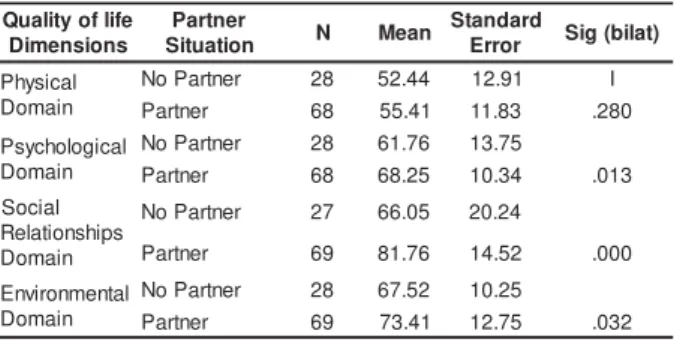
Table 4 – Nurses’ Qualit y of life Dom ain according t o Par t ner Sit uat ion. Concepción, Chile. Decem ber 2005
y t i l a u Q e f i L f
o Age N Mean
d r a d n a t S r o r r
E MinimumMaximum P e u l a V l a c i s y h P n i a m o D s r a e y 0 3 -0
2 27 50.53 11.24 28.57 75.00 s r a e y 0 4 -1
3 32 52.12 12.98 21.43 71.43 s r a e y 0 5 -1
4 19 56.77 10.57 35.71 71.43 .005 + d n a s r a e y 1
5 20 61.82 9.62 46.43 79.17
l a t o
T 98 54.56 12.04 21.43 79.17
The worst percept ion was found in t he group bet w een 20 and 30 y ear s old, w it h a m ean scor e = 50.53. The group of 51 years and older gave t he best evaluat ion of t his Dom ain, w it h a m ean = 61.82. No significant evidence was found for GQoL, alt hough t he eldest group gave t he best evaluat ion, while t he worst a s s e s s m e n t w a s f o u n d i n t h e y o u n g e s t g r o u p . How ev er, t h e r esu lt s ob t ain ed in t h e d if f er en t ag e groups indicat ed t hat GQoL was “ Good”, as m ost m ean sco r e s w e r e a b o u t 4 , w h i ch co r r e sp o n d s t o t h i s evaluat ion, given in response t o t he quest ion “ How is y ou r Qu alit y of Lif e?” w h en apply in g t h e WHOQOL-BREF. I t should be highlight ed t hat , in all age groups, GQoL w as at t h e least assessed as “ Mor e or Less”, answered by 18 nurses ( 18.4% ) , while t he m axim um a s s e s s m e n t w a s “ Ve r y Go o d ” , a l s o g i v e n b y 1 8 professionals ( 18.4% ) . As t o t he evaluat ion of HRQoL in t h e dif f er en t age gr ou ps, n o sign if ican t ev iden ce w as found eit her, w it h all m ean scor es lying close t o 4 , w h ich m ean s t h at t h eses n u r ses f eel “ Sat isf ied ” when t hey are asked ¿To what ext ent are you sat isfied w it h y our healt h st at us? Nur ses bet w een 31 and 40 g av e t h e b est ev alu at ion . As op p osed t o w h at t h e r esear cher s m ight ex pect , pr ofessionals bet w een 2 1 an d 3 0 g av e t h e w or st ev alu at ion . Acr oss all ag e groups, t he m inim um evaluat ion of HRQoL was “ More or Less”, answ er ed by 20 nur ses ( 20.2% ) , w hile t he m ax im u m w as “ Ver y Sat isf ied”, by 1 7 pr of ession als
e f i l f o y t i l a u Q s n o i s n e m i D r e n t r a P n o i t a u t i
S N Mean
d r a d n a t S r o r r
E Sig(bilat)
l a c i s y h P n i a m o D r e n t r a P o
N 28 52.44 12.91 I r e n t r a
P 68 55.41 11.83 .280
l a c i g o l o h c y s P n i a m o D r e n t r a P o
N 28 61.76 13.75 r e n t r a
P 68 68.25 10.34 .013 l a i c o S s p i h s n o it a l e R n i a m o D r e n t r a P o
N 27 66.05 20.24
r e n t r a
P 69 81.76 14.52 .000
l a t n e m n o r i v n E n i a m o D r e n t r a P o
N 28 67.52 10.25 r e n t r a
P 69 73.41 12.75 .032
The r esult s dem onst r at e t hat w het her t hese pr ofessionals hav e a st able r elat ionship w it h a par t ner w a s n o t r e l e v a n t f o r t h e Ph y s i c a l D o m a i n o n l y. Pr o f e ssi o n a l s w i t h a p a r t n e r b e t t e r a sse sse d t h e Ps y c h o l o g i c a l ( p = . 0 1 3 ) , S o c i a l Re l a t i o n s h i p s ( p= . 000) and Env ir onm ent al Dom ains ( p= . 032) . For GQo L, i n p er cen t a g e t er m s, “ Go o d ” ( 6 4 . 7 % ) a n d “ Ve r y Go o d ” ( 1 9 . 1 % ) w e r e m o r e f r e q u e n t i n p r o f essi o n al s w i t h a f i x ed p ar t n er. Am o n g n u r ses w it h ou t a p ar t n er, 5 7 . 1 % p er ceiv ed t h eir GQoL as “ Good” and only 14. 3% as “ Ver y Good”. HRQoL was bet t er assessed by nur ses w it h a par t ner r elat ionship. Th u s, pr of ession als w h o declar ed t h at t h ey did n ot h av e a par t n er r elat ion sh ip obt ain ed a m ean scor e of 3.79, t hat is, t hey felt bet w een “ Mor e or Less” and “ Sat i sf i ed ” w i t h t h ei r HRQo L, w h i l e n u r ses w i t h a p a r t n e r o b t a i n e d a m e a n sco r e o f 4 . 0 3 , f e e l i n g b et w een “ Sat isf ied ” an d “ Ver y Sat isf ied ” w it h t h eir HRQoL. No differ en ce w as fou n d in t h e assessm en t “ Sat isfied” bet w een nur ses w ho declar ed t hey did or did n ot h av e a st able par t n er. Am on g pr of ession als w h o d i d n o t h a v e a p a r t n e r, 6 4 . 3 % g a v e t h i s a sse ssm e n t , a g a i n st 6 2 . 3 % a m o n g t h o se w i t h a par t ner r elat ionship. This was not t he case for “ Ver y Sa t i sf i e d ” , r e p l i e d b y o n l y 7 . 1 % o f p r o f e ssi o n a l s w i t h o u t a p ar t n er, b u t b y 2 0 . 3 % o f t h o se w i t h a p a r t n e r. Th e sa m e w a s t r u e f o r “ Mo r e o r Le ss” , a n s w e r e d b y 2 8 . 6 % o f p r o f e s s i o n a l s w i t h o u t a par t ner, but 17.4% of t hose w it h a par t ner.
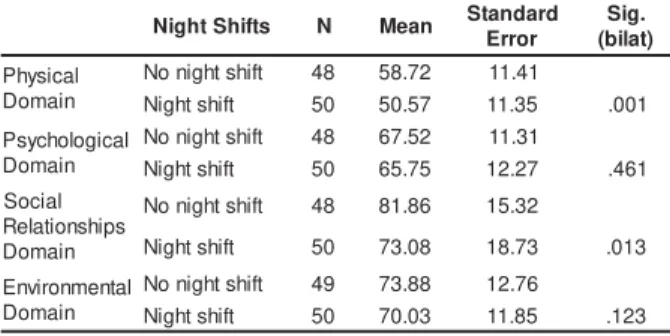
Table 5 - Dom ains of Nurses’ Qualit y of life according t o Night Shift s. Concepción, Chile. Decem ber 2005
t h e au t h or s an d as t h is asp ect r eceiv ed t h e w or st assessm ent by t he nurses in t his st udy, it are fact ors in h er en t in t h eir q u alit y of b ein g w om an , m ot h er, n u r s e , w i f e a n d h o u s e w i f e t h a t i n f l u e n c e t h i s assessm ent , as com plying wit h all t hese roles provoke fat igue, pains, lack of sleep, am ong ot hers. A sim ilar st udy( 4) found m ore encouraging result s in t his Dom ain. The nursing profession int erferes in t he wom an’s life, m ainly do t o t he t ype of work j ourney ( 2). This m eans t h at n u r ses, i n t h ei r m u l t i p l e r o l es, o f t en f eel an overload. Research has dem onst rat ed t hat nurses who w ork shift s assess t heir w ork as m ore st ressing t han nur ses w or k ing dur ing t he day, and m or e fr equent ly t h i n k t h a t t h e i r w o r k i s p h y si ca l l y a n d m e n t a l l y ex h au st in g . As t o t h e Psy ch olog ical Dom ain , som e aut hors( 5) conclude t hat , in wom en, t he work dem ands c o u l d s u p p o s e a l a c k o f a t t e n t i o n f o r f a m i l y r e sp o n si b i l i t i e s, e n t a i l i n g r e p e r cu ssi o n s f o r t h e i r pr iv at e life. Accor ding t o t he r esear cher s, t his could r eflect in feelings of guilt , w hich ar e assessed w it hin t his Dom ain. These result s coincided wit h ot her st udies
( 4)
. For Social Relat ionships, sharing t he pain and t he r e su l t i n g su cce sse s a n d f a i l u r e s w i t h co l l e a g u e s st rengt hen friendship bonds, which are t hen t ranslat ed i n t o s o c i a l s u p p o r t n e t w o r k s , w h o s e p r e s e n c e , a c c o r d i n g t o s o m e a u t h o r s( 6 ), s t r e n g t h e n s int erpersonal relat ions and privat e m at t ers. For som e researchers( 7), social int eract ion is inherent t o wom en’s nat ur e, w hich is w hy she is or ient ed t ow ar ds ot her s a n d co n si d e r s su p p o r t n e t w o r k s i m p o r t a n t . I n a st u d y( 8 ), in t er p er son al su p p or t ob t ain ed im p or t an t scores in t he percept ion of wom en’s healt h st at e. For t he Env ir onm ent , w hich assesses facet s lik e secur it y, t r a n sp o r t , h o m e a n d f i n a n ce , a m o n g o t h e r s, t h e aut hor s suppose t hat t hese nur ses feel w ell in t heir environm ent . These result s do not coincide wit h sim ilar st udies( 4), w hich found t he w or st assessm ent of QoL on t h is Dom ain . Wit h r esp ect t o GQoL, w h ich w as assessed as “ Good”, t h e r esu lt s coin cide w it h ot h er st u d ies( 4 ) an d , f or HRQoL, t h ese p r of ession als f eel “ Sat isf ied” w it h t h eir Healt h , alt h ou gh t h e Nat ion al Healt h Survey ( 2003) concluded t hat w om en’s healt h is at a disadv an t age in com par ison w it h m en , w it h h i g h e r p r e v a l e n ce l e v e l s o f h e a l t h p r o b l e m s f o r different pat hologies. This st udy found different result s f r o m o t h er si m i l ar st u d i es( 4 , 8 - 9 ). I n a co m p ar at i v e st udy( 10), st at ist ically significant differences were found bet w een m en an d w om en in t er m s of ph y sical an d m ent al healt h, w it h w or se r esult s for w om en. What healt h and w om en’s w or k is concer ned, it should be
s t f i h S t h g i
N N Mean Standard
r o r r E . g i S ) t a l i b ( l a c i s y h P n i a m o D t f i h s t h g i n o
N 48 58.72 11.41 t f i h s t h g i
N 50 50.57 11.35 .001
l a c i g o l o h c y s P n i a m o D t f i h s t h g i n o
N 48 67.52 11.31 t f i h s t h g i
N 50 65.75 12.27 .461 l a i c o S s p i h s n o it a l e R n i a m o D t f i h s t h g i n o
N 48 81.86 15.32
t f i h s t h g i
N 50 73.08 18.73 .013
l a t n e m n o r i v n E n i a m o D t f i h s t h g i n o
N 49 73.88 12.76 t f i h s t h g i
N 50 70.03 11.85 .123
Nurses who do not work night shift s gave t he b e s t a s s e s s m e n t o f b o t h D o m a i n s . Fo r t h e Psy chological and Env ir onm ent al Dom ains, how ev er, n o si g n i f i can t ev i d en ce w as f o u n d , an d t h e sam e nur ses gav e t he best assessm ent of t hese Dom ains. For GQoL, n o st at ist ical sign if ican ce w as obser v ed, but nurses who do not work night shift s gave t he best ev a l u a t i o n . Nu r ses w h o d o n o t w o r k t h ese sh i f t s assessed t heir GQoL pr act ically in t he sam e w ay as t hose working night shift s, wit h 60% replying “ Good” an d “ Ver y Good”, again st 6 4 . 6 % of n u r ses w or k in g n i g h t sh i f t s r e p l y i n g “ Mo r e o r Le ss” a n d “ Go o d ”. Nevert heless, for “ Very Good”, an im port ant difference w as found bet w een bot h gr oups, w it h 24% of t hose not working night shift s against a m ere 125% of t hose w or k ing at night . The low est scor e on GQoL am ong n u r ses w h o do n ot w or k n igh t sh if t s w as f ou n d f or “ More or Less”, replied by 16% , while 20.8% of nurses w or k ing at night gav e t he sam e r eply. As t o HRQoL, like GQoL, no st at ist ical significance was found eit her, w i t h si m i l a r b e h av i o r, t h a t i s, HRQo L w a s b e t t e r assessed b y p r o f essi o n al s w h o d o n o t w o r k n i g h t shift s. I t is highlight ed t hat alm ost 90% of t he nurses who do not work night shift s felt “ Sat isfied” and “ Very Sat isfied” wit h t heir HRQoL. On t he ot her hand, alm ost 9 0 % of pr of ession als w h o do w or k n igh t sh if t s f eel b et w een “ Mor e or Less” an d “ Sat isf ied ” w it h t h eir HRQoL.
DI SCUSSI ON
h ig h lig h t ed t h at t h ey su f f er m or e accid en t s on t h e w a y f r o m h o m e t o w o r k a n d b a ck a n d a r e m o r e af f ect ed by occu pat ion al illn esses. How ev er, on t h e average, t heir leaves of absence caused by accident s are short er t an m en’s ( OPS, 2004) . As t o t he Physical Dom ain and t he nurses’ age groups – t he only Dom ain of Qualit y of Life wit h st at ist ically significant result s – it was t he group bet ween 21 and 30 years t hat gave t he w or st assessm ent . This could be due t o t he fact t h at t h ese p r o f essi o n al s ar e i n a st ag e o f r ai si n g children, seeking and/ or est ablishing a st able relat ion w it h a p ar t n er, p er son al d ev elop m en t an d g r ow t h , search for a st able j ob, et c., w hich m akes t hem play a double or t r iple r ole as w om en and pr ofessionals. Th is giv es r ise t o a w or k ov er load, f at igu e, lack of sleep, physical pains ( in t he lower lim bs, back, et c.) , all of w hich ar e facet s assessed in t his Dom ain. Due t o t h ese f act or s, w om en f eel ph y sically m or e w or n out . Expert s indicat e( 11) t hat raising children is a very v alu ab le act iv it y f or w om en an d t h at it con t in u es affect ing t heir decision m aking about t he direct ion t hey g iv e t o t h eir liv es. Th e n eed t o t ak e car e of t h eir children or work t o m aint ain t hem prevent s t hem from dedicat ing t im e t o t hem selv es. On t he opposit e, t he group t hat m ade t he best assessm ent of t his Dom ain was t he eldest group. According t o t he aut hors, t hese w om en hav e r eached a calm er st age in t heir life, in w h i c h m a n y c o n c e r n s a r e s o l v e d , s o m e t i m e s g r an d ch i l d r en ar e p r esen t , w i t h p er so n al an d j o b st abilit y. As a result , t hey have t o spend less energy on daily living, have m ore possibilit ies of a reparat ory sleep, am ong ot her s.
Wit h r espect t o t he associat ion bet w een t he Physical Dom ain and t he part ner sit uat ion, t he result s ar e differ en t fr om sim ilar st u dies( 2 ) t h at h igh ligh t ed t h e p a r t n e r ’ s s u p p o r t , m a i n l y i n t h e c h i l d r e n ’ s educat ion and housework. On t he ot her hand, t he fact t h at t h ese p r of ession als h av e a st ab le r elat ion sh ip m ak es t h em per ceiv e a bet t er Qu alit y of life in t h e Psychological Dom ain. Alt hough m aint aining a part ner r e l a t i o n r e v e a l s t o b e q u i t e c o m p l e x o n s o m e occasion s, it gen er ally m ean s a gr at if icat ion in lif e. Affect ion in t he couple generat es posit ive feelings and t h o u g h t s, h i g h er sel f - est eem an d , i n g en er al , l i f e p r ob lem s ar e of t en f aced b et t er if sh ar ed w it h t h e part ner. A st able couple is an im port ant social support elem en t . Th e ab sen ce of social su p p or t , g en er at ed b y ab solu t e in d iv id u alism( 6 ), af f ect s t h e sp h er e of i n t e r p e r s o n a l r e l a t i o n s a n d p r i v a t e m a t t e r s t hem selv es. Anot her r esear ch( 12), in t ur n, concluded
t hat “ hum an r elat ions” m ean possible condit ioner s of Qu alit y of Lif e, sp ecif ically f r om t h e p er sp ect iv e of w o r k . On t h e o t h e r h a n d , m a i n t a i n i n g a p a r t n e r r elat ionship allow s t hem t o liv e and enj oy sex ualit y in a m or e st able way.
Wi t h r esp ect t o En v i r o n m en t , t h e au t h o r s t hink t hat , for wom en, sharing t heir life wit h a part ner oft en m eans a feeling of securit y, at hom e as well as i n t h e p er so n al an d eco n o m i c sp h er es. As t o t h e associat ion b et w een Nig h t Sh if t s an d t h e Ph y sical D o m a i n , a l t h o u g h n u r s e s p e r m a n e n t l y a n d cont inuously deliv er car e t o hospit alized pat ient s, for t h em , n ig h t sh if t s r ep r esen t an an t i- n at u r al st at e. St at ing aw ak e dur ing t he night m eans an effor t for t hese pr ofessionals, w hich is undoubt edly t r anslat ed int o fat igue; pain, especially in t he low er lim bs and back, lack of energy and sleep t hat is never recovered. On t he ot her hand, aft er t he night shift , t hese nurses fr equent ly cont inue per for m ing t heir double or t r iple role. Thus, possibilit ies t o relax are scarce, increasing t heir fat igue.
Re se a r ch( 1 3 - 1 4 ) su p p o r t s t h a t n i g h t sh i f t s n e g a t i v e l y a f f e c t w o r k , c h a n g i n g t h e b i o l o g i c a l equilibrium due t o t he lag in body rhyt hm s and due t o changes in eat ing, rest ing and sleeping habit s, am ong ot h er s.
Expert s( 15) found t hat nurses working at night pr esent ed higher st r ess lev els t han nur ses w ho only w or ked dur ing t he day. Chile is st ill a ver y pat r iar cal cou n t r y. Con sequ en t ly, t h e f u ll ex t en t of ch ild car e and housew or k ar e not equally shar ed by t he couple and ar e t hus m ainly per for m ed by w om en.
childr en’s gr ow t h and dev elopm ent( 1). A collect ion of ar t icles by t he Epidem iology sect ion of t he I nst it ut e of Can cer Resear ch st an ds ou t , w h ich est ablish es a probable causal relat ion bet ween shift work and breast can cer. Th is r elat ion cou ld b e est ab lish ed t h r ou g h changes in cert ain horm onal levels, due t o t he lack of ex posur e t o day light .
I n view of t hese result s, and considering t hat
only age, par t ner r elat ion and night shift s pr edict ed Qualit y of Life in t he nurses under st udy, t he aut hors su g g est f u r t h er st u d ies t o an aly ze esp ecially t h ose v ar iables t h at did n ot appear t o be pr edict or s, an d t h at t h ese p r of ession als’ t r ip le r ole cou ld in f lu en ce t h eir p er cep t ion of t h eir Qu alit y of Lif e. Lik ew ise, com p ar at iv e g en d er st u d ies cou ld p r ov id e g r eat er k now ledge about t his const r uct .
REFERENCES
1 . W o r l d He a l t h Or g a n i za t i o n . W HOQOL St u d y Pr o t o co l . 1 9 9 3 . WHO ( MNH7 PSF/ 9 3 . 9 ) .
2. Spíndola T, Sant os R. Muj er y Trabaj o – La hist oria de vida d e m a d r e s t r a b a j a d o r a s e n e n f e r m e r ía . Re v La t i n o - a m En f er m agem 2 0 0 3 ; 1 1 ( 5 ) : 5 9 3 - 6 0 0
3. Collière M. Prom over la Vida, 1º ed.. Madrid: Mc Graw Hill 1 9 9 3 .
4. Saupe R, Niet che E, Cest ari M, Giorgi M, Krahl M. Calidad d e Vid a d e los Est u d ian t es d e En f er m er ía. Rev Lat in o- am En f er m agem 2 0 0 4 ; 1 2 ( 4 ) : 6 3 6 - 4 2 .
5 . Casas J, Repu llo J, Lor en zo S, Cañ as J. Dim en sion es y m e d i ci ó n d e l a ca l i d a d d e v i d a l a b o r a l e n p r o f e si o n a l e s sanit ar ios. Rev Adm inist r ación Sanit ar ia, 2002; 6 ( 23) : 527-4 527-4 .
6 . Mon car z E. “ Ref lex ion es sobr e Mu j er es, t r abaj o y salu d m ent al”. Cuadernos Muj er y Salud, Red de Salud de las Muj eres Lat in oam er ican as y del Car ibe 1 9 9 7 ; 2 : 8 7 - 9 0 .
7. Rosenblut h C, Hidalgo C. La m uj er desde una perspect iva p sicológ ica. : I n : Cov ar r u b ias P, Fr an co R. Ch ile, Mu j er y Socied ad . San t iag o: UNI CEF 1 9 7 8 ; 4 3 5 - 5 7 .
8 . Ca r o C. Est i l o d e Vi d a Pr o m o t o r d e Sa l u d y Fa ct o r es Asociados: Muj er es Com una de Hualqui- Chile, 1999. [ Tesis] Ch ile: Un iv er sidad de Con cepción ; 2 0 0 0 .
9. St iepovich J, Angeram i E. Salud Física Percibida en Muj eres y Fact or es Asociados. En f er m er ía 2 0 0 4 ; 1 2 5 .
1 0 . Su p e r i n t e n d e n ci a d e Sa l u d [ h o m e p a g e e n I n t e r n e t ] Sant iago, Gobierno de Chile; [ acceso 15 de j ulio 2005, cit ado en m ar zo 2006] . Per fil del est ado de salud de beneficiar ios d e I s a p r e s : I n f o r m e Pr e l i m i n a r d e O l i v a r e s - Ti r a d o P. D i sp o n i b l e e n : h t t p : / / w w w . su p e r i n t e n d e n ci a d e sa l u d . cl / c o m m o n / a s p / p a g At a c h a d o r V i s u a l i z a d o r. a s p ?a r g Cr y p t e d D a t a = G P 1 T k T X d h R J A S 2 W p 3 v 8 8 h F b D % 2 B V w 7 j p 6 c& ar g Mod o= in lin e& ar g Or ig en = BD& ar g Flag YaGr ab ad os= & a r g Ar ch i v o I d = 4 5 2 1
11. Diez Celay a R. La Muj er en el m undo. Madr id: CESMA; 1 9 9 9 .
12. Rocha S, Felli V. Calidad de Vida en el Trabaj o Docent e en En fer m er ía. Rev Lat in o am En fer m agem 2 0 0 4 ; 1 2 ( 1 ) : 2 8 -3 5 .
1 3 Na ch r e i n e r F. I n d i v i d u a l a n d so ci a l d e t e r m i n a n t s o f shift w or k t oler ance. Scan J. Wor k Env ir on Healt h 1 9 9 8 ; 2 4 ( 3 ) : 3 5 - 4 2 .
14. Bohle P, Tilley A. Early experience of shift w ork: influences on at t it u d es. Occu p Or g an it at ion al Psy ch ol, 1 9 9 8 ; 7 1 ( 1 ) : 6 1 - 7 9 .
15. Pafaro R, De Mart ino M. Est udio del est rés del enferm ero con d ob le j or n ad a d e t r ab aj o en u n h osp it al d e on colog ía p ed iát r ica d e Cam p in as. Rev Esc En f er m ag em USP 2 0 0 4 ; 3 8 ( 2 ) : 1 5 2 - 6 0 .
1 6 . Mon k T. Wh at Can t h e Ch r on obiologist Do t o Help t h e Sh ift Wor k er ? Jou r n al of Biological Rh y t h m s 2 0 0 0 ; 1 5 ( 2 ) : 8 6 - 9 4 .