HESSD
9, 11227–11266, 2012Modelling dependence of rainfall variables into
a stochastic model
P. Cantet and P. Arnaud
Title Page
Abstract Introduction
Conclusions References
Tables Figures
◭ ◮
◭ ◮
Back Close
Full Screen / Esc
Printer-friendly Version Interactive Discussion
Discussion
P
a
per
|
Dis
cussion
P
a
per
|
Discussion
P
a
per
|
Discussio
n
P
a
per
Hydrol. Earth Syst. Sci. Discuss., 9, 11227–11266, 2012 www.hydrol-earth-syst-sci-discuss.net/9/11227/2012/ doi:10.5194/hessd-9-11227-2012
© Author(s) 2012. CC Attribution 3.0 License.
Hydrology and Earth System Sciences Discussions
This discussion paper is/has been under review for the journal Hydrology and Earth System Sciences (HESS). Please refer to the corresponding final paper in HESS if available.
Gains from modelling dependence of
rainfall variables into a stochastic model:
application of the copula approach at
several sites
P. Cantet and P. Arnaud
IRSTEA, 3275 Route de C ´ezanne, CS 40061, 13182 Aix en Provence, France
Received: 30 August 2012 – Accepted: 4 September 2012 – Published: 2 October 2012
Correspondence to: P. Arnaud ([email protected])
HESSD
9, 11227–11266, 2012Modelling dependence of rainfall variables into
a stochastic model
P. Cantet and P. Arnaud
Title Page
Abstract Introduction
Conclusions References
Tables Figures
◭ ◮
◭ ◮
Back Close
Full Screen / Esc
Printer-friendly Version Interactive Discussion
Discussion
P
a
per
|
Dis
cussion
P
a
per
|
Discussion
P
a
per
|
Discussio
n
P
a
per
|
Abstract
Since the last decade, copulas have become more and more widespread in the con-struction of hydrological models. Unlike the multivariate statistics which are
tradition-ally used, this tool enables scientists to model different dependence structures without
drawbacks. The authors propose to apply copulas to improve the performance of an
5
existing model. The hourly rainfall stochastic model SHYPRE is based on the simu-lation of descriptive variables. It generates long series of hourly rainfall and enables
the estimation of distribution quantiles for different climates. The paper focuses on the
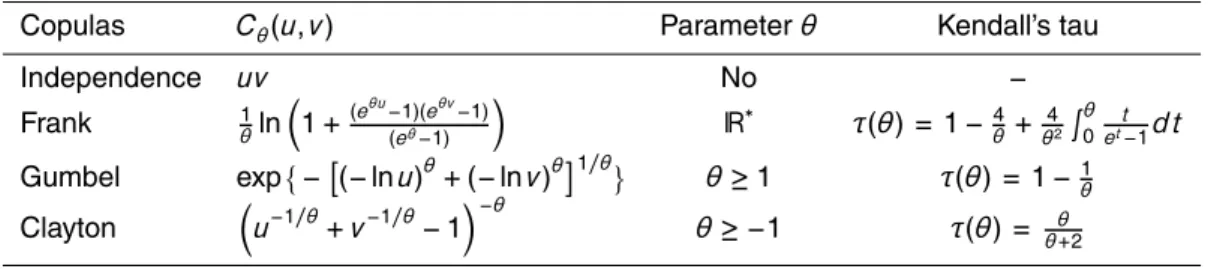
relationship between two variables describing the rainfall signal. First, Kendall’s tau is estimated on each of the 217 rain gauge stations in France, then the False
Discov-10
ery Rate procedure is used to define stations for which the dependence is significant. Among three usual archimedean copulas, a unique 2-copula is chosen to model this dependence for any station. Modelling dependence leads to an obvious improvement in the reproduction of the standard and extreme statistics of maximum rainfall, espe-cially for the sub-daily rainfall. An accuracy test for the extreme values shows the good
15
asymptotic behaviour of the new rainfall generator version and the impacts of the cop-ula choice on extreme quantile estimation.
1 Introduction
The utilization of stochastic models in a hydrological framework was introduced by (Eagleson, 1972). He derived the peak flow rate frequency from average intensity
20
and storm duration, by assuming the two random variables independent and expo-nentially distributed. This paper stimulated much subsequent works aimed at various purposes in which same hypotheses are assumed (Eagleson, 1978a,b,c; C ´ordova and
Rodr´ıguez-Iturbe, 1985; D´ıaz-Granados et al., 1984; Guo and Adams, 1999; Li and
Adams, 2000).
HESSD
9, 11227–11266, 2012Modelling dependence of rainfall variables into
a stochastic model
P. Cantet and P. Arnaud
Title Page
Abstract Introduction
Conclusions References
Tables Figures
◭ ◮
◭ ◮
Back Close
Full Screen / Esc
Printer-friendly Version Interactive Discussion
Discussion
P
a
per
|
Dis
cussion
P
a
per
|
Discussion
P
a
per
|
Discussio
n
P
a
per
Even if these papers led to remarkable results, observed data statistics undermined the assumption of independence between the depth (or intensity) and the duration of a rainfall. However, Adams and Papa (2000) compared analytical models by assum-ing both dependent and independent rainfall characteristics and showed that models have better performances and more conservative results by neglecting the association
5
among the random variables. These results might be explained by the selection of an inappropriate dependence model.
The joint probability function make it possible to model dependence between hydro-logical variables (Goel et al., 2000; Kurothe et al., 1997). The main limitation of this approach is that the individual behavior of the variables (marginal distributions) must
10
then be characterized by the same parametric family of univariate distributions. Ex-ponential marginal distribution is generally used to model the intensity or duration of rainfall (Singh and Singh, 1991; Bacchi et al., 1994). However, the exponential function does not always fit the sample distributions exactly and distinct marginal probability functions may be needed for the variables (Salvadori and De Michele, 2006;
Haber-15
landt et al., 2008).
An opportunity to overcome these modelling drawbacks has been achieved using
copula functions introduced by (Hoeffding, 1940; Sklar, 1959). Copulas are functions
that join or “couple” multivariate distribution functions to their one-dimensional marginal distribution functions (Nelsen, 2006). Starting with the papers of De Michele and
Sal-20
vadori (2003) and Favre et al. (2004), copula models have become more and more widespread in hydrological models (Salvadori and De Michele, 2004; De Michele et al., 2005; Zhang and Singh, 2007; Salvadori et al., 2007; Haberlandt et al., 2011) to im-prove their performance (Vandenberghe et al., 2011). The flexibility of copulas can be
applied on different topics. Salvadori and De Michele (2006); Gargouri-Ellouze and
25
HESSD
9, 11227–11266, 2012Modelling dependence of rainfall variables into
a stochastic model
P. Cantet and P. Arnaud
Title Page
Abstract Introduction
Conclusions References
Tables Figures
◭ ◮
◭ ◮
Back Close
Full Screen / Esc
Printer-friendly Version Interactive Discussion
Discussion
P
a
per
|
Dis
cussion
P
a
per
|
Discussion
P
a
per
|
Discussio
n
P
a
per
|
on one station alone or on several stations subject to the same precipitation regime. Balistrocchi and Bacchi (2011) proposed similar marginal distributions and the same dependence structure to reproduce three Italian rainfall time series.
The aim of this paper is to present a practical framework which stochastically
gener-ates a dependence between the different rainstorm characteristics into a rainfall model
5
already presented in (Cernesson et al., 1996; Arnaud and Lavabre, 1999, 2002; Ar-naud et al., 2007). Like in Wu et al. (2006), the proposed model is applicable for
sim-ulating rainstorm at different sites. The model structure (marginal distribution functions
of rainstorm characteristics or relationships between them) is the same for any sta-tion, shifting from one climate to another is possible based uniquely on the model’s
10
parameters. Arnaud et al. (2007) highlighted that the model can reproduce extreme rainfall for all types of climate by adding a dependence structure between the depths of successive rainstorms. The current version of the model has been regionalized on French territory providing a knowledge of the rain risk on ungauged sites (Arnaud et al., 2006) and reproduced in a satisfactory way the standard and extreme statistics of long
15
duration maximum rainfall (≥24 h) (Muller et al., 2009; Neppel et al., 2007).
However, the sub-daily rainfalls generated by the model do not properly respect ob-servations on several sites, particularly for sites situated in the mountain landscape
and near the Atlantic Ocean. In these regions, the coefficients of the Montana’s laws1
estimated from the simulated rainfalls are really different from the reality. It can be
20
explained by a non-modelling dependence. To improve the generation of the sub-daily rainfall, the paper focuses on the application of the copula theory to generate correlated rainfall characteristics, especially the depth and duration of a rainstorm.
1
HESSD
9, 11227–11266, 2012Modelling dependence of rainfall variables into
a stochastic model
P. Cantet and P. Arnaud
Title Page
Abstract Introduction
Conclusions References
Tables Figures
◭ ◮
◭ ◮
Back Close
Full Screen / Esc
Printer-friendly Version Interactive Discussion
Discussion
P
a
per
|
Dis
cussion
P
a
per
|
Discussion
P
a
per
|
Discussio
n
P
a
per
2 The rainfall generator: SHYPRE
This Section briefly presents the rainfall generator: principle and variables. For further details, a methodological guide has been published (Arnaud and Lavabre, 2010) in French language. Arnaud et al. (2007) can be considered as the referential scientific paper about SHYPRE written in English.
5
2.1 The principle
SHYPRE is a sequential model of hydrograph simulation based on an hourly rainfall generation. It was developed at IRSTEA in Aix-en-Provence and can be coupled with
a rainfall-runoffmodel (Cernesson, 1993; Arnaud, 1997). This generator is of the
aggre-gation type and models only intense rainfall events. Descriptive variables are used to
10
define the hourly rainfall signal into a rainfall event. Each variable was fitted by a prob-ability law (Cernesson et al., 1996). Monte Carlo methods were used to reproduce the rainfall signal from the generation of these variables. Then time series, statistically equivalent to observations, can be reproduced for any desired time period. Quantiles are empirically estimated from these simulated times series. The robustness and the
15
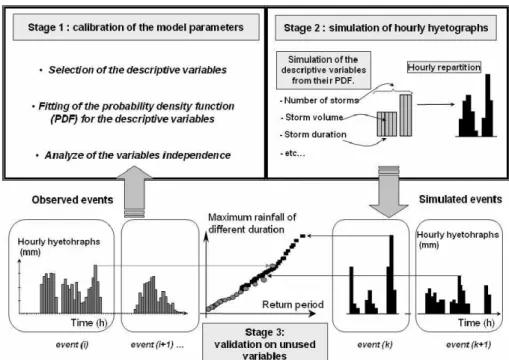
accuracy of these quantiles has been tested for the daily rainfall (Muller et al., 2009; Neppel et al., 2007). Figure 1 illustrates the generator’s principle.
2.2 Generator’s descriptive variables
First, the descriptive analysis of rainfall was based on rainfall events selected on daily criteria, i.e. a succession of daily rainfall depths of more than 4 mm, including one
20
HESSD
9, 11227–11266, 2012Modelling dependence of rainfall variables into
a stochastic model
P. Cantet and P. Arnaud
Title Page
Abstract Introduction
Conclusions References
Tables Figures
◭ ◮
◭ ◮
Back Close
Full Screen / Esc
Printer-friendly Version Interactive Discussion
Discussion
P
a
per
|
Dis
cussion
P
a
per
|
Discussion
P
a
per
|
Discussio
n
P
a
per
|
Based on these events, selected at daily intervals, the hourly rainfall signal is char-acterized by seven other descriptive variables. These variables are the number of rainy
periods within an event (NRP), the number of storms within a rainy period (NS), and
the dry duration that separates it from the next rainy periodDRP. The storm is the
ba-sic entity for the analysis of rainfall events, and is defined as a succession of hourly
5
rainfall accumulations with a single local maximum. Each storm is characterized by its
duration (DS) and its volume (VS). The quantitative analysis of storm volumes and
du-rations showed the need to distinguish two types of storm called “major” and “ordinary” storms, and therefore to create a storm typology based on a daily criterion (Fine and Lavabre, 2002). This storm typology enables us to extract the main information from
10
rainfall modelling (Arnaud et al., 2007). Furthermore, two other variables have been introduced to characterize the hourly rainfall itself: the ratio between the hourly peak of
the storm and its volume (1/DS≤RXS≤1) and the relative position of the maximum
(1≤RPXS≤DS). These allow for a satisfactory representation of the different hourly
rainfall patterns. Figure 2 illustrated an example of a rainy event where the different
15
descriptive variables are presented.
2.3 Model calibration
A first study carried out by Cernesson et al. (1996) determined the most adapted prob-ability laws to the various descriptive variables. The objective of the model regional-ization (realized on the whole French territory) led us to define the same theoretical
20
law for a given variable, whatever the studied station. For example, an exponential law has been chosen for the storm volume, and Poisson’s law for the duration storm, whatever the studied station. Only parameters of these probability laws distinguish the
climate (Arnaud et al., 2007). Calibrating the generator consists in estimating different
parameters of the chosen probability laws with observed rainfall in a given rain gauge
25
station. 20 parameters are required to fully calibrate the rainfall generator for two dif-ferent seasons namely the “winter” season from December to May and the “summer”
HESSD
9, 11227–11266, 2012Modelling dependence of rainfall variables into
a stochastic model
P. Cantet and P. Arnaud
Title Page
Abstract Introduction
Conclusions References
Tables Figures
◭ ◮
◭ ◮
Back Close
Full Screen / Esc
Printer-friendly Version Interactive Discussion
Discussion
P
a
per
|
Dis
cussion
P
a
per
|
Discussion
P
a
per
|
Discussio
n
P
a
per
the precipitation regimes. Note that some of the 20 parameters either vary only slightly or have very little impact on the results.
2.4 Simulation and rainfall quantiles estimation
After the model calibration, in order to simulate a rainy event, all descriptive variables are generated in a specific order. Many rainy events are created to build time series
5
as long as wanted in which the average number of observed events per year for each
season are respected. To reduce the sampling effect on the simulated events, we chose
to generate rainfall on periods which were a thousand times longer than the strongest return period which we want to determine. For example, a 100 yr-quantile is determined by generated hyetographs on a 100 000 yr simulation period. Quantiles can then be
10
empirically estimated from these simulated times series without uncertainty due to the sampling variability.
At the beginning, the descriptive variables of the model were considered statistically independent. Many studies highlighted that some variables are dependent according to observations and that the dependence modelization is needed in order to reproduce
15
the rainfall signal. Indeed, Arnaud et al. (2007) shows that the model can reproduce extreme rainfall for all types of climate by adding a dependence structure between the depths of successive rainstorms. In this paper, we focus on the dependence between two variables: the depth and the duration of a rainstorm.
2.5 An operational model
20
Prima facie, SHYPRE appears to be a complex model due to the number of variables or
the different typologies used to define them. Nevertheless, an effort has been made to
simplify it enabling an application on many hydrological problems. For example, Cantet et al. (2011) detected climate change impact on extreme rainfall throughout the model parameters; the SHYPRE outputs are also used to determine the dimension of a dam
HESSD
9, 11227–11266, 2012Modelling dependence of rainfall variables into
a stochastic model
P. Cantet and P. Arnaud
Title Page
Abstract Introduction
Conclusions References
Tables Figures
◭ ◮
◭ ◮
Back Close
Full Screen / Esc
Printer-friendly Version Interactive Discussion
Discussion
P
a
per
|
Dis
cussion
P
a
per
|
Discussion
P
a
per
|
Discussio
n
P
a
per
|
with a radar (Fouchier, 2007) or in a flash flood warning (Javelle et al., 2010). A
region-alized version of the model allows the estimation of rainfall quantiles for different time
durations on a square of 1 km2everywhere in the French territory (Arnaud et al., 2006).
3 How to diagnose and model the dependence
The aim of this part is to introduce the mathematical tools used in the study of
depen-5
dence between random variables. Only tools used in our study are clearly presented. For further information, see Nelsen (2006) and Genest and Favre (2007).
3.1 Measuring dependence: Kendall’s tau
Classically, dependence is measured by correlation coefficients. The most well-known
is Pearson’s coefficient (R) used for example in a linear regression. It only
character-10
izes a linear dependence between two variables. When the dependence is not linear, a correlation computed on ranks appears to be the best approach (Oakes, 1982)
lead-ing to the buildlead-ing of two other correlation coefficients: Spearman’s rho and Kendall’s
tau. Only Kendall’s tau (notedτ) is presented in this paper:
Suppose that a random sample (X1,Y1),. . ., (Xn,Yn) is given from some pair (X,Y)
15
of continuous variables. Here,Ri stands for the rank of Xi among X1,. . .,Xn, and Si
stands for the rank of Yi among Y1,. . .,Yn. The empirical version of Kendall’s tau is
given by:
τn = Pn−Qn
n(n−1)/2 = 4
n(n−1)Pn−1 (1)
where Pn and Qn are the number of concordant and discordant pairs, respectively.
20
Here, two pairs (Xi,Yi), (Xj,Yj) are said to be concordant when (Xi−Xj)(Yi−Yj)>0,
and discordant when (Xi−Xj)(Yi−Yj)<0. The borderline case (Xi−Xj)(Yi−Yj)=0
occurs with a probability zero under assumption that X and Y are continuous. The
HESSD
9, 11227–11266, 2012Modelling dependence of rainfall variables into
a stochastic model
P. Cantet and P. Arnaud
Title Page
Abstract Introduction
Conclusions References
Tables Figures
◭ ◮
◭ ◮
Back Close
Full Screen / Esc
Printer-friendly Version Interactive Discussion
Discussion
P
a
per
|
Dis
cussion
P
a
per
|
Discussion
P
a
per
|
Discussio
n
P
a
per
It is obvious that τn is a function of the ranks of the observations only, since (Xi−
Xj)(Yi−Yj)>0 if and only if (Ri−Rj)(Si−Sj)>0.
If X and Y are mutually independent, we have τn≈0. The closer to 1|τn| is, the
stronger the dependence between two variables. Ifτn>0 (resp.<0), the dependence
is positive (resp. negative).
5
An independence test can be based onτn, since underH0: independence between
two variables,big this statistic is close to normal with zero mean and variance 2(2n+
5)/(9n(n+1)). For example, we can reject H0 with a significance level (type I error)
α=5 % ifq2(29n(nn++1)5)|τn| > zα/2 =1.96.
With discrete variables, this statistical test is biased by the ties. An unbiasing test
10
consists in replacingnbyn−number of ties in the variance calculus under H0.
How-ever, this case will be discussed further.
3.2 Modelling dependence: copula approach
Traditionally, the pairwise dependence between variables has been described using classical families of multivariate distributions. The main limitation of this approach is
15
that the individual behavior of the two variables must be characterized by the same
parametric family of univariate distributions. The copula model, introduced by (Hoeff
d-ing, 1940; Sklar, 1959), is more and more widespread since it avoids this restriction. For simplicity purposes, we restrict attention to the bivariate case in this paper. A bidimensional copula, also called a 2-copula, is a two-place real function defined
20
on [0, 1]×[0, 1]→ [0, 1] such as
1. ∀u,v ∈[0, 1],
C(u, 0)=0,C(u, 1)=u,C(0,v)=0,C(1,v)=v;
2. ∀u1,u2,v1,v2 ∈[0, 1] such asu1≤u2andv1≤v2,
C(u2,v2)−C(u2,v1)−C(u1,v2)+C(u1,v1)≥0
HESSD
9, 11227–11266, 2012Modelling dependence of rainfall variables into
a stochastic model
P. Cantet and P. Arnaud
Title Page
Abstract Introduction
Conclusions References
Tables Figures
◭ ◮
◭ ◮
Back Close
Full Screen / Esc
Printer-friendly Version Interactive Discussion
Discussion
P
a
per
|
Dis
cussion
P
a
per
|
Discussion
P
a
per
|
Discussio
n
P
a
per
|
FX Y a joint cumulative distribution function of any pair of (X,Y) of continuous random
variables can be written in the form
FX Y(x,y) =C(FX(x),FY(y)) , ∀x,y ∈R (2)
whereFX and FY are the marginal functions andC: [0, 1]×[0, 1]→[0, 1] is a copula.
Sklar (1959) showed thatC,FX, andFY are uniquely determined whenFX Y is known,
5
a valid model for (X,Y) arises from Eq. (2) whenever the three “ingredients” are chosen
from given parametric families of distributions.
The main advantage of the copula approach is that the choice of the dependence
model betweenX andY does not depend on the marginal distributions.
For a random sample (X1,Y1),. . ., (Xn,Yn) from some pair (X,Y), anempirical copula
10
can be introduced, and is defined by
Cn(u,v)=
1
n
n
X
i=1 1(F
X(Xi)≤u∩FY(Yi)≤v) (3)
where1(.)denotes the indicator function,FX andFY are the marginal distributions ofX
andY.
3.3 Estimation and choice of models
15
Modeling dependence between two random variables (X and Y) can be achieved by
using some families of copulas. In this paper, we only considered 3 archimedean copu-las: the Frank copula (Frank, 1979), the Clayton copula (Clayton, 1978), and the Gum-bel copula (GumGum-bel, 1961). These copulas have been chosen because they have only one parameter and are easily applicable.
20
Like usual statistic laws, different methods are used to estimate copula parameters.
HESSD
9, 11227–11266, 2012Modelling dependence of rainfall variables into
a stochastic model
P. Cantet and P. Arnaud
Title Page
Abstract Introduction
Conclusions References
Tables Figures
◭ ◮
◭ ◮
Back Close
Full Screen / Esc
Printer-friendly Version Interactive Discussion
Discussion
P
a
per
|
Dis
cussion
P
a
per
|
Discussion
P
a
per
|
Discussio
n
P
a
per
(Genest et al., 1995). For other methods, see Joe (1997), Tsukahara (2005) and Gen-est et al. (2008a). In this study, we Gen-estimated the copula parameter with the Kendall’s tau.
In typical modelling exercises, the user can choose between many different
depen-dence structures. Consequently, a method is necessary to select, among different
cop-5
ulas, the best adapted dependence structure for the studied data. For the unidimen-sional law, several tests provide the best fitting to the observations, for example the Kolmogorov-Smirnov test. To test the suitability of copula models, the same principle can be used. For example, we can compare the empirical copula (defined in Eq. (3)) to a theoretical copula through the calculation of the Kolmogorov-Smirnov statistic or
10
through a QQ-plot. In this way, Genest and Rivest (1993); Hillali (2001) proposed a test for the Archimedean copulas. Genest et al. (2008b) compared a lot of measures to choose the best copula. Genest and R ´emillard (2008) use a bootstrap procedure for suitability testing. This test has been implemented in the “copula” package (Yan, 2007) from the language R (http://www.r-project.org/).
15
3.4 Generating a pair from a copula
Simple simulation algorithms are available for most copula models, e.g. Devroye (1986, Ch. 2), or Whelan (2004) for the Archimedean copulas. In the bivariate case, a good
strategy for generating a pair (U,V) from a copulaC consists in using the conditional
distributions:
20
1. Generateufrom a uniform distribution on the interval [0, 1],
2. GivenU=u, generate from the conditional distribution:
Qu(v) =P V ≤v|U =u= ∂u∂ C(u,v)
HESSD
9, 11227–11266, 2012Modelling dependence of rainfall variables into
a stochastic model
P. Cantet and P. Arnaud
Title Page
Abstract Introduction
Conclusions References
Tables Figures
◭ ◮
◭ ◮
Back Close
Full Screen / Esc
Printer-friendly Version Interactive Discussion
Discussion
P
a
per
|
Dis
cussion
P
a
per
|
Discussion
P
a
per
|
Discussio
n
P
a
per
|
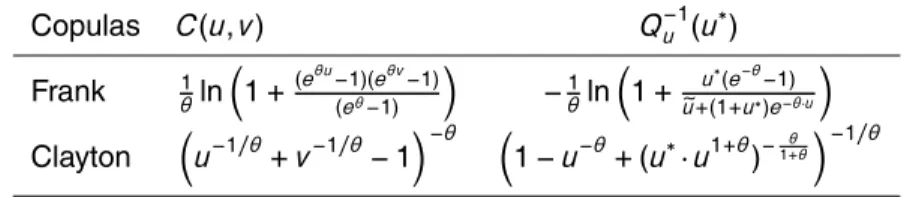
The explicit formulas forQ−u1are illustrated in the Table 2 for the Frank and Clayton
copulas. For the Gumbel copula, no explicit formula exists, the valuev =Q−u1(u◦) can
be determined by a numerical approach2.
To avoid using an optimization algorithm, Embrechts et al. (2003) or Mc Neil (2008)
propose to generate directly the pair (U,V). In our case, the latter approach is not
5
suitable since the storm duration must be generated for a given volume storm (already generated Arnaud et al., 2007).
3.5 The discrete variable case
In the context of dependence, the methods described above depend on the continu-ity assumptions for the marginal distributions. In the case of discrete variables, many
10
desirable properties of dependence measures no longer hold. The main technical ar-gument consists in a continuous extension of integer-valued random variables. Here, we used the method proposed by (Denuit and Lambert, 2005).
Assume thatX is a discrete variable and X ≥0. We associateX with a continuous
randomX∗such as
15
X∗ =X +(U−1), whereU ∼ U[0, 1]. (4)
4 Application into the rainfall generator: Depth/Duration dependence
The subject of this section is to apply the copula approach to the rainfall generator to simulate the relationship between the depth and duration of a rainstorm. This
relation-ship is called further theDepth/Duration dependence. Only major storms are taken into
20
account to study this dependence.
2
HESSD
9, 11227–11266, 2012Modelling dependence of rainfall variables into
a stochastic model
P. Cantet and P. Arnaud
Title Page
Abstract Introduction
Conclusions References
Tables Figures
◭ ◮
◭ ◮
Back Close
Full Screen / Esc
Printer-friendly Version Interactive Discussion
Discussion
P
a
per
|
Dis
cussion
P
a
per
|
Discussion
P
a
per
|
Discussio
n
P
a
per
First, the data used in the study are briefly presented. Then, the mathematical tools, presented in Sect. 3, are applied to model this dependence. Finally, the impacts on the rainfall quantiles estimation are illustrated.
4.1 Presentation of data used
217 rain-gauge stations are used in metropolitan France (Fig. 3). Among the 217
sta-5
tions studied, 173 are reference rainfall stations for the French weather office M ´et
´eo-France (synoptic network). The others are stations with long observation records, and data that have been validated by management agencies – mainly Cemagref; DDE,
the local offices of the France Ministry of Equipment; and Diren, the regional
environ-ment authorities. If all stations are taken into account, the median observation period
10
is 17.8 yr, with observation periods ranging from a few years for some of the alpine sta-tions to 78 yr for the rainfall series in Marseille. The sampling of data used in this study indicates an extremely wide range of rainfall values, providing the opportunity to see how the hourly rainfall models perform in highly diverse contexts. Arnaud et al. (2007) used the same stations and presented them in further details.
15
4.2 TheDepth/Duration dependence model
In the rainfall generator, the volume of a rainstorm, noted V, follows an exponential
law while the duration of a rainstorm, notedD, follows a Poisson’s law, a discrete law.
Consequently, the method described in Sect. 3.5 is applied to transformDtoD∗without
losing information.
20
4.2.1 Where is theDepth/Duration dependencesignificant?
First Kendall’s tau between V and D∗ is estimated on each of the 217 rain gauge
HESSD
9, 11227–11266, 2012Modelling dependence of rainfall variables into
a stochastic model
P. Cantet and P. Arnaud
Title Page
Abstract Introduction
Conclusions References
Tables Figures
◭ ◮
◭ ◮
Back Close
Full Screen / Esc
Printer-friendly Version Interactive Discussion
Discussion
P
a
per
|
Dis
cussion
P
a
per
|
Discussion
P
a
per
|
Discussio
n
P
a
per
|
determine, from the 217 obtained p-values3, the number of rejected null hypothesis,
that is the number of stations for which theDepth/Durationindependence hypothesis
is rejected at a fixed significance levelα=0.05 (type I error).
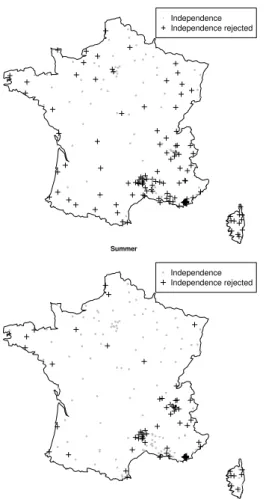
The null hypothesisH0: independence betweenV and D∗ is not rejected for all
sta-tions. Actually the significance of the dependence seems to depend on the season and
5
the geographical location (climate) (See Fig. 3). In Winter, 140 among 217 rain gauge stations have a significant positive dependence, that is to say, a storm with a big volume is usually associated with a storm with a long duration (on these 140 stations). In Sum-mer, only 81 stations have a significant positive dependence, these stations are mostly located in the mountain landscape or near the ocean. These results are
climatologi-10
cally consistent. Indeed, summer rainfall, especially in the continental climate, occur in rainy phenomena providing rainstorms with a strong intensity and a short duration (convective systems).
4.2.2 How can theDepth/Duration dependencebe modelled?
The goal is to maintain a single model structure: only model parameters can distinguish
15
the climate. Therefore only one copula should be used to model theDepth/Duration
dependencefor any station.
On each station where the dependence is significant (140 for Winter and 81 for
Summer), theL2-distance between the empirical copula and the 3 theoretical copulas
is calculated and is ordered. The best copula, that is to say the copula whose distance
20
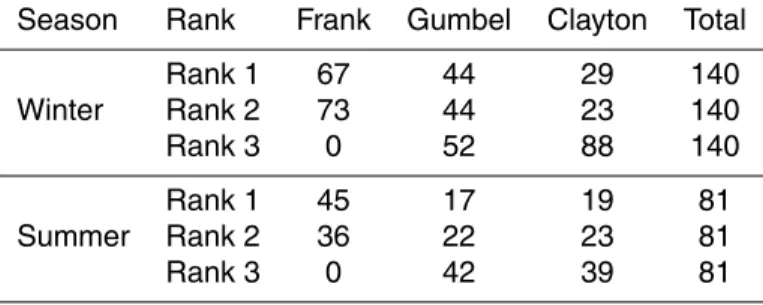
is minimum, has the rank 1. Most of the time, the copula which is selected is the Frank copula (see Table 3). When another copula seems to be better (it often occurs when the numbers of storms is lower than 40), the Frank copula is always the second
best copula, never the “worst” copula. Besides, the L2-distance for the Frank copula
3
the p-value is the probability of obtaining a result at least as large as the one actually observed, given that the null hypothesis is true. In our case, it corresponds toP(X >tau) where
HESSD
9, 11227–11266, 2012Modelling dependence of rainfall variables into
a stochastic model
P. Cantet and P. Arnaud
Title Page
Abstract Introduction
Conclusions References
Tables Figures
◭ ◮
◭ ◮
Back Close
Full Screen / Esc
Printer-friendly Version Interactive Discussion
Discussion
P
a
per
|
Dis
cussion
P
a
per
|
Discussion
P
a
per
|
Discussio
n
P
a
per
is close to theL2-distance for the best copula. Finally, there is no specific geographic
localization where the Frank copula is not the best one.
This procedure is not a formal test, it only permits to define the best adapted copula among others according to a criterion. To assure the goodness-of-fit, the test presented
by (Genest and R ´emillard, 2008)4has been performed on each station where the
de-5
pendence is significant. As for the independence test, the FDR procedure is applied on
thep-values (140 for Winter and 81 for Summer). No null hypothesis – Frank copula is
well adapted – is rejected at a fixed significance levelα=0.05 for Winter and Summer.
Note that, the same test has been performed for the Gumbel copula and only 5 (resp. 2) null hypothesis are rejected for Winter (resp. Summer). For the Clayton copula, 102
10
(resp. 69) null hypothesis are rejected for Winter (resp. Summer).
The Frank copula is chosen to model the Depth/Duration dependence for any station.
The parameterθof the copula is estimated with the inversion of Kendall’s tau which is
estimated on each station (as shown in Fig. 3). Therefore, the shifting from one climate
to another is possible based uniquely on the parameterθ.
15
4.3 Impacts on the rainfall quantiles estimated by the generator
The Depth/Duration dependence modelling (by Frank and Gumbel copulas) has been implemented into the rainfall generator as shown in the Sect. 3.4. Simulations were performed on all 217 available stations and the performance of the new model was compared to the performance of the model that does not take into account the
20
Depth/Duration dependence for all stations. The model is only tested in terms of repro-duction of the maximum rainfall of an event. Testing autocorrelation, cross-validation or intermittency is not the subject of the paper.
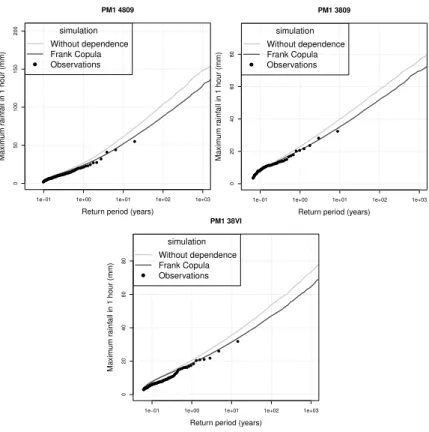
First, the impact of the Depth/Duration dependence modelling is illustrated by the plotting of the frequency distributions for 1-h maximum rainfall for three stations (see
25
HESSD
9, 11227–11266, 2012Modelling dependence of rainfall variables into
a stochastic model
P. Cantet and P. Arnaud
Title Page
Abstract Introduction
Conclusions References
Tables Figures
◭ ◮
◭ ◮
Back Close
Full Screen / Esc
Printer-friendly Version Interactive Discussion
Discussion
P
a
per
|
Dis
cussion
P
a
per
|
Discussion
P
a
per
|
Discussio
n
P
a
per
|
the positive dependence is significant. Nevertheless the new model allows a better es-timation according to the observations. Indeed, without the dependence modelling, the generator seems to overestimate 1-h rainfall. Note that, the quantiles with the Gumbel copula model are not shown in Fig. 4 because they are very close to Frank’s quantiles.
Then, we also compared the quantiles obtained from fitting an exponential law5 to
5
the observation samples (notedQTobs) with quantiles from simulations of rainfall events
(notedQTRG) according to two criteria:
1. The relative error given by
Error =100Q
T
RG−Q
T
obs
QTobs (5)
is calculated on each 217 available stations. Its distribution is illustrated by a
box-10
plot where whiskers corresponding to the 0.05 and 0.95 quantile (See Fig. 5).
2. The Nash criterion (Nash and Sutcliffe, 1970) given by
Nash =1−
n
X
i=1
(QTobs−QTRG)2
n
X
i=1
(QobsT −QTobs)2
(6)
whereQTobs=n1
n
X
i=1
QTobs andnis the number of studied stations. It is widely
con-sidered that Nash≥0.7 signifies that the two series are similar. Table 5 illustrated
15
5
HESSD
9, 11227–11266, 2012Modelling dependence of rainfall variables into
a stochastic model
P. Cantet and P. Arnaud
Title Page
Abstract Introduction
Conclusions References
Tables Figures
◭ ◮
◭ ◮
Back Close
Full Screen / Esc
Printer-friendly Version Interactive Discussion
Discussion
P
a
per
|
Dis
cussion
P
a
per
|
Discussion
P
a
per
|
Discussio
n
P
a
per
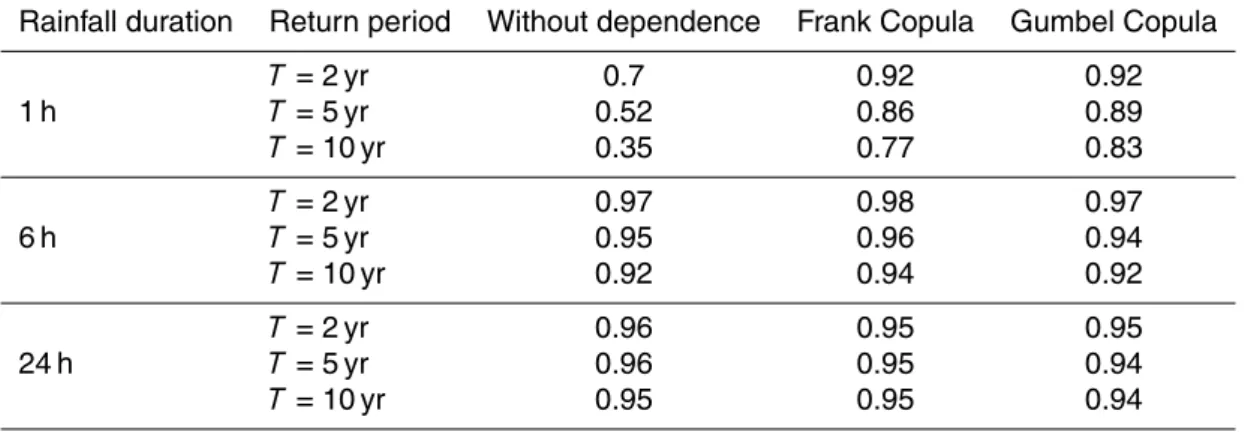
the value of the Nash criterion forT =2, 5, 10 yr calculated on the 217 available
stations coming from quantiles estimated by the two models.
Rainfall patterns can be distinguished according to the ratio between the short
dura-tion rainfall and long duradura-tion rainfall. Figure 6 illustrated the difference (like in Eq. (5))
betweenRobsT andRRGT where:
5
RobsT (D1,D2)=Q
T
obs(D1)
QTobs(D2) and R
T
RG(D1,D2)=
QTRG(D1)
QTRG(D2) (7)
D1 orD2 being the duration of the maximum rainfall with D1=1 h or 6 h andD2=6 h
or 24 h.
Results presented in Table 5 and Figs. 5 and 6 show an obvious gain of the copula used to reproduce hourly extreme rainfall. Indeed quantiles are globally more similar
10
to observed data when dependence is modelled for both models (Gumbel or Frank). This improvement is due to a better grasp of the observed phenomena. Modelling the Depth/Duration dependence results in a more accurate plotting of rainfall quantiles,
especially for the sub-daily maximum rainfall, enables us to generate different rainfall
patterns. The copula choice in the Depth/Duration dependence modelling leads to little
15
impact on the estimation of rainfallT-quantiles withT ≤10 yr for any duration.
The previous part showed that quantiles estimated by the new models are similar to
the quantiles coming from a fitting by an exponential forT ≤10 yr. Dealing with (very)
extreme values, finding a relevant accuracy test is not an easy task6.
Arnaud et al. (2008) proposed a simple test which is also used in (Garavaglia et al.,
20
HESSD
9, 11227–11266, 2012Modelling dependence of rainfall variables into
a stochastic model
P. Cantet and P. Arnaud
Title Page
Abstract Introduction
Conclusions References
Tables Figures
◭ ◮
◭ ◮
Back Close
Full Screen / Esc
Printer-friendly Version Interactive Discussion
Discussion
P
a
per
|
Dis
cussion
P
a
per
|
Discussion
P
a
per
|
Discussio
n
P
a
per
|
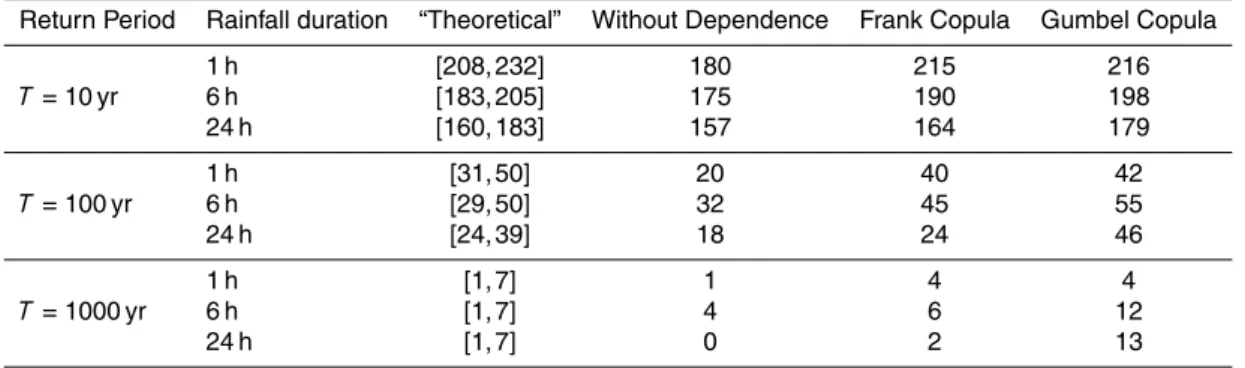
performed on 414 rain gauge stations7. Table 6 shows the number of stations where
theT-quantiles are exceeded by the maximum observed rainfall.
The results of the accuracy test show that the model without dependence proposes overestimated extreme quantiles, especially for the sub-daily rainfalls. Unlike the mod-els where the Depth/Duration dependence is modeled, the number of stations where
5
the observed records exceed extreme quantiles is too small compared to the “theoret-ical” number. Modelling dependence allows the researchers to obtain extreme rainfall quantiles that are coherent with the accuracy test for the sub-daily rainfall. The choice
of the copula (Frank versus Gumbel) affects the rainfall quantiles for durationD >1 h,
especially when the return period is high. Unlike the Frank copula, the Gumbel
cop-10
ula “amplifies” the dependence in extreme values leading to a clear underestimation for daily rainfall extreme quantiles. An extreme rainfall event is often constructed from a succession of heavy storms (persistence phenomenon in Arnaud et al., 2007). Gen-erating too long durations for these heavy storms causes a decrease of the number of rainstorms occurring in 24 h leading to a decrease of daily rainfall depth.
15
5 Discussion and conclusions
In this paper, the copula approach is applied into a stochastic hourly rainfall generation model. With this tool, any dependence can easily be taken into account in an existing stochastic model, because a copula process permits the desciption of the dependen-cies between many random variables, independently of their marginal distributions. It
20
has been applied to generate a relation between the depth and the duration of a rain-storm.
The rainfall generator has been developed to be applicable for all types of climate. The rainfall model structure is the same for any station, a shifting from one climate to
7
HESSD
9, 11227–11266, 2012Modelling dependence of rainfall variables into
a stochastic model
P. Cantet and P. Arnaud
Title Page
Abstract Introduction
Conclusions References
Tables Figures
◭ ◮
◭ ◮
Back Close
Full Screen / Esc
Printer-friendly Version Interactive Discussion
Discussion
P
a
per
|
Dis
cussion
P
a
per
|
Discussion
P
a
per
|
Discussio
n
P
a
per
another is possible based uniquely on the model’s parameters. To continue in the same way, only one copula has been chosen to model the same structure of dependence on any sites. A procedure has been performed to find the best adapted copula among others. For both seasons, the Frank copula appears to be the best for most of the sites, according to our criteria, and has been validated by a formal goodness-of-fit test.
5
No influence seems to be exerted by the rain gauge locations over the dependence structure. Here, two seasons are distinguished into the generator calibration. A future
version of the model will distinguish different weather patterns based on meteorological
circulation used in Garavaglia et al. (2010). This distinction could lead to use different
copulas for each class of weather providing a better generation of all rainfall patterns.
10
Taking dependence into account enables the researchers to improve the results of the rainfall model, especially in the sub-daily rainfall generation. The copula choice in the Depth/Duration dependence modelling (Gumbel or Frank) leads to minor impact
on the estimation of rainfallT-quantiles withT ≤10 yr for any duration. The two criteria
used have shown that the proposed model could reproduce the standard statistics of
15
maximum rainfall for all durations. Indeed biennial or decennial quantiles estimated by the model are close to those estimated by a fitting on observations: the relative errors
are centred to 0 and do not exceed±20 % for 95 % of 217 available stations. Stations
can be clustered according to three different types of climate: alpine, temperate and
Mediterranean to test the model’s performance in each type of climate. For the three
20
climates, the Frank copula seems to be the best adapted and the two criteria (relative error and the Nash criterium) are approximately the same for each type of climate. However, simulated hourly rainfall in the alpine climate seems to be overestimated in the high elevation site. This overestimation can be caused by the fact that the snow can lead to inaccurate knowledge of the real rainfall intensity.
25
HESSD
9, 11227–11266, 2012Modelling dependence of rainfall variables into
a stochastic model
P. Cantet and P. Arnaud
Title Page
Abstract Introduction
Conclusions References
Tables Figures
◭ ◮
◭ ◮
Back Close
Full Screen / Esc
Printer-friendly Version Interactive Discussion
Discussion
P
a
per
|
Dis
cussion
P
a
per
|
Discussion
P
a
per
|
Discussio
n
P
a
per
|
heaviest storms leading an underestimation on the daily rainfall quantiles. As previously mentioned, this test should be performed in each climate but the authors think the number of stations is too small to apply it. However, the location of the stations where the quantiles have been exceeded can give an idea of the good representation of all types of climate. For example, the stations where the decennial quantile is exceeded
5
are well distributed all over France. It is similarly for the centennial quantiles except for alpine sites where no centennial quantiles are exceeded. It can be explained by the relatively short observation periods (about 10 yr for the alpine stations).
To conclude, the proposed model can reproduce the standard and extreme statistics of maximum rainfall for any duration. Only one parameter has been added compared
10
to the previous version. It has been regionalized and can provide rainfall quantiles on ungauged sites (Arnaud et al., 2006). The additional parameter can be explained by geographical variables and has been regionalized to apply the proposed version of the rainfall generator in the whole France leading to an improvement of the estimation of the hourly rainfall quantiles.
15
Note that, in this study, copulas are applied to model the Depth/Duration dependence but their application can be extended to many dependencies. In another study, the “per-sistence” phenomenon (dependence between the depth of rainstorms in a rainy event) introduced by (Arnaud et al., 2007), is modeled by an approach based on copulas, providing good results in extreme rainfall generation.
20
Appendix A
Controlling the global significance level of a multiple tests approach using the False Discovery Rate (FDR): the Benjamini and Hochberg (BH) procedure
Benjamini and Hochberg (1995) proposed a procedure to control the global
signifi-cance levelαgof a multiple tests procedure. Assuming thatK tests of a null hypothesis
25
HESSD
9, 11227–11266, 2012Modelling dependence of rainfall variables into
a stochastic model
P. Cantet and P. Arnaud
Title Page
Abstract Introduction
Conclusions References
Tables Figures
◭ ◮
◭ ◮
Back Close
Full Screen / Esc
Printer-friendly Version Interactive Discussion
Discussion
P
a
per
|
Dis
cussion
P
a
per
|
Discussion
P
a
per
|
Discussio
n
P
a
per
1. Letp(1)≤p(2) ≤. . .≤p(K)be the sorted observed p-values related to theK tests;
2. Computem=max{1 ≤j≤K,p(j) ≤
j K α};
3. If m exists, then reject among the K hypothesis the m ones corresponding to
p(1) ≤. . .≤p(m)p-values; else reject no hypothesis.
Appendix B
5
An accuracy test for the extreme values
A procedure has proposed to test the pertinence of extreme quantiles estimated by a method. This test can be performed on many stations.
Let be NYi the number of years of observation at the stationi.
Let be NEi the number of rainfall events observed during the NYi years at the
sta-10
tioni.
Let be NEidef= NENAii: the average number of events per year for the stationi.
Xi ={Xji}j=1...NEi: the depth of the rainfall observed during the NE
i
rainy events.
XSi =max{Xji}j=1...NEi: the maximum rainfall observed at the stationi.
qTi: the “true” quantile with the return periodT years at the stationi
15
c
qTi: the quantile with the return periodT years at the stationi estimated by the tested
method.
Nsup: the number of stations, amongN, whereq
i
T is exceeded byX
i
S.
d
nsup: the number of stations, amongN, whereqcTi is exceeded byX
i
S.
The goal is to define the theoretical law ofNsup.
HESSD
9, 11227–11266, 2012Modelling dependence of rainfall variables into
a stochastic model
P. Cantet and P. Arnaud
Title Page
Abstract Introduction
Conclusions References
Tables Figures
◭ ◮
◭ ◮
Back Close
Full Screen / Esc
Printer-friendly Version Interactive Discussion
Discussion
P
a
per
|
Dis
cussion
P
a
per
|
Discussion
P
a
per
|
Discussio
n
P
a
per
|
Assuming that theXj are independent, we have:
P(XSi < x) =
NEi
Y
j=1
P(Xji < x)
=P(Xji < x)NE
i
5
By definition, P(Xji < qTi)=1− 1
T×NEi
. Therefore, we obtain P(XSi > qTi) =1−1−
1
T×NEi
NEi
On each station, a Bernouilli draw is realized where the success
probabil-ity P(XSi > qiT) depends on NEi and NEi. Consequently, this success probability is
different from a station to another:Nsup does not follow an usual binomial distribution.
The idea is to approach this distribution by a Monte-Carlo method.
10
When the observed records are considered independent between them, the following
procedure is proposed to approximate the theoretical distribution ofNsup:
Let beNsima large number
fork=1 :Nsim do
Nsupk =0
15
fori =1 :N do
u∼ U[0, 1]
ifu <1−1− 1
T×NEi
NEi
thenNsupk =Nsupk +1
end for end for
20
Nsim values of the random variable Nsup have been performed to obtain Πe(x) an
approximation ofΠ(x), the theoretical distribution ofNsup. Then, it is easy to estimate
HESSD
9, 11227–11266, 2012Modelling dependence of rainfall variables into
a stochastic model
P. Cantet and P. Arnaud
Title Page
Abstract Introduction
Conclusions References
Tables Figures
◭ ◮
◭ ◮
Back Close
Full Screen / Esc
Printer-friendly Version Interactive Discussion
Discussion
P
a
per
|
Dis
cussion
P
a
per
|
Discussion
P
a
per
|
Discussio
n
P
a
per
construction of a confidence intervalIconfofNsup has been chosen. Ifndsup ∈ Iconfthen
the quantileqcTi estimated by the method appears to be correct according to the data. If
d
nsupis too large (respectively small), the method seems to underestimate (respectively
overestimate) rainfall quantiles.
To obtain the independence between the observed records (a strong hypothesis to
5
constructΠe(x)), we propose to delete the stations where their records occur on the
same day (only one station is kept, randomly chosen). Thus, the confidence interval
Iconfcan differ according to the rainfall duration.
References
Adams, B. and Papa, F.: Urban Stormwater Management Planning with Analytical Probabilistic
10
Models, John Wiley & Sons, New York, 2000. 11229
Arnaud, P.: Mod `ele de pr ´edetermination de crues bas ´e sur la simulation stochastique des pluies horaires, Ph.D. thesis, Universit ´e Montpellier II, Montpellier, 1997. 11231
Arnaud, P. and Lavabre, J.: Using a stochastic model for generating hourly hyetographs to study extreme rainfalls, Hydrolog. Sci. J., 44, 433–446, 1999. 11230
15
Arnaud, P. and Lavabre, J.: Coupled rainfall model and discharge model for flood frequency estimation., Water Resour. Res., 38, 1075–1085, 2002. 11230
Arnaud, P. and Lavabre, J.: Estimation de l’al ´ea pluvial en France m ´etropolitaine, Editions QUAE, Versailles, 2010. 11231
Arnaud, P., Lavabre, J., Sol, B., and Desouches, C.: Cartographie de l’al ´ea pluviographique de
20
la France, La Houille Blanche, 5, 102–111, 2006. 11230, 11234, 11246
Arnaud, P., Fine, J., and Lavabre, J.: An hourly rainfall generation model adapted to all types of climate., Atmos. Res., 85, 230–242, 2007. 11230, 11231, 11232, 11233, 11238, 11239, 11244, 11246, 11261
Arnaud, P., Lavabre, J., Sol, B., and Desouches, C.: R ´egionalisation d’un g ´en ´erateur
25
HESSD
9, 11227–11266, 2012Modelling dependence of rainfall variables into
a stochastic model
P. Cantet and P. Arnaud
Title Page
Abstract Introduction
Conclusions References
Tables Figures
◭ ◮
◭ ◮
Back Close
Full Screen / Esc
Printer-friendly Version Interactive Discussion
Discussion
P
a
per
|
Dis
cussion
P
a
per
|
Discussion
P
a
per
|
Discussio
n
P
a
per
|
Bacchi, B., Becciu, G., and Kottegoda, N.: Bivariate exponential model applied to intensities and durations of extreme rainfall, J. Hydrol., 155, 225–236, doi:10.1016/0022-1694(94)90166-X, 1994. 11229
Balistrocchi, M. and Bacchi, B.: Modelling the statistical dependence of rainfall event variables through copula functions, Hydrol. Earth Syst. Sci., 15, 1959–1977,
doi:10.5194/hess-15-5
1959-2011, 2011. 11230
B ´ardossy, A. and Pegram, G. G. S.: Copula based multisite model for daily precipitation simula-tion, Hydrol. Earth Syst. Sci., 13, 2299-2314, doi:10.5194/hess-13-2299-2009, 2009. 11229 Benjamini, Y. and Hochberg, Y.: Controlling the false discovery rate: a practical and powerful
approach to multiple testing, J. Roy. Stat. Soc. B Met., 57, 289–300, 1995. 11246
10
Cantet, P., Bacro, J., and Arnaud, P.: Using a rainfall stochastic generator to detect trends in extreme rainfall, Stoch. Env. Res. Risk A., 25, 429–441, 2011. 11233
Carvajal, C., Peyras, L., and Arnaud, P., Boissier, D., and Royet, P.: Probabilistic Modeling of Floodwater Level for Dam Reservoirs, J. Hydrol. Eng., 14, 223–232, 2009. 11233
Cernesson, F.: Mod `ele simple de pr ´edetermination des crues de fr ´equences courantes `a rares
15
sur petits bassins versants m ´edit ´eran ´eens., Ph.D. thesis, Universit ´e Montpellier II, Montpel-lier, 1993. 11231
Cernesson, F., Lavabre, J., and Masson, J.: Stochastic model for generating hourly hyetograph, Atmos. Res., 42, 149–161, 1996. 11230, 11231, 11232
Clayton, D.: A model for association in bivariate life tables and its application in epidemiological
20
studies of familial tendency in chronic disease incidence, Biometrika, 65, 141–151, 1978. 11236
C ´ordova, J. R. and Rodr´ıguez-Iturbe, I.: On the probabilistic structure of storm surface runoff, Water Resour. Res, 21, 755–763, doi:10.1029/WR021i005p00755, 1985. 11228
De Michele, C. and Salvadori, G.: A Generalized Pareto intensity-duration model of storm
rain-25
fall exploiting 2-Copulas, J. Geophys. Res., 108, 4067, doi:10.1029/2002JD002534, 2003. 11229
De Michele, C., Salvadori, G., Canossi, M., Petaccia, A., and Rosso, R.: Bivariate statistical approach to spillway design flood, J. Hydraul. Eng. ASCE, 10, 50–57, 2005. 11229
Denuit, M. and Lambert, P.: Constraints on concordance measures in bivariate discrete data,
30
J. Multivariate Anal., 93, 40–57, 2005. 11238
HESSD
9, 11227–11266, 2012Modelling dependence of rainfall variables into
a stochastic model
P. Cantet and P. Arnaud
Title Page
Abstract Introduction
Conclusions References
Tables Figures
◭ ◮
◭ ◮
Back Close
Full Screen / Esc
Printer-friendly Version Interactive Discussion
Discussion
P
a
per
|
Dis
cussion
P
a
per
|
Discussion
P
a
per
|
Discussio
n
P
a
per
D´ıaz-Granados, M. A., Valdes, J. B., and Bras, R. L.: A physically based flood frequency distri-bution, Water Resour. Res., 20, 995–1002, doi:10.1029/WR020i007p00995, 1984. 11228 Eagleson, P.: Dynamics of flood frequency, Water Resour. Res., 8, 878–898, 1972. 11228 Eagleson, P.: Climate, soil, and vegetation. 2. The distribution of annual precipitation derived
from observed storm sequences, Water Resour. Res., 14, 713–721, 1978a. 11228
5
Eagleson, P.: Climate, soil, and vegetation. 5. A derived distribution of storm surface runoff, Water Resour. Res., 14, 741–748, 1978b. 11228
Eagleson, P.: Climate, soil, and vegetation. 7. A derived distribution of annual water yield, Water Resour. Res., 14, 765–776, 1978c. 11228
Embrechts, P., Lindskog, F., and Mcneil, A.: Modelling dependence with copulas and
applica-10
tions to risk management, Handbook of Heavy Tail Distributions in Finance, North Holland, Amsterdam, 324–384, 2003. 11238
Favre, A., El Adlouni, S., Perreault, L., Thiemonge, N., and Bobee, B.: Multivariate hydrological frequency analysis using copulas, Water Resour. Res., 40, W01101, 12PP, 2004. 11229 Fine, J. and Lavabre, J.: Synth `ese des d ´ebits de crue sur l’Ile de la R ´eunion. Phase I : la
15
pluviom ´etrie. ´El ´ements de r ´egionalisation du g ´en ´erateur de pluie., Tech. rep., Cemagref, Aix en Provence, 2002. 11232
Fouchier, C.: AIGA: an operational tool for flood warning in Southern France. Principle and performances on Mediterranean flash floods, In: Geophysical Research Abstracts of EGU, Vienne, 15–20 avril 2007, vol. 9, p. 02843, Copernicus, Gottingen, 2007. 11234
20
Frank, M.: On the simultaneous associativity of F(x,y) and x+y−F(x,y), Aeq. Math., 19, 194–226, 1979. 11236
Garavaglia, F., Gailhard, J., Paquet, E., Lang, M., Garc¸on, R., and Bernardara, P.: Introducing a rainfall compound distribution model based on weather patterns sub-sampling, Hydrol. Earth Syst. Sci., 14, 951-964, doi:10.5194/hess-14-951-2010, 2010. 11243, 11245
25
Gargouri-Ellouze, E. and Chebchoub, A.: Modelisation de la structure de dependance hauteur-duree d’evenements pluvieux par la copule de Gumbel/Modelling the dependence structure of rainfall depth and duration by Gumbel’s copula, Hydrolog. Sci. J., 53, 802–817, 2008. 11229
Genest, C. and Favre, A.: Everything you always wanted to know about copula
mod-30
HESSD
9, 11227–11266, 2012Modelling dependence of rainfall variables into
a stochastic model
P. Cantet and P. Arnaud
Title Page
Abstract Introduction
Conclusions References
Tables Figures
◭ ◮
◭ ◮
Back Close
Full Screen / Esc
Printer-friendly Version Interactive Discussion
Discussion
P
a
per
|
Dis
cussion
P
a
per
|
Discussion
P
a
per
|
Discussio
n
P
a
per
|
Genest, C. and R ´emillard, B.: Validity of the parametric bootstrap for goodness-of-fit testing in semiparametric models, Annales de l’Institut Henri Poincar ´e-Probabilit ´es et Statistiques, 44, 1096–1127, 2008. 11237, 11241
Genest, C. and Rivest, L.: Statistical inference procedures for bivariate Archimedean copulas, J. Am. Stat. Assoc., 88, 1034-1043, 1993. 11237
5
Genest, C., Ghoudi, K., and Rivest, L.: A semiparametric estimation procedure of dependence parameters in multivariate families of distributions, Biometrika, 82, 543–552, 1995. 11237 Genest, C., Masiello, E., and Tribouley, K.: Estimating copula densities through wavelets, Insur.
Math. Econ., 44, 170–181, 2008a. 11237
Genest, C., R ´emillard, B., and Beaudoin, D.: Goodness-of-fit tests for copulas: A review and a
10
power study, Insur. Math. Econ., 44, 199–213, 2008b. 11237
Ghosh, S.: Modelling bivariate rainfall distribution and generating bivariate correlated rainfall data in neighbouring meteorological subdivisions using copula, Hydrol. Process., 24, 3558– 3567, 2010. 11229
Goel, N. K., Kurothe, R. S., Mathur, B. S., and Vogel, R. M.: A derived flood frequency
distribu-15
tion for correlated rainfall intensity and duration, J. Hydrol., 228, 56–67, doi:10.1016/S0022-1694(00)00145-1, 2000. 11229
Gumbel, E.: Bivariate logistic distributions, J. Am. Stat. Assoc., 56, 335–349, 1961. 11236 Guo, Y. and Adams, B. J.: An analytical probabilistic approach to sizing flood control detention
facilities, Water Resour. Res, 35, 2457–2468, doi:10.1029/1999WR900125, 1999. 11228
20
Haberlandt, U., Ebner von Eschenbach, A.-D., and Buchwald, I.: A space-time hybrid hourly rainfall model for derived flood frequency analysis, Hydrol. Earth Syst. Sci., 12, 1353–1367, doi:10.5194/hess-12-1353-2008, 2008. 11229
Haberlandt, U., Hundecha, Y., Pahlow, M., and Schumann, A. H.: Rainfall Generators for Appli-cation in Flood Studies, Flood Risk Assessment and Management, edited by: Schumann, A.
25
H., Springer The Netherlands, 117–147, doi:10.1007/978-90-481-9917-4 7, 2011. 11229 Hillali, Y.: Test d’ajustement d’une loi bidimensionnelle; Application a des donnees
clima-tologiques, Rev. Stat. Appl., 49, 79–96, 2001. 11237
Hoeffding, W.: Maszstabinvariante Korrelationstheorie, Schrijtfenr. Math. Inst. Inst., Angew. Math. Univ. Berlin, 5, 179–233, 1940. 11229, 11235
30
HESSD
9, 11227–11266, 2012Modelling dependence of rainfall variables into
a stochastic model
P. Cantet and P. Arnaud
Title Page
Abstract Introduction
Conclusions References
Tables Figures
◭ ◮
◭ ◮
Back Close
Full Screen / Esc
Printer-friendly Version Interactive Discussion
Discussion
P
a
per
|
Dis
cussion
P
a
per
|
Discussion
P
a
per
|
Discussio
n
P
a
per
Joe, H.: Multivariate models and dependence concepts, Chapman & Hall/CRC, London, 1997. 11237
Kurothe, R. S., Goel, N. K., and Mathur, B. S.: Derived flood frequency distribution for negatively correlated rainfall intensity and duration, Water Resour. Res., 33, 2103–2107, 1997. 11229 Li, J. Y. and Adams, B. J.: Probabilistic models for analysis of urban runoff control systems,
5
J. Environ. Eng., 126, 3, 217–224, doi:10.1061/(ASCE)0733-9372(2000)126:3(217), 2000. 11228
McNeil, A.: Sampling nested Archimedean copulas, J. Stat. Comput. Sim., 78, 567–581, 2008. 11238
Muller, A., Arnaud, P., Lang, M., and Lavabre, J.: Uncertainties of extreme rainfall quantiles
10
estimated by a stochastic rainfall model and by a generalized Pareto distribution, Hydrolog. Sci., 54, 417–429, 2009. 11230, 11231
Nash, J. and Sutcliffe, J.: River flow forecasting through conceptual models part I – A discussion of principles, J. Hydrol., 10, 282–290, 1970. 11242
Nelsen, R.: An introduction to copulas, Springer Verlag, New York, 2006. 11229, 11234
15
Neppel, L., Arnaud, P., and Lavabre, J.: Connaissance r ´egionale des pluies extr ˆemes. Com-paraison de deux approches appliqu ´ees en milieu m ´edit ´eran ´eens, C. R. Geoscience, 339, 820–830, 2007. 11230, 11231
Oakes, D.: A model for association in bivariate survival data, J. Roy. Stat. Soc. B, 44, 414–422, 1982. 11234
20
Salvadori, G. and De Michele, C.: Frequency analysis via copulas: Theoretical as-pects and applications to hydrological events, Water Resour. Res., 40, W12511, doi:10.1029/2004WR003133, 2004. 11229
Salvadori, G. and De Michele, C.: Statistical characterization of temporal structure of storms, Adv. Water Resour., 29, 827–842, 2006. 11229
25
Salvadori, G., de Michele, C., Kottegoda, N., and Rosso, R.: Extremes in Nature: An Approach Using Copulas, Springer, Dordrecht, The Netherlands, 2007. 11229
Salvadori, G., De Michele, C., and Durante, F.: On the return period and design in a multivariate framework, Hydrol. Earth Syst. Sci., 15, 3293–3305, doi:10.5194/hess-15-3293-2011, 2011. 11229
30