Short Report
Printed in Brazil - ©2013 Sociedade Brasileira de Química0103 - 5053 $6.00+0.00S
*e-mail: [email protected]
Development of a New Solid Phase Extraction Procedure for
Selective Separation and Enrichment of Au(III) Ions in Environmental Samples
Hamide Elvan,a Duygu Ozdes,b Celal Duran,*,c V. Numan Bulut,d Nurhan Gümrükçüoğlue and Mustafa Soylakf
aReşadiye Vocational School, Gaziosmanpaşa University, 60250 Reşadiye/Tokat, Turkey
bGumushane Vocational School, Gumushane University, 29100 Gumushane, Turkey
cDepartment of Chemistry, Faculty of Sciences, Karadeniz Technical University,
61080 Trabzon, Turkey
dMacka Vocational School, Karadeniz Technical University, 61750 Macka/Trabzon, Turkey
eVocational School of Health Services, Karadeniz Technical University, 61080 Trabzon, Turkey
fDepartment of Chemistry, Faculty of Sciences, Erciyes University, 38039 Kayseri, Turkey
Um procedimento de extração em fase sólida (SPE) altamente sensível, seletivo e de baixo custo foi desenvolvido para separação e enriquecimento de íons Au(III) em amostras ambientais previamente a sua detecção por espectrometria de absorção atômica com chama (FAAS). O complexo Au(III)-2-piridina-5-(4-toluil)-1,3,4-oxadiazol (PYTOX) foi quantitativamente adsorvido em resina Amberlite XAD-4 na condição de HNO3 0,5 mol L
-1 e a eluição foi realizada com 7,5 mL de HCl
1,0 mol L-1 em acetona. Alguns parâmetros analíticos afetam as recuperações de íons Au(III), tais
como concentração de HNO3 da solução da amostra, quantidade de PYTOX, tipo, concentração e
volume do eluente, volume de amostra e concomitantes. Sob condições experimentais ideais, o limite de detecção para Au(III) foi 1,03 µg L-1, com fator de pré-concentração de 50 e desvio padrão relativo
(RSD) de 3,7%. A determinação de íons Au(III) em resíduo anódico, minério de ouro, solo e águas de mar e de rio foi efetuada após verificação da exatidão do método por testes de adição e recuperação.
A highly sensitive, selective and low cost solid phase extraction (SPE) procedure was developed for separation and enrichment of Au(III) ions in environmental samples prior to its flame atomic absorption spectrometric detection. Au(III)-2-pyridin-5-(4-tolyl)-1,3,4-oxadiazole (PYTOX) complex was adsorbed quantitatively on Amberlite XAD-4 resin in 0.5 mol L-1 HNO
3 condition and
the elution was carried out with 7.5 mL of 1.0 mol L-1 HCl in acetone. Some analytical parameters,
affect the recoveries of Au(III) ions, such as HNO3 concentration of sample solution, amount
of PYTOX, type, concentration and volume of eluent, sample volume and concomitants were examined. Adopting optimized experimental conditions, the limit of detection for Au(III) ions was 1.03 µg L-1 with preconcentration factor of 50 and a relative standard deviation (RSD) of 3.7%.
The determination of Au(III) ions in anodic slime, gold ore, soil and sea and stream waters was performed after checking the accuracy of the method by addition-recovery tests.
Keywords: separation, preconcentration, Amberlite XAD-4, gold, anodic slime
Introduction
Gold, one of the precious metals, is present on Earth in very low levels. Its products are widely used in several industrial applications including medicine, electronics, petrochemical industry and nuclear power industry.1 Its
concentration is about 4.0 ng g-1 in basic rocks, 5.0 ng g-1 in
ultrabasic rocks, 4.5 ng g-1 granitoide rocks and 1.0 ng g-1 in
soils. Apart from these, Au(III) levels are 0.05 and 0.2 µg L-1
in sea and river water, respectively.2-4
of detection of the instrumental methods. Consequently, to enhance the sensitivity and accuracy of the analyses and to eliminate matrix effects, separation and preconcentration techniques are usually necessary.5,6
Various techniques such as coprecipitation,7,8 solid
phase extraction (SPE),2,9,10 cloud point extraction,11
liquid-liquid extraction12 and electrodeposition13 have
been used for separation and enrichment of Au(III) ions. Solid phase extraction has a wide range of applications in comparison with other preconcentration methods because of its several advantages including simple operation and easy automation, obtaining high enrichment factor, rapid phase separation, reusability of adsorbent, environmentally friendly and inexpensive due to low consumption of chemical reagents.14,15
In the presented method, a selective SPE procedure has been proposed for Au(III) ions by using Amberlite XAD-4 adsorption resin and 2-pyridin-5-(4-tolyl)-1,3,4-oxadiazole (PYTOX) as a complexing reagent prior to its flame atomic absorption spectrometric (FAAS) determinations. At the beginning of the study, the selectivity of PYTOX towards the quantitative recovery values of several metal ions, such as Au(III), Cu(II), Pb(II), Cd(II), Mn(II), Co(II), Cr(III), Cr(VI), Fe(III), Ni(II), Zn(II), Pd(II) and Pt(IV), was tested. For optimization of the developed procedure, experimental conditions were examined in detail. After checking the accuracy of the procedure, it was applied to anodic slime, gold ore, soil and sea and stream waters to determine their Au(III) concentrations.
Experimental
Apparatus
A Perkin Elmer AAnalyst 400 flame atomic absorption spectrometer equipped with deuterium lamp background corrector was used for determination of Au(III) and also other metal ion levels. The instrumental settings of the spectrometer for Au(III) ion detection were as follows: wavelength at 242.80 nm, spectral resolution of 2.7 nm, lamp applied current at 10 mA, acetylene flow rate of 2.5 L min-1 and air flow rate of 10.0 L min-1. The pH
adjustments were carried out using a Hanna pH-211 (Hanna Instruments, Romania) digital pH meter with a glass electrode. A closed vessel microwave system (Milestone Ethos D) was used for digestion of solid samples.
Reagents and solutions
All chemical reagents were obtained from Merck (Darmstadt, Germany) or Fluka (Buchs, Switzerland).
1000 mg L−1 stock solutions of metal ions were diluted to
obtain standard and working solutions.Distilled/deionized water (Sartorius Milli-Q system) was used in all the experiments. For adjustment of the pH values of aqueous solutions, 0.1 mol L-1 HNO
3 and NaOH solutions were used.
PYTOX was synthesized16 according to the literature and
0.2% m v-1 PYTOX solution was prepared in ethanol.
Column preparation
The Amberlite XAD-4 resin was washed according to the literature.15 It was dried at 105 ºC in an oven. A mass
of 250 mg washed resin was slurred in water and poured into the column (10.0 cm length and 1.0 cm diameter) with a porous disk and stopcock. After each use, the resin was conditioned with 1.0 mol L-1 HNO
3 in acetone, and then
stored in water for further application.
Analytical procedure
Volumes of 25 mL of sample solutions containing 20 µg of Au(III) were prepared in 0.5 mol L-1 HNO
3, and then
0.5 mL (0.2% m v-1) of PYTOX solution was added to them.
After standing for 15 min, the resulting solution was passed through the column with a flow rate of 20 mL min-1. The
retained metal ions on the resin were eluted with 7.5 mL of 1.0 mol L-1 HCl solution in acetone. The eluent was
evaporated to near dryness on a hot plate and volume was made up to 5.0 mL with distilled water. Finally, solutions were analyzed for their Au(III) levels by FAAS.
Sample preparation
The stream water (Şana River, Trabzon, Turkey) and sea water (Blacksea, Trabzon, Turkey) samples were collected in prewashedpolyethylene bottles. First of all, the water samples were filtered through a cellulose nitrate membrane and after acidified with1% v v-1 HNO
3 solution,
they were stored at 4 °C in arefrigerator. When the water samples were used in the experiments, appropriate amount of PYTOX was added and the developed procedure was applied.
Anodic slime, soil and gold ore samples were microwave-assisted acid digested. Masses of 0.100 g of gold ore and anodic slime and 0.750 g of soil samples were weighed into PTFE vessels, separately. Volumes of 1.5 mL of HNO3, 4.5 mL of HCl, 2 mL of H2O2 and 2 mL HF were
added into the vessels. The digestion conditions were set according to the literature.17 The volume of the digests was
Results and Discussion
Parameter optimization
The experimental parameters which affect the quantitative recoveries of Au(III) were studied in detail and optimized, before applying the procedure to environmental samples. First of all, the influence of the HNO3 concentration on recoveries of Au(III) and also other
metal ions including Cu(II), Pb(II), Cd(II), Mn(II), Co(II), Cr(III), Cr(VI), Fe(III), Ni(II), Zn(II), Pd(II) and Pt(IV) was studied in HNO3 concentration range of 0.01-3.0 mol L
-1.
Although recoveries of Au(III) ions were quantitative in the 0.25-3.0 mol L-1 HNO
3 concentration range, the recovery
values were lower than 5% for other metal ions. The effect of HNO3 concentration on the recoveries of the Au(III) ions
is shown in Figure 1. Au(III) were quantitatively separated from other metal ions in the 0.25-3.0 mol L-1 HNO
3
concentration range. Thus, for selective separation and preconcentration of Au(III) ions, 0.5 mol L-1 HNO
3 medium
was recommended.
Effects of PYTOX amount on recoveries of Au(III) were examined in the PYTOX amount range of 0-4.0 mg (0-2.0 mL, 0.2% m v-1). Au(III) ion recoveries were
quantitative in the PYTOX amount range of 1.0-4.0 mg (Figure 2). Above 2.0 mg of PYTOX amounts, recoveries were approximately constant. As a result, all further experiments were carried out by using 1.0 mg (0.5 mL of 0.2% m v-1 of PYTOX amount).
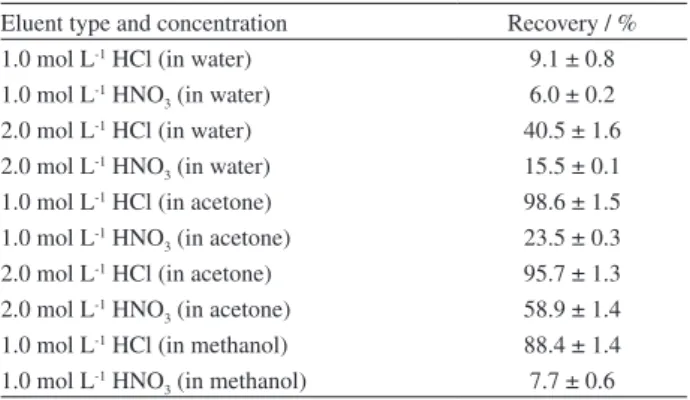
HNO3 and HCl solutions, prepared in water, acetone and
methanol at different concentrations, were tested as eluent solutions for desorption of Au(III) from Amberlite XAD-4 resin (Table 1). Quantitative recoveries (95%) for Au(III)
were obtained when using 1.0 mol L-1 HCl solution in
acetone as eluent. The effect of the eluent volume on the recovery of Au(III) was also studied in the eluent volume range of 2.5-10.0 mL. Quantitative recoveries were obtained with 7.5 mL of 1.0 mol L-1 HCl in acetone solution.
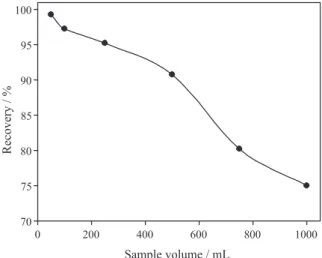
To evaluate the effect of the sample volume on the separation and preconcentration of Au(III), 50-1000 mL of sample solution containing 20 µg of Au(III) ions were processed. Recoveries of Au(III) were quantitative until 250 mL of sample volume (Figure 3). The preconcentration factor is calculated by the ratio of the highest sample volume and the lowest final volume, and it was found as 50 when the final volume was 5.0 mL.
Effects of matrix ions
The effects of some foreign ions on the retention of Au(III) on Amberlite XAD-4 resin were investigated by testing some common anions, cations and trace metal ions at different concentrations. Results are summarized in Table 2.
Figure 1. Relation between HNO3 concentration and recovery values (N:3, PYTOX amount: 1.0 mg, eluent: 7.5 mL of 1.0 mol L−1 HCl in acetone, and sample volume: 50 mL).
Figure 2. Effect of ligand quantities on the recovery of Au(III) (N:3, eluent: 7.5 mL of 1.0 mol L−1 HCl in acetone, and sample volume: 50 mL).
Table 1. Effects of eluent type and concentration on the recovery of Au(III) (N:3, 0.5 mol L-1 HNO
3 conditions, PYTOX amount: 1.0 mg, and sample volume: 50 mL)
Eluent type and concentration Recovery / % 1.0 mol L-1 HCl (in water) 9.1 ± 0.8 1.0 mol L-1 HNO
3 (in water) 6.0 ± 0.2 2.0 mol L-1 HCl (in water) 40.5 ± 1.6 2.0 mol L-1 HNO
3 (in water) 15.5 ± 0.1 1.0 mol L-1 HCl (in acetone) 98.6 ± 1.5 1.0 mol L-1 HNO
3 (in acetone) 23.5 ± 0.3 2.0 mol L-1 HCl (in acetone) 95.7 ± 1.3 2.0 mol L-1 HNO
3 (in acetone) 58.9 ± 1.4 1.0 mol L-1 HCl (in methanol) 88.4 ± 1.4 1.0 mol L-1 HNO
Recoveries of Au(III) were generally higher than 90%. These results indicated that the developed procedure can be applied to samples containing high amount of salts and transition metal ions.
Adsorption capacity of the resin
To determine the adsorption capacity of the Amberlite XAD-4 resin, 50 mL of sample solutions containing different amounts of Au(III) in the range of 50-2000 µg were loaded to the column containing 250 mg of resin. The Langmuir isotherms were plotted in order to determine the resin
capacity (Figure 4) , where qe (mg g–1) is the amount of
Au(III) ions adsorbed per unit mass of adsorbent, Ce (mg L–1)
is the equilibrium Au(III) ion concentration in aqueous solution. The maximum amount of Au(III) adsorbed onto 1.0 g of resin and the adsorption equilibrium constant were calculated as 2.7 and 0.137 L mol−1, respectively.
Analytical performance of the presented procedure
The limit of detection (LOD), defined as the concentration that gives a signal equivalent to three times the standard deviation of 10 replicate measurements of the blank samples, for Au(III) was found to be 1.03 µg L-1. The
precision of the procedure, expressed as relative standard deviation (RSD), was determined after analyzing a series of ten replicate solutions under the optimum conditions mentioned in the analytical procedure section, and it was found to be 3.7% for Au(III).
Accuracy test and application to real samples
In order to test the accuracy of the method, different amounts of Au(III) ions were added to liquid samples (sea and stream waters) (Table 3) and microwave-assisted
Figure 3. Effect of sample volume on the recovery of Au(III) (N:3, eluent: 7.5 mL of 1.0 mol L−1 HCl in acetone).
Table 2. Influence of matrix components on recoveries of Au(III) (N:3, 0.5 mol L-1 HNO
3 conditions, PYTOX amount: 1.0 mg, eluent: 7.5 mL of 1.0 mol L-1 HCl in acetone, and sample volume: 50 mL)
Ion Added as Concentration / (mg L-1)
Recovery / %
Na+ NaCl 5000 102.8 ± 3.2
K+ KCl 1000 100.3 ± 3.1
Ca2+ CaCl
2 1000 94.3 ± 1.1
Mg2+ Mg(NO
3)2 500 95.4 ± 2.3
NO3– NaNO
3 5000 95.1 ± 3.4
CO32– Na
2CO3 1000 91.2 ± 1.7
SO42– Na2SO4 1000 95.5 ± 4.4
PO43– Na
3PO4 1000 91.6 ± 1.5
I– KI 100 95.3 ± 2.5
F- NaF 100 95.8 ± 4.0
CH3COO– NaCH3COO 250 94.3 ± 0.8 C d ( I I ) , N i ( I I ) ,
Al(III), Pb(II), Cr(III), V(V)
a 25 93.1 ± 0.6
Mixedb 94.3 ± 2.7
aV(V) added as V
2O5, other ions added as their nitrate salts. b7428 mg L-1 Na+, 8389 mg L-1 Cl–, 6461 mg L-1 NO
3–, 265 mg L-1 K+, 250 mg L-1, Ca2+, Mg2+, CO
32–, SO42–, PO43–, 50 mg L-1 I–, F–, CH3COO–, 10 mg L-1 Cd(II), Ni(II), Al(III), Pb(II), Cr(III), V(V)
Figure 4. Langmuir adsorption isotherm for Au(III).
Table 3. Recoveries of Au(III) from water samples (N:3, 0.5 mol L-1 HNO 3 conditions, and sample volume: 50 mL)
Added / µg
Stream water Sea water Determined /
µg
Recovered / %
Determined / µg
Recovered / %
0 < LODa – < LODa –
acid digested environmental solid samples (soil, anodic slime and gold ore) (Table 4). Then, the developed procedure was performed to determine Au(III). Good agreement was obtained between added and recovered values.
Lastly, the procedure was applied to soil, anodic slime, gold ore and sea and stream waters samples for the determination of trace amounts of Au(III) ions after being verified the accuracy of the method (Table 5).
Conclusion
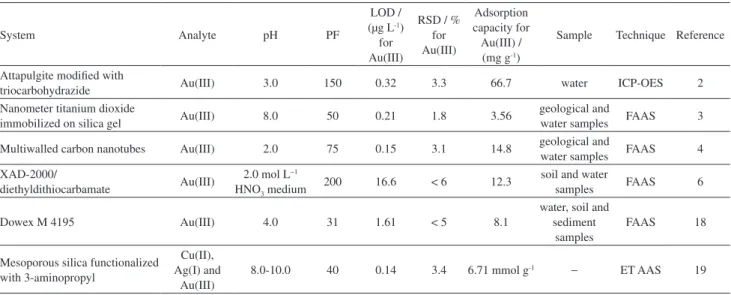
The proposed Amberlite XAD-4/2-pyridin-5-(4-tolyl)-1,3,4-oxadiazole solid phase extraction system is a simple, highly selective and low cost method for separation and preconcentration of Au(III) in complex matrices. Most of the common ions present together with Au(III) do not interfere with the selectivity of the procedure. After optimizing the experimental parameters and checking the accuracy of the procedure, it was successfully applied to anodic slime, gold ore, soil and sea and stream waters to determine their Au(III) levels. The procedure was also compared with other reported SPE methods in terms of pH, preconcentration factor, limit of detection, relative standard deviation, adsorption capacity of the resin, type of the sample and determination technique.2-4,6,18-23
First of all, the proposed method is less expensive with respect to the sorbent used4,21,23 and the determination
technique.2,19,23 Contrary to many studies3,19,21 given in
Table 6, the suitability of the acidic medium for the selective separation, preconcentration and determination of Au(III) in complex matrices prevents the contamination risk that originates from the precipitation of different metal ions at high pH values. This also avoids the use of additional chemical reagent for adjusting the pH of the acid digested solid samples. On the other hand, although the adsorption capacity of the resin for Au(III) is lower in the proposed system than in other similar methods, it has high preconcentration factor,18,19,20 low RSD6 and relatively
low LOD6,18,20,22 values when compared with some of the
other methods reported in Table 6.
Table 4. Recoveries of Au(III) from solid samples (N:3, sample amount: 0.750 g of soil, 0.100 g of gold ore and anodic slime, and final volume: 5.0 mL)
Added / µg Anodic slime Gold Ore Soil
Determined / µg Recovered / % Determined / µg Recovered / % Determined / µg Recovered / %
0 21.15 ± 0.53 − 2.03 ± 0.12 − < LODa −
10 30.93 ± 0.81 97.8 11.88 ± 0.25 98.5 9.25 ± 0.49 92.5
20 40.38 ± 1.24 96.2 21.08 ± 0.74 95.3 18.68 ± 0.60 93.4
aBelow the limit of detection.
Table 5. Au(III) contents in real samples after application of the presented SPE procedure (N:3, stream and sea water volume: 250 mL, amount of sample: 0.750 g of soil, 0.100 g of gold ore and anodic slime, and final volume: 5.0 mL)
Liquid sample / (µg L-1) Solid sample / (µg g-1)
Sea water Stream water Anodic slime Gold ore Soil
4.74 ± 0.12 9.64 ± 0.32 211.50 ± 5.30 20.30 ± 1.24 < LODa
aBelow the limit of detection.
Table 6. Comparison of the developed procedure with some recent studies based on SPE reported in literature
System Analyte pH PF
LOD / (µg L-1) for Au(III)
RSD / % for Au(III)
Adsorption capacity for Au(III) /
(mg g-1)
Sample Technique Reference
Attapulgite modified with
triocarbohydrazide Au(III) 3.0 150 0.32 3.3 66.7 water ICP-OES 2
Nanometer titanium dioxide
immobilized on silica gel Au(III) 8.0 50 0.21 1.8 3.56
geological and
water samples FAAS 3
Multiwalled carbon nanotubes Au(III) 2.0 75 0.15 3.1 14.8 geological and
water samples FAAS 4 XAD-2000/
diethyldithiocarbamate Au(III)
2.0 mol L−1
HNO3 medium 200 16.6 < 6 12.3
soil and water
samples FAAS 6
Dowex M 4195 Au(III) 4.0 31 1.61 < 5 8.1
water, soil and sediment
samples
FAAS 18
Mesoporous silica functionalized with 3-aminopropyl
Cu(II), Ag(I) and
Au(III)
8.0-10.0 40 0.14 3.4 6.71 mmol g-1
Acknowledgements
Authors wish to thank the Unit of the Scientific Research Projects of Karadeniz Technical University (Project No. 1156) for the financial support.
References
1. Pyrzynska, K.; Anal. Chim. Acta 2012, 741, 9.
2. Zhang, L.; Li, Z.; Hu, Z.; Chang, X.; Spectrochim. Acta, Part A
2011,79, 1234.
3. Liu, R.; Liang, P.; Anal. Chim. Acta2007,604, 114. 4. Liang, P.; Zhao, E.; Ding, Q.; Du, D.; Spectrochim. Acta, Part B
2008,63, 714.
5. Amin, A. S.; Spectrochim. Acta, Part A 2010, 77, 1054. 6. Şentürk, H. B.; Gundogdu, A.; Bulut, V. N.; Duran, C.;
Soylak, M.; Elci, L.; Tufekci, M.; J. Hazard. Mater. 2007,149, 317.
7. Soylak, M.; Tuzen, M.; J. Hazard. Mater. 2008,152, 656. 8. Tuzen, M.; Soylak, M.; J. Hazard. Mater. 2009, 162, 724. 9. Elci, L.; Sahan, D.; Basaran, A.; Soylak, M.; Environ. Monit.
Assess.2007,132, 331.
10. Mladenova, E.; Dakova, I.; Karadjova, I.; Karadjov, M.;
Microchem. J. 2007,101, 59.
11. Chen, S.; Zhu, X.; Miner. Eng. 2010,23, 1152.
12. El-Shahawi, M. S.; Bashammakh, A. S.; Bahaffi, S. O.; Talanta
2007, 72, 1494.
13. Konečná, M.; Komárek, J.; Spectrochim. Acta, Part B 2007, 62, 283.
14. Bulut, V. N.; Gundogdu, A.; Duran, C.; Senturk, H. B.; Soylak, M.; Elci, L.; Tufekci, M.; J. Hazard. Mater. 2007,146, 155.
15. Soylak, M.; Elci, L.; Dogan, M.; J. Trace Microprobe Tech.
2001, 19, 329.
16. Gümrükçüoğlu, N.; Serdar, M.; Çelik, E.; Sevim, A.; Demirbas, N.; Turk. J. Chem.2007, 31, 335.
17. Duran, C.; Ozdes, D.; Sahin, D.; Bulut, V. N.; Gundogdu, A.; Soylak, M.; Microchem. J.2011, 98, 322.
18. Tuzen, M.; Saygi, K. O.; Soylak, M.; J. Hazard. Mater. 2008,
156, 591.
19. Kim, M. L.; Tudino, M. B.; Talanta 2010, 82, 923. 20. Soylak, M.; Elci, L.; Dogan, M.; Anal. Lett.2000, 33, 513. 21. Shamspur, T.; Mostafavi, A.; J. Hazard. Mater.2009, 168, 1548. 22. Bozkurt, S. S.; Merdivan, M.; Environ. Monit. Assess.2009,
158, 15.
23. Li, D.; Chang, X.; Hu, Z.; Wang, Q.; Tu, Z.; Li, R.; Microchim. Acta2011, 174, 131.
Submitted: November 12, 2012
Published online: August 30, 2013
Table 6. continuation
System Analyte pH PF
LOD / (µg L-1)
for Au(III)
RSD / % for Au(III)
Adsorption capacity for Au(III) / (mg g-1)
Sample Technique Reference
Amberlite XAD-2000 Au(III) 0.1 mol L -1
HCl medium 20 2.0 3.2
water and
potassium salts FAAS 20 Multiwalled carbon nanotubes
modified with N,N’-bis(2- hydroxybenzylidene)-2,2’(aminophenylthio) ethane
Au(III) and
Mn(II) 6.0 250 0.03 1.61 75 water FAAS 21
Silica gel modified with
benzoylthiourea Au(III)
1.0 mol L-1
HCl medium 267 1.4 1.2 0.92 mmol g
-1 water FAAS 22
Activated carbon modified with 2,6-diaminopyridine
Au(III), Pd(II) and
Pt(IV)
1.0 75 0.16 < 3.0 202.7 ore and rock
samples ICP-OES 23
XAD-4/
Au(III)-2-pyridin-5-(4-tolyl)-1,3,4-oxadiazole Au(III)
0.5 mol L-1
HNO3 medium 50 1.03 3.7 2.7
water samples, soil, anodic slime and gold
ore
FAAS this work