Article
J. Braz. Chem. Soc., Vol. 26, No. 10, 2105-2115, 2015. Printed in Brazil - ©2015 Sociedade Brasileira de Química 0103 - 5053 $6.00+0.00
A
*e-mail: [email protected]
Efficient Eco-Friendly Solvent-Free Click Synthesis and Antimicrobial Evaluation
of New Fluorinated 1,2,3-Triazoles and their Conversion into Schiff Bases
Mohamed R. Aouad*,a,b
aDepartment of Chemistry, Faculty of Sciences, Taibah University,
30002 Al-Madinah Al-Munawarah, Saudi Arabia
bLaboratoire de Chimie & Electrochimie des Complexes Métalliques (LCECM) USTO-MB,
Department of Chemistry, Faculty of Sciences, University of Sciences and Technology Mohamed Boudiaf, B.p. 1505 El M’nouar, 31000 Oran, Algeria
A facile and convenient green click synthesis has been developed for the preparation of new fluorinated 1,2,3-triazoles under solvent-free conditions via a Huisgen 1,3-dipolar cycloaddition reaction between dimethylacetylene dicarboxylate (DMADC) and fluorophenyl azides in excellent yields within 2 min. Treatment of the resulting diesters with hydrazine hydrate furnished the corresponding dihydrazides, which, upon condensation with benzaldehyde derivatives, afforded a new series of bis-hydrazones. All of the synthesized compounds were fully characterized using infrared (IR) spectroscopy, 1H, 13C and 19F nuclear magnetic resonance (NMR), mass spectrometry
(MS) and elemental analysis. A preliminary bioassay indicated that some of the tested compounds exhibited significant antimicrobial activity.
Keywords: free solvent reaction, click synthesis, 1,2,3-triazoles, Schiff bases, antimicrobial activity
Introduction
During the last few years, the development of fast, safe and high-yielding click chemistry methodologies have rapidly emerged as one of the most challenging and attractive topics in modern heterocyclic chemistry.1-6 The most popular example of click chemistry is the synthesis of 1,2,3-triazoles via 1,3-dipolar cycloaddition reactions.7 The 1,2,3-triazole based derivatives have been employed in various medicinal chemistry applications, such as anti-HIV,8 antiviral,9 anticonvulsant,10 antiallergic,11 anticancer,12 and antifungal13 agents. In addition, several fluorinated drug structures have incorporated a 1,2,3-scaffold.14 Therefore, considerable attention has been devoted to the synthesis and applications of fluorinated compounds in medicinal chemistry and agrochemistry.15-20 The incorporation of a fluorine atom into organic molecules results in high thermal stability and enhanced lipophilicity, which can enhance the rate of cell penetration and transport of a drug to an active site.21-24 1,3-Dipolar Huisgen cycloaddition of organic azides with alkynes has been
To the best of our knowledge, the synthesis of 1-aryl-1,2,3-triazoles under solvent-free conditions has not been previously reported. Inspired by Shanmugavelan
et al.’s work,26 we investigated the viability of utilizing the solvent-free conditions as an efficient eco-friendly protocol for the synthesis of 1-aryl-1,2,3-triazoles. Herein, we describe our modified methodology for the quick synthesis of new 1-fluoroaryl-1,2,3-triazole-4,5-diesters via 1,3-dipolar cycloaddition of DMADC with different fluorophenyl azides under solvent-free conditions. Moreover, the main purpose of the present study was to design and to synthesize some novel 1-fluoroaryl-1,2,3-triazole-hydrazone hybrids in order to improve the physiochemical properties of 1,2,3-triazole and/or synergistic effect by combining the 1,2,3-triazole nucleus with hydrazone linkage in one scaffold. The synthesized bis-hydrazones were evaluated for their antimicrobial activity against different Gram-negative and Gram-positive bacteria. In addition, the effect of introducing the fluorine substituent on the antimicrobial activity has also been investigated.
Results and Discussion
Chemistry
Initially, fluorophenyl azides were synthesized via diazotization of their corresponding fluoroanilines in the presence of a sodium nitrite solution in acidic media followed by the addition of sodium azide according to the method described by Boyer and Canter.31 1,3-Dipolar cycloaddition of 2-fluorophenyl azide (2a) to dimethylacetylene dicarboxylate (1) in the presence of dichloromethane has been previously reported by Bouasla et al.32 under
both conventional and microwave heating methods. The resulting dimethyl 1-(2-fluorophenyl)-1,2,3-triazolo-4,5-dicarboxylate (3a) was obtained in 68% yield after regular stirring for 24 h and in 88% yield under microwave irradiation (MWI) for 8 min. In the current study, the same reaction was conducted under solvent-free conditions in a sealed tube. The reaction required heating in a water bath for 2 min to afford 1,2,3-triazole 3a in 96% yield. The promising result obtained from the cycloaddition of 2-fluorophenylazide 2a with 1 inspired us to extend the
reaction to other fluorophenylazides. Accordingly, new 1-(fluorophenyl)-1,2,3-triazoles 3b-d were synthesized in 93-96% yield within 2-3 min through the same eco-friendly solvent-free protocol previously described (Scheme 1).
The synthesized 1,2,3-triazole diesters 3a-d were fully characterized based on their infrared (IR), 1H and 13C nuclear magnetic resonance (NMR) and mass spectrometry (MS) spectra. Their IR spectra contained two absorption bands at 1727-1737 and 2923-2988 cm-1, which are characteristic of the ester C=O and CH3 groups, respectively. The 1H NMR spectra of compounds 3a-d recorded in CDCl3 revealed the presence of two characteristic singlets at d 3.83-3.94 ppm, which confirmed the nonequivalence of the two methyl ester protons. The phenyl protons appeared in the aromatic region at a δ of approximately 7.39-8.09 ppm. In the 13C NMR spectra, the signal corresponding to the two nonequivalent carbonyl ester groups appeared at 157.56-161.28 ppm, and the two methyl carbons appeared at 52.69-54.83 ppm.
Diesters 3a-d were refluxed with hydrazine hydrate in ethanol for 4 h to afford corresponding dihydrazides 4a-d in 88-92% yields. The formation of dihydrazides 4a-d was confirmed by IR, 1H NMR, 13C NMR and MS analyses. Their IR spectra revealed the appearance of characteristic hydrazide NH and NH2 groups at 3227-3371 cm-1. In the 1H NMR spectra of compounds 4a-d, the disappearance of the methyl ester signals and appearance of two singlets at d 4.50-4.79 and 10.34-11.55 ppm due to the NH2 and NH protons, respectively, confirmed the success of the hydrazinolysis reaction. In addition, carbonyl signals of the amide functionalities in the 13C NMR spectra appeared at 157.16-163.67 ppm, which supported the proposed structures for dihydrazides 4a-d.
However, the heating of dihydrazides 4a-d with benzaldehyde derivatives in the presence of a catalytic amount of hydrochloric acid for 2 h yielded the corresponding bis-hydrazones 5a-p in 83-91% yields (Scheme 2). The structures of the synthesized bis-hydrazones have been elucidated by IR, 1H NMR, 13C NMR and MS analyses.
Hydrazones were reported to exist as E/Z geometrical
isomers about the imine bond (HC=N) and cis/trans
conformers to the carbonyl amide linkage.33-35 These arrangements may be due to the restricted rotation around the C=N bond, which could generate different
O
O OCH3
H3CO N
N N
O O
OCH3
OCH3
Ar1
Solvent-free Water bath 2-3 min +
1 2a d
-Ar1N3
3a d
steric rearrangements of the hydrazone functionality in the geometric syn and anti isomers. In addition, the
E-geometrical isomer and the cis/trans conformers were the more predominant forms in highly polar solvent, such as deuterated dimethylsulfoxide (DMSO-d6), and the Z-isomer
was only observed in less polar solvents.36,37 Scheme 3
summarizes the general E/Z geometrical isomers and cis/
trans conformers (Scheme 3).
The 1H NMR and 13C NMR spectra of all of the
synthesized Schiff bases 5a-p recorded in DMSO-d6
confirm the existence of a mixture of diastereomers (i.e.,
E/cis and E/trans) for each imino-amide moiety.
The 1H NMR spectrum of bis-hydrazone 5f derived
fromp-methoxybenzaldehyde contained four different characteristic singlet peaks at d 7.95, 8.21, 8.48 and 8.59 ppm with a ratio of 1:1:1:1, which have a total integration of two protons that are related to the two nonequivalent imine protons (HC=N). The spectrum also contained four singlets at d 12.25, 12.39, 12.47 and 12.79 ppm that have a total integration of two NH protons with the same ratio. In addition, the two methoxy groups split into four singlets at d 3.71, 3.79, 3.80 and 3.81 ppm and have a total integration of six protons. The aromatic protons appeared at their expected chemical shifts and have a total integration of 12 protons. The 13C NMR spectrum
also confirmed the presence of the E/cis and E/trans isomers due the appearance of three signals at d 55.18, 55.25 and 55.29 ppm, which are characteristic of the two methoxy
groups. In addition, the nonequivalent carbonyl (C=O) and imine (C=N) signals resonated in the downfield region betweend 152.92-161.40 ppm.
The absence of this pairing of signals in the 1H NMR
spectrum of bis-hydrazides 4a-d compared to bis-hydrazones 5a-p confirmed the formation these compounds as a mixture of E/cis and E/trans diastereomers.
To confirm the solvent effect for the isomerism of hydrazones, the 1H NMR spectrum of compound 5f was
measured in a less polar solvent (chloroform-d). Two singlet signals were observed at 12.01 and 14.68 ppm for the NH proton, 8.61 and 8.79 ppm for the HC=N proton and 5.10 and 5.58 ppm for the OCH3 protons corresponding to the cis or trans conformers of the E isomer.
Antimicrobial screening
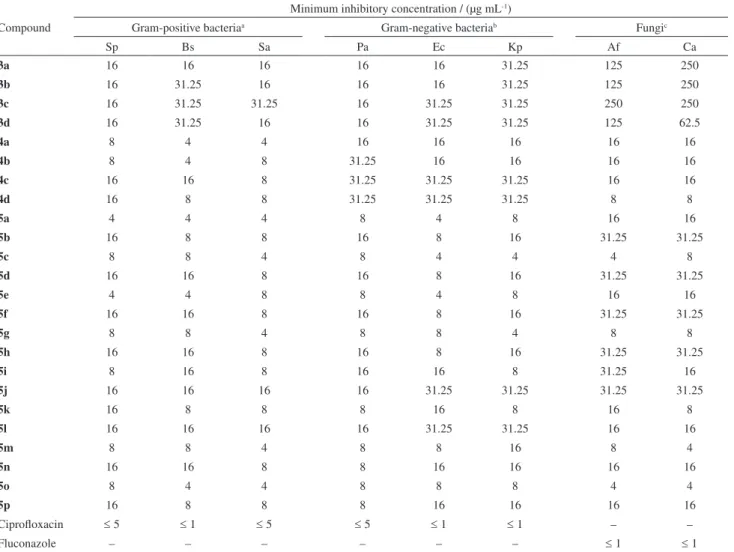
The synthesized 1,2,3-triazoles were evaluated for their in vitro antimicrobial activity against three Gram-positive bacteria, three Gram-negative and two fungal strains. Both microbial screenings were assessed by the minimum inhibitory concentration (MIC) using the broth dilution method.38,39 The MIC is defined as the minimum
concentration of compounds required to completely inhibit bacterial growth. The antibacterial and antifungal screening data expressed as MIC are listed in Table 1. The 1,2,3-triazole diesters 3a-d exhibit good to moderate antibacterial activity against all of the bacterial strains with a MIC range of 16 to 31.25 µg mL-1. However, a
lack of activity was observed against all of the fungal strains. The antimicrobial activity of dihydrazides 4a-d indicated that compounds 4a and 4b possessing 2-F and/or 4-F substitution on the phenyl ring exhibited excellent antibacterial activity against all of the Gram-positive bacteria with a MIC range of 4 to 8 µg mL-1 and good
activity against all of the Gram-negative bacterial strains at a MIC of 16 µg mL-1. Compound 4d, which contains
both fluoro and iodo substitutions, exhibited excellent
antifungal activity at a MIC of 8 µg mL-1. The antimicrobial screening revealed that of the tested bis-hydrazones 5a-p, compounds 5a, 5c, 5e, 5g, 5m and 5o exhibited excellent activity against all of the tested bacterial strains with a MIC range of 4 to 8 µg mL-1. In addition, the highest antifungal
N N N
O O
OCH3 OCH3 Ar1
N N N
O O
NHNH2 NHNH
2
Ar1
N N N
O O
NHN NHN Ar1
Ar2
Ar2
NH
2NH2.H2O
EtOH, ref lux 4 h
3a d- 4a d- 5a p
-Ar1CHO, EtOH
HCl, ref lux 2 h
Scheme 2. Synthesis of new fluorinated-1,2,3-triazole dihydrazides 4a-d and bis-hydrazones 5a-p.
trans, E Q N
N H H
Ar O
trans, Z Q N
N H H Ar
O
cis, E Q
N N
H H
Ar O
cis, Z Q
N
N H H Ar O
activity with a MIC range of 4 to 8 µg mL-1 was exhibited
by compounds 5c, 5g, 5m and 5o, possessing NO2 and/or
iodo substitution. The remaining compounds were found to be more active at higher concentrations (16-31.25 µg mL-1).
Therefore, the antimicrobial activity and structure activity relationship indicated that the higher inhibition exhibited by the bis-hydrazones against all of bacterial and fungal strains is most likely due to the presence of imine linkage in addition to the 1,2,3-triazole moiety. In addition, the
incorporation of fluorine, nitro and/or iodo groups increased the antimicrobial activity.
Conclusions
In conclusion, an eco-friendly, safe, high-yielding and experimentally simple method has been developed for the synthesis of 1-(fluorinated phenyl)-1,2,3-triazole diesters in
shorter reaction times. These reactions were carried out via interaction of fluorophenyl azides with dimethylacetylene dicarboxylate under solvent-free conditions in a water bath. The dihydrazides, which were synthesized through hydrazinolysis of the diesters, were condensed with different benzaldehydes to afford the corresponding bis-hydrazones. Some of the tested 1,2,3-triazoles exhibited significant antibacterial and antifungal activities with a MIC range of 4-16 µg mL-1.
Experimental
General procedures
The melting points were determined on a Melt-temp apparatus and are uncorrected. Thin-layer chromatography (TLC) was performed on Merck silica gel 60 F254, and
Table 1. Antimicrobial activity expressed as MIC
Compound
Minimum inhibitory concentration / (µg mL-1)
Gram-positive bacteriaa Gram-negative bacteriab Fungic
Sp Bs Sa Pa Ec Kp Af Ca
3a 16 16 16 16 16 31.25 125 250
3b 16 31.25 16 16 16 31.25 125 250
3c 16 31.25 31.25 16 31.25 31.25 250 250
3d 16 31.25 16 16 31.25 31.25 125 62.5
4a 8 4 4 16 16 16 16 16
4b 8 4 8 31.25 16 16 16 16
4c 16 16 8 31.25 31.25 31.25 16 16
4d 16 8 8 31.25 31.25 31.25 8 8
5a 4 4 4 8 4 8 16 16
5b 16 8 8 16 8 16 31.25 31.25
5c 8 8 4 8 4 4 4 8
5d 16 16 8 16 8 16 31.25 31.25
5e 4 4 8 8 4 8 16 16
5f 16 16 8 16 8 16 31.25 31.25
5g 8 8 4 8 8 4 8 8
5h 16 16 8 16 8 16 31.25 31.25
5i 8 16 8 16 16 8 31.25 16
5j 16 16 16 16 31.25 31.25 31.25 31.25
5k 16 8 8 8 16 8 16 8
5l 16 16 16 16 31.25 31.25 16 16
5m 8 8 4 8 8 16 8 4
5n 16 16 8 8 16 16 16 16
5o 8 4 4 8 8 8 4 4
5p 16 8 8 8 16 16 16 16
Ciprofloxacin ≤ 5 ≤ 1 ≤ 5 ≤ 5 ≤ 1 ≤ 1 – –
Fluconazole – – – – – – ≤ 1 ≤ 1
aGram-positive bacteria: Streptococcus pneumonia (RCMB 010010, Sp), Bacillus subtilis (RCMB 010067, Bs), Staphylococcus aureus (RCMB 010025,
Sa); bGram-negative bacteria: Pseudomonas aeroginosa (RCMB 010043, Pa), Escherichia coli (RCMB 010052, Ec), Klebsiella pneumonia (RCMB 010058,
the spots were visualized by UV light absorption. The IR spectra were measured using potassium bromide pellets on a Perkin-Elmer 1430 series FTIR spectrometer. NMR spectra were recorded on an Avance Bruker-400 MHz spectrometer (1H NMR at 400 MHz, 13C NMR at 100 MHz and 19F NMR
at 377 MHz) in DMSO-d6 using tetramethylsilane (TMS) as the internal standard. Elemental analyses were performed using an elementary analyser system Elementar-vario EL III element analyzer. The MS spectra were measured on a high-performance liquid chromatographer-mass spectrometer (HPLC-MS) (ion trap) from Thermo Scientific.
General procedure for the synthesis of dimethyl 1-(substituted phenyl)-1H-1,2,3-triazole-4,5-dicarboxylate 3a-d
Dimethyl acetylenedicarboxylate (0.015 mmol) and the appropriate fluorophenyl azide (0.02 mmol) were heated in
a water bath for 2-3 min. The reaction mixture was cooled, and then, ether was added to precipitate the product. The solid was filtered and washed with ether to obtain the desired product.
Dimethyl 1-(2-fluorophenyl)-1H
-1,2,3-triazole-4,5-dicarboxylate(3a)
IR (KBr) υmax / cm-1 3061 (C–H, aromatic), 2946, 2959
(C–H, aliphatic), 1737 (C=O), 1573 (C=C); 1H NMR (400 MHz, DMSO-d6) d 3.83 (s, 3H, OCH3), 3.94 (s, 3H, OCH3), 7.52 (dd, 1H, J 8,16 Hz, Ar–H), 7.63 (ddd, 1H,
J 4,8,16 Hz, Ar–H), 7.77 (ddd, 1H, J 4,8, 16 Hz, Ar–H),
7.86 (ddd, 1H, J 4, 8, 16 Hz, Ar–H); 13C NMR (100 MHz, DMSO-d6) d 52.85 (OCH3), 53.77 (OCH3), 116.62, 116.80, 122.87, 122.99, 125.59, 125.63, 128.24, 132.02, 133.33, 133.41, 138.67, 153.90, 156.40 (Ar–C), 157.71, 159.70 (C=O); 19F NMR (377 MHz, DMSO-d
6) d –123.63 to –123.70 (m, 1F, Ar–F); MS (EI) [M+] 279.10; anal. calcd. (C12H10FN3O4): C 51.62%, H 3.61%, N 15.05%; found: C 51.86%, H 3.47%, N 15.19%.
Dimethyl 1-(4-fluorophenyl)-1H
-1,2,3-triazole-4,5-dicarboxylate(3b)
IR (KBr) υmax / cm-1 3053 (C–H, aromatic), 2951, 2967
(C–H, aliphatic), 1727 (C=O), 1583 (C=C); 1H NMR (400 MHz, DMSO-d6) d 3.84 (s, 3H, OCH3), 3.92 (s, 3H, OCH3), 7.51 (dd, 2H, J 8, 16 Hz, Ar–H), 7.74 (dd, 2H, J 4, 12 Hz, Ar–H); 13C NMR (100 MHz, DMSO-d
6) d 52.69 (OCH3), 53.85 (OCH3), 116.56, 116.80, 127.41, 127.50, 131.44, 131.47, 131.86, 138.32 (Ar–C), 158.43, 159.80, 161.61, 164.08 (C=O); 19F NMR (377 MHz, DMSO-d
6) d –109.89 to –109.96 (m, 1F, Ar–F); MS (EI) [M+] 279.20; anal. calcd. (C12H10FN3O4): C 51.62%, H 3.61%, N 15.05%; found: 51.79%, H 3.75%, N 15.24%.
Dimethyl 1-(3-fluoro-4-methylphenyl)-1H -1,2,3-triazole-4,5-dicarboxylate(3c)
IR (KBr) υmax / cm-1 3025 (C–H, aromatic), 2923, 2970
(C–H, aliphatic), 1733 (C=O), 1577 (C=C); 1H NMR (400 MHz, DMSO-d6) d 3.38 (s, 3H, CH3), 3.86 (s, 3H, OCH3), 3.92 (s, 3H, OCH3), 7.39 (dd, 2H, J 4, 12 Hz, Ar–H), 7.53-7.59 (m, 2H, Ar–H); 13C NMR (100 MHz, DMSO-d6) d13.97 (CH3), 52.68 (OCH3), 53.89 (OCH3), 111.99, 112.26, 120.58, 120.61, 127.44, 127.61, 131.79, 132.40, 133.77, 133.66, 138.22, 158.47 (Ar–C), 159.72, 161.28 (C=O); 19F NMR (377 MHz, DMSO-d
6) d –114.28 to –114.34 (m, 1F, Ar–F); MS (EI) [M+] 293.29; anal. calcd. (C13H12FN3O4): C 53.24%, H 4.12%, N 14.33%; found: C 53.06%, H 4.31%, N 14.16%.
Dimethyl 1-(2-fluoro-4-iodophenyl)-1H -1,2,3-triazole-4,5-dicarboxylate (3d)
IR (KBr) υmax / cm-1 3084 (C–H, aromatic), 2942, 2988
(C–H, aliphatic), 1735 (C=O), 1559 (C=C); 1H NMR (400 MHz, DMSO-d6) d 3.83 (s, 3H, OCH3), 3.92 (s, 3H, OCH3), 7.62 (dd, 1H, J 8, 12 Hz, Ar–H), 7.89 (dd, 1H,
J 4,8 Hz, Ar–H), 8.09 (d, 1H, J 8 Hz, Ar–H); 13C NMR (100 MHz, DMSO-d6) d 52.88 (OCH3), 53.81 (OCH3), 117.60, 120.62, 124.26, 124,81, 125.08, 125.19, 129.77, 131.30, 132.06, 133.88, 133.92, 137.52, 139.60, 153.54, 154.10, 154.23 (Ar–C), 157.58, 158.55 (C=O); 19F NMR (377 MHz, DMSO-d6) d –121.29 to –121.33; MS (EI) [M+] 404.69; anal. calcd.(C12H9FIN3O4): C 35.58%, H 2.24%, N 10.37%; found: C 35.77%, H 2.40%, N 10.21%.
General procedure for the synthesis of 1-(substituted phenyl)-1H-1,2,3-triazole-4,5-dicarbohydrazide 4a-d
A mixture of 3a-d (0.02 mmol) and hydrazine hydrate (0.04 mmol) in ethanol (50 mL) was heated under reflux for 4 h. After cooling, ethanol was removed under reduced pressure, and the product was recrystallized from ethanol.
1-(2-Fluorophenyl)-1H-1,2,3-triazole-4,5-dicarbohydrazide (4a)
IR (KBr) υmax / cm-1 3242-3365 (NH, NH2), 3071 (C–H,
aromatic), 1697 (C=O), 1562 (C=C); 1H NMR (400 MHz, DMSO-d6) d 4.55 (bs, 4H, NH2), 7.43 (dd, 1H, J 8,12 Hz, Ar–H), 7.51 (dd, 1H, J 8,12 Hz, Ar–H), 7.63-7.70 (m, 2H,
Ar–H), 10.61 (bs, 2H, NH); 13C NMR (100 MHz, DMSO-d
6) d 115.96, 116.14, 124.80, 124.84, 125.08, 125.21, 128.35, 132.14, 132.28, 132.36, 137.56, 154.31, 154.67 (Ar–C), 157.16, 158.68 (C=O); 19F NMR (377 MHz, DMSO-d
1-(4-Fluorophenyl)-1H-1,2,3-triazole-4,5-dicarbohydrazide (4b)
IR (KBr) υ
max / cm-1 3227-3369 (NH, NH2), 3076 (C–H,
aromatic), 1694 (C=O), 1581 (C=C); 1H NMR (400 MHz,
DMSO-d6) d 4.74 (bs, 4H, NH2), 7.41-7.45 (m, 2H, Ar–H),
7.63-7.65 (m, 2H, Ar–H), 10.55 (bs, 2H, NH); 13C NMR
(100 MHz, DMSO-d6) d 115.92, 116.16, 127.27, 127.70, 132.19, 132.89, 138.39, 155.55 (Ar–C), 158.64, 163.67 (C=O); 19F NMR (377 MHz, DMSO-d
6) d –111.20 to
–111.28 (m, 1F, Ar–F); MS (EI) [M+] 279.01; anal. calcd.
(C10H10FN7O2): C 43.01%, H 3.61%, N 35.11%; found:
C 43.33%, H 3.49%, N 35.24%.
1-(2-Fluoro-4-methylphenyl)-1H
-1,2,3-triazole-4,5-dicarbohydrazide(4c)
IR (KBr) υ
max / cm-1 3249-3371 (NH, NH2), 3023
(C–H, aromatic), 1688 (C=O), 1560 (C=C); 1H NMR
(400 MHz, DMSO-d6) d 2.33 (s, 3H, CH3), 4.69 (bs, 4H,
NH2), 7.33 (dd, 1H, J 4, 8 Hz, Ar–H), 7.44-7.51 (m, 2H,
Ar–H), 10.34 (s, 1H, NH), 10.96 (s, 1H, NH); 13C NMR
(100 MHz, DMSO-d6) d 112.28, 112.54, 120.99, 121.03, 126.40, 126.57, 131.81, 131.86, 132.17, 135.12, 135.23, 138.43, 155.47 (Ar–C), 158.61, 161.04 (C=O); 19F NMR
(377 MHz, DMSO-d6) d –115.39 to –115.44 (m, 1F, Ar–F); MS (EI) [M+] 293.26; anal. calcd. (C
11H12FN7O2): C
45.05%, H 4.12%, N 33.43%;found: C 44.87%, H 4.28%, N 33.26%.
1-(2-Fluoro-4-iodophenyl)-1H-1,2,3-tr
iazole-4,5-dicarbohydrazide (4d)
IR (KBr) υ
max / cm-1 3235-3359 (NH, NH2), 3086
(C–H, aromatic), 1691 (C=O), 1557 (C=C); 1H NMR
(400 MHz, DMSO-d6) d 4.79 (bs, 4H, NH2), 7.49 (dd, 1H, J 8, 12 Hz, Ar–H), 7.81 (dd, 1H, J 4, 8 Hz, Ar–H), 7.99 (d, 1H, J 8 Hz, Ar–H), 10.84 (s, 1H, NH), 11.55 (s, 1H, NH);
13C NMR (100 MHz, DMSO-d
6) d 117.60, 120.62, 124.81, 125.08, 125.19, 129.77, 132.06, 133.88, 133.92, 137.52, 137.60, 153.54, 154.23 (Ar–C), 157.58, 158.55 (C=O);
19F NMR (377 MHz, DMSO-d
6) d –120.40 to –120.43;
MS (EI) [M+] 404.84; anal. calcd. (C
12H9FIN3O4): C
35.58%, H 2.24%, N 10.37%;found: C 35.39%, H 2.09%, N 10.51%.
General procedure for the synthesis of Schiff bases 5a-q
A mixture of 4a-d(0.01 mmol) and the appropriate benzaldehyde derivative (0.02 mmol) was refluxed in ethanol (30 mL) containing HCl (0.5 mL) for 2 h. After cooling, the obtained precipitate was filtered and recrystallized from ethanol to afford the desired product.
1-(2-Fluorophenyl)-N'4,N'5-bis(4-fluorobenzylidene)-1H
-1,2,3-triazole-4,5-dicarbohydrazide (5a)
IR (KBr) υ
max / cm-1 3279-3346 (NH), 3047 (C–H,
aromatic), 1693 (C=O), 1575 (C=C); 1H NMR (400 MHz,
DMSO-d6) d 7.10-7.15 (m, 1H, Ar–H), 7.26-7.37 (m, 3H, Ar–H), 7.43-7.61 (m, 3H, Ar–H), 7.70-7.85 (m, 5H, Ar–H), 7.99 (s, 0.55H, H–C=N), 8.36 (s, 0.5H, H−C=N), 8.50 (s, 0.4H, H–C=N), 8.68 (s, 0.55H, H–C=N), 12.46 (s, 0.7H, NH), 12.79 (bs, 0.6H, NH), 13.27 (s, 0.6H, NH); 13C NMR (100 MHz, DMSO-d
6) d 115.88, 116.10, 123.01, 128.33, 128.77, 129.26, 129.74, 136.23, 138.39, 140.19, 140.48, 144.11, 144.79 (Ar–C), 155.40, 155.55, 156.12, 156.56, 156.97, 159.21 (C=O, C=N); 19F NMR
(377 MHz, DMSO-d6) d –109.76 to –110.41 (4m, 2F, Ar–F), –122.78 to –122.92 (2m, 1F, Ar–F); MS (EI) [M+] 491.42; anal. calcd. (C
24H16F3N7O2): C 58.66%,
H 3.28%, N 19.95%; found: C 58.85%, H 3.44%, N 19.78%.
1-(2-Fluorophenyl)-N'4,N'5-bis(4-methoxybenzylidene)-1 H -1,2,3-triazole-4,5-dicarbohydrazide (5b)
IR (KBr) υ
max / cm-1 3268-3360 (NH), 3079 (C–H,
aromatic), 1687 (C=O), 1562 (C=C); 1H NMR (400 MHz,
DMSO-d6) d 3.94 (s, 1.4H, OCH3), 4.02 (s, 0.4H, OCH3),
4.04 (s, 0.9H, OCH3), 4.06 (s, 1.65H, OCH3), 4.07 (s,
1.65H, OCH3), 7.03-7.17 (m, 1H, Ar–H), 7.24-7.32 (m,
3H, Ar–H), 7.65-7.87 (m, 4H, Ar–H), 7.93-8.04 (m, 4H, arH), 8.18 (s, 0.5H, H–C=N), 8.55 (s, 0.6H, H–C=N), 8.71 (s, 0.4H, H–C=N), 8.88 (s, 0.5H, H–C=N), 12.54 (s, 0.7H, NH), 12.88 (s, 0.6H, NH), 13.51 (s, 0.6H, NH); 13C NMR (100 MHz, DMSO-d
6) d 55.39, 55.51, 55.55, 55.57 (OCH3), 114.18, 114.38, 114.53, 114.64,
114.67, 124.53, 124.66, 125.46, 125.15, 126.31, 126.66, 126.85, 128.08, 128.57, 128.91, 129.34, 129.42, 134.22, 135.10, 138.53, 140.79, 145.98, 148.83, 149.84, 150.57, 152.28, 154.67, 155.66 (Ar–C), 156.72, 157.16, 159.24, 161.05, 161.16, 161.47, 161.54 (C=O, C=N); 19F NMR
(377 MHz, DMSO-d6) d –122.47 to –122.60, –122.74 to –122.81 (2m, 1F, Ar–F); MS (EI) [M+] 515.49; anal. calcd.
(C26H22FN7O4): C 60.58%, H 4.30%, N 19.02%; found:
C 60.74%, H 4.46%, N 19.34%.
1-(2-Fluorophenyl)-N'4,N'5-bis(4-nitrobenzylidene)-1H
-1,2,3-triazole-4,5-dicarbohydrazide (5c)
IR (KBr) υ
max / cm-1 3255-3339 (NH), 3086 (C–H,
aromatic), 1698 (C=O), 1559 (C=C); 1H NMR (400 MHz,
(100 MHz, DMSO-d6) d 114.52, 114.66, 114.89, 123.02, 123.77, 124.81, 125.24, 125.63, 126.12, 126.77, 127.58, 128.23, 128.67, 129.06, 129.58, 133.12, 134.68, 137.95, 139.68, 144.36, 145.89, 148.30, 150.89, 152.16, 154.94, 155.72 (Ar–C), 156.12, 157.28, 159.09, 160.99, 162.28, 162.63 (C=O, C=N); 19F NMR (377 MHz, DMSO-d
6) d –122.65 to –122.74, –123.02 to –123.08 (2m, 1F, Ar–F); MS (EI) [M+] 545.43; anal. calcd. (C
24H16FN9O6):
C 52.85%, H 2.96%, N 23.11%; found: C 52.61%, H 2.74%, N 23.35%.
1-(2-Fluorophenyl)-N'4,N'5-bis(benzylidene)-1
H -1,2,3-triazole-4,5-dicarbohydrazide (5d)
IR (KBr) υ
max / cm-1 3261-3382 (NH), 3019 (C–H,
aromatic), 1683 (C=O), 1583 (C=C); 1H NMR (400 MHz,
DMSO-d6) d 7.31-7.34 (m, 1H, Ar–H), 7.43-7.60 (m, 8H, Ar–H), 7.65-7.80 (m, 5H, Ar–H), 8.01 (s, 0.55H, H−C=N), 8.35 (s, 0.5H, H–C=N), 8.53 (s, 0.4H, H–C=N), 8.69 (s, 0.55H, H–C=N), 12.49 (s, 0.7H, NH), 12.80 (bs, 0.6H, NH), 13.27 (s, 0.6H, NH); 13C NMR (100 MHz,
DMSO-d6) d 116.59, 116.87, 117.48, 125.22, 126.99, 127.12, 127.35, 127.45, 127.73, 128.81, 128.87, 128.94, 130.22, 130.66, 130.79, 133.31, 133.94, 134.04, 138.43, 140.45, 145.91, 148.75, 149.67 (Ar–C), 150.22, 154.00, 154.39, 155.53, 156.55, 159.27 (C=O, C=N); 19F NMR
(377 MHz, DMSO-d6) d –122.70 to –122.76, –122.88 to –122.93 (2m, 1F, Ar–F); MS (EI) [M+] 455.02; anal. calcd.
(C24H18FN7O2): C 63.29%, H 3.98%, N 21.53%; found:
C 63.14%, H 3.86%, N 21.70%.
1-(4-Fluorophenyl)-N'4,N'5-bis(4-fluorobenzylidene)-1H
-1,2,3-triazole-4,5-dicarbohydrazide (5e)
IR (KBr) υ
max / cm-1 3285-3357 (NH), 3078 (C–H,
aromatic), 1679 (C=O), 1568 (C=C); 1H NMR (400 MHz,
DMSO-d6) d 7.20 (dd, 1H, J 8, 12 Hz, Ar–H), 7.27-7.36 (m, 3H, Ar–H), 7.43-7.51 (m, 3H, Ar–H), 7.67-7.76 (m, 3H, Ar–H), 7.79-7.85 (m, 2H, Ar–H), 8.03 (s, 0.6H, H– C=N), 8.31 (s, 0.45H, H–C=N), 8.56 (s, 0.5H, H–C=N), 8.68 (s, 0.45H, H–C=N), 12.40 (s, 0.55H, NH), 12.66 (bs, 1.45H, NH); 13C NMR (100 MHz, DMSO-d
6) d 115.73, 115.77, 115.85, 115.95, 115.98, 116.06, 116.41, 116.64, 116.83, 117.07, 126.31, 126.40, 127.32, 127.41, 129.08, 129.24, 129.33, 129.42, 129.65, 129.74, 130.16, 130.69, 131.78, 132.24, 133.78, 134.48, 139.06, 139.90, 145.01, 147.68, 148.40, 148.58 (Ar–C), 153.22, 155.39, 156.12, 160.06, 161.37, 161.43, 161.88, 162.06, 162.19, 164.35 (C=O, C=N); 19F NMR (377 MHz, DMSO-d
6) d –109.50 to –109.58, –109.94 to –110.04, –110.26 to –110.33, –110.48 to –110.55 (4m, 3F, Ar–F); MS (EI) [M+] 491.36; anal.
calcd. (C24H16F3N7O2): C 58.66%, H 3.28%, N 19.95%;
found: C 58.79%, H 3.12%, N 20.21%.
1-(4-Fluorophenyl)-N'4,N'5-bis(4-methoxybenzylidene)-1H
-1,2,3-triazole-4,5-dicarbohydrazide (5f)
IR (KBr) υ
max / cm-1 3253-3339 (NH), 3062 (C–H,
aromatic), 1695 (C=O), 1571 (C=C); 1H NMR (400 MHz,
DMSO-d6) d 3.71 (s, 1.5 H, OCH3), 3.79 (s, 1.5 H, OCH3),
3.80 (s, 1.5 H, OCH3), 3.81 (s, 1.5 H, OCH3), 6.87-6.90
(m, 1H, Ar–H), 6.99-7.05 (m, 3H, Ar–H), 7.34-7.37 (m, 1H, Ar–H), 7.45-7.51 (m, 2H, Ar–H), 7.61-7.74 (m, 5H, Ar–H), 7.95 (s, 0.5H, H–C=N), 8.21 (s, 0.5H, H–C=N), 8.48 (s, 0.5H, H–C=N), 8.59 (s, 0.5H, H–C=N), 12.25 (s, 0.5H, NH), 12.39 (s, 0.5H, NH), 12.47 (s, 0.5H, NH), 12.79 (s, 0.5H, NH); 13C NMR (100 MHz, DMSO-d
6) d 55.18, 55.25, 55.29 (OCH3), 114.24, 114.29, 114.38,
116.39, 116.62, 116.83, 117.07, 125.86, 126.00, 126.24, 126.34, 126.54, 126.63, 127.33. 127.43, 128.53, 128.76, 128.95, 129.14, 131.81, 132.28, 133.72, 134.49, 139.04, 139.93, 145.92, 148.63, 149.30, 149.59 (Ar–C), 152.92, 155.22, 155.95, 159.82, 160.88, 161.08, 161.26, 161.33, 161.40 (C=O, C=N); 19F NMR (377 MHz, DMSO-d
6)
d –110.30 to –110.37, –110.51 to –110.58 (2m, 1F, Ar–F); MS (EI) [M+] 515.31; anal. calcd. (C
26H22FN7O4):
C 60.58%, H 4.30%, N 19.02%; found: C 60.40%, H 4.39%, N 19.21%.
1-(4-Fluorophenyl)-N'4,N'5-bis(4-nitrobenzylidene)-1H
-1,2,3-triazole-4,5-dicarbohydrazide (5g)
IR (KBr) υ
max / cm-1 3248-3350 (NH), 3092 (C–H,
aromatic), 1688 (C=O), 1579 (C=C); 1H NMR (400 MHz,
DMSO-d6) d 7.42-7.53 (m, 2H, Ar–H), 7.56-7.76 (m, 3H, Ar–H), 7.90 (d, 1H, J 8 Hz, Ar–H), 8.03 (dd, 2H, J 8, 12 Hz, Ar–H), 8.13-8.16 (m, 2H, Ar–H), 8.26-8.33 (m, 2.6H, Ar–H, H–C=N), 8.39 (s, 0.45H, H–C=N), 8.62 (s, 0.5H, H– C=N), 8.75 (s, 0.45H, H–C=N), 12.73 (s, 0.6H, NH), 12.86 (s, 1.45H, NH) 12.92 (s, 0.45H, NH), 13.05 (s, 0.45H, NH);
13C NMR (100 MHz, DMSO-d
6) d 116.57, 116.80, 116.87, 117.10, 123.95, 124.02, 124.05, 124.12, 126.47, 126.56, 127.25, 127.34, 127.88, 128.02, 128.20, 128.44, 131.66, 131.93, 133.80, 134.17, 139.16, 139.38, 139.67, 140.00, 140.25, 144.12, 146.47, 147.32, 147.85, 148.03, 148.21 (Ar–C), 153.63, 155.73, 156.23, 160.24, 161.42, 163.90 (C=O, C=N); 19F NMR (377 MHz, DMSO-d
6) d –110.05 to –110.11, –110.17 to –110.23 (2m, 1F, Ar–F); MS (EI) [M+]
545.28; anal. calcd. (C24H16FN9O6): C 52.85%, H 2.96%, N
23.11%; found: C 52.67%, H 2.82%, N 23.27%.
1-(4-Fluorophenyl)-N'4,N'5-bis(benzylidene)-1
H -1,2,3-triazole-4,5-dicarbohydrazide (5h)
IR (KBr) υ
max / cm-1 3258-3337 (NH), 3064 (C–H,
aromatic), 1682 (C=O), 1565 (C=C); 1H NMR (400 MHz,
Ar–H), 8.04 (s, 0.6H, H–C=N), 8.29 (s, 0.45H, H–C=N), 8.57 (s, 0.5H, H–C=N), 8.66 (s, 0.45H, H–C=N), 12.44 (s, 0.6H, NH), 12.56 (s, 0.5H, NH), 12.64 (s, 0.45H, NH), 12.88 (s, 0.45H, NH); 13C NMR (100 MHz, DMSO-d
6) d116.45, 116.68, 116.87, 117.10, 126.30, 126.39, 126.89, 127.12, 127.27, 127.33, 127.43, 128.45, 128.77, 128.87, 128.89, 129.89, 130.20, 130.29, 130.42, 130.68, 131.74, 131.77, 132.17, 132.20, 133.30, 133.50, 133.79, 134.04, 134.11, 134.53, 139.11, 139.91, 144.89, 145.85, 146.14, 148.81, 149.50, 149.70 (Ar–C), 153.20, 155.39, 156.10, 159.44, 160.11, 161.37, 161.44, 163.84, 163.91 (C=O, C=N); 19F NMR (377 MHz, DMSO-d
6) d –110.21 to –110.28, –110.40 to –110.47 (2m, 1F, Ar–F); MS (EI) [M+]
455.30; anal. calcd. (C24H18FN7O2): C 63.29%, H 3.98%,
N 21.53%; found: C 63.11%, H 3.85%, N 21.73%.
1-(2-Fluoro-4-methylphenyl)-N'4,N'5
-bis(4-fluoro-benzylidene)-1H-1,2,3-triazole-4,5-dicarbohydrazide (5i)
IR (KBr) υ
max / cm-1 3272-3341 (NH), 3038 (C–H,
aromatic), 1690 (C=O), 1572 (C=C); 1H NMR (400 MHz,
DMSO-d6) d 2.29 (s, 1.5H, CH3), 2.34 (s, 1.5H, CH3),
7.10 (dd, 1H, J 8, 12 Hz, Ar–H), 7.27-7.37 (m, 4H, Ar–H), 7.46-7.59 (m, 3H, Ar–H), 7.71-7.83 (m, 3H, Ar–H), 8.01 (s, 0.55H, H–C=N), 8.28 (s, 0.45H, H–C=N), 8.54 (s, 0.55H, H–C=N), 8.65 (s, 0.45H, H–C=N), 12.44 (s, 0.7H, NH), 12.64 (s, 0.8H, H–C=N), 12.84 (s, 0.4H, NH); 13C NMR
(100 MHz, DMSO-d6) d 13.55, 13.93, 14.00 (CH3),
111.18, 11.45, 111.86, 111.98, 115.80, 115.90, 116.02, 116.12, 119.53, 120.63, 127.20, 127.42, 128.85, 128.99, 129.19 129.19, 129.35, 129.51, 129.68, 129.76, 130.71, 132.39, 133.72, 134.28, 139.14, 139.94, 145.03, 147.69, 148.41, 148.61 (Ar–C), 153.21, 155.34, 156.70, 158.98, 160.03, 161.32, 161.45 (C=O, C=N); 19F NMR (377 MHz,
DMSO-d6) d –109.48 to –110.46 (4m, 2F, Ar–F), –114.02 to –114.61 (2m, 1F, Ar–F); MS (EI) [M+] 505.34; anal. calcd.
(C25H18F3N7O2): C 59.41%, H 3.59%, N 19.40%; found: C
59.58%, H 3.67%, N 19.29%.
1-(2-Fluoro-4-methylphenyl)-N'4,N'5
-bis(4-methoxy-benzylidene)-1H-1,2,3-triazole-4,5-dicarbohydrazide (5j)
IR (KBr) υ
max / cm-1 3253-3324 (NH), 3027 (C–H,
aromatic), 1690 (C=O), 1569 (C=C); 1H NMR (400 MHz,
DMSO-d6) d 2.30 (s, 1.5H, CH3), 2.34 (s, 1.5H, CH3),
3.70 (s, 0.2H, OCH3), 3.72 (s, 0.4H, OCH3), 3.76 (s, 0.3H,
OCH3), 3.80 (s, 1.3H, OCH3), 3.81 (s, 2.8H, OCH3), 6.89
(d, 1H, J 8 Hz, Ar–H), 7.00-7.06 (m, 3H, Ar–H), 7.35-7.42 (m, 2H, Ar–H), 7.46-7.63 (m, 3H, Ar–H), 7.72 (dd, 2H,
J 8, 12 Hz, Ar–H), 7.95 (s, 0.55H, H–C=N), 8.22 (s, 0.5H, H–C=N), 8.48 (s, 0.45H, H–C=N), 8.58 (s, 0.5H, H–C=N), 11.89 (s, 0.6H, NH), 12.50 (brs, 1.3H, NH); 13C NMR
(100 MHz, DMSO-d6) d 13.95, 13.98, 14.00, 14.03 (CH3),
55.19, 55.26, 55.30 (OCH3), 110.83, 111.26, 112.36, 112.86,
114.24, 114.30, 114.38, 119.48, 120.73, 120.87, 125.86, 126.07, 126.57, 126.93, 128.54, 128.74, 128.91, 129.12, 132.25, 132.73, 134.36, 134.52, 134.79, 139.09, 139.95, 146.28, 148.60, 149.25, 149.47 (Ar–C), 155.14, 155.85, 158.78, 159.84, 160.87, 161.06, 161.23, 161.45 (C=O, C=N);
19F NMR (377 MHz, DMSO-d
6) d –114.02 to –114.08, –114.73 to –114.78 (2m, 1F, Ar–F); MS (EI) [M+] 529.52;
anal. calcd. (C27H24FN7O4): C 61.24%, H 4.57%, N 18.52%;
found: C 61.41%, H 4.35%, N 18.69%.
1-(2-Fluoro-4-methylphenyl)-N'4,N'5-bis(4-nitro
benzylidene)-1H-1,2,3-triazole-4,5-dicarbohydrazide (5k)
IR (KBr) υ
max / cm-1 3260-3337 (NH), 3090 (C–H,
aromatic), 1678 (C=O), 1567 (C=C); 1H NMR (400 MHz,
DMSO-d6) d 2.30 (s, 1.7H, CH3), 2.34 (s, 1.3H, CH3),
7.37-7.43 (m, 1H, Ar–H), 7.49-7.55 (m, 2H, Ar–H), 7.68 (d, 1H, J 8 Hz, Ar–H), 7.91 (d, 1H, J 8 Hz, Ar–H), 7.98-8.08 (m, 2H, Ar–H), 8.13-8.16 (m, 2H, Ar–H), 8.27-8.34 (m, 2.6H, H–C=N, Ar–H), 8.40 (s, 0.45H, H–C=N), 8.63 (s, 0.5H, H–C=N), 8.75 (s, 0.45H, H–C=N), 12.75 (s, 0.7H, NH), 12.96 (brs, 1.2H, H–C=N); 13C NMR
(100 MHz, DMSO-d6) d 13.97, 14.00, 14.04 (CH3), 111.09,
11.16, 112.48, 112.86, 119.59, 121.29, 123.95, 124.05, 124.15, 127.89, 128.02, 128.18, 128.42, 134.08, 134.33, 139.42, 140.02, 140.26, 140.73, 141.01, 144.08, 146.45, 147.28, 147.89, 148.16 (Ar–C), 155.66, 156.16, 157.34, 157.59, 160.30, 161.09, 161.47 (C=O, C=N); 19F NMR
(377 MHz, DMSO-d6) d –113.95 to –114.02, –114.44 to –114.50 (2m, 1F, Ar–F); MS (EI) [M+] 558.96; anal. calcd.
(C25H18FN9O6): C 53.67%, H 3.24%, N 22.53%; found:
C 53.81%, H 3.10%, N 22.62%.
1-(2-Fluoro-4-methylphenyl)-N'4,N'5-bis(benzylidene)-1 H -1,2,3-triazole-4,5-dicarbohydrazide (5l)
IR (KBr) υ
max / cm-1 3277-3369 (NH), 3052 (C–H,
aromatic), 1690 (C=O), 1576 (C=C); 1H NMR (400 MHz,
DMSO-d6) d 2.29 (s, 1.7H, CH3), 2.34 (s, 1.3H, CH3),
7.33-7.37 (m, 2H, Ar–H), 7.41-7.59 (m, 8H, Ar–H), 7.66-7.68 (m, 1H, Ar–H), 7.73-7.77 (m, 2H, Ar–H), 8.03 (s, 0.6H, H–C=N), 8.28 (s, 0.45H, H–C=N), 8.56 (s, 0.5H, H–C=N), 8.66 (s, 0.45H, H–C=N), 12.44 (s, 0.7H, NH), 12.67 (s, 1.2H, NH); 13C NMR (100 MHz, DMSO-d
6) d 13.96, 13.99, 14.00, 14.03 (CH3), 110.90, 111.16, 112.04,
112.25, 119.54, 120.65, 126.89, 127.12, 127.25, 127.43, 128.77, 128.82, 128.89, 130.67, 131.14, 132.32, 132.75, 132.81, 133.27, 133.53, 133.80, 134.04, 134.08, 134.35, 139.16, 139.94, 146.15, 148.82, 149.50, 149.60 (Ar–C), 153.31, 155.34, 155.98, 158.81, 159.08, 160.09, 161.36 (C=O, C=N); 19F NMR (377 MHz, DMSO-d
[M+] 469.26; anal. calcd. (C
25H20FN7O2): C 63.96%, H
4.29%, N 20.88%; found: C 63.77%, H 4.43%, N 20.62%.
1-(2-Fluoro-4-iodophenyl)-N'4,N'5
-bis(4-fluorobenzylidene)-1H-1,2,3-triazole-4,5-dicarbohydrazide (5m)
IR (KBr) υ
max / cm-1 3258-3326 (NH), 3068 (C–H,
aromatic), 1683 (C=O), 1564 (C=C); 1H NMR (400 MHz,
DMSO-d6) d 7.11-7.15 (m, 1H,Ar–H), 7.27-7.37 (m, 3H, Ar–H), 7.49-7.58 (m, 2H, Ar–H), 7.64-7.72 (m, 1H, Ar–H), 7.82-7.88 (m, 3H, Ar–H), 8.00 (s, 0.45H, H–C=N), 8.04-8.08 (m, 1H, Ar–H), 8.38 (s, 0.6H, H–C=N), 8.49 (s, 0.4H, H–C=N), 8.69 (s, 0.55H, H–C=N), 12.45 (s, 0.7H, NH), 12.80 (s, 0.6H, NH), 13.37 (s, 0.6H, NH); 13C NMR
(100 MHz, DMSO-d6) d 115.62, 115.76, 115.89, 115.94, 116.11, 116.16, 125.25, 125.45, 129.29, 129.58, 129.67, 129.78, 129.92, 130.20, 130.49, 130.62, 130.70, 133.89, 134.31, 134.50, 138.30, 140.71, 144.96, 147.63, 148.83, 149.42 (Ar–C), 152.17, 153.89, 155.50, 156.64, 159.04, 161.28, 162.22, 163.36, 163.77 (C=O, C=N); 19F NMR
(377 MHz, DMSO-d6) d –109.35 to –110.40 (4m, 2F, Ar–F), –120.46 to –120.83 (2m, 1F, Ar–F); MS (EI) [M+]
617.21; anal. calcd. (C24H15F3IN7O2): C 46.69%, H 2.45%,
N 15.88%; found: C 46.48%, H 2.39%, N 15.81%.
1-(2-Fluoro-4-iodophenyl)-N'4,N'5
-bis(4-methoxy-benzylidene)-1H-1,2,3-triazole-4,5-dicarbohydrazide (5n)
IR (KBr) υ
max / cm-1 3261-3350 (NH), 3070 (C–H,
aromatic), 1696 (C=O), 1584 (C=C); 1H NMR (400 MHz,
DMSO-d6)d 3.68 (s, 0.5H, OCH3), 3.79 (s, 0.5H, OCH3),
3.81 (s, 2.5H, OCH3), 3.84 (s, 2.5H, OCH3), 6.79-6.92
(m, 1H, Ar–H), 6.98-7.07 (m, 3H, Ar–H), 7.40-7.61 (m, 3H, Ar–H), 7.70-7.75 (m, 2H, Ar–H), 7.83-7.87 (m, 1H, Ar–H), 7.94 (s, 0.55H, H–C=N), 8.05-8.08 (m, 1H, Ar–H), 8.31 (s, 0.6H, H–C=N), 8.44 (s, 0.4H, H–C=N), 8.63 (s, 0.45H, H–C=N), 12.49 (s, 0.7H, NH), 12.66 (s, 0.6H, NH), 13.37 (s, 0.6H, NH); 13C NMR (100 MHz,
DMSO-d6) d55.14, 55.26, 55.31, 55.33 (OCH3), 114.11,
114.27, 114.40, 124.37, 124.59, 125.88, 126.08, 126.39, 128.75, 129.09, 129.17, 129.48, 129.68, 133.84, 134.26, 134.41, 138.21, 145.86, 148.56, 149.74 (Ar–C), 150.50, 151.85, 153.95, 155.30, 156.50, 158.81, 160.80, 160.93, 161.24, 161.31 (C=O, C=N); 19F NMR (377 MHz,
DMSO-d6) d –120.45 to –120.49, –120.66 to –120.70
(2m, 1F, Ar–F); MS (EI) [M+] 641.22; anal. calcd.
(C26H21FIN7O4): C 48.69%, H 3.30%, N 15.29%; found:
C 48.93%, H 3.19%, N 15.42%.
1-(2-Fluoro-4-iodophenyl)-N'4,N'5
-bis(4-nitrobenzylidene)-1H-1,2,3-triazole-4,5-dicarbohydrazide (5o)
IR (KBr) υ
max / cm-1 3273-3342 (NH), 3058 (C–H,
aromatic), 1697 (C=O), 1577 (C=C); 1H NMR (400 MHz,
DMSO-d6) d 7.55-7.60 (m, 1H,Ar–H), 7.69-7.78 (m, 1H, Ar–H), 7.81-7.89 (m, 2H, Ar–H), 8.00-8.14 (m, 4.55H, H–C=N, Ar–H), 8.23-8.26 (m, 1H, Ar–H), 8.31-8.38 (m, 2H, Ar–H), 8.50 (s, 0.55H, H–C=N), 8.55 (s, 0.45H, H–C=N), 8.79 (s, 0.45H, H–C=N), 12.73 (s, 0.5H, NH), 12.78 (s, 0.4H, NH), 13.08 (s, 0.5H, NH), 13.41 (s, 0.5H, NH); 13C NMR (100 MHz, DMSO-d
6) d 123.79, 123.97, 124.06, 124.16, 125.57, 127.96, 128.31, 128.45, 128.59, 129.19, 129.62, 133.98, 134.11, 134.39, 138.52, 139.45, 139.74, 140.11, 140.89, 144.03, 146.38, 147.64, 147.74, 147.88, 147.92, 148.13, 148.23 (Ar–C), 152.64, 155.85, 156.75, 159.28, 159.43, 162.27 (C=O, C=N); 19F NMR
(377 MHz, DMSO-d6) d –120.50 to –120.55, –120.85 to –120.92 (2m, 1F, Ar–F); MS (EI) [M+] 671.18; anal. calcd.
(C24H15FIN9O6): C 42.94%, H 2.25%, N 18.78%; found:
C 42.87%, H 2.36%, N 18.64%.
1-(2-Fluoro-4-iodophenyl)-N'4,N'5-bis(benzylidene)-1 H -1,2,3-triazole-4,5-dicarbohydrazide (5p)
IR (KBr) υ
max / cm-1 3255-3356 (NH), 3087 (C–H,
aromatic), 1686 (C=O), 1569 (C=C); 1H NMR (400 MHz,
DMSO-d6) d 7.24-7.39 (m, 2H, Ar–H), 7.43-7.59 (m, 6H, Ar–H), 7.64-7.67 (m, 1H, Ar–H), 7.75-7.88 (m, 3H, Ar–H), 8.01 (s, 0.45H, H–C=N), 8.04-8.08 (m, 1H, Ar–H), 8.37 (s, 0.6H, H–C=N), 8.52 (s, 0.4H, H–C=N), 8.70 (s, 0.55H, H–C=N), 12.47 (s, 0.7H, NH), 12.79 (s, 0.6H, NH), 13.36 (s, 0.6H, NH); 13C NMR (100 MHz,
DMSO-d6) d 125.25, 125.38, 125.79, 125.91, 127.01, 127.12, 127.39, 127.46, 128.66, 128.79, 128.88, 128.94, 129.12, 129.67, 130.23, 130.62, 130.73, 133.29, 133.56, 133.88, 134.01, 134.32, 134.61, 138.34, 140.67, 146.00, 146.08, 148.36, 148.81, 149.91 (Ar–C), 150.53, 153.52, 153.93, 155.47, 156.63, 159.10 (C=O, C=N); 19F NMR
(377 MHz, DMSO-d6) d –120.44 to –120.49, –120.72 to –120.81 (2m, 1F, Ar–F); MS (EI) [M+] 580.88; anal. calcd.
(C24H17FIN7O2): C 49.58%, H 2.95%, N 16.87%; found:
C 49.73%, H 2.88%, N 16.73%.
Biological Assays
Cells
The newly synthesized compounds (3a-d, 4a-d and 5a-p) were tested to determine their in vitro
growth inhibitory activity against standard pathogenic strains from the Regional Center for Mycology and Biotechnology (RCMB), i.e., Streptococcus pneumonia
RCMB 010010, Bacillus subtilis RCMB 010067,
Staphylococcus aureus RCMB 010025 (Gram-positive
bacteria), Pseudomonas aeuroginosa RCMB 010043,
Escherichia coli RCMB 010052, Klebsiella pneumonia
pathogenic fungi Aspergillus fumigatus RCMB 02568 and
Candida albicans RCMB 05036.
Antibacterial and antifungal assays
The preliminary antimicrobial activities of the newly synthesized compounds (3a-d, 4a-d and 5a-p) were tested using the broth microdilution method.33-35 The MIC
determination of the synthesized compounds was carried
out in a side-by-side comparison with ciprofloxacin against Gram-positive (S. pneumonia, B. subtilis, S. aureus) and
Gram-negative (P. aeruginosa, E. coli, K. pneumoniae)
bacteria. The antifungal activity was assayed against yeasts (i.e., A. fumigatus, C. albicans). The minimum inhibitory
concentrations of the compounds were recorded as the lowest concentration of each chemical compound in the tubes with no turbidity (i.e., no growth) of inoculated bacteria/fungi. The test compounds (10 mg) were dissolved in DMSO (1 mL) and then diluted in culture medium (Mueller-Hinton broth for bacteria and Sabouraud liquid medium for fungi). Further progressive dilutions were made to obtain final concentrations of 1, 2, 4, 8, 16, 31.25, 62.5, 125, 250 and 500 mg mL-1. The DMSO content never exceeded 1% v/v. The tubes were inoculated with 105 colony forming unit mL-1 (cfu mL-1) and incubated at 37 ºC for 24 h. The growth control consisting of media and media with DMSO at the same dilutions as used in the experiments was employed.
Supplementary Information
Supplementary data are available free of charge at http://jbcs.sbq.org.br as PDF file.
References
1. Huisgen, R.; Szeimies, G.; Mobius, L.; Chem. Ber./Recl. 1967, 100, 2494.
2. Kolb, H. C.; Finn, M. G.; Sharpless, K. B.; Angew. Chem., Int. Ed. Engl. 2001, 40, 2004.
3. Sletten, E. M.; Bertozzi, C. R.; Acc. Chem. Res. 2011, 44, 666. 4. Jewett, J. C.; Bertozzi, C. R.; Chem. Soc. Rev. 2010, 39, 1272. 5. Moses, J. E.; Moorhouse, A. D.; Chem. Soc. Rev. 2007, 36,
1249.
6. Nwe, K.; Brechbiel, M. W.; Cancer Biother. Radiopharm. 2009, 24, 289.
7. Gil, M. V.; Arévalo, M. J.; López, Ó.; Synthesis 2007, 1589. 8. Velázquez, S.; Alvarez, R.; Pérez, C.; Gago, F.; De Clercq, E.;
Balzarini, J.; Camarasa, M.-J.; Antiviral Chem. Chemother. 1998, 9, 481.
9. Chen, X.-M.; Li, Z.-J.; Ren, Z.-X.; Huang, Z.-T.; Carbohydr. Res. 1999, 315, 262.
10. Kadaba, P. K.; J. Med. Chem. 1998, 31, 196.
11. Buckle, D. R.; Rockell, C. J. M.; Smith, H.; Spicer, B. A.; J. Med. Chem. 1986, 29, 2262.
12. Yu, J.; Wua, Q.; Zhang, Q.; Liu, Y.; Li, Y.; Zhou, Z.; Bioorg. Med. Chem. Lett. 2010, 20, 240.
13. Vicentini, C. B.; Brandolini, V.; Guarneri, M.; Giori, P.; Farmaco 1992, 47, 1021; Fung-Tomc, J. C.; Huczko, E.; Minassain, B.; Bonner, D. P.; Antimicrob. Agents Chemother. 1998, 42, 313. 14. Genin, M. J.; Allwine, D. A.; Anderson, D. J.; Barbachyn,
M. R.; Emmert, D. E.; Garmon, S. A.; Graber, D. R.; Grega, K. C.; Hester, J. B.; Hutchinson, D. K.; Morris, J.; Reischer, R. J.; Ford, C. W.; Zurenco, G. E.; Hamel, J. C.; Schaadt, R. D.; Stapertand, D.; Yagi, B. H.; J. Med. Chem. 2000, 43, 953. 15. Kirk, K. L.; J. Fluorine Chem. 2006, 127, 1013. 16. Kirk, K. L.; Curr. Top. Med. Chem. 2006, 6, 1447.
17. Shah, P.; Westwell, A. D.; J. Enzyme Inhib. Med. Chem. 2007, 22, 527.
18. Swinson, J.; PharmaChem 2007, 6, 38.
19. Isanbor, C.; O’Hagan, D.; J. Fluorine Chem. 2006, 127, 303. 20. Begue, J.-P.; Bonnet-Delpon, D.; Actual Chim. 2006, 83. 21. Prestwich, G. D.; Pestic. Sci. 1986, 17, 430.
22. Chamorro, E. R.; Sequeira, A. F.; Zalazar, M. F.; Peruchena, N. M.; Bioorg. Med. Chem. 2008, 16, 8535.
23. Ismail, F. M. D.; J. Fluorine Chem. 2002, 118, 27.
24. Park, B. K.; Kitterringham, N. R.; O’Neill, P. M.; Annu. Rev. Pharmacol. Toxicol. 2001, 41, 443.
25. Savin, K. A.; Robertson, M.; Gernert, D.; Green, S.; Hembre, E. J.; Bishop, J.; Mol. Diversity 2003, 7, 171.
26. Shanmugavelan, P.; Nagarajan, S.; Sathishkumar, M.; Ponnuswamy, A.; Yogeeswari, P.; Sriram, D.; Bioorg. Med. Chem. Lett. 2011, 21, 7273.
27. Mohammed, S.; Padala, A. K.; Dar, B. A.; Singh, B.; Sreedhar, B.; Vishwakarma, R. A.; Bharate, S. B.; Tetrahedron2012, 68, 8156; Wang, L.; Cai, C.; Green Chem. Lett. Rev. 2010, 3, 121; Silva, B. N. M.; Silva, B. V.; Silva, F. C.; Gonzaga, D. T. G.; Ferreira, V. F.; Pinto, A. C.; J. Braz. Chem. Soc. 2013, 24, 179. 28. Kamalraj, V. R.; Senthil, S.; Kannan, P.; J. Mol. Struct. 2008,
892, 210.
29. Zarei, A.; Tetrahedron Lett. 2012, 53, 5176.
30. Jiang, Y.; Kuang, C.; Yang, Q.; Tetrahedron 2011, 67, 289. 31. Boyer, J. H.; Canter, F. C.; Chem. Rev. 1954, 54, 1.
32. Bouasla, S.; Chames, E. F.; Teguiche, M.; Rasayan J. Chem. 2011, 4, 806.
33. Karthikeyan, M. S.; Prasad, D. J.; Poojary, B.; Bhat, K. S.; Holla, B. S.; Kumari, N. S.; Bioorg. Med. Chem. 2006, 14, 7482. 34. Varvaresou, A.; Siatra-Papastaikoudi, T.; Tsotinis, A.;
Tsantili-Kakoulidou, A.; Vamvakides, A.; Farmaco 1998, 53, 320. 35. Galic, N.; Peric, B.; Kojic-Prodic, B.; Cimerman, Z.; J. Mol.
Struct. 2001, 559, 187.
37. Palla, G.; Predieri, G.; Domiano, P.; Tetrahedron1986, 42, 3649; Hagar, M.; Soliman, S.; Ibid, F.; El Ashry, E. S. H.; J.
Mol. Struct. 2013, 1049, 177.
38. European Committee for Antimicrobial Susceptibility Testing (EUCAST) of the European Society of Clinical Microbiology and Infectious Diseases (ESCMID); Clin. Microbiol. Infect.
2000, 6, 509.
39. National Committee for Clinical Laboratory Standards (NCCLS); Methods for Dilution Antimicrobial Susceptibility Tests for Bacteria that Grow Aerobically, Approved Standard
M7-A5, 5th ed.; NCCLS: Wayne, PA, 2000.
Submitted: June 15, 2015