Control of Chaoti Magneti Fields in Tokamaks
I. L.Caldas 1
, R. L.Viana 2
, M. S. T. Araujo 1
, A. Vannui 1
,
E.C. daSilva 1
, K.Ullmann 1
,and M.V. A. P. Heller 1
1. InstitutodeFsia,Universidadede S~aoPaulo,
C.P.66318,05315-970, S~aoPaulo,S~aoPaulo,Brazil.
2. Departamentode Fsia,UniversidadeFederaldoParana,
C.P.19081,81531-990, Curitiba,Parana,Brazil.
Reeivedon2April,2002. Revisedversionreeivedon6August,2002.
Chaoti magnetield lines play an important role in plasma onnement by tokamaks. They
aneitherbegeneratedintheplasmaasaresultofnaturalinstabilitiesorartiiallyproduedby
externalondutors,likeresonanthelialwindingsandergodimagnetilimiters. Thisisareview
of works arried out at the Universidade de S~ao Paulo and Universidade Federal doParana on
theoretial and experimentalaspets of generation and ontrol of haoti magnetield lines in
tokamaks.
I Introdution
Chaoti behavior is one of the most intensively
stud-ied aspets of nonlinear dynamis, with appliations
ranging from physis to neurosiene, inluding
virtu-allyanybranh ofsiene and agreatpartof modern
tehnology [1℄. One of the areasin whih haoti
dy-namishasreeivedmostattentioninreentpastyears
isplasmaphysis. Therearemanyreasonsforthisfat
-ifweonsiderauidmodelofaplasma,thereare
in-trinsinonlinearities in the model equations that may
leadtoomplexbehavior,assolitonpropagation,
inter-mitteny,andturbulene[2,3℄. Thesephenomenahave
been veried both in laboratory [4℄ and astrophysial
plasmas [5℄. In orbit theories, resonant partile-wave
interations have been onsidered as a paradigm for
Hamiltonianhaos[6℄. Chargedpartilemotionin
mag-netieldongurationshasbeenprovedtheoretially
to giveriseto haoti dynamis, andhasbeenrelated
to ionospheriplasmas[7℄. Threeand fourwave
inter-ationsisanothersubjetinwhihnonlineardynamis
playsamajor role [8℄, with many astrophysial
appli-ations[9℄.
Inthispaperwewillfousonaspeitypeof
plas-mas,namelythosegeneratedandmagnetiallyonned
in fusion mahines. For reasonsthat shall be laried
later on in this paper, haotidynamis is oneof the
striking properties of the magneti eld lines in
toka-maks[10℄,stellarators[11℄,reversedeldpinhes[12,13℄
and otherfusion mahines; this has profound
implia-tionsontheoutomeofexperiments. Morespeially,
wefouson theLagrangiandynamisof themagneti
eldline owintokamaks[14℄.
Tokamaks(arussianaronymfortoroidalmagneti
hamber) are toroidal pinhes in whih the plasma is
formed by ohmiheating of alling gas, produed by
pulsed eletri elds generated by transformer oils.
The toroidal plasma is onned by the superposition
of twobasimagnetields: atoroidaleld produed
by oils mounted around the tokamak vessel, and a
poloidal eld generated by the plasma itself [15,16℄.
Thesuperpositionoftheseeldsresultsinhelial
mag-netield lines. It isusefultoonsidertheseeldlines
as lying on nested toroidal surfaes, alled magneti
surfaes, on whih the pressure gradient that auses
aplasmaexpansionisounterbalanedby theLorentz
fore that appears due to the interation between the
plasma urrent and the magneti eld, in an
equilib-riumonguration[15,16℄
Thisongurationisstati,sothatwedesribethe
magneti eld lines in a Lagrangian fashion [14,17℄.
We parameterize the eld lines by using a spatial
ig-norableoordinate(anazimuthalanglefor
axisymmet-ri ongurations, like in tokamaks). This
parame-ter plays the role of time, so that magneti eld line
equations an be viewed as anonial equations; the
othervariablesbeingeldlineoordinatesand/or
mag-neti surfae labels as well [18℄. One of the
advan-tages of this approah is the possibility of desribing
eld lines bymeansof Hamiltonianmaps, soreduing
the numberof degreesof freedom for thesystem [19℄.
Inthisframework,equilibrium ongurationsare
inte-grable systems, whereas symmetry-breaking magneti
eld perturbations spoil their integrability. This may
lead to haoti behavior, that in a Lagrangian sense
means that twoinitially nearby eld lines diverge
ex-ponentiallyafter manyturns aroundatoroidalsystem
[14,20℄. However, ifthehaotield lines aretrapped
on smallplasma regions, mostofthe linesan stillbe
approximatelydesribed as theywere averagedwithin
themagnetisurfae[21℄.
Therearemanysituationsinwhihtheexisteneof
haoti magneti eld lines has deep impliations for
the plasmaonnement in tokamaks. One is the
on-troloftheplasma-wallinterations,resultingfrom
ol-lisions of esaping plasma partiles with the tokamak
inner metalli wall[15℄,whih isanimportant
tehno-logialprobleminthelong-termoperationoftokamaks
[22℄. Thequalityoftheplasmaonnementisaeted
by the presene of impurities released from the inner
wallduetosputteringproessesausedbyloalized
en-ergyandpartileloadings. Controllingthisinteration
may leadto aderease of theimpurity ontent in the
plasmaoreandanimprovementoftheplasma
onne-ment. Itisbelievedthathaotimagnetieldlinesin
the region next to the wall help to enhane heat and
partile diusion, soreduingloalized attakson the
wall. Thus,toapplythiseet,adeviedesignedto
re-ate haotield linesin theplasmaedge andnear the
wall,theergodimagnetilimiter,wasproposedto
im-proveplasmaonnement[23,24℄.Infat,improvement
of plasma onnement hasbeen ahieved byusing
er-godimagnetilimitersinseveraltokamaks[22,25,26℄.
Anotherappliationofhaotimagnetieldlinesis
relatedtotheontrolofdisruptiveinstabilities. Severe
obstrutions to the obtention of long lasting plasma
onnement in tokamaks are due to these
instabili-ties,whihareusuallypreededbyMirnovosillations,
or utuations of thepoloidal magneti eld that an
be deteted by magneti probes [27℄. An
experimen-tal methodtoprodueahaotiregionartiiallyuses
ondutorsexternally wound aroundthevessel wallin
a suitable way, as resonant helial windings (RHW)
[28,30,31℄. Thesehelialoilsreateresonantmagneti
perturbations inside the plasma, in the same way
er-godilimitersdointheplasmaedgeregion. Theuseof
RHWhasbeenobservedtoinhibittheseosillations
be-lowathresholdvalueoftheperturbation[28,30,31℄. A
RHW also reates a magneti island struture within
the plasma olumn that an be used to ontrol
mag-netohydrodynamial (MHD) mode interation. Thus,
sometypeofdisruptiveinstabilityanourwithinthis
island struture, eventually leading to the loss of the
plasma onnement. In this ase, the existene of a
thiklayerof haotimagneti eld linesmaybe
on-sidered theresponsiblefortriggeringthese disruptions
[28-30℄.
Theloalizedreationofhaotimagnetieldlines
in tokamaks,therefore,anbeanimportanttoolto
in-vestigate these instabilities, but are is needed to do
so in a ontrolled manner, sine a large sale haoti
Controlof haotimagnetield lineshasbeenthusa
major issue both of the experimental and theoretial
tokamak researh. Sinetheearly 80'saresearh
pro-grammehasbeenarriedoutatthePlasmaLaboratory
oftheInstitutodeFsia -UniversidadedeS~aoPaulo,
Brazil,whihhasbeensystematiallyondutedin
or-dertounveilthemehanismswherebyhaotimagneti
eld linesin tokamaks may be reatedand, aboveall,
ontrolled in a useful way. This programme hasbeen
pursuedin lose relation with theexperimental group
that built the rst Brazilian tokamak, the TBR-1, as
earlyasin1978[32℄. Theexperimentalandtheoretial
results obtained, involving the TBR-1 tokamak until
theend of its operationin 1998, onstitute an
impor-tant Brazilian ontribution to many areas of plasma
physis. Atpresent, anewmahine, theTCABR[33℄,
hasreplaedTBR-1inthePlasmaLaboratoryofUSP,
and the ontrol of haoti eld lines ould be used in
thismahineas well[34℄.
Themain purposeofthispaperistoreviewpartof
the researh program onduted at TBR-1, with
em-phasisonthemehanismsofgenerationandontrol of
haotimagneti eld lines byusing ergodi magneti
limiters(EML)andresonanthelialwindings(RHW).
Wedonotaimto reviewalltheworkpublished inthe
pasttwenty years or more by people that has worked
in problems involving theTBR-1 but, instead, we
fo-usonsomeontributionsto theHamiltonian
desrip-tion of eld line ow, mentioning also other related
work,wheneverappropriate. Inthis spirit, we review
somerelevantexperimental work arriedoutby
TBR-1,mainly related to RHW and EML researh, aswell
asplasmaturbuleneobservationsattheplasmaedge.
The rest of this paper is organized as follows: in
the next setion we review someexperimental results
whih we onsider of relevane to the generation and
ontrolofhaotieldlinesintokamaks. InSetionIII
atheoryofintegrablemagnetieldsispresented,and
inthefollowingsetionthegeneralHamiltoniantheory
foralmost-integrableelds is developed. Finally,
Se-tionsV and VIshow theappliation of thetheory to
theasesofresonanthelialwindingsandergodi
mag-netilimiters, respetively. Thelast setionisdevoted
toouronlusions.
II Experimental results
The basi geometry of a tokamak is depited in Fig.
1,where wedenote byb and R
0
the minorand major
radius of the toroidal vessel respetively, so that the
orresponding aspet ratio A = R
0
=b anbe dened.
Theirular plasma olumn has aradius a < b. The
poloidaland toroidalequilibrium magnetields point
along the minor and the major urvatures along the
propriate oordinate system. The simplest of them is
theylindrialone: (R ;;Z),Rbeingaradial
oordi-nate withrespetto themajor axis,alongwhih runs
the Z oordinate [Fig. 1℄, and is an azimuthal, or
toroidalangle,usuallyanignorableoordinate. The
lo-al oordinate system, depited by Fig. 2, usespolar
oordinates(r;)at a=onst: setionof thetorus,
with the origin at the minor axis of the torus. The
oordinate isommonlyalledthepoloidal angle.
Figure1. Shemativiewofatokamak.
R
0
R
r
θ
a
b
φ
Ζ
Figure2. Crosssetion ofatokamakshowingthe
relation-shipbetweenylindrialandpseudo-toroidal(loal)
oordi-nates.
TheTBR-1tokamakhasitsmainparameterslisted
in Table I.Its ohmi heating transform and onning
eld oils werepoweredbyapaitor banks. The
va-uumvesselwasmadeofstainlesssteelwitheighteen
a-ess ports fordiagnosti andpumping purposes. Base
pressuresofsomemiroTorrsouldbeeasilyattainable
bymeansofaturbomoleularpump. Thereweremany
standard diagnostis, like Mirnov oils, mirowave
in-terferometry, soft and hard X-rays, spetrosopy and
eletrostati probes. Its assembly begun in 1977 and
the rst plasma, in tokamak mode, was obtained in
1980. Sine the eortsof the PlasmaPhysis
Labora-of anewmahine - theTCABR -theTBR-1 was
dis-abledin1998,asmentionedbefore.
Parameter Symbol Value
Majorradius R
0
0:30m
Minorradius b 0:11m
Plasmaradius a 0:08m
Toroidaleld B
0
0:5T
Plasmaurrent (I
P )
max
12kA
Centraleletrontemperature T
e0
200eV
Central eletrondensity n
e0
710 18
m 3
Pulseduration
p
7 9ms
Fillingpressure p 10
4
Torr
TABLEI:MainparametersoftheTBR-1tokamak
[32℄.
Duringthesemorethantwentyyearsofresearh,the
TBR-1mahinehadhelpedtodevelopastrong
Brazil-ianexperimental programin fusionplasmasalongtwo
main lines: (i) haraterization and ontrol of MHD
ativity, and(ii) study ofplasmaedge phenomena. In
parallel with the experimental ativities, a vigorous
theoretial researh programwasonduted along the
abovementionedlines. Themaingoalofthispaperisto
provideanoverviewoftheoretialahievementsinthese
areas. Beforedesribing thetheoretial framework on
whihthisresearhis based,however,weshallpresent
abriefsummary of important experimentalresults, in
order togivethereaderaglimpseof thenatureof the
omplexproblemsweusuallyndinfusionplasma
the-ory.
The magnetohydrodynamial (MHD) plasma
the-oryombinestheontinuummehanisbasiequations
andonstitutiverelationswithMaxwell'sequationsfor
a onduting uid subjetedto eletri and magneti
elds [15,17℄. While it is desirable to have a
situa-tionofglobalmarosopiMHDequilibriumtoahieve
magneti plasmaonnement, wehaveto beawareof
the largenumberof marosopiosillations, orMHD
modes,thatmayappear. Theharaterizationand
on-trolofsuhMHDativityisavitalpartofmodern
toka-makresearh. Thus,rightfromthebeginning,themain
MHDmodespresentin theTBR-1dishargeswere
ex-perimentallyidentied[27℄.
The most important instabilities in tokamak
plas-mas are the disruptive instabilities. They are usually
lassiedasinternal(saw-teeth)andexternal,thelatter
beingfurthersubdividedintominorandmajor
disrup-tiveinstabilities. Thengerprintsofthemajor
disrup-tion, for example, are the presene of negative spikes
intheloopvoltagealongtheplasma,rapidlossof
on-nedplasmaenergy,andanintenseMHDativitywith
equilib-Mirnovoils[28,30℄leading,nally,tothetotalplasma
ollapse.
IntheTBR-1devietherewereaddedhelial
wind-ings wound around the toroidalvessel whose funtion
wastogenerateresonantMHDmodesharaterizedby
awavevetork=(m=r)^e
(n=R
0 )^e
withatoroidal
numbern=1andthepoloidalnumbersm=2;3;4;:::,
dependingontheombinationhosenforthewindings.
The inueneofthese resonanthelialurrentsonthe
Mirnov osillations of TBR-1 disharges was rst
re-portedin Ref. [31℄. Fig. 3shows,foratypialTBR-1
disharge,theMHDativityrepresentedbythe
behav-iorofthepoloidaleldosillations ~
B
whentheurrent
in thehelialwinding isativated. Wesee an
attenu-ation of the Mirnov osillation amplitude due to the
ation oftheRHW with modenumbersm:n=2:1.
Interestingly, assoon as theexternal perturbing
mag-neti eld ends, theMHD ativity regains its original
amplitude.
Figure3.Timeevolutionof: (a)plasmaurrent;(b)urrent
ina 2=1RHW;and ()poloidal eldosillations during a
dishargeinTBR-1. TakenfromRef. [31 ℄.
Theinuene of RHW on theonset of the
disrup-tiveinstabilitiesintheplasmadishargesoftheTBR-1
tokamakwasalsoinvestigatedindetail[29℄. Fig. 4,for
example,depitstheevolutionoftheplasmaurrentin
aontrolleddishargewithaseriesofminordisruptions
beforeamajordisruptiontakesplaeatt1:5ms. We
showboththeloop voltage spikesindiatingthe
pres-eneofminor disruptionsandtheonsequentderease
oftheMHD ativity,asmeasuredbythepoloidaleld
(Mirnov)osillations.
Figure4. Timeevolution of: (a)plasma urrent; (b)loop
voltage,and()poloidaleldosillationduringadisharge
inTBR-1. The arrow in (b)indiates the ourene of a
minordisruption. AdaptedfromRef. [29 ℄.
A Fourier analysis of the osillations showed that
the dominant MHD modes involved in the preursor
phase of the minor disruption for this disharge were
them : n= 2 : 1and 3 : 1ones. Aordingly, a
nu-meriallyobtainedPoinaremapofmagnetieldlines
[Fig. 5℄,withthesameparametersusedin the
experi-ment,hasshownthat theoverlapoftheorresponding
magnetiislandsplaysaroleinthisproessduetothe
existeneofahaotimagnetieldlineregionbetween
theislands, whih gives riseto apartial relaxationof
theplasmadisharge.
The knowledge of the transport properties of the
plasma in the tokamak edge (i.e., the region
ompris-ing the outer portion of the plasma olumn and the
vauumregionthatseparatesitfromthevesselwall)is
essentialtothestableoperationofthetokamak[35,36℄.
Fieldlinehaosplayshereamajorroleinthe
interpre-tationoftheexperimentalresults,sineitwaslong
re-ognizedthatturbulenttransportispartiularly
impor-tantintheplasmaedge. Anumberofprobeshavebeen
developedbytheTBR-1team tomeasure thepartile
densityandtemperatureutuationsinthis region,as
well asthepartile onnement time[37℄. The
exper-imental resultssuggestthat theturbulenttransportis
mainly of eletrostatinature [38℄. These resultshave
beenalsoobservedbyanalyzingdatafromotherT
oka-maks[39℄.
Inspiteof this, there havebeenperformedstudies
on the orrelationbetweeneletrostati and magneti
utuations. It is believed that high-frequeny MHD
ativity modulates the density and potential
utua-tions in the plasma edge. Furthermore, the
onne-tion between turbulent density utuations and
low-dimensional haotidynamis has beenquantitatively
veriedbyusingsuitablenumerialalgorithmslikethe
orrelation dimension[40℄ and thestatistial
distribu-tionofreurrenetimes[41℄.
The inuene of resonant magneti perturbation
ausedbyhelialwindings ontheplasmaedge
param-eterswasstudiedbyCaldasetal. [42℄. Theradial
par-tile ux was found to beproportionalto the density
gradientattheplasmaedge. InFig. 6thepartileux
isplottedagainstthefrequeny,bothwithandwithout
theationoftheresonanthelialwindings. Weseethat
asigniativeeet wasprodueddue to theexternal
resonantperturbation,showingnotonlyaredutionof
thepartileux throughoutthespetrum,butalsoan
inversionoftheux forsomelowfrequenies.
Figure6. Partile uxspetrum at axedradial position
r=0:89a. Fullanddashedlinesindiateabseneand
pres-IntheTBR-1tokamak,afterwards,thehelial
wind-ings were replaed by an ergodi magneti limiter
(EML) omposed of four poloidal rings, distributed
alongthetoroidaldiretions,withtoroidalandpoloidal
numbersn=2andn=7,respetively. Forseveral
sim-ilarplasmadisharges,boththemeaneletrondensity
(Fig. 7)andeletrontemperature(Fig. 8)proleswere
measuredwithintheplasmaedgewithatriple
eletro-statiprobe. Asobservedin Figs. 7and 8,the
exper-imental measurementsshowaderease intemperature
and density values, when the external perturbation is
applied [43℄. This indiatesthat morepeakedproles,
andonsequentlyabetteronnement,anbeobtained
bymeansofanergodimagnetilimiter.
Figure7.Radialproleofthemeaneletronplasmadensity
with(2)andwithout(1)theationofanergodimagneti
limiter. TakenfromRef. [43℄.
Figure8.Radialproleoftheeletronplasmatemperature
with(2)andwithout(1)theationofanergodimagneti
limiter. TakenfromRef. [43℄.
ontrol-spetrumobtainedprior(Fig. 9a)andjust after (Fig.
9b)theEML isturnedon[43℄. Asaresultofthe
per-turbingexternaleld,theintensityoftheMHDativity
dereases,theMHDmodedeompositionbroadensup,
andtheorrespondingmodefrequenyspetraare
on-siderably enlarged, indiating that theergodi limiter
an indeed make theplasma onnement morestable
[28,30℄.
Figure9.Powerspetraldensitiesversusthefrequenyand
modenumbers,prior(a)andjustafter(b)anergodi
mag-netilimiteristurnedon. TakenfromRef. [43℄.
In summary, the eet of haoti magneti eld
lines, bothwithin theplasma andat itsedge, annot
beoverlookedwhenonsideringavarietyof
experimen-talphenomenarelatedtoMHDativityandedge
trans-port. Hene,weneedtheoretialtoolsfordesribingthe
behaviorofhaotieldlinesintokamakplasmas. This
knowledgeanberuialforontrollingtheplasma
sta-bilitywhenhaosisnotdesiredorelseforenhaningits
eet whenitturnsouttobeuseful.
III Theory of integrable
mag-neti elds
The starting point of our theoretial treatment of
plasmaonnementintokamaksistheequilibrium
on-vanish. The equilibrium magneti eld represents, in
termsoftheHamiltoniandesriptionforeldlineow,
anintegrabledynamialsystem. Inthissetionwewill
reviewthe basiequations of theMHD stati
equilib-rium theory for axisymmetri plasmas and how they
anbeused to obtainthemagnetields that onne
theplasmaintermsoftheplasmaharateristi
param-eters.
IntheframeworkofMHDequilibriumtheory,a
ne-essaryonditionforplasmaonnementisthatthe
ex-pansionausedbyapressuregradientmustbe
ounter-balanedbytheLorentzforeproduedbytheplasma
urrentdensityJ
0
=(1=
0 )rB
0 , hene
J
0 B
0 =rp
0
; (1)
where J
0 , B
0 and p
0
arethe plasma equilibrium
ele-triurrentdensity,magnetieldandkinetipressure,
respetively. Taking thesalarprodutof(1)withthe
magnetield resultsin
B
0 :rp
0
=0; (2)
insuhawaythattheequilibriummagnetield lines
lieononstantpressuresurfaes,ormagneti surfaes.
The pressure is an example of a surfae quantity,
i.e., some property that is onstant on all points of a
magnetisurfae. Other importantsurfaequantity is
thepoloidalmagnetiux
p
,sothattheondition(2)
isequivalentto
B
0 :r
p
=0: (3)
andthemagnetisurfaesarealsouxsurfaes
hara-terizedby
p
=onst:[15,16℄. Applyingthesame
def-initionto theuxofurrentdensity lines,thepoloidal
urrent uxI isanothersurfaequantityofinterest.
The ondition(1) is not suÆient forplasma
on-nement sine, in addition to it, we must havelosed
magneti surfaes. Using topologial arguments we
onludethattheplasmashallpresentazimuthal
sym-metryinordertohavelosedsurfaeswiththetopology
of nestedtori. As aonsequene, no surfaequantity
dependsonthetoroidalangle. Inthefollowing
sub-setionsweshalldisusstheequilibriumplasma
ong-urationbyusingtwooordinatesystems.
Whentheonnedplasmahassomesymmetrywith
respettoagivenoordinate,itispossibletowritethe
magnetield lineequations,B
0
dl=0,in theform
of Hamilton's equations of motion. We are
onsider-ingstatiequilibrium situations, sothe roleof time is
nowplayedbytheignorable,oryli,oordinate. The
remainingoordinatesgivethe anonialposition and
momentumvariables. Theadvantageofthisproedure
is that one an use the powerful methods of
Hamil-toniandynamis, like perturbation theory, KAM
the-ory,adiabatiinvariane,et. toanalyzemagnetield
AHamiltoniandesriptionforeldlineowwasrst
proposed byKerst [46℄,andlater usedto desribethe
eetofnon-symmetriperturbationsinvariousplasma
onnement mahines: stellarators [47℄, levitrons [48℄
andtokamaks[10,49℄. AHamiltoniandesriptionvalid
in an arbitrary urvilinear oordinate system is also
available [18℄. and it has been applied for magneti
eldswithhelialsymmetry[50℄andspherial
symme-try[51,52℄,thelatterbeingrelevantfor someompat
tori models (spheromaks and eld reversed
ongura-tions).
A. Equilibriumin loaloordinates
The loal oordinate system (r;;') is a kind of
\toroidalized"ylindrialsystem,in whihthevariable
z = R
0
' runs along the symmetry axis of the
toka-mak, where R
0
is its major radius and ' = is the
toroidal angle. This is averysimpleand, asweshall
see,sometimesunsatisfatorydesription,butitisable
to desribe situations in whih the toroidal urvature
doesnotplayamajorrole. Theuxsurfaesare
ylin-ders,forwhihf(r)=onst:,wheref(r)isanysmooth
funtion of thesurfaeradius. Themagneti axisis a
degeneratesurfaewithr=0[15,16℄.
AmagnetieldwhihisonsistentwiththeMHD
equilibrium requirements is B
0
= (0;B
(r);B
' (r;)),
where thepoloidal eld is obtained,throughan
appli-ationofAmpere'slaw,fromaplasmaurrentdensity
whoseradialproleisknown,likethepeakedmodel[53℄
J ' (r)= I p R 0 (+1)
a 2 1 r a 2 ^ e ' ; (4) where I p
is the total plasma urrent, a is the plasma
radius,and isattingparameter.
ThetoroidaleldB
'
iseitheronsideredtobe
uni-form(B
0
)or,morepreisely,auniformomponentwith
atoroidalorretionintheform
B 0' = B 0 1+ r R 0 os ; (5)
whihtakesintoaountthatthetoroidaleldishigher
intheinnerportionofthetorus[54℄.
Themagnetieldlinessatisfythedierential
equa-tions
B
0
dl=0; (6)
and they wind on the ylindrial ux surfaes with
a well-dened pith related to the so-alledrotational
transform, whihis theaveragepoloidal angleswept
byaeldline afteroneompletetoroidalturn.
Math-ematiallyitisgivenby[55℄
(r)2 d d' 2 q(r) ; (7)
where q is the safety fator of the ux surfae. The
q 1on themagneti axis to avoidkink instabilities
thataredangeroustotheplasmaonnement
(Kruskal-Shafranovriterion)[15℄. Fig. 10showstheradial
pro-lesfor thenormalizedplasmaurrentdensity J
=J
0
(10 a), poloidal eld B
=B
a
(10 b), and rotational
transform=
a
(10). Tokamakparametersweretaken
from the TBR-1 mahine (see Table I), and we set
q(r =0) = 1and q
a
= q(r = a)=5 at themagneti
axisandplasmaedge,respetively.
0
0,2
0,4
0,6
0,8
1
0
0,2
0,4
0,6
0,8
1
J
φ/
J
φ0
0
0,2
0,4
0,6
0,8
1
1,2
0
0,5
1
1,5
2
B
θ
/
B
θ
a
0
0,2
0,4
0,6
0,8
1
1,2
r/a
0
1
2
3
4
5
ι/ι
a
Figure10. Radialprolesofthenormalized(a)urrent
den-sity;(b)poloidaleld;and()rotationaltransformforthe
model in loal oordinates. Parameters were taken from
TableI.
The Hamiltonian desription of the eld line ow
in this ase uses the following ation and angle
vari-ables: J =r 2
=2 and # =, respetively, whereas the
azimuthalanglet='playstherole oftime [56℄. The
magnetieldlineequationsanbewrittenina
anon-ialform dJ dt = H 0 ; (8) d dt = H 0 J ; (9)
referringto aHamiltonian[57℄
H
0 (J)=
1 2 Z J 0 (J 0 )dJ 0 ; (10)
Intheaseforwhihisanintegeritispossibleto
writedownanexpliitform forthis Hamiltonian[58℄
H
0 (J)=
+1 X k =1 k () J J a k ; (11)
in whihJ
a =a
2
=2andtheoeÆientsare
k ()= J a q a ( 1) k +1 k
(+1)!
k!(+1 k)!
B. Equilibriumin polartoroidaloordinates
Itisaommonpratieinmathematialphysisto
hooseoordinatesystemswhihreetsthesymmetry
of the system or the boundary onditions. The loal
oordinates(r;;') havetheshortomingthat the
o-ordinate surfaes r = onst: hardly oinide with
a-tual equilibriumux surfaes. This hasledto aquest
formoresophistiatedsystems,likethetoroidal
oordi-nates(;!;'),thathavebeenextensivelyusedinspite
of anotherdrawbak: their oordinate surfaes donot
have the right Shafranov shift. The Shafranov shift
is the outward displaement of the magneti axis (a
degenerate ux surfae) withrespet to thegeometri
axis,duetothetoroidalgeometry.
In order to overome this problem, Kuinski and
Caldashaveintroduedapolartoroidaloordinate
sys-tem(r t ; t ;' t
)[60℄whih,inthelargeaspetratiolimit,
reduestotheloaloordinatesystemandhastheright
ShafranovshiftR 0
0 R
0
, whereR 0
0
isthemajorradius
ofthe magneti axis. Furtherdetails aboutthis
oor-dinatesystemarefoundintheAppendix.
A MHD equilibrium theory of an axisymmetri
plasmamaybeonstruteduponthesurfaequantities
likeJ,B andp,orequivalently,onthesurfae
quanti-ties
p
andI. TheidealMHD equations anbe used
toderiveanelliptipartialdierentialequationforthe
poloidal uxes, the so-alled Grad-Shafranov-Shluter
equation[16℄. It iswritten , in the polar toroidal
sys-tem,as[61℄
1 r t r t r t p r t + 1 r 2 t 2 p 2 t = 0 J 30 ( p )+ 0 R 0 0 2 dp 0 d p 2 r t R 0 0 os t + r 2 t R 0 0 2 sin 2 t ! + + r t R 0 0 os t 2 2 p r 2 t + 1 r t p r t +sin t 1 r 2 t p t 2 r t 2 p t r t ; (13) d whereJ 30
isthetoroidalomponentoftheequilibrium
plasmaurrentdensity,givenby
J
30 (
p )= R
0 0 2 dp 0 d p d d p 1 2 0 I 2 : (14)
The relationships between the magneti eld
on-travariant omponents and the surfae quantities
p
andI are
B 0 1 = 1 R 0 0 r t p t ; (15) B 0 2 = 1 R 0 0 r t p r t ; (16) B 0 3 = 0 I R 2 ; (17) where R 2 =R 0 2 0 " 1 2 r t R 0 0 os t r t R 0 0 2 sin 2 t # : (18)
AnalytialsolutionstotheGrad-Shafranov-Shluter
equation are rare,evenfor simpleoordinate systems.
We thus look for approximate solutionsof (13)in the
form p = p0 (r t )+Æ
p (r
t ;
t
),where jÆ
p jj
p0 j,
and expandJ
30 anddp
0 =d
p
in powersofÆ
p
. Inthe
largeaspetratiolimit(R 0
b ),andsupposingthat
in lowest order the solution
p0
does not depend on
t
, Eq. (13) redues to an unidimensional equation,
similar to theone obtainedin ylindrialoordinates.
However, in our solution the intersetions of the ux
surfaes
p0 (r
t
)=onst: with atoroidal plane'=0
arenotonentriirlesandpresentaShafranovshift
towardtheexteriorequatorialregion.
Tosolve the Grad-Shafranov-Shluterequation we
need,inaddition,toassumespatialprolesforboththe
surfaequantitiespandI. Inlowestorder,however,it
suÆesto assumea single prolefor J
30
, asgiven by
Eq. (14)intermsofpandI. So,wehoosethepeaked
model[Eq. (4)℄. Weskipthedetailsofthealulation,
whih maybe foundin Ref. [62℄. In lowest order,the
equilibriumeldomponentsare
B
0 1
= 0; (19)
B
0 2
(r
t
) = B
a " 1 1 r 2 t a 2 +1 # ; (20) B 0 3 (r t ; t
) = B
T 1 2 r t R 0 0 os t 1 : (21) where B a B 2 0 (r t
=a)=
0 I p =2r 2 t , B T B 3 0 (r t = 0) = 0 I e =2R 0 0 2
, and I
e
I=2 for large aspet
The poloidally-averaged safety fator of the
mag-netieldlinesis,in theseoordinates, givenby
q=q
(r
t
) 1 4 r
2
t
R 0
0 2
!
1=2
; (22)
where
q
(r
t )=
I
e
I
p r
2
t
R 0
0 2
"
1
1 r
2
t
a 2
+1 #
1
: (23)
Figure 11 is a ross-setion of the ux surfaes in
atokamak whose lengthsare normalizedtothe minor
radius(b
t
=1),andparametersaretakenfromTableI,
suhthat: a=R 0
0
=0:26,q1atthemagnetiaxisand
q
a
5atplasmaedge(r
t
=a). Thezerothandrst
or-derresultspratiallyoinide. Radialprolesforthe
poloidalB 2
0 (r
t
)andtoroidal<B 3
0 (r
t )>
t
eld
ompo-nentsaredepitedinFigs. 12(a)and(b),respetively.
Thepoloidaleldisasymmetriwithrespettothe
ge-ometri axis, and the toroidal eld is stronger in the
internalpartofthetorus,sinetheoils thatgenerate
itaremoredenselypakedthere. Fig. 12()showsthe
safety fatorq(r
t
) proles, andthe dierenebetween
zeroand rst order resultsis notieableonlynear the
plasmaedgeandresultsinaslightdisplaementofthe
magnetisurfaes.
−1.20
−0.80
−0.40
0.00
0.40
0.80
1.20
(R−R
0
)/b
−1.20
−0.80
−0.40
0.00
0.40
0.80
1.20
Z/b
Figure 11. Flux surfaes for the MHDequilibrium model
inpolartoroidaloordinates. Parametersweretakenfrom
TableI.
0.0
0.2
0.4
0.6
0.8
1.0
r
t
/a
0.0
2.0
4.0
6.0
q
(c)
−1.0
−0.5
0.0
0.5
1.0
(R−R
0
)/b
0.0
1.0
2.0
3.0
B
0
3
/B
T
(b)
−1.0
−0.5
0.0
0.5
1.0
(R−R
0
)/b
0.0
1.0
2.0
3.0
4.0
5.0
B
0
2
/B
a
(a)
Figure 12. (a)Poloidal and (b)toroidalequilibrium
mag-neti eld omponents; () safety fator of magneti
sur-faes. Zeroth and rst orderresults are shown by dashed
andfulllines,respetively.
In order to obtain a Hamiltonian formulation for
eldlineowinpolartoroidaloordinatesweshall
de-ne onvenientationand anglevariables. Theation
isdenedintermsofthetoroidalmagnetiuxas[62℄
J(r
t ) =
1
2R 0
2
0 B
T Z
B
0 :d
3
= 1
4 2
4
1 1 4
r 2
t
R 0
0 2
!
1=2 3
5
; (24)
where d
3 =R
0
0 r
t dr
t d
t ^ e 3
. Expandingthis ation in
powers of the aspet ratio gives, for the lowest order,
thevariabler 2
t
=2,asintheprevioussetion. The
andtheanglevariableisamodiedpoloidalangle[63℄
#(r
t ;
t ) =
1
q(r
t )
Z
t
0 B
3
0 (r
t ;
t )
B 2
0 (r
t ;
t )
d
= 2artan
1
(r
t )
sin
t
1+os
t
;(25)
andtheeldlineequationsbeomeHamiltonequations
dJ
dt =
H
#
; (26)
d#
dt =
H
J
; (27)
withtheintegrableHamiltonian
H =H
0 (J)=
1
B
T R
0
0 2
p0
(J); (28)
where B
T
=
0 I
e =2R
0
0
is the toroidal eld on the
magnetiaxis.
IV Theory of almost-integrable
magneti elds
Any magnetostati eld that breaks the exat
ax-isymmetry of the equilibrium tokamak eld is a
non-integrableperturbation,fromtheHamiltonianpointof
view. If thestrengthof these perturbations isnottoo
high, it is possibleto usestandardresultsof
Hamilto-nian dynamis - likeKAM theory, adiabati and
se-ular perturbation theory, et. - to predit the
behav-ior of the eld lines in the presene of suh
almost-integrable magneti elds. Two soures of perturbing
elds shall be dealt with in this paper: resonant
he-lial windings (RHW) and ergodi magneti limiters
(EML). Both examplesan be treatedusing thesame
theoretialframework,that is theanonial
perturba-tiontheory,thedierenebeingthedependene ofthe
perturbationstrengthonthespeidetailsofthe
mag-netostatieldproduedbysuh devies.
Beforeweonsidertheseappliations,inthissetion
wewill outline somebasi aspetsof the Hamiltonian
theoryofalmost-integrablesystems. Wedonotintend
topresentaompletepresentationofthisvastsubjet,
whih an be found at exellent available textbooks
[6,44,45,64℄,but onlyto fous ontherelevant
theoret-ialargumentsthatjustify someoftheonlusions we
reahonthemagnetieldlinetopologyinthepresene
ofa smallperturbation. In addition, we shall notuse
hereaspei oordinate systembut ratherthe usual
formulationination-anglevariables,thatmayassume
dierentforms depending ifwearedealingwith
ylin-drialorpolar toroidaloordinates,representing
mod-elsforlargeandmoderateaspetratio,respetively.
Let H
1 = H
1
(J;#;t) be the Hamiltonian
orre-sponding to the non-integrable perturbation. The
expliit dependene on t reets the
axisymmetry-breakingnatureoftheperturbation. Considerasmall
quantityrepresentingtheperturbationstrength.
Com-biningwiththeunperturbedHamiltonianH
0
(J)(whih
depends only on J sine the system is integrable) we
have as a general almost-integrable Hamiltonian
sys-temthefollowingexpression[64℄
H(J;#;t)=H
0
(J)+H
1
(J;#;t); (29)
where1.
Weanassume,withoutlossofgenerality,thatthe
perturbationHamiltonianisdoublyperiodiinthe
vari-ables# and t, sine both are either angles orsmooth
funtionsof angles. Thus, weanformallyexpand H
1
inadouble Fourierseriesin thesevariablesandwrite
H(J;#;t)=H
0 (J)+
+1
X
m= 1 +1
X
n= 1 A
mn (J)e
i(m# nt)
; (30)
d
wheremandnarethepoloidalandtoroidalmode
num-bers, respetively, assuming positive or negative
vari-ables. TheFourieroeÆientsA
mn
arerelated to the
speitypeofperturbationwedealwith.
A. Magnetiislands
Thersttheoretialtoolwehaveathandfor
investi-gatingthesymmetry-breakingeetsontheintegrable
magneti eld linestruture is anonial perturbation
theory. Itsgeneralideaisto ndaanonial
transfor-mation from the \old" ation-anglevariables (J;#)to
the\new"variables(J 0
;# 0
)insuhawaythatthenew
Hamiltonianis integrable,i.e. H 0
= H 0
(J 0
). The
un-knownvariable hereisthegenerating funtion ofsuh
anonial transformation S = S(J 0
;#) (of the seond
kind),andformallyitisasolutionoftheorresponding
Hamilton-Jaobi equation [64℄. We look for
approxi-matesolutionsofitasaperturbativeseriesforthe
un-knowngeneratingfuntion,whihiswrittenasapower
seriesinthesmallparameter:
S(J 0
;#)=J 0
#+S + 2
wherethelowestordertermissimplyanidentity
trans-formation,andS
i (J
0
;#)arefuntionstobedetermined.
Akeyquestionin theperturbation theory is: does
thisseries onverge? Eventhough1this doesnot
warrantautomationvergenefor allvaluesof J 0
be-ause of the resonanes whih may be present in the
Hamiltonian (29). Resonanes our if the
ombina-tionm# ntisstationary,i.e.,ifthefrequenies _
#and
_
t = 1 are ommensurate, it turns out that there
ap-peardivergenttermsintheperturbativeseries[6℄. This
is theelebrated\smalldenominator problem",whih
plaguesperturbationtheory[44℄.
From the above disussion it turns out that
reso-nanes ourforrationalvaluesof thesafety fatorof
theuxsurfaes: q(J
0
)=m=n,where mandnare
o-primeintegers. Fortheintegrablemagnetieldmodels
studied in theprevioussetion wehavemonotonially
inreasingforms forq(J), fromq=1at magnetiaxis
to q=5 atthe plasmaedge. We an thus hoosethe
mostappropriateperturbationinordertoexitea
par-tiularresonaneat agivenradialloationr
0 =r
0 (J
0 )
within the plasmaolumn. This is thebasi
theoreti-al priniple underlying the design of resonant helial
windings(RHW)andergodimagnetilimiters(EML).
Typially, the presene of resonanes hanges the
topology of ux surfaes wherever they our in the
plasma. Unperturbed ux surfaes have the topology
ofnestedtori,butwhenaperturbationisswithedon,
someofthese surfaeswillsurvivewhileothersare
de-stroyed, leaving in their plae tubular shaped
stru-turesalledmagnetiislands. Theross-setionofthese
tubular magneti islands have the same Hamiltonian
strutureofanonlinearpendulum.
Inordertoobtainphysiallysoundresultsusing
per-turbationtheorywehavetoremovetheresonanes,
a-ording theseularperturbationtheory. Theoutome
of this alulation is worth the eort, however, sine
it gives the position and size of the magneti islands
appearing due to the resonanes between the
equilib-rium and perturbingelds. The resonaneloated at
theationJ =J
0
anberemovedbygoingtoa
rotat-ing frame through aanonial transformation to new
variables,whihweusuallyall\slow"and\fast",due
tothediereneintheirfrequenies. Themethod
pro-eeds by averagingoverthe \fast" variable, in suh a
waythat weobtainthependulumHamiltonian[6℄
H
pend
G
2 p
2
Fosq; (32)
where(p;q)areanoniallyonjugatevariablesrelated
to the original ation-angle variables of the problem.
Theonstants
G m
2 d
2
H
0
dJ 2
J=J0
; (33)
F A (J ); (34)
are related to the details of the equilibrium and
per-turbingelds, respetively.
TheHamiltonian(32)haraterizestheorbit
stru-tureneartheresonaneforwhihq(J
0
)=m=n,andit
shallbedesribedfromnowonsimplyasbeingam:n
magneti island. Bounded orbitsfor thisHamiltonian
ourforation valuesofamplitudeequalto the
half-width of this island (J)
m=n
. The island width and
frequenyatresonanearegiven,respetively,by
J
m=n = 2
F
G
1=2
; (35)
!
0
= jFGj 1=2
: (36)
Usually, monotonisafety fator radialprolesare
onsidered, as those desribed by Equation (22). In
these ases, eah resonane reates only one island
hain. However, for non-monotoni safety fators
a given resonane may reate more than one island
hain, whose reonnetion gives rise to dimerized
is-lands[65,66℄.
B. Rational and irrational uxsurfaes
Thefateoftheequilibriumuxsurfaes,aftera
per-turbation breaks the system integrability, is basially
determined by their safety fators. KAMtheory
pre-ditsthat, forthoseirrationalsurfaes withsafety
fa-torssuÆientlyfarfromarationalm=n,thetopologyis
preserved, andthe surfaes are onlyslightlydeformed
from the unperturbed tori (KAM surfaes) [6℄. On a
rationalsurfaeandwithinitsneighborhoodtheKAM
theorem fails, and we have to resortto the Poinar
e-Birkhotheorem.
Let us rst onsider the unperturbed Hamiltonian
( = 0), and a Poinare ross setion of the
equilib-riumuxsurfaes,asinFig. 11,forexample. Theux
surfaes areinvariantirlesinthePoinaresurfaeof
setion, eah of them haraterized by a safetyfator
q(J). If itis arationalsurfae,then any pointon the
invariantirleq(J)=m=nisaperiod-nxedpointof
thePoinaremappingforthemagnetieldlines.
A-ording to the Poinare-Birkhotheorem there exists
anevennumber(2kn,withk=1;2;:::)ofxedpoints
that remain after the perturbation. Half of them are
ellipti(linearlystable), withlosed trajetories
enir-lingthem, and theotherhalf arehyperboli(linearly
unstable). Suessivehyperbolipoints are onneted
by aseparatrix, repeatingthe pendulum Hamiltonian
pattern. Inotherwords,rationalsurfaesdisappear
un-der the perturbation leaving an even number of xed
points,aroundwhih thereexistsanislandhain [67℄.
The width and frequeny related to these islands
anbeobtainedperturbatively,asdesribedinthe
sineforapendulumtheseparatriessmoothlyjoin
ad-jaenthyperbolipoints,andforanear-integrable
sys-tem(small)thisisnolongertrue. Theunstable
man-ifoldleaving onehyperboli pointintersetsthestable
manifold arriving at the neighboring hyperboli point
(homoliniorheteroliniintersetions,dependingon
whether the rossing manifolds ome from the same
point orfrom dierent points, respetively). If a
sin-gle intersetionours,there areaninnitenumberof
suhintersetions, leadingtoasequeneofhomolini
points. Sinetheareasenlosedbytheintersetionsare
mappedoneintoanother,theseareasarepreservedand
as suessive rossings beome loser to a hyperboli
xed point, theunstable andstable manifoldshaveto
osillatemorewildly.
The region near the separatrix, where the
homo-liniorheterolinipointsareabundant,is
harater-izedbytheabseneofKAMsurfaesandonsequently
haotimotion,inthesensethat thelargestLyapunov
exponent is positive and the magneti eld line is no
longer onstrained to a magneti surfae but an ll
someregionofnonzerovolume[8℄. ForsuÆientlysmall
perturbations,however,thishaotibehavioroursin
regions bounded by KAMsurfaes, that at as dikes,
preventing large-salehaotidiusion. These regions
of loalseparatrixhaosgrowastheperturbation
am-plitude inreases. A barrier transition to global eld
linehaosisusuallyexpetedifthisamplitudeexeeds
aritialvalue[6℄.
The grounds for the onset of global or large-sale
haoshavealreadybeeninvestigatedin depthfor
one-and-a-half degree of freedom near-integrable systems.
Rather sophistiated methods, asthe renormalization
sheme of Esande and Doveil [68℄, or the Greene's
residue tehnique[69℄,andeterminewith great
au-raythethresholdfordestrutionofthelastKAM
sur-fae between two neighbor resonanes. Good results
(within the numerial auray) an be obtained by
using moresimple methods, as the modied Chirikov
riterion [6℄. Inits originalversion,this riterion
pre-sribes the touhing of neighbor separatries in order
to ahieveglobalHamiltonianhaos[70℄.
Whenlooking for theonset of large-saleeld line
haosin theregionbetweentheadjaentislandhains
m:nandm 0
:n 0
,itisusefultoworkwiththeso-alled
stohastiity parameter[70℄
= (J)
m=n
+(J)
m 0
=n 0
jJ
0m=n J
0m 0
=n 0j
(37)
where J
m=n
isthe half-widthof theisland arounda
m:n resonane,andJ
0m=n
istheloation (inthe
a-tionspae)oftheorrespondingrationalux surfaes.
The threshold ondition for simple island overlap
an be written as
rit
= 1. However, this
ondi-perturbationstrength,sinetheloallyhaotiregions
overlap long before the separatries themselves. The
reasons for this are basially: (a) the nite width of
theloallyhaotiregionsrelatedtoeahisland,taken
separately(theseparatrixisnolongerdenedforthese
islands);(b)thereareamultitudeofhigher-order
satel-liteislandsbetweentheoverlappingislands, eah with
theirownloallyhaotiregions,whihalsoontribute
totheproess.
Hene, empirial rules, as the \two-thirds" rule
(
rit
=2=3),havebeenproposedinordertotakethis
fat into aount without modifying the simple form
of the Chirikov riterion [6℄. This simple rule omes
from the omparison between the numerially
deter-mined value for the onset of large-sale Hamiltonian
haos for thestandard (or Chirikov-Taylor) map, and
theorrespondingpredition, basedonthe
stohasti-ityparameter(37)[6℄. However,itturnsoutthat even
this rule isnot always auseful tool, sine it holds for
pairsof islandsofsimilarwidths(as isindeedthease
forthestandardmap),whihisnolongervalidforthe
perturbationproduedbyanergodilimiterfor
exam-ple, that makesislands thinner aswedepart from the
tokamak periphery. A\four-fths" rulehasthenbeen
proposedasadesriptionforsomesituationsin whih
the overlappingislands are not of omparable widths
[71,72℄.
There is a universal relation between the ritial
valueoftheChirikovparameter(37)tothesafetyfator
q
e
intheenterofanisland:
rit =4=q
e
. Itis
univer-salinthesensethatitholdsforresonanesofarbitrary
higherorder. Theritialvalueforthelimiter urrent
wehavejust estimated orrespondsto theappearane
ofahainofveseondaryislands,forwhihq
e =5=1,
inthemidstoftheprimaryisland.
V Resonant Helial Windings
Ithasbeenonjeturedthatdisruptiveinstabilitiesmay
resultfromtopologialhangesinthemagnetisurfae
withsafetyfatorq=m=n=2=1[30℄.ARHWmaybe
usedtoproduearesonantexternalperturbation with
suitablyhosenmodenumbers,in order toinvestigate
the onset of this instability and how it ould be
on-trolled. The use of RHW with other mode numbers
hasexperimentallyshown to help ontrolling
topolog-ial hanges on other rational magneti surfaes, like
thosewithq=3=2[28℄and q=4=1[29℄.
After the rather general approah to the
almost-integrableelds developed in theprevioussetion, we
shallapplytheseoneptsintheanalysisoftheonned
wind-ase,thetreatmentwillbeseparatedforloalandpolar
toroidaloordinates.
A. RHWin loal oordinates
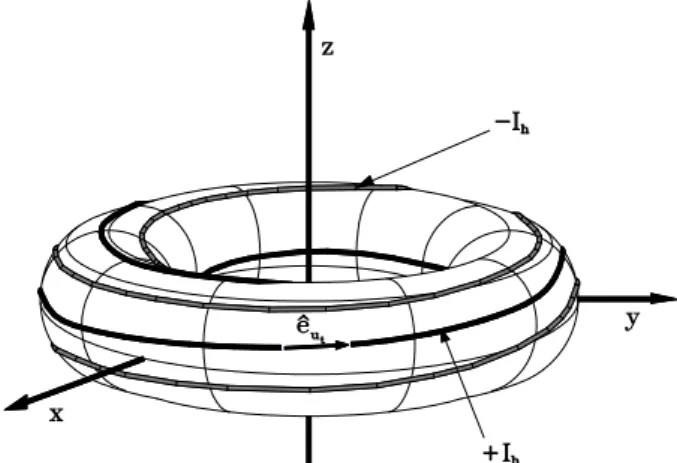
Resonant helial windings are m pairs of
lamen-tary helial ondutors, arrying a urrent I
H in
op-positediretionsforadjaentwires,andwoundaround
thetokamakouterwall(r=b) suhthat thevariable
u=m n' (38)
hasaonstantvalue[seeFig. 13℄. Thismeansthatthe
ondutorsloseonthemselvesafternturnsalongthe
poloidaldiretion,andmturns alongthetoroidalone.
Wewill hoose theintegersm and nsoasto exite a
mainresonaneatthedesiredpositionofarationalux
surfaewithq=m=n.
Letus rst derivethe magneti eld generated by
suh a onguration of RHW. Negleting both the
plasmaresponseandthepenetrationtimeofthe
metal-liwallweanassumethatthemagnetieldofaRHW
isavauumeld,givenbyB
1
=r
M
,where
M isa
magnetisalarpotentialsatisfyingLaplae'sequation
r 2
M
(r;;'=0),withproperboundaryonditionsat
r=b. Its solution,forr<b,isgivenby[54℄
Figure13. Shemativiewofresonanthelialwindingswith
(m;n)=(4;1)inatokamak.
M
(r;;')=
0 I
H
1
X
p=0 1
2p+1
r
b
m(2p+1)
sin[(2p+1)(m n')℄; (39)
d
where the magnitude of the terms in this summation
dereases veryfast with p, suh that it suÆes to
re-tainonlythelowestordertermintheaboveexpression
(p=0).
Nowwederivetheexpliitformoftheperturbation
HamiltonianforaRHWinloaloordinates. Itshould
bepointed out,however, that asingleRHW does not
break the symmetry of the equilibrium onguration.
This ours beause, although thetime-like variable t
appearexpliitlyintheperturbingmagnetield (39),
it does so through the ombination expressed by Eq.
(38). As a result, we pass from azimuthal to helial
symmetry, andasingleRHW with ylindrial
equilib-riumisstillanintegrablesystem[73,74℄.
A way to break the system integrability without
adding moreRHW is to onsider the toroidal
orre-tiononthetoroidal equilibriumeld B
0
, givenbyEq.
(5). This will introdue an additional Fourier series
in the perturbation Hamiltonian (30), suh that it is
rewrittenas[57℄
H
1
(J;;')= X
k ;m;n p
2J
R
0 !
jk j
A
mnk (J)e
i(m+k )
e in'
; (40)
d
whoseFourieroeÆientsarerelatedtotheoeÆients
oftheradialperturbingeld omponentb
rmn (J)by
A
mnk (J)=
p
2JR
0 b
rmn (J)
i(m+k)B
0
: (41)
that thisoeÆientisgivenby
b
rmn (r)=i
0 I
H
b
r
b
m 1
: (42)
Poinare-Birkhotheorem. However,thedominant
res-onane (in termsofits spetralpower) that isexited
by suh aRHW is the onewith q =m=n. Using the
methodsoutlinedintheprevioussetionweanobtain
thewidth ofthem:nisland andthefrequenyat the
exatresonanebyusingEq. (30),wheretheonstants
should bereplaedfor
G !
1
2
(m1) 2
d
dJ
J
0
; (43)
F !
p
2J
0
R
0 A
mn;1 (J
0
); (44)
where J
0 = r
2
0
=2 is given by solving numerially the
equationq(r
0
)=m=n.
Letuspresentsomeresultsofnumerialintegration
of themagneti eld line equations obtainedfrom the
equilibrium and perturbing elds in loal oordinates
with toroidal orretion (5). We hoose a RHW with
m = 3;n = 1 beause the main resonane to be
ex-ited is to be entered at 0:06m inside the plasma
(see Fig. 14). Theeld linesaretraedthroughmany
turnsaboutthetorusfromaseriesofinitialonditions.
A Poinaresurfaeofsetionat '=0is usedtoshow
ross-setions ofthe eld line ow. Fig. 14showsthe
phaseportraitforahelialurrentofI
H
equalto0:9%
of the plasma urrent I
P
. We see the formation of a
main hain of m = 3 island related to a mode
num-ber3: 1. Due to the toroidalorretion, the satellite
islands 4: 1 and 2 : 1 havean enhaned appearane.
The loations and widths of these islands are in good
agreementwiththetheoretialvalues[58℄.
Figure 14. Phase portrait of a Poinare surfae of
se-tion map in loal oordinates. We onsider a RHW with
(m;n)=(3;1) andIH =90A. Theremaining parameters
Figure 15. Phase portrait of a Poinare surfae of
se-tionmap in loal oordinates. We onsider a RHW with
(m;n)=(3;1)andIH =160A. Theremainingparameters
aretakenfromTableI.
Notie that the main island has a quite sizeable
stohasti layer, but there are some remaining
mag-neti surfaes isolating it from theirsatellites. In this
ase,weanseethatathikstohastilayerisformed
around the main 3 : 1 island, through interation of
` =6 and 7 seond-orderresonanes, sine the` =5
hainisstillvisible. Onlyforhigherurrents(withI
H
equalto1:6%ofI
P
,seeFig. 15)weanseetheonsetof
globalstohastiitysinethe3:1and4:1islandlayers
interonnetthemselves,i.e., eldlineswander
ergodi-allythrougharegionomprisingbothresonanes. We
alsoseethatthehelialurrentneededtoobtainglobal
stohastiityfor the3:1-2:1island pairisverylarge
omparedwiththepairformedwiththeothersatellite,
sothereis little interestin onsidering this possibility
asthemainauseofstohastiityduetothisRHW.
For main and satellite islands the amplitude
in-reaseswithI 1=2
H
,butthetoroidalorretionintrodues
a fator proportional to (r
0 =R
0 )
m=2
whih dereases
substantially the satellite half-widths when ompared
withthemain island. Theonset ofmagneti eldline
stohastiitybetweenthemain island andeither ofits
satellitesisdesribedbyanalyzingthestohastiity
pa-rameter(37). Numerialobservationsoftheislands
be-haviornearthetransitionhaspointedthat
rit 4=5
(\four-fths rule"). It indiates a ritial helial
ur-rent ofabout1:4%of the plasmaurrent, onsidering
theoverlappingofthe 3: 1-4:1island pairand 2:6%
B. RHW in polartoroidaloordinates
Therearemanyreasonsto onsidertheproblemof
aRHWthatexitesmodenumbersm:nusingamore
sophistiatedoordinatesystem,likethepolartoroidal
(r
t ;
t
;'): (i) the toroidiity eets are naturally
in-luded inthegeometry,andthere isnoneedforanad
ho toroidal orretion, as for loal oordinates; (ii) a
realisti design of a RHW needs to takeinto aount
theeets ofthe toroidalgeometry. While in a
ylin-drialapproximationthehelialpithisonstant,with
the eet of toroidiity we nd that the pith is no
longeruniformduetothebehaviorofthetoroidaleld
omponent, whih is stronger in the inner partof the
torus.
Heneweuseawindinglawtobestemulatethe
a-tualpathsfollowedbymagnetieldlines,introduing
atunableparameter,suhthatthevariable
u
t =m(
t
+sin
t ) n'
t
(45)
isonstantalongagivenhelialwinding[59℄. The
pa-rameter is hosen aording to the anonial angle
variable # dened in (25). In this setionweonsider
apairof RHW,loatedat u
t
=0and u
t
=,
respe-tively.
Weanobtainanalytiallythemagnetield
gener-ated byaRHW in polartoroidaloordinates,by
solv-ingtheLaplaeequationforthemagnetisalar
poten-tial. The algebrai manipulations, however, are more
involvedthantheaseofloal oordinates,and we
re-fer to aprevious paper[62℄ for details of the
alula-tions. TheorrespondingvetorpotentialA
1
,suhthat
B
1
= rA
1
hasthe ovariantomponent, in lowest
order,givenby
A
13 (r
t ;
t ;')=
0 I
H R
0
0
+m
X
k = m J
k (m)
r
t
b
t
m+k
e i[(m+k )
t n'
t ℄
; (46)
d
where J is the Bessel funtion of order k, and from
whihtheomponentsoftheRHW eldaregivenby
B 1
1 =
1
R 0
0 r
t A
13
t
; (47)
B 2
1 =
1
R 0
0 r
t A
13
r
t
; (48)
B 3
1
= 0; (49)
inwhihweretainedrstorderpowersoftheinverse
as-petratio. Notie howeverthat the zerothorderterm
already ontains toroidal eets, sine r
t
depends on
both r and [see Appendix℄. It is useful to ompare
thisresultwiththatobtainedinthelimitofylindrial
geometry. In this ase we negletthe Shafranovshift
suhthatthemagnetiaxisoinideswiththe
geomet-riaxis(R 0
0 !R
0
); andtheRHWhasnowauniform
pith ( = 0), so that the helial variable is simply
u
t
!m n'.
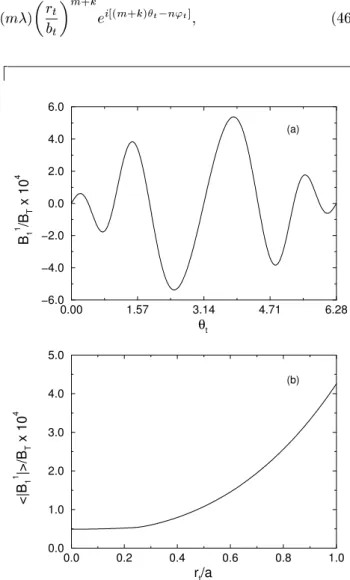
InFig. 16(a) weshowapoloidalproleof the
ra-dial omponentof theeld generatedbyaRHW with
(m;n) = (4;1), (I
H =I
P
) = 0:003, = 0:4826and at
axedradialpositionr
t
=a =0:911. Wenote thatthe
poloidalperturbingeldB 2
1
intheinternalregion(low
t
)issmallerthanintheexternalregionduetothe
ef-fetof thetoroidalurvatureonthe RHW pith. Fig.
16(b)showsaradialproleof thepoloidally-averaged
radialomponent < B 1
1
>, for similar parameters. It
falls down rapidly whenever the radius dereases, so
thatonlytheplasmaedgeregionis expetedtobe
no-tieablyaetedbytheperturbinghelialeld.
0.0
0.2
0.4
0.6
0.8
1.0
r
t
/a
0.0
1.0
2.0
3.0
4.0
5.0
<|B
1
1
|>/B
T
x 10
4
0.00
1.57
3.14
4.71
6.28
θ
t
−6.0
−4.0
−2.0
0.0
2.0
4.0
6.0
B
1
1
/B
T
x 10
4
(a)
(b)
Figure 16. Radial omponent of the eld generated by a
(m;n)=(4;1)RHWwithIH=IP =0:003 and=0:4826.
(a) Poloidal prole for rt = 0:91a; (b) Radial prole for
0.00
1.57
3.14
4.71
6.28
θ
t
0.55
0.65
0.75
0.85
0.95
1.05
r
t
/a
Figure 17. Phase portraitof aPoinare surfaeof setion
mapduetoa(4;1)RHWinpolartoroidaloordinates,with
I
H =I
P
=0:001and=0:4826. Theremainingparameters
aretakenfromTableI.
InFig. 17 wepresenta phaseportrait of theeld
linestrutureduetoa4:1RHWinwhihtheurrent
is 0:1%of the total plasma urrent. The main island
tobeexitedbytheRHWisenteredataformer
mag-neti surfae with safety fator q = 4=1, onsistently
with themodenumbersherehosen. Othernotieable
islands havesafetyfators5=1,3=1and2=1,for
exam-ple. In order to see the eet of the parameter on
the eld line struture, we show in Fig. 18 the same
phaseportrait,but with=0. Itisapparentthat the
number of sizeable island hains has been redued in
this ase. Inpartiular,the2:1and3:1islandshave
theirwidths dramatiallydereased. Hene,theuseof
awindinglawsuhas(45)enhanestheresonanteet
produedbyaRHW.
0.00
1.57
3.14
4.71
6.28
θ
t
0.55
0.65
0.75
0.85
0.95
1.05
r
t
/a
Figure 18. Phase portraitof aPoinare surfaeof setion
mapduetoa(4;1)RHWinpolartoroidaloordinates,with
IH=IP =0:001and=0.
The RHW urrent in Fig. 19 has been inreased
to 0:3% of the total plasma urrent, and Fig. 20 is
many island hainsbesidesthemain 4: 1islands,but
therearesomedierenes: (i)theislands'widthshave
inreased;(ii)withintheregionneartotheisland
sepa-ratrixtherearethinarea-llingportionswheretheeld
linesare haoti. In Fig. 20 wemay alreadysee suh
aregionoflimitedhaotimotionintheneighborhood
oftheseparatriesofthe4:1islandhain. Theother
hainshavelikewisetheirownhaotiregions,butthey
arenotso evident,either due to theirsmall widthsor
beausetheinitialonditionsusedinthephaseportrait
failedtogenerateanorbitin thehaotiregion.
0.00
1.57
3.14
4.71
6.28
θ
t
0.55
0.65
0.75
0.85
0.95
1.05
r
t
/a
Figure19. Phase portraitof a Poinare surfae ofsetion
mapduetoa(4;1)RHWinpolartoroidaloordinateswith
I
H =I
P
=0:003and=0:4826.
0.00
1.57
3.14
4.71
6.28
θ
t
0.55
0.65
0.75
0.85
0.95
1.05
r
t
/a
Figure20. Phase portraitof a Poinare surfae ofsetion
mapduetoa(4;1)RHWinpolartoroidaloordinateswith
IH=IP =0:003and=0.
As longas theperturbation is small enough,
how-ever, these loally haoti regions are separated from
eah other by surviving magneti surfaes, and the
radial exursion of eld lines is naturally limited by
surviving magneti surfaes areprogressivelyengulfed
byloally haoti regionsbelonging to adjaentisland
hains. Depending on the perturbation strength, the
adjaent island hains over a given region may be so
largethat the entireregion aroundthem is lledwith
haoti eld lines. This eventually leads to a
glob-allyhaotiregionwherelarge-salehaotiexursions
are possible. In the limit of very large perturbation
strength,eventheelliptipointsintheislands'enters
maylosetheirstabilityandbifurate,generatingother
periodiorbits.
VI Ergodi Magneti Limiters
Thenon-symmetriharaterofthemagnetield
gen-erated by aRHW is due to the toroidal eet onthe
helialsymmetry. This breakstheintegrability(inthe
Hamiltonian sense) of the equilibrium onguration,
thus leadingto all the onsequenesmentionedin the
lastsetion,themostimportanttousbeingthe
gener-ationofhaotieldlines. Notethat,fromthepointof
viewof reduingplasma-wallinterations, it would be
usefultoreatesuhahaotiregionintheperipheral
regionoftheplasmaolumn.
In priniple this is feasible by using a RHW with
appropriatevaluesof(m
0 ;n
0
),asthe4:1asealready
studied. However, the mounting of suh windings on
a tokamak is sometimes a verydiÆult task, beause
of thelargenumberof diagnostiwindowsdistributed
along the tokamak wall. This has led to the onept
of an ergodi magneti limiter (EML) [23,24℄, whih
is omposed byoneor moregrid-shapedurrentrings
of nite length, poloidally wound around the torus.
We will onsider theEML problem in loal andpolar
toroidaloordinates,inthesamespiritwehavetreated
theRHWase.
A. EMLin loal oordinates
The EMLmodel to be onsideredhereisthe same
asthatoriginallytreatedbyMartinandTaylor[75,76℄,
but withadierentgeometry. OneEML ringonsists
ofaoilofwidth`withmpairsofwiresorientedinthe
toroidaldiretion and arryinga urrentI
L
[Fig. 21℄.
Adjaentondutorshaveurrentsowingin opposite
diretions,andweignoretheontributionsforthe
mag-netieldfromthepieesorientedinthepoloidal
dire-tion,sinetheireetonthetoroidaleldisnegligible.
With these simpliations, the EML onsists of a
bird-ageof2mstraightwiresequallyspaedbyan
an-gle=m. Ifweweretreatingwireswith\innite"length
(i.e., whih extend all overthe toroidal irumferene
2R
0
, in theperiodi ylinder approximationof large
aspet ratio)the systemwould be nothingbut a
heli-alwindingwithoutapithangle. Hene,themagneti
eld of suh aongurationan beobtainedfrom the
Figure 21. Shematiview of anergodimagnetilimiter
ring. Below: explodedviewofoneEMLring.
Howeverthewireshavenitesize`,whatbreaksthe
symmetryalongthetoroidaldiretion. Theabseneof
favorable boundary onditions turns diÆult an
ana-lytial solutionfor theLaplae's equationr 2
M =0.
An ad hoand non-rigorouswayofirumventingthis
problemistoneglet,inarstapproximation,the
bor-dereetsandwritethemagnetieldgeneratedbyan
EMLintheformB
1 =(
~
B
1r ;
~
B
1
;0),withthefollowing
deomposition [77℄
B
1r;
(r;;')= ~
B
1r;
(r;)f('); (50)
where ~
B
1r;
are the magneti eld omponents of
in-nitelylongwires[78℄
~
B
1r
(r;) =
0 mI
L
b
r
b
m 1
sin(m); (51)
~
B
1
(r;) =
0 mI
L
b
r
b
m 1
os(m): (52)
The toroidal dependene of the EML elds is
de-sribed by the funtion f('). Twokinds of funtions
have been used in our previous work on this subjet
[77℄: (i)square-pulsewaveforms
f(')=
1; if `
2R0
'+ `
2R0 ;
0; otherwise;
(53)
whih assumes that the limiter eld falls down very
sharplyoutoftheringextension;and(ii)aDiraomb,
oraperiodisequeneofdelta-funtionkiks
f(')= `
R
0 +1
X
j= 1
Æ(' 2j): (54)
Thewayweanseethemagnetieldlineowdue
to anEML depends onwhat kindofform,from those
exposedabove,weintendtouse. Ifweadopta
square-wavefuntion,aPoinaremapofeldlinesanonlybe
delta kiksenablesustoderiveananalytialmapping.
Thebasiideaisthataeldlinetwistsfreely,aording
toitsrotationaltransform,untilitreahesthelimiterat
'=0;2;:::n (foronering)or'=0;2=p;4=p;:::
for p rings, when it reeives a kik. We dene
dis-retized variables r
n and
n
asthe values of the eld
line oordinatesjust afterthen-thkik.
Themapsodened isgivenby
r n+1 = r n b r n b m 1 sin(m n ); (55) n+1 = n b 2 r n b m 2 os(m n ); (56)
where =
0 mI`=B
0
measures the strength of the
perturbationausedbytheEMLring,and
n = n + 2B (r n )R 0 B 0 ; (57)
in theylindrialase,and
n
=2artan[(r
n
)tan ((r
n
)+artan(r
n ;
n
))℄+2;
(58)
with thetoroidalorretion. Thepoloidal eldin (57)
is given in terms of the urrent prole (4) by
apply-ingAmpere'slaw,andthefollowingauxiliaryquantities
havebeendened:
(r n ) = R 0 B (r n ) B 0 r n (r n ) 1 r n R 0 ; (59) (r n ) = 1 r n R 0 1 r 2 n R 2 0 1=2 ; (60) (r n ) = 1 (r n ) tan n 2 : (61)
This map was rst derived by Viana and
Cal-das [79,80℄, but it is not exatly sympleti
(area-preserving) dueto theapproximationsemployedin its
derivation. Thisproblem, however,wasformally
over-ame byUllmannandCaldas[81℄,whohaveapplieda
anonialtransformationto thevariables(r
n ;
n )with
thehelpofageneratingfuntionoftheseondkind. In
this waythey havearrived to aradialmap whih has
tobenumeriallyinverted(usingNewton'smethod)to
giver
n+1
in termsofr
n and
n .
Numerial resultsof Poinaremaps havebeen
ob-tainedthroughtheuseofthenumerialintegration(in
the square-wave ase) and the above analytial map
(intheDiraombase)[76,77℄.InFig. 22,whihwas
generatedusingtheimpulsiveexitationmap,weshow
phase portraits for four (p = 4) EML rings, eah of
themwithm=6pairsofwireswithlength`=0:08m.
TheremainingparametersaretakenfromTableI,and
wepresent onlythose results withtoroidal orretion,
and for dierent limiter urrents. We observe many
primaryislandhains,thelargeronesorrespondingto
by 6: 2islands at 0:060m,and a seriesof satellite
is-landsdue to thetoroidaleet. All these features are
inaordanewiththetheoryofquasi-integrableelds
developedintheprevioussetion.
0.00
0.20
0.40
0.60
x(m)
0.00
0.02
0.04
0.06
0.08
y(m)
0.00
0.20
0.40
0.60
x(m)
Figure22. Phase portraitof a Poinare surfae ofsetion
map dueto a EML withp = 4 rings, eah of them with
m= 6pairs of wires, inthe retangular loal oordinates
x=bandy=b r. (a)IL=IP =0:01;(b)IL=IP =0:04.
Figure23. MaximalLyapunovexponentfor asetofinitial
onditionsatx
0
=0:60mandvaryingEMLurrentI
L ,for
the sameparameters as in Fig. 22. The Lyapunov
expo-nentsaredepitedingray-sale.
Aninterestingwaytoanalyzethegrowthofthe
res-onantmagnetiislandhainandtheonsetofhaosdue
toitsoverlappingwiththeadjaentones,asweinrease
the limiter urrent, is to ompute the maximal
Lya-punovexponentfordierentorbits. InFig. 23weplot
theleadingLyapunovexponentforvariousorbitsinthe
Poinaresetion,fromdierentinitialonditionsat
dif-ferentradialpositionsy
0
andaxedpoloidalanglex
0 ,
andforavaryinglimiterurrentI
L
. TheLyapunov
ex-ponentis representedin gray-sale, and blak regions
indiatepositivevaluesforit. Weobservethe
appear-aneoftherstthinhaotilayersatI
L
about1:0%of
I
P
,whiheventuallygrowforhigherI
L
andjoin other
layerstoformalargehaotiregion[81℄.
Theboundarybetweenhaotiand regularregions
in Fig. 23 is quite irregular and atually of a