R
ev
ie
w
0103 - 5053 $6.00+0.00
*e-mail: [email protected]
Online Isotope Dilution and Inductively Coupled Plasma Mass Spectrometry: from
Elemental to Species Quantiication
Maria Fernanda Giné* and Ana Paula Packer
Centro de Energia Nuclear na Agricultura, Universidade de São Paulo, Av. Centenário 303, 13416-000 Piracicaba-SP, Brazil
Apresentam-se sistemas de análises em luxo propostos para a quantiicação de elementos e espécies por diluição isotópica (ID) utilizando espectrometria de massas com fonte de plasma acoplada indutivamente (ICP-MS). Detalham-se os esquemas para adicionar em linha a solução isotopicamente enriquecida à amostra. São relatadas as aplicações em meio aquoso e outras com transferência do analito para a fase vapor, seja por processo de vaporização eletrotérmica, geração de vapor ou ablação por laser. Apresentam-se as aplicações com quantiicação de espécies por ID caracterizadas pela adição do isótopo enriquecido, antes ou após a separação das espécies, seja por cromatograia a líquido, a gás ou por eletroforese capilar acoplada a ICP-MS. As principais equações envolvidas na quantiicação por ID e as principais fontes de erro são descritas. São discutidas as mudanças introduzidas na estratégia de quantiicação temporal por ID de elementos e espécies pela calibração do luxo de massas da amostra e do isótopo enriquecido adicionado.
Flow analysis has been utilized for elemental and species quantiication by online isotope dilution inductively coupled plasma mass spectrometry (ICP-MS). Online isotope dilution (ID) herein refers to strategies promoting the addition of enriched isotopic solutions to the samples while lowing towards the plasma. Applications of online ID’s are commonly performed in aqueous media, however, in some processes the analyte transference to the vapor phase using electrothermal vaporization, vapor generation or laser ablation is also required. Flow diagrams to perform online pre or post-column spiking with the enriched isotope for quantiication by ID in speciation analysis by liquid chromatography, gas chromatography or capillary electrophoresis devices coupled to ICP-MS are presented. The main igures of merit and equations applied to elemental and species quantiication by ID in lowing schemes are assessed.
Keywords: isotope dilution, online spike, inductively coupled plasma mass spectrometry, elemental analysis, speciation
1. Introduction
Isotopic analysis by inductively coupled plasma mass spectrometry (ICP-MS) allows the quantitative and accurate
determination of most elements via the method of isotope
dilution (ID). Quantiication by ID involves measuring the isotope ratio in a sample before and after spiking with a known amount of a standard enriched in one isotope. The mass spectrometer allows measuring the isotopic composition of the blended sample after attaining isotopic equilibrium. The single and multi-isotopic capability of ICP-MS for precise and accurate isotope ratios (IR) measurements has been exploited for elemental and species
quantiication by ID analysis. Fundamental and applied research on ID analysis with detection by ICP-MS (ICP-IDMS) has signiicantly increased in the last 20 years. The availability of isotopic enriched materials and improved ICP-MS equipments has allowed for the expansion of online ID to different application ields.
Flow injection (FI) strategies and online schemes had been useful to spike samples with the enriched isotopic solutions for elemental and speciation analysis by ICP-IDMS. The spiking procedure can be accomplished manually or under lowing conditions for an accurate quantiication. The ability of FI has been demonstrated for online quantiication by applying the standard additions method,
internal standardization, and matrix-matching calibration.1
in different applications.2,3 The most common proposal
to perform online FI-ID applications involves the introduction of both, sample and isotopic enriched spike, in different channels and the continuous merging of both in a T-junction before introduction into the plasma. The ICP-MS equipments are able to measure at least two isotopes free from interferences for many elements. The eficiency of measuring IR in transient signals is based on some considerations; the ICP high ionization eficiency for gaseous and liquid samples assure isotopic equilibrium in the plasma and the fast scanning detection of the involved isotopes allows good precision to be attained, thus
minimizing any plasma luctuation.4
Eficient nebulizers and spray chambers coupled to the ICP provide not just the mixing of samples with the isotopic enriched solutions but also increase the eficiency of their transport towards the plasma, thus attaining high sensitivity. The accuracy of quantiication of the element by ID is directly related to the precision of IR measurements, which enclose isotopic discrimination, spectroscopic interferences and instrumental stability. The online injection of discrete sample volumes allows the eficient baseline restoration reducing undesirable effects, such as material deposition or clogging of nebulizers and interface cones. On the other hand, the online ID calibration strategy can improve precision and accuracy for analyte quantiication. So, ICP-IDMS was applied to quantify analytes in samples produced along transient analytical processes, such as online
electrolytic dissolution,5 sample vaporization by laser
ablation (LA),6 vapor generation (VG)7 and electrothermal
vaporization (ETV).8
FI devices facilitate the application of ID by improving sample and spike mixing while lowing to the ICP, which is eficient to increase sample throughput. In order to attain accurate results, adjustment of the sample to spike ratio is however necessary to minimize counting statistic errors. Unlike the ofline ID, the online approach demands precise sample introduction devices, stable low-rates and a mass spectrometer properly adjusted for monitoring transient events.
Online interfaces for species separation techniques, such as liquid chromatography (LC), gas chromatography (GC) and capillary electrophoresis (CE) to the ICP-MS, allowed improving elemental speciation analysis. However, the application of online ID for speciation analysis by ICP-MS has been largely applied since the
proposal of Rottman and Heumann in 1994.9 Authors
described the online species-unspeciic quantiication by ID of one or more elements in different species by sample and spike mass low calibration, regardless of their chemical forms.
This review presents the development, advantages and applications of online spiking modes to perform elements and species quantiication by ICP-IDMS.
2. Isotope Dilution and ICP-MS
ICP-IDMS has currently the potential to provide highly precise and accurate results for elements and species quantiication. IDMS is considered an accurate method once it is based on the addition of a known amount of an isotopic enriched element to the sample which is able to
act as an ideal internal standard.10-12 Once equilibration
of the spike and analyte isotopes has been achieved, the total recovery of the analyte is not required. Instead,
quantiication is based on measuring the altered IR.13,14 The
IR absolute values are not affected by sample matrix effects, transport eficiency, instrument instability or signal drift
due to variation along the sample ionization process.15 In
principle, all elements with at least two natural isotopes can be quantiied by ICP-IDMS. The main requirements are the availability of enriched isotopic standards of elements with at least two non-interfered isotopes. There are proposals for applying IDMS to mono-isotopic elements when long-lived
radioisotopes are used as spikes.14,16
The concentration of the element in the sample can be calculated as:
(1)
where AS and BS = atom fractions of isotopes A and
B in the sample; ASp and BSp = idem, in the spikes; CS
and CSp = concentrations of the elements in the sample
and spike; mSp = spike mass; VS = sample volume,
Rb = measured isotope ratio of the blended sample corrected
for mass discrimination; K = ratio of the atomic mass of
the element over that of the spike. Considering Rb as the
enriched to natural isotope ratio, consequently the K factor assumes values slightly above or below the unity depending on the spike being enriched on the heavy or light isotope. Calibration of the isotopic abundances and concentration of the spike is required to achieve accurate concentration data by IDMS. The spike characterization is made by
reverse isotope dilution.16,17
Parameters affecting accuracy and precision in IR measurements by ICP-MS are well known and extensively
described.18-20 The accuracy of the ID method can be
attained by properly deining the analytes, knowing the purity of the isotopic enriched spike, adding exactly the spike and sample masses, and ensuring the identical
Best IDMS measurements are attained under the theoretical optimum ratio and optimum ion counting
statistics.16,18 The error magnification factor due to
propagation of the uncertainties increases as the IR of the blended sample approaches the spike IR (overspiking) or the
natural IR (underspiking).16,17 To calculate the concentration
by IDMS, the effect of the error magniication factor is dependent on the precision of MS measurements and the relative spike to natural isotopic enrichment. In terms of error propagation in concentration, the theoretical optimum ratio corresponds to the square root of the product of sample and spike isotope ratios. Therefore, the best mass spectrometric
precision is achieved for IR approaching unity.16
3. Online Spiking to Perform ID for Element
Quantiication
3.1. Features for online addition of enriched isotope solution
The irst low systems to perform online ID by ICP-MS
were proposed in 1989 and 1990.2,3 The online ID was
performed by continuously pumping sample and spike solutions through separated streams merged in a T-device before reaching the ICP-MS nebulizer. FI and other continuous low systems have been largely used for online
ICP-IDMS (Table 1). In the irst paper a sequence of short time synchronized multiple injections of both solutions introduced into a single carrier stream was exploited. The optimum sample to spike ratio and the measurement parameters were experimentally determined for samples
with 1.0 to 10 ng mL-1 Pb. Reverse low isotope dilution
was proposed to verify the Pb concentration and isotopic composition of the spike solution. These dilutions were also used to calculate correction factors due to any difference in the merging streams or in the mixing valves. The multiple injection modes produced transient signals in the spiked
samples, covering a wide analyte concentration range.2,3
This application emphasized the effect of nebulizer low rate, measurement period and dwell times, along transient
signals for isotope ratio (IR) measurements.3
Klinkenberg et al.22 presented in 1993 a simpliied
flow scheme to perform time controlled injection of discrete volumes of sample or calibration standard into a continuous flowing isotopic enriched solution. By taking into account the corrections for detector dead time and mass discrimination, the spike composition and concentration were adjusted to provide good precision of IR measurements. Furthermore, the authors described the theoretical adaptation of the classical ID approach
for online ICP-IDMS.23 From classical ID, the amount of
spike and sample and the respective isotopic compositions
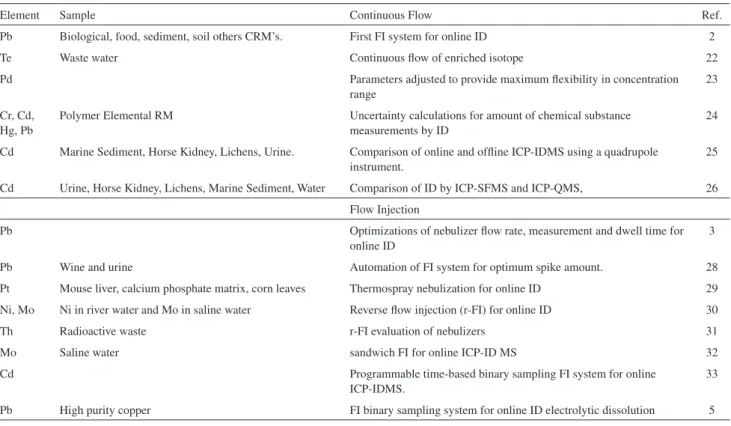
Table 1. Examples of works using low conigurations for online introducing the enriched isotope solution
Element Sample Continuous Flow Ref.
Pb Biological, food, sediment, soil others CRM’s. First FI system for online ID 2
Te Waste water Continuous low of enriched isotope 22
Pd Parameters adjusted to provide maximum lexibility in concentration
range
23 Cr, Cd,
Hg, Pb
Polymer Elemental RM Uncertainty calculations for amount of chemical substance measurements by ID
24 Cd Marine Sediment, Horse Kidney, Lichens, Urine. Comparison of online and ofline ICP-IDMS using a quadrupole
instrument.
25 Cd Urine, Horse Kidney, Lichens, Marine Sediment, Water Comparison of ID by ICP-SFMS and ICP-QMS, 26
Flow Injection
Pb Optimizations of nebulizer low rate, measurement and dwell time for
online ID
3
Pb Wine and urine Automation of FI system for optimum spike amount. 28
Pt Mouse liver, calcium phosphate matrix, corn leaves Thermospray nebulization for online ID 29 Ni, Mo Ni in river water and Mo in saline water Reverse low injection (r-FI) for online ID 30
Th Radioactive waste r-FI evaluation of nebulizers 31
Mo Saline water sandwich FI for online ICP-ID MS 32
Cd Programmable time-based binary sampling FI system for online
ICP-IDMS.
played key roles in the system optimization for attaining precise IR measurements of the blended sample. The injection of a deined sample volume into the lowing spike solution produced a transient signal relecting the continuous temporal variation of the isotope ratios. Within the transient signal, it was possible to select an appropriate range for precise determination of isotope ratios for a given sample. This procedure was used in the project Polymer Elemental Reference Material to calculate the uncertainties associated with the determination of Cr, Cd, Hg and Pb in
two polyethylene materials by online ICP-IDMS.24
The analytical igures of merit and procedures involved in online and ofline ICP-IDMS were compared for Cd determinations in biological and environmental samples. For online experiments, sample and spike solutions were continuously pumped and mixed just before the ICP-MS nebulizer. Both approaches presented similar results, although online ID was faster. Authors proposed a correction factor considering the sample and spike
solutions densities for the online ID equation.25 However,
the density correction was considered unnecessary when the ID equation is expressed in terms of mass low. The online and ofline ID’s were compared by using an ICP sector ield mass spectrometer (ICP-SFMS) and a quadrupole
mass spectrometer (ICP-QMS).26 ICP-SFMS in the low
resolution mode presented higher sensitivity and improved IR precision compared to ICP-QMS. The precision of the IR measurements by ICP-SFMS was improved to RSD < 0.1% by increasing the number of scans across the selected mass range. However, the precision of IR measurements
of interfered isotopes, such as 78Se/77Se was characterized
by RSD of 0.09% with the collision cell ICP-QMS with
H2 whereas by ICP-SFMS at medium resolution presented
RSD of 0.14%.27
3.2. Flow injection conigurations for ICP- IDMS
The continuous merging of sample and spike solutions to perform online ICP-IDMS was enhanced by FI strategies improving the mixing of both solutions, reducing their consumption and providing spiking repeatability. The control of the injected sample and spike volumes made the system more lexible to adjust the optimum IR, and reduced memory effects. The precision and accuracy of IR measurements in monitoring transient signals was considered dependent on the mass spectrometer, data acquisition parameters and transient peak obtained by the
FI system.4 Examples of works using FI or continuous
addition of the enriched isotope are presented in Table 1. The irst works using FI system coupled to an ICP-MS
instrument for online ID and sample dilution,2,3 suggested
either the merging zones configuration or multiple injections to control the sample to spike ratio. Various sample dilution rates were systematically studied for Pb determinations in diverse standard reference materials to evaluate the precision of the isotope ratio measurements.
A FI system to evaluate the ID capability for overcoming matrix effects was tested for Pb determination in wine
and urine samples by ICP-MS.28 A FI system with
three different merging streams in two T-junctions was proposed for online performing external calibration, standard additions and isotope dilution with a thermospray nebulizer for introducing solutions into the plasma. The disadvantages appointed for online ID concerned to the high sample dilution and the fact of not correcting losses during the previous handling of the sample. The thermospray nebulization presented better eficiency than pneumatic nebulization for the determination of trace
levels of platinum.29 In both papers, the relative merits of
quantiication by online ID, online standard additions and external calibration were compared in terms of accuracy and precision. The authors also highlighted the lexibility of the FI manifold for automation. This facility helped to deine the optimum spike amount required for measuring precise IR for a wide range of analyte concentrations. However, to attain good results several enriched isotope
solutions in variable concentrations were necessary.28,29
Reverse low injection (r-FI), proposed by Beauchemin
and Specht30 provided an easy way to select the optimum
spike. In r-FI, online ICP-IDMS is accomplished with
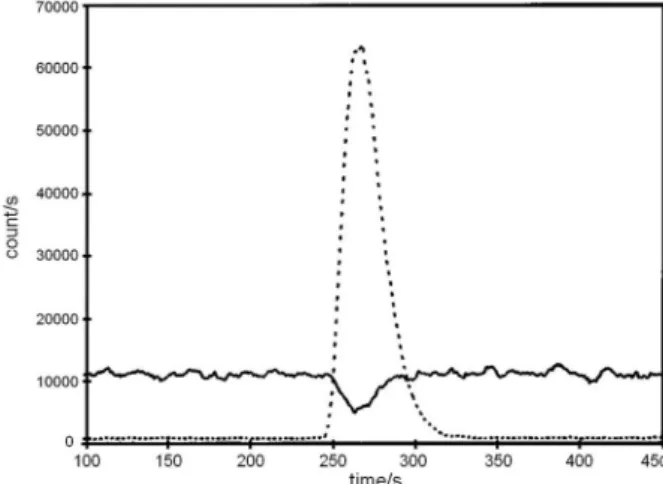
simple manifolds once the sample is used as the carrier and the enriched solution is injected into it. The resulting transient signal is presented in Figure 1. The observed peak
corresponds to the spike enriched 62Ni solution, whereas
a dip is observed for 58Ni, the impoverished isotope.
Figure 1. Signals for 58Ni (solid line) and 62Ni (dashed line) resulting
from the low injection of 100 µL of 5 µg L-162Ni isotopic spike solution
into a 1 µg L-1 multielement standard (Reprinted from reference 30 with
Therefore, the corresponding concentration was calculated point-by-point from the resulting proile. Compared to the ofline and merging zones strategies, in r-FI approach the selection of the best isotope ratio is attained after a point-by-point calculation on the peak proile. The r-FI was applied to the analysis of river water certiied reference material and
to saline water.30 Similarly, 230Th a long lived radionuclide
was determined in waste samples using r-FI.31
To reduce the high sample consumption of r-FI, an
automated manifold to perform the sandwich low injection
system was proposed for online ICP-IDMS.32 The spike
solution was intercalated between two sample plugs as shown in Figure 2, which created a concentration gradient in the superposed proile of the analyte in the
sample-spike-sample sequence. However, in the r-FI and the sandwich
low approaches a point-by-point isotope ratio needs to be computed, eventually corrected and calculated using a modiied ID equation. Even with the lexibility described, the complexity in computing the results to attain the element concentration makes this methodology tricky for routine analysis. Compared to ofline ICP-IDMS, the relative error of a single determination using these approaches is greater, because the precision on the isotope ratios was affected by the limited data point measurements along the FI peaks.
A FI system with programmable time-based binary sampling of small plugs of sample and spike solution was proposed for online ICP-IDMS. Mixing of different
sample and spike volumes were programmed until a steady state condition was attained to perform automatic
isotope dilution.33 Computer controlled solenoid valves
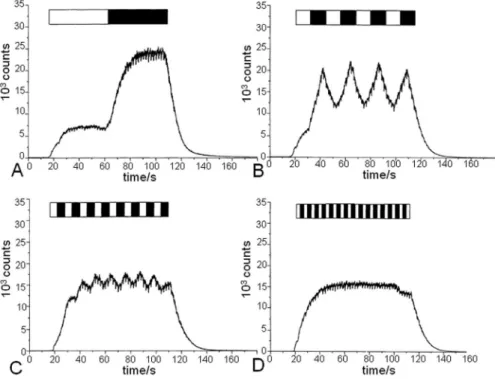
were connected and properly programmed to adjust independently the volumes of the sample or spike solutions introduced into the carrier stream on the way to the nebulizer (Figure 3). Compared to the systems exploiting gradient concentrations, the computer controlled binary sampling present high versatility to attain a wide range of sample to spike volumetric ratios. High lexibility for mixing solutions to attain precise IR, low consumption of
Figure 2. Signals for 96Mo (full line) and 97Mo (crossed line) resulting from
the sandwich injection of 100 µL of 5 µg L-197Mo isotopic spike solution
into 1.5 mL of 3 µg L-1 multielement standard, with 1% (v/v) HNO 3
as carrier (Reprinted from reference 32 with permission of American Chemical Society).
Figure 3. Transient signals at m/z 112 produced by the alternated injection of natural and enriched 112Cd solutions during 90 s. Signal proiles corresponding
to the injection of 1 (A), 4 (B), 8 (C) and 15 (D) alternated aliquots. The bars represent the alternated aliquots of natural (white) and enriched 112Cd (black)
isotopic enriched standards, and high sampling throughput are the main advantages of this procedure. The volumes introduced into the system are established by the time delay during sample introduction and the low rate. A variation of the classical ID calculation was proposed for binary sampling low conditions. Considering that sample and spike solutions are introduced into the system with identical low rates, the time during which the valves remain switched on establishes the volume introduced. Under this condition the ID equation was modiied to:
(2)
Where: Rb = isotope measured in the mixture corrected
for mass discrimination, CS and CSp = analyte concentration
in the sample and enriched solution, AS, BS and ASp, BSp =
sample and spike isotope abundances. The time delay for
introducing the sample was tS and the time delay for the
spike was tSp.
Online ID by binary sampling was applied to quantify Pb in high-purity Cu after online electrolytic dissolution of the metal. Synchronized binary sampling was completed
among the dissolved sample aliquots and the 208Pb spiked
solution. This solution was analysed by the ICP-MS for determining Pb isotope ratios and Cu in the same aliquot. Cu was determined to deduce the corresponding sample
dissolved mass.5 Dissolved iron in seawater samples was
separated from the sample matrix by using a nitriloacetic acid chelating resin. The eluted Fe from the resin column
was mixed with a post-column low of 54Fe and determined
by ICP-IDMS.34
4. Online ID with Analyte Transference from
Liquid to Gas Phase
Online ICP-IDMS has been used for quantiication after sample vaporization by laser ablation (LA), vapor generation (VG) and electrothermal vaporization (ETV). Different instrumental arrangements hyphenating the vapor generating devices to the ICP-MS allowed performing ID procedures involving analyte transference from liquid to gas phase. Possible drifts of mass bias during the measurements could result in systematic errors in IR. However, these errors are corrected by comparison of the experimental
results with true values for a reference standard.18,35,36
4.1. Laser ablation online ICP-IDMS
The advantages of coupling a laser ablation (LA) system
to the ICP-MS is the in situ sampling from solids without
any further sample preparation. In addition, the introduction of dried samples into the plasma reduces polyatomic interferences. However, the ablation process and the analyte quantiication demands for new calibration strategies due to a lack of suitable certiied reference materials (CRM) with a matrix composition similar to the sample. The amount of ablated mass, the element fractionation and the gas phase formation are highly dependent on the laser and sample properties.
Online solution-based calibration procedure was developed by Becker and co-workers for LA-ICP-MS. The calibration was performed by producing a dried aerosol from standard solutions introduced into the LA chamber to join the ablated material while being transported towards the ICP. The dried aerosol was produced by means of an ultrasonic or microconcentric nebulizer equipped with
a dessolvator coupled to the LA chamber.6 The online
LA-ICP-MS solution-based calibration procedures could be applied for external calibration, standard additions and isotope dilution for trace metal determinations. This procedure is as a new calibration strategy for LA-ICP-MS. However, in all solution-based calibration strategies, the difference in element sensitivities between LA-ICP-MS and ICP-MS should be considered and corrected using a
deined correction factor via an internal standard element.37
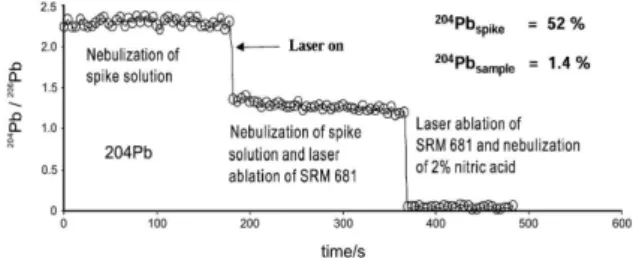
To perform online LA-ICP-IDMS, the dried aerosol of the enriched isotope spike solution was transported with argon into the laser ablation chamber. Therefore, a deined amount of a dried spiking aerosol joined the ablated sample while being transferred to the ICP. To calculate the element concentration by online isotope dilution in LA-ICP-MS three measurements of the ablated material
were determined in sequence as shown in Figure 4.37 First
the 204Pb/206Pb isotope ratio due to the nebulization of the
spike solution alone, the spike solution plus the LA of the platinum NIST SRM 681 sample, and the ablated sample carried by nitric acid. Data in Figure 4 were collected for 8 min and represented the standard and analyte IR during LA. ID calibration using LA-ICP-MS has been applied for stable or radioactive isotopic tracer quantiication in
Figure 4. 204Pb/206Pb isotope ratio (corrected for mass bias) measurements
diverse ields. This procedure was discussed in several
reviews.38-42 Solution-based LA isotope dilution was
applied to determine impurities in small amounts of noble
metals43 and trace elements in hair samples for biological
monitoring.44 The potential for several other applications
was described.42 Following the same concept, the insertion
of a microlow nebulizer in the laser ablation chamber was proposed as another arrangement for online
solution-based isotope dilution.45 Insertion of the microlow total
consumption nebulizer into the LA chamber is handy and low cost. It represents a compact arrangement for solution-based calibration in LA-ICP-MS. This device is characterized by a low solution uptake rate. This low rate reduces the amount of isotope-enriched tracer solution needed for online isotope dilution in LA-ICP-MS.
4.2. Gas generation online ICP-IDMS
A low injection system with merging of the sample and isotopic tracer for iodine introduction into an ICP-MS
via a gas phase apparatus was described to perform ID.7
The long-lived 129I radionuclide mixed with 70% (v/v)
perchloric acid by using a Y-shaped glass tube was used as spike for quantitative determination of iodine by ID in several biological materials.
4.3. ETV-ICP-MS with online ID
For solid sampling analysis by ETV-ICP-IDMS the introduction of a continuous stable low of gaseous spike generated in a permeation tube constructed in-house
was reported.8 The steady-state signal of the continuous
gaseous spike was isotopically altered during the sample vaporization. To demonstrate the feasibility of the proposed
procedure,8,46 a continuous low of enriched 200Hg was
circulated through the furnace; meanwhile, the sample was subjected to a multistep heating program. This allowed the simultaneous determination of methylmercury and inorganic mercury in biological materials. The possibility of using the same approach for total Hg determination in ish, human air and river sediments by ID was veriied. In general the approach was capable of correcting for matrix effects. It provided satisfactory results in spite of the
different vaporization behavior for each samples matrix.47
5. Online Spike to Perform ID for Species
Quantiication
Elemental and molecular speciation analysis has been an analytical challenge in this millennium. Implementation of ID for species quantiication by ICP-IDMS experienced
amazing development driven by environmental applications and quantitative proteomics.
5.1. ID for elemental speciation analysis
The quantiication of elements as separated chemical species has been performed by online coupling techniques, such as LC, GC and CE with atomic detection systems. The multi-element capability of inductively coupled plasma and microwave induced plasma (MIP) with detection by optical emission (OES) or mass spectrometry has been exploited for online analysis of separated liquid and gaseous species.48,49
Online ID in speciation analysis has been accomplished by spiking with the isotopic enriched solution in lowing conditions before reaching the plasma. The isotopic equilibrium is supposed to be attained in the ICP which is considered as a compound independent ionization source. In principle, the main advantage of ID in speciation analysis is the self-calibration ability that avoids the
use of internal standards for instability corrections.48
However, the main dificulty is to attain precise isotope ratio measurements for transient signals. The ability of ICP-MS to perform isotope ratio determinations in volatile organic species separated by GC was irst reported in 1987
by Chong and Houk.50
5.2. ID modes for speciation analysis
Applications of ID for speciation analysis differentiate between the species-specific isotope dilution (SSID)
and species-unspecific isotope dilution (SUID).9 The
species-speciic isotope dilution modality SSID search for quantiication of the species itself and is performed by spiking a sample with the isotopic enriched labeled species. Nevertheless, this case is out of the scope of the present review once the isotopic labeling is performed ofline,
commonly during sample preparation and derivatization.51,52
The unspeciic ID approach supports the quantiication of an element present in different species by spiking with an enriched isotopic solution with known composition. This is independent of the chemical form of both. The applicability of ID is facilitated by the availability of enriched isotopic elements from different commercial suppliers. The online spike to perform SUID is widely applied even when the isotopic equilibrium among the isotopes in the species and spikes are not attained; though, it is assumed that the ICP
converts both forms with equal eficiency into atomic ions.52
The quantitative elemental speciation by ID was peer
reviewed by Rodríguez-González et al.53 These authors
associated with species-speciic and species-unspeciic ICP-IDMS for a wide range of applications. This tutorial review on isotope dilution analysis for elemental speciation was published in 2005 containing a peer description of fundaments, instrumental procedures, requirements for accurate and precise measurements, and applications of related research. The singular expansion of species quantiication by ICP-IDMS in part is due to the availability of isotopic enriched elements, some reference materials for speciation, instrumental analytical improvements and demand for applications in environmental, biochemical and medicinal research areas. One of the initial scopes was to establish protocols for attending many environmental requirements. However, the availability of reference materials for speciation analysis forced research for synthesizing isotopic labeled species.
The determination of an element in separated species by SUID sometimes allows quantiication of the species. This occurs when the analyte to compound stoichiometry is known or the molecule was previously identiied by other
mass spectrometry technique.54 Following this proposal,
the online isotope dilution has been exploited in numerous applications of speciation analysis by coupling HPLC or CE to ICP-MS.
Nowadays, online isotope dilution speciation analysis by ICP-MS also includes quantiication in heteroatom-containing proteins. This is another challenge being
increasingly addressed in recent years.54-57
In this sequence, two possibilities are described to perform online spike for ID quantification of species by ICP-MS. The basis for quantification of species by ID in flow systems involving different separation techniques coupled to ICP-MS is presented. The instrument improvements and the achievements attained along the main applications are described.
6. Species Unspecific Quantification with
Online Spike to Perform ICP-IDMS
The online spike for applying species unspeciic ID in speciation analysis has been performed prior and after the species separation (pre or post-column) by chromatography or capillary electrophoresis.
6.1. Post-column ICP-IDMS
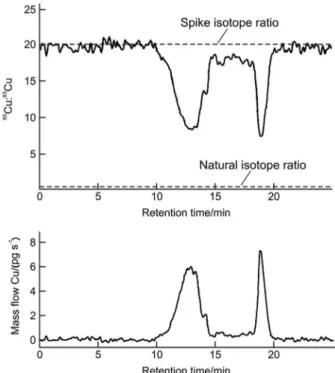
Online applications of species-unspeciic ICP-IDMS for elemental quantiication in different species with post-column continuously pumping the spike are presented in Table 2. Also, the temporal scan of natural Cu isotope ratio and that of Cu in humic acid complexes separated by size
exclusion chromatography (SEC) are depicted (Figure 5).51
The IR of the spike solution remains around 20 until the fall down corresponding to the mixed spike to analyte IR in each of the eluted species delivered from the separation column. The resulting transient IR peaks are dependent on the amounts of Cu in each humic acid complex, the IR and amount of added spike and the dilution factor introduced by the spike conluent stream. Care should be taken to adjust the isotope ratio and concentration of the spike solution considering the expected analyte content in the sample and the low rate ratio of both, to avoid rising uncertainties owing to poor counting statistics. To prevent this trouble the enrichment of the spike solution is previously calculated based on an estimative of the analyte
amount in the sample.51 The accuracy of the quantiication
by post-column ID is directly correlated to uncertainties introduced by the spike pumping low rate stability, isotopic composition and concentration.
Two methods for calibrating the spike mass flow
Msp were described, the irst one by directand the other
by reverse ID.51 In method #1 the spike mass flow is
calculated by assessing gravimetrically the low rate fSP
of a solution with known concentration CSP and deined
isotopic abundance.
(3)
Figure 5. Chromatograms of Cu complexes with humic acids in a river water sample, separated by size exclusion chromatography. Chromatogram of Cu isotope ratios (top) and in terms of mass low [pg s-1] (bottom) (Reprinted
Equation 3 allows calculating the mass of spike at any
point of the transient proile of the separated species.57
In method #2, the spike mass low is determined by reverse ID of a standard and the procedure is performed
in two steps. First a volume of the standard solution Vstd
with natural isotope ratios and known concentration Cstd is
injected into the column and the transient signal is achieved.
In sequence the base of the transient peak width (wpeak) is
measured to calculate the standard mass low Mstd by the
equation:
(4)
The spike mass low Msp(t) is calculated by:
(5)
where: Rx = isotope ratio in the sample, Ra = average
isotopic ratio of the chromatographic peak. The transient signals attained by performing online species-unspeciic ID are considered to calculate the analyte mass low at any point:
(6)
where Mx(t) = analyte mass low, Msp(t) = spike mass low
and, Rb(t) = IR of the blended sample are variable along
the transient signals; hix and hiy = isotopic abundance of
the reference isotope in the sample and spike, other terms as in equation 4.
The analyte mass low at any point can be calculated if the spike mass low is known and the corresponding isotope ratio is measured. The spike mass low calibration, allows converting the temporal isotope ratio measurements graph to mass low diagram as presented in Figure 5.
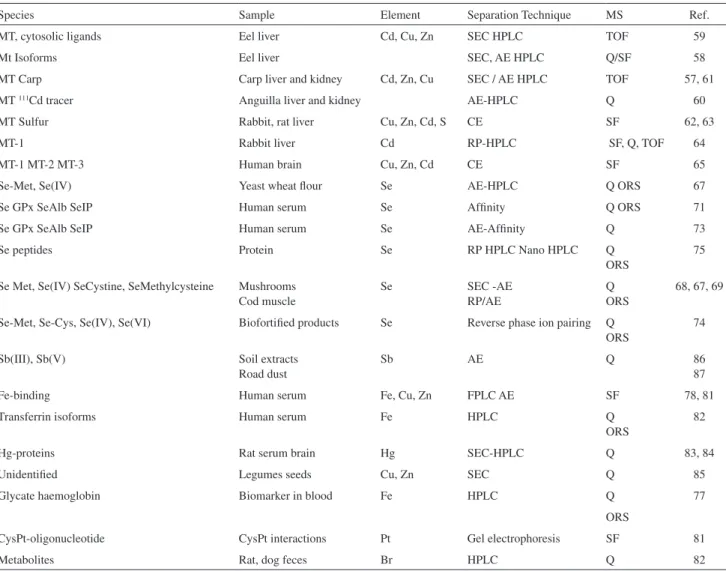
Table 2. Applications of online post-column species-unspeciic ICP-IDMS
Species Sample Element Separation Technique MS Ref.
MT, cytosolic ligands Eel liver Cd, Cu, Zn SEC HPLC TOF 59
Mt Isoforms Eel liver SEC, AE HPLC Q/SF 58
MT Carp Carp liver and kidney Cd, Zn, Cu SEC / AE HPLC TOF 57, 61
MT 111Cd tracer Anguilla liver and kidney AE-HPLC Q 60
MT Sulfur Rabbit, rat liver Cu, Zn, Cd, S CE SF 62, 63
MT-1 Rabbit liver Cd RP-HPLC SF, Q, TOF 64
MT-1 MT-2 MT-3 Human brain Cu, Zn, Cd CE SF 65
Se-Met, Se(IV) Yeast wheat lour Se AE-HPLC Q ORS 67
Se GPx SeAlb SeIP Human serum Se Afinity Q ORS 71
Se GPx SeAlb SeIP Human serum Se AE-Afinity Q 73
Se peptides Protein Se RP HPLC Nano HPLC Q
ORS
75 Se Met, Se(IV) SeCystine, SeMethylcysteine Mushrooms
Cod muscle
Se SEC -AE
RP/AE
Q ORS
68, 67, 69 Se-Met, Se-Cys, Se(IV), Se(VI) Biofortiied products Se Reverse phase ion pairing Q
ORS
74
Sb(III), Sb(V) Soil extracts
Road dust
Sb AE Q 86
87
Fe-binding Human serum Fe, Cu, Zn FPLC AE SF 78, 81
Transferrin isoforms Human serum Fe HPLC Q
ORS
82
Hg-proteins Rat serum brain Hg SEC-HPLC Q 83, 84
Unidentiied Legumes seeds Cu, Zn SEC Q 85
Glycate haemoglobin Biomarker in blood Fe HPLC Q 77
ORS
CysPt-oligonucleotide CysPt interactions Pt Gel electrophoresis SF 81
Metabolites Rat, dog feces Br HPLC Q 82
Correction factors to improve measurements of IR, such as instrumental mass discrimination affecting differently
both isotopes,52 isobaric overlaps in one of the isotopes and
detector dead time should be considered in applying ID.53
The uncertainties associated to the species unspeciic quantiication strategies performed by online ID were evaluated for HPLC-ICP-MS. Tests were performed by using a cysplatin standard solution being spiked
post-column with 196Pt introduced by a micro syringe pump
to perform online measurements by ICP with ICP-SFMS or with ICP-QMS. Authors found lower expanded uncertainties when the spike mass low was determined gravimetrically than by reverse ID applied to a standard
solution of natural IR.57 However, the spike mass low
determined by reverse ID of a standard has been applied throughout.
7. Instrumentation and Applications
Instrumental improvements in measuring transient signals for online speciation analysis covers the combination of different separation techniques hyphenated to ICP with quadrupole, sector ield or time of light mass spectrometers to perform the applications presented in Table 2. The application of online ID to quantify metallothionein (MT) isoforms presented good resolution when separated by HPLC coupled to ICP with time of light mass spectrometer (ICP-TOFMS) and ICP-QMS. However high resolution can be attained when using separation by CE but, due to the low sample volumes the high sensitivity detection of ICP-SFMS is required.
The post column SUID has been applied for determination of Cd, Cu and Zn in MT isoforms separated
by HPLC58-62 and CE.63,64 The application of online ID to
quantify metallothionein (MT) isoforms presented good resolution when separated by HPLC coupled to ICP with ICP-TOFMS and ICP-QMS. The spike mass low has been calibrated by reverse ID for online quantiication of species separated by CE coupled to ICP-SFMS using separations
at medium resolution.63,64 In both works the determination
of Cd, Cu, Zn and S in metallothionein isoforms allowed assessing the stoichiometric composition. The spike mass low calibration of species separated by CE is laborious once calibration standards with eletrophoretic mobility are required. So, previous complexation of metal ions was performed and for S a thiourea standard was used. Quite the opposite the spike mass low calibration procedure is easily performed when using HPLC. Although high resolution can be attained when using separation by CE the high sensitivity detection of ICP-SFMS is required due to the low sample volumes separated.
The performance of three equipments of ICP-MS with different spectrometers SFMS, QMS and TOFMS was compared for determining Cd binding in one isoform MT-1 of a rabbit liver MT standard. The MT-1 isoform was separated by reverse phase chromatography (RP-HPLC)
and Cd determined by post-column SUID.65 Peaks from
the ICP-SFMS presented signal instabilities due to the methanol used in HPLC separation. The plasma in the ICP-SFMS extinguished with 20% (v/v) methanol using a Scott-type spray chamber refrigerated by cooled water, but supported up to 30% (v/v) with a cyclonic chamber refrigerated in an ice bath. Signals from MT isoforms separated by HPLC with detection by ICP-TOFMS presented the highest chromatographic resolution and stability demonstrating the good tolerance to methanol of this instrumental coniguration. Furthermore, the proposal of coupling to ICP-MS eficient nano-HPLC columns and nebulizers for online speciation analysis minimized the effect of the organic phase and extended its applicability to small sample volumes required for accurate analysis of
proteins.66,67 Applications included the determination of Cd,
Cu and Zn in human brain MT isoforms for comparison of
samples from normal and Alzheimer patients.67
The application of online ID using ICP-MS to determine
species of Se and Fe was possible by introduction of H2
into the octopole reaction system (ORS) to minimize interferences. However, correction factors were required
when measuring 77Se/78Se due to the formation of hydride
ions such as SeH+.68-71 Thus, species of Se were quantiied
by SUID in yeast and wheat lour,68 cod muscle,69 edible
wild mushrooms,70 natural and selenised mushrooms.71
Depending on the application, Se speciation by reverse phase, anion exchange (AE) and size exclusion (SE)
chromatography with continuous 77Se post-column spiking
was accomplished.
Online SUID was applied for determining Se species
bound to proteins in human serum samples.72 The separation
of Se species by anion exchange chromatography with gradient elution presented good Se recovery but not enough resolution to identify the species. However the arrangement of affinity chromatography with two HPLC columns, an heparine-sepharose and a blue- sepharose columns, allowed determining Se bound to proteins, mainly plasma glutathione peroxidase (GSH-Px) and seleno protein
(Sel-P) in human serum.72
Recently, a low system for simultaneous speciation analysis of GSH-Px, SeI-P and seleno albumin (Se-Alb) in human serum with Se quantiication by post column
ICP-IDMS was described.73 The system setup depicted
injector, the post-column introduction of 77Se and a knotted
reactor to ensure good mixing previously to the ICP-MS.
Interferences on m/z 78 and 82 during determination of
GSH-Px were avoided by retention of Cl and Br in the anion exchange column dismissing the requirement for a collision/reaction cell. Thereafter the sequential elution of SeI-P and Se-Alb allowed determining Se in both fractions.
The post-column spike with 76Se was reported to
identify and quantify the bioavailability of Se species in
grains.74 A nano-HPLC (75 µm id) interfaced to ICP-MS
with post column spike was proposed for determining
seleno peptides in protein triptic digests.75
Since 2001 the isotopic enriched standard 57
Fe-transferrin has been synthesized and used for post-column
spiking allowing identification of five Fe-transferrin
isoforms.76 Several applications using 57Fe as post-column
spike have been described to determine the heme-group in
glycate hemoglobin and total hemoglobin77 or to evaluate
transferrin saturation.78,79
The relevance of HPLC-ICP-IDMS for quantitative analysis of endogenous iron-containing proteins was
recently described.80 The usefulness of this methodology
is conirmed by applications described in Table 2 and the increased number of publications; more than 70% of the papers were published in the last 4 years. Applications of the species-unspeciic isotope dilution for S containing species performing post-column spike are presented in Table 3. The occurrence of sulfur in several amino-acids, peptides and metallothioneins makes it a key element for quantitative proteomic analysis by ICP-IDMS. ICP-SFMS at medium resolution or ICP-QMS with the technology of
collision cells was employed to measure sulfur isotopes 32S
and 34S whichsuffer strong interferences in low resolution
mass spectrometers.88
Sulfur has been the choice in quantitative proteomic analysis because it is present in several proteins and easily
label metals and metalloids.89 The post column spiking with
34S, 65Cu and 67Zn solutions allow quantifying by ICP-IDMS
sulfur containing proteins.90 The online ID quantiication
of S in proteins separated by SEC coupled to a ICP-QMS with collision cell was applied to bovine serum albumin, superoxide dismutase and metallothioneins-II. The online
post-column spiking with 34S, 65Cu and 67Zn and oxygen
added to the collision cell allowed measuring the isotope ratio 32S16O+/34S16O+ as well as the isotopic ratios of Cu and
Zn. The S/Cu and S/Zn ratios were useful to characterize the protein composition by using stoichiometric data. A micro LC column coupled to ICP-SFMS was described
for protein separation and quantiication with sulfur.90 The
Figure 6. Scheme of the AE-AF-HPLC setup (up) and the chromatograms obtained monitoring 77Se, 82Se and 34S (down) on the separated GPx, SeP
and SeAlb from human serum (peaks from left to right). Instrument parts are HPLC injector, columns (1) (2) and (3) and the commutation device P1. The post column entry for 77Se and a knotted reactor KR before the
ICP-MS (Reprinted from reference 74 with permission of Springer).
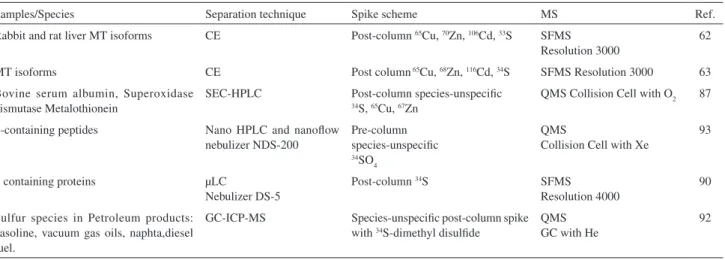
Table 3. Schemes to determine sulfur containing species by online ID-ICP-MS
Samples/Species Separation technique Spike scheme MS Ref.
Rabbit and rat liver MT isoforms CE Post-column 65Cu, 70Zn, 106Cd, 33S SFMS
Resolution 3000
62
MT isoforms CE Post column 65Cu, 68Zn, 116Cd, 34S SFMS Resolution 3000 63
Bovine serum albumin, Superoxidase dismutase Metalothionein
SEC-HPLC Post-column species-unspeciic
34S, 65Cu, 67Zn
QMS Collision Cell with O2 87 S-containing peptides Nano HPLC and nanolow
nebulizer NDS-200
Pre-column species-unspeciic
34SO
4
QMS
Collision Cell with Xe
93
S containing proteins µLC
Nebulizer DS-5
Post-column 34S SFMS
Resolution 4000
90 Sulfur species in Petroleum products:
gasoline, vacuum gas oils, naphta,diesel fuel.
GC-ICP-MS Species-unspeciic post-column spike with 34S-dimethyl disulide
QMS GC with He
growing interest in proteomic analysis and the potential of isotope dilution ICP-MS for absolute quantiication of
heteroatoms were pearly described in a recent review.91
Recently the SUID by GC-ICP-MS was described for
determining sulfur species in petroleum sub-products.92 A
special interface was designed to merge the gaseous spike to the species leaving the GC while being transported directly towards the ICP without using nebulizers. Online coupling of GC-ICP-IDMS with post-column spike was proposed for determining sulfur in petroleum subproducts. The post-column sample gaseous components were spiked with
gaseous 34S-dimethyldisulide mixed with puriied argon. In
this case, the gaseous sample compounds were eficiently transported towards the plasma and no interferences were found for measuring sulfur isotope ratios in a number of separated compounds. However, the GC separation technique is affected by temperature variations of the transfer line to the plasma, which may inluence the mass low stability. Authors developed an equation for calculating the amount of sulfur in the sample as a function of the time-dependent mass low of the species and measured isotope ratios IR(t). The addition of an internal standard to the sample was useful for calibration of the spike mass low and for calculating the amount of sulfur in the separated species.
7.1. Pre-column ICP-IDMS
The absolute quantification of sulfur-containing peptides mainly methionine and cysteine residues in protein tryptic digests was accurately attained by a nano
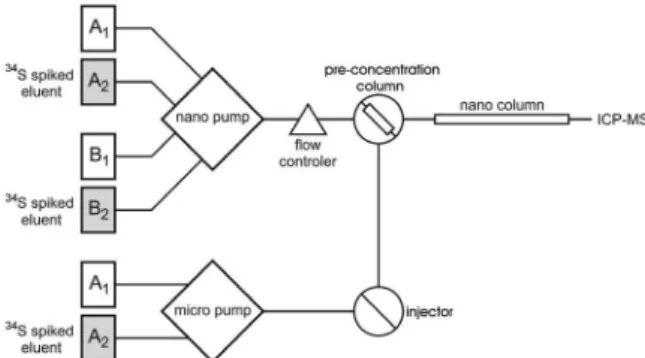
HPLC column coupled to ICP-IDMS.93 The original
scheme of the instrumental setup (Figure 7) presents the pre-column spike in a nano low system to perform SUID. The reverse phase nano HPLC column was connected to a nano low nebulizer installed in a small spray chamber
(3 cm3) with total sample transportation to the plasma at
300 ± 5 nL min-1. Sample solutions were online spiked
with sulfate enriched in 34S before separation of species
by reverse phase HPLC. No spike to analyte interaction occurred, as expected for application of SUID. This was demonstrated for methionine and cysteine. However, in excess of spike the formation of adducts with arginine, lysine and histidine was observed. This problem was
overcome by adjusting the concentration of 34S in the eluent.
Interferences free isotope ratio measurements 34S/ 32S were
feasible by using Xe gas in the collision cell to eliminate
O2+. For total sulfur determinations Ti isotopes were used
to determine the mass bias correction factor, assuming similarity on mass discrimination. The instrumental setup allowed also the online sample concentration in a
C18 reverse phase cartridge before the chromatographic
separation. This facility allowed improving detection limits and the possibility of switching from the ID analysis to the external quantiication mode.
The pre-column ID results were more precise when compared to those obtained by post-column due to the compensation for instrumental drift once the isotope acted as internal standard and the absence of post column confluent streams preserved the peak broadening. Calibration of the spike mass low was performed by reverse ID using taurocholate as standard. This compound is water
soluble, stable and inert in relation to 34S. In this case the
standard was concentrated in the column, thus its mass low was time dependent. Equations 7 and 8 allowed calculating the standard mass low and the injected mass of sulfur.
(7)
where the transient mass low of the standard MFstd is related
to the spike mass low MFsp by the ID relation considering
the respective masses Mstd and Msp and transient isotope
ratio R(t). Terms hsp and hstd are the isotopic abundances
of the S isotopes, m/z 32 and 34 in the spike and standard
solutions, respectively. The mass of standard mstd was
calculated by integration of the standard mass low MFstd
during the injection time delay:
(8)
The sample mass low can be calculated from equation 7 by changing the terms of standard by the sample. The method was validated by injecting 1 µL of a Met-Leu-Phe tri-peptide solution attaining a recovery factor of 103% of the S mass. The procedure was applied to the quantiication of sulfur-containing peptides in 1 µL of human serum albumin after tryptic digestion. A chromatogram presenting
Figure 7. Scheme of the instrumental set-up for precolumn isotope dilution analysis by nanoHPLC-ICP-MS. A1 and B1 represent the mobile phases of 0.2% of triluoracetic acid in water and acetonitrile, respectively. A2 and B2 were the eluents spiked with 10 µg mL-134S pumped at 300 nL min-1
24 peaks was obtained where the peak area represented the sulfur contained in each peptide. However for identiication of peptides the parallel analysis by HPLC interfaced with electrospray ionization to a TOF-MS is required.
8. Conclusions
The improvements in the applicability of online isotope dilution analysis by ICP-MS are certainly related to the instrumental developments, to the eficient detection of transient signals and to the availability of high quality enriched isotopic solutions for spiking samples. Automation in analytical chemistry has enhanced the possibilities for replacing step by step independent procedures by a chain of coupling techniques such those for online ICP-IDMS presented in this review. Applications of online ICP-IDMS for speciation purposes present a tendency towards the miniaturization of separation columns, pumps and nebulizers searching for increasing ionization eficiency and matrix compatibility with the plasma source in ICP-MS. The application of online ICP-IDMS has been extended to small volumes of biological samples with consequent decrease of reagents and residues. The increased number of publications concerning online ICP-IDMS for speciation analysis conirms the feasibility of this procedure.
Acknowledgments
To Prof. Elias Zagatto for scientiic collaboration and to the Brazilian Financing Agencies FAPESP (Fundação de Amparo à Pesquisa do Estado de São Paulo) and CNPq (Conselho Nacional de Desenvolvimento Científico e Tecnológico).
Maria Fernanda Giné received her PhD from the University of São Paulo (1986). She is Associate Professor in the Division of Analytical and Nuclear Methodologies at the Center of Nuclear Energy in Agriculture of the University of São Paulo. Her research is focused on the development of methodology for environmental and agriculture samples by low injection analysis coupled to inductively coupled plasma optical emission (ICP OES) or mass spectrometry (ICP-MS).
Ana Paula Packer is graduated in Agronomy Engineering at the University of São Paulo where she also concluded the PhD program in analytical chemistry at the Institute of Chemistry of São Carlos (2000). She
contributed to several research groups in Brazil as a postdoctoral and participated in the fellowship program at the Radiation Protection Bureau, Health Canada (2006). Nowadays, she is a postdoctoral in the Division of Analytical and Nuclear Methodologies at the Center of Nuclear Energy in Agriculture of the University of São Paulo. Her research interests are the development of methodology for analysis of environmental and agriculture samples by laser induced breakdown spectroscopy (LIBS) and inductively coupled plasma optical emission (ICP OES) or mass spectrometry (ICP-MS).
References
1. Luque de Castro, M. D.; Tena, M. T.; Talanta 1995, 42, 151. 2. Lásztity, A.; Viczián, M.; Wang, X.; Barnes, R. M.; J. Anal. At.
Spectrom. 1989, 4, 761.
3. Viczián, M.; Lásztity, A.; Wang, X.; Barnes, R.M.; J. Anal. At. Spectrom. 1990, 5, 125.
4. Ray, S. J.; Andrade, F.; Gamez, G.; McClenathan, D.; Rogers, D.; Schilling, G.; Wetzel, W.; Hieftje, G.; J. Chromatogr., A 2004, 1050, 3.
5. Packer, A. P.; Gervasio, A. P. G.; Miranda, C. E. S.; Reis, B. F.; Menegário, A. A.; Giné, M. F.; Anal. Chim. Acta 2003, 485, 145.
6. Pickhardt, C.; Becker, J. S.; Dietze, H. J.; Fresenius J. Anal. Chem. 2000, 368, 173.
7. Kerl, W.; Becker, J. S.; Dietze, H. J.; Dannecker, W.; J. Anal. At. Spectrom. 1996, 11, 723.
8. Gelaude, I.; Dams, R.; Resano, M.; Vanhaecke, F.; Moens, L.; Anal. Chem. 2002, 74, 3833.
9. Rottmann, L.; Heumann, K. G.; Fresenius J. Anal. Chem. 1994, 350, 221.
10. Kingstom, H. M.; Huo, D.; Lu, Y.; Chalk, S.; Spectrochim. Acta, Part B 1998, 53, 299.
11. Sabé, R.; Rauret, G.; TrAC, Trends Anal. Chem. 2004, 23, 273. 12. Yip, Y.; Lam, J.C.;Tong, W.; TrAC, Trends Anal. Chem. 2009,
28, 214.
13. Meija, J.; Mester, Z.; Anal. Chim. Acta 2008, 607, 115. 14. Vogl, J.; J. Anal. At. Spectrom. 2007, 22, 475.
15. Vanhaecke, F.; Boonen, S.; Moens, L.; Dams, R.; J. Anal. At. Spectrom. 1997, 12, 125.
16. Fassett, J. D.; Paulsen, P. J.; Anal. Chem. 1989, 61, 643A. 17. DeBièvre, P. J.; Peiser, H.; Fresenius J. Anal. Chem. 1997, 359,
523.
19. Beauchemin, D.; Anal. Chem. 2008, 80, 4455.
20. Becker, J. S.; Inorganic Mass Spectrometry: Principles and Applications, John Wiley & Sons: Chichester, England, 2007. 21. De Bièvre, P. J.; Debus, G. H.; Nucl. Instrum. Meth. 1965, 32,
224.
22. Klinkenberg, H. L.; Beeren, T.; van Borm, W. L.; van der Linden, F.; Raets, M.; Spectrochim. Acta, Part B 1993, 48, 649. 23. Klinkenberg, H.; van Borm, W.; Souren, F.; Spectrochim. Acta,
Part B 1996, 51, 139.
24. Dobney, A.; Klinkenberg, H.; Souren, F.; van Borm, W.; Anal. Chim. Acta 2000, 420, 89.
25. Valles Mota, J. P.; Fernández de la Campa, M. R.; García Alonso, J. I.; Sanz-Medel, A.; J. Anal. At. Spectrom. 1999, 14, 113. 26. Valles Mota, J. P.; Ruiz Encinar, J.; Fernández de la Campa, M.
R.; García Alonso, J. I.; Sanz-Medel, A.; J. Anal. At. Spectrom. 1999, 14, 1467.
27. Elwaer, N.; Hintelmann, H.; Talanta 2008, 75, 205.
28. Goossens, J.; Moens, L.; Dams, R.; Anal. Chim. Acta1994, 293, 171.
29. Parent, M.; Vanhoe, H.; Moens, L.; Dams, R.; Anal. Chim. Acta 1996, 320, 1.
30. Beauchemin, D.; Specht, A. A.; Anal. Chem. 1997, 69, 3183. 31. Becker, J. S. ; Soman, R. S.; Sutton, K. L.; Caruso, J. A.; Dietze,
H. J.; J. Anal. At. Spectrom. 1999, 14, 933.
32. Specht, A. A.; Beauchemin, D.; Anal. Chem. 1998, 70, 1036. 33. Packer, A. P.; Giné, M. F.; dos Reis, B. F.; Menegário, A. A.;
Anal. Chim. Acta 2001, 438, 267.
34. De Jong, J.; Schoemann, V.; Lannuzel, D. ; Tyson, J. L.; Mattelli, N.; Anal. Chim. Acta 2008, 623, 126.
35. Roehl, R.; Gomez, J.; Woodhouse, L. R.; J. Anal. At. Spectrom. 1995, 10, 15.
36. Yang, L.; Sturgeon, R. E.; J. Anal. At. Spectrom. 2003, 18, 1452.
37. Becker, J. S.; Spectrochim. Acta, Part B 2002, 57, 1805. 38. Becker, J. S.; Dietze, H. J.; Int. J. Mass Spectrom. 2003, 228,127. 39. Durrant, S. F.; Ward, N. I.; J. Anal. At. Spectrom. 2005, 20, 821. 40. Becker, J. S.; J. Anal. At. Spectrom. 2005, 20, 1173. 41. Sylvester, P. J.; Geostand. Geoanal. Res. 2006, 30, 197. 42. Becker, J. S.; Sela, H.; Dobrowolska, J.; Zoriy, M.; Becker. J.
S.; Int. J. Mass Spectrom. 2008, 270, 1.
43. Becker, J. S.; Pickhardt, C.; Pompe, W.; Int. J. Mass Spectrom. 2004, 237, 13.
44. Sela, H.; Karpas, Z.; Zoriy, M.; Pickhardt, C.; Becker, J. S.; Int. J. Mass Spectrom. 2007, 261, 199.
45. Pickhardt, C.; Izmer, A. V.; Zoriy, M. V.; Schaumlöffel, D.; Becker, J. S.; Int. J. Mass Spectrom. 2006, 248, 136.
46. Vanhaecke, F.; Resano, M.; Moens, L.; Anal. Bioanal. Chem. 2002, 374, 188.
47. Resano, M.; Gelaude, I.; Dams, R.; Vanhaecke, F.; Spectrochim. Acta, Part B 2005, 60, 319.
48. Szpunar, J.; Analyst 2000, 125, 963.
49. Łobinski, R.; Adams, F. C.; Spectrochim. Acta, Part B 1997, 52, 1865.
50. Chong, N. S.; Houk, R. S.; Appl. Spectrosc. 1987, 41, 66. 51. Heumann, K. G.; Rottmann, L.; Vogl, J.; J. Anal. At. Spectrom.
1994, 9, 1351.
52. Heumann, K. G.; Gallus, S. M.; Rädlinger, G.; Vogl, J.; Spectrochim. Acta, Part B 1998, 53, 273.
53. Rodríguez-González, P.; Marchante-Gayón, J. M.; García Alonso, J. I.; Sanz-Medel, A.; Spectrochim. Acta, Part B 2005, 60, 151.
54. Sanz-Medel, A.; Anal. Bioanal. Chem. 2008, 391, 885. 55. Szpunar, J.; Analyst 2005, 130, 442.
56. Sanz-Medel. A.; Montes-Bayón, M.; Fernández de la Campa, R.; Ruiz Encinar, J.; Bettmer, J.; Anal. Bioanal. Chem. 2008, 390, 3. 57. Koellensperger, G.; Hann, S.; Nurmi, J.; Prohaska, T.; Stingeder,
G.; J. Anal. At. Spectrom. 2003, 18, 1047.
58. Goenaga Infante, H.; Van Campenhout, K.; Blust, R.; Adams, F. C.; J. Chromatogr., A 2006, 1121, 184.
59. Rodríguez-Cea, A.; Fernández de la Campa, M. R.; Blanco González, E.; Aldón Fernández, B. ; Sanz-Medel, A.; J. Anal. At. Spectrom. 2003, 18, 1357.
60. Van Campenhout, K.; Goenaga Infante, H.; Goemans, G.; Belpaire, C.; Adams, F. C.; Blust, R.; Bervoets, L.; Sci. Total Environ. 2008, 194, 379.
61. Rodríguez-Cea, A.; Fernández de la Campa, M. R.; García Alonso, J. I.; Sanz-Medel, A.; J. Anal. At. Spectrom. 2006, 21, 270.
62. Goenaga Infante, H.; Van Campenhout, K.; Schaumlöffel, D.; Blust, R.; Adams, F. C.; Analyst 2003,128, 651.
63. Polec-Pawlak, K.; Schaumlöffel, D.; Szpunar, J.; Prange, A.; Łobinski, R.; J. Anal. At. Spectrom. 2002, 17, 908.
64. Schaumlöffel, D.; Prange, A.; Marx, G.; Heumann, K. G.; Brätter, P.; Anal. Bioanal. Chem. 2002, 372, 55.
65. Ferrarello, C. N.; Ruiz Encinar, J.; Centineo, G.; García Alonso, J. I.; Fernández de la Campa, M. R.; Sanz-Medel, A.; J. Anal. At. Spectrom. 2002, 17, 1024.
66. Prange, A.; Schaumlöffel, D.; Brätter, P.; Richarz, A. N.; Wolf, C.; Fresenius J. Anal. Chem. 2001, 371, 764.
67. Giusti, P.; Łobinski, R.; Szpunar, J.; Schaumlöffel, D.; Anal. Chem. 2006, 78, 965.
68. Díaz Huerta, V.; Hinojosa Reyes, L.; Marchante-Gayón, J. M.; Fernández Sánchez, M. L.; Sanz-Medel, A.; J. Anal. At. Spectrom. 2003, 18, 1243.
69. Diaz Huerta, V.; Fernández Sánchez, M. L.; Sanz-Medel, A.; J. Anal. At. Spectrom. 2004, 19, 644.
70. Díaz Huerta, V.; Fernández Sánchez, M. L.; Sanz-Medel, A.; Anal. Bioanal. Chem. 2006, 384, 902.
71. Diaz Huerta, V.; Fernández Sanchez, M. L.; Sanz-Medel, A.; Anal. Chim. Acta 2005, 538, 99.
73. Hinojosa-Reyes, L.; Marchante-Gayón, J. M.; García Alonso, J. I.; Sanz-Medel, A.; J. Anal. At. Spectrom. 2003, 18, 1210. 74. Jitaru, P. ; Cozzi, G.;. Gambaro, A; Cescon, P.; Barbante, C.;
Anal. Bioanal. Chem. 2008, 391, 661.
75. Kirby, J. K.; Lyons, G. H.; Karkkainen, M. P.; J. Agric. Food Chem. 2008, 56, 1772.
76. Giusti, P.; Schaumlöffel, D.; Ruiz Encinar, J.; Szpunar, J.; J. Anal. At. Spectrom. 2005, 20, 1101.
77. Castillo Busto, M. E.; Montes-Bayón, M.; Añon, E.; Sanz-Medel, A.; J. Anal. At. Spectrom. 2008, 23, 758.
78. Castillo Busto, M. E.; Montes-Bayón, M.; Bettmer, J.; Sanz-Medel, A.; Analyst 2008, 133, 379.
79. Sariego Muniz, C.; Marchante Gayón, J. M.; García Alonso, J. I.; Sanz-Medel, A.; J. Anal. At. Spectrom. 2001, 16, 587. 80. Castillo Busto, M. E.; Montes-Bayón, M.; Sanz-Medel, A.;
Anal. Chem. 2006, 78, 8218.
81. Brüchert, W.; Krüger, R; Tholey, A.; Montes Bayón, M.; Bettmer, J.; Electrophoresis 2008, 29, 1451.
82. Cuyckens, F.; Balcaen, L. I. L.; De Wolf, K.; De Samber, B.; Van Looveren, C.; Hurkmans, R.; Vanhaecke, F.; Anal. Bioanal. Chem. 2008, 390, 1717.
83. Wang, M.; Feng, W.; Wang, H.; Zhang, Y.; Li, J.; Li, B.; Zhao, Y.; Chai, Z.; J. Anal. At. Spectrom. 2008, 23, 1112.
84. Shi, J.; Feng, W.; Wang, M.; Zhang, F.; Li, B.; Wang, B.; Zhu, M.; Chai, Z.; Anal. Chim. Acta 2007, 583, 84.
85. Mestek, O.; Komínková, J.; Koplik, R.; Borková, M.; Suchanek, M.; Talanta 2002, 57, 1133.
86. Amereith, S.; Meisel, T.; Kahr, E.; Wegscheider, W.; Anal. Bioanal. Chem. 2005, 383, 1052.
87. Amereith, S.; Meisel, T;. Scholger, R.; Wegscheider, W.; J. Environm. Monit. 2005, 7, 1200.
88. Rappel, C.; Schaumlöffel, D.; Anal. Bioanal. Chem. 2008, 90, 605.
89. Wang, M.; Feng, W.; Lu, W.; Li, B.; Wang, B.; Zhu, M.; Wang, Y.; Yuan, H.; Zhao, Y.; Chai, Z.; Anal. Chem. 2007, 79, 9128. 90. Zinn, N.; Krüger, R.; Leonard, P.; Bettmer, J.; Anal. Bioanal.
Chem. 2008, 391, 537.
91. Bettmer, J.; Montes Bayón, M.; Ruiz Encinar J.; Fernández Sanches, M. L.; Fernández de la Campa, M. R.; Sanz Medel, A.; J. Proteom. 2009, 72, 989.
92. Heilmann, J.; Heumann, K. G.; Anal. Chem. 2008, 80, 1952. 93. Schaumlöffel, D.; Giusti, P.; Preud´Homme, H.; Szpunar, J.;
Łobinski, R.; Anal. Chem. 2007, 79, 2859.
Received: August 28, 2009
Web Release Date: February 25, 2010