Gest. Prod., São Carlos, v. 24, n. 4, p. 704-718, 2017 http://dx.doi.org/10.1590/0104-530X2262-16
Resumo: O artigo caracteriza e analisa a implantação de BPF e APPCC e os benefícios percebidos na indústria de alimentos para animais de produção. Realizou-se pesquisa survey com uma amostra de 60 unidades industriais. Além de análise descritiva dos programas adotados, realizou-se análise de cluster, identiicando 3 agrupamentos de empresas, diferenciados, principalmente, pelo porte da unidade, mercado e certiicações em normas para segurança de alimentos. Embora a qualidade seja uma exigência geral do setor, o entendimento de que a adoção de programas para segurança é importante para a qualidade dos alimentos fornecidos aos animais e dos produtos inais (carne, leite, ovos) parece não ser uma percepção unânime no setor, tendo em vista que 26,7% da amostra ainda não adota o APPCC e apenas 50,0% da amostra possui alguma certiicação relacionada à segurança de alimentos. As unidades que atendem a mercados mais exigentes tendem a adotar estes programas e sua certiicação. Os principais benefícios internos percebidos, com a implantação, foram a redução na ocorrência de problemas com a segurança do alimento e melhoria no nível de capacitação dos funcionários da área produtiva; quanto aos benefícios externos destacam-se a melhoria na imagem da marca e no nível de satisfação dos clientes.
Palavras-chave: Segurança do alimento; BPF; APPCC; Indústria de rações; Benefícios percebidos.
Abstract: This article aimed to analyze the internal and external perceived beneits of the implementation of GMP and HACCP in factories of the feed industry, and the dificulties perceived during deployment. A survey research was conducted through a questionnaire which was sent to the companies. Sixty units responded the questionnaire. Descriptive statistics, correlation tests and clusters were applied for data analysis. The cluster analysis identiied three groups of companies, which differed from each other mainly by their size and certiication of food safety standards. While product quality is a general requirement of the sector, the understanding that the adoption of programs to guarantee food safety is important for the quality of feed provided to the animals and essential for the quality of food of animal origin (meat, milk, eggs) does not seem to be a unanimous perception of the industry, considering that 26.7% of the sample does not apply the HACCP yet and only 50.0% has some certiication related to food safety. It was observed that the units that supply the most demanding markets tend to adopt these programs and their certiication. The main internal beneits reported after the implementation of GMP/HACCP were reduction of food safety related problems and improvement of the level of training of production employees. As for external beneits, the most cited were improved brand image and customer satisfaction.
Keywords: Food safety; GMP; HACCP; Feed industry; Perceived beneits.
Safety programs for the feed industry: characterization
and perceived benefits of the implementation
Programas para segurança na indústria de alimentos para animais: caracterização e benefícios percebidos com a implantação
Raquel Pelicer Coelho1 José Carlos de Toledo1
1 Programa de Pós-graduação em Engenharia de Produção, Departamento de Engenharia de Produção, Centro de Ciências e Tecnologia, Universidade Federal de São Carlos – UFSCar, Rodovia Washington Luís, Km 235, CEP 13565-905, São Carlos, SP, Brazil, e-mail: [email protected]; [email protected]
Received July 20, 2016 - Accepted Dec. 16, 2016 Financial support: None.
1 Introduction
Brazil is the third largest producer of animal feed in the world (IFIF, 2015). The feed industry is an important link in the food production chain. Some contaminants introduced into the feed provided to animals for beef cattle are not removed during the processing and may remain in the meat and cause disease.
Consumers are more alert and concerned about food safety issues. The incidence of foodborne diseases worldwide, such as BSE (Bovine Spongiform Encephalopathy), the mad cow disease, has increased the public interest in food safety (Forsythe, 2002).
than 48 million patients, 128,000 hospitalizations and 3,000 deaths annually (CDC, 2011; Painter et al., 2013).
Good hygiene practices and food safety assurance contribute to reducing this problem and should be lagged for the market. The companies decide to adopt certiications for food safety by consumers, public authorities’ demands or voluntarily, because they perceive that the beneits outweigh the costs (Karipidis et al., 2009; Taylor, 2001). The demand for food safety certifications also comes from distributors, retailers and importers. Food retailers, with an expressive bargaining power and the globalized international market with large non-tariff barriers pass these demands on to agents of the agroindustrial system (Baddini, 2005). The expressions feed for food and farm to fork are increasingly widespread, stressing the importance of concern for food quality and safety, from primary production to the inal product, i.e., from “farm to fork”.
In February 2003, the Ministry of Agriculture, Livestock and Food Supply (MAPA) approved through Normative Instruction nº 1, the irst legislation on hygienic-sanitary conditions and good manufacturing practices for feed manufacturers. This legislation was repealed and replaced by Normative Instruction nº 4 in February 2007 (Brasil, 2007).
According to the United Nations (UN, 2012), the world’s population is expected to reach 9.6 billion people by 2050 and this growth will occur mainly in developing countries. As a consequence, the consumption of animal protein should increase, in line with population growth.
Brazil is the largest meat exporter in the world. In the period from 2000 to 2009, the country multiplied by 5 the volume of poultry meat exported and the quantity of pork and beef increased respectively 8 and 10 times. The value of Brazilian exports of animal origin products increased from US$ 435 million in 1995 to US $ 7.280 billion in 2006 (FAO, 2009).
In order to obtain safe food, it is recommended to adopt food safety programs, such as Good Manufacturing Practices (GMP) and HACCP (Hazard Analysis and Critical Control Points). The main advantage, according to Forsythe (2002), in the adoption of the HACCP system is the focus on the prevention of risks associated with food safety. HACCP is a scientiically based protocol that identiies speciic hazards and control measures, ensuring food safety and reducing the incidence of foodborne diseases, and has as one of its basic requirements the adoption of good manufacturing practices and hygiene.
The main beneits with HACCP implantation, based in literature review, were synthesized in Chart 1.
There are several dificulties to implement the HACCP system. Among the most mentioned are: dificulties related to the employee’s resistance to the behavioral and work changes imposed by the adoption of the HACCP (Motarjemi & Kaferstein, 1999; Panisello & Quantick, 2001; Ramírez Vela & Martı́n Fernández, 2003; Walker et al., 2003; Azanza & Zamora-Luna, 2005; Maldonado et al., 2005; Baş et al., 2007; Fotopoulos et al., 2011); The lack of technical knowledge and qualiied professionals for the implementation of the HACCP (Panisello et al., 1999; Panisello & Quantick, 2001; Deodhar, 2003; Baş et al., 2007; Celaya et al., 2007; Khatri & Collins, 2007; Ramnauth et al., 2008; Fotopoulos et al., 2011; Escanciano & Santos-Vijande, 2014); Technical barriers related to installations and equipment (Panisello & Quantick, 2001; Maldonado et al., 2005); Extended time required for deployment (Deodhar, 2003), and the high cost for implantation (Ehiri et al., 1995; Maldonado et al., 2005; Khatri & Collins, 2007; Escanciano & Santos-Vijande, 2014).
In Brazil, although the implementation of Good Manufacturing Practices has become mandatory for feed manufacturers since 2003, the adoption of HACCP is not mandatory. SINDIRAÇÕES (2016) (National Union of the Animal Feed Industry) has
Chart 1. Mains beneits obtained with HACCP.
Beneits obtained with HACCP References (Authors)
assurance of food safety for prevention,
not by inspection
(Bauman, 1992; Huss, 1994; Forsythe, 2002; CAC, 2003; Deodhar, 2003; Zugarramurdi et al., 2007; Jin et al., 2008; Lupin et al., 2010; Fotopoulos et al., 2011; Macheka et al., 2013);
may be applicate in food chain (Forsythe, 2002; CAC, 2003; Deodhar, 2003; Hartog, 2003) improvement in product quality (Forsythe, 2002; CAC, 2003; Deodhar, 2003; Hartog 2003; Zugarramurdi et al., 2007; Fotopoulos et al., 2011);
Coelho, R. P. et al.
706 Gest. Prod., São Carlos, v. 24, n. 4, p. 704-718, 2017
created a structure for certiication of companies in the sector called Feed & Food Safety, providing three levels of certiication: 1 for GMP, 2 for HACCP, which includes GMP, and 3 for certiication with International equivalence, which includes HACCP. Among the 123 feed and food manufacturing companies associated with SINDIRAÇÕES up to November 2016, 3 units had a level 3 certiication, 16 had HACCP certiication (level 2) and 34 GMP certiication (level 1).
This paper presents the results of a survey that
characterized the implementation and perceived
beneits of GMP and HACCP in a sample of feed manufacturers. Also, the main problems faced are discussed and the prospects of this deployment. In sequence, the paper presents the research method, the results observed and the conclusion.
2 Research method
The research method adopted is the survey, with subsequent analysis of the data. This survey is descriptive, as it proposes to describe a situation (implementation of food safety programs) in a sample of a certain population (animal feed manufacturers associated with SINDIRAÇÕES (National Union of the Animal Feed Industry), for the possibility of identiication and access to companies) and to identify and to make comparisons between possible clusters of the units surveyed.
The data were collected from December/2013 to January/2014, therefore as a cross-section. The unit of analysis was the food safety management system of the factories studied.
As a research technique, a questionnaire was sent by email, with support from SINDIRAÇÕES, to managers of quality or equivalent function, followed by a text clarifying the goals of the research.
In order to test the reliability of the research instrument, the Cronbach’s alpha was calculated considering all the questions in the questionnaire, obtaining a value of 0.867, which indicates that the questionnaire was suficiently adequate and consistent for its comprehension and desired data. The alpha coeficient is used to evaluate the magnitude in which the items of an instrument are correlated, values above 0.70 are considered good results (Cortina, 1993).
Prior to the effective application of the questionnaire, a pre-test was performed for its validation. The irst version of the questionnaire was applied in 4 companies, two small and two large, of which two with GMP level 1 certiication and two with GMP level 2 certiication in the Feed & Food Safety program. During this test the questionnaire was improved until reaching its inal version, which was sent back to these four companies and the entire target population. The questionnaire consists of 40 questions divided into 5 parts: General data on unit and certiication;
Internal beneits and perceived external beneits; Dificulties faced and prospects for certiication.
The data obtained were analyzed using Statistica 8.0 software, using the following techniques:
- descriptive statistics: use of descriptive measures to characterize the data set;
- correlation analysis: to identify possible correlations between variables;
- cluster analysis: to identify groups with common characteristics.
The study population is the set of manufacturing units that produce ingredients and feed for production animals with units in Brazil, associated with SINDIRAÇÕES, which at that time totaled a population of 161 units. Units that exclusively manufacture petfood and units that only commercialize the product in Brazil are not included in this population. Companies not afiliated with this syndicate are also not included.
3 Results and discussion
Among the 161 questionnaires sent, 60 were answered, corresponding to a response rate of 37.27%. The questionnaires were sent to the member companies, but they were requested to be answered by a manufacturing unit, since each company can have more than one unit and ind themselves in different situations regarding the programs and certiications obtained.
3.1 General characterization of the sample The sample is composed of 5.0% of micro-enterprises, 33.33% of small companies, 50.0% of medium-sized companies and 11.67% of large companies, according to criteria of employees’ number. As for capital, 37 units (61.67% of the sample) are national and 23 (38.33%) are multinational. Fifteen companies operate in a single market segment: 7 in the feed segment, 3 in the segment of supplements, 3 in the segment of ingredients and 2 in the segment of additives. The other 45 are multiproducts and operate in more than one market segment. Regarding exports, 29 units (48.33% of the sample) produce exclusively to serve the domestic market and 31 units (51.67%) serve the domestic and foreign markets. The main export destinations are Latin American countries. Only 3 units export to European Community countries and 4 to the United States.
The majority of the sample is of national companies of medium and large size, that produce multiple products and act in the internal and external markets.
(EC), these companies are not obligated to certify the units even though they have implemented the security program. The EC legislations regarding the control of contaminants such as inorganic and dioxin are much more restrictive. For example, there are substances, such as drugs and growth promoters, which are allowed in Brazil and in several other countries, which have been banned in Europe for some time.
According to Brazilian legislation, in order to obtain export authorization, it is necessary a prior inspection by the MAPA, obtaining at least 91 points in the check list of Normative Instruction n° 04 (IN 04). Therefore, it is understood that, even if they do not have certiication, these units must comply with most IN 04 requirements, otherwise they would not obtain authorization to export. The 3 units exporting to the European Community possess internationally recognized certiications such as ISO 22000 and GMP +.
3.2 Certiications
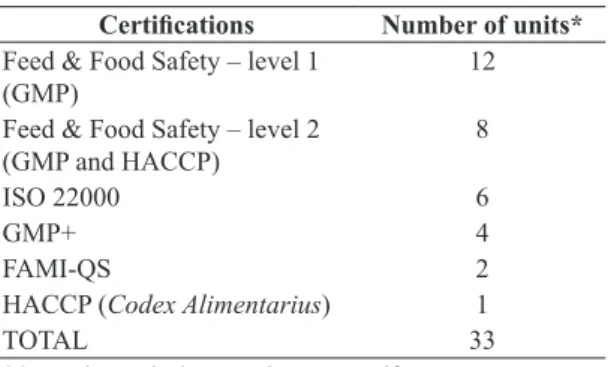
When questioned about certiications, 23 units (38.33%) reported having no certiication, and 37 (61.67%) had at least one type of certiication. The most frequent certiication is from Feed & Food Safety level 1 (GMP) of SINDIRAÇÕES, followed by ISO 9001 certiication, which is not speciic to food safety. Tables 1 and 2 present, respectively, the frequencies of safety-speciic certiications and other certiications. A unit may have more than one certiied program.
Among the twenty-three units with no certiication, 16 (26.67% of the sample) do not have HACCP
implemented and are also not in the deployment
phase. Of these 23 units, approximately 80% are of national capital, 4% are micro enterprises, 20% are small, 56% are medium-sized and 20% are large. Only 6 of these units serve the foreign market, one exporting to Europe and one to the US, the other exporting to Mercosur countries, the Middle East and Africa.
Of the 23 units that do not have any certiication, 10 have indicated the MAPA inspection as a GMP certification (in the category of choice, in the questionnaire, for other certiications), which can not be considered a certiication. MAPA is responsible for monitoring and evaluating compliance with IN 04 by feed manufacturers and, for this evaluation, performs an audit where it applies the checklist of IN 04 to verify the score obtained and to classify the company. However, this inspection can not be considered a certiication and has no established periodicity, as it is not performed with determined frequency.
Among these units, 3 indicated, for example, MAPA authorization for the manufacture of medicated products - class of products that must comply with Normative Instruction 65 - as a certiication. In order to obtain the license to manufacture medicated products, it is necessary to obtain at the check list of IN 04 at least 80 points and have the system deployed for at least six months. However, these units have not undergone standard procedures for obtaining a certiicate such as Feed & Food Safety or ISO 22000.
Regarding the deployment and certiication in Good Manufacturing Practices, 20 (33.3%) units are certiied by the Feed & Food Safety program, with 12 units certiied in level 1 and 8 in level 2, of higher range and requirements.
Of the 12 units certiied in Level 1 of the Feed & Food Safety program, 7 declared that HACCP was not implemented, 4 declared to be in the initial phase of implementation and one in the inal phase of implementation. Of the 8 units certiied in Level 2 of the Feed & Food Safety program, 3 are of national capital and 5 are multinational. Of these 8, two units are also ISO 9001 certiied, one national and one multinational, the others have not appointed any other certiication.
Ten units have other certiications (Table 1), other than the SINDIRAÇÕES Program, which embrace HACCP concepts (ISO 22000 or GMP+ or FAMI-QS or HACCP), 5 are multinationals, 3 are nationals that export to the European markets and two are nationals that only serve the domestic market. Out of these 10 units, 8 have these speciic certiications to serve the matrix or external market standard.
Table 1. Certiications in programs of food safety.
Certiications Number of units* Feed & Food Safety – level 1
(GMP) 12
Feed & Food Safety – level 2
(GMP and HACCP) 8
ISO 22000 6
GMP+ 4
FAMI-QS 2
HACCP (Codex Alimentarius) 1
TOTAL 33
*One unit may be in more than one certiicate.
Table 2. Others certiications.
Certiications Number of units*
ISO 9001 10
ISO 14001 3
TOTAL 13
Coelho, R. P. et al.
708 Gest. Prod., São Carlos, v. 24, n. 4, p. 704-718, 2017
3.3 Perceived beneits
Among the main internal beneits perceived after implementation of GMP and/or HACCP, those with the highest averages (on the scale from 0 - no improvement was perceived to 5 - improved above expectations) are the improvements in the occurrences of problems related to food safety - physical, chemical or biological contaminations - detected before the product was sent to the client (average score = 3.86; standard deviation = 0.84); (average score = 3.65, standard deviation = 0.77), and the improvement in the organization of the manufacturing environment (average score = 3.63, standard deviation = 0.71). Improving the occurrences of food safety issues is a basic goal of GMP and HACCP implementation. Monitoring all production steps, from the acquisition of the raw material to the inal product, required in these programs, especially in HACCP, allows contamination to be detected before the product reaches the customer. In HACCP it is necessary to evaluate the hazards that may occur at all stages of production and then take appropriate measures to control these hazards. Improvement in the level of training of production staff is expected due to the need for training for the implementation and maintenance of the programs and use of the procedures. The necessity to have a unidirectional low of operations, as well as identiication of raw materials, products and equipment and the need for routine cleaning improves the organization of the manufacturing environment.
The item that received the lowest score (average = 2.98, standard deviation = 1.22) was the improvement in the productivity, in other words, in the respondents’ perception, the impact is relatively lower in technical productivity, than in the organization of the work environment and the training of the workforce. Productivity may depend more on equipment than on workforce, so even with improvements in the organization of the manufacturing environment and greater capacity of employees, the inluence on productivity is not signiicant.
Among the main external beneits perceived with the implementation of GMP and/or HACCP, the ones with the highest average score were the improvement in the brand image (average = 3.68 and standard deviation = 0.79); improvement concerning the customer satisfaction (average = 3.63 and standard deviation = 0.76) and qualiication for supply to certiied companies (average = 3.54 and standard deviation = 0.62). Obtaining certiication and dissemination of this information in advertising
materials means that the company is viewed as
concerned about the quality of its products. Improvement in food safety issues, identiied as one of the major internal beneits of certiication, as well as all measures taken to control contamination,
enable potential problems to be detected within the
company, before the product is delivered to the client, which decreases the customer complaints index. The certiication makes it possible to supply to companies that have the qualiication of their suppliers that they have food safety certiication.
3.4 Diiculties and prospects
Among the dificulties faced in the implementation of GMP and/or HACCP, the most frequent was the resistance, lack of involvement and awareness of the employees. The second was the lack of training of production staff. Followed by dificulties in conducting investments in infrastructure (facilities and equipment), in order to meet GMP/HACCP requirements. These three responses were the most common among small, medium and large units, i.e., regardless of the size of the company.
The resistance of the employees to the implementation of new programs in companies is a common fact, faced by companies of any industry or size and relects the dificulty of involving all the employees, so that they collaborate with the new practices. The lack of training of the employees requires that the company has to perform the necessary training to qualify the workforce, which leads to an increase in the cost of implementing these programs and also to the increase in the time of implementation, which was the fourth dificulty among the most frequent responses. The dificulty in performing investments in structure (facilities and equipment) to meet GMP/HACCP requirements may be due to the fact that many companies have old facilities when food safety requirements were not yet taken into account which makes adaptation dificult, requiring deep structural changes. The same applies to the equipment, i.e. the previous design of the equipment did not consider some requirements, such as the absence of “dead” corners that allow dirt accumulation, and the suitability of the equipment to meet the food safety requirements is not always possible.
Regarding the prospects for current certiication, of the 12 units certiied by the Feed & Food Safety Program level 1, 8 reported their intention to invest in new technologies and 6 in level evolving, to level 2. The fact that the implementation of HACCP for feed manufacturers is not mandatory by law, can explain this lower interest in evolving to level 2.
imposed by the speciic requirements of level 3. To reach level 3, in addition to other requirements, the use of medicines in products is not allowed, i.e., the company must not use medicines or, if it has a license to use medicines (requirement of Normative Instruction 65) must have a totally separate production line, so that it can be certiied.
Among 10 units with HACCP (Codex Alimmentarius), GMP +, FAMI-QS or ISO 22000 certiication, the most frequent prospects were to invest in new technologies for 6 units and to invest in training of employees for 5 units.
3.5 Correlation analysis
Variables of the research questionnaire were confronted, such as: types of products manufactured, markets to which it exports and certiications. In general, few signiicant correlations were found between the variables. Tables 3 and 4 present the
correlations, and those valid for the signiicance level of 95% (p <0.05) are highlighted in bold. From the correlations obtained, according to Table 3, it is possible to conclude that:
- Premix manufacturing appears to correlate with Feed & Food Safety level 1 (GMP) and Feed & Food Safety level 2 (HACCP) certiications. The fact that the premixes are products of higher production complexity and higher value added, compared to other products, such as feed, in addition to being very concentrated products, i.e., a small amount of premix is used for the production of the inal feed, it is necessary that these products are associated with an image of quality and reliability, which may explain the option of these companies for certiication; - the manufacture of additives - substances
intentionally added to the products to improve
their characteristics or to improve animal
performance - is correlated to GMP + and ISO 9001 certiications. Both certiications are internationally recognized. As the additives are widely used in the manufacture of animal feed, by companies of different sizes and that manufacture various types of products, the decision for this certiication must have been taken to guarantee safety and quality and to signal to the market that quality through these certiications;
- exports to Europe, the USA, the Middle East, Asia and Oceania are correlated to GMP +, ISO 22000 and ISO 9001 certiications, which shows that
the exporting units choose internationally recognized certiications;
- ISO 22000, ISO 9001 and ISO 14001 certiications are correlated, probably because similarities in this three standards, although they have different goals. Food Safety, Quality and Environmental Management Systems use the same structure, which facilitates use and certiication in other standards, once the company is already certiied in one of the standards;
- GMP + and ISO 22000 certiied units have a negative correlation with the Feed & Food level 1 and level 2 certiications, since the former covers the scope of the Feed & Food level 1 and level 2 certiication, and the GMP + and ISO 22000 standards have international recognition. Confronting the size of the company, type of capital, certiication and certiication time with internal, external beneits, implementation dificulties and perspectives regarding the current certiication,
as shown in Table 4, it is possible to conclude that:
- the type of certiication, GMP or HACCP, is
correlated with improvement in operational
error rates. Negative correlations indicate that GMP certiied units report higher scores for this internal beneits compared to HACCP certiied units (more complex than GMP). For the implementation of the HACCP, prior implementation of the GMP is necessary. It is possible to note reductions in operational errors after the implementation of GMP, but after the implementation of HACCP, which focuses on the identiication and control of contaminants, there is less improvement in this aspect, compared to that already obtained with GMP;
Coelho, R. P
. et al.
710
Gest. Pr
od.
, São Carlos, v
. 24, n. 4, p. 704-718, 2017
Table 3. Signiicative correlations (p<0.05) between products, market exportation and certiications.
Export market Certiications
Mercosur Middle
East Europe USA Asia Oceania
F&F level 1
F&F level 2
FAMI-QS GMP+
ISO 22000
ISO 9001
ISO
14001 HACCP Others
Manufactured Products
Premixes 0.018 -0.287 -0.238 -0.238 -0.309 -0.211 0.291 0.296 0.045 -0.211 -0.149 -0.077 -0.024 -0.103 -0.238 Additives 0.154 0.150 0.244 0.244 0.226 0.309 0.000 0.113 0.107 0.309 0.192 0.258 0.044 -0.075 -0.035
Veterinary
medicinal 0.201 -0.110 -0.091 -0.091 0.059 -0.081 0.000 0.237 0.280 -0.081 -0.101 0.027 0.208 -0.039 0.091 Ingredients 0.120 0.255 0.351 0.674 0.482 0.418 -0.224 0.088 -0.83 0.598 0.298 0.400 0.103 -0.058 0.027
Certiications
GMP+ 0.152 0.527 0.645 0.645 0.485 0.732 -0.134 -0.106 -0.060 X 0.579 0.598 -0.061 -0.035 -0.081 ISO 22000 0.245 0.398 0.503 0.503 0.360 0.579 -0.167 -0.131 -0.062 0.579 X 0.745 0.433 -0.043 0.302 ISO 9001 0.209 0.255 0.351 0.351 0.219 0.418 -0.224 -0.044 0.166 0.598 0.745 X 0.513 -0.058 0.189 Source: Statistica 8.0.
Table 4. Signiicative correlations (p<0.05) between size, capital, certiication and age of certiication with benefíts interns, externs, diiculties and prospects.
Intern beneits Extern beneits Implementation dificulties Perspectives
Certiication Certiication Age in operational Improvement errors
Improved the level of
employee adherence to standards
and work procedures
Improved the level of client satisfaction
Improved the brand
image
Resistance, lack of involvement and awareness
of the employees
to the importance of implementing GMP/HACCP
Dificulty of performing investimens in structure (facilities and equipment) in order to meet GMP/HACCP
requirements
Upgrade in level
Investing in the training of customers
in relation to GMP and
HACCP
Search international
markets
Characterization
number of
employees 0.18 -0.02 0.02 -0.14 0.17 0.16 0.20 -0.02 -0.10 0.45 -0.19
business
capital 0.00 -0.29 -0.05 0.16 -0.39 -0.55 -0.50 0.43 -0.18 0.12 0.29
Certiication
Type Certiication X -0.23 -0.46 -0.41 -0.14 -0.18 -0.01 0.10 -0.69 0.29 0.23
Certiication
greater complexity of HACCP is a factor of dificulty for the employees;
- the type of capital is correlated with the resistance, lack of involvement and awareness of the employees to the importance of implementing GMP/HACCP, one of the dificulties faced during the implementation of these programs, showing that multinational capital companies face this dificulty less, possibly due to the imposition of the policies and programs of the matrices;
- the type of capital is correlated with external beneits such as improvement in the brand image and the level of customer satisfaction, i.e., national capital units score higher for these items, compared to multinationals. It is likely that multinationals, because they are better known and recognized for having been present longer in several countries and often for products produced by multinationals are perceived to be of a higher quality, feel less expressive of these beneits;
- there is a correlation between the type of capital and the dificulty of performing investments in structure (facilities and equipment) in order to meet GMP/HACCP requirements, probably because the national capital units have facilities that are more dificult to meet the requirements. Multinationals usually adopt in their plants a pattern that follows the matrix determinations. Since the regulation of the animal feed sector, concerning the GMP, in Brazil, is very recent, since the irst legislation on this subject dates back to 2003, and the regulation in other countries is older, it is possible that plant designs of multinational units take into account GMP aspects from the conception and thus, more easily meet the constructive and equipment requirements; - the type of certiication appears to be correlated
with the prospect of evolving level compared to the current certiication, since units that are certiied in HACCP, except when the certiication is level 2 of the SINDIRAÇÕES program, where there is the possibility of progressing to level 3 certiication, already have the highest certiication when it comes to food safety; - larger units tend to indicate the prospect of
investing in the training of customers in relation to GMP and HACCP, which can be explained by the availability of people for this activity.
Customers, feed raisers on their farms or owners of feed mills, for the most part, have little knowledge of GMP / HACCP. Since the legislation on GMP implantation in the feed industry is relatively recent, GMP requirements are unknown to many producers, so training in these programs takes time from trained people.
3.6 Cluster analysis
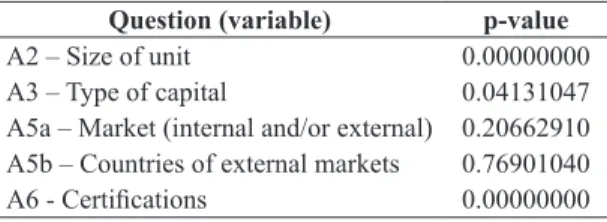
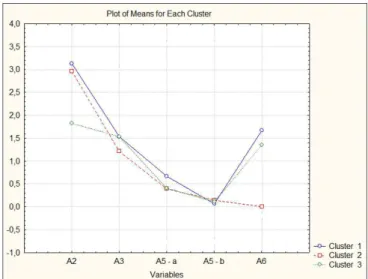
In order to group the companies with similar characteristics, a cluster analysis was performed, with the help of Software Statistica 8.0. For this grouping, four questions were chosen that belong to the pack of general characterization of the units: the A2 question related to the size of the unit, A3 to the type of capital, A5 to the market served - internal and/or external - and question A6 dealing with certiications. The cluster analysis was performed by k-means, which forms the clusters based on the mean of the responses. Three groups were obtained: 1, containing 25% of the units; 2, which represents 46.7% of the units and 3, with 28.3% of units. The differentiation capacity of the clusters can be seen by the p-value of each question (variable), obtained in the analysis of variance, according to Table 5, where p values are included. The lower this value, the greater the capacity of differentiation between the groupings in relation to that variable. It should be noted that the questions with the greatest capacity to differentiate the groupings are A2 and A6, which deal respectively with the size of the unit and the certiications.
The graph generated by the software presents the mean of these variables for each of the groups and shows how the groups distance themselves from each of the variables (Figure 1). The characteristics of each of the groups are presented below.
Group 1
The 15 units of group 1 are of medium (86.7%) or large (13.3%) size, with 53.33% multinational capital and 46.67% national. Among the units in the group, 10 (66.7%) serve the domestic and foreign market, exporting their products mainly to South American countries, especially to Paraguay. Only one of the
Table 5. p-value for variables in cluster analyses.
Question (variable) p-value
A2 – Size of unit 0.00000000
A3 – Type of capital 0.04131047
A5a – Market (internal and/or external) 0.20662910 A5b – Countries of external markets 0.76901040
A6 - Certiications 0.00000000
Coelho, R. P. et al.
712 Gest. Prod., São Carlos, v. 24, n. 4, p. 704-718, 2017
companies exports to Europe and the USA, which are more demanding markets regarding to food quality and safety.
All units in the group are certiied in food safety standards, with:
- ive units (33.3%) have a Feed & Food Safety level 1 certiication, equivalent to GMP certiication; - four (26.67%) are ISO 22000 certiied; - three (20%) have Food & Safety level 2 certiication,
equivalent to HACCP certiication; - two (13.33%) are GMP + certiied; - one unit (6.67%) is FAMI-QS certiied.
Most companies (73.33%) have been certiied for
more than 4 years, long enough to be able to evaluate
beneits from the implementation of GMP/HACCP. Five of the units with Feed & Food Safety level 1 certiication, none declared to have HACCP fully implemented. Two of them reported having the HACCP in the initial state of implementation, two declared as a perspective to evolve from certiication level, which means to seek HACCP certiication. This little interest of these companies in the certiication in HACCP is possibly due to not being a requirement and not to see as something that adds beneits with this certiication. Because the group is formed by medium and large companies, it is probable that the requirement of qualiied professionals and investments for the complete implementation of HACCP is not an impediment.
In addition to certiications in standards related to food safety, 7 units are ISO 9001 certiied, and three of them are also certiied in ISO 14001, which
denotes the search by these companies to improve their
management systems, both Quality and Environmental. Considering the internal benefits, after the implementation of GMP/HACCP, the highest average was the improvement in the occurrences of problems related to food safety, followed by improvement in the training of the employees directly related to the production. For the external beneits, the biggest averages were the improvement of the brand image and the level of customer satisfaction.
The main dificulty pointed out by the units of the group is the resistance, lack of involvement and awareness of the employees for the importance of the implementation of GMP/HACCP, which indicates the dificulty of the employees in the understanding of GMP/HACCP and its objectives. Conducting training that clariies the importance of these programs to ensure safe food, and also that companies are part of a chain of food production, i.e., the employee understands that their activity is performed in a chain link that generates, as inal products, food that he, himself, consumes, is a possibility for reducing this resistance of the employees.
In relation to expectations, it was indicated, as the highest average, to invest in new technologies (equipment / processes) that guarantee greater food safety. This denotes safety concern and it wants to guarantee it with improvements in equipment, but
there is no intention to implement and certify the
HACCP, which would probably require more time and dedication from its professionals.
Group 2
This group consists of 28 units, almost half of the sample, of which 6 (21.4%) were small, 17 (60.7%) were medium-sized and 5 (17.9%) were large.
The majority (78.5%) of the units in this group is of national capital.
None of the units is certiied in food safety or quality management standards. Three units, with multinational capital, reported having certiication in other standards:
- two are certified in one’s own program, which encompasses the requirements of Good Manufacturing Practices;
- one has implemented and certiied the FEMAS (Feed Materials Assurance Scheme) system, a food safety standard that is in part based on the HACCP principles.
Among the units in the group, only 4 exports to the USA and European Community countries, which
are considered to be more demanding regarding food
safety. Two multinational capital units export to the USA, one of them with FEMAS certiication.
In comparison to the other groups, the units of group 2 are the ones that, less frequently, produce premixes and additives, products with higher added value, which may represent one of the reasons why the units of this group are the ones that least seek certiication in food safety. Table 6 shows the
comparison, by type of product manufactured, between the units of the different groups.
Ten units from Group 2 pointed to MAPA’s inspection of their GMP programs as a certiication, although, as already mentioned, it can not be considered as a certiication, but attests that the unit has implemented the requirements of IN 04. These units are mostly (90%), medium-sized, one is small and all are of national capital. Of these 10 units, 5 reported having HACCP fully implemented, but not certiied. Four units reported having MAPA authorization to manufacture medicated products, in compliance with IN 65, which required implementation of GMP for at least 6 months and attendance of at least 80 points in the IN 04 check list. None of these 4 units have HACCP implanted.
Considering the internal beneits, among the main ones indicated by the group are the improvement in the occurrences of problems related to food safety and improvement in the index of customer complaints about problems related to food safety, both with the same average, followed by improvement in the organization of the manufacturing environment. For the external beneits, the highest averages were for improvement in the level of customer satisfaction followed by reduction in the number of recall and improvement in the brand image, with the same average.
The main dificulties indicated were the resistance, lack of involvement and awareness of the employees for the importance of the implementation of GMP/HACCP followed by lack of training of production staff. Regarding the perspectives, the most mentioned were investing in employee training, a solution to the greater dificulty indicated and investing in new technologies that guarantee greater food safety.
Group 3
The 17 units of group 3 are composed of micro (17.6%) and small (82.4%) companies. Eight units (47.1%) are of national capital and nine (52.9%) are multinational.
Of the units that compose the group, 7 (41.2%) serve the domestic and foreign markets, exporting mainly to South American countries. Only two units export to Europe and the USA, both are of national capital and produce supplements and ingredients for animal feed.
Among the units in the group, 15 (88.2%) have certiication in standards related to food safety, being that:
- seven (41.2%) have Feed & Food Safety certiication level 1, which is equivalent to GMP certiication;
- four (23.5%) have Feed & Food Safety certiication level 2, equivalent to HACCP certiication; - two (11.8%) are GMP + and ISO 22000 certiied;
Table 6. Diferentiation between percents of units(companies) in groups about manufactured product.
Product Group 1 (%) Group 2 (%) Group 3 (%)
Feeds 86.67* 67.86 35.29
Nucleus 66.67 46.43 41.18
Concentrates 80.00 57.14 29.41
Premixes 66.67 25.00 35.29
Additives 26.67 10.71 47.06
Supplements 66.67 50.00 41.18
Veterinary medicinal 13.33 3.57 11.76
Ingredients 26.67 14.29 11.76
PET 26.67 17.86 11.76
Coelho, R. P. et al.
714 Gest. Prod., São Carlos, v. 24, n. 4, p. 704-718, 2017
- one (5.9%) has FAMI-QS certiication; - one (5.9%) is HACCP certiied.
Most of these companies (76.5%) have been certiied for more than 4 years.
The two units that have GMP + and ISO 22000 certification are also certified in ISO 9001 and are units that serve European and US countries. One has no food safety certiication but is ISO 9001 certiied.
Among the seven units with Feed & Food Safety level 1 certiication, two reported being in the initial phase of HACCP implementation and one in the inal stage of this implementation. Four units indicated as a perspective to evolve in relation to the current certiication.
The internal beneits, after the implementation of GMP/HACCP, which presented the highest averages were: improvement in the level of training of the production employees followed by improvement in the occurrences of problems related to food safety and improvement in the effectiveness of corrective actions applied to nonconformities, with equal averages. Regarding the external beneits, the highest averages were attributed to the improvement in the brand image and reduction in the number of non-conformities during audits, with the same average.
The main dificulty was to invest in infrastructure (facilities and equipment), in order to meet the requirements of GMP/HACCP, which in the two previous groups was not the highest average item, possibly due to the size of the unit and/or building structure require greater investment to meet the requirements. The second dificulty was the resistance, lack of involvement and awareness of the employees for the importance of implementing GMP/HACCP.
From the perspectives, group 3 units intend to invest in new technologies (equipment/processes) that guarantee greater food safety, employee training and physical structure. The last two are directly related to the main dificulties indicated by the units of this group.
3.7 Comparative analysis between groups Groups 1 and 3, which contain food safety certiication units, are composed of units that are predominantly multinational, probably because these units have a corporate “management model” to follow, in order to standardize units in the various countries where they operate. In these groups, a higher percentage of units serve the external market, compared to group 2. Groups 1 and 3 also have more units certiied in the ISO 9001 standard, which suggests that the units belonging to these groups, besides implanting the food safety standards, value ISO 9001 certiication.
In groups 1 and 3, level 1 certification of SINDIRAÇÕES prevails, representing, respectively, 33.3% and 46.7% of the certiied units of these groups. Among the units that opted for certiications covering the HACCP concepts, the most mentioned were the certiication level 2 of SINDIRAÇÕES (26.7% of group 1 and 23,5% of group 3) followed by ISO 22000 certiication (26.7% % of group 1 and 11.8% of group 3). It is also noted that all units certiied in ISO 22000 also have ISO 9001 certiication. As these standards have similar structures, it is likely that these units were irst certiied in ISO 9001 and then opted for the adoption of ISO 22000, since, during the implementation of ISO 22000 part of the requirements would have been previously implemented.
Regarding the internal beneits, all the groups indicated the improvement in the events related to food safety, a major objective of these standards, as one of the main results perceived. However, group 1, where all the units are certiied and group 3, where 88.2% of the units are certiied, also mentioned the improvement in training of production staff as one of the main results. The requirement to conduct training after updating critical documents for food quality and safety, such as Standard Operating Procedures, by standards, should be the cause of this response in certiied units.
The most mentioned external benefits were improved brand image and customer satisfaction. However, the same behavior observed in the internal beneits is also seen in the external ones: the units of groups 1 and 3, where the majority has certiication in security norms, indicated, as main external beneit, the improvement in the brand image, evidencing that the units understand that certiication in these programs generates trust in the brand.
Regarding the dificulties in the implementation of GMP/HACCP, the units of the three groups indicated, in general, the resistance and lack of involvement and awareness of the employees for the implementation of GMP/HACCP among the most mentioned factors. Groups 1 and 2 indicated, as the main factor, the employees’ resistance to adopting the new practices, while group 3 indicated the dificulty in investing in facilities and equipment to meet GMP/HACCP requirements. This difference can be due to the fact that the units of group 3 are smaller.
fulillment of procedures was the greater dificulty faced.
4 Final considerations
This paper characterized the implementation of
GMP/HACCP and the beneits perceived in feed manufacturers, associated with SINDIRAÇÕES, as well as the main problems faced and classiied the units in groups with similar characteristics.
The view that programs that guarantee the feed safety are important for the quality of the product (premixes, cores, feed, etc.) and essential for the quality of the inal product of the chain (meat, milk, eggs and derivatives) it seems not to be unanimous between the units, since 26.67% of the sample does not have HACCP implemented and 50.00% of the units have implemented GMP, but not certiied. Some companies may perceive GMP or HACCP certiication only as one more certiicate, without recognizing the possibilities and advantages of these systems being critically analyzed by external audits, nor the advantages of meeting requirements beyond IN 04, which represents the minimum requirement in the sector, since there are more restrictive requirements in the Feed & Food Safety program for SINDIRAÇÕES level 1 (GMP) than IN 04. The other standards mentioned, such as Feed & Food Safety Level 2, ISO 22000, GMP + and FAMI-QS, include HACCP, therefore, are more demanding than MAPA requirements. Certiication alone does not bring excellence, but it can improve how the
company perceives the adoption and implementation
of a standard not just to obtain a certiicate, but all the beneits that can be gained by following all the requirements demanded by the standard.
The sample units were classiied into three groups: Group 1, consisting of medium and large units, all with certiication in food safety standards that include GMP or HACCP requirements; Group 2, consisting of small, medium and large units that do not have certiication; And Group 3, with small units, the majority with certiication in food safety standards.
Adoption of GMP, according to IN 04, is mandatory for manufacturers of animal feed products, but the adoption of HACCP is not mandatory. Thus, companies that implement HACCP do so to meet customer requirements or voluntarily, to improve the control of contaminants and guarantee greater safety and a better image of the brand.
Concerning the total of the sample, 30 units (50% of the sample) are certiied in GMP or HACCP, 12 in GMP and 18 in standards that include HACCP. Of these 30 units, 14 (46.7%) are of national capital and 16 (53.3%) are of multinational capital.
Small irms face a series of obstacles and restriction that complicate the effective implementation of HACCP (Ehiri et al., 1995; Panisello et al., 1999; Gilling et al., 2001), while larger companies have more resources and the technical assistance needed to implement and maintain HACCP. Small irms will have more dificulties because they do not have the appropriate resources and technical knowledge, and usually have minimally needed employees, therefore, prioritize productivity over food safety (Panisello & Quantick, 2001). The assertions of these authors can be considered, in part, conirmed in the sample of this research, since Group 3 has units with certiication, all of smaller size, and indicated as greater dificulty in the implementation of investments in structure (facilities and equipment), in a way to meet the GMP/HACCP requirements, which can also lead to a longer implementation time. In a study conducted by Pellegrini et al. (2015) in four Brazilian feed mills, it was concluded that the equipment in use was not designed to perform continuous cleaning and sanitation, since most of them do not allow access to hygiene and have surfaces or points of accumulation of dirt along the production line.
Group 3 units did not indicate as one of the main dificulties, the lack of technical and professional support (both from the company itself and from consultancies) with knowledge to assist the implementation, as the authors suggest. Although they may have more dificulties in the implementation of HACCP, they have not prevented smaller units of this sample from seeking certiication, which is different from that observed by Panisello et al. (1999) and Mortlock et al. (1999), in ield surveys in the United Kingdom, which showed that HACCP is much less deployed in small businesses compared to large ones.
Among the 18 units with certiication in HACCP standards, present in Groups 1 and 3, 44.5% are micro or small, 44.4% are medium-sized and 11.1% are large, i.e., many small units of sample has the HACCP implemented and certiied.
Coelho, R. P. et al.
716 Gest. Prod., São Carlos, v. 24, n. 4, p. 704-718, 2017
lack of involvement and employee awareness for the importance of implementing GMP/HACCP and lack of training of production employees, which may be related to training failures.
Among the beneits perceived with the implementation of GMP/HACCP, the units noticed little increase in productivity. Khatri & Collins (2007) reinforces that in some cases, other beneits, besides reducing the occurrence of contaminations, are not clear to be noticed. Reducing the occurrence of contamination is the initial and immediate result; other beneits may arise in the long-term as a consequence of several improvements achieved with the implementation.
The main beneits indicated with the implementation were: reduction in the occurrences of problems related to food safety, improvement in the level of training of the production employees, improvement of the brand image and in the level of customer satisfaction, which is in agreement with what was observed by Azanza & Zamora-Luna (2005) and Ramírez Vela & Martı́n Fernández (2003).
In the feed manufacturers sector, it is noticed that most companies are aware of the quality and safety requirement of the products, however, not all of them associate safe products with certiication in programs focused on food safety. Although in Brazil, through IN 04, the requirement for the implementation of Good Manufacturing Practices in feed manufacturers is veriied, the veriication of full compliance with the legislation is subject to the supervision of MAPA. The implementation of HACCP in this sector is not provided in legislation, and companies that opt for their implementation and certiication do so voluntarily or by customer demand.
References
Azanza, P., & Zamora-Luna, M. (2005). Barriers of
HACCP team members to guideline adherence. Food Control, 16(1), 15-22. http://dx.doi.org/10.1016/j. foodcont.2003.10.009.
Baddini, S. (2005). Impactos da Globalização no contexto da Segurança Alimentar – Requisitos para a organização na cadeia alimentar. In: Anais do II Simpósio Brasileiro da Indústria de Alimentação Animal. Recuperado em 10 de março de 2013, de www.br.sgs.com
Baş, M., Yüksel, M., & Çavuşoğlu, T. (2007). Difficulties and barriers for the implementing of HACCP and food safety systems in food business in Turkey. Food Control, 18(2), 124-130. http://dx.doi.org/10.1016/j. foodcont.2005.09.002.
Bauman, H. E. (1992). Introduction to HACCP. In H. Chapman. HACCP: principles and applications (pp. 1-5). New York: Chapman & Hall.
Brasil. (2007, março 1). Instrução Normativa nº 4, 23 de fevereiro de 2007. Regulamento técnico sobre as condições higiênico-sanitárias e de boas práticas de fabricação para estabelecimentos fabricantes de produtos destinados à alimentação animal e o roteiro de inspeção (seção 1). Brasília, DF: Diário Oficial da República Federativa do Brasil.
Celaya, C., Zabala, S. M., Pérez, P., Medina, G., Mañas, J., Fouz, J., Alonso, R., Antón, A., & Agundo, N. (2007). The HACCP system implementation in small business of Madrid’s community. Food Control, 18(10), 1314-1321. http://dx.doi.org/10.1016/j.foodcont.2006.09.006. Centers for Disease Control and Prevention – CDC (2011).
CDC 2011 estimates. Atlanta: CDC.
Codex Alimentarius Commission – CAC (2003). Recommended International Code of Practice – General Principles of Food Hygiene (CAC/RCP 1-1969). Rome: FAO/WHO Food Standards Programme.
Cortina, J. M. (1993). What is coefficient alpha? An examination of theory and applications. The Journal of Applied Psychology, 78(1), 98-104. http://dx.doi. org/10.1037/0021-9010.78.1.98.
Deodhar, S. Y. (2003). Motivation for and cost of HACCP in Indian food processing industry. Indian. Journal of Economics and Business, 2, 193-208.
Dora, M., Kumar, M., van Goubergen, D., Molnar, A., & Gellynck, X. (2013). Food quality management system: reviewing assessment strategies and a feasibility atudy for European food small and medium-sized enterprises. Food Control, 31(2), 607-616. http://dx.doi.org/10.1016/j. foodcont.2012.12.006.
Ehiri, E., Morris, P., & Mcewen, J. (1995). Implementation of HACCP in food business: the way ahead. Food Control, 6(6), 341-345. http://dx.doi.org/10.1016/0956-7135(95)00045-3.
Escanciano, C., & Santos-Vijande, M. L. (2014). Reasons and constrains to implementing an ISO 22000 food safety management system: evidence from Spain. Food Control, 40, 50-57. http://dx.doi.org/10.1016/j. foodcont.2013.11.032.
Food Agriculture Administration of the United Nations – FAO. (2009). The state of food and agriculture: Livestock in the balance. Roma: FAO.
Fotopoulos, C., Kafetzopoulos, D., & Gotzamani, K. (2011). Critical factors for effective implementation of the HACCP system: a Pareto analysis. British Food Journal, 113(5), 578-597. http://dx.doi.org/10.1108/00070701111131700. Gilling, S. J., Taylor, E. A., Kane, K., & Taylor, J. Z. (2001). Successful hazard analysis critical control point implementation in the United Kingdom: understanding the barriers through the use of a behavioural adherence model. Journal of Food Protection, 64(5), 710-715. PMid:11348006. http://dx.doi.org/10.4315/0362-028X-64.5.710.
Hartog, J. (2003). Feed for food: HACCP in the animal feed industry. Food Control, 14(2), 95-99. http://dx.doi. org/10.1016/S0956-7135(02)00111-1.
Huss, H. H. (1994). Assurance of seafood quality (FAO Fisheries Technical Paper, N° 334). Rome: FAO. Huss, H. H. (1995). Quality and quality changes in fresh
ish (FAO Fisheries Technical Paper, N° 348). Rome: FAO. Recuperado em 1 de julho de 2013, de http:// www.fao.org/docrep/v7180e/v7180e00.htm
International Feed Industry Federation – IFIF. (2015). Annual Report 2014/15. Wiehl: IFIF. Recuperado em 21 de novembro de 2016, de http://annualreport.ifif. org/IFIF-Annual-Report-2014-15.pdf
Jin, S., Zhou, J., & Ye, J. (2008). Adoption of HACCP system in the Chinese food industry: a comparative analysis. Food Control, 19(8), 823-828. http://dx.doi. org/10.1016/j.foodcont.2008.01.008.
Karipidis, P., Athanassiadis, K., Agelopoulos, S., & Giompliakis, E. (2009). Factors affecting the adoption of quality assurance systems in small food enterprises. Food Control, 20(2), 93-98. http://dx.doi.org/10.1016/j. foodcont.2008.02.008.
Khatri, Y., & Collins, R. (2007). Impact and status of HACCP in the Australian meat industry. British Food Journal, 109(5), 343-354. http://dx.doi.org/10.1108/00070700710746768. Lupin, H. M., Parin, M. A., & Zugarramurdi, A. (2010). HACCP economics in fish processing plants. Food Control, 21(8), 1143-1149. http://dx.doi.org/10.1016/j. foodcont.2010.01.009.
Macheka, L., Manditsera, F. A., Ngadze, R. T., Mubaiwa, J., & Nyanga, I. K. (2013). Barriers, benefist and motivation factors for the implementation of food safety management system in the food sector in Harare Province, Zimbabwe. Food Control, 34(1), 126-131. http://dx.doi.org/10.1016/j.foodcont.2013.04.019. Maldonado, E. S., Henson, S. J., Caswell, J. A., Leos, L.
A., Martinez, P. A., Aranda, G., & Cadena, J. A. (2005).
Cost-benefit analysis of HACCP: implementation in the Mexican meat industry. Food Control, 16(4), 375-381. http://dx.doi.org/10.1016/j.foodcont.2004.03.017. Mortlock, M. P., Peters, A. C., & Griffith, C. (1999). Food hygiene and hazard analysis and critical control point in the United Kingdom food industry: practices, perceptions and atitudes. Journal of Food Protection, 62(7), 786-792. PMid:10419273. http://dx.doi.org/10.4315/0362-028X-62.7.786.
Motarjemi, Y., & Kaferstein, F. (1999). Food safety, hazard
analysis and critical control point and the increase in
food-borne disease: a paradox? Food Control, 10(10), 325-333. http://dx.doi.org/10.1016/S0956-7135(99)00008-0. Painter, J. A., Hoekstra, R. M., Ayers, T., Tauxe, R. V., Braden, C. R., Angulo, F. J., & Griffin, P. M. (2013). Attribution of foodborne illnesses, hospitalizations, and deaths to food commodities by using outbreak data, United States, 1998-2008. Emerging Infectious Diseases, 19(3), 407-415. PMid:23622497. http:// dx.doi.org/10.3201/eid1903.111866.
Panisello, P. J., & Quantick, P. C. (2001). Technical barriers to hazard analysis critical control point (HACCP). Food Control, 12(12), 165-173. http://dx.doi.org/10.1016/ S0956-7135(00)00035-9.
Panisello, P. J., Quantick, P. C., & Knowles, M. J. (1999). Towards the implementation of HACCP: results of a UK regional survey. Food Control, 10(10), 87-98. http:// dx.doi.org/10.1016/S0956-7135(98)00161-3. Pellegrini, D. C. P., Paim, D. S., Lima, G. J. M. M., Pissetti,
C., Kich, J. D., & Cardoso, M. R. I. (2015). Distribution of Salmonella clonal groups in four Brazilian feed mills. Food Control, 47, 672-678. http://dx.doi.org/10.1016/j. foodcont.2014.08.013.
Ramírez Vela, A., & Martı́n Fernández, J. (2003). Barriers for the developing and implementation of HACCP plans: results from a Spanish regional survey. Food Control, 14(5), 333-337. http://dx.doi.org/10.1016/ S0956-7135(02)00098-1.
Coelho, R. P. et al.
718 Gest. Prod., São Carlos, v. 24, n. 4, p. 704-718, 2017
Taylor, E. (2001). HACCP in small companies: benefit or burden? Food Control, 12(12), 217-222. http://dx.doi. org/10.1016/S0956-7135(00)00043-8.
United Nations – UN. Deparment of Economic and Social Affairs. Population Division. (2012). World urbanization prospects: the 2011 revision. New York: UN. Recuperado em 15 de junho de 2013, de http:// esa.un.org/unpd/ wup/pdf/WUP2011_Highlights.pdf
Walker, E., Pritchard, C., & Forsythe, S. (2003). Hazard analysis critical control point and prerequisite programme implementation in small and medium-sized food business. Food Control, 14(3), 169-174. http://dx.doi. org/10.1016/S0956-7135(02)00061-0.