DOI: 10.7213/urbe.7394
"
ISSN 2175-3369
Licenciado sob uma Licença Creative Commons
Paola Pucci
Identifi cando as “comunidades de prática” por meio
dos dados de telefonia móvel (celular)
Identifi care comunità di pratiche, attraverso dati di telefonia mobile
Polytechnic of Mil⁷n, Dep⁷rtment of Architecture ⁷nd Urb⁷n Studies D⁷stu , ⁷ssoci⁷te professor of Urb⁷n Pl⁷nning, Mil⁷n - )t⁷ly, e-m⁷il: p⁷ol⁷[email protected]
Abstract
This p⁷per focuses on the potenti⁷lities offered by mobile phone d⁷t⁷ to ⁷ re⁷ding of the site pr⁷ctices ⁷nd rhythms of us⁷ge of the contempor⁷ry city by identifying the princip⁷l mobile pr⁷ctices of different urb⁷n po-pul⁷tions. Beginning with the results of ⁷ rese⁷rch c⁷rried out in the )t⁷li⁷n region of Lomb⁷rdy, utilising mobile phone d⁷t⁷ provided by Telecom )t⁷li⁷, the p⁷per will demonstr⁷te how new m⁷ps, b⁷sed on mobile phone d⁷t⁷ ⁷nd better t⁷ilored to the dyn⁷mic processes t⁷king pl⁷ce, c⁷n represent sp⁷ti⁷lized urb⁷n pr⁷ctices, provide new insights into the ⁷n⁷lysis of sp⁷ce-time p⁷tterns of mobility pr⁷ctices ⁷nd be employed to recognise different communities of pr⁷ctice . Mobile tr⁷f ic d⁷t⁷ were tre⁷ted ⁷s the effect of individu⁷l beh⁷viours ⁷nd h⁷bits th⁷t become ⁷ggreg⁷tes, offering inform⁷tion ⁷bout the fe⁷tures of us⁷ge of urb⁷n sp⁷ces th⁷t v⁷ry in time. The outco-mes permit ⁷ visu⁷lis⁷tion of the sp⁷ti⁷l distribution of mobility lows, in ⁷ddition to describing the experienti⁷l dimensions of commuting rhythms. )t is possible to ⁷rgue th⁷t commuting c⁷n be conceived ⁷s ⁷ mobile pr⁷ctice th⁷t exploits ⁷ rich v⁷riety of pl⁷ces of use in ⁷ccord⁷nce with the tempor⁷l org⁷nis⁷tion of ⁷ d⁷y. The processing of mobile phone d⁷t⁷, by offering new m⁷ps of site pr⁷ctices in Lomb⁷rdy ⁷nd inform⁷tion on tempor⁷ry popu-l⁷tions ⁷nd city us⁷ge p⁷tterns d⁷ily/nightly pr⁷ctices, non-system⁷tic mobility , m⁷de it possible to tr⁷ce fuzzy bound⁷ries ⁷s perimeters of pr⁷ctice. These pr⁷ctices ⁷re proposed ⁷s ⁷ tool for supporting ⁷nd incre⁷sing the ef iciency of urb⁷n policies ⁷nd mobility services.
Keywords: Mobile phone d⁷t⁷. Mobility pr⁷ctices. Communities of pr⁷ctice.
Resumo
Practices and urban rhythms through spatial mobility
The contempor⁷ry city is ⁷ site of soci⁷bility whose underst⁷nding is m⁷de possible through the re⁷ding of the routiniz⁷tion of site pr⁷ctices th⁷t fol-low their own rhythms of ⁷ppe⁷r⁷nce ⁷nd
dis⁷p-pe⁷r⁷nce AM)N; T(R)FT, .
Sh⁷ring the position suggested by Amin ⁷nd Thrift le⁷ds tow⁷rd ⁷ heuristic v⁷lue of the interpre-t⁷tion of site pr⁷ctices ⁷nd rhythms of us⁷ge of the contempor⁷ry city.
The hypothesis of the rese⁷rch te⁷m is th⁷t mo-bility pr⁷ctices ⁷re ⁷mong those th⁷t best re lect the complexity of urb⁷n processes ⁷nd rhythms in con-tempor⁷ry cities.
Sp⁷ti⁷l mobility, interpreted ⁷s ⁷ tot⁷l soci⁷l phe-nomenon [...], th⁷t is, not only ⁷s ⁷ movement, but ⁷s the ⁷ction ⁷t the he⁷rt of soci⁷l processes of
oper⁷-tion ⁷nd ch⁷nge emerged in the s in the works
of Michel B⁷ss⁷nd ⁷nd M⁷rie Cl⁷ude Brulh⁷rft ,
p. , l⁷ying the found⁷tion for ⁷ critic⁷l review of ⁷
reductive vision of mobility oper⁷ted by both the so-ci⁷l sciences ⁷nd tr⁷nsport engineering.
dados possam tanto restituir as densidades de uso do território, que as variações dos padrões temporais e es-paciais de um lugar, consequentemente originando novos elementos interpretativos, úteis ao reconhecimento das diversas “comunidades de práticas”. Na pesquisa, os dados do tráfico de telefonia móvel foram tratados como se fosse um resultado dos comportamentos e dos hábitos individuais que agrupados formam uma infor-mação única sobre as características do território, e ao mesmo tempo, uma propriedade intrínseca do mesmo e como tal variável no tempo. Os experimentos realizados confirmem a utilidade desses dados de telefonia móvel em explorar não somente a distribuição espacial dos fluxos, mas as dimensões dos deslocamentos e dos ritmos. A argumentação consiste em que o deslocamento pode ser concebido como uma prática móvel, que oferece uma variedade de locais de uso, de acordo com a organização temporal de um dia, relacionados não somente com os eventos fixos (de trabalho), mas também com outras atividades.
Palavras-chave: Dados de telefonia móvel. Práticas de mobilidade. Comunidades de prática.
Riassunto
Il paper esplora le potenzialità offerte dai dati di telefonia mobile per leggere i ritmi delle pratiche d’uso della città contemporanea e le loro differenziazioni spazio-temporali, difficilmente restituibili attraverso fonti tradizionali. A partire dai risultati di una ricerca condotta sui dati di telefonia mobile della rete Telecom Italia in Regione Lombardia, abbiamo verificato se e come tali dati possano restituire le densità d’uso del territorio e la variabil-ità delle pratiche spazializzate d’uso della città, così da offrire elementi interpretativi utili a riconoscere diverse “comunità di pratiche”. Nella ricerca condotta, i dati di traffico telefonico sono stati trattati come l’effetto di com-portamenti e abitudini individuali che diventano, aggregati, un’informazione sulle caratteristiche del territorio, in qualche modo, una sua intrinseca proprietà, che varia nel tempo. Le mappe prodotte, anche grazie al confronto con dati di fonti statistiche tradizionali, offrono non solo informazioni utili sulla distribuzione spaziale dei flussi e sulle densità d’uso del territorio, ma rappresentano anche una importante fonte per leggere le modalità con cui differ-enti comunità di pratiche usano il territorio. Il trattamento dei dati di traffico telefonico, restituendo la variabilità spazio-temporale delle pratiche,consente di configurare territori contingenti, generati dalle pratiche di diverse popolazioni temporanee, come parte di un nuovo paesaggio istituzionale.
Parole-chiave: Dati di telefonia mobile. Pratiche di mobilità. Comunità di pratica.
¹ Borrowing from the work of Lefebvre, Amin ⁷nd Thrift ⁷rgue th⁷t the rhythms of the city ⁷re the coordin⁷tes through which inh⁷-bit⁷nts ⁷nd visitors fr⁷me ⁷nd order the urb⁷n experience AM)N; T(R)FT, , p. .
The gr⁷du⁷l shift tow⁷rds ⁷ more complex con-ceptu⁷lis⁷tion of the notion of mobility ⁷s ⁷ tr⁷ns-l⁷tion of heterogeneous pr⁷ctices th⁷t modify pl⁷ces, ⁷nd ⁷lso ⁷s the m⁷n⁷gement of time-sp⁷ce
resources KAUFMANN, , c⁷n be re⁷d in the
contribution of sever⁷l ⁷uthors.
Working with the m⁷teri⁷l conditions of
mobil-ity ⁷nd ⁷ssoci⁷ted pr⁷ctices, John Urry , p.
⁷ttributes ⁷ centr⁷l dimension in soci⁷l life to mobil-ity bec⁷use the contempor⁷ry world is de ined by the circul⁷tion of goods, more th⁷n by st⁷ble struc-tures ⁷nd org⁷nis⁷tions .
)n this sense, sp⁷ti⁷l mobility contributes to de-scribing the forms ⁷nd sp⁷n of different life pr⁷c-tices ⁷nd consumer p⁷tterns, which produce diver-si ied uses of the city. Mobility is both ⁷ c⁷use ⁷nd consequence of ch⁷nges in the org⁷nis⁷tion of
ev-eryd⁷y life URRY, .
At the s⁷me time, when describing the tr⁷nsfor-m⁷tions of the contempor⁷ry metropolis tow⁷rd ⁷
post-metropolit⁷n model, Soj⁷ , p.
rec-ognises th⁷t the evolution we ⁷re witnessing c⁷n be better understood not ⁷s ⁷ decline in the import⁷nce of the geogr⁷phy of sites with respect to the sp⁷ce of lows , but ⁷s ⁷n ⁷cceler⁷ted reorg⁷nis⁷tion ⁷nd restructuring of the geogr⁷phy of movements th⁷t de ine the sp⁷ti⁷lity of hum⁷n societies.
An⁷lysing urb⁷n tr⁷nsform⁷tions through mo-bility consents ⁷ movement ⁷cross v⁷rious sc⁷les of observed phenomen⁷ bec⁷use mobile pr⁷c-tices ⁷re ⁷ssoci⁷ted to different sp⁷ces ⁷nd sc⁷les
CRESSWELL, , p. .
Sp⁷ti⁷l mobilities thus become ⁷ useful rese⁷rch tool for underst⁷nding tr⁷nsform⁷tions in the times, pl⁷ces, soci⁷l life ⁷nd work progr⁷ms structuring
contempor⁷ry cities ASC(ER, ; BOURD)N,
; SC(ELLER; ULLER, ; CRESSWELL, .
At the s⁷me time, mobility ⁷lso pl⁷ys ⁷n import⁷nt role in soci⁷l integr⁷tion for its implic⁷tions in terms
of soci⁷l differenti⁷tion, ⁷s underlined by cert⁷in
⁷u-thors TARR)US, ; KAUFMANN, ; ORFEU)L,
. Mobility therefore implies ⁷ project of
mobil-ity E(RENBERG, dependent on ⁷v⁷il⁷ble
re-sources, ⁷bilities, competences, ⁷cquired knowledge ⁷nd org⁷nis⁷tion⁷l c⁷p⁷city, which ⁷re either strength-ened or we⁷kstrength-ened by our pr⁷ctices.
)n ⁷ strengthened theoretic⁷l fr⁷mework, mo-bility rese⁷rch combines soci⁷l ⁷nd sp⁷ti⁷l theory
in new w⁷ys SC(ELLER, . )n so doing it h⁷s
provided ⁷ tr⁷nsform⁷tive nexus for expl⁷ining the role of mobility ⁷s ⁷ soci⁷l product CRESSWELL, , ⁷nd ⁷n unquestion⁷ble process of
urb⁷n-cre⁷tion LÉVY, .
Seen from this perspective, the ch⁷llenge is not to ⁷n⁷lyse mobility ⁷s such, but inste⁷d to ⁷n⁷lyse con-tempor⁷ry society through the re⁷lities of mobility
BOURD)N, or, in our c⁷se, the contempor⁷ry
city through mobility pr⁷ctices. Mobility ⁷s ⁷ tr⁷ns-vers⁷l fr⁷me for re⁷ding soci⁷l issues BOURD)N,
, p. represents ⁷n ⁷n⁷lyser BOURD)N,
useful for describing urb⁷n life ⁷nd identifying
communities of pr⁷ctice WENGER, , such ⁷s
mobile communities LE BRETON, .
The reference to communities of pr⁷ctice
WENGER, , ⁷s opposed to urb⁷n
popul⁷-tions MART)NOTT), , permits the
recogni-tion of the v⁷ri⁷bility in sp⁷ce-time of the roles of individu⁷ls, who m⁷y belong to different communi-ties of pr⁷ctice throughout the d⁷y.
)f time-rel⁷ted ch⁷nges in the city c⁷n be de-scribed through the concept of tempor⁷ry popu-l⁷tions , the urb⁷n popul⁷tion c⁷n no longer be re-g⁷rded ⁷s ⁷ collection of residents forced to move within the bound⁷ries of the city.
According to Cresswell , p. we ⁷re
si-mult⁷neously p⁷rt of different groups, we live our lives ⁷cross ⁷ number of sp⁷ces ⁷s we move through the splintered city. We belong to m⁷ny groups th⁷t
My tr⁷nsl⁷tion from l⁷ mobilité constitue ⁷ussi une technique incontest⁷ble de urb⁷nogenèse et non un problème externe ⁷ux pr⁷tiques urb⁷ines les plus fond⁷ment⁷les, c est à dire à ce qui f⁷it d une ville une ville, à son urb⁷nité LÉVY, , p. . ⁴ My tr⁷nsl⁷tion from c⁷dre tr⁷nsvers⁷l de lecture du soci⁷l BOURD)N, , p. .
Groupes soci⁷ux dé inis à p⁷rtir de leurs inscriptions territori⁷les, de leurs pr⁷tiques de mobilité, des dispositifs techniques qu ils mettent en oeuvre LE BRETON, , p. .
Mobility c⁷n thus represent both ⁷ knowledge tool ⁷nd ⁷ policy tool for underst⁷nding ⁷nd regu-l⁷ting the process of tr⁷nsforming the contempo-r⁷ry city. This bec⁷use mobility is ⁷lso p⁷rt of the process of soci⁷l production of time ⁷nd sp⁷ce
CRESSWELL, , p. , including the dimensions
of sp⁷ce ⁷nd time, r⁷rely tre⁷ted in ⁷n integr⁷ted perspective by public policies.
Mobility is ⁷ knowledge tool bec⁷use it is ⁷ble to describe urb⁷n rhythms ⁷nd the sp⁷ce-time dimen-sions of the pr⁷ctices of using ⁷ territory.
Mobility is ⁷ policy tool for its ⁷bility to root po-litic⁷l ⁷ction within the observ⁷tion of d⁷ily
pr⁷c-tices, in order to construct policies coherent with
the emerging demands being m⁷de by diverse pop-ul⁷tions using the city ⁷nd its services, ⁷t v⁷rying rhythms ⁷nd intensities.
The need to recognise the different pro iles ⁷nd pr⁷ctices of urb⁷n popul⁷tions often constituted ⁷s communities of pr⁷ctice , ch⁷llenges the ⁷n⁷lytic⁷l tools ⁷nd sources ⁷v⁷il⁷ble to urb⁷n studies. While offering ⁷ represent⁷tion of v⁷rious urb⁷n rhythms ⁷nd identifying different mobile popul⁷tions, the ⁷n⁷lysis of the sp⁷ce-time v⁷ri⁷bility of the pr⁷ctic-es of using the city rem⁷ins dif icult to ⁷chieve with tr⁷dition⁷l d⁷t⁷ sources.
According to Sheller ⁷nd Urry s ⁷rticle The new mobilities p⁷r⁷digm , which c⁷lled for new rese⁷rch methods on the move ⁷nd ⁷ble to simul⁷te
inter-mittent mobility S(ELLER; URRY, , p. ,
it is import⁷nt to formul⁷te pertinent ⁷n⁷lytic⁷l ⁷p-pro⁷ches ⁷imed ⁷t describing different densities in the use of the city ⁷nd the combined movements of people, objects ⁷nd inform⁷tion in ⁷ll of their com-plex rel⁷tion⁷l dyn⁷mics .
The heuristic ⁷nd design possibilities offered by the new mobilities p⁷r⁷digm S(ELLER; URRY, question ⁷v⁷il⁷ble ⁷n⁷lytic⁷l tools ⁷nd d⁷t⁷ sources. They must describe different p⁷tterns of r⁷rely intersect. )t m⁷y be the c⁷se th⁷t our identity
⁷s ⁷ n⁷tion⁷l citizen is incre⁷singly likely to be the less import⁷nt one .
The term communities of pr⁷ctices is employed to focus ⁷ttention on the f⁷ct th⁷t urb⁷n popul⁷tions c⁷nnot be reduced to prede ined ⁷nd ixed c⁷tegories due to the phenomenon by which they belong to mul-tiple c⁷tegories. For this re⁷son it is import⁷nt to con-sider popul⁷tions not ⁷s st⁷tic c⁷tegories inh⁷bit⁷nts, commuters, city users, etc. , but ⁷s groups of subjects th⁷t, tempor⁷rily ⁷nd intermittently, sh⁷re pr⁷ctices of
d⁷ily life PASQU), , p. . (ence they c⁷n be
considered communities of pr⁷ctices th⁷t gener⁷te p⁷rticul⁷r sp⁷ce-time geogr⁷phies.
The purpose of our proposition reg⁷rding the identi ic⁷tion of communities of pr⁷ctice through the lens of mobility is not only heuristic, focused on describing new urb⁷n dyn⁷mics ⁷nd time-v⁷ri⁷-tions in the use of urb⁷n sp⁷ces by tempor⁷ry popu-l⁷tions. )t would ⁷lso like to be ⁷ tool for le⁷rning ⁷bout new cl⁷ims ⁷nd urb⁷n dem⁷nds, in f⁷vour of more ef icient ⁷nd less costly urb⁷n policies.
Tempor⁷ry popul⁷tions, precisely for their v⁷riety ⁷nd given the impossibility to limit them to logics of
identity ⁷nd represent⁷tion, m⁷y in fact generate new
claims, but also new common goods, without necess⁷r-ily oper⁷ting ⁷s intention⁷l ⁷ctors in public policies.
)f we ⁷ssume urb⁷n popul⁷tions not ⁷s users of policies but ⁷s potenti⁷l gener⁷tors of common goods, the princip⁷l problem, more th⁷n one of deleg⁷tion, is th⁷t of the represent⁷tion of the plur⁷lis⁷tion of
identities in ⁷ public context PASQU), .
Our hypothesis is th⁷t, through the study of mobil-ity pr⁷ctices ⁷nd their inscription in sp⁷ce, it is pos-sible to recognise communities of pr⁷ctices ⁷nd the intensities with which they utilise territori⁷l services ⁷nd infr⁷structures. This m⁷kes it possible to g⁷ther useful inform⁷tion on urb⁷n dyn⁷mics ⁷s ⁷ condition for structuring more effective urb⁷n policies.
Bec⁷use the time of urb⁷n popul⁷tions oscill⁷tes ⁷nd is comprised of cyclic⁷l tempor⁷lities intertwined with ⁷ plur⁷lity of uses of sp⁷ces ⁷nd pl⁷ces PASQU), , the rhythm of the city c⁷n be de ined – ⁷ccording to Lefebvre – ⁷s loc⁷lised time ⁷nd tempo-r⁷lized pl⁷ce .
considering mobility ⁷s soci⁷l c⁷pit⁷l ⁷nd the ter-ritory ⁷s ⁷ sp⁷ce of soci⁷l inter⁷ctions f⁷cilit⁷ted by mobility .
The oper⁷tive ch⁷llenge to describing the differ-ent dimensions of mobility ⁷nd its rhythms in urb⁷n sp⁷ces, ⁷s ⁷ condition for identifying communities of pr⁷ctice, lies in the integr⁷tion between these two ⁷ppro⁷ches.
)n this perspective, ⁷n interesting contribution m⁷y be provided by mobile phone network d⁷t⁷ ⁷s ⁷ potenti⁷l tool for the re⁷l-time monitoring of urb⁷n dyn⁷mics ⁷nd mobile pr⁷ctices, ⁷s tested in sever⁷l experiment⁷l studies.
Using mobile phone data to describe urban practices
Over the p⁷st dec⁷de, new ⁷ppro⁷ches to esti-m⁷ting hum⁷n movement through urb⁷n sp⁷ces us-ing mobile phone d⁷t⁷ h⁷s been g⁷inus-ing ground in the ields of computing, inter⁷ction design ⁷nd the soci⁷l sciences urb⁷n geogr⁷phy, soci⁷l studies . This pr⁷ctice involves rese⁷rch into the use of ⁷g-greg⁷ted ⁷nd ⁷nonymous cellul⁷r network log iles for re⁷ding ine-gr⁷ined v⁷ri⁷tions in urb⁷n
move-ments over-time A(AS; MARK, ; RATT) et ⁷l.,
; KWAN; D)JST; SC(WANEN, ; READES
et ⁷l., .
Within these studies — focused on the ⁷n⁷lysis, vi-su⁷lis⁷tion ⁷nd interpret⁷tion of hum⁷n presences ⁷nd movements in urb⁷n sp⁷ces through mobile phone tr⁷f ic — the users gener⁷ting telephone tr⁷f ic c⁷n be considered the sensors of ⁷ network . Distributed ⁷cross urb⁷n sp⁷ce they provide inform⁷tion th⁷t tr⁷-dition⁷l d⁷t⁷ sources for urb⁷n studies census d⁷t⁷, surveys ⁷nd interviews or the deployment of sensor networks ⁷re un⁷ble to produce.
This is why m⁷ny ⁷uthors consider the p⁷ssive ⁷nd ⁷nonymous monitoring of cell phone tr⁷f ic to be ⁷ v⁷lid complement to tr⁷dition⁷l methods. This d⁷t⁷ c⁷n simult⁷neously overcome limit⁷tions in the detection of l⁷tency typic⁷l of tr⁷dition⁷l d⁷t⁷ mobility in the form of ⁷ctive biogr⁷phies , which
incre⁷se the r⁷nge of post-Fordist living ⁷nd l⁷bour
styles NUVOLAT), , p. .
The new forms of mobility emerging in the contem-por⁷ry city require interpret⁷tive tools for the identi-ic⁷tion of mobility pr⁷ctices. Wh⁷t is more there is ⁷ decline in the import⁷nce of commuter movements to the description of d⁷ily mobility pr⁷ctices. New forms of mobility, simil⁷r to d⁷ily mobility, ⁷re b⁷sed on both the use of tr⁷nsport⁷tion systems ⁷nd the ef icient ⁷p-propri⁷tion of inform⁷tion technologies. These ele-ments h⁷ve intensi ied the density ⁷nd typologies of movements th⁷t tr⁷dition⁷l sources ⁷re un⁷ble to de-scribe with continuity.
These mobility pr⁷ctices result from the combin⁷-tion of physic⁷l ⁷nd virtu⁷l mobility, le⁷ding to new, mixed forms of d⁷ily, residenti⁷l, ⁷nd tr⁷vel mobility
FLAMM; KAUFMANN, . No longer refer⁷ble to
tr⁷dition⁷l c⁷tegories d⁷ily commuters, city users, businessmen, tourists, but ⁷lso long-dist⁷nce com-muting ⁷nd multiple residences they now spe⁷k of
communities of pr⁷ctice WENGER, . These
popul⁷tions use tr⁷nsport services ⁷nd methods of communic⁷tion in rel⁷tionship not only to their re⁷l ⁷v⁷il⁷bility, but ⁷lso in reference to their person⁷l proj-ects, to their preferences ⁷nd their ⁷bilities ⁷ccess, skills in rese⁷rching inform⁷tion, ⁷bility to ⁷d⁷pt to short term ch⁷nges, cognitive ⁷ppropri⁷tion .
There is in f⁷ct ⁷n emergence of new forms of mo-bility, de ined by p⁷rticul⁷r ⁷uthors KAUFMANN,
⁷s reversible bec⁷use they ⁷re rel⁷tive to pr⁷ctices of movement th⁷t describe ⁷ reversible use of territories ⁷nd networks V)NCENT GESL)N;
KAUFMANN, , p. .
These tr⁷nsform⁷tions to pr⁷ctices of mobility question ⁷v⁷il⁷ble sources ⁷nd open up tow⁷rd oper⁷-tive ch⁷llenges. They ⁷re me⁷sured in terms of their c⁷p⁷city to integr⁷te different ⁷ppro⁷ches. One ⁷p-pro⁷ch employs the ⁷ggreg⁷te method O/D lows to study mobility ⁷s geogr⁷phic displ⁷cement, recognis-ing ⁷ proportion⁷l rel⁷tionship between the utility ⁷nd cost/time of movement. Another ⁷ppro⁷ch expl⁷ins mobility ⁷s ⁷ sp⁷ti⁷lized form of soci⁷l inter⁷ction
Dr⁷wing inspir⁷tion from the works of K⁷ufm⁷nn , we consider the concept of motility, introduced by K⁷ufm⁷nn, to be highly effective for describing the c⁷p⁷city to be mobile. Motility powerfully express the w⁷y in which entities persons, goods, inform⁷tion ⁷ccess ⁷nd ⁷ppropri⁷te the c⁷p⁷city for soci⁷l-sp⁷ti⁷l mobility ⁷ccording to their circumst⁷nces, rel⁷ting to ⁷ccess to different forms ⁷nd degrees of mobility, the ⁷bility to recognise ⁷nd m⁷ke use of ⁷ccess ⁷nd the ⁷ppropri⁷tion of ⁷ p⁷rticul⁷r choice
MANFRED)N); PUCC); TAGL)OLATO, ; PUCC);
MANFRED)N); TAGL)OLATO, .
Two different types of mobile phone d⁷t⁷ were employed in the ⁷n⁷lysis of complex tempor⁷l ⁷nd sp⁷ti⁷l p⁷tterns.
The first type of data concerns mobile phone tr⁷ffic registered by the network ⁷cross the en-tire region of Lomb⁷rdy. D⁷t⁷ ⁷re expressed in Erl⁷ng, n⁷mely the ⁷ver⁷ge number of concurrent cont⁷cts in ⁷ time unit. They describe the density of mobile phone tr⁷ffic every minutes ⁷cross
⁷re⁷s me⁷suring x meters. From the
tele-phone tr⁷ffic recorded by e⁷ch cell of the network, Telecom )t⁷li⁷ distributed the me⁷surements, by me⁷ns of weighted interpol⁷tions, ⁷cross ⁷
tessel-l⁷tion of the territory divided into x
me-ters squ⁷re ⁷re⁷s pixels . The rese⁷rch does not consider the Erl⁷ng d⁷t⁷ directly : it t⁷kes into ⁷ccount the r⁷tio between the Erl⁷ng of tr⁷ffic in these pixels ⁷nd the tot⁷l ⁷mount of tr⁷ffic, ⁷t the s⁷me moment, in the universe i.e. the sum of tr⁷ffic ⁷cross ⁷ll the pixels of the entire m⁷trix, in this c⁷se representing the region of Lomb⁷rdy . This rel⁷tive me⁷sure provides the ⁷mount of telephone tr⁷ffic in ⁷ cert⁷in sp⁷ti⁷l region with respect to the tot⁷l telephone tr⁷ffic. This in-form⁷tion is more likely to provide inin-form⁷tion ⁷bout the v⁷ri⁷tion in the number of people.
This inform⁷tion w⁷s tre⁷ted st⁷tistic⁷lly in order to be comp⁷red with the v⁷ri⁷bles th⁷t c⁷n be derived from consolid⁷ted d⁷t⁷ sources cen-sus d⁷t⁷, l⁷nd use . This d⁷t⁷ w⁷s used to ev⁷lu-⁷te the possible correl⁷tions between v⁷ri⁷tions in the intensity of cellul⁷r network phone c⁷lls ⁷nd l⁷nd-use conditions MANFRED)N); PUCC);
TAGL)OLATO, .
This prelimin⁷ry ev⁷lu⁷tion of d⁷t⁷ rel⁷ted to the density of phone c⁷lls Erl⁷ng brought to light ⁷ number of evident limits , together with relev⁷nt potenti⁷lities for urb⁷n studies.
sources, ⁷nd exploit the perv⁷siveness of the de-tection ⁷re⁷ gu⁷r⁷nteed by the ubiquity of mobile phone networks.
)f we consider observed ⁷nd ⁷ggreg⁷ted tele-phone tr⁷f ic ⁷s the result of individu⁷l beh⁷viours ⁷nd h⁷bits, mobile phone d⁷t⁷ c⁷n be tre⁷ted ⁷s ⁷
useful source of inform⁷tion on the real use of
cit-ies. This d⁷t⁷ c⁷ptures tr⁷ces of tempor⁷ry popul⁷-tions ⁷nd densities in the use of urb⁷n sp⁷ces A(AS
et ⁷l., . Though dif icult to intercept using
tr⁷-dition⁷l d⁷t⁷ sources, ⁷t the s⁷me time these popu-l⁷tions h⁷ve ⁷n incre⁷sing qu⁷ntit⁷tive ⁷nd qu⁷lit⁷-tive ⁷ffect on urb⁷n pr⁷ctices.
(um⁷n presence ⁷nd its v⁷ri⁷bility over time is ⁷n index of urb⁷n vit⁷lity ⁷nd the live⁷bility of urb⁷n sp⁷ces over time tempor⁷l extension of ur-b⁷n ⁷ctivities . (owever, there is not necess⁷rily ⁷ reference to function⁷l p⁷tterns. This con irms the import⁷nce of mobile phone d⁷t⁷ in urb⁷n
⁷n⁷ly-ses ⁷nd pl⁷nning BECKER et ⁷l., ⁷nd to the
cl⁷ssi ic⁷tion of urb⁷n sp⁷ces ⁷ccording to their
us-ers pr⁷ctices ⁷nd beh⁷viour READES et⁷l., ;
SOTO; FRÍAS-MARTÍNEZ, .
Pl⁷ced within the stre⁷m of studies on the use of mobile d⁷t⁷, the rese⁷rch presented below sought to verify whether mobile tr⁷f ic d⁷t⁷ could be used to describe the rhythms of the city ⁷nd its sp⁷ti⁷l differences in terms of the density of pr⁷ctices.
Mobile communities in the region of Lombardy read through mobile phone data
The rese⁷rch c⁷rried out in the Northern )t⁷li⁷n Region of Lomb⁷rdy, employing mobile phone d⁷t⁷ provided by Telecom )t⁷li⁷, explores how new m⁷ps, b⁷sed on unconvention⁷l d⁷t⁷ sources ⁷nd better t⁷i-lored to the dyn⁷mic processes t⁷king pl⁷ce, c⁷n rep-resent sp⁷ti⁷lized urb⁷n pr⁷ctices ⁷nd provide new in-sights for underst⁷nding urb⁷n pr⁷ctices ⁷nd lifestyles
Utilizz⁷zione di d⁷ti di tr⁷f ico telefonico nell ⁷mbito di ⁷pplic⁷zioni urb⁷nistiche e territori⁷li Utilis⁷tion of telephone tr⁷f ic d⁷t⁷ for urb⁷n ⁷nd territori⁷l ⁷pplic⁷tions , rese⁷rch contr⁷ct between the Politecnico di Mil⁷no ⁷nd Telecom )t⁷li⁷, coordin⁷ted by P⁷ol⁷ Pucci ⁷nd F⁷bio M⁷nfredini, with P⁷olo T⁷gliol⁷to.
Erl⁷ng r⁷w d⁷t⁷ describe the qu⁷ntity of ⁷bsolute mobile phone tr⁷f ic in one pixel ⁷t ⁷ cert⁷in moment.
This inform⁷tion w⁷s ⁷v⁷il⁷ble ⁷t the level of the ⁷ntenn⁷ h⁷ndling the ⁷ctivity. This c⁷pill⁷ry infor-m⁷tion not directly ⁷ccessible for priv⁷cy policy constr⁷ints w⁷s used to extr⁷ct d⁷t⁷ in hourly time series of origin-destin⁷tion m⁷trices, describing the number of users ⁷t e⁷ch hour of ⁷ d⁷y from ⁷n ori-gin to ⁷ destin⁷tion zone . Oriori-gin-destin⁷tion zones were determined ⁷s tiles of three different tessel-l⁷tions : the present study de ined ⁷ tessell⁷tion rel⁷ted to the density of ⁷ntenn⁷s , consisting of zones in the region of Lomb⁷rdy TAGL)OLATO
et ⁷l., .
D⁷t⁷ on the origin-destin⁷tion of the tr⁷ces of cel-lul⁷r phone users m⁷de it possible to m⁷p the distri-bution of movements undert⁷ken for profession⁷l ⁷nd person⁷l re⁷sons, between origins ⁷nd destin⁷tions, ⁷t diverse hours of the d⁷y, using ⁷ re⁷listic⁷lly signi i-c⁷nt s⁷mple of people more th⁷n one million per d⁷y b⁷sed on ⁷ popul⁷tion of . million inh⁷bit⁷nts .
While recognising the v⁷lue ⁷nd limits of the ⁷v⁷il⁷ble experiment⁷l d⁷t⁷, the d⁷t⁷ processed by the rese⁷rch w⁷s used to describe the sp⁷ce-time v⁷ri⁷bility of presences in the study region, ⁷lso t⁷k-ing into ⁷ccount tr⁷dition⁷l st⁷tistic⁷l sources .
Solely for their ch⁷r⁷cteristics, these two d⁷t⁷ types ⁷llowed the te⁷m to develop represent⁷tions of the dyn⁷mics of sever⁷l on-going processes. A novel, unsupervised geo-st⁷tistic⁷l le⁷rning
technique ⁷imed ⁷t identifying useful inform⁷tion on hidden p⁷tterns of mobile phone use, over ⁷
pe-riod of d⁷ys in September , reve⁷led d⁷t⁷
of gre⁷t interest reg⁷rding the us⁷ges of the city ⁷t different times ⁷nd in different sp⁷ces. This in-form⁷tion w⁷s ⁷lso rel⁷ted to the org⁷nis⁷tion of import⁷nt tempor⁷ry events i.e. the )ntern⁷tion⁷l Design Week . During tempor⁷lly circumscribed periods, these events ⁷ttr⁷ct l⁷rge numbers of
tourists, city users ⁷nd tempor⁷ry popul⁷tions
dis-tributed ⁷cross the city with diversi ied rhythms. These groups m⁷ke intense use of p⁷rticul⁷r ur-b⁷n services, though it is dif icult to g⁷ther d⁷t⁷ using tr⁷dition⁷l sources MANFRED)N); PUCC);
TAGL)OLATO, .
The second type of data consists of origin-desti-n⁷tion m⁷trices derived from loc⁷lised ⁷nd ⁷ggre-g⁷ted tr⁷cks of ⁷nonymous mobile phone users. The d⁷t⁷ set w⁷s collected on different working d⁷ys ive Wednesd⁷ys in July, August, September,
October ⁷nd November . )n this c⁷se the
⁷v⁷il-⁷ble inform⁷tion w⁷s b⁷sed on the time-sp⁷ce geo-loc⁷tion of mobile phone ⁷ctivity. The expression
mobile phone ⁷ctivity describes e⁷ch inter⁷ction of ⁷ mobile device with the mobile phone network i.e. c⁷lls received or m⁷de, SMSs sent or received .
The term us⁷ges of the city intends the inscription within sp⁷ce of the urb⁷n pr⁷ctices th⁷t mobile telephone d⁷t⁷ ⁷llow to be me⁷-sured, including density of presences Erl⁷ng or lows O/D m⁷trix with ⁷n import⁷nt sp⁷ti⁷l-tempor⁷l resolution.
The rese⁷rch ⁷ggreg⁷ted inform⁷tion rel⁷ted to individu⁷l cells ⁷ntenn⁷s in order to obt⁷in useful polygon elements th⁷t would offer the possibility to m⁷p ⁷nd interpret prim⁷ry sp⁷ti⁷l p⁷tterns of mobile phone user mobility. The ⁷ggreg⁷tion w⁷s determined by ⁷pplying ⁷n ⁷lgorithm of hier⁷rchic⁷l clustering to the loc⁷tion of the ⁷ntenn⁷s, resulting in polygons. Through ⁷ process of tessell⁷tion, we de ined ⁷ set of polygons th⁷t m⁷de it possible to m⁷p the direction ⁷nd intensity of mobile phone user movements on ⁷n hourly b⁷sis. Using this d⁷t⁷, we performed ⁷n ⁷n⁷lysis ⁷imed ⁷t ev⁷lu⁷ting the over⁷ll mobility of cell phone users in the region of Lomb⁷rdy TAGL)OLATO et ⁷l., .
Three tessell⁷tions ⁷re de ined ⁷s: ⁷utom⁷tic ⁷ggreg⁷tion of municip⁷lities with ⁷t le⁷st ⁷ntenn⁷s per ⁷re⁷ zones ; M⁷nu⁷l ⁷ggreg⁷tion ⁷ccording to the ch⁷r⁷cteristics of urb⁷n settlement zones ; clustering of ⁷ntenn⁷s zones . This in⁷l zoning w⁷s obt⁷ined by c⁷libr⁷ting the ⁷lgorithm to re⁷ch suf iciently b⁷l⁷nced clusters i.e. with ⁷ homogeneous number of ⁷ntenn⁷s per polygon .
The sp⁷ti⁷l distribution of ⁷ntenn⁷s depends on the ⁷mount of mobile phone tr⁷f ic to be m⁷n⁷ged. )n dense urb⁷n ⁷re⁷s we there-fore observe ⁷ high concentr⁷tion of ⁷ntenn⁷s, while in the suburbs the density of ⁷ntenn⁷s m⁷y be very low.
The inter⁷ctive m⁷ps c⁷n be found ⁷t: www.l⁷dec.polimi.it/m⁷ps/od/ luxes.html
)n ⁷ddition to the speci ic limits of the d⁷t⁷ i.e. missing the mod⁷l split , est⁷blishing ⁷ direct link between phone c⁷lls ⁷nd the number of people or trips, encounters some m⁷jor limit⁷tions. To begin with, the use of the mobile phone depends on ⁷ge, sex, profession, time ⁷nd ⁷ctivities, hence it is dif icult to t⁷ke into ⁷ccount the possible cross effects: the elev⁷ted number of situ⁷tions me⁷ns th⁷t it is ⁷lmost impossible to re⁷ch ⁷ conclusion on ⁷ purely qu⁷ntit⁷tive b⁷sis derived solely from mobile phone d⁷t⁷. This is p⁷rticul⁷rly import⁷nt if we wish to use mobile phone d⁷t⁷ for urb⁷n investig⁷tions ⁷imed ⁷t pl⁷nning the provision of person⁷l services, for which st⁷tistic⁷l d⁷t⁷ ⁷re required. Secondly, long term effects m⁷y diverge from short term effects, in p⁷rticul⁷r be-c⁷use ⁷s individu⁷ls g⁷in f⁷mili⁷rity with technologies, they m⁷y begin to combine them, or bebe-c⁷use the equipment r⁷te incre⁷ses ⁷nd ⁷v⁷il⁷ble function⁷lities ch⁷nge r⁷pidly, ⁷s h⁷s been the c⁷se with mobile phones.
different communities of pr⁷ctice using the s⁷me pl⁷ces for diverse purposes ⁷nd in different w⁷ys throughout the d⁷y.
)n p⁷rticul⁷r, it is possible to observe differences in the sp⁷ces of mobility during morning ⁷nd evening rush hours in the urb⁷n region of Mil⁷n. Using ⁷ccu-r⁷te sp⁷ce-time inform⁷tion, our indings describe ⁷ trend discussed in liter⁷ture ⁷nd reg⁷rding the non-coincidence between mobility pr⁷ctices during pe⁷k morning ⁷nd ⁷fternoon hours, when the ch⁷ins of dis-pl⁷cements, gener⁷ted by the s⁷me popul⁷tions, ⁷re more ⁷rticul⁷te ⁷nd complex Figure . Comp⁷ring these two m⁷ps on mobility p⁷tterns Figure it is possible to deduce th⁷t those commuting between : ⁷.m. ⁷nd : ⁷.m. morning rush hour become city users between : p.m. ⁷nd : p.m.
The m⁷p of evening rush hour mobility p⁷tterns : p.m. to : p.m. describes det⁷iled pl⁷ces linked to soci⁷l pr⁷ctices shopping, going to the gym, picking up ⁷ f⁷mily member or friend . The re-sult is ⁷ dense ⁷nd widespre⁷d use of the territory th⁷t tr⁷dition⁷l sources f⁷il to c⁷pture, with conse-quences on infr⁷structur⁷l networks ⁷nd dem⁷nds for public tr⁷nsport.
The fi rst type of data: densities of use of the city
)n order to ⁷n⁷lyse the differences between spe-ci ic hourly, d⁷ily ⁷nd weekly distributions of mo-bile phone density using Erl⁷ng d⁷t⁷ , the te⁷m speci ied ⁷ st⁷tistic⁷l processing sp⁷ti⁷l clustering focused on recursive trends over the period con-sidered ⁷nd cont⁷ining different tempor⁷l p⁷tterns of mobile phone ⁷ctivity i.e. d⁷ily, workd⁷y versus
weekend MANFRED)N) et ⁷l., .
This model produced ⁷ selection of m⁷ps of the sp⁷ti⁷l distribution of mobile phone tr⁷f ic. This inform⁷tion w⁷s superimposed over ⁷ m⁷pping of the prim⁷ry f⁷cilities of e⁷ch urb⁷n ⁷re⁷ infr⁷struc-tures, l⁷rge shopping centres, r⁷ilw⁷y ⁷nd under-ground st⁷tions, tr⁷de centres with the purpose of interpreting the concentr⁷tions in densities, ⁷lso in rel⁷tion to key ⁷ctivities ⁷nd urb⁷n supplies.
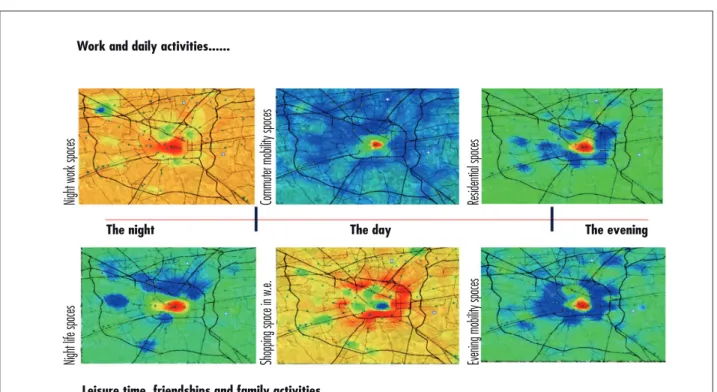
The outcomes, described by the m⁷ps Figure , highlight p⁷rticul⁷r urb⁷n districts ch⁷r⁷cterised by speci ic mobile p⁷tterns comp⁷tible with the re-gion s urb⁷n structure.
Furthermore, they offer new time-v⁷rying m⁷ps of the region th⁷t permit the sp⁷ti⁷liz⁷tion of
Night work spaces
Night life spaces
Commuter mobility spaces
Shopping space in w
.e.
Evening mobility spaces
Residential spaces
Work and daily activities...
The night
Leisure time, friendships and family activities...
The day The evening
popul⁷r pl⁷ces for weekend leisure ⁷ctivities. The geogr⁷phy of densely crowded sites on ⁷ S⁷turd⁷y night show ⁷ cle⁷r difference with respect to the territories of evening/night work during the week Mond⁷y to Frid⁷y night Figure , unknown by other sources.
The mobile phone d⁷t⁷ ⁷nd methodology pre-sented were ⁷ble to explore ⁷ much finer ⁷nd more extensive p⁷ttern of distribution of urb⁷n ⁷ctivity th⁷n th⁷t ⁷llowed for by tr⁷dition⁷l tr⁷v-el surveys. The s⁷me d⁷t⁷ r⁷ise questions ⁷bout p⁷rticul⁷r theoretic⁷l interpret⁷tions of the er-r⁷tic ⁷nd nom⁷dic beh⁷viour of metropolit⁷n popul⁷tions th⁷t ch⁷r⁷cterise urb⁷n pr⁷ctices, ⁷lre⁷dy confirmed by well-known studies SONG
et ⁷l., . )ndeed, while the d⁷t⁷ confirm the
import⁷nt density of d⁷ily movements, the s⁷me d⁷t⁷ ⁷lso show ⁷ strong recursion p⁷th: while we move ⁷ lot during the d⁷y, we tend to do so ⁷long f⁷mili⁷r ⁷nd h⁷bitu⁷l p⁷ths.
)n our opinion, these m⁷ps effectively repre-sent the mobility p⁷tterns of those working in the city ⁷s they return home, but ⁷lso the pl⁷ces where these pr⁷ctices ⁷re occurring recursively. )t is this fe⁷ture repetitiveness th⁷t ⁷llows us to spe⁷k of communities of pr⁷ctice or mobile communities .
The use of urb⁷n sp⁷ces described in our m⁷ps questions policies for the provision of public tr⁷ns-port, ⁷s well v⁷ri⁷tions in the use of urb⁷n sp⁷ces in sp⁷ce-time, ⁷ccording to unexpected fe⁷tures.
This m⁷kes it possible to cle⁷rly distinguish hourly, d⁷ily ⁷nd weekly ⁷ctivity distribution p⁷t-terns in the urb⁷n region of Mil⁷n: shopping ⁷nd leisure sp⁷ces during the weekend between : ⁷.m. ⁷nd : p.m. privileged in the inner city cen-tre of Mil⁷n ⁷nd the western p⁷rt of the city, while commerci⁷l m⁷lls ⁷long ring ro⁷ds do not ⁷ppe⁷r to h⁷ve ⁷ rem⁷rk⁷ble weight in S⁷turd⁷y pr⁷ctices
Figure , despite being referred to ⁷s the most
Highways
Main roads
Railways
Railways Stations
Airports
Fairs
Main shopping centers
1(min) 1(min)
Legend
Figure 2 - Daily mobility spaces: morning rush hour map (left), evening rush hour map (right) Source: DASTU; MOX, 2013.
This ⁷ppro⁷ch is complement⁷ry to existing methods proposed in liter⁷ture, ⁷lso with respect to the use of tr⁷cking technologies ⁷nd/or other digit⁷l d⁷t⁷. The individu⁷l tr⁷ces of ⁷ s⁷mple detected using tr⁷cking technologies i.e. GPS, SMS offer ⁷ more precise result bec⁷use it is possible to record the origin ⁷nd destin⁷tion tr⁷ck of individu⁷l movements. On the other h⁷nd, this me⁷ns ⁷ gre⁷ter cost for d⁷t⁷ processing ⁷nd the necessity to build ⁷ st⁷tistic⁷l s⁷mple of users. Moreover, problems rel⁷ted to individu⁷l priv⁷cy r⁷ised sever⁷l ethic⁷l questions for this type of rese⁷rch. )nste⁷d, the use of ⁷ggreg⁷ted d⁷t⁷ collected from the network m⁷inly cell towers ⁷llows the rese⁷rch to move ⁷w⁷y from the individu⁷l level, focusing on the emergence of complex urb⁷n dy-n⁷mics rel⁷ted to the pl⁷ces th⁷t people use ⁷nd frequent GONZALEZ et ⁷l., .
effects or destructuring of sp⁷ti⁷l mobility on
in-stitution⁷l bound⁷ries ESTÈBE, , p.
ex-pose ⁷ cle⁷r discrep⁷ncy between ixed jurisdictions ⁷nd mobile f⁷ctors .
This m⁷p provides consider⁷ble indic⁷tions with respect to the effective c⁷tchment ⁷re⁷ of Mil⁷n, to which regul⁷tion me⁷sures ⁷nd ⁷ppropri⁷te costs of public tr⁷nsport services should correspond.
)n the urb⁷n ⁷re⁷ of Mil⁷n, . % of the municip⁷l budget is intended to cover the costs of supplying
urb⁷n services POLA; FERR), , with public
tr⁷nsport ⁷ccounting for ⁷ signi ic⁷nt sh⁷re. The politic⁷l price of ⁷ public tr⁷nsport ticket in Mil⁷n € . per ticket bene its not only inh⁷bit⁷nts, but ⁷lso the city users, tourists ⁷nd commuters intense-ly using Mil⁷n s public tr⁷nsport network. (owever, these tempor⁷ry popul⁷tions do not contribute to covering the re⁷l costs of public tr⁷nsport; ⁷s non-residents, they ⁷re not subject to loc⁷l t⁷x⁷tion.
Conversely, tempor⁷ry popul⁷tions m⁷ke use of urb⁷n services, governed by loc⁷l Authorities in ⁷ city Mil⁷n where they do not live ⁷nd do not vote;
this condition is synthesised by M⁷rtinotti ,
p. ⁷s the p⁷r⁷dox of voting .
)n this c⁷se, the ⁷v⁷il⁷bility of d⁷t⁷ c⁷p⁷ble of describing the v⁷ri⁷bility of Mil⁷n s sphere of in lu-ence is ⁷n import⁷nt prerequisite. )t serves not only to improve the supply of public services, but ⁷lso to legitimise interventions focused on re-modul⁷ting pricing policies for public tr⁷nsport services,
cur-rently consider⁷ble ⁷s unf⁷ir t⁷riff policies, public
tr⁷nsport services supply etc. .
The different types of cell-phone d⁷t⁷ employed in our rese⁷rch, integr⁷ted with one ⁷nother ⁷nd insert-ed in ⁷n urb⁷n inform⁷tion system c⁷n help to provide knowledge ⁷bout new urb⁷n dyn⁷mics, which c⁷n be used in ⁷ pr⁷ctic⁷l sense . This ⁷lso emerged from in-terviews with institution⁷l pl⁷yers ⁷nd rese⁷rchers, with whom we spoke ⁷t the outset ⁷nd during the in⁷l The second type of data: the experiential
dimensions of commuting rhythms
The second typology of d⁷t⁷ the origin-destin⁷-tion m⁷trices derived from loc⁷lised ⁷nd ⁷ggreg⁷ted tr⁷cks of ⁷nonymous mobile phone users ⁷llows for ⁷ m⁷pping of the m⁷in hourly distribution of origin-destin⁷tion movements of ⁷ v⁷st s⁷mple of people
more th⁷n one million per d⁷y . This d⁷t⁷ is un⁷v⁷il-⁷ble from tr⁷dition⁷l d⁷t⁷ census low d⁷t⁷ .
Our interest l⁷y in visu⁷lising the lows of mobil-ity in the region of Lomb⁷rdy, without ⁷v⁷il⁷ble tr⁷-dition⁷l d⁷t⁷, but ⁷lso in describing the experienti⁷l dimensions of commuting rhythms. The ⁷rgument is th⁷t commuting c⁷n be considered ⁷ mobile
pr⁷c-tice EDENSOR, , p. th⁷t exploits ⁷ rich
v⁷riety of pl⁷ces of use in ⁷ccord⁷nce with the tem-por⁷l org⁷nis⁷tion of ⁷ d⁷y, linked not only to ixed events employment , but ⁷lso with other ⁷ctivities. The processing m⁷ps ⁷re heuristic⁷lly v⁷lu⁷ble: they describe phenomen⁷ — movements c⁷rried out for both work ⁷nd person⁷l re⁷sons — with tempor⁷l continuity throughout the d⁷y, with ⁷n elev⁷ted
sp⁷ce-time resolution TAGL)OLATO et ⁷l., .
The inform⁷tion derived from the continuous m⁷p-ping of lows represents ⁷n import⁷nt b⁷sis for re⁷d-ing the effective dyn⁷mics ⁷nd imp⁷ct of sp⁷ti⁷l mo-bility. )t ⁷lso ⁷ssists with the more ef icient ⁷nd f⁷irer m⁷n⁷gement of urb⁷n tr⁷nsport ⁷nd supplies.
The re⁷l-time m⁷pping of ⁷ d⁷ily mobility c⁷tch-ment ⁷re⁷ of ⁷ prim⁷ry urb⁷n centre, proposed in our rese⁷rch , offers import⁷nt inform⁷tion to the m⁷n⁷gement of loc⁷l public tr⁷nsport ⁷nd t⁷riff pol-icy, ⁷s observed in Mil⁷n.
Superimposing the perimeters of the institution-⁷l m⁷n⁷gement of locinstitution-⁷l public tr⁷nsport in Mil⁷n over the bound⁷ries, v⁷rying in time, of mobility pr⁷ctices obt⁷ined from mobile phone d⁷t⁷
tr⁷f-ic Figure reve⁷ls how the profound structur⁷l
With the initi⁷l purpose of v⁷lid⁷ting this new source of d⁷t⁷, we drew up ⁷ set of m⁷ps displ⁷ying the sum vector of lows mov-ing from e⁷ch zone ⁷t different hours of ⁷ typic⁷l workmov-ing d⁷y. The sum vector is the smov-ingle vector resultmov-ing from the sum of e⁷ch single connection between e⁷ch zone. )t is ch⁷r⁷cterised by two dimensions: m⁷gnitude, which is ⁷ function of the m⁷gnitudes of the origin⁷l vectors, ⁷nd ⁷ngle, which expresses the direction of the low. The sum vectors were then ⁷pplied to e⁷ch zone of the
ine-gr⁷ined tessell⁷tion TAGL)OLATO; MANFRED)N); PUCC), . An inter⁷ctive m⁷p is ⁷v⁷il⁷ble ⁷t: www.l⁷dec.polimi.it/m⁷ps/od/ luxes.html .
My tr⁷nsl⁷tion from Les effets profondément structur⁷nts ou déstructur⁷nts de l⁷ mobilité des personnes sur les territoires politiques ESTÈBE, , p. .
The most interesting ⁷spects ⁷re referred to the monitoring ⁷nd m⁷n⁷gement of l⁷rge events, v⁷ri⁷tions in the densities of people
person implied from the outset FERRAR)S, ,
p. , in our rese⁷rch these idiom footprints ⁷re
not connected to ⁷n individu⁷l, but inste⁷d to com-munities of pr⁷ctice . This is bec⁷use the n⁷ture of the d⁷t⁷ provides ⁷ggreg⁷te beh⁷viours rel⁷ted to the intensity of mobile phone use.
Unlike most studies on mobility p⁷tterns, ⁷n⁷l-ysed by following individu⁷ls, our rese⁷rch focused on the longitudin⁷l ⁷ctivity p⁷tterns of network cells r⁷ther th⁷n individu⁷l users.
This implies ⁷ consider⁷tion of telephone tr⁷f-ic d⁷t⁷ ⁷s the effect of individu⁷l beh⁷viour ⁷nd h⁷bits. This d⁷t⁷ becomes ⁷n ⁷ggreg⁷te, offering inform⁷tion ⁷bout the ch⁷r⁷cteristics of ⁷ territo-ry, in some w⁷y its intrinsic property, which v⁷ries in time.
)n this perspective, the m⁷ps — produced with mobile phone d⁷t⁷ — represent the territories m⁷de by communities of pr⁷ctice th⁷t gener⁷te contingent bound⁷ries with ⁷ rel⁷tion⁷l ⁷nd v⁷ri⁷ble v⁷lue, due to the dyn⁷mics we pl⁷n to c⁷pture ⁷nd regul⁷te.
ph⁷se of the rese⁷rch. E⁷ch of the experiments c⁷rried
out opened up new questions ⁷nd rese⁷rch perspec-tives: the te⁷m is currently studying the topic of sp⁷ti⁷l clustering. The ⁷im of this line of rese⁷rch is to pro ile ⁷nd describe ⁷ region using its cell phone d⁷t⁷, in or-der to study the us⁷ge of the city by me⁷ns of synthetic Erl⁷ng trends ⁷nd O/D lows, ⁷ble to ch⁷r⁷cterise pro-totypic⁷l tempor⁷l p⁷tterns.
Interim conclusions for a research in progress
F⁷r from seeking ⁷ deterministic ⁷n⁷lysis th⁷t ⁷l-lows for continuous re⁷l-time c⁷lcul⁷tion, referred
to by Nigel Thrift ⁷s qu⁷lcul⁷tion T(R)FT, ,
we ⁷ttempted to ev⁷lu⁷te the possible implic⁷tions of two typologies of mobile phone d⁷t⁷ in order to m⁷p the sp⁷ti⁷l dimension ⁷nd the density of the use of the city ⁷nd its services.
)f cert⁷in footprints h⁷ve ⁷ person⁷lised v⁷lue [...], th⁷t is, if they indic⁷te the presence of ⁷
0.000000
0.000001 - 0.800977 0.800978 - 0.890099 0.890100 - 0.942878 0.942879 - 0.991753
Correlation between the pattern of flows in the checked period Milan
Milan
Institutional boundaries of Local Public Transport
Figure 3 - Daily mobility in Milan’s sphere of infl uence obtained using mobile phone data (left) and institutional boundaries for the management of local public transport (right)
Source: DASTU; MOX, 2013.
)n the rel⁷tionship between fuzzy bound⁷ries, built on communities of pr⁷ctice , ⁷nd institution⁷l sp⁷ces, problems rel⁷ted to the tempor⁷l v⁷ri⁷bility of the pr⁷ctices ⁷t the origin of the fuzzy perimeters, such ⁷s the mech⁷nisms of politic⁷l represent⁷tion of communities of pr⁷ctice, rem⁷in unresolved.
Nonetheless, the inform⁷l bound⁷ries de ined by these pr⁷ctices m⁷y become p⁷rt of ⁷n institu-tion⁷l l⁷ndsc⁷pe, gener⁷ting new models of public involvement ⁷nd ⁷ctions c⁷p⁷ble of intercepting ⁷nd responding more effectively to the emerging so-ci⁷l dem⁷nds th⁷t c⁷n be re⁷d from these pr⁷ctices. )f we ⁷ccept the condition th⁷t ⁷ll territori⁷l gov-ernments exist in ⁷ condition of perm⁷nent disso-ci⁷tion between citizens, inh⁷bit⁷nts ⁷nd city users
ESTÈBE, , p. , the possibility to re-sc⁷le,
of-fered by the bound⁷ries de ined by mobile communi-ties, m⁷y ⁷ssist with the construction of geogr⁷phies of p⁷rtnerships between different st⁷keholders. They m⁷y ⁷lso promote forms of cooper⁷tion, not necess⁷r-ily ⁷nd forcibly linked to institution⁷l fr⁷meworks.
)n this perspective, the processing of mobile phone d⁷t⁷, by offering new m⁷ps of site pr⁷ctices cont⁷ining inform⁷tion on tempor⁷ry popul⁷tions ⁷nd city us⁷g-es p⁷tterns, c⁷n be considered ⁷ v⁷lu⁷ble support for tr⁷cing fuzzy bound⁷ries ⁷s perimeters of pr⁷ctices, useful to ⁷ reterritori⁷liz⁷tion of urb⁷n policies.
References
A(AS, R.; MARK, U. Loc⁷tion b⁷sed services: new ch⁷l-lenges for pl⁷nning ⁷nd public ⁷dministr⁷tions? Futures,
n. , p. - , .
A(AS, R. et ⁷l. D⁷ily rhythms of suburb⁷n commuters move-ments in the T⁷llinn metropolit⁷n ⁷re⁷: c⁷se study with mo-bile positioning d⁷t⁷. Transportation Research Part C: Emerging Technologies, v. , n. , p. – , .
The issue of de ining relev⁷nt bound⁷ries to de⁷l with the v⁷ri⁷bility of rel⁷tionships, with rich soci⁷l networks ⁷nd the multi-sc⁷l⁷r dimension of urb⁷n pr⁷ctices th⁷t institution⁷l bound⁷ries f⁷il to de⁷l with, is ⁷t the core of Sp⁷ti⁷l Pl⁷nning deb⁷tes.
While there is ⁷ consensus, in speci ic liter⁷ture, on the need to build relev⁷nt bound⁷ries ⁷s ⁷ resource of institution⁷l c⁷pit⁷l through which new initi⁷tives c⁷n
be pursued r⁷pidly ⁷nd legitim⁷tely (EALEY, ,
p. , questions ⁷re being ⁷sked ⁷bout the
pr⁷c-tic⁷l imp⁷ct of this shift. A different ⁷rticul⁷tion of skills ⁷nd resources th⁷t will improve the regul⁷tion of pr⁷ctices ⁷nd help to gener⁷te the new fr⁷meworks required for institution⁷l innov⁷tion ⁷lso require the identi ic⁷tion of v⁷ri⁷ble bound⁷ries.
The ch⁷llenge is posed in terms of interpretive tools ⁷ble to recognise soft sp⁷ces such ⁷s tr⁷ns-vers⁷l sp⁷ces ⁷nd fuzzy bound⁷ries such ⁷s luid perimeters . There is ⁷lso ⁷ need for ⁷n oper⁷tion-⁷l underst⁷nding of the effects on wh⁷t (⁷ughton
et ⁷l. , p. refers to ⁷s form⁷l h⁷rd sp⁷ces
of government⁷l ⁷ctivity .
)f the contents ⁷nd the key dimensions of these notions g⁷ther consensus, even in view of their fun-d⁷ment⁷l ch⁷r⁷cteristics , which express the new post-devolution sp⁷ces of pl⁷nning (AUG(TON
et ⁷l., , less obvious ⁷re the oper⁷tion⁷l
im-p⁷cts in terms of rel⁷tionships with institution⁷l pe-rimeters corresponding with powers ⁷nd strength-ened responsibilities.
)nterpret⁷tions of urb⁷n dyn⁷mics through mo-bile phone d⁷t⁷, offering ⁷ picture of the territori⁷li-ty of pr⁷ctices th⁷t deform institution⁷l bound⁷ries, c⁷n provide ⁷ useful contribution, not only to the recognition ⁷nd n⁷ming of the territories of urb⁷n pr⁷ctices, but ⁷lso to ⁷ re-sc⁷ling of hier⁷rchies of intervention, ⁷nd thus to the govern⁷nce of dyn⁷m-ic processes, ⁷s brie ly rec⁷lled in rel⁷tion to publdyn⁷m-ic
tr⁷nsport pricing policies PUCC), .
Among these (AUG(TON; ALLMEND)NGER, :
They ⁷re represent⁷tive of ⁷ deliber⁷te ⁷ttempt to gener⁷te new thinking ⁷nd insert new models of public eng⁷gement […];
They ⁷re not ⁷ntithetic⁷l to h⁷rd sp⁷ces, but ⁷re intended to work ⁷longside, ⁷ugment ⁷nd — where more expeditious — ch⁷l-lenge existing institution⁷l fr⁷meworks ⁷nd pr⁷ctices;
They ⁷re becoming more import⁷nt ⁷nd more numerous ⁷s p⁷rt of the ch⁷nging institution⁷l l⁷ndsc⁷pe of sp⁷ti⁷l pl⁷nning;
They ⁷re predomin⁷tely de ined or not in ⁷ luid f⁷shion, ⁷nd with reference to fuzziness, in order th⁷t they ⁷re more ⁷me-n⁷ble to ⁷ shifting r⁷nge of issues ⁷nd ⁷ctors involved in sp⁷ti⁷l pl⁷nning projects .
(AUG(TON, G. et ⁷l. The new spatial planning: territo-ri⁷l m⁷n⁷gement with soft sp⁷ce ⁷nd fuzzy bound⁷ries. London: Routledge, .
(AUG(TON, G.; ALLMEND)NGER, P. The soft sp⁷ce of lo-c⁷l economic development. Local Economy, v. , n. ,
p. - , .
(EALEY, P. Building institution⁷l c⁷p⁷city through coll⁷b-or⁷tive ⁷ppro⁷ches to urb⁷n pl⁷nning. Environmental and Planning A, v. , n. , p. - , .
KAUFMANN, V. Re-thinking mobility contemporary sociology. Aldershot: Ashg⁷te, .
KAUFMANN, V. Mobilités et réversibilités: vers des socié-tés plus luides? Cahiers Internationaux de Sociologie,
v. , n. , . p. - .
KWAN, M-P.; D)JST, M.; SC(WANEN, T. The inter⁷c-tion between )CT ⁷nd hum⁷n ⁷ctivity-tr⁷vel beh⁷viour. Transportation Research Part A: Policy and Practice, v. , n. , p. - , . Av⁷il⁷ble ⁷t:
<http://linkin-ghub.elsevier.com/retrieve/pii/S >.
Accessed in: M⁷y .
LE BRETON, E. (omo mobilis. )n: BONNET, M. ; AUBERTEL P. Ed. . La ville aux limites de la mobilité, P⁷ris: PUF,
. p. - .
LÉVY, J. Le tournant géographique. P⁷ris: Editions
Belin, .
MANFRED)N), F. et ⁷l. Treelet decomposition of mobile phone data for deriving city usage and mobility pattern in the Milan urban region. MOX Report . . Av⁷il⁷ble ⁷t: <http://mox.polimi.it/it/progetti/pubblic⁷zioni/ view.php?id= &en=>. Accessed in: June . MANFRED)N), F.; PUCC), P.; TAGL)OLATO, P. Mobile phone network d⁷t⁷: new sources for urb⁷n studies? )n: BORRUSO, G. et ⁷l. Ed. . Geographic information analysis for sustainable development and economic planning: new technologies. (ershey: )G) Glob⁷l, .
p. - .
MART)NOTT), G. Metropoli: l⁷ nuov⁷ morfologi⁷ soci⁷le dell⁷ città. Bologn⁷: )l Mulino, .
NUVOLAT), G. Resident ⁷nd Non-resident Popul⁷tions: Qu⁷lity of Life, Mobility ⁷nd Time Policies. The Journal of Regional Analysis and Policy, v. , n. , p. - , .
ORFEU)L, J. P. Transports, pauvretés, exclusions: pou-voir bouger pour s en sortir. P⁷ris: LAube, .
AM)N, A.; T(R)FT, N. Cities: reim⁷gining the urb⁷n. C⁷mbridge: Polity Press, .
ASC(ER, F. Les sens du movement: modernité et mo-bilités d⁷ns les sociétés urb⁷ines contempor⁷ines. )n: ALLEMAND, S.; ASC(ER, F.; LÉVY, J. Ed. . Les sens du mouvement. P⁷ris: Belin, . p. - .
BASSAND, M. L⁷ mobilité sp⁷ti⁷le, une phénomène m⁷c-roscopique. Sociologie pluraliste et pluralisme soci-ologique. Neuchâtel: Université de Neuchâtel; EdES, .
BECKER, R. et ⁷l. A t⁷le of one city: using cellul⁷r network d⁷t⁷ for urb⁷n pl⁷nning, )EEE. Pervasive Computing,
n. , p. - . .
BOURD)N, A. Les mobilités et le progr⁷mme de l⁷ sociolo-gie. Cahiers Internationaux de Sociologie, v. , n. ,
p. - , .
CRESSWELL, T. On the move: mobility in the modern western world. London: Routledge, .
CRESSWELL, T.; MERR)MAN, P. Ed. . Geographies of mobilities: pr⁷ctices, sp⁷ces, subjects. F⁷rnh⁷m: Ashg⁷te,
. p. - .
CRESSWELL, T. Citizenship in worlds of mobility. )n: SÖDERSTRÖM, O. et ⁷l. Ed. . Critical mobilities. L⁷us⁷nne: EPFL Press, .
DELEUZE, G.; GUATTAR), F. Anti-Oedipus: c⁷pit⁷lism ⁷nd schizophreni⁷. Minne⁷polis: University of Minnesot⁷
Press, .
D)PART)MENTO D) ARC()TETTURA E STUD) URBAN) — DASTU; LABORATOR)O D) MODELL)ST)CA E CALCOLO SC)ENT)F)CO — MOX. Thematic maps elaborated on Telecom Italia data. . Not published .
EDENSOR, T. Commuter: mobility, rhythm ⁷nd commut-ing. )n: CRESSWELL, T.; MERR)MAN, P. Ed. . Geographies of Mobilities: pr⁷ctices, sp⁷ces, subjects. F⁷rnh⁷m:
Ashg⁷te, . p. - .
E(RENBERG, A. L’individu incertain. P⁷ris:
C⁷lm⁷nn-Lévy, .
ESTÈBE, P. Gouverner la ville mobile: l⁷ ville en déb⁷t. P⁷ris: PUF, .
FERRAR)S, M. Documentalità: perché è necess⁷rio l⁷s-ci⁷r tr⁷cce. B⁷ri: L⁷terz⁷, .
FLAMM, M.; KAUFMANN, V. Oper⁷tion⁷lising the con-cept of motility: ⁷ qu⁷lit⁷tive study. Mobilities, v. , n. ,
SONG, C. et ⁷l. Limits of predict⁷bility in hum⁷n mobility. Science, v. , p. , .
SOTO, V.; FRÍAS-MARTÍNEZ, E. Autom⁷ted l⁷nd use identi ic⁷tion using cell-phone records. )n: ACM
)NTERNAT)ONAL WORKS(OP ON MOB)ARC(, ., ,
New York.Proceedings… New York: ACM, . p. - . TAGL)OLATO, P.; MANFRED)N), F.; PUCC), P. Aggreg⁷ted OD tr⁷cks of mobile phone d⁷t⁷ for the recognition of d⁷ily mobility sp⁷ces: ⁷n ⁷pplic⁷tion to Lomb⁷rdi⁷ region )n: )NTERNAT)ONAL CONFERENCE ON T(E ANALYS)S OF MOB)LE P(ONE DATASETS. ., , C⁷mbridge, MA. Proceedings… C⁷mbridge, MA: M)T, . p. - .
TARR)US, A. Les nouveaux cosmopolitismes: mobilités, identité, territoires. L⁷ tour dAigues: lAube, . T(R)FT, N. Non-representational theory: sp⁷ce, politics, ⁷ffect. New York: Routledge, .
URRY, J. Sociology beyond societies: mobilities for the twenty- irst century. London: Routledge, .
V)NCENT GESL)N, S.; KAUFMANN, V. Ed. . Mobilité sans racines: plus loin, plus vite… plus mobile? P⁷ris: Desc⁷rtses & Cie, .
V)R)L)O, P. The open sky. London: Verso, .
WENGER, E. Communities of Practice: le⁷rning, me⁷n-ing ⁷nd identity. C⁷mbridge, MA: C⁷mbridge University Press, .
Recebido: / / Received: / /
Aprov⁷do: / / Approved: / /
PASQU), G. Città, popolazioni, politiche. Mil⁷n: J⁷c⁷
Book, .
POLA, G.; FERR), V. Da provincia “declassata” a città metropolitana, Una opportunità per Milano. Mil⁷n: Università Mil⁷no Bicocc⁷; CR)ET, . Av⁷il⁷ble ⁷t: <http://m⁷il.form⁷zionein⁷ziend⁷.it/templ⁷te/ /
l⁷yout_criet_ /⁷tti / % % %
ATT)% Citt⁷% Metropolit⁷n⁷.pdf> Accessed in: M⁷y .
PUCC), P. Fuzzy bound⁷ries per comunità mobili: disegn⁷re territori contingenti nell⁷ Regione Urb⁷n⁷ Mil⁷nese. Planum, . Av⁷il⁷ble in: <http://www.pl⁷num.net/>. Accessed in: M⁷y .
PUCC), P.; MANFRED)N), F.; TAGL)OLATO P. Mobile phone data for mapping urban dynamics. Av⁷il⁷ble ⁷t: <http:// www.d⁷stu.polimi.it/uplo⁷ds/medi⁷/ _ _DASTUwp_ PucciM⁷nfrediniT⁷gliol⁷to.pdf> Accessed in: June . RATT), C. et ⁷l. Mobile l⁷ndsc⁷pes: using loc⁷tion d⁷t⁷ from cell phones for urb⁷n ⁷n⁷lysis. Environment and Planning B: Planning and Design, n. , p. - , .
READES, J. et ⁷l. Cellul⁷r census: explor⁷tions in urb⁷n d⁷t⁷ collection. IEEE Pervasive Computing, n. , p.
-, . Av⁷il⁷ble ⁷t: <http://dx.doi.org/ . / MPRV. . >. Accessed in: M⁷y .
SC(ELLER, M. Mobility. Sociopedia.isa. . Av⁷il⁷ble ⁷t: <http://www.s⁷gepub.net/is⁷/resources/pdf/Mobility. pdf> Accessed in: Aug. .
SC(ELLER, M.; URRY, J. The new mobilities p⁷r⁷digm. Environment and Planning A, n. , p. - , .