Vol. 34, No. 03, pp. 821 – 830, July – September, 2017 dx.doi.org/10.1590/0104-6632.20170343s20160040
* To whom correspondence should be addressed
ELECTROFLOTATION OF PRECIPITATED
PHOSPHATE FROM SYNTHETIC SOLUTION
S. G. da Cruz
1*, M. B. de M. Monte
2and A. J. B. Dutra
11Metallurgical and Materials Engineering Program, PEMM/COPPE, Federal University of Rio de Janeiro, P.O. Box 68.505, Rio de Janeiro-RJ, Brazil.
2Vale Technology Institute (ITV Mining), Ouro Preto, Brazil. *E-mail: [email protected]; Phone: +55 21 39388548
(Submitted: January 20, 2016; Revised: April 13, 2016; Accepted: May 10, 2016)
ABSTRACT – The phosphate recovery from a 20 mg L-1 Na2HPO4 solution through precipitation with Ca(OH)2 followed
by electroflotation was evaluated. X-ray diffraction and particle size measurements indicated that the precipitates were a mixture of hydroxyapatite and calcium-deficient hydroxyapatite, with size ranging from 3 to 10 mm. Electroflotation with Na-oleate as surfactant was used to recover the precipitates. The surfactant adsorption was evaluated through zeta potential measurements. The influence of Na-oleate concentration, pH and bubble size on phosphate recovery was investigated. In the absence of Na-oleate, a phosphate recovery of 50% was achieved, while in the presence of 20 mg L-1 of Na-oleate it was increased to 90%, at pH 11. The phosphate recovery also increased with Ca(OH)2 concentration
increase and bubble size decrease, reaching 100% at 300 mg L-1 Ca(OH)2 and bubble size around 39 µm.
Keywords: Phosphate recovery, precipitation, electroflotation.
INTRODUCTION
Industrial and agricultural expansion currently demands a growing exploitation of phosphorus sources in the environment to supply human needs. This wide utilization of phosphates leads to a considerable amount of phosphorus-containing wastes being discharged into water bodies, demanding previous treatment to avoid eutrophication. Additionally, rainwater can wash the soil, removing phosphate fertilizers which can exacerbate still further the eutrophication issue, a phenomenon characterized by algae overpopulation and the rapid growth of aquatic plants, which impair the penetration of light in the water, thus reducing photosynthesis reactions and, consequently, the amount of dissolved oxygen in
the water, suffocating aquatic animals and converting the
water body into an open sewer (Hosni et al., 2008). Thus, the development of phosphorus management strategies in
the environment has been considered an important issue for quality of life support, leading to the search for new technologies to recover this element (Cordell et al., 2009),
offering opportunities for its recycling, and contributing
to phosphorus sustainability (Morse et al., 1998). At the present time, chemical and biological processes are the most used for phosphate removal from wastewaters. Among the biological processes, activated sludge is considered the
most versatile and efficient, while among the chemical
processes, precipitation through the use of aluminum, iron and calcium salts has been widely employed (Jenkins and Ferguson, 1971; Morse et al., 1998). Aluminum and iron salts present the disadvantage of generating sludge, which cannot be reused or reclaimed (Urano and Tachikawa, 1991). This problem does not occur with calcium salts, as they react with phosphate to generate precipitates such as hydroxyapatite, monetite, brushite and amorphous calcium phosphate, among others, which are compounds normally
of Chemical
exploited in phosphate rock mining for fertilizer production and present the potential for reuse and recycling. However,
calcium phosphate precipitates are difficult to settle, requiring the use of flocculants (Liu and Chang, 2009).
Thus, there is a need to employ other solid/liquid separation
techniques, such as flotation, which is a well established
technique for minerals separation and is also commercially used for wastewater treatment (Hoseinian et al., 2015; Matis, 1995; Rubio et al., 1996; Rubio, 1998a,b; Rubio et al., 2002; Voronin and Dibrov, 1999). This technique is
based on the different hydrophobicity of the particles to
be separated. Thus, hydrophobic particles can be captured
by gas bubbles and float to the liquid surface. To be effective, flotation requires the use of surfactants to render the particle surface more hydrophobic. The efficiency of
this process depends on the probability of particle–bubble collision and attachment. For small particles there is a need for small bubbles such as those produced by dissolved air
flotation or by electrolysis, which produce even smaller
bubbles (Venkatachalam et al., 1992; Burns et al., 1997).
Electroflotation is a process where particulate matter and/ or polluting substances are floated through their adhesion
on tiny hydrogen and oxygen (and other gases, depending on the electrolyte) bubbles generated electrolytically as a result of water decomposition. The application of this
technique to ore fines recovery has been the object of
investigation since 1946 (Miettinen et al., 2010). Bhaskar
Raju and Khangaonkar (1984) studied the electroflotation of chalcopyrite ultrafines (~4 μm) in a modified Hallimond
tube with platinum anodes and copper cathodes. The authors observed that electrolytically generated bubbles
rendered better floatability (~81.3%) compared to the floatability with an oxygen cylinder in a conventional Hallimond tube (~39.1%). Ketkar et al. (1991) studied the electroflotation of fine and ultrafine quartz particles (<20 mm) in a modified Hallimond tube, with a stainless steel
cathode and platinum as anode, and reported a recovery of 94% of the particles. Sarkar et al. (2010) compared the
flotation of silica ultrafines (~13 μm) in a Denver flotation
cell using both air and hydrogen as the sparged gases with
an electroflotation cell, and reported that much higher recoveries (~95%) were achieved when the electroflotation
cell was used.
The feasibility of electroflotation applied to water and
industrial wastewaters treatment has been demonstrated by several authors (Aoudj et al., 2015; Casqueira et. al., 2006; Nahui et al., 2008; Vu et al., 2014); however, there is little
information in the literature about the use of electroflotation
for phosphate recovery from aqueous solutions. Vlyssides et al. (2002) studied the electrolytic treatment of domestic wastewater with an electrolytic cell with a Ti/Pt anode and an AISI 304 stainless steel cathode. The authors reported that the phosphate concentration decreased by 98% of its initial value (17.5 mg L-1) in 60 minutes.
The electrocoagulation process has already reported by several authors as an alternative wastewater treatment
(Brahmi et. al, 2015a,b; Bouguerra et al, 2015a,b;
Kuokkanen et al., 2015). The main difference between electrocoagulation and electroflotation lies in the electrode
type. In electrocoagulation soluble anodes of aluminum or iron are used, while insoluble anodes, such as RuO2 coated
titanium, are used in electroflotation. The technique used
in this study has the advantage of generating more and smaller bubbles than those generated by electrocoagulation (Chen, 2003). Furthermore, electrocoagulation generates a more complex sludge, with aluminum or iron hydroxides,
turning its reuse and recycling more difficult.
Considering the need for alternative treatments to recover phosphate from wastewaters and the success
of flotation for apatite separation from other minerals,
the objective of this paper was to assess the viability of recovering phosphate from a dilute synthetic solution, simulating a polishing stage of a municipal sewage treatment station by precipitation with calcium hydroxide
followed by electroflotation.
MATERIALS AND METHODS
Calcium phosphate precipitate was obtained from a synthetic solution with 20 mg L-1 of Na2HPO4 and 50
mg L-1 of Ca(OH)2. The precipitating agent Ca(OH)2
concentration range was previously determined through a Jar test equipment. The precipitate was analyzed by
X-ray diffraction (Shimadzu model XRD-6000), with CuKα radiation. The zeta potential was determined with
a Zetasizer Nano Series (Nano-ZS). The particle size of the precipitate and the average bubble diameter were determined with a Malvern Instruments Mastersizer 2000SM capable of analyzing particles with diameters between 0.1–2000 µm.
The average bubble diameter was determined with the help of a specially designed acrylic cylindrical cell
with a volume of 1 liter, to fit in a Malvern Instruments
Mastersizer 2000SM device. The cathode was a stainless steel mesh and the anode an RuO2 coated titanium grid. A constant electrical current was applied to the electrodes
using a DC power supply. The influence of pH and current
density on the bubble diameter in a 0.1 mol L-1 NaCl
solution was evaluated.
Electroflotation tests were carried out in a 1-liter
volume acrylic cell, with an AISI 316 stainless steel cathode and RuO2 coated titanium as anode, as shown in Figure 1. A cathode–anode potential of 3.5 V, producing a cathodic current density of 6.25 mA cm-2, was used
in all the electroflotation experiments. Sodium oleate (CH3(CH2)7CH=CH(CH2)7COO−Na+) was used as
surfactant for the phosphate precipitate.
The influence of Na-oleate concentration, pH, calcium
hydroxide concentration and bubble size on the phosphate recovery and on the zeta potential of the precipitate was
was 20 mg L-1 of Na2HPO4, 50 mg L-1 of Ca(OH)2 and
0.1 mol L-1 NaCl as electrolyte with 0.1 mol L-1 HCl or
NaOH as pH regulators. All reagents used were obtained from VETEC and were analytical grade.
For each experiment, a phosphate solution with
a definite concentration of Ca(OH)2 was fed into the
electroflotation cell. After 20 minutes the phosphate
concentration of the residual solution was determined by the photometric method (HI 83099, HANNA Instruments).
RESULTS AND DISCUSSION
Precipitate characterization.
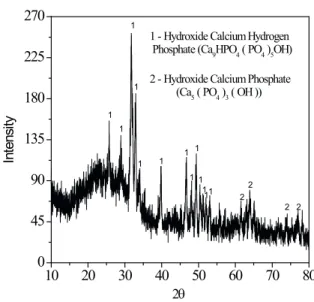
The X-ray diffractogram of the precipitate obtained
from a solution containing 20 mg L-1 of Na2HPO4 and
50 mg L-1 of Ca(OH)2 at pH 11 is presented in Figure
2. It can be observed that the precipitate is composed of a mixture of hydroxyapatite [hydroxide calcium phosphate, Ca5(PO4)3(OH)] and a calcium-deficient hydroxyapatite [hydroxide calcium hydrogen phosphate Ca9HPO4(PO4)5OH] which is a non-stoichiometric hydroxyapatite. According to some authors (Abbona et al., 1986; Musvoto et al., 2000; Liu et al., 2009), hydroxyapatite precipitation starts at pH> 5; however, the precipitation reaction kinetics is not favored and other species, such as amorphous calcium phosphate, octacalcium phosphate and brushite, act as precursors of the hydroxyapatite precipitation. Gray and Schwab (1993) reported that calcium phosphate precipitation is almost complete at pH values higher than 9.8. A convenient method to classify the calcium phosphates is through their [Ca]:[P] molar ratio, which ranges from 0.5 to 2.0. The stoichiometric hydroxyapatite has a [Ca]:[P] molar ratio 1.67, while this molar ratio for non-stoichiometric hydroxyapatite can be
1.5 ≤ [Ca]:[P] < 1.67 (Stoia et al., 2008). Zawacki et al.
(1990) proposed a two-step mechanism for the precipitation
of calcium-deficient hydroxyapatite, as shown in the
reactions 1 and 2:
Precipitation of amorphous calcium phosphate
9Ca2+ + 6PO43- → Ca9( PO4)6 .nH2O
Hydrolysis of
PO43-PO43- + H2O → HPO42- +
OH-resulting in the final product (Ca10-x(HPO4)x(PO4)6-x(OH)2-x), 0< x ≤1. For X=1, [Ca]:[P]=1.5, the product
found was hydroxide calcium hydrogen phosphate,
Ca9(HPO4)(PO4)5OH, as shown in the diffractogram of
Figure 2.
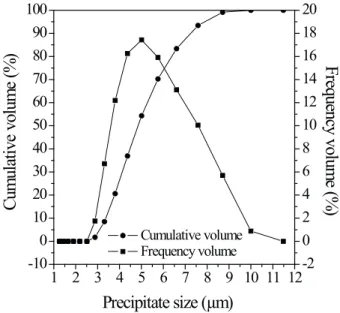
The precipitate size distribution is presented in Figure 3. Among the information generated by the particle size analyzer is the cumulative curve that corresponds to the result accumulated below a given diameter, and the frequency characteristic curve is represented in the chart by the curve with a peak obtained by derivation of the cumulative curve. It can be observed that 10% of precipitates in the sample have diameters below 3 mm, 50% of precipitates in the sample have diameters below 5 mm (generally regarded as the average particle size of the sample) and 90% of precipitates in the sample have diameters below 8 mm, a size small enough to justify the
use of electroflotation to recover the phosphates, since this
technique produces bubbles smaller than those produced
in the regular flotation process or even in dissolved air flotation.
Figure 1. Schematic of the electroflotation system: (a) DC power source; (b) electroflotation cell; (c) electrodes.
10 20 30 40 50 60 70 80
0 45 90 135 180 225 270
2 2 2 2 1 1 1 1 1
1 1 1 1 1 1
1
1 - Hydroxide Calcium Hydrogen Phosphate (Ca9HPO4 ( PO4 )5OH) 2 - Hydroxide Calcium Phosphate (Ca5 ( PO4 )3 ( OH ))
2θ
In
tens
ity
1
1
Figure 2. Precipitate X-ray diffractogram obtained from a solution
containing 20 mg L-1 of Na2HPO4 and 50 mg L-1 of Ca(OH)2 at pH 11.
(1)
Effect of sodium oleate on the phosphate recovery
The effect of Na-oleate concentration on the phosphate recovery by electroflotation and on the zeta potential of
the precipitate particles is presented in Figure 4. It can be observed that, in the absence of Na-oleate, a phosphate recovery of 50% was achieved. The precipitates formed are sparingly soluble species, hydrophilic and with an average
diameter around 5.5 μm. Therefore, it is suggested that the
phosphate recovery is a function of entrainment (Warren, 1985). According to this author, in the entrainment mechanism there is no discrimination between hydrophobic and hydrophilic particles. This phenomenon occurs when the particles enter the base of the froth column suspended in the water occupying the spaces between the bubbles. Some of the inter-bubble water and some of the larger particles are drained back into the pulp, but the remainder is carried upwards and is ultimately recovered in the concentrate. The
finer the particle (<10 µm), the more likely it is to remain
suspended in the inter-bubble water and to be recovered
by entrainment rather than by true flotation, a process that
occurs only with hydrophobic particles.
In the presence of Na-oleate, it is possible to observe an increase of phosphate recovery in the range of less concentrated surfactant (2–20 mg L-1) and a decrease of
phosphate recovery for concentrations above 20 mg L-1.
The zeta potential of the precipitate is around -7 mV in the absence of Na-oleate. In the presence of Na-oleate, it can be observed that the zeta potential of the precipitate assumes more negative values in the concentration range studied, as shown in Figure 4B, which suggests the surfactant adsorption on the precipitate. According to the oleate adsorption isotherm on apatite reported by Lu et al. (1998), in the less concentrated range of Na-oleate (2–20 mg L-1), the adsorption occurs by means of
a chemisorption mechanism: the interaction between the dissociated ions (Ol- (CH3(CH2)7CH=CH(CH2)7COO-) and Ol22-) of the oleate with the precipitate surface cations (Ca2+ e CaOH+), forming hemimicelles and rendering the surface hydrophobic. This kind of chemical interaction is
a specific adsorption, and therefore of difficult desorption, which justifies the increase of phosphate recovery in this
concentration range, achieving the maximum recovery of 90% in the presence of 20 mg L-1 of Na-oleate.
In the more concentrated range, the adsorption occurs due to the surface precipitation mechanism. The interaction of the oleate ions with the surface cations leads to the formation of insoluble salts at the surface of the precipitate (hydroxyapatite). This interaction can be
represented by a specific reaction between the surface
cations of the precipitate and the Ol- anionic groups of the surfactant, forming calcium oleate on the precipitate surface. In this type of mechanism, the adsorption is weak once the calcium oleate is attached to the mineral surface by attractive Van der Waals forces, and therefore of
1 2 3 4 5 6 7 8 9 10 11 12 -10 0 10 20 30 40 50 60 70 80 90 100 Cumulative volume Frequency volume
Precipitate size (µm)
C
um
ul
at
ive
vo
lum
e (
%
)
-2 0 2 4 6 8 10 12 14 16 18 20F
re
que
nc
y v
ol
um
e (
%
)
Figure 3. Precipitate size distribution obtained from a solution containing 20 mg L-1 of Na2HPO4 and 50 mg L-1 of Ca(OH)2 at pH 11.
0 20 40 60 80 100 120 140 160
-50 -40 -30 -20 -10 0 10 B
Z
eta
p
o
te
n
tia
l (
m
V
)
Na-oleate concentration (mg L
-1)
0 20 40 60 80 100 120 140 160
40 50 60 70 80 90 100
P
ho
sph
at
e r
ec
ov
er
y
(
%
)
Na-oleate concentration (mg L
-1)
A
easy desorption, justifying the decrease of the phosphate recovery in this concentration range. Furthermore, some studies (Antti and Forssberg, 1989; Hanumantha Rao et al., 1990; Hanumantha Rao and Forssberg, 1991) have reported that in pH 11 the oleate adsorption isotherm on the apatite surface corresponds to the formation of an oleate bilayer on the same surface. The second layer of surfactant is formed by the bond between the two hydrocarbon chains of the reagent, leaving the polar head groups toward the water solution and rendering the precipitate surface again hydrophilic, causing a decrease of the phosphate recovery. It can be concluded that, in the more concentrated range,
the floatability of precipitated hydroxyapatite decreases
as a result of oleate dimer adsorption and precipitation of CaOl2.
Effect of pH on the phosphate recovery
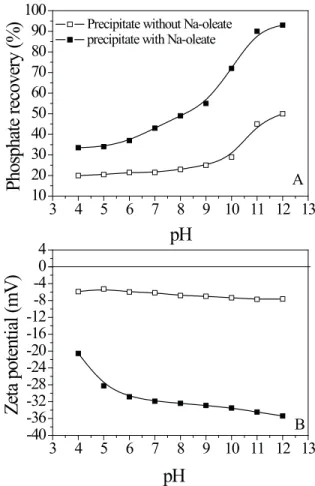
The effect of pH on the phosphate recovery and on the
zeta potential of precipitated hydroxyapatite in the absence and in the presence of Na-oleate is presented in Figure 5. It can be observed that, in the absence of Na-oleate, the phosphate recovery was possible at high pH, being increased from 20% to 50% when the pH is increased from 4 to 12. This increase can be attributed to the stability of hydroxyapatite at high pH. Diagrams of the total calcium and total phosphorus concentration as a function of pH for hydroxyapatite, as described by Chander and Fuerstenau
(1979), confirm that the solubility of the hydroxyapatite
decreases with the pH increase, which can contribute to the increasing phosphate recovery as a function of entrainment.
In the presence of Na-oleate an increase of the phosphate recovery in the whole pH range studied was observed. This increase can be attributed to the adsorption of Na-oleate on the precipitate surface and, with that, the phosphate
recovery can become a function of the true flotation.
In Figure 5B, it can be observed that, in the absence of surfactant, the zeta potential of the precipitate is negative in the whole pH range, due to the prevalence of negatively charged species in the Stern layer of the electrical double layer of hydroxyapatite, as proposed by Vucinic et al. (2010). In the presence of 20 mg L-1 Na-oleate, the
precipitate charge became more negative in the whole pH range studied.
According to the distribution diagram of phosphoric acid, the predominant species in the solution are H2PO4- ions in the pH range from 2.4 to 7.2, HPO42- ions from 7.2 to 12, and PO43- ions above pH 12. With regard to calcium, Ca2+ ions are the main species up to pH 12.5. The monohydroxy complex CaOH+ is present in notable concentrations above pH 11, while calcium hydroxide precipitates above pH 13.3 (Somasundaran et al., 1985).
Vucinic et al. (2010) evaluated the electrokinetic properties of hydroxyapatite and presumed that the surface ions Ca2+, PO43- and OH- are the species that participate
in the surface reactions, similar to those reactions that occur in the bulk.
According to the distribution diagram of oleate (Somasundaran et al., 1999), the predominant species below pH 5 are neutral acid molecules (HOl). In the pH range from 5 to 9, oleate ions (Ol-) and ion-molecule complexes H(Ol)-2 are the dominant species, whereas at pH >9 the dominant ions are Ol- and dimers Ol22-. Based on the distributions of the species mentioned above, in the pH range from 4 to 6, the increase in the negative zeta potential of the precipitate indicates the chemisorption of oleate ions and neutral molecules, oriented with head groups toward the solid, and with hydrocarbon chains toward the water solution, forming hemimicelles and rendering the
surface hydrophobic, and therefore more floatable (Nunes
et al., 2011; Vucinic et al., 2010). In the pH range from 7 to 9, the oleate ions and the ion molecule complex, oriented with head groups toward the solid and associated due to the chain–chain interaction into hemimicelles make the precipitate surface more hydrophobic and
more floatable (Vucinic et al., 2010). The maximum zeta potential difference with and without Na-oleate addition
3 4 5 6 7 8 9 10 11 12 13
-40 -36 -32 -28 -24 -20 -16 -12 -8 -4 0 4
Z
eta
p
ote
ntia
l (
m
V
)
pH
3 4 5 6 7 8 9 10 11 12 13
10 20 30 40 50 60 70 80 90 100
Precipitate without Na-oleate precipitate with Na-oleate
P
ho
sph
at
e r
ec
ov
er
y (
%
)
pH
B A
was observed above pH 10. This can be attributed to the adsorption of oleate ions, dimers, as well as OH- on the precipitate surface. It is believed that the high phosphate recovery above pH 10 can be explained by the formation of the monohydroxy complex (CaOH+), which adsorbs on the negatively charged precipitate, forming reactive sites available for the surfactant adsorption and allowing
an increase of the floatability of minerals. Therefore, the
phosphate recovery around 90% can be explained by the adsorption of oleate ions and dimers at the positive surface sites of the negatively charged precipitate surface.
Effect of the calcium hydroxide concentration on the phosphate recovery
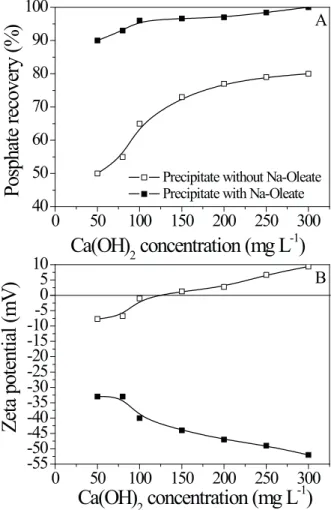
The effect of the calcium hydroxide concentration
on the phosphate recovery and on the zeta potential of precipitates in the absence and presence of Na-oleate is presented in Figure 6. In Figure 6A it can be observed that, in both the presence and absence of Na-oleate, the phosphate recovery slightly increases as the concentration of Ca(OH)2 is increased. In the absence of Na-oleate the phosphate recovery increased from 50% to 80% when the Ca(OH)2 concentration was increased from 50 mg L-1 to 300 mg L-1. This increase can be attributed to the
increase of phosphate precipitation with increasing concentration of the precipitating agent, which may suggest the generation of a calcium phosphate mineral that is less soluble at higher pH levels.
According to some studies, phosphate precipitation
from wastewater is significantly increased by calcium
concentrations higher than 50mg.L-1 and water pH higher
than 8 (Ferguson et al., 1973; Jenkins et al., 1971; Arvin, 1983; Diaz et al., 1994). Jenkins et al. (1971) reported that a calcium concentration of 80mg.L-1 and a water pH higher
than 8 were needed to precipitate 80% of the phosphate from
the wastewater. Diaz et al. (1994) reported that an effective
phosphate precipitation requires a calcium concentration higher than 100 mg L-1 and pH 8. However, higher pH
levels (>9) may be needed to form a more stable calcium phosphate mineral. According to the theoretical solubility isotherms for calcium phosphate minerals reported by the same authors, the species beta tricalcium phosphate, octacalcium phosphate, dicalcium phosphate dehydrate and calcite are formed at high calcium concentration (>50 mg L-1) and high pH (>9) conditions. These species of calcium
phosphate formed are less soluble than hydroxyapatite, and therefore more stable, which may contribute to increase the phosphate recovery as a function of entrainment.
In the presence of Na-oleate the phosphate recovery increased from 90% to 100% when the Ca(OH)2 concentration was increased from 50 mg L-1 to 300 mg L-1.
This increase can be attributed to an increase of the Ca2+ and CaOH+ ion concentrations on the precipitate surface, activating the adsorption of oleate ions. Horta et al. (2015)
reported that apatite floatability increases with the rise
of the initial dissolution rate and consequent increase of available Ca2+ ions.
In Figure 6B it can be observed that, in the absence of Na-oleate, the zeta potential of the precipitate becomes less negative with increasing Ca(OH)2 concentrations and the particle charge is changed to positive values for a Ca(OH)2 concentration around 90 mg L-1. These results
can be attributed to an increase of the Ca2+ and CaOH+ ion concentrations in solution, which adsorb on the precipitate surface forming reactive sites for the surfactant adsorption. It can be observed that, in the presence of 20 mg L-1
Na-oleate, the precipitate charge is negative for all of the
concentration range studied. The zeta potential difference,
with and without Na-oleate addition, was increased with the increase of Ca(OH)2. The increased adsorption of oleate ions on the mineral surface in the presence of dissolved calcium ions was reported by Bibawy and Yousef (1985) and Sis and Chander (2003). The increase of phosphate
0
50
100
150
200
250
300
-55
-50
-45
-40
-35
-30
-25
-20
-15
-10
-5
0
5
10
Z
eta
p
ote
n
tia
l (
m
V
)
Ca(OH)
2concentration (mg L
-1)
0
50
100
150
200
250
300
40
50
60
70
80
90
100
Precipitate without Na-Oleate Precipitate with Na-Oleate
P
os
pha
te
r
ec
ove
ry (
%
)
Ca(OH)
2concentration (mg L
-1)
B
A
recovery from 90 to 100% at 300 mg L-1 Ca(OH)2 was
attributed to the adsorption increase of oleate ions on the precipitate surface, since the negative value of zeta potential increases with increasing Ca(OH)2 concentration in the presence of 20 mg L-1 Na-oleate.
Effect of bubble size on the phosphate recovery
The influence of the pH and current density on the
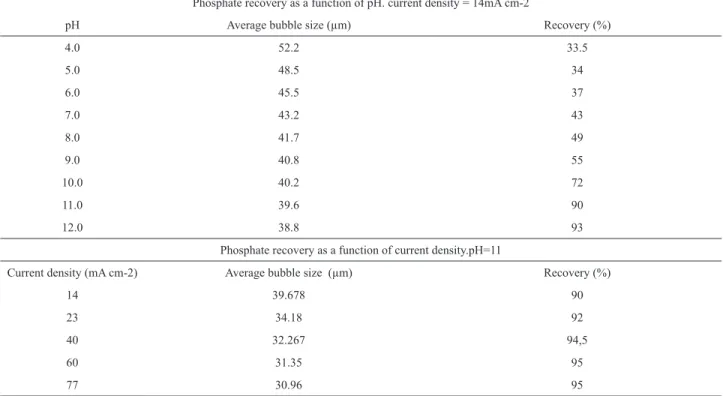
average bubble size and phosphate recovery, in the presence of 20 mg L-1 Na-oleate, is presented in Table 1.
It can be observed that the phosphate recovery increases and the bubble size decreases as the pH and current density increase. The conditions for high phosphate recovery can
be attributed to the increase of the collision efficiency
between the precipitates and the generated bubbles. According to the studies reported by Nguyen et al.
(2006) and Sarrot et al. (2007), the collision efficiency of particles with diameters between 1 and 10 μm is increased with decreasing size of the bubbles. The capture efficiency
of a particle by a rising air bubble is given by the product
between collision efficiency, attachment efficiency and the particle-bubble aggregate stability efficiency as shown in
Equation 1.
=
cap c a s
E
E E E
where Ec is the collision efficiency, Ea is the attachment efficiency and Es is the particle-bubble aggregate stability efficiency.
Dai et al. (2000) considered attachment and stability
efficiencies equal to 1 for small and hydrophobic particles
interacting with microbubbles, both being conditions met
for the electroflotation of the phosphate particles used. Therefore, the capture efficiency is equal to the collision efficiency and can be expressed by Equation 2.
2
3
2
=
p c
b
d
E
d
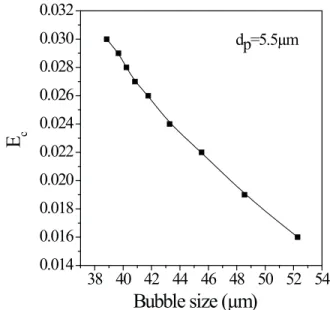
The relationship between the bubble size and the
collision efficiency described by Equation 2 with a value of particle size fixed at 5.5 µm is presented in Figure 7. It can be observed that the particle–bubble collision efficiency
is increased as the bubble size decreases. It is concluded that the smaller bubbles generated in the alkaline pH range and high current density resulted in a higher collision
efficiency, explaining the recoveries above 90% of the fines precipitates.
Table 1. Phosphate recovery and bubble average Sauter’s diameter as a function of pH and current density. Cell with stainless steel (AISI 316) mesh cathode and ruthenium-oxide coated titanium anode. 20 mg L-1 of sodium oleate used as surfactant in phosphate electroflotation and 0.1 mol L-1 NaCl solution as electrolyte.
Phosphate recovery as a function of pH. current density = 14mA cm-2
pH Average bubble size (µm) Recovery (%)
4.0 52.2 33.5
5.0 48.5 34
6.0 45.5 37
7.0 43.2 43
8.0 41.7 49
9.0 40.8 55
10.0 40.2 72
11.0 39.6 90
12.0 38.8 93
Phosphate recovery as a function of current density.pH=11
Current density (mA cm-2) Average bubble size (µm) Recovery (%)
14 39.678 90
23 34.18 92
40 32.267 94,5
60 31.35 95
77 30.96 95
(1)
CONCLUSIONS
The results demonstrated that phosphate precipitation
with calcium hydroxide and electroflotation can be
used to recover phosphate from the synthetic solution.
Hydroxyapatite and calcium-deficient hydroxyapatite with
particle sizes ranging from 3 to 10 mm were obtained with 50 mg L-1 of Ca(OH)2. A recovery of 50% of fine precipitates
was achieved in the absence of surfactant. The addition of Na-oleate favored phosphate recovery. The increase in phosphate recovery was attributed to the adsorption of oleate ions on the precipitate surface, rendering its surface
hydrophobic, and therefore more floatable. A phosphate
recovery around 90% was achieved with 20 mg L-1 of
Na-oleate at pH 11 and bubble sizes around 39 µm. An increase in the calcium hydroxide concentration led to an increase in the phosphate recovery, reaching a recovery of 100% at 300 mg L-1.
These results indicate that electroflotation can be an effective alternative treatment for wastewater with
phosphate concentrations above that established by legislation and, at the same time, recover the phosphates present in the wastewater. Tests with real wastewaters should be the object of a future work.
ACKNOWLEDGMENTS
The authors acknowledge CNPq and CETEM for their support.
REFERENCES
Abbona, E., Lundager Madsen, H. E. and Boistelle, R., The initial phases of calcium and magnesium phosphate precipitated
from solutions of high to medium concentrations, Journal of Crystal Growth, 74, No. 3, 581-590 (1986).
Antti, B. M. and Forssberg, E., Pulp chemistry in industrial mineral flotation. Studies of surface complex on calcite and apatite surfaces using FTIR spectroscopy, Minerals Engineering, 2, No. 2, 217-227 (1989).
Aoudj, S., Khelifa, A., Drouich, N., Belkada, R. and Miroud, D., Simultaneous removal of chromium(VI) and fluoride by electrocoagulation–electroflotation: Application of a hybrid Fe-Al anode, Chemical Engineering Journal, 267,153-162 (2015).
Arvin, E., Observations supporting phosphate removal by biologically mediated chemical precipitation-a review. Water Science and Technology, 15, 43-63 (1983).
Bhaskar Raju, G. and Khangaonkar, P. R., Electroflotation of chalcopyrite fines with sodium diethyldithiocarbamate as collector, International Journal of Mineral Processing, 13, 211-221 (1984).
Bibawy, T. A. and Yousef, A. A., Adsorption behavior of precipitated tribasic calcium phosphate, Tenside Detergents, 22, 83-87 (1985).
Bouguerra, W., Barhoumi, A., Ibrahim, N., Brahmi, K., Aloui, L. and Hamrouni, B., Optimization of the electrocoagulation process for the removal of lead from water using aluminium as electrode material, Desalination and Water Treatment, 56, No. 10, 2672-2681 (2015a).
Bouguerra, W., Brahmi, K., Elaloui, E., Loungou, M. and Hamrouni, B., Optimization of electrocoagulation operating parameters and reactor design for zinc removal: application to industrial Tunisian wastewater, Desalination and Water Treatment, 56, No. 10, 2706-2714 (2015b).
Brahmi, K., Bouguerra, B., Hamrouni, B. and Loungou, M., Removal of zinc ions from synthetic and industrial Tunisian wastewater by electrocoagulation using aluminium electrodes, Desalination and Water Treatment, 56, N0.10, 2689-2698 (2015a).
Brahmi, K., Bouguerra, W., Hamrouni, B., Elaloui, E., Loungou, M. and Tlili, Z., Investigation of electrocoagulation reactor design parameters effect on the removal of cadmium from synthetic and phosphate industrial wastewater, Arabian Journal of Chemistry, (2015b). https://doi.org/10.1016/j. arabjc.2014.12.012
Burns, S. E., Yiacoumi, S. and Tsouris, C., Microbubble generation for environmental and industrial separation, Separation and Purification Technology, 11, No. 3, 221-232 (1997).
Casqueira, R. G., Torem, M. L. and Kohler, H. M., The removal of zinc from liquid streams by electroflotation, Mineral Engineering, 19, 1388-1392 (2006).
Chander, S. and Fuerstenau, D. W., Interfacial properties and equilibria in the apatite-aqueous solution system, Journal of Colloid and International Science, 70, No. 3, 506-516 (1979). Cordell, D., Drangert, J. O. and White, S., The story of
phosphorus: Global food security and food for thought, Global Environmental Change, 19, No. 2, 292-305 (2009).
Dai, Z., Fornasiero, D. and Ralston, J., Particle–bubble collision models - a review, Advances in Colloid and Interface Science, 85, No. 2-3, 231-256 (2000).
38 40 42 44 46 48 50 52 54 0.014
0.016 0.018 0.020 0.022 0.024 0.026 0.028 0.030 0.032
E
cBubble size (µm)
dp=5.5µmDiaz, O. A., Reddy, K. R. and Moore, P. A., Solubility of inorganic phosphorus in stream water as influenced by pH and calcium concentration, Water Research, 28, No. 8, 1755-1763 (1994). Ferguson, J. F., Jenkins, D. and Eastman, J., Calcium phosphate
precipitation at slightly alkaline pH values, Journal of the Water Pollution Control Federation, 45, 620-631 (1973). Gray, C. A. and Schwab, A. P., Phosphorus-fixing ability of high
pH, high calcium, coal- combustion,waste materials. Water Air Soil Pollut, 69, No. 3-4, 309-320 (1993).
Hanumantha Rao, K., Britt-Marie, A. and Forssberg, E., Mechanism of interaction on salt-type minerals, Part II: Adsorption and electrokinetic studies of apatite in the presence of sodium oleate and sodium metasilicate, International Journal of Mineral Processing, 28, 59-79 (1990).
Hanumantha Rao, K. and Forssberg, K. S. E., Mechanism of fatty acid adsorption in salt-type minerals flotation, Minerals Engineering, 4, No. 7-11, 879-890 (1991).
Horta, D., Monte, M.B.M. and Leal Filho, L.S., The effect of dissolution kinetics on flotation response of apatite with sodium oleate, International Journal of Mineral Processing, 146, 97-104 (2015).
Hoseinian, F. S., Irannajad, M. and Nooshabadi, A. J., Ion flotation for removal of Ni(II) and Zn(II) ions from wastewaters, International Journal of Mineral Processing, 143, 131-137 (2015).
Hosni, K., Ben Moussa, S., Chachi, A. and Ben Amor, M., The removal of PO43− by calcium hydroxide from synthetic wastewater: optimisation of the operating conditions, Desalination, 223, No. 1-3, 337-343 (2008).
Jenkins, D. and Ferguson, J. F., Review paper chemical process for phosphate removal. Water Research, 5, 369-389 (1971).
Ketkar, D. R., Mallikarjunan, R. and Venkatachalam, S., Electroflotation of quartz fines. International Journal of Mineral Processing, 31, No. 1-2, 127-138 (1991).
Kuokkanen, V., Kuokkanen, T., Ramo, J., Lassi, U. and Roininen, J., Removal of phosphate from wastewaters for further utilization using electrocoagulation with hybrid electrodes - Techno-economic studies, Journal of Water Process Engineering, 8, 50-57 (2015).
Liu, J. C. and Chang, C. J., Precipitation flotation of phosphate from water, Colloids and Surfaces A: Physicochemical and Engineering Aspects, 34, 215-219 (2009).
Lu, Y., Drelich, J., Miller, J. D., Oleate adsorption at an apatite surface studied by ex-situ FTIR internal reflection spectroscopy, Journal of Colloid and Interface Science, 476, No. 202, 462-476 (1998).
Matis, K. A. (Ed.), Flotation Science and Engineering. Marcel Dekker, New York (1995).
Miettinen, T., Ralston, J. and Fornasiero, D., The limits of fine particle flotation, Minerals Engineering, 23, No. 5, 420-437 (2010).
Morse, G. K., Brett, S. W., Guy, J. A. and Lester, J. N., Phosphate removal and recovery technologies, The Science of the Total Environment, 212, 69-81 (1998).
Musvoto, E. V., Wentzel, M. C. and Ekama, G. A., Integrated chemical-physical process modeling. II: Simulation aeration treatment for anaerobic digester supernatant, Water Research, 34, No. 6, 1868-1880 (2000).
Nahui, F. N. B., Nascimento, M. R., Cavalcanti, E. B. and Vilar, E.O., Electroflotation of emulsified oil in industrial wastes evaluated with a full factorial design, Brazilian Journal of Chemical Engineering, 25, 435-442 (2008).
Nguyen, A. V., George, P. and Jameson, G. J., Demonstration of a minimum in the recovery of nanoparticles by flotation: theory and experiment, Chemical Engineering Science, 61, 2494-2509 (2006).
Nunes, A. P. L., Peres, A. E. C., Araujo, A. C. and Valadão, G. E. S., Electrokinetic properties of wavellite and its floatability with cationic and anionic surfactants, Journal of Colloid and Interface Science, 361, 632-638 (2011).
Rubio, J., Schneider, I. A. H. and Aliaga, W., New processes for heavy metals separations from wastewater streams in the mining industry, Proceedings of Clean Technologies for the Mining Industry, p. 85-98 (1996).
Rubio, J., Environmental applications of flotation. In: Castro, S. H., Vergana, F., Sanchez, M. (Eds.), Effluent Treatment in the Mining Industry. University of Concepción, Chile, p. 335-364 (1998a).
Rubio, J., Flotation applied to effluent treatment. In: Castro, S. H., Vergana, F., Sanchez, M. (Eds.), Environment and Innovation in Mineral Technology, IV International Conference on Clean Technologies for the Mining Industry. University of Concepción, Chile, p. 353-366 (1998b).
Rubio, J., Souza, M. L. and Smith, R. W., Overview of flotation as a wastewater treatment technique, Minerals Engineering, 15, 139-155 (2002).
Sarkar, M. S. K. A., Donne, S. W. and Evans, G. M., Hydrogen bubble flotation of silica, Advanced Powder Technology, 21, No. 4, 412-418 (2010).
Sarrot, V., Huang, Z., Legendre, D. and Guiraud, P., Experimental determination of particles capture efficiency in flotation, Chemical Engineering Science, 62, 7359-7369 (2007).
Sis, H. and Chander, S., Adsorption and contact angle of single and binary mixtures of surfactants on apatite, Minerals Engineering, 16(9), 839-848 (2003).
Somasundaran, P., Ananthapadmabhan, K. P. and Ofori Amankonah, J., Mineral solution equilibria in sparingly soluble mineral system, Colloids and Surfaces, 15, 309-333 (1985).
Somasundaran, P. and Zhang, L. in: P. Zhang, H. El-Shall, R. Wiegel (Eds.), Beneficiation of Phosphates, Advances in Research and Practice, Society of Mining, Metallurgy, and Exploration, Inc., Littleton, CO, Chapter 12 (1999).
Stoia, M., Ionescu, M., Stef, O., Murgan, R. and Stefanescu, M., Preparation of β -Tricalcium Phosphate from Precursors Obtained by a Wet Precipitation Method, Chemical Bulletin of Politehnica University of Timisoara, 53, No. 3, 1-2 (2008).
Urano, K. and Tachikawa, H., Process-development for removal and recovery of phosphorus from wastewater by a new adsorbent. Preparation method and adsorption capability of a new adsorbent, Industrial & Engineering Chemistry Research, 30, No. 8, 1893-1896 (1991).
Vlyssides, A. G., Karlis, P. K., Rori, N. and Zorpas, A. A., Electrochemical treatment in relation to pH of domestic wastewater using Ti/Pt electrodes, Journal of Hazardous Materials, 95, 215-226 (2002).
Voronin, N. N. and Dibrov, I. A., Classification of flotation processes in wastewater decontamination, Journal of Environmental Engineering, 124, No. 5, 469-472 (1999).
Vu, T. P., Vogel, A., Kern, F., Platz, S., Menzel, U. and Gadow, R., Characteristics of an electrocoagulation–electroflotation process in separating powdered activated carbon from urban wastewater effluent, Separation and Purification Technology, 134, 196-203 (2014).
Vucinic, D. R., Radulovic, D. S. and Deusic, S. D., Electrokinetic properties of hydroapatite under flotation conditions, Journal of Colloid and Interface Science, 343, 239-245 (2010). Warren, L. J., Determination of the contributions of true flotation
and entrainment in batch flotation tests, International Journal of Mineral Processing, 14, 33-44 (1985).