Uterine Fibroid Symptom - Quality of Life
questionnaire translation and validation into
Brazilian Portuguese
Tradução e validação para língua portuguesa do
questionário Uterine Fibroid Symptom - Quality of Life
Rita Oliveira da Silva
1Mariano Tamura Vieira Gomes
1Rodrigo de Aquino Castro
1Cláudio Emílio Bonduki
1Manoel João Batista Castello Girão
21Division of General Gynecology, Uterine Fibroid Sector, Escola Paulista de Medicina, Universidade Federal de São Paulo (EPM/ Unifesp), São Paulo, SP, Brasil
2Escola Paulista de Medicina, Universidade Federal de São Paulo (EPM/UNIFESP), São Paulo, SP, Brasil
Rev Bras Ginecol Obstet 2016;38:518–523.
Address for correspondenceRita Oliveira da Silva, MSc, Rua Napoleão de Barros, 715, 7° andar, Vila Clementino, 04024-002, São Paulo, SP, Brazil (e-mail: [email protected]).
Keywords
►
leiomyoma
►
questionnaire
►
quality of life
►
validation studies
►
translation
Abstract
Purpose
To translate into Portuguese, culturally adapt and validate the Uterine
Fibroid Symptom - Quality of Life (UFS-QoL) questionnaire for Brazilian women with
uterine leiomyoma.
Methods
Initially, the UFS-QoL questionnaire was translated into Brazilian
Portu-guese in accordance with international standards, with subsequent cultural, structural,
conceptual and semantic adaptations, so that patients were able to properly answer
the questionnaire. Fifty patients with uterine leiomyoma and 19 patients without the
disease, con
fi
rmed by abdominal pelvic examination and/or transvaginal ultrasound,
were selected at the outpatient clinics of the Department of Gynecology of the
Universidade Federal de São Paulo (Unifesp). The UFS-QoL questionnaire was
adminis-tered to all women twice on the same day, with two different interviewers, with an
interval of 15 minutes between interviews. After 15 days, the questionnaire was
re-administered by the
fi
rst interviewer. Reliability (internal consistency and test-retest),
construct and discriminative validity were tested to ratify the questionnaire.
Results
The reliability of the instrument was assessed by Cronbach
’
s
α
coef
fi
cient
with an overall result of 0.97, indicating high reliability. The survey results showed a
high correlation (
p
¼
0.94;
p
0.001).
Conclusion
The UFS-QoL questionnaire was successfully adapted to the Brazilian
Portuguese language and Brazilian culture, showing reliability and validity.
received
December 3, 2015 accepted July 27, 2016
DOI http://dx.doi.org/ 10.1055/s-0036-1593833. ISSN 0100-7203.
Copyright © 2016 by Thieme Publicações Ltda, Rio de Janeiro, Brazil
Introduction
Uterine leiomyomas are the most common benign tumors of the female pelvis, affecting 20–30% of women at childbearing age, and more than 40% of women over 40 years old.1–3
Although there are few epidemiological studies to investi-gate this condition in Brazil, its prevalence is of23.3% of the female population.4Smoking, physical exercise, a restricted diet low in fats and rich in vegetables, multiparity and contraceptive use are thought to be protective mechanisms due to their anti-estrogenic effects.2–8
These tumors can cause a variety of symptoms, including menstrual disorders, pelvic pain, infertility, sexual dysfunc-tion, urinary incontinence, and pelvic pressure increase, and they can adversely impact pregnancy.4,8–10Many symptoms
experienced by the patients are subjective, regardless of the amount, volume and location of the tumors. For a variety of reasons, including medical and psychological ones, hysterec-tomy is not desirable for many women.4–6Evaluating the
impact caused by uterine leiomyoma on women’s quality of life is a constant challenge for researchers and clinicians. Quality of life is a subjective and multidimensional con-struct, based on the individual’s perception of the position of their life in the cultural context and value systems in which they live, in relation to their objectives, expectations, stand-ards and concerns. The absence of a suitable tool makes the assessment of the disease difficult.
In 2002, Spies et al11published a specific questionnaire for assessing the severity of the disease symptoms and their impact on quality of life, the Uterine Fibroid Symptom -Quality of Life (UFS-QoL). This instrument was a milestone in
the medical literature. The purpose of the questionnaire is to provide a simple tool to assess the impact from the perspec-tive of the patient.1,10–13
The UFS-QoL questionnaire has been chosen to be vali-dated in Brazilian Portuguese as the only specific clinical questionnaire to assess patients with uterine leiomyoma that included psychometric properties in its development.
Methods
This study is an observational case-control study evaluating a quality of life questionnaire for patients with uterine leio-myoma, held at the Uterine Fibroid Section of the Depart-ment of Gynecology at Universidade Federal de São Paulo. It was submitted and approved by the Research Ethics Com-mittee of the Institution (Protocol 1488/10), and all partic-ipants signed a consent form before answering the questionnaire.
A total of 69 women aged between 20 and 50 were included in the study. Of these, 50 women had clinical and ultrasound diagnoses of uterine leiomyoma, with no prior treatment for the disease, no use of any hormonal medica-tion containing estrogen and/or progestin, no pregnancies or menopause and without present malignant pelvic gyneco-logical diseases and/or other benign uterine diseases (case). Nineteen participants had no uterine myoma (control).
The study was conducted infive steps: prior authorization request, translation and cultural adaptation of the question-naire, pilot test, test-retest and validation.
Initially, an authorization from the author of the UFS-QoL questionnaire,11 James B. Spies, MD, MPH, for its
Resumo
Objetivo
Traduzir para o português, adaptar culturalmente e validar o questionário
Uterine Fibroid Symptom - Quality of Life (UFS-QoL) para as mulheres brasileiras com
leiomioma uterino.
Métodos
Inicialmente, o questionário UFS-QoL foi traduzido para o português
brasileiro, em conformidade com as normas internacionais, com adaptações culturais,
estruturais, conceituais e semânticas subsequentes, de modo que as pacientes fossem
capazes de responder o questionário de forma adequada. Cinquenta pacientes com
leiomioma uterino e 19 pacientes sem a doença, con
fi
rmada por exame pélvico
abdominal e/ou ultrassonogra
fi
a transvaginal, foram selecionados nos ambulatórios
do Departamento de Ginecologia da Universidade Federal de São Paulo (Unifesp). A
todas as mulheres foi administrado o questionário UFS-QoL por duas vezes no mesmo
dia, por dois entrevistadores diferentes, com um intervalo de 15 minutos entre as
entrevistas. Após 15 dias, o questionário foi novamente administrado pelo primeiro
entrevistador. Con
fi
abilidade (consistência interna e teste-reteste), constructo e
validade discriminativa foram testados para rati
fi
car o questionário.
Resultados
A con
fi
abilidade do instrumento foi avaliada pelo coe
fi
ciente
α
de
Cronbach com um resultado global de 0,97, indicando alta con
fi
abilidade. Os
resultados da pesquisa mostraram uma correlação elevada (
p
¼
0,94;
p
0,001).
Conclusão
O questionário UFS-QoL foi adaptado com sucesso para a língua
portu-guesa e cultura brasileira, mostrando con
fi
abilidade e validade.
Palavras-chave
translation and use was requested. After the request was accepted, a Brazilian translator with proficiency in Ameri-can English and scientific knowledge of the subject trans-lated the questionnaire from American English into Brazilian Portuguese. Next, the validation was performed through linguistic and cultural adjustments. In this first phase of cultural adaptation of the original questionnaire,
five health professionals with knowledge in both American English and Brazilian Portuguese were selected from vari-ous areas to identify and discuss differences to choose the
final version.
The UFS-QoL questionnaire consists of 37 questions, divided in 2 parts. Thefirst part is composed of a single domain. The second is divided in six areas, where the answer options are in the Li Kert format. Thefirst part evaluates the severity of the symptoms, with points assigned to each answer option. This domain allows raw total scores from 8 to 40. For the calculation of scores, their sum was denoted as the raw score. In sequence, these scores were added and transformed and labeled as the transformed scores (the higher the score, the more severe the symptoms). The second part evaluates the health-related quality of life (HRQL), which is divided into 6 areas: concern, daily activi-ties, changes in mood and energy, self-control, self-con-sciousness and sexual function.
To calculate the transformed score of the HRQL, the values for eachfield (1 to 5) were added, yielding the raw scores and becoming values in the specified formula. This domain allows gross total scores from 29 to 145. The higher the score, the better the quality of life in relation to health.
Later, the questionnaire was submitted to back-translation to American English by an American native translator with profi -ciency in the Brazilian Portuguese language (without mutual consultation between the two translators), to make the review of the versions of the questionnaire possible by comparing them to the original. The two translations were used to establish a consensus version, so that there was no discrepancy between the retranslation and the original questionnaire, following the guidelines of the MAPI Institute (Lyon, France).
Sixty-nine patients were interviewed in three phases: E1, E2 and E3. On the same day, interviews E1 and E2 were performed separately by different interviewers (P1 and P2). Fifteen days after, a third interview (E3) was performed by thefirst interviewer (P1).
Thefinal validation of the UFS-QoL questionnaire was performed by assessing the reliability (internal consistency, intraclass correlation coefficients, intraobserver reproduc-ibility and test-retest) and validity of the construct, as well as the discriminative validity.
For data analysis, the following programs were used: SPSS V17 (SPSS Inc. Apache Software Foundation, Forest Hill, Maryland, US), Minitab 16 (State College, Pa., US) and Office® Excel 2010 (Microsoft®, © 2012 Microsoft Corporation, Impressa Systems, Santa Rosa, California, US).
A descriptive analysis of the demographic data was per-formed, and the Analysis of Variance (ANOVA) statistical test was used, which compares means using the variance and the Two Proportion Equality test, to compare the proportion of
two given varying responses and/or whether their levels are statistically significant.
Psychometric analyses were conducted to assess the severity scales of symptoms and the internal consistency of the quality of life assessed by the UFS-QoL questionnaire using Cronbach’sα(α), intraclass correlation coefficient (or
reproducibility test) and Pearson’s correlation coefficient. All statistical tests showed a 5% significance level.
Results
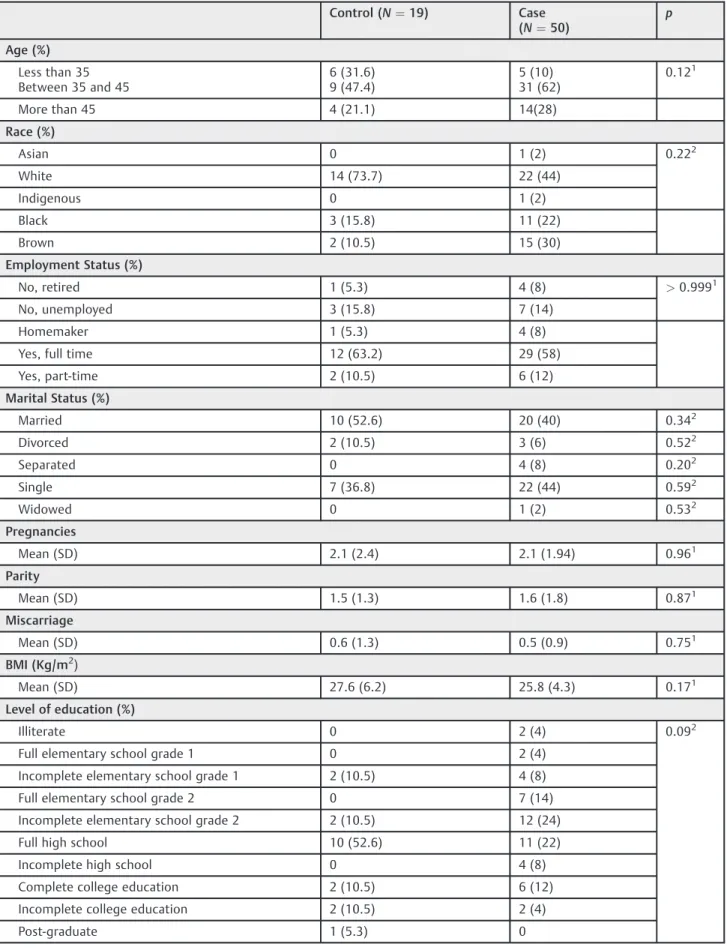
The sample consisted of 69 women, 50 of them with uterine leiomyoma (case) and 19 subjects without the disease (con-trol). Of the 50 patients with myoma, 62% were aged between 35 and 45 years. The clinical and demographic characteristics of each group are shown in►Tables 1and2. Most patients
with uterine leiomyoma were single (44%), engaged in remunerated activities throughout the day (58%), self-re-ported as white (44%) and had studied through elementary school grade 2 (14%). The groups were statistically homoge-neous in terms of number of pregnancies, births, miscar-riages and body mass index (BMI).
The average uterine volume between the patients with leiomyoma was 250 cm3, while those with no uterine myoma had a mean volume of 60 cm3; thus, the groups were statistically heterogeneous. This difference between groups is reflected by the clinical characteristics inherent to uterine leiomyoma, show-ing that patients with myoma had a longer duration of menstrual bleeding (6.7 days) accompanied by dysmenorrhea (84%) and shorter intervals between menstrual cycles (23 days).
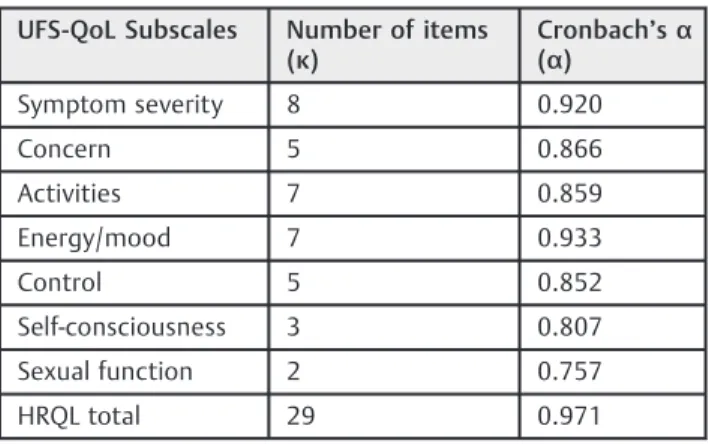
►Table 3shows the estimated reliability of the
question-naire. The values of Cronbach’sαcoefficients are high and
satisfactory. The final internal consistency is more than 0.960, which is defined as excellent.
The UFS-QoL questionnaire domains were also able to discriminate uterine leiomyoma patients from women with no myoma (►Table 4).
There was a statistically significant mean difference be-tween groups for almost all areas except for the self-con-sciousness and sexual function subscales. The uterine leiomyomata group average for HRQL was 90.3 compared with 67.4 for the normal group (p¼0.004).
The time interval between thefirst and second interviews was 15 minutes. The intraclass interobserver correlation coefficients were between 92.8% (95% CI [87.3; 95.9]) and 97.2% (95% CI [95.1; 98.4]). These results indicate a strong correlation between the two interviewers at different times and on the same day, while keeping in mind that the two groups are statistically homogeneous.
Intraclass intraobserver correlation coefficients were be-tween 84.7% (95% CI [73.1; 91.3]) and 97.4% (95%CI [95.3; 98.5]), reflecting a strong correlation between the 2 inter-viewers at different times and on the same day.
Discussion
Table 1 Clinical and demographic characteristics
Control (N¼19) Case (N¼50)
p
Age (%)
Less than 35 Between 35 and 45
6 (31.6) 9 (47.4)
5 (10) 31 (62)
0.121
More than 45 4 (21.1) 14(28)
Race (%)
Asian 0 1 (2) 0.222
White 14 (73.7) 22 (44)
Indigenous 0 1 (2)
Black 3 (15.8) 11 (22)
Brown 2 (10.5) 15 (30)
Employment Status (%)
No, retired 1 (5.3) 4 (8) >0.9991
No, unemployed 3 (15.8) 7 (14)
Homemaker 1 (5.3) 4 (8)
Yes, full time 12 (63.2) 29 (58)
Yes, part-time 2 (10.5) 6 (12)
Marital Status (%)
Married 10 (52.6) 20 (40) 0.342
Divorced 2 (10.5) 3 (6) 0.522
Separated 0 4 (8) 0.202
Single 7 (36.8) 22 (44) 0.592
Widowed 0 1 (2) 0.532
Pregnancies
Mean (SD) 2.1 (2.4) 2.1 (1.94) 0.961
Parity
Mean (SD) 1.5 (1.3) 1.6 (1.8) 0.871
Miscarriage
Mean (SD) 0.6 (1.3) 0.5 (0.9) 0.751
BMI (Kg/m2)
Mean (SD) 27.6 (6.2) 25.8 (4.3) 0.171
Level of education (%)
Illiterate 0 2 (4) 0.092
Full elementary school grade 1 0 2 (4)
Incomplete elementary school grade 1 2 (10.5) 4 (8)
Full elementary school grade 2 0 7 (14)
Incomplete elementary school grade 2 2 (10.5) 12 (24)
Full high school 10 (52.6) 11 (22)
Incomplete high school 0 4 (8)
Complete college education 2 (10.5) 6 (12)
Incomplete college education 2 (10.5) 2 (4)
Post-graduate 1 (5.3) 0
Abbreviation: BMI, body mass index; SD, standard deviation.
1ANOVA test.
researchers and clinicians. Women suffering from the dis-ease exhibit significant symptoms, including menstrual ir-regularities, pelvic pain, infertility, sexual dysfunction, edema, urinary urge incontinence, pelvic pressure and ad-verse impacts on pregnancy.
Psychological tests are tools, and in order to benefit from them, one must know how to evaluate them and what types of information can be provided. No psychological test can do more than measure behavior; therefore, customizing the test is an important step to ensure uniformity.
Uterine leiomyoma is a prevalent disease, and in 2002 Spies et al11published a specific instrument for the assess-ment of symptom severity for this disease and its impact on the quality of life. The purpose of the questionnaire was to provide a simple tool to assess the impact of this disease from the patient’s perspective.
In this study, the questionnaire was translated and ad-ministered to Brazilian women who suffer from uterine leiomyoma. It is an easy-to-understand questionnaire, but it is not self-administered in our culture because we do not have this habit in Brazil.
The administration time varied between 15 and 20 mi-nutes. The patients also made use of this time to reflect more about the disease, emphasizing to the interviewer the angst and inconvenience caused by myomas in their lives.
The original questions were formulated in a complex manner, and had to be adapted into colloquial language. This change was required because when faced with cultured written language, patients may have difficulty understanding it. We worked with a literal translation, trying not to change the meaning because words must be accurate, clear and objective.
Everyday examples were used to obtain consistent an-swers, curbing misinterpretation by the patients. The con-tent of an item may be more familiar in one culture than in another, and the subtlest differences can significantly affect the performance of a test.
Even when reducing the cultural differences in a test, cross-cultural tests do not completely eliminate this differ-ence. The way the test is administered can have diverse impacts in different ethnic/cultural groups. The mere exis-tence of culture stereotypes can affect individual perfor-mance in a test. This is called stereotypical vulnerability, and it influences the test scores for both genders in ethnic comparisons.
When language differences in translation occur, prob-lems regarding the compatibility of standards and the equivalence of scores arise. One should also remember that a simple translation is rarely sufficient, and adjust-ments or reviews are always required. In this study, in a second meeting with the clinical team, there was consen-sus that after retranslation there was no difference in meaning in the questions in the cultural adaptation, which, in fact, could be verified in the pilot study. Thus, modifying terms and/or words was no longer necessary, and the test was ready to be administered. There was some degree of difficulty in making cultural adaptations to the Brazilian culture. Although most patients in our clinic had Table 4 Discriminant validity of the UFS-QoL questionnaire
UFS-QoL Subscales: mean (SD)
Control (N¼19)
Case (N¼50)
p1
Symptom severity 25.3 (17.5) 60 (26.9) <0.001
Concern 61.1 (23.8) 40.2 (32.5) 0.01
Activities 72.6 (19.5) 57.1 (29.0) 0.04
Energy/mood 63.4 (29.3) 42.5 (31.2) 0.01
Control 76.3 (17.8) 47.3 (28.7) <0.001
Self-consciousness 67.1 (27.6) 50.3 (36.1) 0.07
Sexual function 50 (31.5) 38.5 (24.6) 0.11
HRQL total 67.4 (23.1) 90.3 (30.5) 0.004
Abbreviations: HRQL, health-related quality of life; SD, standard devi-ation; UFS-QoL, Uterine Fibroid Symptom - Quality of Life.
1ANOVA
t-test;p0.05.
Table 2 Clinical characteristics inherent to uterine leiomyoma
Control (N¼19)
Case (N¼50)
p
Duration of menstrual bleeding (d)
Mean (SD) 5.4 (2.0) 6.7 (4.2) 0.201
Intermenstrual interval (d)
Mean (SD) 34 (16.2) 23.0 (8.7) 0.0011
Uterine Volume (cm3)
Mean (SD) 60 (22.1) 250 (104.8) 0.00011
Dysmenorrhea (N)(%)
No 14 (73.7) 8 (16) <0.0012
Yes 5 (26.3) 42 (84)
Abbreviation: SD, standard deviation.
1
ANOVA test.
2
Two Proportions Equality Test.
Table 3 Reliability estimate of the UFS-QoL questionnaire: internal consistency
UFS-QoL Subscales Number of items (κ)
Cronbach’sα (α)
Symptom severity 8 0.920
Concern 5 0.866
Activities 7 0.859
Energy/mood 7 0.933
Control 5 0.852
Self-consciousness 3 0.807
Sexual function 2 0.757
HRQL total 29 0.971
more than 8 years of formal education, several changes in words and expressions were necessary so that the ques-tionnaire was properly understood.
As racial categorization in Brazil is very particular when compared with other parts of the world, women with similar phenotypes were probably classified as dif-ferent groups of color/race, showing the fluidity in the Brazilian concept of color/race and some lack of precision on this kind of information when based only on physical characteristics.12
The reliability and validity of an instrument evaluating a patient’s quality of life are key criteria. Reliable measure-ments are reproducible, consistent and coherent, and always give the same result because they are stable and valid measurements, and accurate representations of the features to be measured. The behavior to be tested must be system-atically analyzed to ensure the test items cover all aspects and that they are in the correct proportions. The UFS-QoL questionnaire has an excellent discriminative capacity, not only to differentiate ill patients from healthy ones. However, thefields related to self-consciousness and sexual function were similar in both groups. The self-conscious factor is related to situations where the woman is prone to potential embarrassment at any time or in each menstrual period, creating a degree of anxiety that may disrupt her daily life or its planning. Besides, the sample size may not have been large enough to show a difference in these areas between the two groups.
However, it is important to emphasize the high reliability of the questionnaire as shown by Cronbach’sαfor both the total
score and the evaluation of each domain. When reporting retest reliability, the time interval between surveys should always be cited, because correlation falls progressively just as interval time between visits increases. The time interval should not exceed more than six months. On the other hand, the interval between interviews should not be too short because the subject can recall many of the answers she gave, and they become invalid. In that case, the scores do not end up being acquired independently so that the correlation between them is not falsely high. The interval between the first and second interviews was 15 minutes. The intraclass interobserver correlation coefficients were between 92.8% and 98.1%, showing a strong correlation between the responses of the patients to each question within each domain to the two interviewers (at different times and on the same day). The intraclass intraobserver correlation coeffi -cients also show a strong correlation between the patient’s responses to each question within each domain to the same interviewer on different days.
As uterine leiomyoma has a critical impact on patients’
lives, health care providers should focus on guiding them to recovery. With the specific evaluation of the quality of life related to a specific condition, the professional should be able to measure the impact of the disease. Above all, the quality of life questionnaires offer excellent ways to begin a dialogue between patient and doctor, and the validity
re-flects the competence of an instrument to accurately
mea-sure the phenomenon under study. The impact assessment of uterine leiomyoma on women’s quality of life is very impor-tant because it serves to test whether our treatments are truly effective, and it evaluates the impact of the disease in the population globally.
The adaptation of the UFS-QoL questionnaire for the Brazilian culture has proven to be reliable and valid, making it able to distinguish the different degrees of severity of symptoms caused by uterine leiomyoma and consequently their impact on women quality of life. This instrument should be used as a tool to assess the quality of life in clinical trials involving uterine leiomyoma because it allows the measurement of the result of a therapeutic intervention in relation to the patient’s quality of life. In addition, it can also compare different therapeutic interventions from the per-spective of quality of life of Brazilian women.
References
1 Bozzini N, Ed. Leiomioma uterino: manual de orientação FE-BRASGO. São Paulo: Ponto; 2004
2 Rodrigues CJ, Bozzini ABR, Padilla FA. Epidemiologia do mioma uterino. In: Bozzini N. organizador. Leiomioma uterino. São Paulo: PlanMark; 2005. p. 42–47
3 Gomes MT, Castro RA, Silva ID, Baracat EC, Lima GR, Girão MJ. Análise da patogênese do leiomioma do útero. Femina 2006;34(6):381–387 4 Boclin KL, Faerstein E. Prevalência de diagnóstico médico auto-relatado de miomas uterinos em população brasileira: padrões demográficos e socioeconômicos no Estudo Pró-Saúde. Rev Bras Epidemiol 2013;16(2):310–313
5 Huyck KL, Panhuysen CIM, Cuenco KT, et al. The impact of race as a risk factor for symptom severity and age at diagnosis of uterine leiomyomata among affected sisters. Am J Obstet Gynecol 2008; 198(2):168.e1–168.e9
6 Spies JB, Bradley LD, Guido R, Maxwell GL, Levine BA, Coyne K. Outcomes from leiomyoma therapies: comparison with normal controls. Obstet Gynecol 2010;116(3):641–652
7 Spies JB. Sustained relief of leiomyoma symptoms by using focused ultrasound surgery. Obstet Gynecol 2007;110(6):1427-–1428, author reply 1428–1429
8 Flake GP, Andersen J, Dixon D. Etiology and pathogenesis of uterine leiomyomas: a review. Environ Health Perspect 2003; 111(8):1037–1054
9 Ligon AH, Morton CC. Genetics of uterine leiomyomata. Genes Chromosomes Cancer 2000;28(3):235–245
10 Thiel RdoR, Dambros M, Palma PCR, Thiel M, Riccetto CLZ, Ramos MdeF. [Translation into Portuguese, cross-national adaptation and validation of the Female Sexual Function Index]. Rev Bras Ginecol Obstet 2008;30(10):504–510
11 Spies JB, Coyne K, Guaou Guaou N, Boyle D, Skyrnarz-Murphy K, Gonzalves SM. The UFS-QOL, a new disease-specific symptom and health-related quality of life questionnaire for leiomyomata. Obstet Gynecol 2002;99(2):290–300
12 Harding G, Coyne KS, Thompson CL, Spies JB. The responsiveness of the uterinefibroid symptom and health-related quality of life questionnaire (UFS-QOL). Health Qual Life Outcomes 2008;6:99 13 Boclin KdeL, Faerstein E, Szklo M. Does life-course socioeconomic